Overview
The low resolution summary is one of the most fundamental and frequently tested skills in LSAT Reading Comprehension. This technique involves distilling a complex passage down to its essential structure and main ideas without getting lost in supporting details, examples, or tangential information. Think of it as creating a mental "skeleton" of the passage—capturing the author's primary purpose, the major claims, and the overall argumentative structure while temporarily setting aside the granular specifics.
Mastering the low resolution summary is critical because it serves as the foundation for efficiently and accurately answering virtually every question type in the Reading Comprehension section. When students struggle with RC questions, the root cause is often an inability to distinguish between what matters most (the main point, the author's attitude, the passage structure) and what matters less (specific examples, minor details, tangential illustrations). The LSAT deliberately includes dense, detail-heavy passages designed to overwhelm test-takers who read at only one level of resolution. By developing the ability to read and summarize at "low resolution," students gain the strategic advantage of seeing the forest rather than getting lost among the trees.
This skill connects directly to other passage fundamentals including identifying main points, recognizing passage structure, understanding author's purpose, and efficiently navigating between global and local questions. The low resolution summary acts as an anchor point: once established, it allows students to quickly eliminate wrong answers, predict correct answers, and return to specific details only when necessary. Without this foundational skill, students waste precious time re-reading passages, second-guessing answers, and falling for trap choices that sound plausible but misrepresent the passage's core message.
Learning Objectives
- [ ] Identify how Low resolution summary appears in LSAT questions
- [ ] Explain the reasoning pattern behind Low resolution summary
- [ ] Apply Low resolution summary to solve LSAT-style problems accurately
- [ ] Construct a low resolution summary for any LSAT passage within 30-45 seconds after initial reading
- [ ] Distinguish between high-value structural information and low-value supporting details during active reading
- [ ] Use low resolution summaries to eliminate incorrect answer choices efficiently on main point, primary purpose, and structure questions
Prerequisites
- Basic reading comprehension skills: The ability to understand college-level prose is essential, as LSAT passages assume sophisticated vocabulary and complex sentence structures.
- Familiarity with argument structure: Understanding how claims, evidence, and conclusions relate helps identify what belongs in a low resolution summary versus what constitutes supporting detail.
- Awareness of passage types: Recognizing that LSAT passages come from humanities, social sciences, natural sciences, and law helps anticipate common organizational patterns and purposes.
Why This Topic Matters
The low resolution summary represents perhaps the highest-yield skill in LSAT Reading Comprehension because it directly impacts performance across all question types. Research on LSAT performance indicates that students who can accurately construct mental summaries of passages score, on average, 3-5 points higher on the RC section than those who cannot. This skill appears in approximately 100% of RC passages—every single passage requires this foundational understanding to answer questions efficiently.
On the LSAT, low resolution summary skills are explicitly tested through several question types:
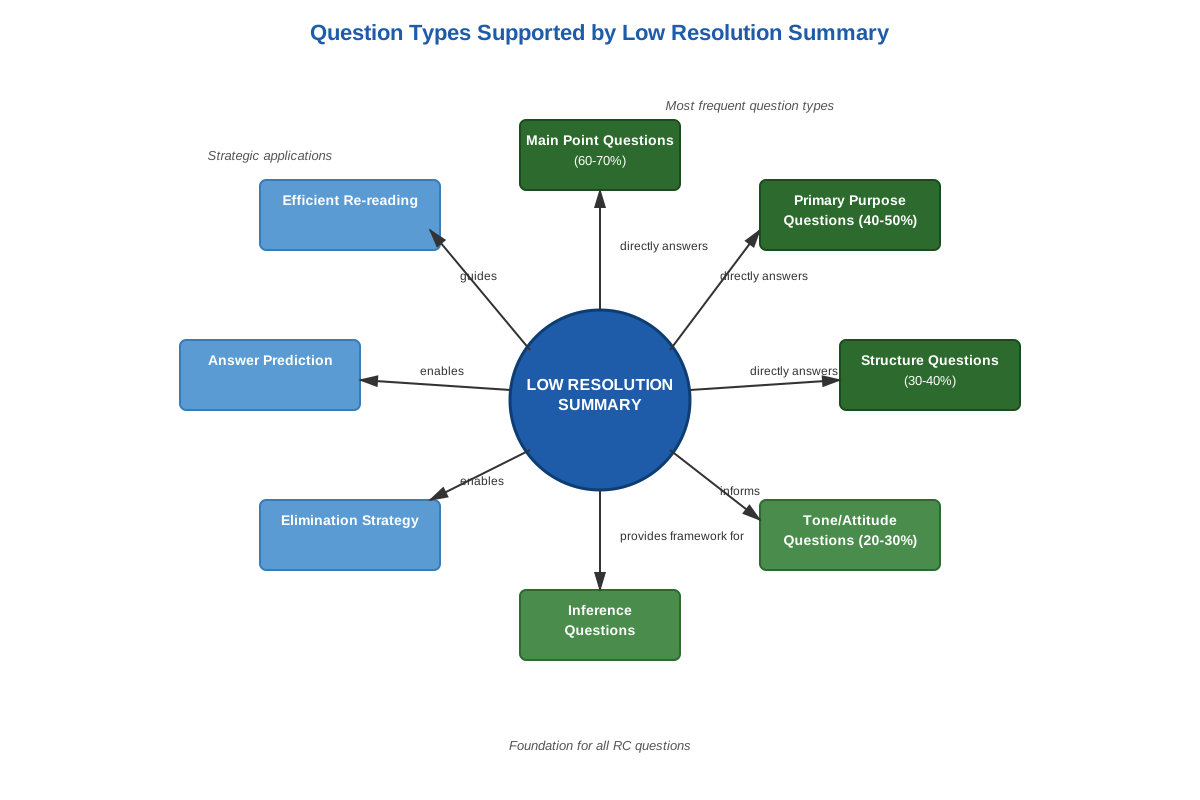
- Main Point questions (appearing in roughly 60-70% of passage sets): These directly ask for the passage's primary message
- Primary Purpose questions (appearing in roughly 40-50% of passage sets): These test whether students understand the author's overarching goal
- Structure/Organization questions (appearing in roughly 20-30% of passage sets): These require understanding the passage's architectural framework
- Attitude/Tone questions: These become far easier when students grasp the author's main argumentative thrust
Beyond explicit question types, the low resolution summary serves as a strategic tool for all questions. When evaluating answer choices for inference questions, detail questions, or application questions, students with a strong grasp of the passage's core message can quickly eliminate options that contradict or misrepresent the author's main ideas. This skill transforms Reading Comprehension from a time-consuming, anxiety-inducing section into a manageable, strategic exercise.
In real-world applications, the ability to extract essential information from complex texts is fundamental to legal practice, academic research, policy analysis, and executive decision-making—precisely the skills law schools seek in candidates.
Core Concepts
What Constitutes a Low Resolution Summary
A low resolution summary captures the essential architecture of a passage in approximately 1-3 sentences, focusing exclusively on:
- The main topic or subject matter (what the passage is about)
- The author's primary claim or thesis (what the author argues or explains)
- The author's purpose or goal (why the author wrote the passage)
- The basic structural approach (how the author organizes the argument)
Critically, a low resolution summary excludes:
- Specific examples, case studies, or illustrations
- Statistical data or experimental details
- Names of researchers, dates, or locations (unless central to the main point)
- Supporting evidence for claims (though noting that evidence exists may be relevant)
- Tangential discussions or minor counterarguments
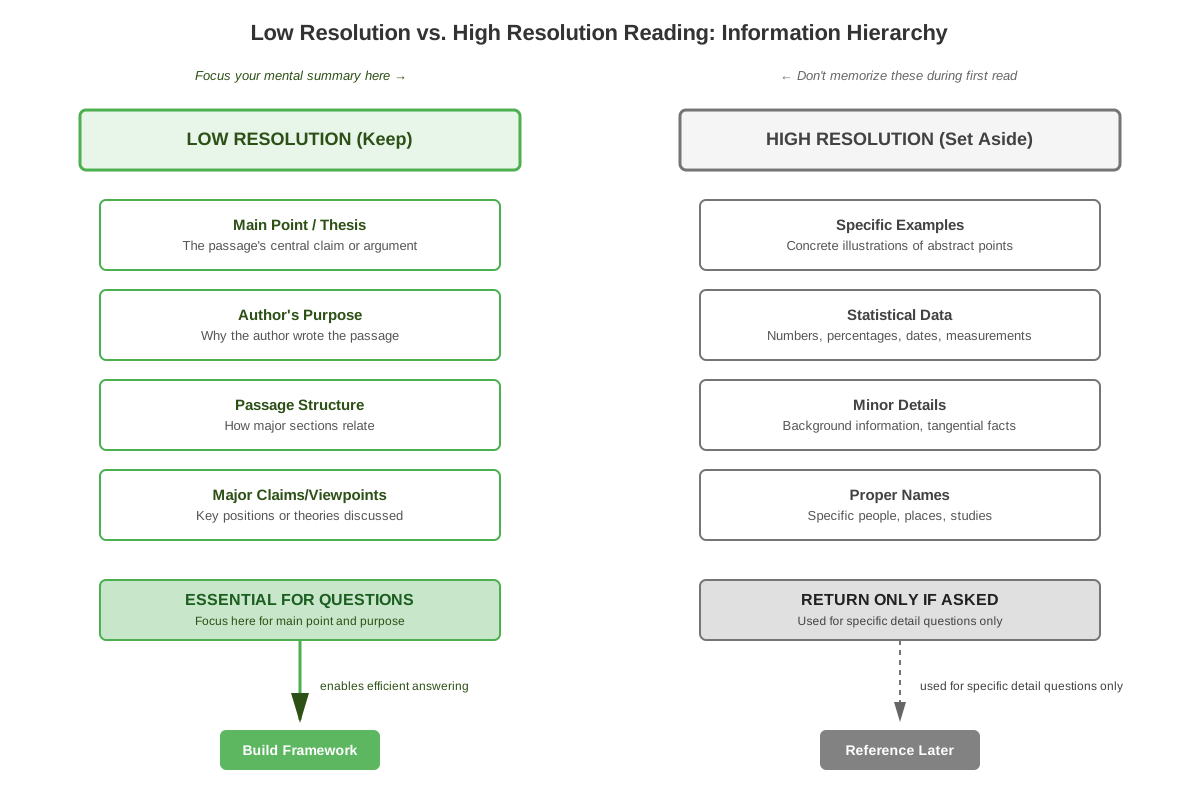
The "resolution" metaphor comes from image processing: a low-resolution image shows the overall shape and composition but lacks fine detail. Similarly, a low resolution summary provides enough information to understand the passage's essence without the granular specifics.
The Hierarchical Nature of Passage Information
LSAT passages contain information at multiple levels of importance, which can be visualized as a pyramid:
| Level | Content Type | Importance | Belongs in Low Resolution Summary? |
|---|---|---|---|
| 1 | Main point/thesis | Critical | Yes - always |
| 2 | Major supporting claims | High | Yes - usually |
| 3 | Structural transitions | High | Yes - implicitly |
| 4 | Examples and illustrations | Medium | No - unless they ARE the point |
| 5 | Specific data and details | Low | No - retrieve only when needed |
| 6 | Tangential information | Very Low | No - often included as distractors |
Understanding this hierarchy allows students to allocate attention appropriately during the initial read. The goal is not to memorize details but to construct a mental framework that enables efficient retrieval when specific questions demand it.
Active Reading for Low Resolution
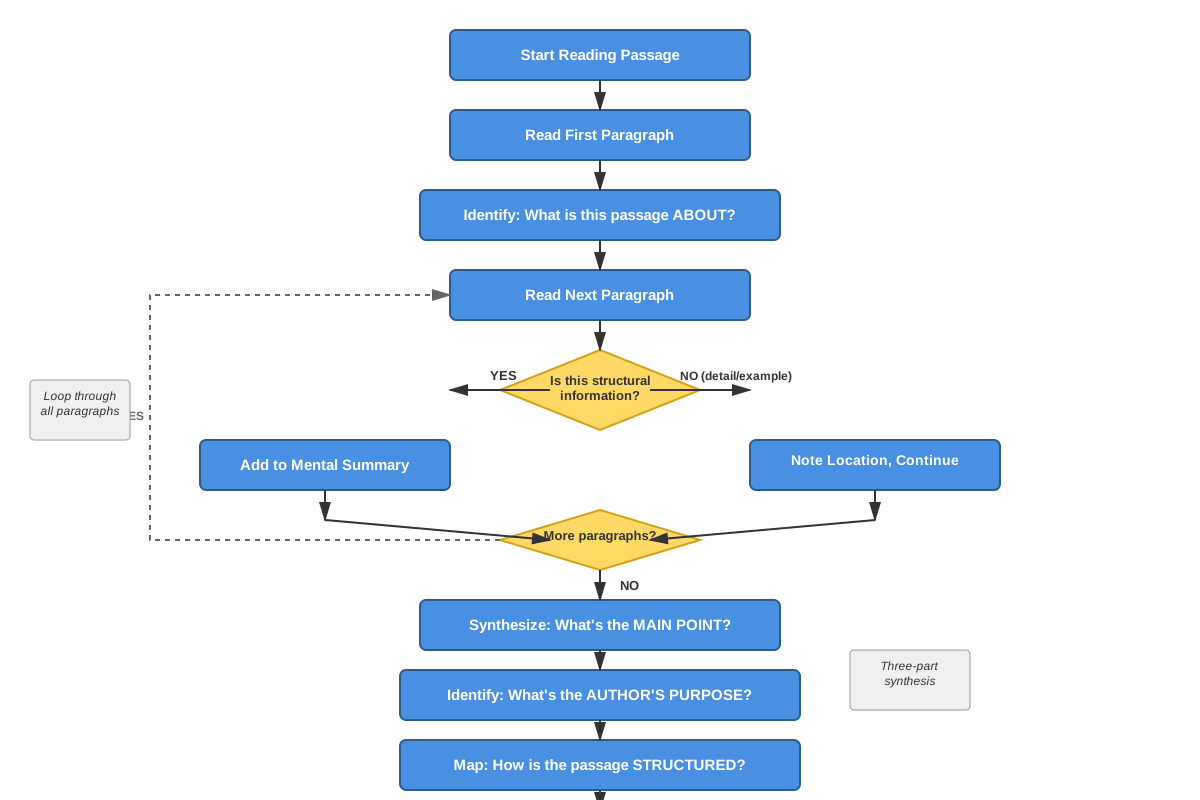
Creating an effective low resolution summary requires active reading—a strategic approach that differs from passive consumption of text. Active reading for low resolution involves:
- Identifying the passage's function in the first paragraph: Is the author arguing, explaining, comparing, critiquing, or proposing? This often reveals the primary purpose.
- Tracking structural keywords: Words like "however," "moreover," "in contrast," "the main problem," and "ultimately" signal shifts in argument and highlight what the author considers most important.
- Distinguishing claims from evidence: When the author makes an assertion, note it as potentially central. When the author provides an example or data point, recognize it as support rather than the core message.
- Noting the author's attitude: Is the tone neutral/explanatory, critical, enthusiastic, or concerned? This often clarifies the purpose.
- Asking "So what?" after each paragraph: This question forces identification of each paragraph's function in the overall argument.
The Relationship Between Low Resolution and Question Strategy
The low resolution summary serves as a strategic anchor for answering questions efficiently:
For Global Questions (main point, primary purpose, structure): The low resolution summary often contains the answer directly or allows immediate elimination of 3-4 wrong choices.
For Local Questions (specific details, inferences about particular claims): The low resolution summary helps students quickly locate where in the passage to find relevant information, avoiding time-wasting re-reading.
For Application Questions (analogies, hypothetical scenarios): The low resolution summary ensures students apply the passage's core logic rather than getting distracted by surface-level similarities to examples mentioned in the passage.
For Comparative Reading: Low resolution summaries of both passages enable quick identification of similarities, differences, and relationships between the texts.
Common Structural Patterns in LSAT Passages
Recognizing recurring organizational patterns accelerates low resolution summary construction:
Pattern 1: Problem-Solution
- Structure: Identify a problem → Explain why existing approaches fail → Present a new solution
- Low resolution focus: What's the problem and what's the proposed solution?
Pattern 2: Theory Critique
- Structure: Present a traditional view → Introduce challenges or new evidence → Argue for a revised understanding
- Low resolution focus: What's being challenged and what's the new perspective?
Pattern 3: Comparative Analysis
- Structure: Describe approach A → Describe approach B → Evaluate strengths/weaknesses of each
- Low resolution focus: What's being compared and what's the author's evaluative stance?
Pattern 4: Explanatory
- Structure: Introduce a phenomenon → Explain its causes, mechanisms, or implications
- Low resolution focus: What's being explained and what's the key insight?
Pattern 5: Historical Development
- Structure: Trace how thinking about a topic has evolved over time
- Low resolution focus: What's the trajectory and where has thinking arrived?
Concept Relationships
The low resolution summary sits at the center of a web of interconnected Reading Comprehension skills. Understanding these relationships clarifies both how to develop this skill and how it enhances overall performance.
Foundational Relationship: Active reading strategies → enable → Low resolution summary construction. Without strategic reading habits (tracking structure, identifying claims vs. evidence, noting transitions), students cannot efficiently extract the essential information needed for a low resolution summary.
Upward Relationship: Low resolution summary → supports → Answering global questions. Main point questions, primary purpose questions, and structure questions all directly test whether students have grasped what the low resolution summary should contain.
Lateral Relationship: Low resolution summary ↔ complements ↔ Passage mapping/notation. While some students create written passage maps, the low resolution summary represents the mental model that guides what to note and how to organize annotations.
Downward Relationship: Low resolution summary → enables → Efficient detail retrieval. When students need to answer specific detail questions, the low resolution summary helps them quickly locate relevant information because they understand the passage's overall organization.
Strategic Relationship: Low resolution summary → accelerates → Process of elimination. Wrong answer choices in RC frequently distort the passage's main message, overstate the importance of minor details, or misrepresent the author's purpose. A solid low resolution summary allows instant recognition of these distortions.
Comparative Relationship: Individual passage low resolution summaries → combine to form → Comparative reading analysis. In comparative reading sets, constructing low resolution summaries of both passages enables quick identification of their relationship (agreement, disagreement, complementary perspectives, etc.).
High-Yield Facts
⭐ The low resolution summary should typically be constructible within 30-45 seconds after completing the initial read of a passage.
⭐ Approximately 60-70% of LSAT RC passages include at least one question that directly tests the low resolution summary (main point or primary purpose).
⭐ The main point of an LSAT passage is most commonly located in one of three places: the end of the first paragraph, the beginning of the final paragraph, or the final sentence of the passage.
⭐ Wrong answer choices on main point questions typically commit one of three errors: too narrow (focusing on a supporting detail), too broad (going beyond the passage's scope), or distorted (misrepresenting the author's actual claim).
⭐ The author's primary purpose can usually be captured in a verb phrase: "to argue that," "to explain how," "to critique the view that," "to compare two approaches to," or "to propose a solution to."
- A low resolution summary should never include specific examples unless the passage is explicitly about those examples (e.g., a passage analyzing a particular legal case).
- Structural keywords like "however," "moreover," "the central problem," and "ultimately" are high-value signals for identifying information that belongs in a low resolution summary.
- The first and last sentences of each paragraph are statistically more likely to contain information relevant to the low resolution summary than middle sentences.
- If a student cannot articulate a low resolution summary after reading, they should not proceed to questions but should instead invest 20-30 seconds reviewing the passage's structure.
- Effective low resolution summaries distinguish between what the passage discusses (topic) and what the passage argues or explains about that topic (main point).
- The author's attitude or tone is often a critical component of the low resolution summary, particularly in passages that critique or evaluate theories.
- In comparative reading, the relationship between the two passages (agreement, disagreement, complementary, etc.) should be part of the low resolution summary.
Quick check — test yourself on Low resolution summary so far.
Try Flashcards →Common Misconceptions
Misconception: A low resolution summary should include the most interesting or memorable details from the passage.
Correction: Interesting details are often included precisely because they're memorable, but they typically serve as examples or illustrations rather than main points. The low resolution summary focuses on the author's primary argument or explanation, which may be less vivid but more structurally important.
Misconception: The longer and more detailed the summary, the better prepared a student is to answer questions.
Correction: Overly detailed summaries defeat the purpose of reading at low resolution. They waste time during the initial read and fail to provide the strategic clarity needed to answer global questions efficiently. The goal is strategic simplification, not comprehensive recall.
Misconception: The main point is always explicitly stated in the passage.
Correction: While LSAT passages often state the main point explicitly, sometimes it must be inferred from the overall argumentative structure. The author may present evidence and analysis that points toward a conclusion without stating it in a single sentence.
Misconception: If a concept appears multiple times in the passage, it must be part of the low resolution summary.
Correction: Repetition can indicate importance, but it can also reflect that a concept serves as a recurring example or illustration. The question is whether the repeated concept is the subject being discussed or the point being made about various subjects.
Misconception: Creating a low resolution summary means skimming the passage quickly without careful reading.
Correction: Low resolution reading is not superficial reading. It requires careful attention to structure, claims, and purpose—but with strategic focus on high-value information rather than attempting to absorb every detail equally.
Misconception: The low resolution summary is only useful for main point and primary purpose questions.
Correction: While these question types most directly test the low resolution summary, this skill enhances performance on all question types by providing context for evaluating answer choices and efficiently locating relevant passage content.
Worked Examples
Example 1: Science Passage
Passage Summary (abbreviated for this example):
"For decades, scientists believed that the human brain's development was largely complete by early adulthood. However, recent neuroimaging studies have revealed that the prefrontal cortex, responsible for executive functions like planning and impulse control, continues developing into the mid-twenties. This finding has significant implications for legal policy, particularly regarding the culpability of young offenders. Some legal scholars argue that this neuroscientific evidence should influence sentencing practices, while others caution against biological determinism in legal contexts. The author ultimately suggests that while brain development research provides valuable context, it should inform rather than determine legal standards of responsibility."
Step 1: Identify the topic
The passage discusses brain development research and its implications for legal policy regarding young offenders.
Step 2: Identify the main claim or thesis
The author argues that neuroscientific findings about brain development should inform but not determine legal standards for young offenders.
Step 3: Identify the author's purpose
The author aims to present a balanced perspective on applying neuroscience to legal policy—acknowledging the value of the research while warning against over-reliance on biological explanations.
Step 4: Note the basic structure
Traditional view → New scientific findings → Debate about implications → Author's nuanced position
Low Resolution Summary:
"The passage discusses how recent findings about extended brain development into the mid-twenties have sparked debate about legal responsibility for young offenders, with the author arguing that this neuroscientific evidence should inform but not determine legal standards."
Application to Questions:
- Main Point question: The correct answer will capture the author's balanced position about using neuroscience to inform (not determine) legal policy.
- Wrong answers to eliminate: Any choice suggesting the author fully endorses using brain development to excuse young offenders (too extreme), any choice focusing only on the scientific findings without the legal implications (too narrow), any choice suggesting the author dismisses the relevance of neuroscience (distortion).
Example 2: Humanities Passage
Passage Summary (abbreviated):
"Traditional literary criticism of 19th-century novels focused primarily on formal elements like narrative structure and characterization. Feminist critics in the 1970s challenged this approach, arguing that it ignored how these novels reflected and reinforced gender ideologies. They demonstrated that seemingly neutral formal choices—such as which characters receive narrative attention or how plots resolve—actually encoded assumptions about women's proper social roles. While some scholars initially dismissed feminist criticism as imposing contemporary politics onto historical texts, it has become widely recognized that all critical approaches reflect particular values and assumptions. The passage concludes that feminist criticism's lasting contribution was not just revealing gender bias in novels but exposing the myth of objective, apolitical literary analysis."
Step 1: Identify the topic
The passage discusses feminist literary criticism's challenge to traditional approaches to 19th-century novels.
Step 2: Identify the main claim
Feminist criticism's most important contribution was demonstrating that all literary criticism reflects particular values, not just revealing gender bias in novels.
Step 3: Identify the author's purpose
To explain and evaluate the significance of feminist literary criticism, emphasizing its broader methodological implications.
Step 4: Note the basic structure
Traditional approach → Feminist challenge → Initial resistance → Broader significance
Low Resolution Summary:
"The passage explains how feminist literary criticism challenged traditional analysis of 19th-century novels and argues that its most significant contribution was exposing the impossibility of truly objective, apolitical literary criticism."
Application to Questions:
- Primary Purpose question: The correct answer will indicate the author is explaining the significance of feminist criticism with emphasis on its broader methodological implications.
- Author's Attitude question: The author is appreciative/favorable toward feminist criticism's contributions.
- Wrong answers to eliminate: Any choice suggesting the passage is primarily about 19th-century novels themselves (confusing topic with point), any choice indicating the author is critical of feminist approaches (misreading tone), any choice focusing only on gender bias without the broader methodological point (too narrow).
Exam Strategy
Approaching Questions with Your Low Resolution Summary
Before looking at any answer choices, mentally review your low resolution summary. For global questions (main point, primary purpose, structure), predict what the correct answer should convey. This prediction, even if imperfect, dramatically improves accuracy by providing a standard against which to evaluate choices.
Trigger Words for Low Resolution Information
During your initial read, heightened attention to these phrases signals information likely to belong in your low resolution summary:
- "The main/central/primary problem/question/issue is..."
- "Ultimately," "In the end," "The key point is..."
- "However," "But," "Yet" (often signal the author's own position after presenting other views)
- "I argue that," "This paper demonstrates," "The evidence suggests..."
- "The most significant/important aspect/implication is..."
Process of Elimination Strategy
When evaluating answer choices on main point or primary purpose questions:
- Eliminate choices that focus on supporting details or examples (too narrow)
- Eliminate choices that go beyond what the passage actually discusses (too broad)
- Eliminate choices that misrepresent the author's position or tone (distorted)
- Choose the remaining option that best matches your low resolution summary
Exam Tip: If you're torn between two answer choices on a main point question, the correct answer is almost always the one that captures the author's position or conclusion rather than just describing what the passage discusses.
Time Allocation
Invest approximately 3-4 minutes in the initial read of a standard LSAT passage, with 30-45 seconds of that time dedicated to mentally consolidating your low resolution summary before proceeding to questions. This upfront investment saves time on questions and dramatically improves accuracy. Students who rush through the initial read to "save time" typically lose more time re-reading and second-guessing answers.
When Your Low Resolution Summary Doesn't Match Any Answer
If none of the answer choices for a main point question seem to match your low resolution summary, resist the urge to immediately select the "closest" option. Instead:
- Quickly review the passage's first and last paragraphs
- Ask whether you focused on a supporting point rather than the main point
- Check whether the question asks for something slightly different than you assumed (e.g., "primary purpose" vs. "main point")
- Re-evaluate the answer choices with fresh perspective
This situation often indicates that your initial summary focused on what the passage discusses rather than what it argues or concludes about that topic.
Memory Techniques
The "TAPS" Framework for Low Resolution Summaries
Topic: What is the passage about?
Argument/Analysis: What does the author claim or explain about this topic?
Purpose: Why did the author write this (to argue, explain, critique, propose, compare)?
Structure: How is the argument organized (problem-solution, theory-critique, comparison, etc.)?
Mentally running through TAPS after reading ensures your low resolution summary captures all essential elements.
The "Zoom Out" Visualization
Imagine reading the passage while slowly zooming out from the text, like a camera pulling back from a detailed scene. As you zoom out, small details blur and disappear, but the overall shape and structure become clearer. This mental image reinforces the goal of low resolution reading: seeing the big picture rather than fixating on specifics.
The "Headline" Technique
After reading, imagine you must write a newspaper headline for the passage—something that captures the essential message in 10-15 words. This exercise forces the kind of compression and prioritization that effective low resolution summaries require.
The "Dinner Party" Test
Imagine someone at a dinner party asks what the passage was about. You have 20-30 seconds to explain before they lose interest. What would you say? This social scenario naturally encourages focus on the most important, interesting aspects—which typically align with the main point and purpose.
Summary
The low resolution summary represents the foundational skill for LSAT Reading Comprehension success, enabling students to distill complex passages into their essential structure and main ideas. This technique involves identifying the passage's topic, the author's primary claim or thesis, the author's purpose, and the basic organizational structure while strategically setting aside supporting details, examples, and tangential information. Mastering this skill requires active reading that distinguishes between high-value structural information and low-value specifics, recognizes common passage patterns, and tracks the author's argumentative trajectory. The low resolution summary serves as a strategic anchor for all question types: it directly answers global questions about main point and purpose, enables efficient elimination of wrong answers that distort the passage's core message, and facilitates quick location of relevant details when local questions demand them. Students should be able to construct a low resolution summary within 30-45 seconds after completing their initial read, and this mental model should guide their approach to every question in the passage set. The skill connects fundamentally to passage mapping, structural analysis, and strategic time management, making it perhaps the highest-yield technique in the entire Reading Comprehension section.
Key Takeaways
- The low resolution summary captures a passage's essential architecture (topic, main claim, purpose, structure) while excluding supporting details and examples
- This skill is explicitly tested in 60-70% of passage sets through main point and primary purpose questions, and implicitly supports all other question types
- Effective low resolution summaries distinguish between what a passage discusses (topic) and what it argues or explains about that topic (main point)
- The main point typically appears in one of three locations: end of first paragraph, beginning of final paragraph, or final sentence
- Wrong answers on global questions typically commit one of three errors: too narrow (focusing on details), too broad (exceeding scope), or distorted (misrepresenting the author's position)
- Creating a low resolution summary requires active reading with attention to structural keywords, claims versus evidence, and the author's purpose and attitude
- Students should invest 30-45 seconds after the initial read to mentally consolidate their low resolution summary before attempting questions
Related Topics
Main Point Questions: Building directly on low resolution summary skills, this topic focuses specifically on identifying and articulating the passage's central claim, with emphasis on distinguishing main points from supporting points and recognizing how test-makers construct wrong answers.
Primary Purpose Questions: This closely related topic examines how to determine the author's overarching goal (to argue, explain, critique, propose, etc.) and how purpose differs from but relates to main point.
Passage Structure and Organization: This advanced topic explores how to map the function of each paragraph and recognize common organizational patterns, providing the architectural framework that supports low resolution summary construction.
Active Reading Strategies: This foundational topic covers the specific reading techniques (annotation, structural tracking, claim identification) that enable efficient construction of low resolution summaries.
Mastering low resolution summary creates the foundation for all these related skills, making it the ideal starting point for developing comprehensive Reading Comprehension expertise.
Practice CTA
Now that you understand the principles and strategies behind low resolution summary, it's time to put this knowledge into practice. The practice questions and flashcards for this topic will challenge you to construct summaries under timed conditions, identify main points in complex passages, and distinguish between high-value and low-value information. Remember: this skill improves dramatically with deliberate practice. Each passage you read with conscious attention to low resolution summary strengthens your ability to see the forest rather than getting lost in the trees. Approach the practice materials with confidence—you now have the conceptual framework to excel at this high-yield skill. Your investment in mastering low resolution summary will pay dividends across every Reading Comprehension passage you encounter on test day.
Sign up free to keep reading
Create a free AnvayaPrep account to finish this LSAT guide on Low resolution summary — plus flashcards and practice questions.