Overview
The purpose of examples is one of the most frequently tested elements in LSAT Reading Comprehension passages. Understanding why authors include specific examples, illustrations, case studies, or anecdotes is crucial for answering questions that probe deeper than surface-level comprehension. Rather than simply identifying what an example says, successful test-takers must recognize what function that example serves within the author's broader argumentative structure. Examples rarely exist in isolation; they typically support claims, illustrate abstract concepts, provide evidence for theories, contrast competing viewpoints, or demonstrate the application of principles.
Mastering the purpose of examples requires recognizing that LSAT passages are carefully constructed arguments where every element serves a strategic function. Authors use examples as rhetorical tools to make their points more concrete, persuasive, or comprehensible. When the LSAT asks about an example's purpose, the question tests whether students can distinguish between the content of an example (what it describes) and its function (why the author included it). This distinction separates high-scoring test-takers from those who struggle with inference and structure questions.
Within the broader framework of passage fundamentals, understanding example purposes connects directly to identifying main ideas, recognizing argumentative structure, and tracking the author's viewpoint. This skill forms the foundation for answering function questions, inference questions, and questions about the author's reasoning strategy. The ability to quickly identify why an author includes specific examples also accelerates passage comprehension and improves accuracy on questions requiring structural understanding of the text.
Learning Objectives
- [ ] Identify how Purpose of examples appears in LSAT questions
- [ ] Explain the reasoning pattern behind Purpose of examples
- [ ] Apply Purpose of examples to solve LSAT-style problems accurately
- [ ] Distinguish between the content of an example and its rhetorical function within a passage
- [ ] Recognize the six most common purposes that examples serve in LSAT passages
- [ ] Predict likely question types based on how examples are positioned in passage structure
- [ ] Evaluate answer choices by matching them to the specific function an example performs
Prerequisites
- Basic passage structure recognition: Understanding how LSAT passages organize information into introduction, body paragraphs, and conclusions helps locate examples within argumentative frameworks
- Claim vs. evidence distinction: Recognizing the difference between assertions and supporting material enables identification of when examples function as evidence
- Author's tone and viewpoint: Determining whether the author endorses, critiques, or neutrally presents information affects interpretation of example purposes
- Paragraph function awareness: Knowing whether a paragraph introduces a theory, presents objections, or offers solutions contextualizes the examples within it
Why This Topic Matters
In real-world academic and professional contexts, the ability to discern why authors use specific examples demonstrates critical reading skills essential for legal analysis, scholarly research, and persuasive writing. Lawyers must understand how precedents function as examples supporting legal arguments, while researchers must evaluate whether case studies appropriately support theoretical claims. This analytical skill transfers directly to evaluating the strength and relevance of evidence in any argumentative context.
On the LSAT, questions about the purpose of examples appear in approximately 15-20% of Reading Comprehension questions across all passages. These questions typically take several forms: direct function questions ("The author mentions X primarily in order to..."), inference questions requiring understanding of example purposes, and structure questions asking about relationships between passage elements. Because Reading Comprehension constitutes roughly one-quarter of the LSAT score, and example-purpose questions represent a significant portion of that section, mastering this topic directly impacts overall performance.
Example-purpose questions appear most frequently in passages discussing scientific theories, legal principles, historical developments, and artistic movements—contexts where abstract concepts require concrete illustration. The LSAT particularly favors passages where multiple examples serve different purposes, testing whether students can distinguish between examples that support the main thesis versus those that illustrate counterarguments or alternative perspectives. Comparative passages often include examples that highlight differences between the two texts' approaches or conclusions.
Core Concepts
The Fundamental Distinction: Content vs. Function
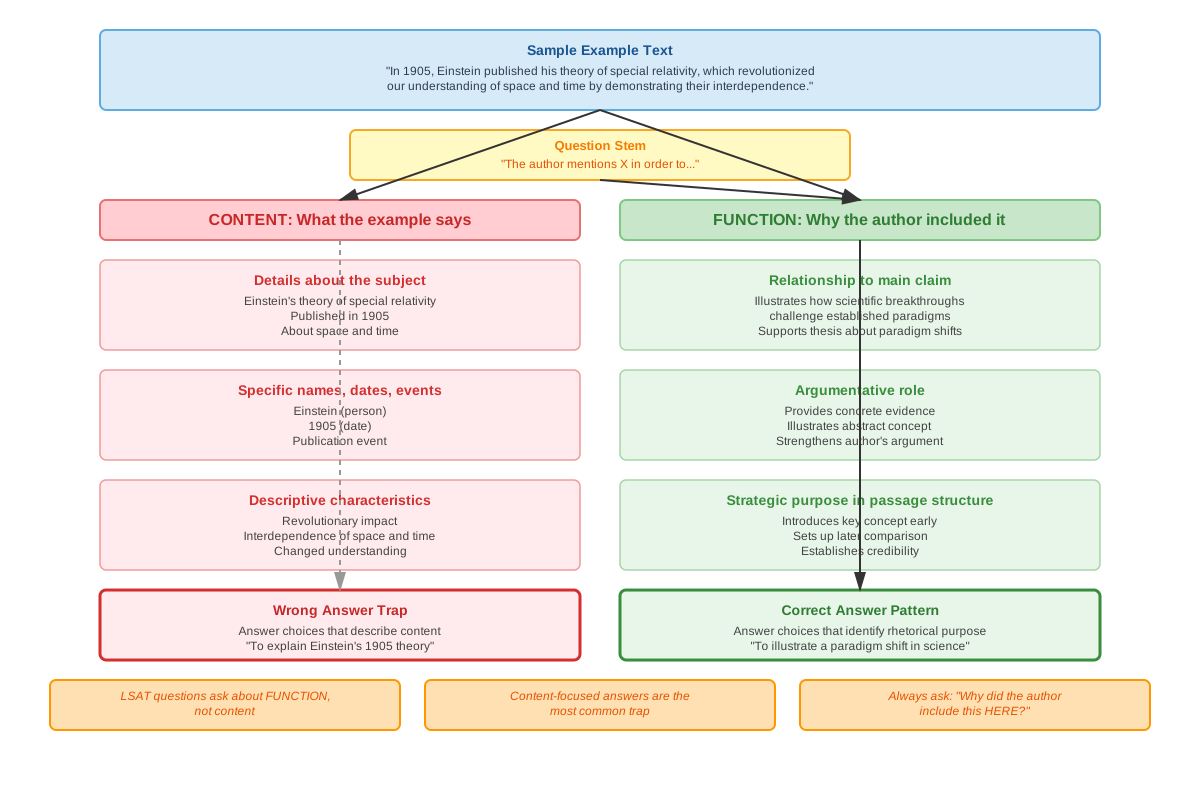
The most critical concept in understanding lsat purpose of examples is distinguishing between what an example describes (its content) and why the author includes it (its function). Consider an example describing how dolphins use echolocation to navigate. The content involves dolphins, sound waves, and underwater navigation. The function might be to illustrate a broader principle about animal cognition, to provide evidence for a theory about sensory adaptation, or to contrast with how bats use similar mechanisms. LSAT questions about example purposes focus exclusively on function, not content.
This distinction challenges test-takers because the most detailed, memorable information in passages often appears in examples. Students naturally focus on understanding the example itself, but LSAT questions require stepping back to ask: "What work is this example doing for the author's argument?" The correct answer to a purpose question typically references the claim or concept the example supports, not the example's specific details.
Six Common Purposes of Examples
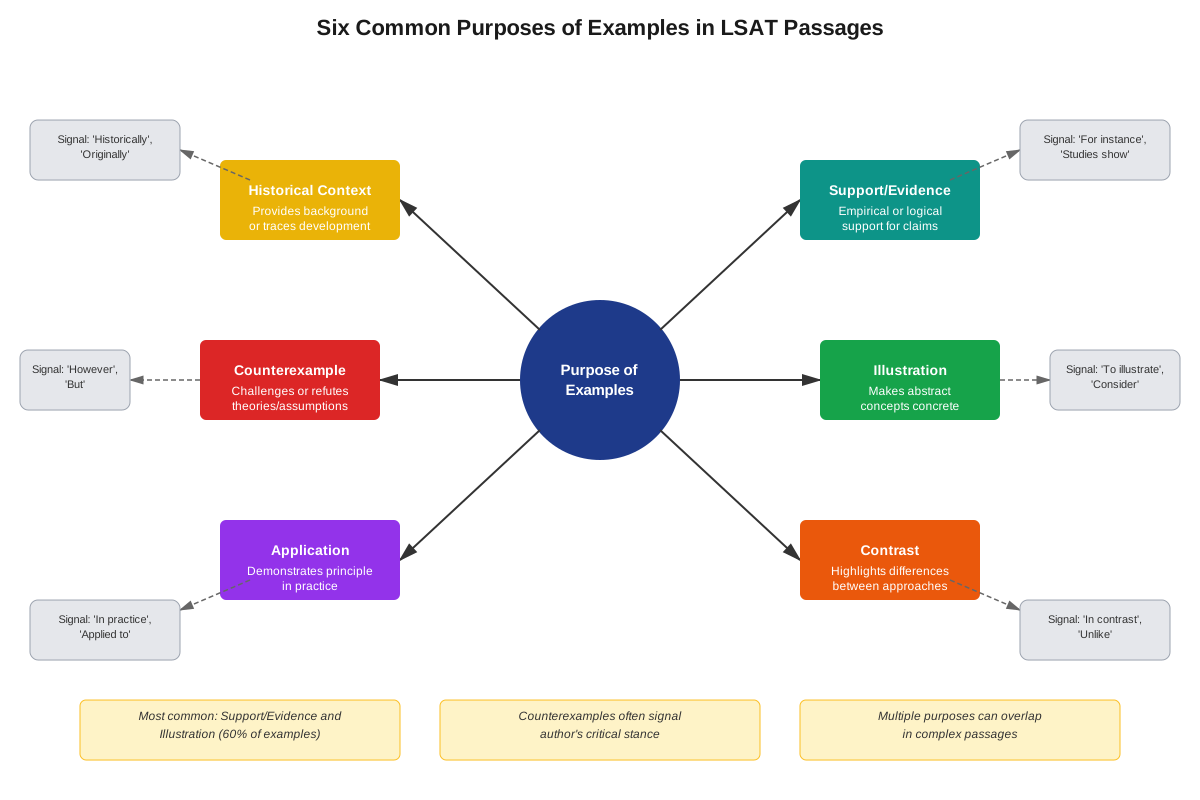
1. Illustrating Abstract Concepts
Authors frequently use concrete examples to make abstract theories, principles, or concepts more comprehensible. When a passage discusses a complex philosophical position or scientific theory, an example might translate that abstraction into tangible terms. For instance, a passage about legal formalism might include an example of a specific court case to illustrate how judges apply formalist reasoning. The example's purpose is clarification, not evidence—it helps readers understand what the abstract concept means in practice.
2. Providing Evidence for Claims
Examples often function as evidence supporting the author's thesis or a specific claim within the argument. When an author asserts that a particular phenomenon occurs or that a theory accurately explains observations, examples may substantiate that assertion. A passage arguing that Renaissance artists incorporated scientific principles might cite Leonardo da Vinci's anatomical studies as evidence. Here, the example's purpose is persuasion through empirical support.
3. Contrasting Competing Views
Examples may highlight differences between alternative theories, approaches, or perspectives. A passage comparing two schools of literary criticism might use the same poem as an example, showing how each school interprets it differently. The example's purpose is to make the contrast concrete and demonstrate the practical implications of theoretical differences. These contrastive examples often appear in comparative passages or in passages presenting debates within a field.
4. Demonstrating Application or Implementation
When passages discuss methods, techniques, or principles, examples may show how these work in practice. A passage about restorative justice might include an example of a specific program to demonstrate how restorative principles translate into actual procedures. The purpose differs from mere illustration because it emphasizes the practical application and feasibility of the approach discussed.
5. Introducing Exceptions or Limitations
Authors use examples to acknowledge boundaries or special cases that qualify their main claims. A passage arguing for a general pattern might include an example that doesn't fit, explicitly noting it as an exception. This purpose serves to strengthen the argument by showing the author recognizes nuance and hasn't overgeneralized. The example's function is to refine or limit the scope of the main claim.
6. Supporting Counterarguments or Objections
Examples may present evidence or scenarios that challenge the main thesis, particularly when the author is building a comprehensive argument that addresses potential objections. A passage ultimately defending a position might include examples that initially seem to undermine it, then explain why these examples don't actually refute the thesis. Recognizing when examples serve this purpose prevents misidentifying the author's viewpoint.
Structural Signals for Example Purposes
The location and introduction of examples provide crucial clues about their purposes. Examples appearing immediately after theoretical statements typically illustrate or provide evidence for those statements. Phrases like "for instance," "for example," or "consider" signal illustrative purposes. Contrastive language like "however," "by contrast," or "on the other hand" preceding examples suggests contrastive purposes. Examples introduced with "despite" or "although" often present exceptions or complications.
The relationship between example length and purpose also matters. Brief examples (one sentence or less) usually illustrate concepts or provide quick evidence. Extended examples (multiple sentences or full paragraphs) often serve more complex purposes: demonstrating application, contrasting views, or presenting cases requiring detailed analysis. The LSAT frequently tests whether students recognize that lengthy examples still serve specific functions within the broader argument rather than constituting independent points.
The Author's Attitude Toward Examples
Understanding whether the author endorses, critiques, or neutrally presents an example affects interpretation of its purpose. An example the author explicitly criticizes might serve to illustrate flawed reasoning or demonstrate problems with an opposing view. An example the author endorses typically supports the main thesis or illustrates a concept the author values. Neutral presentation often appears in comparative contexts or when the author is surveying a field without taking a strong position.
Tone indicators surrounding examples reveal authorial attitude: positive language ("elegantly demonstrates," "compelling evidence") versus critical language ("fails to account for," "oversimplifies") versus neutral language ("illustrates," "shows"). These indicators help determine whether an example functions as support for or objection to the main argument.
Concept Relationships
The purpose of examples connects intimately with passage structure analysis. Identifying the main point of a passage requires distinguishing between the thesis (the central claim) and the examples supporting it. Examples serve the main point; they don't constitute it. This hierarchical relationship—thesis supported by examples—forms the backbone of LSAT passage organization.
Example purposes also relate directly to the author's reasoning strategy. When authors use examples to provide evidence, they're employing inductive reasoning (moving from specific cases to general conclusions). When they use examples to illustrate abstract principles, they're making deductive arguments more accessible (showing how general principles apply to specific cases). Recognizing these reasoning patterns helps predict what questions might ask and how to evaluate answer choices.
The relationship map flows as follows: Passage Main Point → supported by → Major Claims → supported or illustrated by → Examples → which serve specific → Purposes (evidence, illustration, contrast, etc.) → which help establish → Author's Argument. Understanding this chain enables students to work backward from examples to the claims they support, or forward from claims to predict what purposes examples might serve.
Additionally, example purposes connect to inference questions. When the LSAT asks what can be inferred from a passage, the correct answer often relates to why the author included certain examples rather than what those examples literally state. Understanding that an example illustrates a limitation, for instance, allows inference about the scope of the author's main claim.
High-Yield Facts
⭐ The purpose of an example refers to its function in the author's argument, not its content or subject matter
⭐ Examples appearing immediately after abstract statements typically illustrate or provide evidence for those statements
⭐ When an author criticizes or distances themselves from an example, it likely serves to present an opposing view or demonstrate flawed reasoning
⭐ Extended examples (multiple sentences) usually serve complex purposes like demonstrating application or contrasting competing approaches
⭐ The correct answer to a purpose question typically references the claim the example supports, not details within the example itself
- Examples introduced with "for instance" or "for example" most commonly illustrate concepts or provide evidence
- Contrastive examples (introduced with "however," "by contrast") highlight differences between theories, approaches, or viewpoints
- Examples presented as exceptions (introduced with "despite," "although") serve to qualify or limit the scope of main claims
- Multiple examples serving the same purpose (parallel examples) strengthen the author's argument through accumulated evidence
- The LSAT frequently includes wrong answer choices that accurately describe example content but misidentify example purpose
- Examples in comparative passages often serve to highlight the key difference between the two texts' perspectives
- Authors may use hypothetical examples (scenarios that didn't actually occur) to demonstrate logical implications of theories
- The most detailed information in a passage often appears in examples, but detail-focused answer choices are usually incorrect for purpose questions
- Examples can serve multiple purposes simultaneously, but LSAT questions ask for the primary or main purpose
- Recognizing example purposes accelerates passage comprehension by revealing argumentative structure
Quick check — test yourself on Purpose of examples so far.
Try Flashcards →Common Misconceptions
Misconception: The purpose of an example is to provide interesting details about its subject matter → Correction: Examples serve strategic functions in arguments (supporting claims, illustrating concepts, contrasting views) regardless of how interesting their content may be. The LSAT tests understanding of these strategic functions, not retention of example details.
Misconception: If an example discusses a specific case or instance, its purpose must be to provide evidence → Correction: Specific cases can serve multiple purposes. An example might illustrate an abstract concept, demonstrate an exception, or show how a principle applies in practice. The purpose depends on the surrounding context and the claim the example relates to, not merely on its specificity.
Misconception: Longer examples are more important and therefore always support the main thesis → Correction: Extended examples may illustrate counterarguments, present views the author ultimately rejects, or demonstrate complications that qualify the main thesis. Length indicates complexity of purpose, not necessarily alignment with the author's main point.
Misconception: The correct answer to a purpose question should mention specific details from the example → Correction: Purpose questions ask why the author included the example, which requires identifying the claim or concept it supports. Correct answers typically reference these broader argumentative elements rather than example-specific details. Answer choices focusing on example content usually represent traps.
Misconception: Each example in a passage serves a different purpose → Correction: Authors often use multiple examples to serve the same purpose (providing accumulated evidence, offering several illustrations of the same concept). Recognizing parallel examples helps identify patterns in the author's argumentative strategy and can eliminate answer choices that artificially distinguish between examples serving identical functions.
Misconception: If an example appears early in a passage, it must introduce the main topic → Correction: Early examples often illustrate problems or phenomena that the passage will explain, present conventional wisdom the author will challenge, or provide context for the main argument. Their position doesn't automatically indicate they support the thesis; they may set up the issue the thesis addresses.
Worked Examples
Example 1: Scientific Theory Passage
Passage Excerpt:
"The theory of convergent evolution explains how unrelated species develop similar traits when adapting to similar environments. For instance, both birds and bats evolved wings for flight, despite birds being descended from dinosaurs and bats from terrestrial mammals. This demonstrates that environmental pressures, rather than shared ancestry, can drive the development of analogous structures. However, the case of the thylacine—the extinct Tasmanian tiger—presents a more striking example. Despite being a marsupial, the thylacine bore remarkable resemblance to placental canines, with similar body structure, hunting behaviors, and even facial features. This convergence occurred because both thylacines and canines occupied similar ecological niches as mid-sized predators."
Question: The author mentions birds and bats primarily in order to:
(A) Provide evidence that convergent evolution occurs across diverse animal groups
(B) Illustrate the concept of convergent evolution with a familiar example
(C) Contrast the evolutionary paths of birds and mammals
(D) Demonstrate that flight evolved independently multiple times
(E) Support the claim that environmental pressures determine all evolutionary adaptations
Analysis:
First, identify the claim immediately preceding the example: "The theory of convergent evolution explains how unrelated species develop similar traits when adapting to similar environments." The birds-and-bats example appears right after this theoretical statement, introduced with "For instance."
Next, determine what work the example does. It provides a concrete case (birds and bats both having wings) that makes the abstract concept of convergent evolution more understandable. The author then explicitly states this is what the example demonstrates: "environmental pressures, rather than shared ancestry, can drive the development of analogous structures."
Evaluate each answer choice:
(A) This suggests the example provides evidence, but the author presents it as illustration ("For instance") rather than proof. The passage treats convergent evolution as an established theory, not a claim requiring evidence.
(B) CORRECT. The example makes the abstract theory concrete using animals most readers know. It illustrates what convergent evolution means by showing a clear case of unrelated species (birds and bats) developing similar traits (wings) for similar environmental reasons (flight).
(C) This focuses on the content (birds vs. mammals) rather than the function. While the example does involve different evolutionary paths, that's not why the author includes it—the purpose is to illustrate convergent evolution, not to emphasize the contrast itself.
(D) This accurately describes what the example shows but misses the broader purpose. The independent evolution of flight is the content; the purpose is to illustrate the general principle of convergent evolution.
(E) This overstates the example's purpose. The example illustrates convergent evolution but doesn't support the extreme claim that environmental pressures determine "all" evolutionary adaptations.
Key Lesson: The correct answer identifies the function (illustrating a concept) and references the concept being illustrated (convergent evolution), not just the example's content (birds and bats having wings).
Example 2: Legal Theory Passage
Passage Excerpt:
"Legal realists argue that judicial decisions are influenced by judges' personal values and social contexts, not merely by mechanical application of legal rules. Critics of legal realism contend that this view undermines the objectivity and predictability essential to the rule of law. They point to the case of Hadley v. Baxendale (1854), where the court established the foreseeability rule for contract damages. This rule has been consistently applied across thousands of subsequent cases, regardless of individual judges' backgrounds or personal beliefs. The critics argue that such consistency demonstrates that legal rules, not judicial discretion, determine outcomes. Legal realists respond that even seemingly mechanical rules like foreseeability require interpretive judgments about what a reasonable person would foresee, inevitably introducing subjective elements."
Question: The author's discussion of Hadley v. Baxendale serves primarily to:
(A) Illustrate how legal realists interpret landmark cases
(B) Present evidence supporting the critics' objection to legal realism
(C) Demonstrate the historical development of contract law
(D) Show that the foreseeability rule lacks objective criteria
(E) Prove that legal rules determine all judicial outcomes
Analysis:
Identify who presents this example and in what context. The passage states "Critics of legal realism contend..." and then "They point to the case of Hadley v. Baxendale..." This signals that the example supports the critics' position, not the legal realists' view or the author's independent analysis.
Determine the specific claim the example supports. The critics argue that legal realism "undermines objectivity and predictability" and that judicial decisions follow legal rules rather than personal values. The Hadley example shows consistent application of a rule across many cases, which the critics explicitly say "demonstrates that legal rules, not judicial discretion, determine outcomes."
Evaluate answer choices:
(A) The example is presented by critics of legal realism, not by legal realists themselves. The passage shows how legal realists respond to this example, but the example's purpose is to support the critics' view.
(B) CORRECT. The example functions as evidence for the critics' objection. They use the consistent application of the foreseeability rule to argue against legal realism's emphasis on judicial discretion. The phrase "They point to" signals this evidential purpose.
(C) While the example is historical, its purpose isn't to trace contract law's development. The critics use it to make a point about judicial consistency, not to provide historical context.
(D) This reverses the example's purpose. The critics use Hadley to show that the foreseeability rule does provide objective criteria (evidenced by consistent application). The legal realists later argue it involves subjective elements, but that's not the example's purpose when the critics introduce it.
(E) This overstates the critics' claim. They argue the example "demonstrates" their point, but the passage presents this as part of a debate, not as definitive proof. Additionally, "all judicial outcomes" is too extreme.
Key Lesson: Identify who presents an example and what claim they're making. Examples can support counterarguments or positions the author ultimately rejects. The purpose relates to the immediate argumentative context, not necessarily to the passage's main thesis.
Exam Strategy
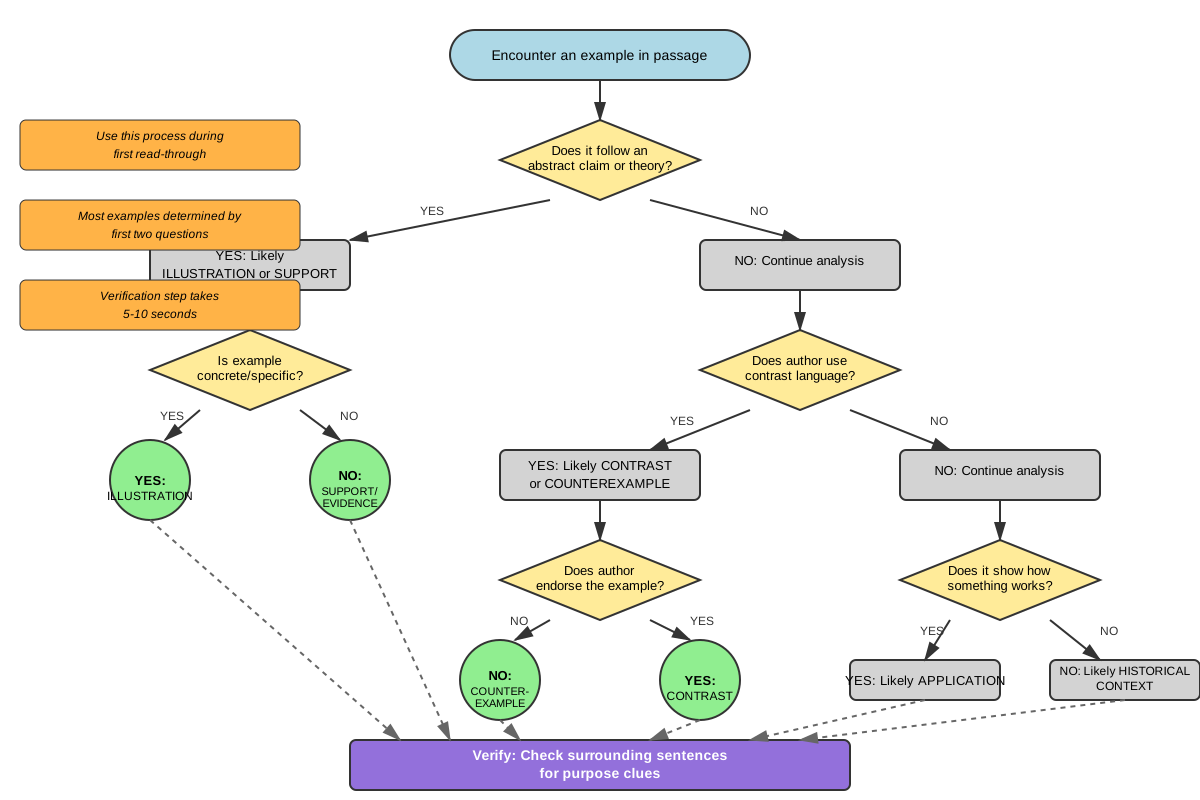
When approaching questions about the purpose of examples on the LSAT, implement this systematic process:
Step 1: Locate the Example in Context
Before evaluating answer choices, return to the passage and read the sentence immediately before the example, the example itself, and the sentence immediately after. This context reveals what claim the example supports or what concept it illustrates. Many students make errors by relying on memory of the example without reviewing its surrounding context.
Step 2: Identify Signal Language
Watch for phrases that indicate purpose: "for example," "for instance," "to illustrate," "consider," "as evidence," "this demonstrates," "this shows." These phrases often explicitly state the example's function. Contrastive signals ("however," "by contrast," "on the other hand") indicate the example serves to highlight differences. Qualifying signals ("although," "despite," "nevertheless") suggest the example presents exceptions or complications.
Step 3: Distinguish Content from Function
Ask yourself: "What is this example about?" (content) versus "Why did the author include this?" (function). The correct answer addresses the second question. If an answer choice focuses primarily on what the example describes rather than what argumentative work it performs, eliminate it.
Step 4: Match to Common Purposes
Determine which of the six common purposes best fits: illustrating a concept, providing evidence, contrasting views, demonstrating application, presenting exceptions, or supporting counterarguments. This categorization helps predict what the correct answer will say and eliminates answers describing different purposes.
Step 5: Evaluate Answer Choices Strategically
Eliminate answers that:
- Focus on example content without addressing function
- Misidentify who presents the example (author vs. critics vs. proponents of a view)
- Overstate the example's purpose (using extreme language like "prove," "all," "never")
- Reference claims the example doesn't actually support
- Describe purposes served by different examples in the passage
Trigger Words in Questions:
- "The author mentions X primarily in order to..."
- "The author's discussion of X serves to..."
- "The function of the example in lines X-Y is to..."
- "The author refers to X in order to..."
- "Why does the author include the example of X?"
Trigger Words in Correct Answers:
- "illustrate," "demonstrate," "show," "provide evidence for," "support the claim that," "contrast with," "highlight the difference between," "present an objection to," "qualify the assertion that"
Time Allocation:
Purpose questions typically require 45-60 seconds once you've read the passage. Spend 15-20 seconds relocating and reviewing the example's context, 10-15 seconds identifying the purpose, and 20-30 seconds evaluating answer choices. If you find yourself spending more than 60 seconds, you're likely overthinking—return to the basic question: "What claim does this example support?"
Exam Tip: The correct answer to a purpose question almost always references something outside the example itself—the claim it supports, the concept it illustrates, or the view it contrasts with. If an answer choice only discusses what happens within the example, it's probably wrong.
Memory Techniques
The SPICE Mnemonic for common example purposes:
- Support (providing evidence for claims)
- Present (introducing counterarguments or objections)
- Illustrate (clarifying abstract concepts)
- Contrast (highlighting differences between views)
- Exceptions (showing limitations or special cases)
The "Function Over Content" Mantra:
When you see a purpose question, mentally repeat: "Not what it says, but what it does." This reminder helps shift focus from example details to argumentative function.
The Context Sandwich Visualization:
Picture every example as the filling in a sandwich, with the bread representing the surrounding sentences. The bread (context) tells you what flavor (purpose) the filling (example) provides. Never eat the filling without the bread—never analyze an example without its context.
The "Who Says?" Technique:
For each example, quickly note: Author's view? Critic's view? Neutral presentation? This identification prevents confusing examples supporting positions the author rejects with examples supporting the main thesis. Visualize different speakers using different colored highlighters in your mind.
The Purpose Question Formula:
Correct Answer = Function Verb + Claim/Concept Referenced
Example: "illustrate" (function verb) + "the principle of convergent evolution" (concept referenced)
This formula helps evaluate whether answer choices have both necessary components.
Summary
Understanding the purpose of examples in LSAT Reading Comprehension requires distinguishing between what examples describe (content) and why authors include them (function). Examples serve strategic roles within arguments: illustrating abstract concepts, providing evidence for claims, contrasting competing views, demonstrating practical applications, presenting exceptions, or supporting counterarguments. Success on purpose questions depends on identifying the claim or concept each example relates to, recognizing signal language indicating function, and selecting answer choices that describe argumentative work rather than example content. The most common error is focusing on memorable details within examples rather than stepping back to analyze their role in the passage's overall structure. Mastering this skill requires reading examples in context—examining surrounding sentences to determine what the example supports or illustrates. This analytical approach applies across all LSAT passage types and connects directly to understanding main points, author's viewpoint, and argumentative structure. The ability to quickly identify example purposes accelerates passage comprehension and improves accuracy on the 15-20% of Reading Comprehension questions that test this skill, making it a high-yield topic for score improvement.
Key Takeaways
- The purpose of an example refers to its function in the author's argument, not its subject matter or specific details
- Examples typically serve six common purposes: illustrating concepts, providing evidence, contrasting views, demonstrating application, presenting exceptions, or supporting counterarguments
- Always read examples in context—the surrounding sentences reveal what claim the example supports or what concept it illustrates
- Correct answers to purpose questions reference the claim or concept the example relates to, not just what happens within the example itself
- Signal language ("for instance," "however," "despite") provides crucial clues about example purposes
- Distinguish between examples the author endorses (supporting the main thesis) and examples presenting views the author critiques or rejects
- Purpose questions appear in approximately 15-20% of LSAT Reading Comprehension questions, making this a high-impact topic for score improvement
Related Topics
Main Point Identification: Understanding example purposes directly supports identifying main points because examples serve the thesis rather than constituting it. Mastering example purposes helps distinguish between central claims and supporting material.
Passage Structure Analysis: Recognizing how examples function within paragraphs reveals overall passage organization. This skill enables prediction of question types and efficient passage navigation.
Author's Viewpoint and Tone: Determining whether the author endorses, critiques, or neutrally presents examples requires understanding authorial attitude, which affects interpretation of example purposes.
Inference Questions: Many inference questions require understanding why authors include specific examples rather than what those examples literally state. Example purposes often provide the basis for valid inferences.
Function Questions: While purpose-of-example questions are a specific type of function question, the broader category includes questions about paragraph functions, rhetorical strategies, and argumentative techniques.
Practice CTA
Now that you understand how to identify and analyze the purpose of examples in LSAT passages, apply these concepts to practice questions and flashcards. Focus on distinguishing content from function, reading examples in context, and matching examples to the claims they support. Each practice question you complete strengthens your ability to quickly recognize example purposes under timed conditions. Remember: mastering this high-yield topic directly improves your Reading Comprehension score by enabling accurate, efficient responses to 15-20% of questions in this section. Your investment in understanding example purposes pays dividends across all passage types and question formats. Start practicing now to transform this knowledge into test-day performance!
Sign up free to keep reading
Create a free AnvayaPrep account to finish this LSAT guide on Purpose of examples — plus flashcards and practice questions.