Overview
The purpose of historical background is a critical analytical skill in LSAT Reading Comprehension that requires test-takers to understand why authors include contextual, historical, or background information in their passages. Rather than simply identifying that historical information exists, students must determine what function it serves within the passage's overall argumentative or explanatory structure. This skill represents a sophisticated level of reading comprehension that moves beyond surface-level understanding to architectural analysis of how passages are constructed.
On the LSAT, passages frequently open with or incorporate historical context, background information, or developmental narratives that trace how ideas, legal concepts, scientific theories, or social movements evolved over time. The test-makers consistently ask questions that probe whether students understand the strategic purpose of this information: Does it establish a problem that the passage will solve? Does it provide contrast to highlight a new development? Does it build credibility for a later claim? Does it explain why a particular issue matters? Understanding these purposes is essential because approximately 15-20% of Reading Comprehension questions directly or indirectly test this skill.
This topic sits at the heart of passage fundamentals because it requires students to think structurally about how passages are organized. Recognizing the purpose of historical background connects to broader skills like identifying main ideas, understanding passage structure, recognizing author's tone and purpose, and tracking the logical flow of arguments. Mastering this concept enables students to read more efficiently, predict question types, and eliminate wrong answers that mischaracterize the function of passage components.
Learning Objectives
- [ ] Identify how Purpose of historical background appears in LSAT questions
- [ ] Explain the reasoning pattern behind Purpose of historical background
- [ ] Apply Purpose of historical background to solve LSAT-style problems accurately
- [ ] Distinguish between different functional purposes that historical background can serve in passages
- [ ] Recognize trigger language that signals when a question is testing understanding of historical background purpose
- [ ] Evaluate answer choices by determining whether they accurately describe the function (not just the content) of historical information
Prerequisites
- Basic passage structure recognition: Understanding how LSAT passages are organized into introduction, body, and conclusion helps identify where historical background typically appears and what role it plays in the overall architecture.
- Distinction between content and function: Students must be able to differentiate between what a passage says (content) and why it says it (function), as purpose questions focus on the latter.
- Familiarity with common LSAT question stems: Recognizing question types helps students quickly identify when they're being asked about purpose versus detail or inference.
Why This Topic Matters
Understanding the purpose of historical background is not merely an academic exercise—it reflects the analytical reading skills that law schools value and that legal practice demands. Lawyers must constantly evaluate why certain information appears in legal briefs, judicial opinions, and statutes. They must distinguish between essential background and tangential information, and they must understand how context shapes arguments.
On the LSAT, questions about the purpose of historical background appear with remarkable frequency. Approximately 2-3 questions per Reading Comprehension section (out of 26-28 total questions) directly test this skill through question stems like "The author mentions [historical detail] primarily in order to..." or "The discussion of [historical development] serves mainly to..." Additionally, many main point, primary purpose, and structure questions indirectly require understanding how historical background functions within the passage.
This topic commonly appears in several ways across LSAT passages:
- Comparative passages often use historical background in one passage to contrast with contemporary analysis in another
- Science passages frequently trace the historical development of theories to explain why current understanding represents an advancement
- Law passages regularly provide historical context about legal precedents or the evolution of legal doctrines
- Humanities passages may use historical background to establish the cultural or intellectual context necessary to understand an artistic or philosophical movement
The ability to quickly identify the purpose of historical background also improves reading efficiency. Students who understand common purposes can predict passage structure, anticipate likely questions, and focus their attention on high-yield information rather than getting lost in historical details.
Core Concepts
What Constitutes Historical Background
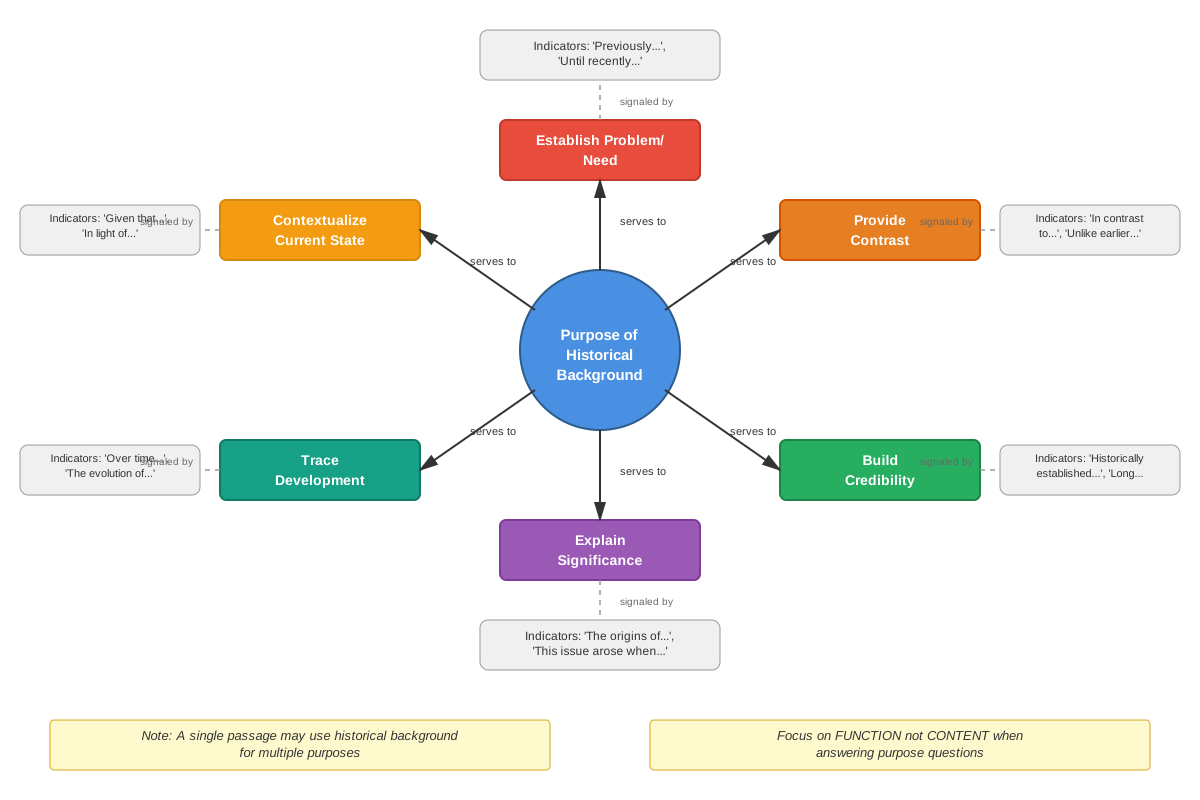
Historical background in LSAT passages refers to any information that provides temporal context, traces development over time, or explains how something came to be. This can include:
- The evolution of scientific theories or discoveries
- The development of legal doctrines or precedents
- The historical origins of social movements or cultural phenomena
- Previous scholarly debates or intellectual traditions
- The chronological sequence of events leading to a current situation
Importantly, historical background is defined not by its age but by its function as contextual information that precedes or explains the passage's main focus.
Common Purposes of Historical Background
Understanding the lsat purpose of historical background requires recognizing that authors include this information strategically. The most common purposes include:
1. Establishing a Problem or Gap
Historical background often describes previous approaches, theories, or situations that were inadequate, incomplete, or problematic. This sets up the passage's main focus as a solution, improvement, or new development.
Example pattern: "For decades, scientists believed X. However, recent discoveries have challenged this view..."
The purpose here is to establish what was wrong or insufficient about the old view, making the new development seem necessary and significant.
2. Providing Necessary Context
Sometimes historical background simply gives readers the information they need to understand the main discussion. Without this context, the passage's central claims would be incomprehensible or lack significance.
Example pattern: "The doctrine of qualified immunity emerged from Supreme Court decisions in the 1960s. Understanding its origins is essential to evaluating current reform proposals..."
The purpose is purely informational—building the foundation for informed analysis.
3. Highlighting Contrast or Change
Historical background can emphasize how dramatically things have changed by showing what came before. The contrast itself is the point.
Example pattern: "Early 20th-century physicists viewed the atom as indivisible. The discovery of subatomic particles revolutionized this understanding..."
The purpose is to emphasize the magnitude of change or the revolutionary nature of new developments.
4. Building Credibility or Authority
Authors may trace the historical development of ideas to show that current understanding rests on a solid foundation of accumulated knowledge and rigorous investigation.
Example pattern: "Through decades of careful observation and experimentation, researchers gradually refined their understanding of..."
The purpose is to demonstrate that conclusions are well-supported and trustworthy.
5. Explaining Current Significance
Historical background can show why a current issue matters by revealing its roots, its long-standing nature, or its connection to important past events.
Example pattern: "The current debate over intellectual property rights has its origins in 18th-century disputes about..."
The purpose is to demonstrate that the issue has depth and importance beyond immediate circumstances.
Distinguishing Purpose from Content
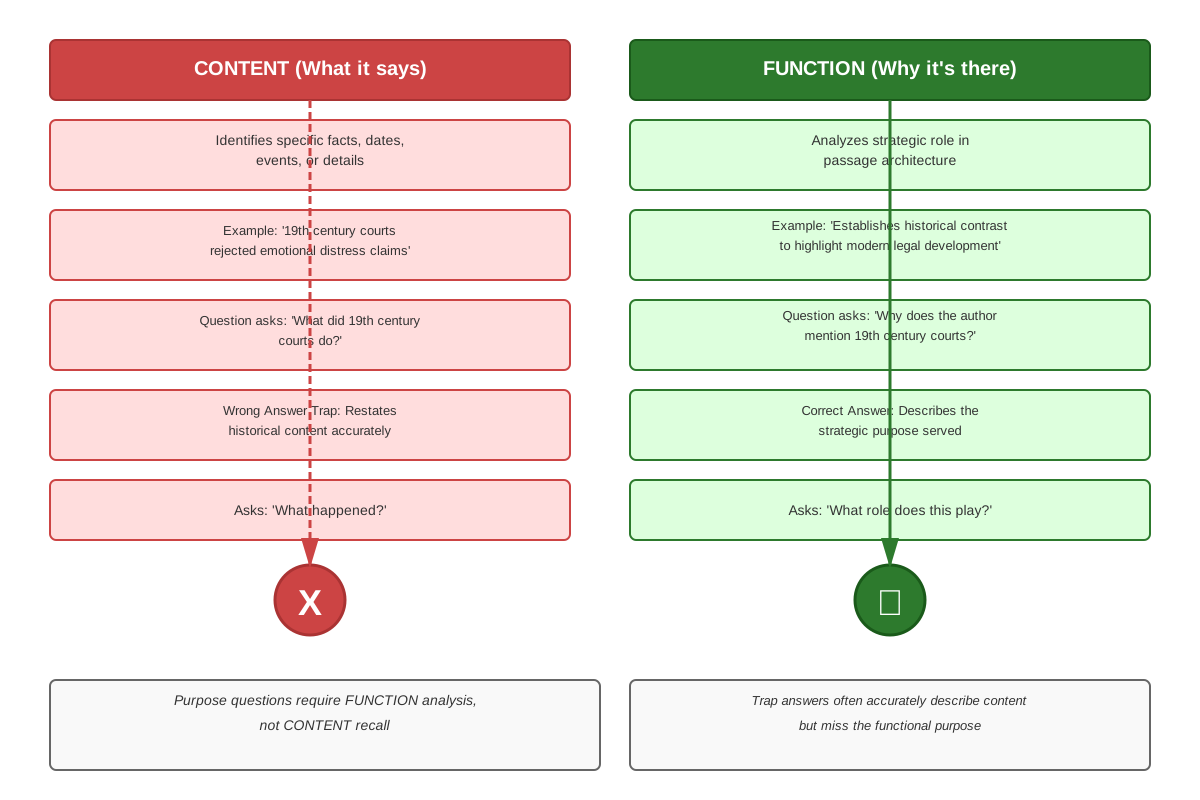
A critical skill in reading comprehension is separating what information says from what it does. Consider this distinction:
| Content (What) | Purpose (Why) |
|---|---|
| The passage describes 19th-century theories about disease transmission | To establish the flawed understanding that germ theory would later replace |
| The passage mentions early legal restrictions on corporate speech | To provide context for understanding current First Amendment doctrine |
| The passage traces the development of abstract expressionism | To highlight the contrast with subsequent minimalist movements |
LSAT questions about purpose focus on the right column. Wrong answers often accurately describe content but mischaracterize function.
Structural Positions of Historical Background
The location of historical background within a passage often signals its purpose:
Opening paragraphs: Historical background here typically establishes context, defines terms, or sets up a problem that the passage will address. It frames the entire discussion.
Middle sections: Historical background embedded in the body of a passage often provides support for specific claims, offers comparison points, or traces the development of ideas being analyzed.
Brief mentions: Quick historical references usually serve to establish credibility, acknowledge alternative views, or provide necessary context without being the focus.
Signal Words and Phrases
Certain language patterns indicate that historical background is being introduced:
- Temporal markers: "traditionally," "historically," "for decades," "until recently," "in the past"
- Developmental language: "evolved," "developed," "emerged," "originated," "grew out of"
- Contrast signals: "previously," "formerly," "once believed," "earlier theories"
- Sequential markers: "initially," "subsequently," "eventually," "over time"
Recognizing these signals helps readers identify historical background and anticipate questions about its purpose.
Concept Relationships
The purpose of historical background connects to multiple aspects of passage fundamentals:
Passage Structure → Purpose of Historical Background: Understanding overall passage organization helps predict where historical background will appear and what function it will serve. Opening historical background typically frames the discussion, while embedded historical details support specific points.
Purpose of Historical Background → Main Idea: The function of historical background often directly supports or establishes the passage's main idea. If historical background sets up a problem, the main idea likely presents a solution. If it provides contrast, the main idea likely emphasizes change or development.
Purpose of Historical Background → Author's Attitude: How an author presents historical information reveals their perspective. Dismissive treatment of historical views suggests the author favors newer approaches. Respectful, detailed historical discussion suggests the author values accumulated knowledge.
Purpose of Historical Background → Question Prediction: Recognizing the purpose of historical background enables students to predict likely questions. Extensive historical setup suggests questions about the problem being addressed or the contrast being drawn.
Textual relationship map:
Passage Structure Analysis → Identify Historical Background → Determine Its Purpose → Connect to Main Idea → Predict Question Types → Eliminate Wrong Answers
This chain of reasoning shows how understanding purpose of historical background integrates into comprehensive passage analysis.
High-Yield Facts
⭐ Historical background questions focus on function (why information is included) rather than content (what the information says).
⭐ The most common purposes are: establishing a problem, providing context, highlighting contrast, building credibility, and explaining significance.
⭐ Historical background in opening paragraphs typically frames the entire passage and often sets up the main idea.
⭐ Wrong answers to purpose questions often accurately describe content but mischaracterize the functional role of the information.
⭐ Signal words like "traditionally," "historically," "previously," and "until recently" indicate historical background is being introduced.
- Historical background can appear in any passage type (science, law, humanities, social science) but is especially common in science and law passages.
- Questions about purpose of historical background often use stems like "primarily in order to," "serves mainly to," or "functions to."
- The length of historical background does not determine its importance; brief mentions can serve crucial purposes.
- Multiple pieces of historical background in a single passage may serve different purposes.
- Understanding the purpose of historical background improves reading efficiency by helping students focus on high-yield information rather than memorizing details.
Common Misconceptions
Misconception: Historical background is always less important than contemporary information in the passage.
Correction: Historical background often establishes the framework for understanding the entire passage. Its purpose may be central to the passage's main idea, especially when it sets up a problem that the passage addresses or provides essential context.
Misconception: If a question asks about historical information, the answer must describe what that information says.
Correction: Purpose questions require identifying why the author included the information, not summarizing its content. The correct answer describes the functional role the information plays in the passage's structure.
Misconception: All historical background serves the same purpose within a passage.
Correction: A single passage may include historical background serving multiple purposes. Opening historical context might establish a problem, while later historical references might provide comparison points or build credibility for specific claims.
Misconception: The purpose of historical background is always explicitly stated by the author.
Correction: Authors rarely announce "I'm including this historical information in order to..." Readers must infer purpose from context, structure, and the relationship between historical background and surrounding content.
Misconception: Longer historical sections are more important than brief historical mentions.
Correction: Length does not determine importance. A single sentence of historical background can serve a crucial purpose (like establishing necessary context), while multiple paragraphs might provide interesting but less functionally central information.
Quick check — test yourself on Purpose of historical background so far.
Try Flashcards →Worked Examples
Example 1: Science Passage
Passage excerpt:
"For most of the twentieth century, paleontologists believed that dinosaurs were cold-blooded reptiles, sluggish creatures whose activity levels depended entirely on external temperature. This view was consistent with the prevailing understanding of reptilian physiology and seemed to explain why dinosaurs, unlike mammals, could grow to enormous sizes without overheating. However, recent discoveries of fossilized dinosaur bone structure have challenged this long-held assumption. The bone tissue of many dinosaur species shows characteristics typical of warm-blooded animals, including evidence of rapid, sustained growth rates that would be impossible for cold-blooded creatures."
Question: The author's discussion of twentieth-century beliefs about dinosaur physiology serves primarily to:
(A) Explain why dinosaurs could grow larger than mammals
(B) Describe the methodology paleontologists used to study fossils
(C) Establish the conventional view that recent discoveries have challenged
(D) Argue that cold-blooded animals cannot sustain rapid growth
(E) Provide evidence supporting the theory that dinosaurs were reptiles
Analysis:
Step 1: Identify that the question asks about purpose ("serves primarily to"), not content.
Step 2: Locate the historical background—the first two sentences describe what paleontologists "believed" and what "seemed to explain" past understanding.
Step 3: Determine the structural relationship—the historical background is followed by "However, recent discoveries have challenged..." This signals that the purpose is to set up a contrast.
Step 4: Evaluate each answer:
(A) This describes content (what the old view explained) but not purpose (why the author mentions it). The author isn't trying to explain dinosaur size; that's just part of the old theory being described.
(B) The passage doesn't discuss methodology at all. This mischaracterizes the content entirely.
(C) CORRECT. This accurately describes the function: the historical background establishes what people used to think so that the passage can explain how new evidence challenges it. The word "conventional view" captures the old consensus, and "recent discoveries have challenged" matches the passage structure.
(D) This misrepresents the passage's argument. The author is presenting what the old view held, not arguing for it. Additionally, this describes content rather than purpose.
(E) This describes part of the content but misses the functional role. The author mentions the old view not to support it but to set it up for challenge.
Connection to learning objectives: This example demonstrates how to identify purpose questions, distinguish content from function, and recognize the "establish a view to challenge it" purpose pattern.
Example 2: Law Passage
Passage excerpt:
"The concept of corporate personhood has deep historical roots in American jurisprudence. As early as 1819, in Dartmouth College v. Woodward, the Supreme Court recognized that corporations possessed certain constitutional protections. Throughout the nineteenth century, courts gradually expanded these protections, culminating in the 1886 case Santa Clara County v. Southern Pacific Railroad, which established that corporations were 'persons' under the Fourteenth Amendment. This historical development provides essential context for understanding contemporary debates about corporate political speech. Critics who argue that corporations should not have First Amendment rights often overlook this long-established legal tradition, while defenders of corporate speech rights sometimes overstate the historical consensus, ignoring significant judicial disagreements about the scope of corporate personhood."
Question: The author's discussion of nineteenth-century legal cases primarily serves to:
(A) Argue that corporate personhood is constitutionally mandated
(B) Provide historical context necessary for understanding current debates
(C) Demonstrate that corporate personhood has always been controversial
(D) Explain the reasoning behind the Fourteenth Amendment
(E) Support the position that corporations should have political speech rights
Analysis:
Step 1: Recognize this as a purpose question ("primarily serves to").
Step 2: Identify the historical background—the first three sentences trace legal developments from 1819 to 1886.
Step 3: Note the explicit purpose statement—"This historical development provides essential context for understanding contemporary debates." The author directly states the purpose.
Step 4: Observe how the historical background is used—the final sentence shows that understanding this history helps evaluate both critics and defenders of corporate rights.
Step 5: Evaluate answers:
(A) The author presents historical information neutrally and discusses both critics and defenders. There's no argument that corporate personhood is mandated.
(B) CORRECT. This matches the author's explicit statement and the functional role of the historical information. The history isn't presented to argue for a position but to provide the background needed to understand current debates.
(C) While the passage mentions "judicial disagreements," the primary purpose of the historical discussion isn't to show controversy but to provide context.
(D) The passage mentions the Fourteenth Amendment but doesn't explain its reasoning. This mischaracterizes the content.
(E) The author remains neutral, presenting both sides. The historical background doesn't support either position but rather provides context for evaluating both.
Connection to learning objectives: This example shows how authors sometimes explicitly state purpose, how to recognize the "providing context" purpose, and how to eliminate answers that suggest the author is arguing for a position when they're actually remaining neutral.
Exam Strategy
Approaching Purpose Questions
When encountering questions about the purpose of historical background on the LSAT:
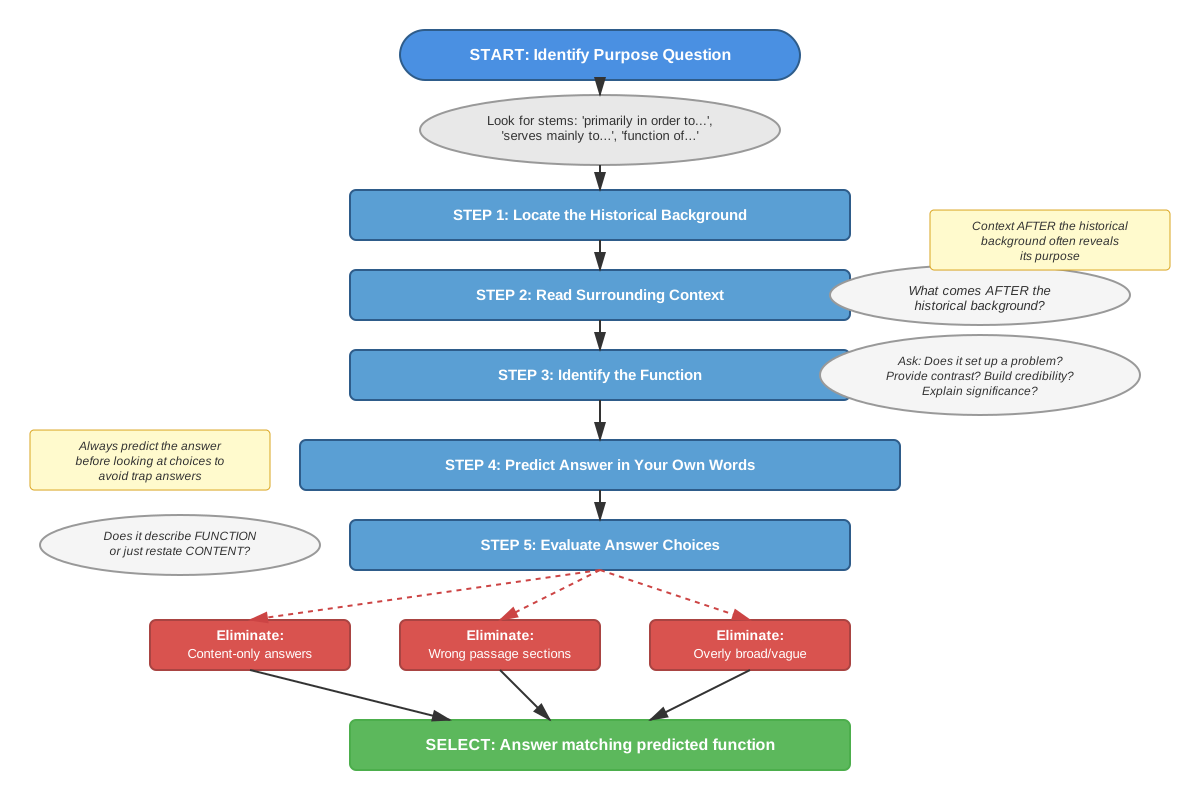
Step 1: Identify the question type. Look for stems containing "primarily in order to," "serves mainly to," "functions to," "the author mentions X to," or "the purpose of the discussion of X is to."
Step 2: Locate the referenced information. Find the specific historical background mentioned in the question stem. Read slightly before and after to understand context.
Step 3: Ask "Why is this here?" Don't summarize what the information says; determine what job it does in the passage structure. Does it set up a problem? Provide contrast? Establish context?
Step 4: Predict the answer. Before looking at choices, formulate your own answer about the purpose. This prevents wrong answers from seeming attractive.
Step 5: Eliminate systematically. Remove answers that describe content rather than function, that mischaracterize the author's attitude, or that describe purposes not supported by the passage structure.
Trigger Words and Phrases
In question stems, watch for:
- "primarily in order to"
- "serves mainly to"
- "functions to"
- "the author mentions [X] to"
- "the purpose of"
- "the author discusses [X] primarily to"
In passages, signal words indicating historical background:
- Temporal: "traditionally," "historically," "for decades," "until recently"
- Developmental: "evolved," "emerged," "originated," "developed"
- Contrast: "previously," "formerly," "once believed," "earlier"
Process of Elimination Tips
Eliminate answers that:
- Describe content accurately but don't explain function
- Attribute positions to the author that the author doesn't hold
- Describe purposes too narrow (missing the main function) or too broad (claiming more than the information does)
- Use extreme language ("prove," "definitively establish") when the purpose is more modest
- Confuse the purpose of historical background with the purpose of the entire passage
Favor answers that:
- Use functional language ("establish," "provide context," "highlight contrast," "set up")
- Match the structural relationship between historical background and surrounding content
- Align with the author's tone and attitude
- Describe purposes that make sense given where the historical background appears in the passage
Time Allocation
Purpose questions typically require 60-90 seconds:
- 15-20 seconds: Read and understand the question stem
- 20-30 seconds: Locate and review the relevant passage content
- 10-15 seconds: Predict the answer
- 15-25 seconds: Evaluate answer choices and select
Don't spend excessive time re-reading large sections. If you understood the passage structure during your initial read, you should quickly recognize the purpose of historical background.
Exam Tip: If you're stuck between two answers, return to the passage structure. The correct answer will align with how the historical background relates to what comes immediately before and after it.
Memory Techniques
The CHESS Mnemonic
Remember the five most common purposes of historical background with CHESS:
- Contrast: Highlighting how things have changed
- History as context: Providing necessary background
- Establish a problem: Setting up an issue to be solved
- Significance: Explaining why something matters
- Support credibility: Building authority for claims
Visualization Strategy
Picture historical background as the foundation of a building. Just as a foundation serves specific purposes (supporting the structure, providing stability, establishing level ground), historical background serves specific purposes in passages. When you encounter historical background, visualize asking: "What is this foundation supporting? What would collapse without it?"
The "Before and After" Technique
To quickly identify purpose, use this mental framework:
BEFORE the historical background: What question or gap exists?
AFTER the historical background: What does the passage now do?
The purpose is the bridge connecting before and after. If before the historical background readers would be confused, the purpose is providing context. If after the historical background the passage introduces a new theory, the purpose is likely establishing the old view to be challenged.
Question Stem Recognition
Create a mental category for purpose questions by memorizing this pattern:
"The [author/passage] [mentions/discusses/describes] [X] [primarily/mainly] [in order to/to/serves to] ___"
Any question matching this pattern is asking about purpose, not content. Train yourself to recognize this structure instantly.
Summary
The purpose of historical background is a high-yield LSAT Reading Comprehension skill that requires students to analyze why authors include contextual or historical information rather than simply understanding what that information says. Historical background serves strategic purposes within passage structure: establishing problems to be solved, providing necessary context, highlighting contrast or change, building credibility, or explaining current significance. LSAT questions consistently test whether students can distinguish between content (what information says) and function (what role it plays), with wrong answers typically describing content accurately while mischaracterizing purpose. Success requires recognizing signal words that indicate historical background, understanding common structural patterns, and systematically eliminating answers that confuse content with function. Mastering this skill improves both accuracy on direct purpose questions and overall reading efficiency, as students learn to focus on high-yield structural relationships rather than memorizing historical details. The ability to quickly identify the purpose of historical background connects to broader passage analysis skills and represents the kind of sophisticated reading that law schools value.
Key Takeaways
- Purpose questions ask why information is included (function), not what it says (content)—this distinction is the key to eliminating wrong answers
- The five most common purposes are establishing problems, providing context, highlighting contrast, building credibility, and explaining significance (remember CHESS)
- Historical background in opening paragraphs typically frames the entire passage and often sets up the main idea or central problem
- Signal words like "traditionally," "historically," and "previously" indicate historical background and should trigger analysis of purpose
- Wrong answers often accurately describe content but mischaracterize function—always ask "Does this answer explain why the author included this information?"
- The structural position and relationship of historical background to surrounding content reveals its purpose—look at what comes immediately before and after
- Understanding purpose improves reading efficiency by helping students focus on structural relationships rather than memorizing details
Related Topics
Passage Structure and Organization: Understanding how LSAT passages are architecturally constructed provides the framework for analyzing the purpose of any passage component, including historical background. Mastering purpose of historical background builds toward comprehensive structural analysis.
Author's Purpose and Attitude: Recognizing why authors include historical background connects directly to understanding their overall purpose and attitude. The way authors present historical information reveals their perspective and argumentative strategy.
Main Idea and Primary Purpose Questions: The purpose of historical background often directly supports or establishes the passage's main idea. Students who master this topic will find main idea questions easier because they understand how passage components work together.
Function Questions: Purpose of historical background is one type of function question. The analytical skills developed here transfer to questions about the function of examples, analogies, quotations, and other passage elements.
Comparative Passages: In comparative passage sets, historical background in one passage often serves to contrast with contemporary analysis in another. Understanding purpose of historical background is essential for analyzing relationships between paired passages.
Practice CTA
Now that you've mastered the core concepts of purpose of historical background, it's time to apply this knowledge! Work through the practice questions to test your ability to distinguish content from function, recognize common purpose patterns, and eliminate wrong answers systematically. Use the flashcards to reinforce the CHESS mnemonic and common signal words. Remember: understanding why authors include historical background isn't just about answering specific questions—it's about reading more efficiently and strategically throughout the entire Reading Comprehension section. Every passage you analyze is an opportunity to strengthen this essential skill. You've built the foundation; now construct mastery through deliberate practice!
Sign up free to keep reading
Create a free AnvayaPrep account to finish this LSAT guide on Purpose of historical background — plus flashcards and practice questions.