Overview
The purpose of research findings is a critical analytical skill tested extensively in LSAT reading comprehension passages. This concept requires test-takers to understand not merely what research findings state, but why authors include them within the broader argumentative structure of a passage. On the LSAT, passages frequently incorporate empirical studies, experimental results, or scholarly research to support claims, challenge existing theories, illustrate phenomena, or provide evidence for conclusions. Recognizing the functional role these findings play—rather than just their content—is essential for answering questions about passage structure, author's purpose, and argumentative strategy.
Understanding the LSAT purpose of research findings connects directly to passage fundamentals because it requires synthesizing multiple reading skills: identifying main ideas, tracking argumentative flow, distinguishing between evidence and claims, and recognizing rhetorical moves. When an author presents research findings, those findings serve specific rhetorical purposes within the passage architecture—they might introduce a problem requiring explanation, provide support for a controversial thesis, offer counterevidence to a prevailing view, or demonstrate the practical application of an abstract principle. The LSAT tests whether students can move beyond surface-level comprehension to recognize these deeper structural functions.
This topic integrates with broader Reading Comprehension skills by demanding that students maintain awareness of both micro-level details (what the research actually found) and macro-level structure (how those findings advance the author's overall purpose). Mastery of this concept enables students to answer not only direct "purpose" questions but also inference questions, strengthening/weakening questions, and questions about passage organization—making it one of the highest-yield skills for improving Reading Comprehension scores.
Learning Objectives
- [ ] Identify how Purpose of research findings appears in LSAT questions
- [ ] Explain the reasoning pattern behind Purpose of research findings
- [ ] Apply Purpose of research findings to solve LSAT-style problems accurately
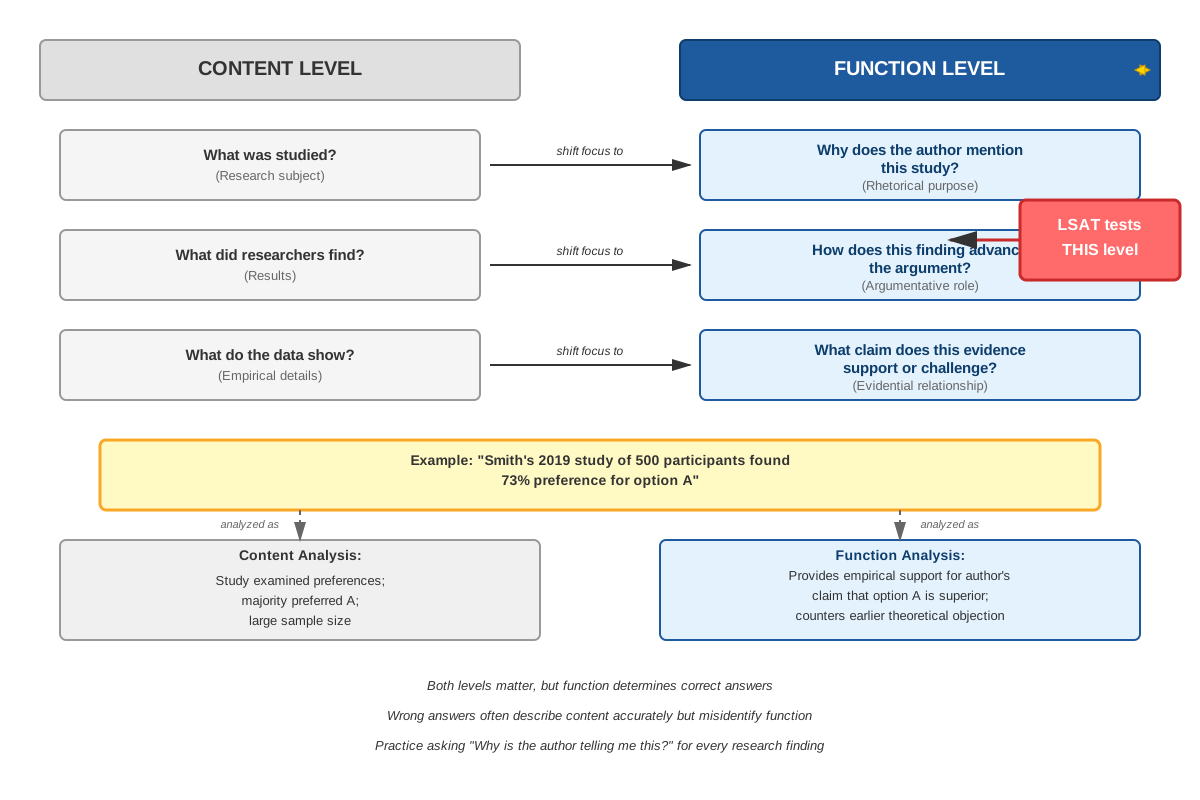
- [ ] Distinguish between the content of research findings and their rhetorical function within a passage
- [ ] Categorize research findings according to their common argumentative purposes (support, refutation, illustration, complication)
- [ ] Predict likely question types based on how research findings are positioned within passage structure
- [ ] Evaluate answer choices by matching them to the specific functional role research findings play in the author's argument
Prerequisites
- Basic passage structure recognition: Understanding introductions, body paragraphs, and conclusions helps locate where research findings typically appear and what roles they might serve
- Distinction between claims and evidence: Recognizing that research findings usually function as evidence supporting broader claims is fundamental to identifying their purpose
- Author's tone and attitude: Detecting whether an author presents research findings neutrally, critically, or enthusiastically reveals their argumentative purpose
- Argument mapping skills: The ability to track how ideas connect and build upon each other enables recognition of how research findings fit into argumentative chains
Why This Topic Matters
In real-world contexts, understanding the purpose of research findings is essential for legal reasoning, academic analysis, and critical evaluation of evidence-based arguments. Lawyers must assess how studies support or undermine legal positions; scholars must evaluate how research advances or challenges theoretical frameworks; and informed citizens must recognize when research is being used appropriately versus manipulatively. The LSAT tests this skill because it reflects the analytical thinking required in law school and legal practice.
On the LSAT Reading Comprehension section, questions about the purpose of research findings appear with remarkable frequency—typically in 15-25% of all Reading Comprehension questions across the four passages. These questions take several forms: direct purpose questions ("The author mentions the study in lines 23-27 primarily in order to..."), function questions ("The research described in the second paragraph serves to..."), and structural questions ("Which one of the following best describes the organization of the passage?"). Additionally, understanding research purpose is crucial for answering inference questions, as the functional role of findings often constrains what can be legitimately inferred.
Research findings commonly appear in LSAT passages in several predictable contexts: scientific passages presenting experimental evidence for theories, social science passages using empirical data to support or challenge conventional wisdom, humanities passages citing scholarly research to contextualize artistic or cultural phenomena, and law passages referencing studies to inform policy debates. The LSAT favors passages where research findings create complexity—where multiple studies conflict, where findings challenge intuitive assumptions, or where research methodology itself becomes relevant to the argument.
Core Concepts
The Functional Nature of Research Findings
Research findings in LSAT passages are never included merely for informational purposes; they always serve specific rhetorical functions within the author's argumentative structure. Understanding this principle is foundational: every piece of research mentioned exists to advance the passage's purpose in some way. The LSAT tests whether students can identify this functional role rather than simply recalling what the research found.
The distinction between content and purpose is crucial. Content refers to what the research discovered (the findings themselves), while purpose refers to why the author included those findings in the passage. For example, a study might find that "bilingual children demonstrate enhanced executive function" (content), but the author might cite this finding to "support the claim that early language education provides cognitive benefits beyond communication skills" (purpose). LSAT questions consistently test purpose over content.
Common Purposes of Research Findings
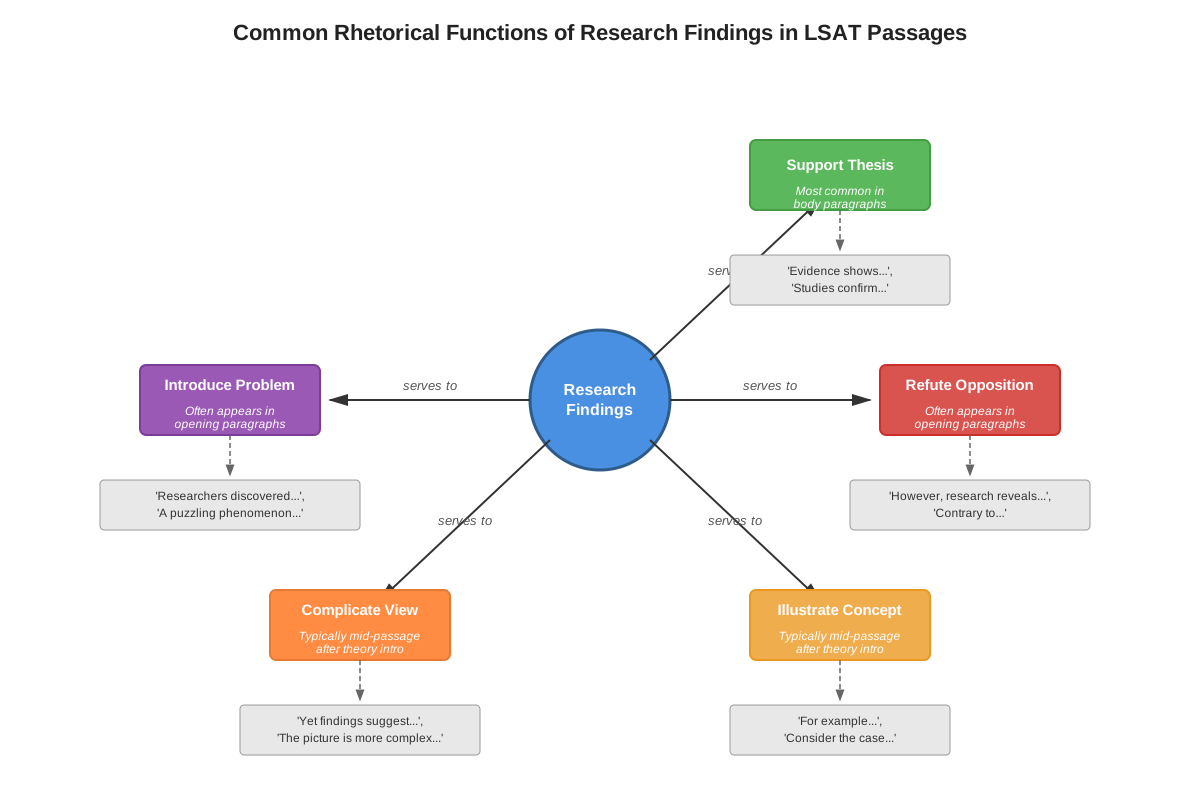
Research findings in LSAT passages typically serve one of several standard purposes, which can be categorized systematically:
| Purpose Category | Function | Typical Indicators |
|---|---|---|
| Direct Support | Provides evidence confirming the author's main claim | "Studies demonstrate...", "Research confirms...", "Evidence shows..." |
| Refutation/Challenge | Undermines an opposing view or conventional wisdom | "However, recent findings...", "Contrary to expectations...", "This challenges..." |
| Illustration | Makes an abstract concept concrete through specific example | "For instance...", "This phenomenon is evident in...", "Consider the case of..." |
| Complication | Introduces nuance, limitations, or complexity to a claim | "Yet research also reveals...", "The picture is complicated by...", "Findings are mixed..." |
| Contextualization | Establishes background or historical development | "Early studies suggested...", "The field has long recognized...", "Initial research..." |
| Methodological Contrast | Highlights how different research approaches yield different insights | "Unlike previous studies that...", "Using a novel methodology...", "This approach differs..." |
Structural Positioning and Purpose
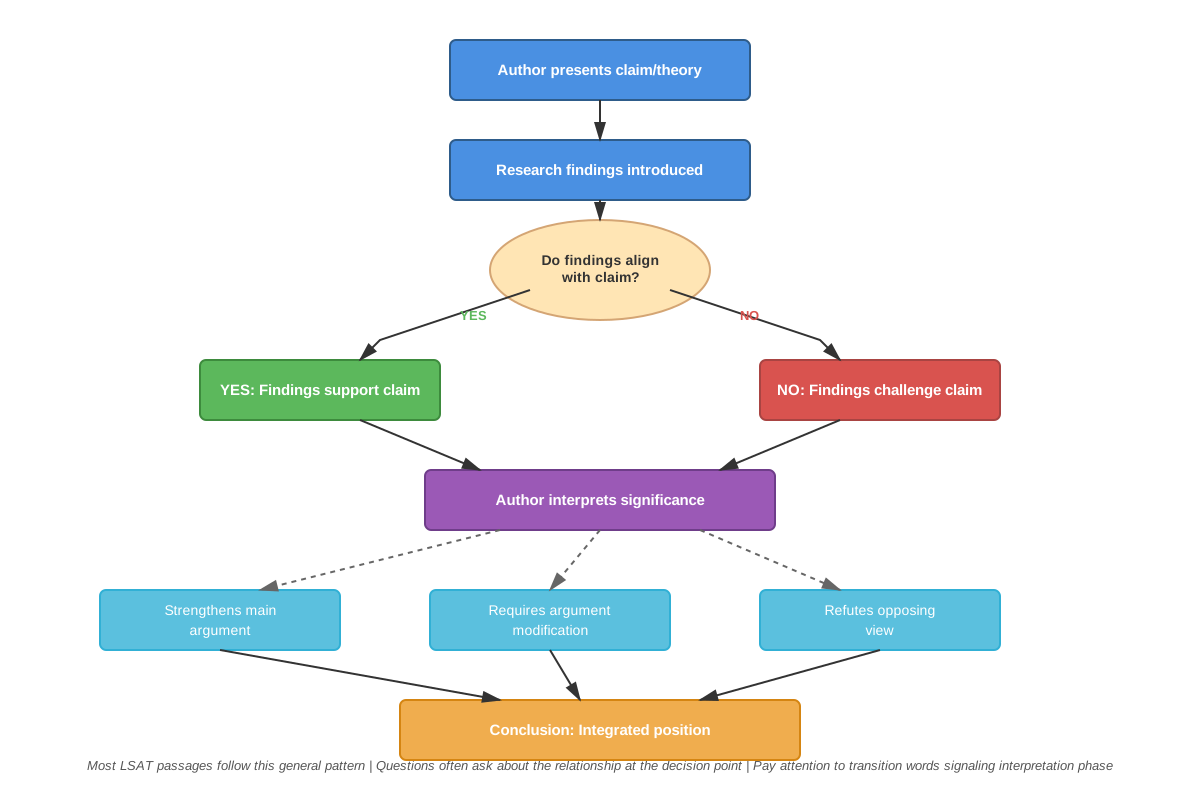
The location of research findings within passage structure strongly correlates with their purpose. Findings presented early in passages often establish context or introduce a problem requiring explanation. Those appearing in middle paragraphs typically provide evidence for the author's developing argument. Research cited near the end of passages frequently serves to reinforce conclusions or address potential objections.
Transitional language surrounding research findings provides critical clues to purpose. Words like "however," "moreover," "surprisingly," and "nevertheless" signal how findings relate to surrounding claims. For example, "Moreover, research by Chen (2019) found..." indicates the research provides additional support, while "However, subsequent studies revealed..." suggests the research complicates or challenges previous claims.
The Author's Attitude Toward Research
The author's stance toward research findings—whether endorsing, questioning, or neutrally reporting—affects their purpose within the passage. When authors present findings with qualifying language ("suggests," "may indicate," "appears to show"), they signal tentative support or acknowledge limitations. When authors present findings assertively ("demonstrates," "proves," "establishes"), they indicate strong reliance on that evidence. When authors critique research methodology or interpretation, the findings serve to illustrate problems with certain approaches rather than to support substantive claims.
Multiple Studies and Comparative Purpose
LSAT passages frequently present multiple research findings that must be understood in relation to each other. When passages cite several studies, their collective purpose often involves showing development over time, presenting conflicting evidence requiring reconciliation, or demonstrating consensus across different methodologies. The relationship between studies—whether they converge, conflict, or build progressively—becomes part of understanding their purpose.
For instance, a passage might present Study A showing one result, then Study B showing a contradictory result, with the author's purpose being to argue that Study B's superior methodology makes it more reliable. Here, both studies serve the purpose of supporting the author's methodological point, even though their findings differ.
Research Findings Versus Theoretical Claims
Distinguishing between empirical findings and theoretical interpretations is essential for understanding purpose. Research findings are observational or experimental results, while theoretical claims are explanatory frameworks. Authors often present research findings to support, challenge, or refine theoretical claims. The purpose of the findings is understood in relation to these theoretical debates.
For example, a passage might describe research showing that "crows can solve multi-step puzzles" (finding) to support the theoretical claim that "tool use indicates abstract reasoning capacity" (theory). The purpose of the research is to provide empirical grounding for the theoretical position.
Concept Relationships
The purpose of research findings connects intimately with several other passage fundamentals. Understanding main idea is prerequisite to identifying research purpose, because findings serve the main idea—they exist to advance, support, or complicate the author's central claim. The relationship flows: Main Idea → determines → Purpose of Supporting Evidence (including research findings).
Passage structure and research purpose are mutually informative. Recognizing where findings appear in the argumentative flow helps identify their purpose, while understanding their purpose clarifies the passage's organizational logic. This creates a bidirectional relationship: Structure ↔ Purpose of Research Findings.
The concept connects forward to inference questions because understanding why research was included constrains what can be inferred from it. If research serves to illustrate rather than prove a point, strong inferences are less justified. The relationship is: Purpose of Research → constrains → Valid Inferences.
Author's tone and attitude directly influences research purpose. A skeptical author citing research might do so to demonstrate flaws in a research program, while an enthusiastic author citing the same research might use it as strong support. The relationship: Author's Attitude → shapes → Purpose of Research Findings.
Within the topic itself, the concepts form a hierarchy: Functional Nature of Research (foundational principle) → Common Purpose Categories (specific applications) → Structural Positioning (contextual factors) → Author's Attitude (interpretive lens) → Multiple Studies (complex applications). Each level builds on previous understanding.
High-Yield Facts
⭐ Research findings in LSAT passages always serve rhetorical purposes; they are never included purely for information
⭐ The most common purposes are: direct support, refutation, illustration, and complication
⭐ Transitional words immediately before or after research citations are critical clues to purpose
⭐ Questions asking "in order to" or "primarily to" are directly testing research purpose
⭐ The location of research within passage structure correlates strongly with its purpose
- Research presented with qualifying language ("suggests," "may") indicates tentative or limited support
- When multiple studies appear, their relationship to each other (convergent, conflicting, progressive) is often the key to understanding purpose
- Authors who critique research methodology are using those findings to make methodological rather than substantive points
- Research findings near the beginning of passages typically establish context or problems; those near the end typically reinforce conclusions
- The distinction between what research found (content) and why it was included (purpose) is the most frequently tested aspect of this topic
Quick check — test yourself on Purpose of research findings so far.
Try Flashcards →Common Misconceptions
Misconception: Research findings are included to inform readers about interesting discoveries → Correction: Research findings serve specific argumentative functions within the passage's rhetorical structure; the LSAT tests understanding of these functions, not retention of interesting facts
Misconception: If research is mentioned, it must support the author's main claim → Correction: Research can serve multiple purposes including refutation of opposing views, illustration of concepts, complication of simple claims, or demonstration of methodological problems; not all research directly supports the main thesis
Misconception: The purpose of research is the same as what the research found → Correction: Purpose refers to the rhetorical function within the passage (why the author included it), while findings refer to the research results themselves (what was discovered); these are distinct concepts
Misconception: Longer descriptions of research indicate greater importance to the author's argument → Correction: Length of description may reflect complexity of findings or need for clarification rather than argumentative centrality; brief mentions can serve crucial purposes
Misconception: Research cited early in a passage is always background information → Correction: While early research often provides context, it can also introduce a puzzle requiring explanation, present a view to be challenged, or establish a methodological standard for comparison
Misconception: When an author presents research neutrally without explicit commentary, it has no specific purpose → Correction: Even neutrally presented research serves purposes like establishing consensus, providing necessary background, or setting up contrasts with later findings; lack of explicit commentary doesn't mean lack of purpose
Misconception: If research findings conflict with each other in a passage, one must be wrong → Correction: Conflicting research often serves the purpose of showing complexity, demonstrating how methodology affects results, or illustrating the evolving nature of understanding in a field
Worked Examples
Example 1: Direct Support Purpose
Passage Excerpt: "Advocates of early music education argue that musical training enhances cognitive development beyond musical skills themselves. Supporting this view, a longitudinal study by Schellenberg (2004) tracked children receiving music lessons over three years and found significant improvements in IQ scores compared to control groups receiving drama lessons or no additional instruction. These findings suggest that the cognitive demands of musical training—including attention, memory, and pattern recognition—transfer to general intellectual capacities."
Question: The author mentions the Schellenberg study primarily in order to:
Analysis Process:
- Identify the claim being made: The passage presents the claim that "musical training enhances cognitive development beyond musical skills"
- Locate the research: The Schellenberg study appears immediately after this claim, introduced with "Supporting this view"
- Note transitional language: "Supporting this view" explicitly signals the purpose—the research provides evidence for the preceding claim
- Examine what follows: The sentence after the research ("These findings suggest...") interprets the results as confirming the cognitive transfer hypothesis
- Determine the functional role: The research serves as direct empirical support for the advocates' position that the author is explaining
Correct Answer: "provide empirical evidence for the claim that musical training produces cognitive benefits extending beyond musical ability"
Why this works: The answer captures both the content (cognitive benefits beyond music) and the function (providing evidence for a claim). It recognizes that the purpose is to support a specific argument, not merely to inform readers about an interesting study.
Connection to Learning Objectives: This example demonstrates identifying how purpose appears in questions (objective 1), explaining the reasoning pattern of direct support (objective 2), and applying this understanding to select the correct answer (objective 3).
Example 2: Complication Purpose
Passage Excerpt: "The standard account of language acquisition holds that children learn grammar through exposure to correct linguistic models in their environment. However, research by Crain and Thornton (1998) complicates this picture. Their experiments showed that children consistently produce grammatical structures they have never heard, including complex question formations that rarely appear in adult speech directed at children. Moreover, children avoid making certain types of errors that would be expected if they were simply imitating patterns from their linguistic environment. These findings suggest that language acquisition involves innate grammatical knowledge rather than pure environmental learning."
Question: The author's discussion of the Crain and Thornton research serves primarily to:
Analysis Process:
- Identify the existing view: The passage begins with "the standard account" that children learn through environmental exposure
- Note the transitional signal: "However" indicates contrast or complication of the standard view
- Examine the verb choice: "complicates this picture" explicitly states the purpose—not complete refutation, but adding complexity
- Analyze the research content: The findings show children doing things environmental learning can't explain (producing unheard structures, avoiding expected errors)
- Observe the conclusion drawn: "These findings suggest" introduces an alternative explanation (innate knowledge) that challenges but doesn't completely reject the standard account
- Determine the functional role: The research introduces evidence that the simple environmental model is incomplete, requiring a more nuanced theory
Correct Answer: "introduce evidence that challenges the adequacy of purely environmental explanations of language acquisition"
Why this works: The answer recognizes that the purpose is to complicate rather than completely refute (note "adequacy" rather than "validity" and "challenges" rather than "disproves"). It captures the function of introducing complexity to a previously simple account.
Common Wrong Answer: "refute the claim that environmental factors play any role in language learning" → This is too strong; the research complicates the environmental account but doesn't eliminate environmental factors entirely. Understanding purpose helps eliminate this overstatement.
Connection to Learning Objectives: This example shows how to distinguish between content (what the research found) and function (complicating a theory), demonstrates the reasoning pattern of complication (objective 2), and illustrates how recognizing purpose helps eliminate wrong answers (objective 3).
Exam Strategy
Approaching Purpose Questions
When encountering questions about research findings, follow this systematic approach:
- Locate the research in the passage and read 2-3 sentences before and after it to understand context
- Identify transitional language that signals how the research relates to surrounding claims
- Determine what claim or idea the research connects to (support, challenge, illustrate, etc.)
- Note the author's attitude toward the research (endorsing, questioning, neutral reporting)
- Predict the purpose before looking at answer choices
Trigger Words and Phrases
Watch for these high-yield signals in questions:
- "primarily in order to" → direct purpose question requiring identification of main function
- "serves to" → function question asking about rhetorical role
- "the author mentions/cites/refers to" → often followed by purpose question
- "the function of" → explicit request for purpose identification
In passages, these phrases signal research purpose:
- Support indicators: "supporting this," "evidence for," "confirming," "demonstrating"
- Challenge indicators: "however," "contrary to," "challenging," "undermining"
- Illustration indicators: "for example," "illustrating," "as seen in," "consider"
- Complication indicators: "yet," "complicates," "nuances," "however, research also"
Process of Elimination Tips
Eliminate answers that:
- Confuse content with purpose (state what was found rather than why it was included)
- Are too broad (could apply to any research in any passage)
- Are too narrow (focus on minor details rather than main function)
- Mischaracterize the author's attitude (claim the author endorses research they actually question)
- Overstate or understate the strength of the relationship (claim "proof" when the passage says "suggests")
Favor answers that:
- Use language matching the passage's transitional signals
- Capture both the specific claim addressed and the functional relationship
- Match the author's level of certainty (tentative vs. definitive)
- Align with the passage's overall argumentative structure
Time Allocation
Purpose questions are typically medium difficulty and should take 45-60 seconds once you've read the passage. If you find yourself spending more time:
- You may not have adequately mapped the passage structure during initial reading
- You may be overthinking the distinction between similar answer choices
- Return to the passage context rather than trying to reason from memory
Exam Tip: During your initial passage reading, mark research findings with "R" in the margin and jot a one-word purpose note ("support," "challenge," "ex."). This pre-work makes purpose questions much faster to answer.
Memory Techniques
The SCIC Framework
Remember the four most common purposes with SCIC (pronounced "sick"):
- Support: Research provides evidence for a claim
- Challenge: Research undermines or complicates a view
- Illustrate: Research makes an abstract concept concrete
- Contextualize: Research provides background or historical development
The "Why Not What" Mantra
When approaching research in passages, repeat: "Why not what" — reminding yourself that the LSAT tests why research was included (purpose), not what it found (content).
The Transition Signal Map
Visualize research findings as arrows pointing in different directions based on transitional signals:
- "Moreover," "Furthermore" → Arrow pointing FORWARD (adding support in same direction)
- "However," "Yet" → Arrow pointing BACKWARD (challenging or complicating previous claims)
- "For example," "Consider" → Arrow pointing DOWN (illustrating abstract with concrete)
- "Early research," "Initially" → Arrow pointing UP (providing foundation/context)
The Three-Question Drill
For any research finding, quickly ask:
- What claim does this connect to? (identifies the target)
- How does it connect? (identifies the relationship)
- What's the author's attitude? (identifies the interpretive frame)
These three questions capture the essential elements of purpose.
Summary
The purpose of research findings is a high-yield LSAT Reading Comprehension concept that requires understanding the functional role research plays within passage argumentation rather than merely recalling what studies found. Research findings serve specific rhetorical purposes—most commonly providing direct support for claims, challenging or complicating existing views, illustrating abstract concepts, or contextualizing discussions. The LSAT consistently tests whether students can distinguish between the content of research (what was discovered) and its purpose (why the author included it). Success requires attention to structural positioning, transitional language, and the author's attitude toward research. Questions about research purpose appear frequently across all passage types and connect to broader skills including main idea identification, passage structure analysis, and inference evaluation. Mastering this topic requires systematic analysis: locating research in context, identifying connecting claims, noting transitional signals, and determining functional relationships before evaluating answer choices.
Key Takeaways
- Research findings in LSAT passages always serve specific rhetorical purposes within the author's argument, never appearing merely for informational value
- The four most common purposes are direct support, challenge/complication, illustration, and contextualization (remember: SCIC)
- Transitional language immediately surrounding research citations provides critical clues to purpose and should be carefully noted
- Purpose questions test why research was included (function) rather than what the research found (content)—this distinction is fundamental
- The location of research within passage structure correlates with purpose: early findings often contextualize, middle findings often support, late findings often reinforce or address objections
- Understanding research purpose enables accurate answering of not only direct purpose questions but also inference, structure, and author's attitude questions
- Systematic analysis—reading context, identifying claims, noting transitions, determining relationships—is more reliable than intuition for identifying purpose
Related Topics
Main Idea and Primary Purpose: Understanding the overall point of a passage is prerequisite to recognizing how research findings serve that point; mastering research purpose strengthens main idea identification skills
Passage Structure and Organization: Recognizing how passages are constructed helps predict where research will appear and what purposes it will serve; these skills are mutually reinforcing
Author's Tone and Attitude: The author's stance toward research findings affects their purpose; developing sensitivity to authorial voice enhances purpose identification
Evidence and Support: Research findings are a specific type of evidence; understanding their purpose connects to broader skills in evaluating how claims are supported
Inference Questions: Recognizing research purpose constrains what can be legitimately inferred, making this topic foundational for inference question success
Strengthen and Weaken Questions: Though more common in Logical Reasoning, understanding how research supports or challenges claims transfers to these question types
Practice CTA
Now that you've mastered the conceptual framework for understanding the purpose of research findings, it's time to apply these skills to authentic LSAT passages. The practice questions and flashcards will reinforce your ability to quickly identify research purpose, distinguish it from content, and select correct answers with confidence. Remember: this is a high-frequency, high-yield topic—every minute spent practicing purpose identification will directly improve your Reading Comprehension score. Approach each practice question systematically using the strategies outlined above, and you'll develop the automatic recognition skills that separate top scorers from the rest. You've built the foundation; now build the fluency through deliberate practice.
Sign up free to keep reading
Create a free AnvayaPrep account to finish this LSAT guide on Purpose of research findings — plus flashcards and practice questions.