Overview
The qualified author stance is one of the most frequently tested concepts in LSAT reading comprehension passages. Unlike authors who take absolute, unequivocal positions, many LSAT passage authors adopt nuanced, measured perspectives that acknowledge complexity, limitations, or alternative viewpoints. Understanding how to identify and interpret these qualified stances is essential for correctly answering questions about author attitude, tone, and primary purpose—question types that appear in virtually every LSAT Reading Comprehension section.
A qualified author stance occurs when a writer expresses support for an idea while simultaneously introducing caveats, acknowledging counterarguments, or limiting the scope of their claims. This rhetorical approach reflects sophisticated academic writing, where authors rarely make sweeping generalizations without recognizing exceptions or competing perspectives. On the LSAT, recognizing these qualifications separates strong test-takers from those who oversimplify an author's position by selecting answer choices that are too extreme or absolute.
Within the broader framework of passage fundamentals, qualified author stance connects directly to understanding tone, identifying main ideas, and evaluating argument structure. Mastering this concept enables students to navigate the subtle distinctions between answer choices that often differ by a single qualifying word like "generally," "primarily," or "suggests." This skill becomes particularly crucial when facing comparative reading passages or passages discussing controversial topics where the author must balance multiple perspectives while still advancing a thesis.
Learning Objectives
- [ ] Identify how qualified author stance appears in LSAT questions
- [ ] Explain the reasoning pattern behind qualified author stance
- [ ] Apply qualified author stance to solve LSAT-style problems accurately
- [ ] Distinguish between qualified and unqualified author positions in passage text
- [ ] Recognize specific linguistic markers that signal author qualification
- [ ] Evaluate answer choices for appropriate degree of qualification matching the passage
- [ ] Predict when passages are likely to feature qualified stances based on subject matter
Prerequisites
- Basic reading comprehension skills: Understanding literal meaning and main ideas forms the foundation for detecting nuanced author positions
- Familiarity with argument structure: Recognizing claims, evidence, and counterarguments helps identify where qualifications appear
- Understanding of tone and attitude: Distinguishing between neutral, positive, and negative tones provides context for interpreting qualified positions
- Knowledge of common LSAT question types: Awareness of author attitude, primary purpose, and inference questions helps focus attention on relevant textual evidence
Why This Topic Matters
In legal practice, attorneys must constantly evaluate arguments that contain qualifications, exceptions, and limitations. The LSAT tests this skill through passages where authors carefully hedge their claims, acknowledge opposing views, or limit the scope of their conclusions. Understanding qualified author stance directly prepares students for the analytical reading required in law school and legal practice.
Exam statistics reveal that qualified author stance appears in approximately 60-70% of LSAT Reading Comprehension passages. Questions explicitly testing this concept typically appear 2-3 times per test, but the skill indirectly affects performance on many additional questions. Common question stems include: "The author's attitude toward X can best be described as...," "The author would most likely agree with which of the following...," and "The primary purpose of the passage is to..."
This topic commonly appears in passages discussing scientific theories (where authors acknowledge limitations of current research), legal or philosophical debates (where authors must engage with opposing viewpoints), and historical analyses (where authors qualify claims based on incomplete evidence). Passages about controversial topics almost invariably feature qualified stances, as authors demonstrate intellectual rigor by acknowledging complexity rather than making absolute pronouncements.
Core Concepts
Defining Qualified Author Stance
A qualified author stance represents an author's position that includes limitations, acknowledgments of complexity, or recognition of alternative perspectives. Rather than making categorical claims, authors using qualified stances employ hedging language, conditional statements, and scope limitations. This rhetorical strategy allows authors to advance arguments while maintaining intellectual honesty about uncertainties, exceptions, or competing viewpoints.
The qualification can manifest in several ways: temporal limitations ("currently available evidence suggests"), scope restrictions ("in most cases," "generally"), acknowledgment of counterarguments ("while some scholars argue X, the evidence better supports Y"), or epistemic modesty ("appears to," "suggests," "may indicate"). Each type of qualification serves a specific rhetorical purpose while maintaining the author's overall argumentative direction.
Linguistic Markers of Qualification
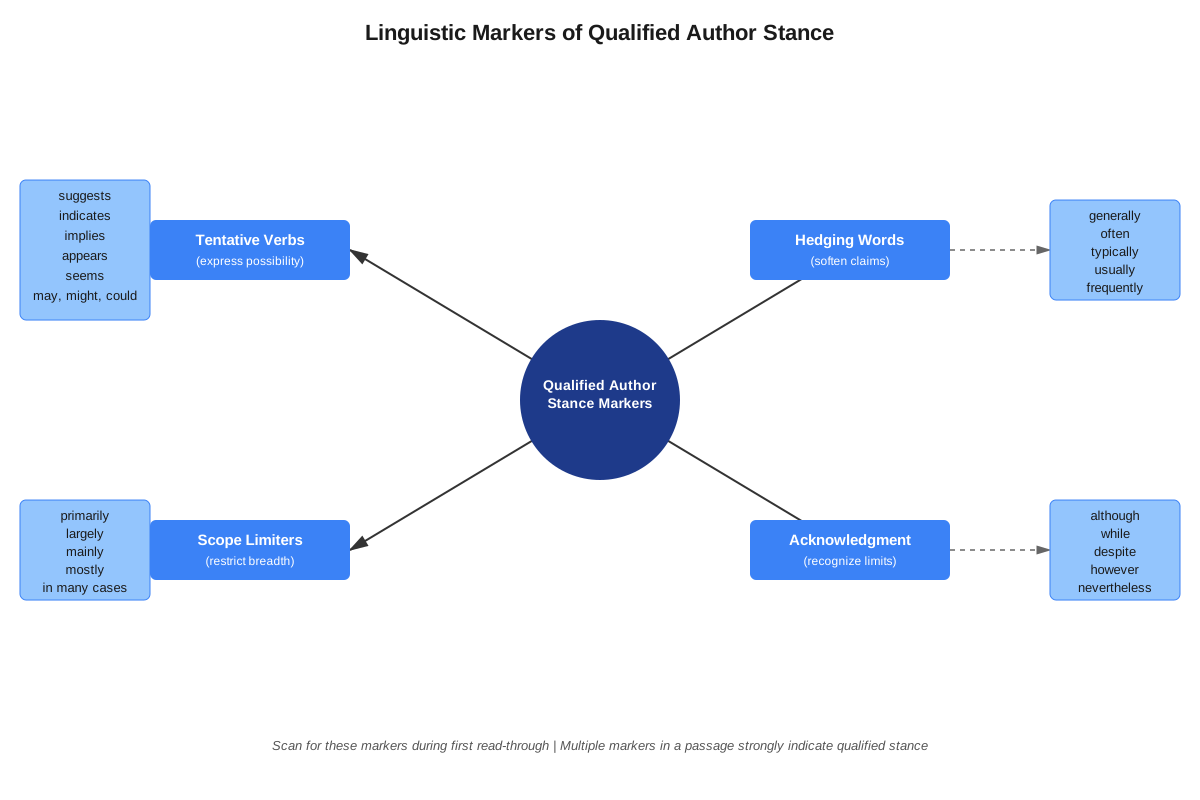
Specific words and phrases consistently signal qualified stances in LSAT passages. Modal verbs like "may," "might," "could," "would," and "should" indicate possibility rather than certainty. Frequency adverbs such as "often," "typically," "generally," "usually," and "frequently" acknowledge exceptions without abandoning the main claim. Hedging phrases including "tends to," "appears to," "seems to," "suggests that," and "indicates that" soften assertions.
Concessive language introduces qualifications by acknowledging opposing views: "although," "while," "despite," "even though," "granted that," and "admittedly." These markers signal that the author recognizes complexity but will ultimately advance a particular position. Limiting phrases like "to some extent," "in certain respects," "within this context," and "under these conditions" restrict the scope of claims without invalidating them entirely.
| Qualification Type | Example Markers | Function |
|---|---|---|
| Modal Uncertainty | may, might, could, possibly | Indicates probability rather than certainty |
| Frequency Limitation | often, usually, generally, typically | Acknowledges exceptions to patterns |
| Hedging | appears, seems, suggests, tends to | Softens direct assertions |
| Concessive | although, while, despite, granted | Acknowledges counterarguments |
| Scope Restriction | in most cases, primarily, largely | Limits applicability of claims |
Distinguishing Qualified from Unqualified Stances
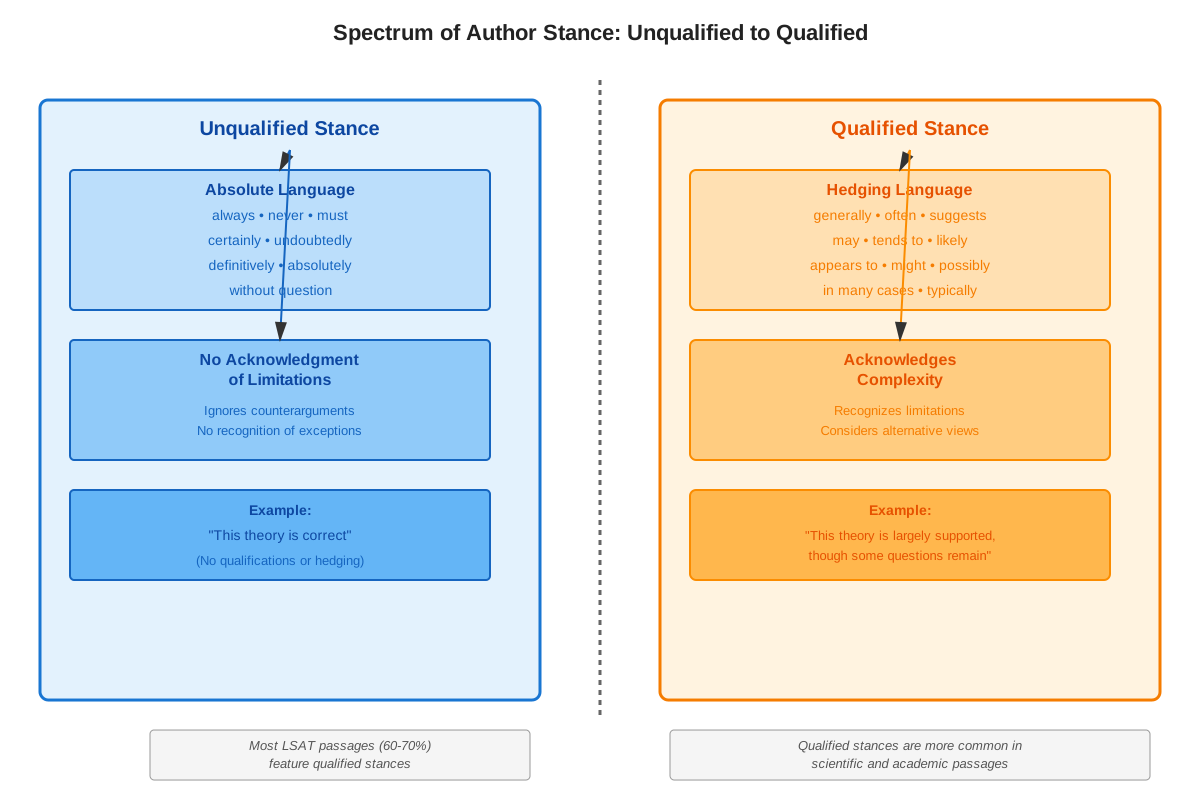
Understanding the spectrum between qualified and unqualified positions helps students select appropriately nuanced answer choices. An unqualified stance makes categorical claims using absolute language: "always," "never," "all," "none," "proves," "demonstrates conclusively," or "establishes definitively." These positions leave no room for exceptions or alternative interpretations.
In contrast, qualified stances occupy middle ground, advancing arguments while acknowledging limitations. The key distinction lies not in whether the author has a position—qualified authors still advocate for specific viewpoints—but in how they frame that position relative to complexity and uncertainty. A qualified author might strongly support a theory while acknowledging gaps in current evidence or areas requiring further research.
Contextual Factors Influencing Qualification
Certain passage characteristics predict qualified author stances. Scientific and academic passages typically feature qualification because scholarly discourse demands acknowledgment of methodological limitations and competing hypotheses. Passages discussing emerging fields or recent discoveries often include qualification because evidence remains incomplete or subject to revision.
Controversial topics almost invariably prompt qualified stances, as authors demonstrate intellectual rigor by engaging seriously with opposing viewpoints. Conversely, historical fact passages or descriptive passages explaining established processes may feature less qualification because the author primarily conveys consensus information rather than advancing debatable claims.
The Rhetorical Purpose of Qualification
Authors employ qualified stances strategically to achieve specific rhetorical goals. Qualification enhances credibility by demonstrating that the author has considered complexity and alternative perspectives rather than oversimplifying. It preempts criticism by acknowledging potential objections before opponents raise them. Qualification also reflects epistemic humility, showing appropriate caution about claims that extend beyond available evidence.
However, qualification does not equal neutrality or lack of position. Qualified authors still advance clear theses and support specific conclusions. The qualification serves to make their arguments more defensible and intellectually honest, not to avoid taking positions. Recognizing this distinction prevents students from incorrectly selecting "neutral" or "ambivalent" answer choices when authors actually hold qualified but definite positions.
Qualification in Different Passage Types
Comparative passages frequently feature qualified stances because authors must acknowledge the merits of competing perspectives while ultimately favoring one approach. Law passages discussing judicial reasoning often include qualification as judges balance precedent, policy considerations, and textual interpretation. Science passages presenting new theories typically qualify claims by acknowledging limitations of current data or areas requiring additional research.
Humanities passages analyzing literature, art, or cultural phenomena commonly employ qualification because interpretation involves subjective judgment and multiple valid perspectives. Even social science passages presenting empirical research include qualification regarding generalizability, methodological constraints, or alternative explanations for observed patterns.
Concept Relationships
The qualified author stance concept connects intimately with several other reading comprehension fundamentals. Tone identification depends on recognizing qualification, as qualified stances typically produce moderate tones (cautiously optimistic, measured criticism, qualified approval) rather than extreme tones (enthusiastic endorsement, harsh condemnation). Understanding qualification enables accurate tone assessment.
Main idea identification requires distinguishing between the author's qualified position and absolute statements that might appear in the passage. The main idea must reflect the author's actual stance, including its qualifications, rather than overstating or understating the position. This connection flows as: Qualified Author Stance → Accurate Tone Assessment → Precise Main Idea Identification.
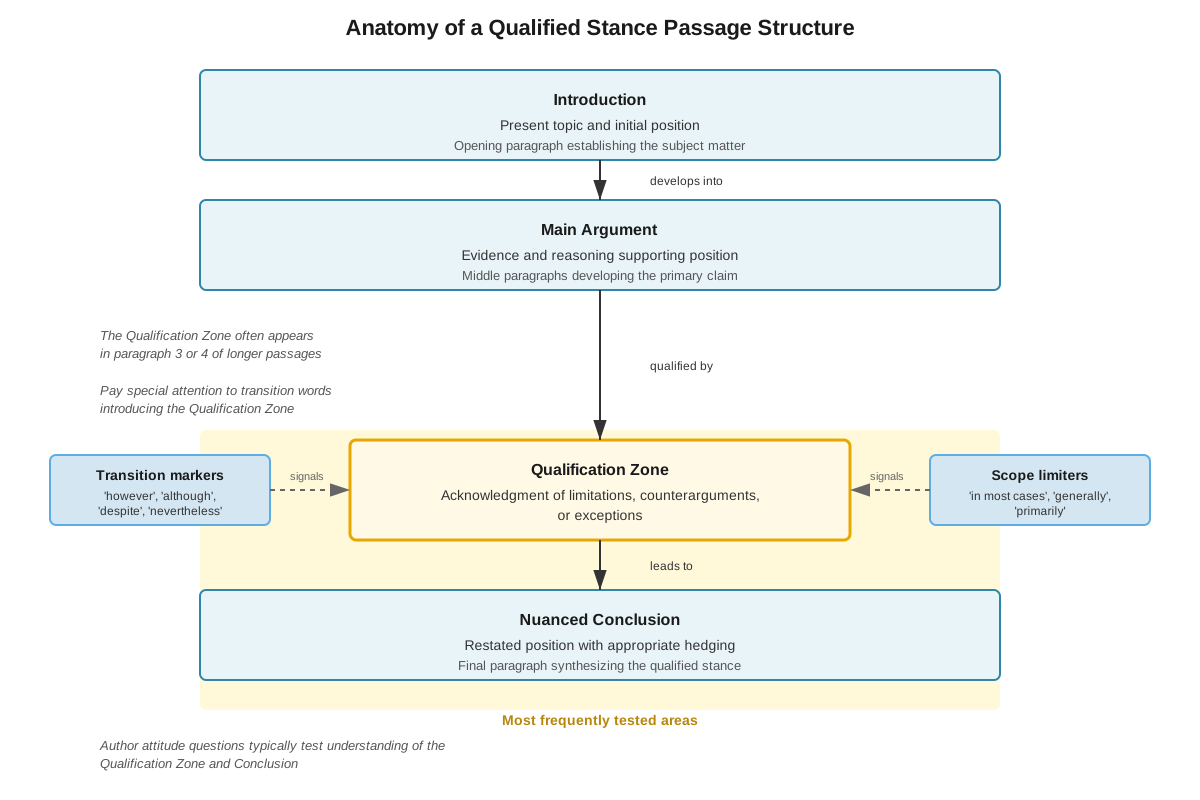
Argument structure analysis reveals where qualifications appear relative to claims and evidence. Typically, qualifications appear when introducing claims (hedging the assertion), when acknowledging counterarguments (concessive qualification), or when discussing evidence limitations (epistemic qualification). This relationship maps as: Claim Introduction → Qualification Markers → Evidence Presentation → Conclusion (often restating qualified position).
The concept also connects to inference questions, where students must draw conclusions consistent with the author's qualified stance. If an author qualifies a claim by saying "most evidence suggests X," an inference stating "X is definitively proven" would be too strong, while "X appears likely based on current evidence" would appropriately match the qualification level.
High-Yield Facts
⭐ Qualified author stances appear in 60-70% of LSAT Reading Comprehension passages, making this one of the most frequently tested concepts.
⭐ Modal verbs (may, might, could, would) and hedging phrases (appears to, seems to, suggests) are the most reliable linguistic markers of qualification.
⭐ Authors can hold strong positions while still qualifying their stances—qualification does not equal neutrality or lack of opinion.
⭐ Answer choices containing absolute language (always, never, all, none, proves definitively) are usually incorrect when the passage features a qualified author stance.
⭐ Concessive language (although, while, despite) signals that the author acknowledges counterarguments but will ultimately advance a different position.
- Frequency adverbs (often, usually, generally, typically) indicate the author recognizes exceptions without abandoning the main claim.
- Scientific and academic passages almost always feature qualified stances due to scholarly conventions requiring acknowledgment of limitations.
- The primary purpose of qualification is to enhance credibility and preempt criticism, not to avoid taking positions.
- Comparative passages frequently feature qualified stances because authors must acknowledge merits of competing perspectives.
- Scope-limiting phrases (in most cases, primarily, largely) restrict applicability of claims without invalidating them.
- Questions asking about author attitude, tone, or primary purpose directly test understanding of qualified stances.
- Qualification typically appears at claim introduction, when acknowledging counterarguments, or when discussing evidence limitations.
Quick check — test yourself on Qualified author stance so far.
Try Flashcards →Common Misconceptions
Misconception: A qualified author stance means the author is neutral or has no clear position on the topic.
Correction: Qualified authors advance definite positions and support specific conclusions; they simply acknowledge complexity, limitations, or alternative perspectives while doing so. An author can strongly advocate for a theory while qualifying that advocacy by noting areas requiring further research.
Misconception: Any passage containing words like "may" or "might" features a qualified author stance throughout.
Correction: Qualification must be assessed at the level of the author's main argument, not individual sentences. Authors may use hedging language when describing others' views or discussing specific details while maintaining an unqualified stance on their primary thesis.
Misconception: Qualified stances are weaker or less persuasive than unqualified positions.
Correction: In academic and legal contexts, qualified stances often demonstrate greater intellectual rigor and credibility. Acknowledging complexity and limitations makes arguments more defensible and persuasive to sophisticated audiences.
Misconception: If an author acknowledges a counterargument, they are giving it equal weight to their own position.
Correction: Acknowledging counterarguments (concessive qualification) serves to demonstrate the author has considered alternatives before reaching their conclusion. The author typically refutes or minimizes the counterargument after acknowledging it, maintaining their primary position.
Misconception: Qualified language always appears in the same location within passages.
Correction: Qualification can appear anywhere: in thesis statements, when introducing evidence, when discussing limitations, or in conclusions. Students must remain alert for qualifying language throughout the entire passage, not just in predictable locations.
Misconception: Answer choices with qualifying language are always correct for passages with qualified author stances.
Correction: The qualification in the answer choice must match the type and degree of qualification in the passage. An answer choice might include hedging language but still misrepresent the author's position by qualifying the wrong aspect of the argument or using inappropriate degree of qualification.
Worked Examples
Example 1: Identifying Qualified Stance in Scientific Passage
Passage Excerpt: "Recent studies suggest that the Mediterranean diet may reduce cardiovascular disease risk in most populations. While some researchers have questioned whether the benefits extend to all demographic groups, the preponderance of evidence indicates significant protective effects. However, more research is needed to determine the precise mechanisms underlying these benefits and to identify which specific dietary components contribute most substantially to improved outcomes."
Question: The author's attitude toward the Mediterranean diet's health benefits can best be described as:
(A) Unqualified enthusiasm based on definitive proof
(B) Cautious optimism tempered by acknowledgment of research limitations
(C) Skepticism regarding claims of health benefits
(D) Neutrality, presenting competing views without taking a position
(E) Strong opposition based on methodological concerns
Analysis:
Step 1: Identify the author's main position. The author supports the Mediterranean diet's benefits ("preponderance of evidence indicates significant protective effects").
Step 2: Locate qualifying language. Multiple qualifications appear: "suggest," "may reduce," "in most populations," "more research is needed," "precise mechanisms" remain undetermined.
Step 3: Assess the degree of qualification. The author clearly favors the diet's benefits but acknowledges limitations (demographic questions, mechanism uncertainty, component identification needs).
Step 4: Eliminate answer choices inconsistent with qualified stance. (A) is too strong—"definitive proof" contradicts "suggest" and "may." (C) and (E) are negative, contradicting "preponderance of evidence indicates significant protective effects." (D) incorrectly suggests neutrality when the author clearly supports the benefits.
Step 5: Select the answer matching the qualified positive stance. (B) correctly captures "cautious optimism" (positive but measured) and "acknowledgment of research limitations" (the qualifications about mechanisms and demographic questions).
Connection to Learning Objectives: This example demonstrates how to identify qualified author stance through linguistic markers (suggest, may, most, needed) and apply that understanding to select appropriately nuanced answer choices.
Example 2: Distinguishing Degree of Qualification
Passage Excerpt: "The theory that early human migration patterns were primarily driven by climate change has gained substantial support among paleoanthropologists. Although some scholars emphasize the role of resource competition and social factors, the correlation between glacial periods and migration waves appears too consistent to be coincidental. Nevertheless, climate likely represents one of several interacting factors rather than a sole determinant of migration decisions."
Question: Which of the following best describes the author's view of climate change as a factor in early human migration?
(A) Climate change was the only significant factor driving migration
(B) Climate change played no meaningful role in migration patterns
(C) Climate change was likely an important but not exclusive factor
(D) The evidence regarding climate change's role remains inconclusive
(E) Climate change's role has been definitively established by research
Analysis:
Step 1: Identify the author's position on climate's role. The author supports climate as important ("gained substantial support," "correlation...too consistent to be coincidental") but qualifies this support.
Step 2: Locate the key qualification. The crucial qualification appears in the final sentence: "climate likely represents one of several interacting factors rather than a sole determinant."
Step 3: Analyze the qualification type. This is scope restriction—the author limits climate's role to "one of several" factors, not the only factor.
Step 4: Eliminate extreme answer choices. (A) contradicts "one of several interacting factors." (B) contradicts the substantial support and consistent correlation. (E) is too strong—"definitively established" contradicts "likely represents."
Step 5: Distinguish between remaining qualified options. (D) suggests uncertainty about climate's role, but the author clearly states the correlation "appears too consistent to be coincidental," indicating confidence in climate's importance. (C) perfectly captures the qualified stance: "important" (acknowledging significance) "but not exclusive" (the scope restriction).
Connection to Learning Objectives: This example illustrates how to explain the reasoning pattern behind qualified author stance (acknowledging importance while restricting scope) and apply this understanding to distinguish between answer choices with different degrees of qualification.
Exam Strategy
When approaching LSAT questions testing qualified author stance, implement a systematic process. First, actively mark qualifying language while reading the passage. Circle or underline modal verbs, hedging phrases, frequency adverbs, and concessive markers. This creates a visual map of where and how the author qualifies their position.
Trigger words requiring heightened attention include: "suggests," "appears," "seems," "may," "might," "could," "generally," "typically," "often," "primarily," "largely," "although," "while," "despite," "to some extent," and "in most cases." When these appear in topic sentences or near the author's main claims, they directly signal qualified stances that will likely be tested.
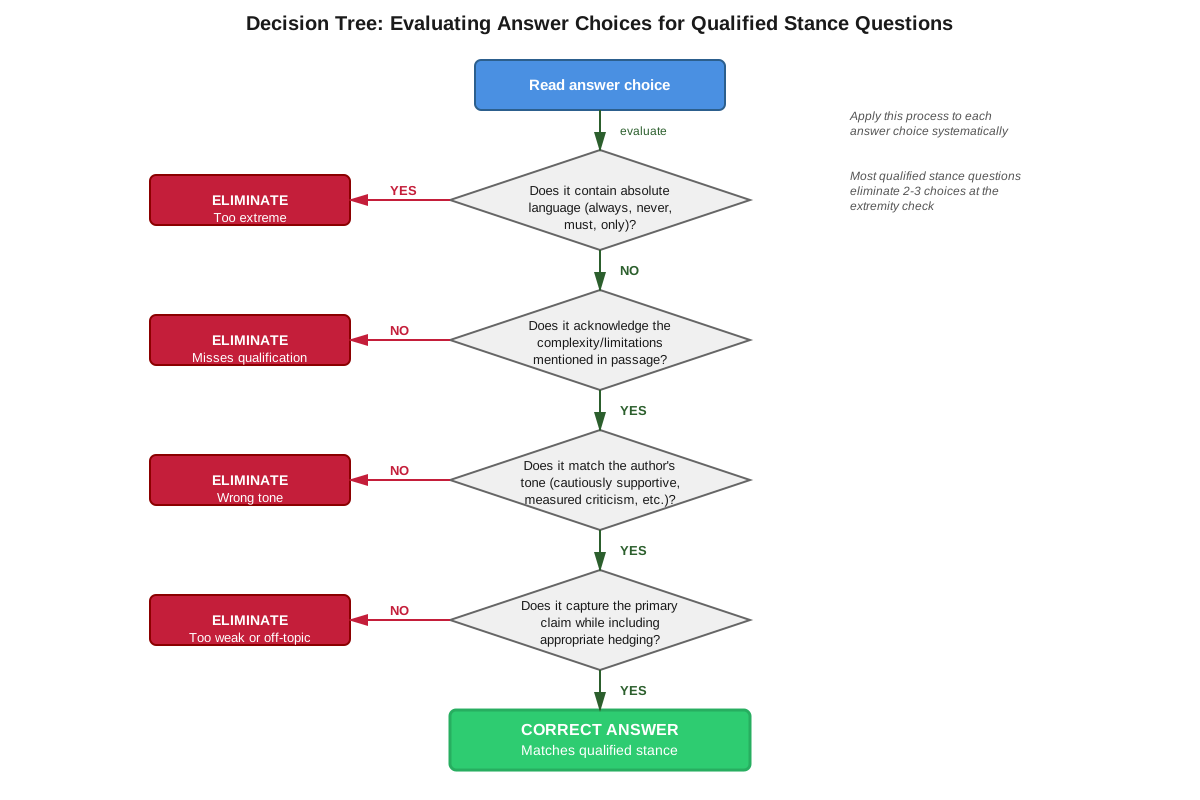
For author attitude questions, immediately eliminate answer choices with extreme language. If the passage contains qualifying markers, answers using "unqualified," "complete," "absolute," "definitive," or "unequivocal" are almost certainly incorrect. Similarly, eliminate answers suggesting neutrality or ambivalence if the author clearly advances a position, even a qualified one.
Apply degree matching between passage and answer choices. If the author says "most evidence suggests," an answer stating "the evidence proves" is too strong, while "some evidence hints" is too weak. The correct answer must match both the direction (positive/negative) and intensity (strong/moderate/weak) of the author's qualified stance.
Time allocation: Spend 10-15 seconds during initial passage reading specifically noting the author's stance and any qualifications. This upfront investment saves time on questions by providing clear reference points. When answering attitude or tone questions, spend 20-30 seconds reviewing the marked qualifications before evaluating answer choices.
Use process of elimination strategically. First, eliminate answers contradicting the author's directional stance (positive vs. negative). Second, eliminate answers with inappropriate qualification degree (too strong or too weak). Finally, choose between remaining options by checking whether they accurately capture both the position and its qualifications.
Exam Tip: If you're torn between two answer choices, one more qualified than the other, reread the author's thesis statement or conclusion. The degree of qualification there typically matches the correct answer choice.
Memory Techniques
MHFCS Mnemonic for common qualifying markers:
- Modal verbs (may, might, could)
- Hedging phrases (appears, seems, suggests)
- Frequency adverbs (often, usually, generally)
- Concessive language (although, while, despite)
- Scope restrictions (primarily, largely, in most cases)
Visualization Strategy: Picture a spectrum with "absolute certainty" at one end and "complete uncertainty" at the other. Qualified stances occupy the middle region. When reading passages, mentally place the author's position on this spectrum. This visual representation helps select answer choices with appropriate qualification levels.
The "Lawyer's Hedge" Acronym (CAREFUL):
- Conditional statements
- Acknowledgment of alternatives
- Restricted scope
- Evidence limitations noted
- Frequency qualifiers used
- Uncertainty markers present
- Limited generalizations
Contrast Technique: When encountering qualifying language, mentally formulate the unqualified version of the same claim. For example, if the passage states "the theory appears to explain most observed phenomena," think "the theory definitively explains all observed phenomena." This contrast highlights the qualification's function and helps identify answer choices that inappropriately remove the qualification.
Summary
Qualified author stance represents one of the most critical concepts in LSAT reading comprehension, appearing in the majority of passages and directly affecting performance on multiple question types. Authors employ qualified stances by using linguistic markers—modal verbs, hedging phrases, frequency adverbs, concessive language, and scope restrictions—to advance positions while acknowledging complexity, limitations, or alternative perspectives. Understanding qualified stances requires recognizing that authors can hold definite positions while still qualifying them; qualification enhances credibility rather than indicating neutrality or weakness. Success on LSAT questions testing this concept depends on identifying qualifying language during passage reading, matching the degree of qualification between passage and answer choices, and eliminating options that are too extreme, too weak, or inappropriately neutral. Mastering qualified author stance enables accurate responses to author attitude, tone, and primary purpose questions while also improving performance on inference and application questions that require understanding the author's nuanced position.
Key Takeaways
- Qualified author stances appear in 60-70% of LSAT passages and directly affect multiple question types, making this a high-yield concept for score improvement
- Linguistic markers (modal verbs, hedging phrases, frequency adverbs, concessive language, scope restrictions) reliably signal qualified stances and should be actively marked during passage reading
- Qualification does not equal neutrality—authors with qualified stances still advance clear positions and support specific conclusions while acknowledging complexity
- Answer choices must match both the direction (positive/negative) and degree (strong/moderate/weak) of the author's qualified stance; extreme language in answer choices usually signals incorrect options
- Concessive language (although, while, despite) indicates the author acknowledges counterarguments but will ultimately advance a different position, not that they give equal weight to competing views
- Scientific, academic, and controversial topic passages almost invariably feature qualified stances due to scholarly conventions and intellectual rigor requirements
- Systematic strategy—marking qualifications during reading, eliminating extreme answers, and degree-matching between passage and choices—significantly improves accuracy on qualified stance questions
Related Topics
Author Tone and Attitude: Building on qualified author stance, this topic explores the full spectrum of authorial attitudes from enthusiastic endorsement to harsh criticism, with particular attention to how qualification affects tone assessment. Mastering qualified stance provides the foundation for nuanced tone identification.
Primary Purpose Questions: Understanding qualified author stance directly enables accurate responses to primary purpose questions, as the correct answer must reflect not just what the author discusses but how they position themselves relative to that discussion—including any qualifications.
Inference and Application Questions: These question types require drawing conclusions consistent with the author's position, including its qualifications. Students who master qualified stance can avoid selecting inferences that are too strong or too weak relative to the passage.
Comparative Reading Passages: Comparative passages frequently feature qualified stances as authors acknowledge merits of competing perspectives. The skills developed for identifying qualified stance in single passages transfer directly to analyzing how two authors' qualified positions relate to each other.
Practice CTA
Now that you understand qualified author stance—its linguistic markers, rhetorical purposes, and strategic importance—you're ready to apply this knowledge to authentic LSAT passages. The practice questions and flashcards will reinforce your ability to identify qualifying language, assess degree of qualification, and select appropriately nuanced answer choices. Each practice problem you complete strengthens the pattern recognition skills essential for LSAT success. Remember: qualified author stance appears in the majority of passages, making every practice opportunity a high-yield investment in your score improvement. Approach the practice materials with confidence, knowing you now possess the conceptual framework and strategic tools to master this critical reading comprehension skill.
Sign up free to keep reading
Create a free AnvayaPrep account to finish this LSAT guide on Qualified author stance — plus flashcards and practice questions.