Overview
Viewpoint shifts represent one of the most critical skills tested in LSAT reading comprehension passages. These shifts occur when an author transitions between different perspectives, opinions, or theoretical positions within a single passage. Recognizing these transitions is fundamental to understanding the structure and argumentative flow of complex legal and academic texts—precisely the type of material law students will encounter throughout their careers.
On the LSAT, passages frequently present multiple perspectives on a single issue: an author might introduce a traditional theory, present critics' objections, offer a new alternative view, and then provide their own assessment. Students who fail to track these viewpoint shifts often misattribute claims to the wrong party, confuse the author's position with that of others discussed in the passage, or miss the nuanced relationships between competing perspectives. This confusion leads directly to incorrect answers on questions about the author's attitude, the purpose of specific paragraphs, and the relationships between different positions presented in the text.
Mastering viewpoint shifts builds directly on fundamental passage fundamentals skills such as identifying main ideas, recognizing structural elements, and understanding authorial purpose. While those foundational skills help students grasp what a passage says, tracking viewpoint shifts enables deeper comprehension of how different voices interact within a passage and why the author has chosen to present information in a particular sequence. This skill connects to virtually every question type in reading comprehension, from main point questions to inference questions to function questions that ask why the author included specific details or perspectives.
Learning Objectives
- [ ] Identify how viewpoint shifts appear in LSAT questions
- [ ] Explain the reasoning pattern behind viewpoint shifts
- [ ] Apply viewpoint shifts to solve LSAT-style problems accurately
- [ ] Distinguish between the author's viewpoint and the viewpoints of others discussed in the passage
- [ ] Recognize linguistic markers that signal transitions between different perspectives
- [ ] Evaluate the relationship between multiple viewpoints (agreement, disagreement, modification, synthesis)
- [ ] Predict which viewpoint shifts are most likely to be tested in specific question types
Prerequisites
- Basic passage structure recognition: Understanding how LSAT passages are organized into introduction, body, and conclusion helps identify where viewpoint shifts typically occur
- Ability to identify main ideas: Recognizing the central claim of each paragraph provides the foundation for noticing when perspectives change
- Familiarity with author's tone and attitude: Distinguishing neutral presentation from endorsement or criticism is essential for tracking whose view is being expressed
- Understanding of argumentative structure: Recognizing claims, evidence, and counterarguments helps contextualize why different viewpoints are introduced
Why This Topic Matters
In legal practice, attorneys must constantly navigate multiple perspectives: their client's position, opposing counsel's arguments, precedent cases, dissenting opinions, and their own strategic analysis. The LSAT tests this fundamental lawyering skill through passages that require students to track and distinguish between various viewpoints. Law school casebooks are structured around competing judicial opinions, and success in legal education depends on the ability to understand how different judges, scholars, or parties view the same issue.
LSAT viewpoint shifts appear in approximately 80-90% of reading comprehension passages, making this one of the most frequently tested concepts in the entire section. Questions explicitly testing viewpoint shifts typically appear 2-3 times per reading comprehension section, but the skill implicitly underlies many additional questions. Common question types include:
- Attitude questions: "The author's attitude toward X can best be described as..."
- Function questions: "The author mentions Y primarily in order to..."
- Perspective questions: "According to the passage, critics of the theory believe..."
- Agreement questions: "With which of the following would the author most likely agree?"
- Purpose questions: "The primary purpose of the third paragraph is to..."
Viewpoint shifts commonly appear when passages discuss scientific theories (traditional view vs. new research), legal interpretations (majority opinion vs. dissent), historical debates (conventional wisdom vs. revisionist historians), or artistic movements (established critics vs. emerging perspectives). The LSAT particularly favors passages where the author presents others' views before offering their own nuanced position.
Core Concepts
What Are Viewpoint Shifts?
A viewpoint shift occurs when a passage transitions from presenting one perspective, opinion, or theoretical position to presenting a different one. These shifts can be explicit (clearly marked with transitional language) or implicit (requiring careful attention to subtle changes in tone or attribution). The key to mastering viewpoint shifts lies in continuously asking: "Whose view am I reading right now?"
In LSAT passages, viewpoints typically fall into several categories:
| Viewpoint Type | Description | Common Markers |
|---|---|---|
| Author's direct opinion | The author's own position, explicitly stated | "I argue," "It is clear that," "The evidence demonstrates" |
| Author's implied opinion | The author's view conveyed through tone, word choice, or emphasis | Evaluative language, selective presentation, rhetorical questions |
| Others' views (neutral presentation) | Positions described without endorsement or criticism | "According to," "X argues that," "The theory proposes" |
| Others' views (endorsed) | Positions the author supports | "X correctly notes," "As Y persuasively argues" |
| Others' views (criticized) | Positions the author opposes | "X mistakenly assumes," "However," "Critics fail to recognize" |
Linguistic Markers of Viewpoint Shifts
Successful LSAT test-takers develop sensitivity to the language that signals transitions between perspectives. These markers function as road signs, alerting readers that a new viewpoint is being introduced or that the author is shifting from neutral presentation to evaluation.
Explicit transition markers include:
- Contrast words: however, nevertheless, yet, but, although, despite, on the other hand, in contrast, conversely
- Addition markers: moreover, furthermore, additionally, also (when adding a different perspective)
- Attribution phrases: according to, X argues, critics contend, proponents believe, scholars suggest
- Temporal markers: traditionally, recently, initially, subsequently (often signal shifts from old to new views)
- Evaluative transitions: unfortunately, surprisingly, importantly, significantly
Implicit markers require more careful attention:
- Shift in verb tense or mood: Moving from indicative ("X is true") to conditional ("X would be true if") often signals hypothetical or contested claims
- Changes in certainty level: "Definitely" vs. "possibly" vs. "allegedly" indicates different levels of authorial commitment
- Quotation marks or reported speech: Often signals the author is presenting others' views rather than endorsing them
- Rhetorical questions: Frequently introduce positions the author will challenge or complicate
Types of Viewpoint Relationships
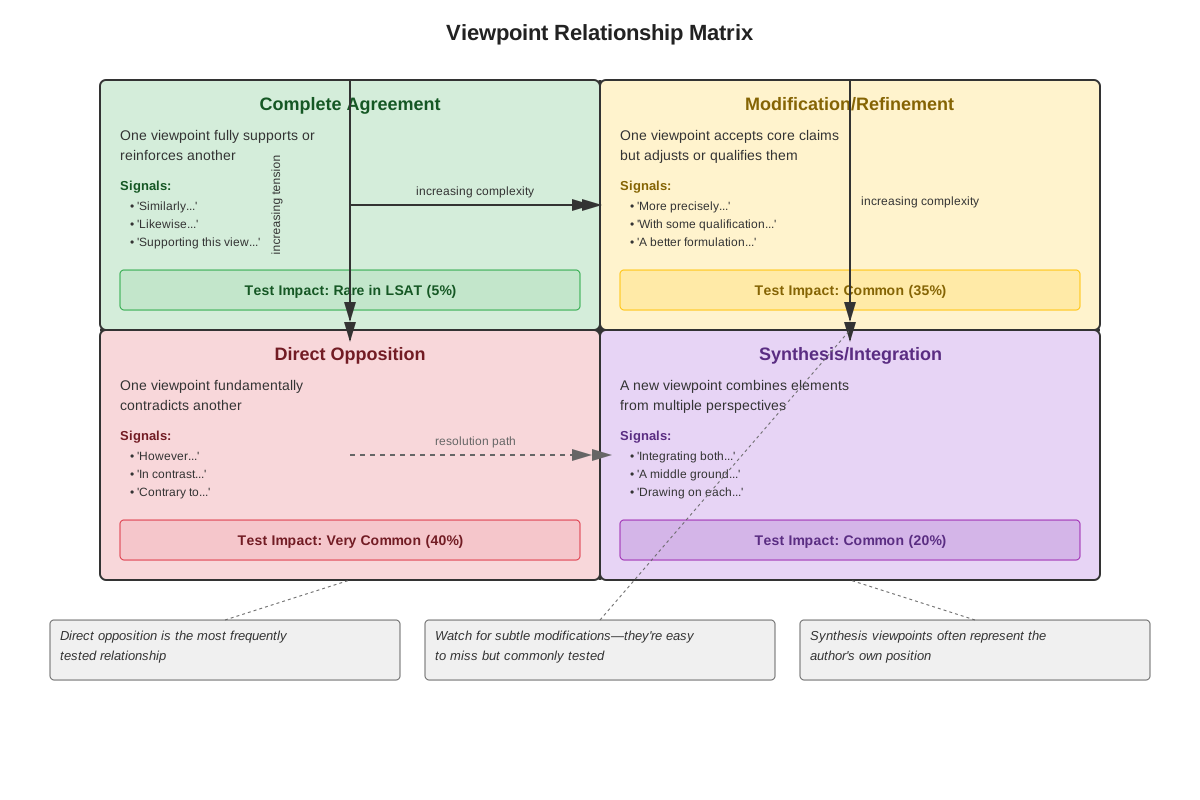
Understanding how different viewpoints relate to each other is crucial for answering questions about passage structure and authorial purpose. The LSAT tests whether students can identify these relationships:
1. Direct Opposition: Two viewpoints that contradict each other on a fundamental claim. Example: "Traditional economists argue that markets are self-correcting, but behavioral economists contend that systematic biases prevent optimal outcomes."
2. Modification/Refinement: A new viewpoint that accepts some aspects of an earlier view while revising others. Example: "While Smith's theory correctly identifies the problem, it fails to account for recent evidence suggesting a more complex mechanism."
3. Synthesis: A viewpoint that combines elements from multiple perspectives. Example: "Drawing on both classical and modern approaches, the author proposes a framework that integrates their respective strengths."
4. Escalation: A viewpoint that extends or intensifies an earlier position. Example: "Not only does the policy fail to achieve its stated goals, but it actively undermines related objectives."
5. Contextualization: A viewpoint that places another perspective within a broader framework. Example: "This debate, while seemingly technical, reflects deeper philosophical disagreements about the nature of knowledge."
The Author's Voice vs. Others' Voices
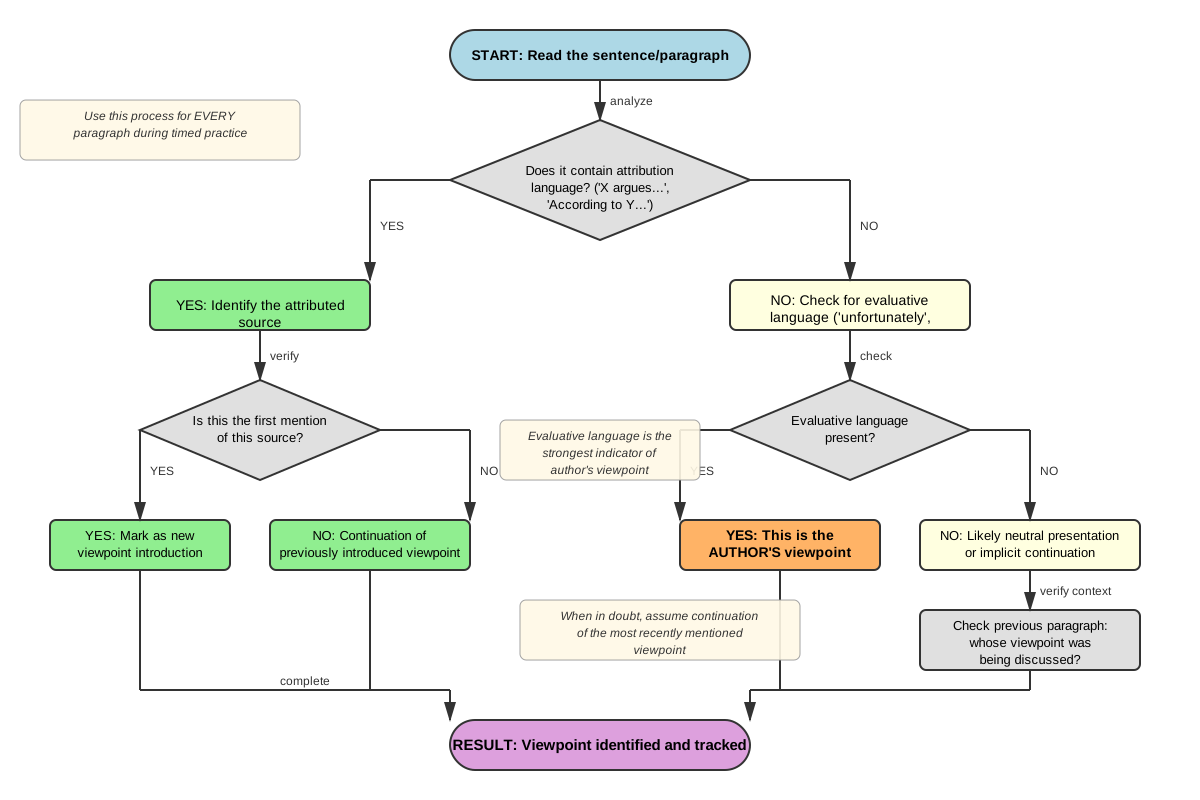
The most critical distinction in tracking viewpoint shifts is separating what the author believes from what the author reports that others believe. The LSAT frequently tests this distinction because students often conflate these categories.
The author's voice appears when:
- Making direct claims without attribution to others
- Using evaluative language that reveals judgment
- Structuring the passage to emphasize certain points
- Choosing which views to present and in what order
- Providing their own analysis or synthesis
Others' voices appear when:
- Ideas are explicitly attributed to named individuals, groups, or schools of thought
- The author uses distancing language ("supposedly," "allegedly," "claims to")
- Positions are presented in quotation marks or reported speech
- The author describes views without endorsing them
A common LSAT trap involves passages where the author spends most of the text neutrally presenting others' views before revealing their own position in the final paragraph. Students who don't track viewpoint shifts carefully may assume the author endorses views that were merely described.
Structural Patterns of Viewpoint Shifts
LSAT passages tend to follow predictable structural patterns in how they present multiple viewpoints. Recognizing these patterns helps students anticipate shifts and understand the passage's overall organization:
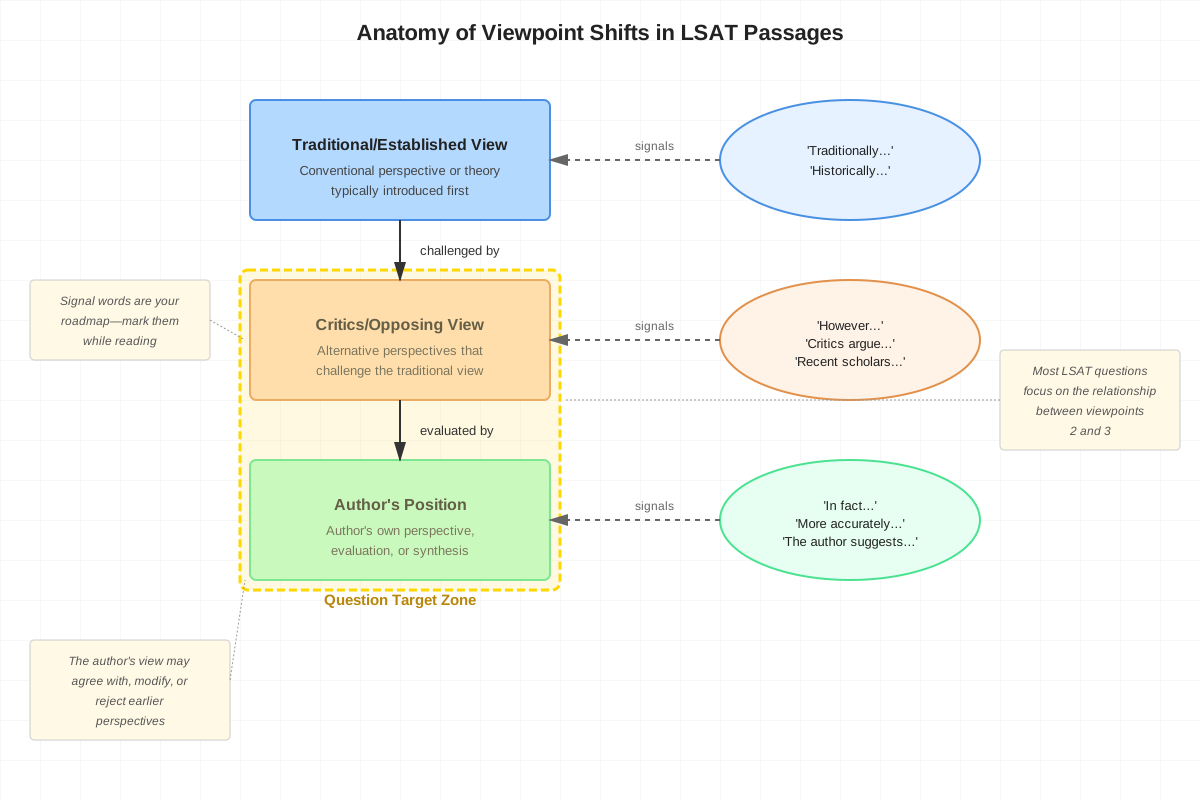
Pattern 1: Traditional View → Challenge → New View
- Paragraph 1: Presents the established or conventional perspective
- Paragraph 2: Introduces problems, criticisms, or new evidence
- Paragraph 3: Offers an alternative theory or revised understanding
- Paragraph 4: Author evaluates or synthesizes
Pattern 2: Phenomenon → Multiple Explanations → Author's Assessment
- Paragraph 1: Describes an observed phenomenon or problem
- Paragraphs 2-3: Present different theories or explanations
- Paragraph 4: Author indicates which explanation is most compelling or proposes synthesis
Pattern 3: Debate Presentation → Author's Position
- Paragraphs 1-2: Outline opposing sides of a controversy
- Paragraph 3: Author stakes out their own position, often a middle ground or novel approach
Pattern 4: Historical Development
- Traces how viewpoints have evolved over time, with each paragraph representing a different era or school of thought
- Author typically appears in the final paragraph to assess this development
Tracking Viewpoint Shifts While Reading
Effective LSAT readers develop active reading strategies to track viewpoint shifts in real-time:
- Annotate perspective markers: Use symbols like "A:" for author, "T:" for traditional view, "C:" for critics, etc.
- Note transition points: Mark the exact sentence where a shift occurs
- Maintain a mental map: Continuously update understanding of who believes what
- Anticipate questions: Recognize that shifts are likely testing points
- Distinguish description from endorsement: Ask whether the author is merely reporting a view or supporting it
Concept Relationships
Viewpoint shifts connect to virtually every aspect of LSAT reading comprehension. Understanding these relationships helps students see how mastering this skill enhances overall performance:
Viewpoint Shifts → Main Point Identification: The author's main point is often their own viewpoint, distinguished from the other perspectives presented. Tracking shifts helps identify which position represents the passage's central claim.
Viewpoint Shifts → Passage Structure: Recognizing where perspectives change reveals the organizational logic of the passage. Each shift typically corresponds to a new paragraph or major section, helping students understand why information appears in a particular sequence.
Passage Structure → Viewpoint Shifts: Understanding typical LSAT passage structures (problem-solution, compare-contrast, chronological development) helps predict where viewpoint shifts will occur.
Viewpoint Shifts → Author's Attitude: Determining the author's attitude requires distinguishing their voice from others' voices. The author's evaluative language when discussing others' views reveals their stance.
Viewpoint Shifts → Inference Questions: Many inference questions ask what can be concluded about a particular viewpoint. Accurately tracking which claims belong to which perspective is essential for valid inferences.
Viewpoint Shifts → Function Questions: Questions about why the author includes specific information often test whether students understand that a paragraph presents an opposing view to be refuted, a supporting view to be endorsed, or background context for the author's own position.
Textual Relationship Map:
Careful Reading → Identify Attribution Markers → Track Whose View Is Presented →
Distinguish Author from Others → Understand Relationships Between Views →
Answer Questions About Attitude, Purpose, and Structure → Higher Score
High-Yield Facts
⭐ Approximately 80-90% of LSAT reading comprehension passages contain multiple viewpoints that must be distinguished.
⭐ The author's own position often appears in the final paragraph after presenting others' views, making it easy to miss or misattribute.
⭐ Words like "however," "but," and "yet" are the most reliable explicit markers of viewpoint shifts and appear in virtually every passage.
⭐ When the author uses phrases like "X argues" or "according to Y," they are presenting someone else's view, not necessarily endorsing it.
⭐ Questions asking about "the author's attitude" or "the author would most likely agree" require distinguishing the author's voice from all other voices in the passage.
- Viewpoint shifts most commonly occur at paragraph boundaries, making paragraph transitions critical reading moments.
- The LSAT frequently tests whether students can identify what "critics" or "proponents" of a view believe, requiring precise tracking of attributed claims.
- Passages that present a "traditional view" almost always follow with a challenge or alternative perspective—this pattern is highly predictable.
- Evaluative adjectives (e.g., "persuasive," "flawed," "important," "misguided") reveal the author's attitude toward the viewpoint being discussed.
- When an author presents multiple views without explicit evaluation, their own position is often revealed through structural emphasis (what gets more space, what comes last, what is presented most completely).
- Comparative passages (Passage A and Passage B) are essentially structured around viewpoint shifts, with each passage representing a different perspective on the same topic.
- The phrase "some scholars argue" or similar constructions typically introduces a view the author will later complicate or challenge.
Quick check — test yourself on Viewpoint shifts so far.
Try Flashcards →Common Misconceptions
Misconception: If the author describes a viewpoint in detail, they must agree with it.
Correction: Authors frequently present opposing views thoroughly before refuting them. Detailed presentation does not equal endorsement. Look for evaluative language or explicit statements of agreement to determine the author's stance.
Misconception: The main point of the passage is whatever view is presented first or takes up the most space.
Correction: The main point is the author's own central claim, which may appear only in the final paragraph after extensive presentation of others' views. Structural prominence doesn't always indicate authorial endorsement.
Misconception: When the author says "X argues that Y," the author believes Y.
Correction: Attribution phrases like "X argues" or "according to X" signal that the author is reporting someone else's view. Without additional evaluative language, this is neutral presentation, not endorsement.
Misconception: All viewpoint shifts are clearly marked with transition words like "however" or "in contrast."
Correction: While explicit markers are common, many shifts are implicit, signaled only by changes in attribution, tone, or the introduction of new evidence. Careful readers must notice subtle shifts in whose voice is speaking.
Misconception: If the author criticizes one view, they must fully endorse the opposing view.
Correction: Authors often critique multiple perspectives or stake out nuanced middle positions. Rejecting View A doesn't automatically mean accepting View B; the author may propose View C that synthesizes or transcends the debate.
Misconception: Rhetorical questions represent the author's own views.
Correction: Rhetorical questions can serve multiple functions: introducing a view the author will challenge, expressing the author's position, or presenting a commonly held belief. Context determines whose viewpoint a rhetorical question represents.
Misconception: The author's attitude is always explicitly stated.
Correction: Authors often reveal their position through implicit cues: word choice, emphasis, what they choose to include or omit, and the structure of their argument. Detecting implied attitude requires attention to tone and rhetorical strategy.
Worked Examples
Example 1: Identifying Multiple Viewpoints
Passage Excerpt:
"For decades, art historians attributed the distinctive style of the Flemish paintings to the influence of Italian Renaissance techniques. According to this traditional view, Flemish artists simply adapted Italian innovations to their own cultural context. However, recent archival research has revealed extensive trade networks between Flanders and regions far beyond Italy. Some scholars now argue that the Flemish style emerged from a complex synthesis of influences from across Europe and even Asia. While this revisionist interpretation correctly emphasizes the cosmopolitan nature of Flemish culture, it risks overcorrecting by minimizing the genuine Italian contribution. A more balanced view recognizes multiple influences while acknowledging that Italian techniques provided a crucial framework that Flemish artists transformed in innovative ways."
Question: The author's attitude toward the "revisionist interpretation" can best be described as:
Step 1: Identify all viewpoints present
- Traditional view: Flemish style came from Italian influence
- Revisionist view: Flemish style came from multiple influences across Europe and Asia
- Author's view: Multiple influences existed, but Italian techniques provided crucial framework
Step 2: Locate the author's voice
The author's voice appears most clearly in the final two sentences, which evaluate both previous views.
Step 3: Analyze evaluative language
- "correctly emphasizes" = partial endorsement
- "risks overcorrecting" = criticism
- "more balanced view" = the author's own position, presented as superior to both previous views
Step 4: Determine the relationship
The author sees value in the revisionist view (it "correctly emphasizes" something) but believes it goes too far ("risks overcorrecting"). This is a modification relationship—accepting some aspects while revising others.
Answer: The author's attitude is one of qualified approval or partial agreement. The author acknowledges the revisionist interpretation's contribution while critiquing its excesses.
Connection to Learning Objectives: This example demonstrates how to identify viewpoint shifts (Objective 1), understand the reasoning pattern of modification/refinement (Objective 2), and apply this understanding to answer attitude questions accurately (Objective 3).
Example 2: Tracking Shifts Through a Full Passage Structure
Passage Structure:
- Paragraph 1: Describes a legal precedent established in 1950 that limited corporate liability
- Paragraph 2: Explains how this precedent was applied consistently for 40 years
- Paragraph 3: Introduces a 1990 case where dissenting judges argued the precedent was outdated
- Paragraph 4: Describes how subsequent courts have gradually eroded the precedent
- Paragraph 5: Author argues that while the original precedent had flaws, its complete abandonment creates new problems
Question: The primary purpose of the third paragraph is to:
Step 1: Map the viewpoint structure
- Paragraphs 1-2: Neutral presentation of established legal doctrine (no clear author voice)
- Paragraph 3: Introduction of dissenting judges' view (others' voice, critical of precedent)
- Paragraph 4: Description of how courts responded (neutral presentation of developments)
- Paragraph 5: Author's own assessment (author's voice, nuanced critique of both positions)
Step 2: Identify the function of paragraph 3
Paragraph 3 introduces the first challenge to the established view. It represents a viewpoint shift from neutral description to presentation of criticism.
Step 3: Understand the structural role
In the Traditional View → Challenge → Development → Author's Assessment pattern, paragraph 3 provides the "Challenge" element. It introduces the perspective that will lead to the changes described in paragraph 4.
Step 4: Recognize what the author is doing
The author is presenting the dissenting judges' view, not endorsing it (note: paragraph 5 reveals the author thinks complete abandonment goes too far). The author includes this view to explain the historical development that led to current problems.
Answer: The primary purpose of the third paragraph is to introduce a challenge to the established precedent that would influence subsequent legal developments.
Connection to Learning Objectives: This example shows how viewpoint shifts structure entire passages (Objective 2), how to identify where shifts occur (Objective 1), and how understanding these shifts enables accurate answers to function questions (Objective 3). It also demonstrates distinguishing the author's voice from others' voices (Objective 4) and recognizing structural patterns (Objective 6).
Exam Strategy
Approaching Questions on Viewpoint Shifts
Before reading the passage:
- Anticipate that multiple viewpoints will appear
- Prepare to track whose voice is speaking at each point
- Expect the author's own view to be distinguished from others' views
While reading the passage:
- Mark transitions: Circle or underline words like "however," "critics argue," "according to," etc.
- Annotate perspectives: Use margin notes to label whose view each paragraph presents
- Track the author: Pay special attention to where the author's own voice emerges
- Note relationships: Identify whether new views oppose, modify, or synthesize previous views
When answering questions:
For attitude questions: Return to passages where the author explicitly evaluates the viewpoint in question. Look for adjectives, adverbs, and phrases that reveal judgment.
For function questions: Consider what role a particular viewpoint plays in the passage's overall structure. Is it being set up to be refuted? Endorsed? Used as background?
For agreement questions: Eliminate any answer choice that reflects others' views rather than the author's own position. The author may have described a view without agreeing with it.
Trigger Words and Phrases
High-priority markers to watch for:
- Contrast: however, but, yet, nevertheless, nonetheless, although, despite, while, whereas
- Attribution: according to, X argues, critics contend, proponents believe, scholars suggest, some claim
- Evaluation: unfortunately, surprisingly, importantly, correctly, mistakenly, persuasively, fails to
- Temporal shifts: traditionally, recently, initially, subsequently, now, currently
- Intensification: moreover, furthermore, indeed, in fact, not only... but also
Red flags for misattribution:
- When you see "the passage states" or "according to the passage," verify whether it's the author or someone discussed in the passage
- Questions asking "with which would the author agree" require the author's view, not views the author merely described
- "The passage suggests" could refer to explicit statements or implications—track carefully
Process of Elimination Tips
- Eliminate answers that confuse whose view is being asked about: If the question asks about "critics" but an answer choice reflects the author's view, eliminate it immediately.
- Eliminate answers that overstate the author's commitment: If the author expressed qualified agreement ("X correctly notes that..."), eliminate answers suggesting complete endorsement.
- Eliminate answers that ignore viewpoint shifts: If an answer treats the passage as presenting a single unified view when multiple perspectives exist, it's likely wrong.
- Eliminate answers that misidentify relationships: If the author modified rather than rejected a view, eliminate answers suggesting complete disagreement.
Time Allocation
- Spend extra time on first reading to track viewpoint shifts accurately—this investment pays off by making questions faster
- When stuck on a question, return to the passage and verify whose voice is speaking in the relevant section
- Don't rush through transition sentences; these are high-value for understanding structure
- If a passage has 4+ paragraphs, expect at least one question testing viewpoint shifts
Memory Techniques
The VOICE Acronym
Use VOICE to remember what to track when reading:
- Viewpoint: Whose perspective is being presented?
- Opinion: Is this descriptive or evaluative?
- Indicators: What markers signal this viewpoint?
- Contrast: How does this relate to other views?
- Endorsement: Does the author agree, disagree, or remain neutral?
The Three-Column Mental Map
Visualize the passage as three columns:
| Traditional/Others' Views | Challenges/Alternatives | Author's Position |
|---|---|---|
| What's been believed | What's being questioned | What the author thinks |
As you read, mentally file information into these columns. Most passages will have content in all three.
The "Says Who?" Technique
After reading each claim in the passage, mentally ask "Says who?" This simple question forces continuous attention to attribution:
- "The theory is flawed" → Says who? The author or critics?
- "New evidence suggests..." → Says who? Researchers or the author interpreting research?
The Transition Highlighter
Create a mental highlight color for transition words. When you see "however," "but," "critics argue," etc., imagine these words glowing bright yellow. This trains your brain to slow down and recognize that a viewpoint shift is occurring.
The Author's Last Word Principle
Remember: The author often gets the last word. In passages where the author's view isn't clear until the end, the final paragraph frequently reveals their position. When in doubt about the author's stance, check the conclusion.
Summary
Viewpoint shifts represent one of the most critical and frequently tested skills in LSAT reading comprehension. Mastering this skill requires students to continuously track whose perspective is being presented at each point in a passage, distinguishing between the author's own views and the views of others that the author describes. The LSAT tests this skill through attitude questions, function questions, agreement questions, and inference questions that require precise understanding of who believes what. Successful students develop sensitivity to both explicit markers (transition words like "however," attribution phrases like "critics argue") and implicit markers (changes in tone, evaluative language, structural emphasis) that signal shifts between perspectives. Common passage structures include presenting traditional views before introducing challenges, describing multiple competing theories before offering synthesis, or neutrally presenting others' positions before revealing the author's own stance in the final paragraph. The key to accuracy is maintaining constant awareness of whose voice is speaking and what relationship each viewpoint has to others in the passage—whether opposition, modification, synthesis, or contextualization. Students who master viewpoint shifts gain a significant advantage across all reading comprehension question types because this skill underlies the ability to understand passage structure, identify main points, and make valid inferences.
Key Takeaways
- Viewpoint shifts occur in 80-90% of LSAT reading comprehension passages and are tested directly or indirectly in multiple questions per section
- The most critical distinction is between the author's own position and positions the author merely describes—attribution phrases like "X argues" signal others' views, not the author's
- Transition words like "however," "but," and "yet" are reliable markers of viewpoint shifts and should trigger heightened attention
- The author's position often appears in the final paragraph after extensive presentation of others' views, making it easy to miss if not tracking carefully
- Understanding the relationship between viewpoints (opposition, modification, synthesis) is essential for answering function and structure questions
- Evaluative language reveals the author's attitude toward the views being discussed—words like "correctly," "mistakenly," "unfortunately," or "importantly" signal authorial judgment
- Active reading strategies like annotating perspectives, marking transitions, and continuously asking "whose view is this?" dramatically improve accuracy on viewpoint-related questions
Related Topics
Author's Purpose and Tone: Building on viewpoint shifts, this topic explores how to determine why an author wrote a passage and what attitude they convey. Mastering viewpoint shifts provides the foundation for understanding authorial intent because recognizing whose voice is speaking enables accurate assessment of the author's goals.
Passage Structure and Organization: This topic examines how LSAT passages are constructed, including common organizational patterns. Viewpoint shifts often correspond to structural divisions, so understanding structure helps predict where shifts will occur.
Comparative Passages: These paired passages present different perspectives on the same topic, essentially creating an extended viewpoint shift exercise. Students who master viewpoint shifts in single passages are well-prepared for the additional complexity of comparing two authors' positions.
Inference Questions: Many inference questions require understanding what can be concluded about specific viewpoints. The ability to track viewpoint shifts ensures that inferences are attributed to the correct perspective.
Main Point and Primary Purpose Questions: These questions often test whether students can distinguish the author's central claim from the various other positions discussed in the passage. Viewpoint shift mastery is essential for identifying what the author actually believes versus what they merely report.
Practice CTA
Now that you understand the critical skill of tracking viewpoint shifts, it's time to put this knowledge into practice. The concepts covered in this guide will become second nature only through active application to real LSAT passages. Challenge yourself with the practice questions and flashcards designed to reinforce these skills. Pay special attention to passages with multiple perspectives, and use the strategies outlined above to track whose voice is speaking at each point. Remember: every passage you read with awareness of viewpoint shifts strengthens your ability to score higher on test day. The investment you make in mastering this skill will pay dividends across every reading comprehension question type. You've built the foundation—now build the expertise through deliberate practice!
Sign up free to keep reading
Create a free AnvayaPrep account to finish this LSAT guide on Viewpoint shifts — plus flashcards and practice questions.