Overview
Constitutional law passages represent one of the most frequently tested and strategically important passage types in the LSAT Reading Comprehension section. These passages typically explore foundational principles of constitutional interpretation, landmark Supreme Court decisions, debates over constitutional rights, the balance of governmental powers, or evolving legal doctrines. Unlike passages from natural sciences or humanities, constitutional law passages demand that test-takers navigate dense legal reasoning, understand competing interpretive frameworks, and track how courts apply abstract principles to concrete cases. The LSAT uses these passages to assess a student's ability to comprehend complex argumentation, identify authorial viewpoint amid multiple perspectives, and recognize the logical structure underlying judicial reasoning.
Mastering constitutional law passages is essential for LSAT success because they appear with remarkable consistency across test administrations and often generate questions that separate high scorers from average performers. These passages require students to synthesize information across multiple paragraphs, distinguish between majority and dissenting opinions, and understand how constitutional principles evolve through judicial interpretation. The reasoning patterns in constitutional law passages—particularly the interplay between textual interpretation, precedent, and policy considerations—mirror the analytical skills tested throughout the LSAT, making proficiency with this passage type transferable to other Reading Comprehension subjects.
Within the broader framework of passage subjects and strategies, constitutional law passages occupy a unique position. They share structural similarities with other argumentative passages but introduce specialized vocabulary, hierarchical legal reasoning, and the distinctive challenge of tracking how abstract constitutional principles apply to specific factual scenarios. Understanding how to approach these passages strategically—identifying the central legal question, mapping competing interpretations, and recognizing the author's analytical moves—provides a foundation for tackling all complex argumentative texts on the LSAT.
Learning Objectives
- [ ] Identify how Constitutional law passages appears in LSAT questions
- [ ] Explain the reasoning pattern behind Constitutional law passages
- [ ] Apply Constitutional law passages to solve LSAT-style problems accurately
- [ ] Distinguish between descriptive and evaluative content in constitutional law passages
- [ ] Recognize common structural patterns in passages discussing judicial interpretation
- [ ] Analyze how authors present competing constitutional theories and signal their own perspective
- [ ] Predict question types most likely to accompany constitutional law passages
Prerequisites
- Basic reading comprehension skills: Ability to identify main ideas, supporting details, and authorial purpose in complex texts—essential for processing dense legal argumentation
- Understanding of argument structure: Recognition of premises, conclusions, and logical relationships—constitutional law passages are fundamentally argumentative
- Familiarity with LSAT question types: Knowledge of main point, inference, function, and attitude questions—these appear consistently with constitutional law passages
- Comfort with abstract reasoning: Capacity to understand how general principles apply to specific cases—the core of constitutional interpretation
Why This Topic Matters
Constitutional law passages hold exceptional significance for LSAT preparation because they appear in approximately 15-20% of all Reading Comprehension sections, making them one of the most reliable passage types test-takers will encounter. These passages serve as ideal vehicles for testing the analytical skills central to legal education: the ability to understand complex arguments, track multiple perspectives, distinguish holding from dicta, and recognize how legal principles evolve through application. Law schools value these skills because they mirror the case-method instruction that dominates first-year legal education.
Beyond exam strategy, constitutional law passages connect to real-world legal practice and civic literacy. They explore questions that shape society: What limits exist on governmental power? How do courts balance individual rights against collective interests? When should courts defer to legislative judgment versus enforce constitutional constraints? Understanding these passages develops the analytical framework lawyers use daily when advising clients, drafting arguments, or interpreting statutes.
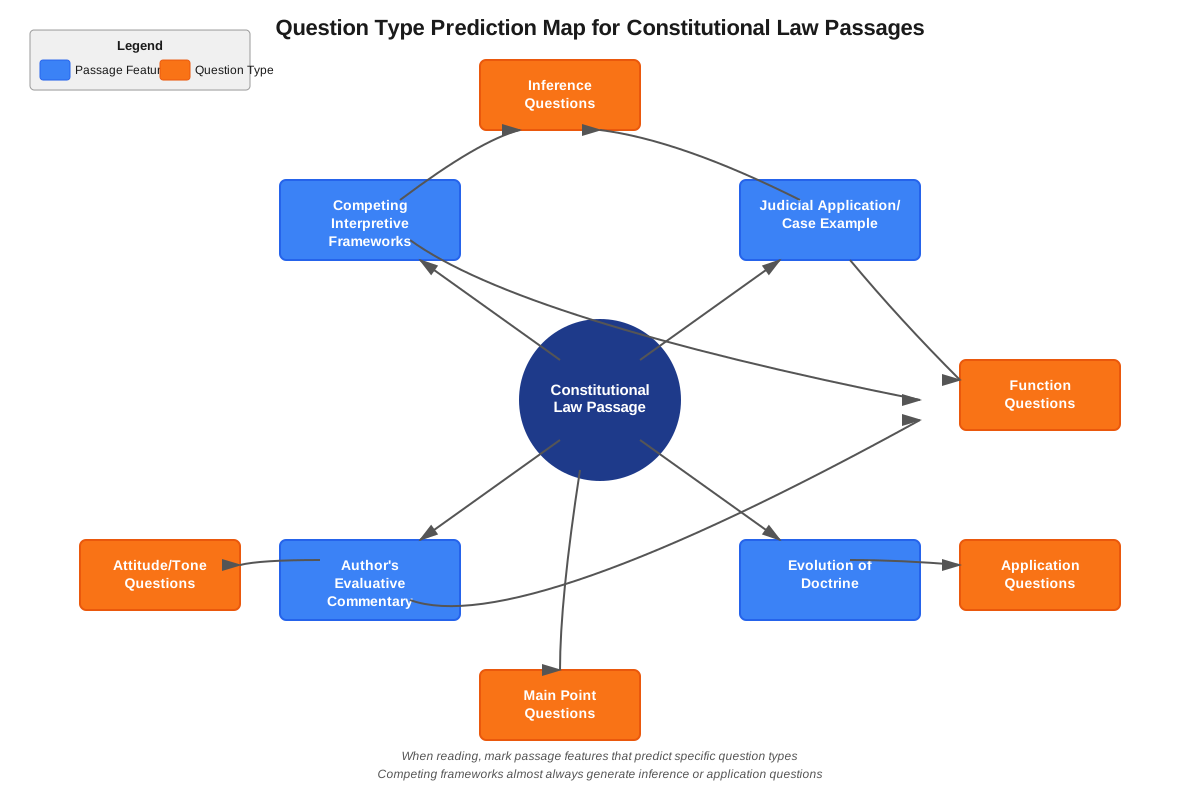
On the LSAT, constitutional law passages commonly appear in several forms: passages analyzing a specific Supreme Court decision and its implications; passages comparing different schools of constitutional interpretation (originalism versus living constitutionalism); passages examining how a particular constitutional provision has been interpreted over time; or passages discussing the constitutional dimensions of contemporary legal issues. Questions accompanying these passages frequently test the ability to identify the author's main point amid complex legal discussion, draw inferences about how a principle would apply to new scenarios, understand the function of specific paragraphs or examples, and recognize the author's attitude toward competing theories.
Core Concepts
Structure of Constitutional Law Passages
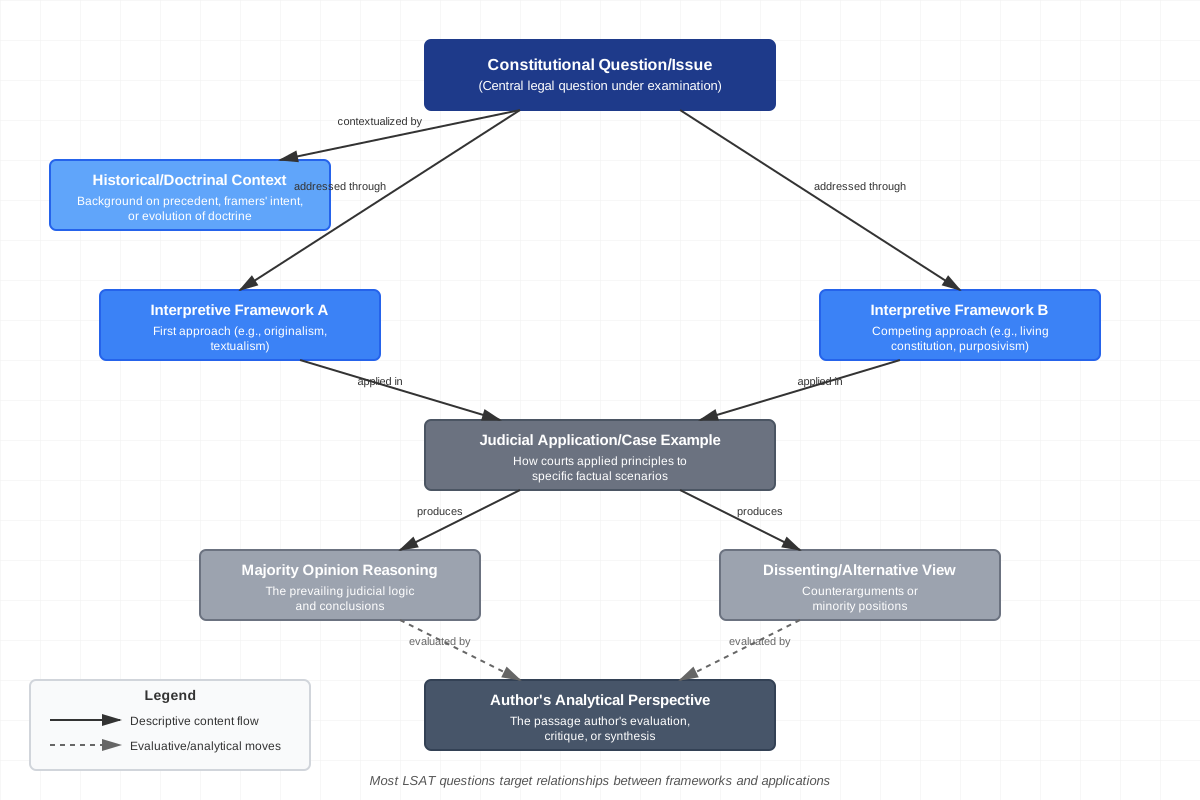
LSAT constitutional law passages typically follow predictable organizational patterns that, once recognized, dramatically improve comprehension efficiency. The most common structure introduces a constitutional question or principle in the opening paragraph, presents competing interpretive approaches or historical context in the middle paragraphs, and concludes with either the author's evaluation or discussion of implications. Understanding this architecture allows test-takers to anticipate information placement and read strategically rather than passively.
Many passages begin by identifying a specific constitutional provision (First Amendment, Commerce Clause, Due Process Clause) or a landmark case, then explore how courts have interpreted or applied it. The passage may present a chronological development—showing how interpretation evolved from early cases through modern decisions—or a theoretical comparison, contrasting different judicial philosophies. Recognizing whether the passage is primarily descriptive (explaining what courts have done) versus evaluative (arguing for a particular interpretive approach) is crucial for answering attitude and purpose questions.
Common Reasoning Patterns
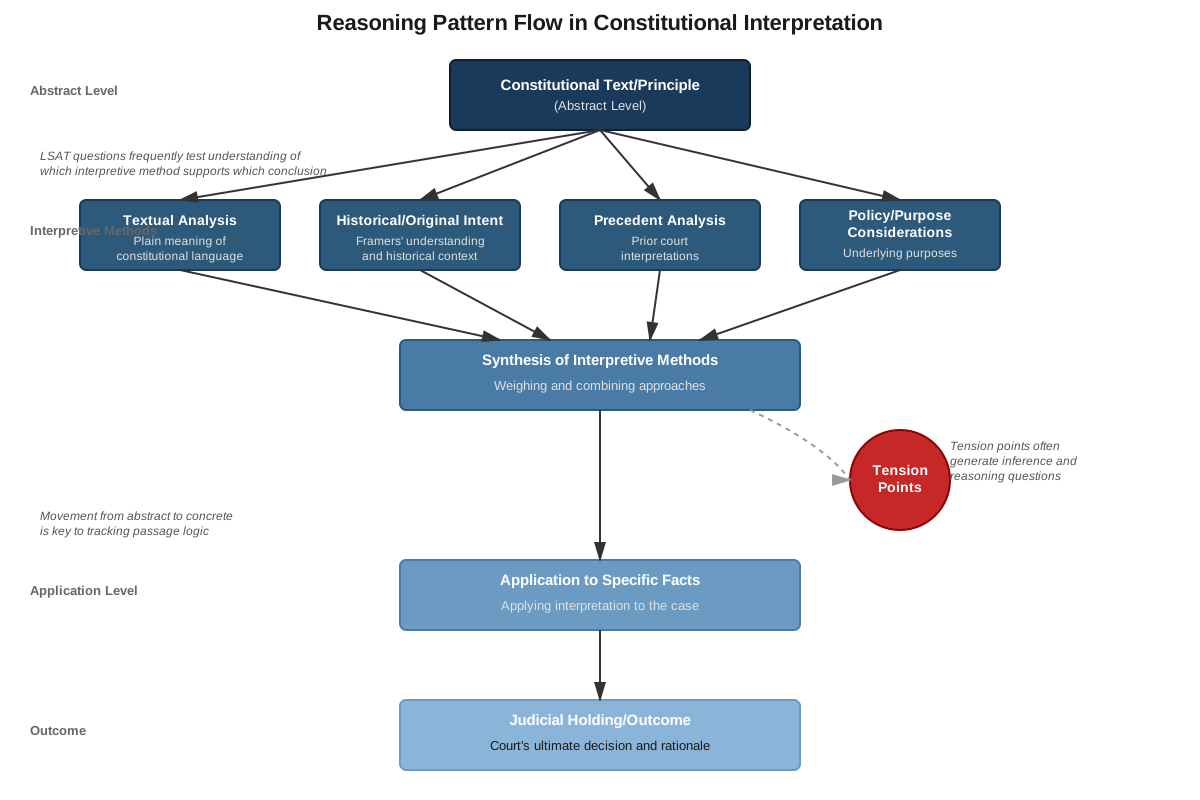
Constitutional law passages exhibit distinctive reasoning patterns that reflect how legal arguments actually function. The textualist pattern focuses on the plain meaning of constitutional language, often discussing original public understanding or dictionary definitions from the founding era. Passages employing this pattern emphasize linguistic analysis and may critique interpretations that depart from textual clarity.
The precedent-based pattern centers on how prior cases establish rules that govern subsequent decisions. These passages discuss the doctrine of stare decisis (adherence to precedent), explain how courts distinguish or extend earlier holdings, and may debate when precedent should be overruled. Test-takers must track which cases support which positions and understand how the passage characterizes their relationships.
The purposive or structural pattern examines the broader purposes underlying constitutional provisions or the relationships between different constitutional structures (federalism, separation of powers). These passages move beyond specific textual language to consider what constitutional arrangements were designed to achieve—protecting individual liberty, preventing tyranny, enabling effective governance—and how interpretations serve or undermine those purposes.
The balancing pattern appears when passages discuss how courts weigh competing interests: individual rights versus governmental authority, state sovereignty versus federal power, free speech versus public safety. These passages often present multi-factor tests or explain how courts determine which interest prevails in particular contexts.
Key Constitutional Concepts
Several constitutional concepts appear repeatedly in LSAT passages. Judicial review—the power of courts to invalidate laws that violate the Constitution—forms the backdrop for many passages, which may discuss its origins in Marbury v. Madison, its scope, or debates over its legitimacy. Understanding that judicial review is not explicitly mentioned in the constitutional text but was established through interpretation helps comprehend passages debating interpretive authority.
Federalism—the division of power between federal and state governments—generates passages exploring Commerce Clause interpretation, state sovereignty, or preemption (when federal law displaces state law). These passages often discuss how broadly or narrowly courts have construed federal power and the policy implications of different approaches.
Individual rights provisions—particularly the Bill of Rights and Fourteenth Amendment—produce passages examining free speech boundaries, religious liberty, due process, equal protection, or criminal procedure protections. These passages frequently present scenarios where rights claims conflict with governmental interests, requiring courts to develop doctrinal tests for resolution.
Separation of powers—the distribution of authority among legislative, executive, and judicial branches—appears in passages discussing presidential power, congressional authority, or the proper role of courts. These passages may explore non-delegation doctrine, executive privilege, or justiciability doctrines that limit judicial intervention.
Interpretive Methodologies
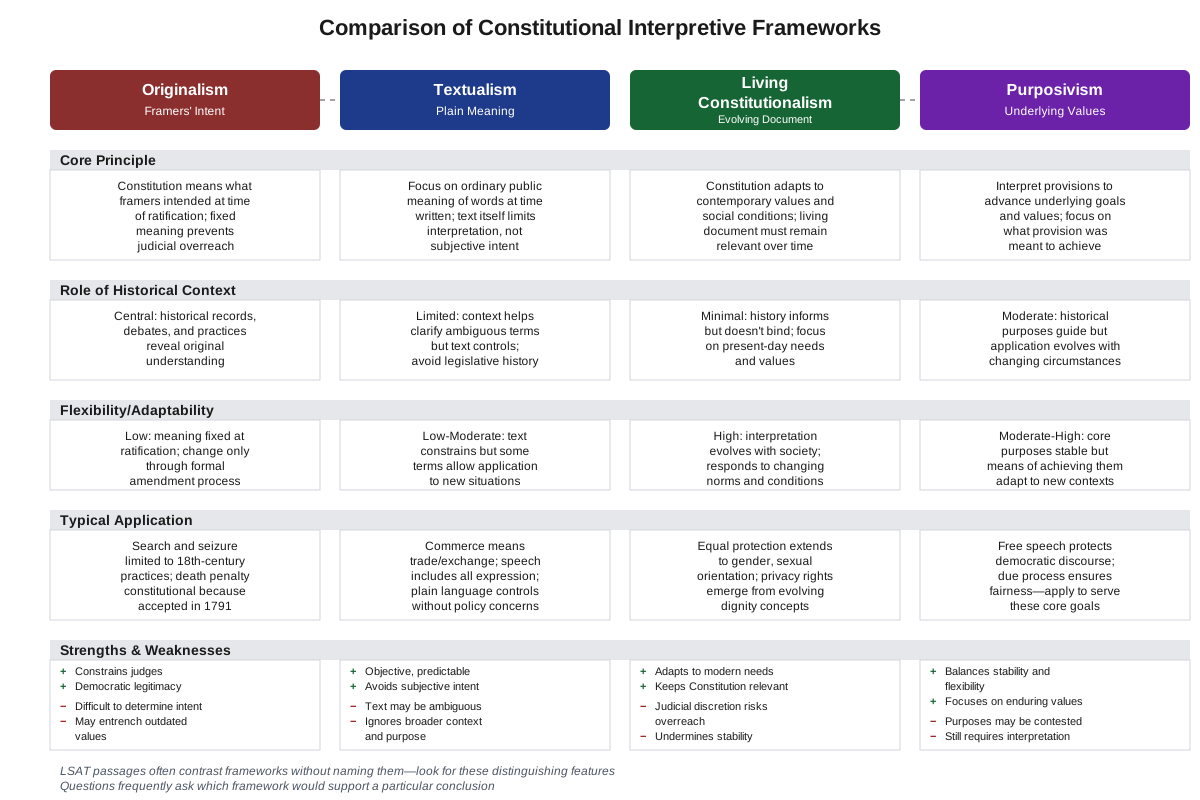
LSAT passages frequently contrast different approaches to constitutional interpretation. Originalism encompasses various theories united by the belief that constitutional meaning was fixed at ratification and should be determined by original understanding. Passages may distinguish between original intent (what framers subjectively intended) and original public meaning (how reasonable people at the time would have understood the text). Originalist passages emphasize historical evidence, founding-era sources, and interpretive stability.
Living constitutionalism or evolutionary interpretation treats the Constitution as adaptable to changing circumstances, values, and social understandings. Passages presenting this approach emphasize that framers used broad language precisely to allow flexibility, that applying 18th-century understandings to 21st-century problems produces absurd results, and that constitutional interpretation inevitably involves value judgments. These passages may discuss how courts have recognized rights not explicitly enumerated or expanded constitutional protections beyond original scope.
Textualism focuses strictly on constitutional language, using ordinary meaning and grammatical structure while avoiding reliance on legislative history or broader purposes. Purposivism looks beyond text to the provision's underlying objectives. Passages contrasting these approaches often use specific cases to illustrate how methodology affects outcomes.
Passage Tone and Authorial Perspective
Unlike neutral scientific passages, constitutional law passages often contain subtle (or explicit) authorial evaluation. Recognizing the author's perspective is essential for attitude questions and understanding the passage's argumentative thrust. Authors may signal approval through phrases like "persuasively argues," "correctly recognizes," or "the better view," while indicating criticism through "unfortunately," "fails to account for," or "the flawed assumption."
Some passages maintain descriptive neutrality, presenting competing views without endorsement. Others clearly advocate for one interpretive approach while acknowledging alternatives. Test-takers must distinguish between the author's voice and views the author is merely reporting. Phrases like "critics contend" or "proponents argue" signal reported perspectives rather than authorial positions.
Concept Relationships
The concepts within constitutional law passages form an interconnected web of legal reasoning. Interpretive methodologies (originalism, living constitutionalism, textualism) → determine how courts approach → specific constitutional provisions (Commerce Clause, First Amendment) → which generates → precedents → that establish → doctrinal tests and frameworks → applied to → concrete cases → producing → outcomes that reflect underlying constitutional values (liberty, equality, federalism).
The relationship between text and precedent is particularly important: passages often explore tension between what constitutional language seems to say and what decades of case law have established. This connects to debates about stare decisis—when should courts follow precedent that arguably misinterpreted the text versus when should they correct errors?
Structural constitutional principles (federalism, separation of powers) interact with individual rights provisions: passages may discuss how federalism affects rights enforcement or how separation of powers limits judicial authority to recognize new rights. Understanding these relationships helps predict how passages will develop arguments and what questions will test.
The connection to broader passage subjects and strategies is direct: constitutional law passages exemplify argumentative texts where identifying the author's main claim, tracking supporting evidence, and recognizing counterarguments are essential. The skills developed with constitutional passages—mapping complex arguments, distinguishing description from evaluation, understanding how abstract principles apply to specific cases—transfer directly to philosophy, social science, and other argumentative passage types in reading comprehension.
High-Yield Facts
⭐ Constitutional law passages appear in approximately 15-20% of LSAT Reading Comprehension sections, making them one of the most frequently tested passage types.
⭐ The most common question types accompanying constitutional law passages are main point, inference, function, and author's attitude questions, requiring careful attention to argumentative structure and authorial perspective.
⭐ Passages typically present either a chronological development of constitutional interpretation or a comparison of competing interpretive methodologies, and recognizing which structure is present improves comprehension efficiency.
⭐ Authors signal their perspective through evaluative language—words like "persuasively," "unfortunately," "correctly," or "fails to account for"—making careful attention to tone essential for attitude questions.
⭐ The distinction between descriptive passages (explaining what courts have done) and evaluative passages (arguing for a particular approach) determines how to answer purpose and primary concern questions.
- Constitutional law passages frequently discuss the tension between textual interpretation and precedent, requiring test-takers to track which interpretive source the author privileges.
- Passages often present hypothetical applications or analogous cases to illustrate how constitutional principles operate, and questions frequently test whether test-takers can extend the reasoning to new scenarios.
- Understanding basic constitutional structure—federalism, separation of powers, individual rights—provides context that accelerates comprehension even when specific doctrines are unfamiliar.
- Many passages explore how courts balance competing interests, and recognizing the factors courts weigh helps predict passage development and answer inference questions.
- The author's main point in constitutional law passages is often evaluative rather than purely informational—not just "here's what courts do" but "this approach is preferable because..."
- Passages discussing originalism typically emphasize historical evidence, founding-era sources, and interpretive stability, while living constitutionalism passages stress adaptability, evolving values, and practical consequences.
- Questions asking how the author would respond to a hypothetical scenario require applying the interpretive methodology or principle the passage endorses, not personal judgment about constitutional meaning.
Quick check — test yourself on Constitutional law passages so far.
Try Flashcards →Common Misconceptions
Misconception: Constitutional law passages require prior legal knowledge or familiarity with specific cases to answer questions correctly.
Correction: The LSAT is designed so that all information needed to answer questions appears in the passage itself. While legal background may speed comprehension, questions test reading comprehension and logical reasoning, not legal knowledge. Treat unfamiliar cases or doctrines as the passage presents them, focusing on the logical relationships and arguments rather than external knowledge.
Misconception: The author's perspective is always explicitly stated in constitutional law passages.
Correction: Authors often signal their views subtly through word choice, emphasis, and the structure of their argument rather than explicit declarations. Phrases like "more persuasive," "fails to consider," or "the better interpretation" reveal authorial preference. Some passages remain genuinely neutral, presenting competing views without endorsement, making it crucial to distinguish reported perspectives from authorial positions.
Misconception: All constitutional law passages are equally difficult and require the same reading strategy.
Correction: Constitutional law passages vary significantly in complexity. Some straightforwardly explain a single interpretive approach or case, while others present intricate debates among multiple theories with subtle distinctions. Effective test-takers adjust their strategy based on passage complexity—spending more time mapping relationships in complex passages while moving efficiently through straightforward ones.
Misconception: Understanding every detail in a constitutional law passage is necessary before attempting questions.
Correction: LSAT Reading Comprehension rewards strategic reading that identifies main ideas, structural organization, and authorial perspective while noting where specific details appear for reference. Attempting to memorize every case name, date, or doctrinal nuance before reading questions wastes time and mental energy. Instead, create a mental map of the passage's organization and return to specific paragraphs when questions require detailed information.
Misconception: Questions about constitutional law passages always have one clearly correct answer that jumps out immediately.
Correction: High-quality LSAT questions, particularly those accompanying constitutional law passages, often feature attractive wrong answers that capture part of the passage's content but miss crucial nuances. Correct answers may seem less obvious initially but align precisely with what the passage states or implies. Effective test-takers use process of elimination, checking each answer choice against passage content rather than selecting the first plausible option.
Misconception: The passage's conclusion paragraph always contains the author's main point.
Correction: While conclusion paragraphs often synthesize key ideas, the main point may appear earlier, particularly in passages that end by discussing implications or applications rather than restating the central claim. Some passages build toward a conclusion that appears only in the final sentences, while others state the main point in the opening paragraph and spend subsequent paragraphs supporting it. Identifying the passage's organizational structure determines where to find the main point.
Worked Examples
Example 1: Identifying Reasoning Pattern and Author's Perspective
Passage Excerpt: "The originalist approach to constitutional interpretation, which seeks to determine the meaning the Constitution's text had at the time of ratification, offers significant advantages over interpretive methods that treat constitutional meaning as evolving. By anchoring interpretation in historical understanding, originalism constrains judicial discretion and prevents judges from imposing their personal policy preferences under the guise of constitutional interpretation. Critics contend that originalism produces outcomes inconsistent with contemporary values and that the framers themselves expected future generations to adapt constitutional principles to changing circumstances. However, this criticism misunderstands originalism's purpose: the Constitution's amendment process, not judicial reinterpretation, provides the legitimate mechanism for adapting constitutional meaning to new social conditions."
Question: The author's primary purpose in the passage is most likely to:
Analysis Process:
- Identify the passage structure: The passage presents originalism, acknowledges a criticism, then rebuts that criticism. This is a classic argumentative structure defending a position.
- Locate evaluative language: "offers significant advantages," "constrains judicial discretion," "prevents judges from imposing," "this criticism misunderstands"—all signal the author favors originalism.
- Distinguish reported views from authorial position: "Critics contend" introduces an opposing view the author is reporting, not endorsing. The author's response ("However, this criticism misunderstands") clearly indicates disagreement.
- Determine the main argumentative move: The author is defending originalism against a specific criticism by explaining why that criticism fails.
- Predict the correct answer: It should capture that the author advocates for originalism by responding to a criticism, not merely describing different approaches neutrally.
Correct answer type: "Defend a particular approach to constitutional interpretation against a common objection" or "Argue that a criticism of originalism rests on a misunderstanding of its purpose."
Connection to learning objectives: This example demonstrates how to explain the reasoning pattern (argumentative defense of a position) and identify authorial perspective through evaluative language and structural cues.
Example 2: Applying Constitutional Reasoning to New Scenarios
Passage Excerpt: "The Supreme Court's dormant Commerce Clause doctrine prohibits states from enacting laws that discriminate against interstate commerce or impose undue burdens on it, even when Congress has not legislated on the subject. In evaluating state regulations, the Court distinguishes between laws that discriminate on their face against out-of-state economic interests and those that apply evenhandedly but incidentally affect interstate commerce. Facially discriminatory laws receive strict scrutiny and are virtually per se invalid unless the state demonstrates that no nondiscriminatory alternatives exist to serve a legitimate local purpose. Evenhanded laws, by contrast, are evaluated under a balancing test: they are upheld unless the burden on interstate commerce clearly exceeds the local benefits."
Question: Based on the passage, which of the following state laws would most likely be upheld under the dormant Commerce Clause doctrine?
Analysis Process:
- Identify the key distinction: The passage establishes two categories—facially discriminatory laws (virtually invalid) versus evenhanded laws (evaluated through balancing).
- Understand the applicable tests: Discriminatory laws need to show no alternatives exist (very difficult). Evenhanded laws are upheld unless burdens clearly exceed benefits.
- Evaluate answer choices by applying the framework:
- A law explicitly favoring in-state businesses over out-of-state competitors → facially discriminatory → likely invalid
- A law applying the same safety requirements to all trucks regardless of origin, with modest compliance costs → evenhanded → likely upheld through balancing
- A law imposing higher taxes on goods produced outside the state → facially discriminatory → likely invalid
- A law banning all interstate shipment of a product while allowing intrastate shipment → discriminatory → likely invalid
- Select the answer matching the "likely upheld" category: The evenhanded law with modest burdens that serves legitimate safety purposes.
Correct answer type: An evenhanded regulation that applies equally to in-state and out-of-state interests and serves a legitimate local purpose without imposing excessive burdens on interstate commerce.
Connection to learning objectives: This example demonstrates how to apply constitutional reasoning patterns to new scenarios by identifying the relevant doctrinal framework and systematically evaluating how it applies to different factual situations—a core skill tested in LSAT constitutional law questions.
Exam Strategy
Initial Reading Strategy
Approach constitutional law passages with a clear strategic framework. During the first read-through (typically 3-4 minutes), focus on identifying: (1) the constitutional provision, principle, or case being discussed; (2) whether the passage is primarily descriptive or evaluative; (3) the passage's organizational structure (chronological, comparative, problem-solution); (4) competing perspectives presented and which the author favors; (5) the main point or central claim. Resist the temptation to memorize details—instead, create a mental map noting where specific information appears for efficient reference when questions require it.
Trigger Words and Phrases
Certain words and phrases signal important analytical moves in constitutional law passages. Interpretive methodology indicators include "originalist approach," "living constitution," "plain meaning," "framers' intent," "evolving standards," "historical understanding," and "contemporary values." Evaluative signals include "persuasively argues," "fails to account for," "the better view," "unfortunately," "correctly recognizes," "overlooks," and "more consistent with." Structural relationship markers include "however," "by contrast," "similarly," "moreover," "nevertheless," and "on the other hand"—these indicate shifts between perspectives or arguments. Precedent and application language includes "the Court held," "distinguished the earlier case," "extended the principle," "overruled," and "applied the test."
Question-Type Specific Strategies
Main point questions: The correct answer must capture both the topic and the author's perspective or argumentative thrust. Wrong answers often state a topic discussed without capturing the author's main claim or focus on a supporting point rather than the central argument.
Inference questions: The correct answer must be supported by passage content but typically requires combining information from multiple locations or recognizing logical implications. Avoid answers that require outside knowledge or make claims beyond what the passage supports.
Function questions: These ask why the author included a particular paragraph, example, or reference. The correct answer describes the rhetorical or argumentative role (e.g., "illustrate a principle," "present a counterargument," "provide historical context") rather than merely summarizing content.
Attitude questions: Carefully distinguish between views the author reports and the author's own perspective. The correct answer must be supported by evaluative language or argumentative structure, not assumptions about what position seems more reasonable.
Process of Elimination
Constitutional law passages often generate wrong answers that are: (1) too extreme—using absolute language ("always," "never," "only") when the passage is more nuanced; (2) out of scope—introducing concepts or claims not discussed in the passage; (3) reversed—attributing a view to the wrong party (e.g., stating the author believes something actually attributed to critics); (4) too narrow or too broad—capturing only part of the main point or overgeneralizing beyond what the passage supports; (5) factually accurate but functionally wrong—stating something true according to the passage but not answering what the question asks.
Time Allocation
Constitutional law passages typically warrant 8-9 minutes total (3-4 minutes reading, 4-5 minutes answering questions), though this varies with passage complexity and individual reading speed. If a passage seems particularly dense, invest an extra 30-60 seconds in the initial read to build a stronger mental map—this investment pays dividends through faster, more accurate question answering. Conversely, if questions can be answered efficiently by returning to specific paragraphs, don't over-invest in initial reading attempting to memorize details.
Memory Techniques
SCOPE Acronym for Passage Analysis
Structure: Is the passage chronological, comparative, or problem-solution?
Competing views: What different perspectives are presented?
Opinion: What is the author's position or evaluation?
Principle: What constitutional provision or doctrine is central?
Examples: What cases or applications illustrate the principle?
Interpretive Methodology Spectrum
Visualize constitutional interpretation approaches on a spectrum from rigid to flexible:
Originalism (fixed meaning at ratification) ← Textualism (plain language focus) ← Precedent-based (following prior cases) → Purposivism (underlying objectives) → Living Constitutionalism (evolving meaning)
This mental image helps track where different theories fall and predict how they would resolve interpretive questions.
The "Three Ps" of Constitutional Passages
Provision: What constitutional text is being interpreted?
Perspectives: What competing interpretive approaches are presented?
Position: What view does the author endorse or what conclusion does the passage reach?
Answering these three questions during initial reading provides a framework for approaching all question types.
Balancing Test Visualization
When passages discuss balancing tests (common in constitutional law), visualize a scale with competing interests on each side. Mentally note what factors increase weight on each side and what the passage suggests about how courts should weigh them. This visualization aids in answering inference questions about how the test would apply to new scenarios.
Summary
Constitutional law passages represent a high-frequency, high-importance passage type in LSAT Reading Comprehension, appearing in approximately 15-20% of sections and testing core analytical skills essential for legal reasoning. These passages explore constitutional interpretation, landmark cases, competing judicial philosophies, and the application of constitutional principles to specific scenarios. Success requires recognizing common structural patterns (chronological development, comparative analysis, argumentative defense), identifying reasoning patterns (textualist, precedent-based, purposive, balancing), and distinguishing between descriptive and evaluative content. The most critical skill is determining the author's perspective through evaluative language and argumentative structure, as this directly impacts attitude, purpose, and main point questions. Effective test-takers approach these passages strategically, creating mental maps of organization and competing views rather than attempting to memorize details, then apply the passage's reasoning framework to answer inference and application questions. Understanding interpretive methodologies—particularly the distinction between originalism's focus on fixed historical meaning and living constitutionalism's emphasis on evolving interpretation—provides context for comprehending passages even when specific doctrines are unfamiliar. Mastery of constitutional law passages develops transferable skills for analyzing all complex argumentative texts on the LSAT.
Key Takeaways
- Constitutional law passages appear frequently on the LSAT and test the ability to comprehend complex legal reasoning, track competing perspectives, and identify authorial viewpoint—skills central to legal education and practice.
- These passages follow predictable organizational patterns (chronological, comparative, argumentative) and reasoning patterns (textualist, precedent-based, purposive, balancing) that, once recognized, dramatically improve comprehension efficiency.
- The distinction between descriptive passages (explaining what courts have done) and evaluative passages (arguing for a particular approach) is crucial for answering purpose, attitude, and main point questions correctly.
- Authors signal their perspective through evaluative language ("persuasively argues," "fails to account for," "the better view") and argumentative structure, making careful attention to tone essential.
- Success requires strategic reading that identifies main ideas, structural organization, and competing views while noting where details appear for reference, rather than attempting to memorize all content before approaching questions.
- Understanding basic interpretive methodologies (originalism, living constitutionalism, textualism, purposivism) provides a framework for comprehending passages even when specific constitutional doctrines are unfamiliar.
- The skills developed with constitutional law passages—mapping complex arguments, distinguishing description from evaluation, applying abstract principles to concrete cases—transfer directly to other argumentative passage types in LSAT Reading Comprehension.
Related Topics
Comparative Law Passages: Many Reading Comprehension sections include passages comparing legal systems or approaches across different jurisdictions, building on the analytical skills developed with constitutional law passages while introducing cross-cultural dimensions.
Legal Reasoning in Logical Reasoning: The argumentative patterns in constitutional law passages—distinguishing holdings from dicta, applying precedent, balancing competing interests—appear throughout LSAT Logical Reasoning questions, making mastery of constitutional passages valuable beyond Reading Comprehension.
Philosophy Passages: Constitutional law passages share structural and analytical similarities with philosophy passages, particularly those discussing competing theoretical frameworks or abstract principles applied to concrete cases.
Social Science Passages on Law and Society: Passages examining how legal institutions function, the relationship between law and social change, or empirical studies of judicial behavior complement constitutional law passages by providing broader context for legal reasoning.
Argumentative Writing and Analysis: The skills developed analyzing constitutional law passages—identifying claims, evaluating evidence, recognizing counterarguments, assessing logical structure—directly support the analytical writing required in law school and legal practice.
Practice CTA
Now that you've mastered the core concepts, reasoning patterns, and strategic approaches for constitutional law passages, it's time to apply this knowledge to authentic LSAT questions. Work through the practice questions accompanying this guide, focusing on implementing the strategies discussed: identify passage structure during initial reading, track competing perspectives and authorial viewpoint, apply the SCOPE framework, and use process of elimination systematically. Review the flashcards to reinforce high-yield facts and common reasoning patterns. Remember that constitutional law passages, while challenging, follow predictable patterns—each passage you practice strengthens your ability to recognize these patterns quickly and answer questions accurately. Your investment in mastering this high-frequency passage type will pay dividends throughout the Reading Comprehension section and beyond. Approach practice with confidence, knowing that the analytical framework you've developed applies to all complex argumentative texts on the LSAT.
Sign up free to keep reading
Create a free AnvayaPrep account to finish this LSAT guide on Constitutional law passages — plus flashcards and practice questions.