Overview
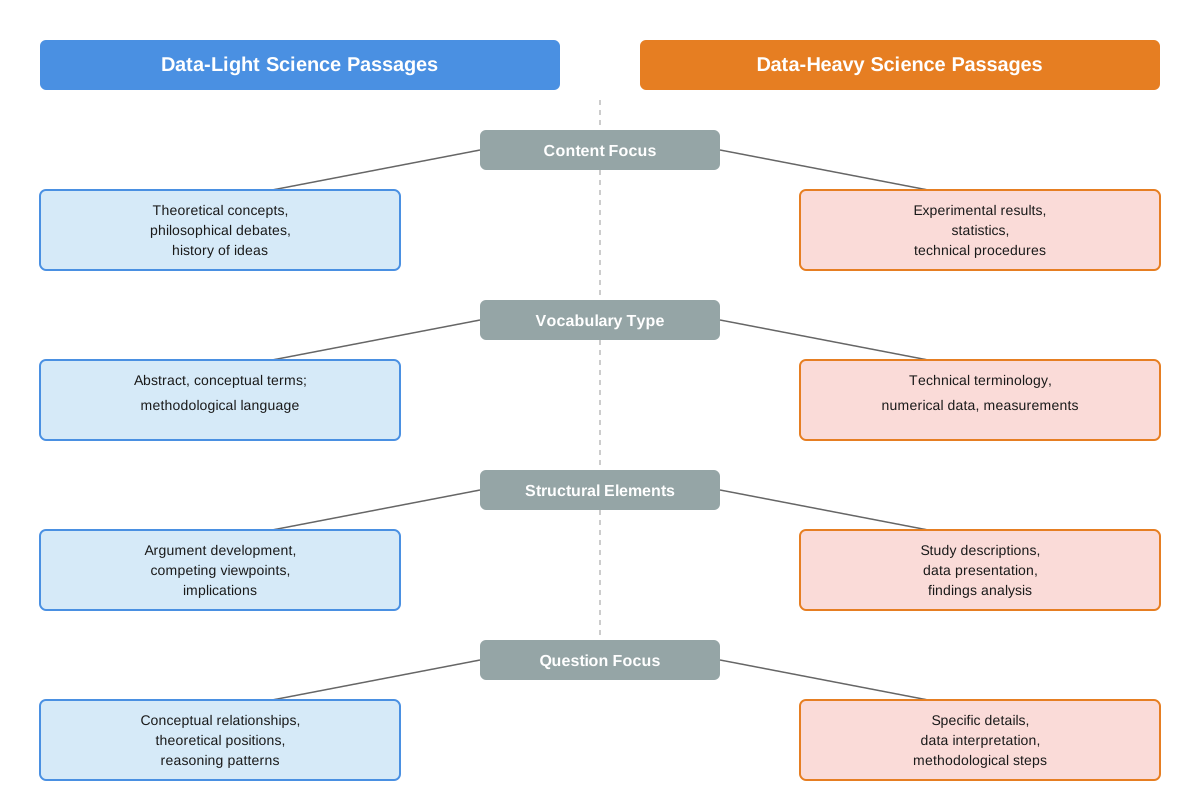
Data-light science passages represent a distinctive category of Reading Comprehension material on the LSAT that focuses on theoretical, conceptual, or philosophical aspects of scientific inquiry rather than experimental results, statistical findings, or technical data. These passages typically explore the history of scientific thought, debates about scientific methodology, theoretical frameworks, or the social and philosophical implications of scientific discoveries. Unlike data-heavy science passages that might present experimental procedures, numerical results, or technical specifications, data-light passages emphasize ideas, arguments, and conceptual relationships within the scientific domain.
Understanding how to approach lsat data-light science passages is essential because they appear regularly on the exam and require a different analytical strategy than passages dense with technical information. These passages test a student's ability to track abstract reasoning, understand theoretical distinctions, and follow arguments about scientific concepts without relying on concrete data points. The LSAT uses these passages to assess whether test-takers can comprehend sophisticated intellectual discourse about science—a skill crucial for law students who must frequently engage with expert testimony, scientific evidence, and technical arguments in legal contexts.
Within the broader framework of reading comprehension and passage subjects and strategies, data-light science passages occupy a unique position. They bridge the gap between pure humanities passages (which focus on art, literature, or philosophy) and technical science passages (which emphasize empirical findings and methodology). Mastering these passages requires developing comfort with scientific vocabulary and concepts while maintaining the same critical reading skills used for argumentative and theoretical texts in other domains. Success with data-light science passages builds transferable skills for handling any LSAT passage that prioritizes conceptual understanding over factual recall.
Learning Objectives
- [ ] Identify how Data-light science passages appears in LSAT questions
- [ ] Explain the reasoning pattern behind Data-light science passages
- [ ] Apply Data-light science passages to solve LSAT-style problems accurately
- [ ] Distinguish between data-light and data-heavy science passages based on content and structure
- [ ] Recognize common theoretical frameworks and argumentative patterns in data-light science passages
- [ ] Evaluate answer choices by identifying conceptual relationships rather than factual details
- [ ] Synthesize information from multiple paragraphs to understand overarching theoretical positions
Prerequisites
- Basic reading comprehension skills: Ability to identify main ideas, supporting details, and passage structure is foundational for analyzing any LSAT passage type
- Familiarity with argument structure: Understanding premises, conclusions, and logical relationships helps track theoretical debates in science passages
- General academic vocabulary: Comfort with college-level terminology enables faster processing of scientific concepts without getting derailed by unfamiliar words
- Experience with LSAT passage types: Knowing the four standard passage categories (humanities, social sciences, natural sciences, law) provides context for where data-light science passages fit
Why This Topic Matters
Data-light science passages appear with significant frequency on the LSAT, typically constituting one of the four passages in each Reading Comprehension section. The LSAC (Law School Admission Council) deliberately includes these passages because legal practice frequently requires attorneys to understand and argue about scientific concepts, expert opinions, and theoretical frameworks without necessarily having technical expertise. Lawyers must cross-examine scientific experts, evaluate the validity of scientific theories presented as evidence, and explain complex scientific concepts to judges and juries—all skills that data-light science passages help assess.
From an exam statistics perspective, data-light science passages generate questions that test inference, main point identification, author's attitude, and application of principles—question types that appear across all passage categories but take on unique characteristics in the scientific context. These passages often yield 6-8 questions per passage, with inference and application questions being particularly common. Students who struggle with these passages frequently lose 3-4 points per test, making mastery of this topic a high-yield investment of study time.
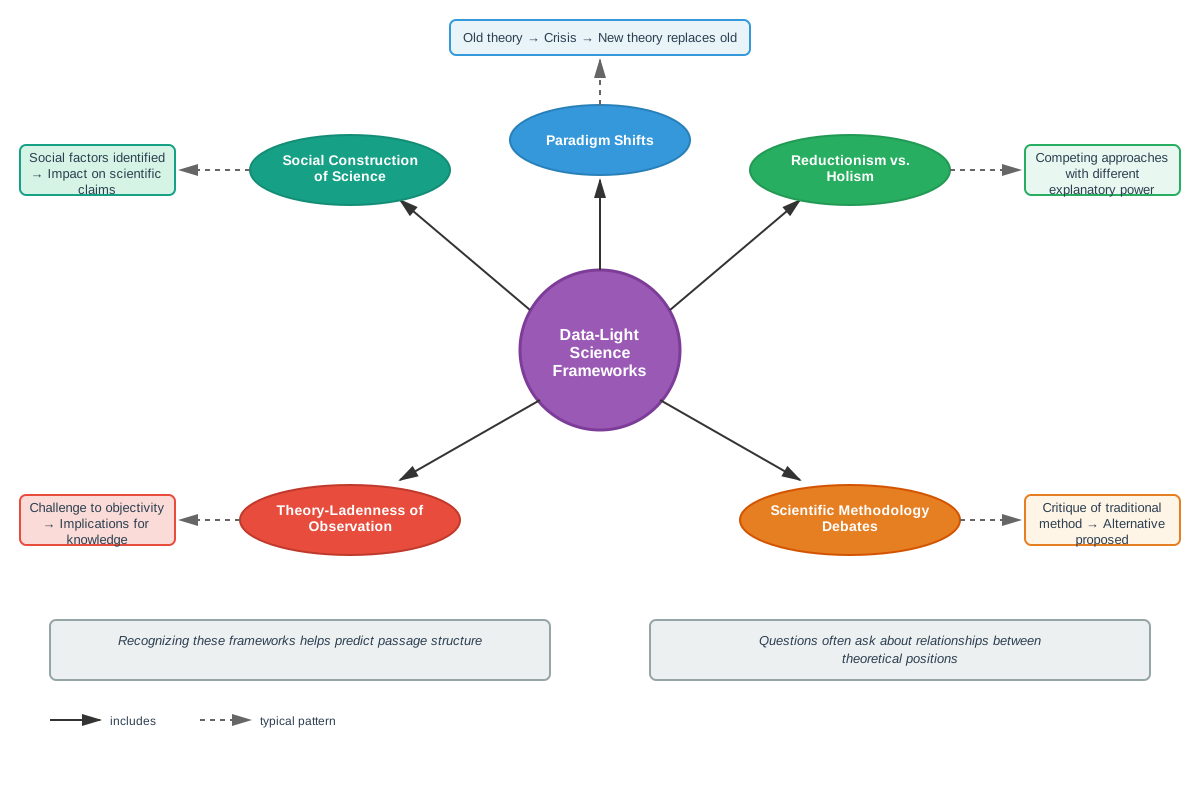
In practice, data-light science passages commonly appear as discussions of scientific paradigm shifts (like the transition from Newtonian to quantum physics), debates about scientific methodology (such as the role of intuition versus empiricism), explorations of how scientific communities establish consensus, or examinations of the philosophical implications of scientific discoveries. These passages might discuss topics like the nature of scientific explanation, the relationship between observation and theory, or how cultural contexts influence scientific thinking—all without presenting experimental data, statistical analyses, or technical procedures.
Core Concepts
Characteristics of Data-Light Science Passages
Data-light science passages are distinguished by their emphasis on ideas, theories, and conceptual frameworks rather than empirical findings or technical specifications. These passages typically feature extensive discussion of "why" and "how" questions about scientific thinking rather than "what" questions about specific discoveries or measurements. The language tends toward the abstract and theoretical, with frequent use of terms like "framework," "paradigm," "approach," "conception," "model," and "perspective."
Key identifying features include:
- Minimal or absent numerical data, statistics, or experimental results
- Focus on the development or critique of scientific theories
- Discussion of scientific methodology or philosophy of science
- Exploration of how scientists think about problems rather than what they discovered
- Emphasis on conceptual relationships and theoretical distinctions
- Historical or sociological perspectives on scientific practice
Common Thematic Patterns
Data-light science passages on the LSAT tend to cluster around several recurring themes that test-takers should recognize:
Paradigm Shifts and Scientific Revolutions: These passages explore how fundamental changes in scientific thinking occur, often referencing Thomas Kuhn's concept of paradigm shifts or discussing how new theoretical frameworks replace older ones. The passage might trace how scientists moved from one way of conceptualizing a phenomenon to another, emphasizing the conceptual barriers and breakthroughs involved.
Methodology Debates: Passages may present competing views about how science should be conducted—for example, whether scientific progress comes primarily from hypothesis testing, from careful observation, from mathematical modeling, or from creative intuition. These passages often present two or more perspectives and may or may not indicate which the author favors.
Interdisciplinary Connections: Some data-light passages explore how scientific concepts relate to other domains—how biology informs ethics, how physics relates to philosophy, or how cognitive science connects to linguistics. These passages test the ability to track analogies and conceptual parallels across domains.
Social and Cultural Dimensions of Science: These passages examine how scientific communities function, how consensus is established, how cultural assumptions influence scientific questions, or how scientific knowledge is communicated to non-specialists. They treat science as a human activity embedded in social contexts.
Structural Organization
Data-light science passages typically follow one of several organizational patterns:
| Structure Type | Description | Common Question Focus |
|---|---|---|
| Chronological Development | Traces evolution of a scientific concept or theory over time | Understanding transitions, identifying turning points |
| Comparative Framework | Contrasts two or more theoretical approaches or perspectives | Distinguishing positions, recognizing implications |
| Problem-Solution | Presents a conceptual problem and explores proposed solutions | Evaluating solutions, understanding constraints |
| Thesis-Support | Advances an argument about scientific practice or theory | Identifying main point, recognizing support |
Understanding these structures helps predict where key information will appear and how paragraphs relate to each other. For instance, in a comparative framework passage, the first paragraph often introduces the general topic, the second and third paragraphs present the competing views, and the final paragraph may synthesize or indicate the author's position.
Reasoning Patterns in Data-Light Science
The reasoning pattern behind data-light science passages centers on conceptual analysis rather than empirical verification. Authors of these passages (and the scientists they discuss) typically employ several characteristic reasoning moves:
- Conceptual Distinction: Drawing fine-grained differences between related ideas (e.g., distinguishing "explanation" from "description" in scientific practice)
- Theoretical Implication: Showing what follows logically from accepting a particular theoretical framework
- Analogical Reasoning: Using comparisons to clarify abstract scientific concepts
- Historical Contextualization: Explaining how ideas emerged from and responded to earlier thinking
- Methodological Critique: Evaluating the strengths and limitations of different approaches to scientific inquiry
These reasoning patterns appear consistently in questions, which often ask test-takers to identify what follows from a theoretical position, recognize analogous situations, or understand why a particular methodological approach has certain limitations.
Question Types and How They Target Data-Light Content
Inference questions on data-light passages frequently ask about theoretical implications or conceptual relationships that aren't explicitly stated. For example: "The passage suggests that proponents of Theory X would most likely agree with which of the following?" These questions test whether students understand the logical commitments of a theoretical position.
Application questions ask students to apply a theoretical principle or methodological approach to a new situation. These questions might present a scenario and ask which scientific approach discussed in the passage would be most appropriate, or how a particular scientist mentioned in the passage would likely respond to new information.
Main point questions require synthesizing the passage's discussion of theoretical issues into a single statement that captures the author's primary purpose—often to explain a theoretical development, contrast competing approaches, or argue for a particular understanding of scientific practice.
Attitude questions probe the author's stance toward the theories or methodologies discussed, requiring careful attention to evaluative language and the overall argumentative structure of the passage.
Concept Relationships
The concepts within data-light science passages form an interconnected web where understanding one element facilitates comprehension of others. The characteristics of data-light passages (emphasis on theory over data) directly determine the thematic patterns that appear (paradigm shifts, methodology debates), which in turn shape the structural organization authors use to present their arguments. For instance, a passage about competing methodologies naturally lends itself to a comparative framework structure.
The reasoning patterns employed in these passages both reflect and reinforce their data-light nature. Because the passages focus on conceptual rather than empirical content, authors rely heavily on conceptual distinction and theoretical implication rather than on experimental evidence or statistical reasoning. This reasoning pattern then influences the question types that appear, as test-makers design questions that probe whether students can follow these abstract reasoning moves.
Relationship map:
Passage Characteristics (data-light, theory-focused) → Thematic Patterns (paradigm shifts, methodology debates) → Structural Organization (comparative, chronological) → Reasoning Patterns (conceptual distinction, theoretical implication) → Question Types (inference, application, main point)
This topic also connects to prerequisite knowledge of argument structure, as the theoretical debates in data-light science passages are fundamentally arguments with premises and conclusions. The ability to identify these argumentative elements transfers directly from Logical Reasoning to Reading Comprehension. Additionally, the vocabulary and conceptual complexity of data-light passages builds on general academic reading skills while preparing students for the interdisciplinary thinking required in law school.
High-Yield Facts
⭐ Data-light science passages emphasize theoretical frameworks, conceptual debates, and methodological discussions rather than experimental results or statistical data
⭐ These passages appear regularly on the LSAT, typically once per Reading Comprehension section, and generate 6-8 questions
⭐ Common themes include paradigm shifts, methodology debates, interdisciplinary connections, and social dimensions of science
⭐ Inference and application questions are particularly frequent with data-light passages, testing conceptual understanding over factual recall
⭐ The reasoning pattern centers on conceptual distinction, theoretical implication, and analogical reasoning rather than empirical verification
- Data-light passages often discuss the history or philosophy of science rather than current research findings
- These passages require tracking abstract relationships between ideas rather than memorizing specific facts or numbers
- Authors of data-light passages frequently present multiple perspectives without explicitly endorsing one
- Question wrong answers often confuse similar theoretical positions or misapply conceptual distinctions
- Time management for data-light passages should prioritize understanding conceptual relationships in the first reading rather than rushing through
- Vocabulary in data-light passages tends toward the abstract (framework, paradigm, conception) rather than the technical (enzyme, wavelength, neurotransmitter)
- The main point of data-light passages typically involves explaining a theoretical development or contrasting approaches rather than reporting a discovery
- Data-light passages may include brief examples or illustrations, but these serve to clarify concepts rather than provide evidence
- Understanding the author's attitude requires attention to subtle evaluative language about competing theories or methodologies
- Comparative structure passages often devote one paragraph to each theoretical position before synthesizing or evaluating them
Quick check — test yourself on Data-light science passages so far.
Try Flashcards →Common Misconceptions
Misconception: Data-light science passages are easier than data-heavy passages because they lack technical details → Correction: Data-light passages can be equally or more challenging because they require tracking abstract conceptual relationships and subtle theoretical distinctions. The absence of concrete data means students cannot rely on factual anchors and must instead follow complex argumentation.
Misconception: You need extensive science background knowledge to understand data-light science passages → Correction: These passages are specifically designed to be accessible to readers without specialized scientific training. All necessary concepts are explained within the passage, and questions test reading comprehension rather than outside knowledge. In fact, students with science backgrounds sometimes struggle because they import assumptions not stated in the passage.
Misconception: The main point of a data-light science passage is always the scientific theory or concept being discussed → Correction: The main point is typically about the passage's discussion of that theory—for example, explaining why a paradigm shift occurred, contrasting two methodological approaches, or arguing that a particular theoretical framework has limitations. The theory itself is the subject matter, but the main point concerns what the author is saying about it.
Misconception: Data-light passages don't require careful attention to passage structure because they're just discussing ideas → Correction: Structure is crucial for data-light passages. Understanding whether the passage is organized chronologically, comparatively, or as thesis-support helps predict where key information appears and how paragraphs relate. Questions frequently test understanding of these structural relationships.
Misconception: If a passage mentions a scientist's name or a specific theory, questions will focus on those details → Correction: Names and specific theories in data-light passages usually serve as examples or illustrations of broader conceptual points. Questions typically focus on the conceptual relationships and theoretical implications rather than on recalling which scientist said what. The LSAT tests reasoning about ideas, not memorization of facts.
Misconception: You should skip science passages if you're not a "science person" → Correction: Data-light science passages test reading comprehension and logical reasoning skills that apply across all passage types. Students who practice these passages develop transferable skills for handling abstract argumentation and complex conceptual relationships in any domain, including legal reasoning.
Worked Examples
Example 1: Identifying Passage Type and Main Point
Passage Excerpt (abbreviated):
"For much of the twentieth century, ecologists operated under the assumption that natural ecosystems tend toward equilibrium states—stable configurations that, once achieved, persist indefinitely unless disturbed by external forces. This equilibrium paradigm shaped research questions, methodologies, and conservation strategies. However, beginning in the 1970s, some ecologists began questioning whether equilibrium models accurately captured the dynamics of real ecosystems. These critics argued that natural systems are characterized by constant flux rather than stability, with disturbances being intrinsic features rather than external disruptions. This non-equilibrium perspective has profound implications for how we understand ecosystem management..."
Question: The primary purpose of the passage is to:
(A) Describe the experimental evidence that led to the rejection of equilibrium ecology
(B) Explain a fundamental shift in ecological thinking from equilibrium to non-equilibrium models
(C) Argue that non-equilibrium models are more scientifically rigorous than equilibrium models
(D) Trace the historical development of ecosystem management strategies
(E) Compare the practical applications of equilibrium and non-equilibrium approaches
Worked Solution:
Step 1: Identify passage type. This is clearly a data-light science passage—it discusses theoretical frameworks (equilibrium vs. non-equilibrium paradigms) without presenting experimental data or specific measurements. The focus is on conceptual models and their implications.
Step 2: Identify structure. The passage follows a chronological/comparative structure: it presents the older equilibrium paradigm, introduces the challenge from non-equilibrium thinking, and mentions implications. This is a classic paradigm shift theme.
Step 3: Determine the main point. The passage is explaining a theoretical transition in ecology—from equilibrium to non-equilibrium thinking. It's not primarily arguing for one view over another (eliminating C), not focused on experimental evidence (eliminating A), not tracing management strategies specifically (eliminating D), and not comparing practical applications (eliminating E).
Step 4: Select the answer. (B) accurately captures the passage's primary purpose: explaining a fundamental shift in theoretical perspective.
Connection to Learning Objectives: This example demonstrates how to identify data-light passages by their emphasis on theoretical frameworks and how to recognize the reasoning pattern (paradigm shift) that shapes the passage's organization and main point.
Example 2: Application Question
Passage Context: A data-light passage discusses two approaches to scientific explanation. The "covering-law model" holds that scientific explanations work by showing how particular events follow from general laws. The "causal-mechanical model" holds that explanations work by describing the specific causal mechanisms that produce phenomena.
Question: Based on the passage, a proponent of the causal-mechanical model would be most likely to criticize which of the following as an inadequate scientific explanation?
(A) An explanation that describes the step-by-step process by which a chemical reaction occurs
(B) An explanation that cites a general principle from which the phenomenon logically follows but doesn't describe how the phenomenon is produced
(C) An explanation that identifies the specific mechanisms responsible for a biological process
(D) An explanation that traces the causal chain linking an initial event to a final outcome
(E) An explanation that describes the particular interactions between components of a system
Worked Solution:
Step 1: Understand the theoretical distinction. The passage contrasts two models of explanation. The covering-law model emphasizes general laws and logical relationships. The causal-mechanical model emphasizes specific mechanisms and causal processes.
Step 2: Identify what the question asks. We need to find what a causal-mechanical proponent would criticize—meaning we're looking for an explanation that fits the covering-law model but not the causal-mechanical model.
Step 3: Evaluate each answer:
- (A) describes a process/mechanism—fits causal-mechanical model, wouldn't be criticized
- (B) cites general principles without describing mechanisms—fits covering-law but not causal-mechanical, would be criticized
- (C) identifies specific mechanisms—fits causal-mechanical model, wouldn't be criticized
- (D) traces causal chains—fits causal-mechanical model, wouldn't be criticized
- (E) describes interactions—fits causal-mechanical model, wouldn't be criticized
Step 4: Select the answer. (B) is correct because it describes exactly the type of explanation that covering-law proponents would accept but causal-mechanical proponents would find inadequate—one that appeals to general laws without describing the specific mechanisms at work.
Connection to Learning Objectives: This example shows how to apply theoretical distinctions from data-light passages to evaluate new scenarios, demonstrating the reasoning pattern of theoretical implication (what follows from accepting a particular theoretical position).
Exam Strategy
Initial Reading Approach
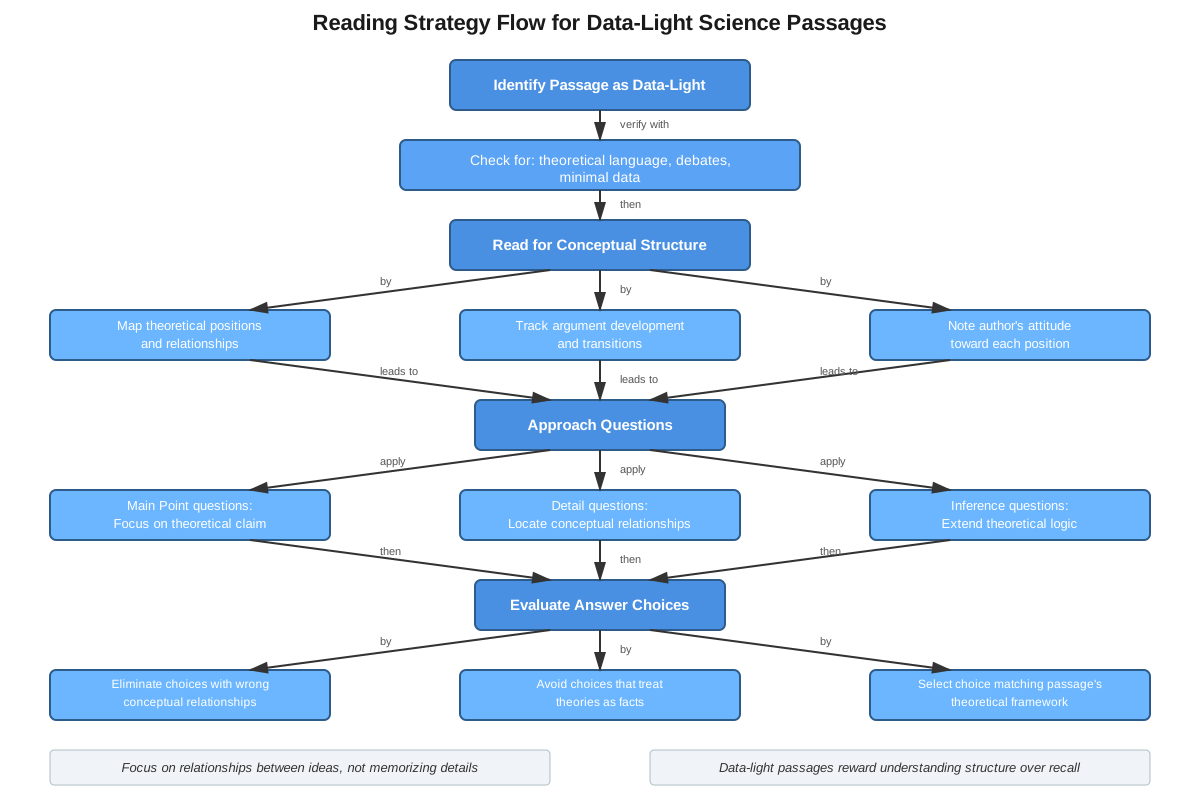
When encountering a data-light science passage, invest time in the first reading to understand conceptual relationships rather than rushing through to get to questions. Unlike data-heavy passages where you might skim technical details and return to them when needed, data-light passages require grasping the theoretical framework upfront. Focus on:
- Identifying the theoretical positions being discussed (often signaled by phrases like "one approach," "traditional view," "critics argue")
- Tracking transitions between perspectives (words like "however," "in contrast," "alternatively")
- Noting the author's attitude toward each position (subtle evaluative language like "merely," "sophisticated," "overlooks")
- Understanding the conceptual distinctions being drawn (phrases like "differs from," "unlike," "distinguishes between")
Trigger Words and Phrases
Certain language patterns signal important conceptual content in data-light passages:
Theoretical Framework Indicators: "paradigm," "model," "framework," "approach," "conception," "perspective," "view," "school of thought"
Conceptual Relationship Markers: "implies," "suggests," "follows from," "presupposes," "assumes," "entails," "is consistent with"
Contrast Signals: "whereas," "in contrast," "alternatively," "on the other hand," "differs from," "challenges"
Evaluation Language: "overlooks," "fails to account for," "successfully explains," "inadequate," "sophisticated," "simplistic"
When you encounter these triggers, slow down and ensure you understand the conceptual relationship being established.
Process of Elimination Tips
For inference and application questions on data-light passages:
Eliminate answers that:
- Introduce concepts not discussed in the passage (even if scientifically accurate)
- Confuse which theoretical position holds which view
- Make claims too strong or absolute for the passage's nuanced discussion
- Focus on factual details when the question asks about theoretical implications
- Reverse the relationship between concepts (e.g., saying A implies B when the passage indicates B implies A)
Favor answers that:
- Use language parallel to the passage's conceptual vocabulary
- Correctly apply the theoretical distinctions the passage establishes
- Reflect the author's attitude toward the positions discussed
- Follow logically from the theoretical commitments described
Time Allocation
Data-light science passages typically warrant slightly more time on the initial reading (4-5 minutes) compared to more straightforward passages, because understanding the conceptual framework is essential for answering questions efficiently. However, once you grasp the theoretical structure, questions often go quickly because they test the same conceptual relationships repeatedly. Aim for:
- Initial reading: 4-5 minutes
- Questions: 4-5 minutes (approximately 45 seconds per question)
- Total: 8-10 minutes per passage
If you find yourself re-reading extensively while answering questions, you likely moved through the initial reading too quickly without grasping the conceptual framework.
Memory Techniques
The PARADIGM Acronym for Data-Light Passage Elements
Positions: Identify the theoretical positions or perspectives discussed
Arguments: Note the reasoning supporting each position
Relationships: Track how concepts relate to each other
Attitude: Determine the author's stance toward each view
Distinctions: Understand the conceptual differences being drawn
Implications: Consider what follows from each theoretical position
General vs. specific: Note whether discussion is abstract or includes examples
Methodology: Pay attention to debates about how science should be conducted
Visualization Strategy
Picture data-light passages as a conceptual map rather than a timeline or data table. Visualize:
- Each theoretical position as a distinct territory
- Conceptual distinctions as boundaries between territories
- Implications as arrows pointing outward from positions
- The author's attitude as elevation (higher = more favorable)
This spatial metaphor helps organize abstract information and makes it easier to recall relationships when answering questions.
The "Theory vs. Evidence" Reminder
Create a mental note: "Data-light = Theory-heavy." When you identify a passage as data-light, remind yourself that questions will focus on conceptual relationships (what follows from a theory, how theories differ, what a theory implies) rather than factual details (what experiment was conducted, what data showed). This mental frame helps you focus attention appropriately while reading.
Summary
Data-light science passages on the LSAT emphasize theoretical frameworks, conceptual debates, and methodological discussions rather than experimental findings or technical data. These passages appear regularly on the exam and test the ability to track abstract reasoning, understand theoretical distinctions, and follow arguments about scientific concepts. Common themes include paradigm shifts in scientific thinking, debates about scientific methodology, interdisciplinary connections, and social dimensions of scientific practice. The reasoning pattern in these passages centers on conceptual distinction, theoretical implication, and analogical reasoning rather than empirical verification. Success requires understanding the passage's conceptual framework during the initial reading, recognizing structural patterns (chronological, comparative, problem-solution), and applying theoretical distinctions to answer inference and application questions. Unlike data-heavy passages, data-light passages reward careful attention to abstract relationships and subtle evaluative language rather than memorization of facts. Mastering these passages builds transferable skills for handling complex theoretical argumentation across all LSAT sections and in legal practice.
Key Takeaways
- Data-light science passages focus on theories, concepts, and methodologies rather than experimental data or technical specifications
- These passages appear regularly on the LSAT and generate questions testing conceptual understanding through inference and application
- Common themes include paradigm shifts, methodology debates, and philosophical aspects of scientific practice
- Success requires grasping the conceptual framework during initial reading and tracking theoretical distinctions carefully
- Questions focus on theoretical implications and conceptual relationships rather than factual recall
- Structural patterns (chronological, comparative, thesis-support) help predict where key information appears
- The reasoning pattern emphasizes conceptual distinction and theoretical implication rather than empirical evidence
Related Topics
Data-Heavy Science Passages: While data-light passages emphasize theory, data-heavy passages present experimental procedures, statistical findings, and technical specifications. Mastering data-light passages provides a foundation for understanding the conceptual frameworks that motivate the experiments described in data-heavy passages.
Comparative Reading Passages: The skills developed for tracking multiple theoretical positions in data-light science passages transfer directly to comparative reading, where two passages present different perspectives on a topic. Understanding how to distinguish and relate competing viewpoints is essential for both.
Logical Reasoning - Method of Reasoning Questions: The conceptual analysis required for data-light passages parallels the skills needed to identify reasoning patterns in Logical Reasoning. Both require recognizing how premises support conclusions and understanding the structure of arguments.
Philosophy Passages in Humanities: Data-light science passages share characteristics with philosophy passages, particularly those discussing epistemology or philosophy of science. The abstract reasoning and attention to conceptual distinctions required for both passage types reinforce each other.
Practice CTA
Now that you understand the characteristics, reasoning patterns, and strategies for data-light science passages, it's time to apply this knowledge. Work through the practice questions and flashcards for this topic, paying special attention to how questions test conceptual relationships and theoretical implications. As you practice, consciously apply the PARADIGM framework and the elimination strategies discussed above. Remember that mastery comes from repeated application—each data-light passage you encounter builds your ability to recognize patterns and track abstract reasoning efficiently. You're developing skills that will serve you not only on test day but throughout law school and legal practice. Start practicing now to transform understanding into performance.
Sign up free to keep reading
Create a free AnvayaPrep account to finish this LSAT guide on Data-light science passages — plus flashcards and practice questions.