Overview
Sociology passages represent one of the most frequently tested subject areas in LSAT Reading Comprehension, appearing in approximately 15-20% of all passages. These passages explore human social behavior, institutions, cultural phenomena, group dynamics, and societal structures through an academic lens. Unlike natural science passages that focus on empirical observations or humanities passages that emphasize aesthetic interpretation, lsat sociology passages typically present theoretical frameworks, research findings, or debates about how societies function and evolve.
Understanding how to approach sociology passages is essential for LSAT success because these passages often contain dense theoretical content, specialized terminology, and complex arguments about social phenomena that may be unfamiliar to test-takers. The LSAT frequently uses sociology passages to test a student's ability to track multiple viewpoints, understand the relationship between theory and evidence, and recognize how authors position their arguments within broader academic debates. These passages may discuss topics ranging from social stratification and cultural transmission to collective behavior and institutional change.
Mastering passage subjects and strategies for sociology content builds directly on fundamental reading comprehension skills while requiring specific adaptations. Sociology passages share structural similarities with other social science passages (such as psychology or economics) but demand particular attention to how social theories are constructed, how evidence from different societies or time periods is used comparatively, and how normative claims about social justice or policy may be embedded within descriptive analysis. Success with these passages translates to improved performance across all Reading Comprehension question types, particularly those involving author's purpose, structural analysis, and application of principles to new situations.
Learning Objectives
- [ ] Identify how Sociology passages appears in LSAT questions
- [ ] Explain the reasoning pattern behind Sociology passages
- [ ] Apply Sociology passages to solve LSAT-style problems accurately
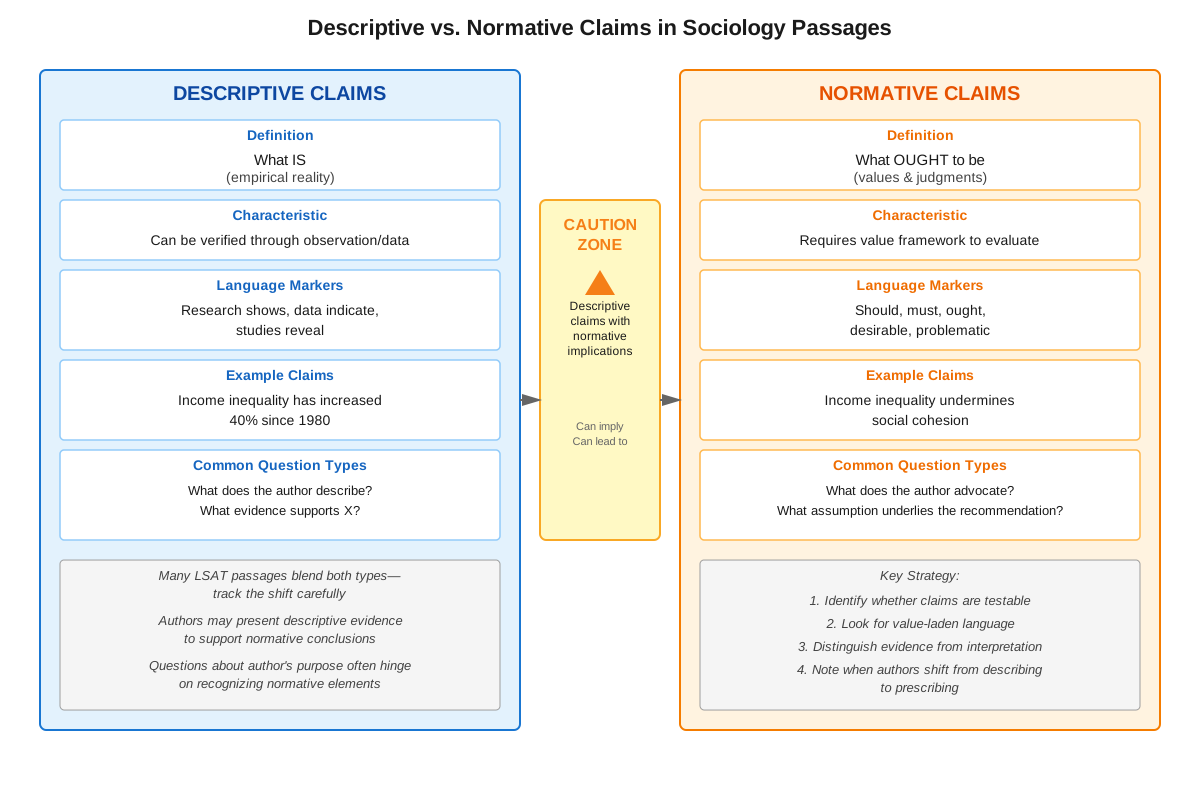
- [ ] Distinguish between descriptive sociological claims and normative arguments within passages
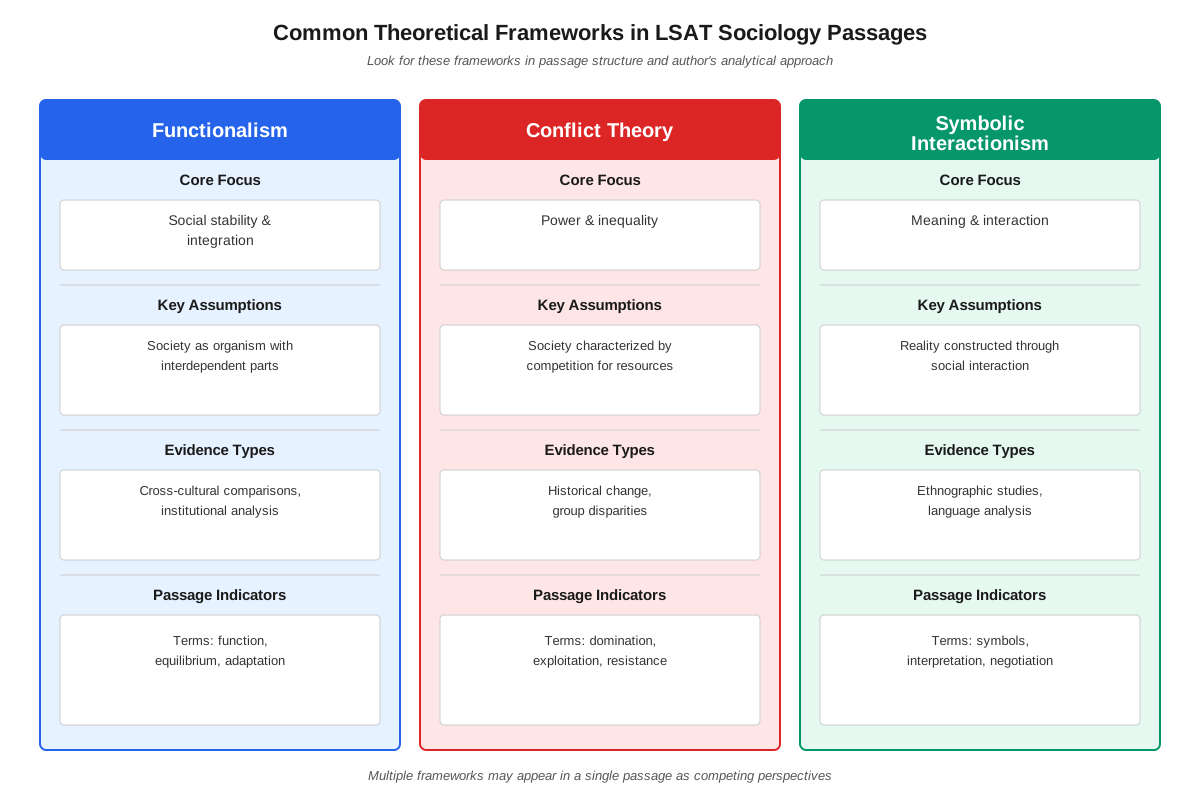
- [ ] Recognize common theoretical frameworks used in sociology passages (functionalism, conflict theory, symbolic interactionism)
- [ ] Analyze how authors use comparative evidence from different cultures or historical periods
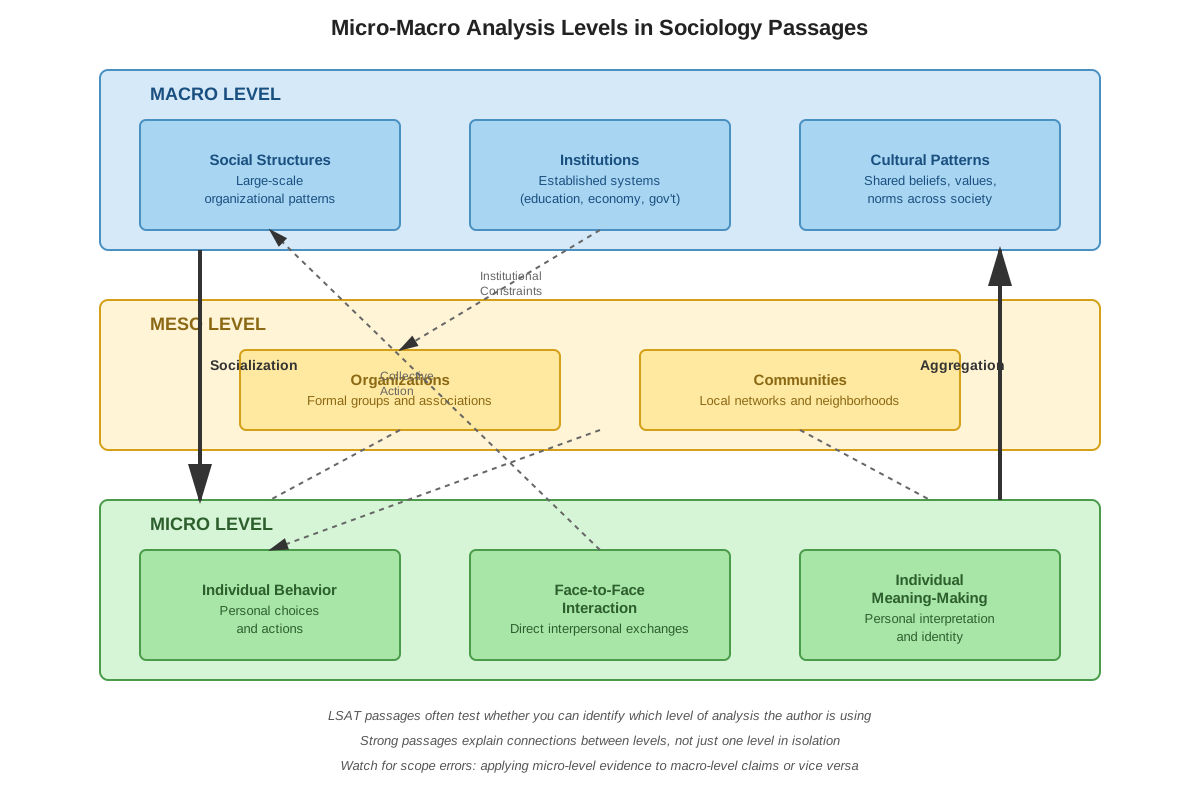
- [ ] Evaluate the relationship between micro-level (individual) and macro-level (societal) explanations in sociological arguments
Prerequisites
- Basic reading comprehension skills: Ability to identify main ideas, supporting details, and passage structure is foundational for tackling any LSAT passage, including sociology content.
- Understanding of argument structure: Recognition of premises, conclusions, and evidence types enables students to map the logical flow of sociological theories and claims.
- Familiarity with academic writing conventions: Sociology passages use formal academic language, citation of research, and disciplinary terminology that requires comfort with scholarly prose.
- General knowledge of social concepts: Basic awareness of terms like "culture," "institution," "norm," and "social structure" prevents confusion with specialized usage in passages.
Why This Topic Matters
Sociology passages matter for LSAT success because they test critical thinking skills that law schools value highly: the ability to understand complex social systems, evaluate competing explanations for human behavior, and recognize how evidence supports or undermines theoretical claims. Legal practice frequently involves understanding social contexts, institutional dynamics, and how different groups experience laws and policies—skills directly assessed through sociology passages.
Exam statistics reveal that sociology passages appear in approximately 3-4 Reading Comprehension sections per year, with each passage generating 5-8 questions. These passages commonly appear as either single passages (approximately 450-500 words) or as part of comparative reading sets where two shorter passages present contrasting sociological perspectives. Question types most frequently associated with sociology passages include: main point questions (15-20% of questions), inference questions (25-30%), function/purpose questions (20-25%), and application questions that ask how principles would apply to new scenarios (15-20%).
Common manifestations of sociology passages include: debates about social inequality and its causes, discussions of cultural change and globalization, analyses of social movements and collective action, examinations of family structures and gender roles across societies, investigations of deviance and social control, and explorations of how technology affects social relationships. The LSAT particularly favors passages that present a theoretical controversy or challenge conventional sociological wisdom, as these structures naturally generate questions about author's attitude, competing viewpoints, and logical relationships between claims.
Core Concepts
Characteristics of Sociology Passages
Sociology passages on the LSAT share several distinctive features that distinguish them from other passage types. First, they typically present social phenomena as objects of systematic study rather than as common-sense observations. The passage will frame everyday social experiences—like family dinners, workplace hierarchies, or neighborhood interactions—through theoretical lenses that make the familiar strange and worthy of analysis. This analytical distance is crucial to recognize because questions often test whether students understand the difference between folk explanations and sociological explanations.
Second, these passages frequently employ comparative methodology, examining how social patterns vary across cultures, historical periods, or demographic groups. The author might contrast marriage practices in industrial versus agrarian societies, compare social mobility rates across nations, or trace how attitudes toward authority have shifted over generations. This comparative structure creates opportunities for inference questions about what similarities or differences reveal about underlying social mechanisms.
Third, sociology passages regularly navigate between levels of analysis—moving from individual experiences (micro-level) to group dynamics (meso-level) to societal structures (macro-level). A passage might begin with how individuals experience workplace discrimination, then discuss organizational policies that perpetuate inequality, and finally examine how economic systems shape employment opportunities. Tracking these analytical shifts is essential for answering questions about passage structure and the function of specific paragraphs.
Common Theoretical Frameworks
Understanding the major theoretical traditions in sociology helps students anticipate how arguments will develop and what kinds of evidence will be presented. Functionalist approaches view society as a system of interconnected parts that work together to maintain stability. Passages using this framework emphasize how social institutions (family, education, religion) serve specific functions and how social practices persist because they meet societal needs. The LSAT might present functionalist explanations for phenomena like religious rituals (promoting social cohesion) or educational tracking (efficiently allocating talent).
Conflict theory perspectives, by contrast, emphasize competition over scarce resources, power struggles between groups, and how dominant groups maintain advantages. Passages employing conflict frameworks often discuss social inequality, exploitation, resistance, and social change. These passages might analyze how economic elites shape political institutions, how gender hierarchies are maintained through cultural practices, or how subordinate groups challenge existing arrangements.
Symbolic interactionist approaches focus on how people create meaning through social interaction, how identities are constructed and negotiated, and how symbols shape behavior. Passages using this framework typically examine face-to-face interactions, the role of language and gestures, and how individuals interpret social situations. The LSAT might present symbolic interactionist analyses of professional socialization, stigma management, or how cultural meanings are transmitted.
Evidence Types in Sociology Passages
Sociology passages draw on several distinct types of evidence, each with characteristic strengths and limitations that the LSAT tests. Quantitative research includes statistical data from surveys, census information, or experimental studies. Passages might cite correlation coefficients, percentage differences between groups, or trends over time. Questions often test whether students recognize the difference between correlation and causation or understand what statistical findings do and don't demonstrate.
Qualitative research involves detailed observations, interviews, or textual analysis. Passages might describe ethnographic studies where researchers immerse themselves in communities, in-depth interviews revealing how people understand their experiences, or historical analysis of documents. The LSAT tests whether students recognize the interpretive nature of qualitative evidence and understand claims about representativeness or generalizability.
Historical and comparative evidence examines social patterns across time or cultures. A passage might contrast contemporary American family structures with those in 19th-century Europe or compare educational systems in different nations. Questions test whether students can identify what specific comparisons demonstrate and recognize the limitations of cross-cultural generalizations.
Argument Patterns in Sociology Passages
Sociology passages typically follow several recognizable argument patterns. The challenge pattern presents a conventional view or established theory, then introduces evidence or reasoning that undermines it. For example, a passage might describe the traditional view that modernization inevitably leads to nuclear families, then present evidence from societies that maintain extended family structures despite industrialization. Questions test whether students can identify what's being challenged and how the challenge works.
The synthesis pattern presents two seemingly contradictory perspectives or findings, then offers a framework that reconciles them. A passage might discuss how some research shows social media increases isolation while other research shows it strengthens relationships, then propose that effects depend on usage patterns. Questions test whether students understand how the synthesis resolves the apparent contradiction.
The application pattern introduces a theoretical concept or research finding, then explores its implications for understanding specific social phenomena. A passage might explain the concept of "social capital" (networks and relationships as resources), then analyze how it explains educational achievement differences. Questions test whether students can apply the concept to new scenarios or recognize what phenomena it does and doesn't explain.
Vocabulary and Terminology
Sociology passages employ specialized terminology that students must interpret from context. Technical terms like "stratification," "socialization," "anomie," or "hegemony" will typically be defined or explained through examples within the passage. The LSAT rarely requires prior knowledge of sociological jargon but does test whether students can track how terms are used consistently throughout the passage.
Ordinary words with specialized meanings present a greater challenge. Terms like "structure," "function," "role," "status," or "institution" have specific sociological meanings that differ from everyday usage. A passage discussing "social structure" isn't referring to physical buildings but to patterns of relationships and positions. Questions may test whether students recognize these specialized meanings.
Concept Relationships
The core concepts within sociology passages form an interconnected system. Theoretical frameworks (functionalism, conflict theory, symbolic interactionism) → determine what evidence types are considered relevant and how they're interpreted. For instance, conflict theorists emphasize quantitative data on inequality, while symbolic interactionists favor qualitative data on meaning-making. These frameworks also shape argument patterns: functionalist passages often use synthesis patterns to show how apparent dysfunctions serve hidden functions, while conflict theory passages frequently use challenge patterns to expose how supposedly neutral institutions perpetuate inequality.
Levels of analysis (micro, meso, macro) → connect to evidence types: micro-level claims about individual behavior typically rely on qualitative interviews or observations, while macro-level claims about societal patterns draw on quantitative data or historical comparisons. Understanding these connections helps predict what kind of evidence will support different claims.
The relationship between descriptive and normative claims runs throughout sociology passages. Descriptive claims characterize what is (how societies function, what patterns exist), while normative claims assert what should be (whether arrangements are just, what policies should change). Many sociology passages move between these modes, and questions test whether students recognize when authors shift from description to evaluation.
These concepts connect to prerequisite knowledge of argument structure by providing specific instantiations of general logical relationships. The premises in sociology passages are often research findings or theoretical principles, while conclusions are explanations of social phenomena or predictions about social change. Understanding academic writing conventions helps students recognize when authors are presenting their own views versus summarizing others' positions—a crucial distinction for author's attitude questions.
Quick check — test yourself on Sociology passages so far.
Try Flashcards →High-Yield Facts
⭐ Sociology passages appear in approximately 15-20% of LSAT Reading Comprehension sections, making them one of the most common passage types alongside law, science, and humanities.
⭐ The LSAT never requires prior knowledge of sociological theories or terminology—all necessary information is contained within the passage, though familiarity with common frameworks aids comprehension speed.
⭐ Questions following sociology passages most frequently test inference (25-30%), function/purpose (20-25%), and main point (15-20%), with application questions also common.
⭐ Comparative structures are extremely common in sociology passages, with authors contrasting different societies, time periods, or theoretical perspectives to develop arguments.
⭐ The distinction between correlation and causation is heavily tested in passages presenting quantitative sociological research—authors often present correlational data while questions test whether students recognize causal claims aren't established.
- Sociology passages frequently present a theoretical debate or challenge to conventional wisdom, creating natural opportunities for questions about competing viewpoints and author's attitude.
- Micro-level and macro-level explanations often appear together in passages, with questions testing whether students can distinguish individual-level from societal-level claims.
- Passages discussing social inequality (class, race, gender) are particularly common and often involve normative dimensions that questions probe.
- Methodological limitations of sociological research (sample size, generalizability, researcher bias) are frequent subjects of inference and strengthening/weakening questions.
- Authors of sociology passages typically adopt a measured, analytical tone rather than strongly advocative positions, though subtle evaluative language appears in how research is characterized.
Common Misconceptions
Misconception: Sociology passages require background knowledge of sociological theories to answer questions correctly.
Correction: The LSAT is designed to test reading comprehension and reasoning skills, not prior content knowledge. All information needed to answer questions is contained in the passage. However, familiarity with common sociological concepts can improve reading speed and comprehension efficiency.
Misconception: Statistical evidence in sociology passages establishes causal relationships between social variables.
Correction: Most quantitative evidence in sociology passages shows correlations or associations, not causation. The LSAT frequently tests whether students recognize this distinction. Authors may speculate about causal mechanisms, but correlation alone doesn't prove causation—a principle heavily tested in inference and reasoning questions.
Misconception: When a sociology passage presents multiple theoretical perspectives, the author endorses all views equally.
Correction: Authors typically favor one perspective over others, signaled through evaluative language, amount of space devoted to each view, or explicit statements. Questions often test whether students can identify the author's attitude toward competing theories based on subtle textual cues.
Misconception: Sociology passages are primarily about social problems and policy solutions.
Correction: While some passages discuss social issues, most focus on explaining social phenomena, testing theoretical frameworks, or analyzing how social processes work. The LSAT emphasizes analytical and explanatory content over prescriptive policy arguments.
Misconception: Qualitative evidence (interviews, observations) is less rigorous or convincing than quantitative data in sociology passages.
Correction: The LSAT treats different evidence types as appropriate for different purposes. Qualitative evidence effectively reveals meanings, processes, and experiences that statistics cannot capture. Questions test whether students understand what each evidence type can and cannot demonstrate, not whether one type is inherently superior.
Misconception: Technical sociological terms must be memorized to understand passages.
Correction: Passages define or contextualize specialized terms sufficiently for comprehension. The key skill is tracking how terms are used consistently throughout the passage, not memorizing definitions from external sources.
Worked Examples
Example 1: Theoretical Challenge Passage
Passage Summary: A sociology passage discusses how traditional theories assumed that modernization would lead to secularization (decline of religious influence). The first paragraph presents this conventional view, citing evidence from Western European countries where church attendance declined as industrialization progressed. The second paragraph introduces the author's challenge: the United States represents a major exception, maintaining high religiosity despite advanced modernization. The third paragraph proposes an alternative theory: religious vitality depends not on modernization level but on whether religious institutions operate in competitive "markets" where multiple denominations vie for adherents. The final paragraph applies this market theory to explain both European decline (state-sponsored churches face no competition) and American vitality (denominational diversity creates competition).
Question: The author's primary purpose in the passage is to:
(A) Advocate for separation of church and state based on sociological evidence
(B) Challenge a theoretical prediction by proposing an alternative explanatory framework
(C) Demonstrate that modernization has no effect on religious participation
(D) Reconcile contradictory evidence about secularization through statistical analysis
(E) Criticize European religious institutions for failing to adapt to modernity
Worked Solution:
Step 1: Identify the passage structure. This follows the challenge pattern—conventional view presented, then undermined with counterevidence, then alternative explanation offered.
Step 2: Determine the author's main goal. The author isn't primarily advocating policy (eliminate A), demonstrating no relationship exists (eliminate C—the author proposes a different relationship), or criticizing institutions (eliminate E—the tone is analytical, not evaluative).
Step 3: Distinguish between (B) and (D). Does the author reconcile contradictory evidence or challenge a prediction? The passage presents the U.S. case as contradicting the secularization prediction, then offers a new theory (market competition) to explain patterns. This is challenging and replacing, not reconciling existing frameworks.
Answer: (B) The passage exemplifies the challenge pattern common in sociology passages, where established theories are questioned and alternatives proposed. Recognizing this structure immediately focuses attention on what's being challenged and what replaces it.
Example 2: Levels of Analysis Passage
Passage Summary: A sociology passage examines why some neighborhoods experience rapid gentrification while others remain stable. The first paragraph describes individual-level factors: young professionals seeking affordable housing near urban amenities make location decisions based on housing costs and commute times. The second paragraph shifts to organizational-level factors: real estate developers target specific neighborhoods for investment based on infrastructure and zoning regulations. The third paragraph introduces macro-level factors: global economic restructuring has created a new class of highly-paid knowledge workers who prefer urban living, while deindustrialization has left certain neighborhoods with undervalued property. The final paragraph argues that gentrification results from the interaction of all three levels—individual preferences, organizational strategies, and economic structures.
Question: According to the passage, which of the following best describes the relationship between individual location decisions and neighborhood gentrification?
(A) Individual decisions are the primary cause of gentrification, with other factors playing minor roles
(B) Individual decisions are influenced by macro-level economic changes and organizational investment patterns
(C) Individual decisions about housing are unrelated to broader gentrification processes
(D) Individual decisions can prevent gentrification if residents collectively resist change
(E) Individual decisions reflect personal preferences that exist independently of social context
Worked Solution:
Step 1: Locate relevant passage content. The passage discusses individual decisions in paragraph 1 but emphasizes interaction across levels in the final paragraph.
Step 2: Eliminate extreme answers. (A) contradicts the passage's emphasis on multiple levels. (C) contradicts the entire passage argument that individual decisions contribute to gentrification. (D) introduces collective resistance not discussed in the passage. (E) contradicts paragraph 3's point that individual preferences are shaped by economic restructuring.
Step 3: Confirm (B) matches the passage's multi-level framework. The passage explicitly states that individual preferences (for urban living) result from macro-level economic changes (knowledge economy) and that individuals respond to organizational actions (developer investment). This captures the interconnection across levels that the passage emphasizes.
Answer: (B) This question tests whether students recognize how sociology passages connect different levels of analysis. The passage doesn't privilege one level but shows how micro, meso, and macro factors interact—a common structure in LSAT sociology passages.
Exam Strategy
When approaching sociology passages on the LSAT, begin by identifying the passage structure in the first 30-45 seconds. Ask: Is this presenting a challenge to conventional wisdom? Comparing different theoretical perspectives? Applying a concept to explain phenomena? Recognizing the structure helps predict where the passage is going and what questions will likely ask.
Trigger words and phrases signal important logical relationships. Watch for: "traditionally assumed," "conventional view," or "long believed" (signals something will be challenged); "however," "yet," or "surprisingly" (introduces contrasts or counterevidence); "this suggests," "this explains," or "this accounts for" (marks causal claims or theoretical explanations); "some scholars argue... while others contend" (signals theoretical debate); "at the individual level... at the societal level" (marks shifts in analytical level).
For process-of-elimination, actively eliminate answers that: (1) confuse descriptive and normative claims—if the passage describes how society functions, eliminate answers suggesting the author advocates for change; (2) overstate causal claims—if the passage presents correlational evidence, eliminate answers asserting causation; (3) attribute views to the wrong source—carefully track whether claims belong to the author, other scholars, or research subjects; (4) introduce concepts not discussed in the passage—sociology passages are self-contained, so outside knowledge shouldn't drive answers.
Time allocation for sociology passages should follow the standard Reading Comprehension approach: spend 3-4 minutes on initial reading, focusing on structure and main argument rather than memorizing details. Use paragraph summaries (mental or brief notes) to track the function of each paragraph. Spend remaining time (approximately 5-6 minutes for a typical passage) on questions, returning to the passage to verify answers rather than relying on memory.
For comparative reading sets with sociology content, identify the relationship between passages immediately: Do they present competing theories? Different evidence for the same conclusion? Different aspects of the same phenomenon? This relationship generates most questions in comparative sets.
Memory Techniques
CAFE helps remember common theoretical frameworks in sociology passages:
- Conflict theory (competition, power, inequality)
- Action/Symbolic Interactionism (meaning, interaction, symbols)
- Functionalism (stability, integration, functions)
- Evolutionary/Historical (change over time, development)
QUALHIST captures the three main evidence types:
- QUALitative (interviews, observations, ethnography)
- Historical (change over time, cross-temporal comparison)
- International/Cross-cultural (comparative across societies)
- STatistical/Quantitative (surveys, experiments, numerical data)
MicroMesoMacro visualization: Picture a ladder with three rungs. Bottom rung = individuals and face-to-face interactions (micro). Middle rung = organizations and institutions (meso). Top rung = societies and large-scale structures (macro). When reading, mentally place each claim on the appropriate rung to track analytical levels.
The Challenge Pattern Formula: OLD VIEW + PROBLEM + NEW VIEW. When you see a passage presenting traditional assumptions, expect evidence that creates problems for those assumptions, followed by an alternative framework. This structure generates predictable questions about what's being challenged and how.
Summary
Sociology passages on the LSAT examine human social behavior, institutions, and cultural phenomena through theoretical frameworks and empirical evidence. These passages typically present arguments about how societies function, why social patterns exist, or how social change occurs. Success requires recognizing common passage structures (challenge patterns, theoretical debates, multi-level analyses), tracking different types of evidence (quantitative, qualitative, comparative), and distinguishing between descriptive claims about social reality and normative arguments about how society should be organized. The LSAT tests reading comprehension and reasoning skills through sociology content, not prior knowledge of sociological theories. Key skills include: identifying what theoretical claims are being made and what evidence supports them, recognizing shifts between micro-level (individual) and macro-level (societal) analysis, understanding the difference between correlation and causation in research findings, and tracking the author's attitude toward competing perspectives. Sociology passages appear frequently on the LSAT and generate questions across all major types, particularly inference, function/purpose, and main point questions. Mastering these passages requires attention to logical structure, careful tracking of multiple viewpoints, and recognition of how evidence relates to theoretical claims.
Key Takeaways
- Sociology passages appear in 15-20% of Reading Comprehension sections and test analytical reasoning through social science content, not prior sociological knowledge
- Common passage structures include challenge patterns (conventional view undermined), theoretical debates (competing frameworks compared), and multi-level analyses (connecting individual, organizational, and societal factors)
- Track the distinction between descriptive claims (what is) and normative claims (what should be), as questions frequently test whether students recognize this difference
- Evidence types in sociology passages—quantitative data, qualitative research, and comparative/historical analysis—each have characteristic strengths and limitations that questions probe
- Recognize shifts between micro-level (individual behavior), meso-level (organizations/groups), and macro-level (societal structures) analysis, as questions test whether students understand these different analytical levels
- The LSAT heavily tests whether students distinguish correlation from causation when passages present statistical evidence about social patterns
- Author's attitude in sociology passages is typically analytical and measured rather than strongly advocative, with subtle evaluative language signaling preferences among competing theories
Related Topics
Psychology passages share similarities with sociology passages in examining human behavior but focus on individual cognition, emotion, and mental processes rather than social structures and group dynamics. Mastering sociology passages builds skills for psychology content.
Economics passages overlap with sociology in analyzing social institutions and collective behavior but emphasize resource allocation, market mechanisms, and rational choice frameworks. Understanding sociology passages helps with economic content that addresses social dimensions of economic behavior.
Anthropology passages examine cultural practices and human societies with methods similar to sociology but often focus on non-Western or historical societies and emphasize cultural relativism. Skills developed for sociology passages transfer directly to anthropological content.
Law passages discussing social policy frequently incorporate sociological evidence and reasoning about how legal rules affect social behavior. Sociology passage skills enhance comprehension of law passages with empirical social science content.
Comparative reading sets often pair sociology passages with related content from other disciplines, requiring integration of sociological and non-sociological perspectives on the same phenomenon.
Practice CTA
Now that you've mastered the core concepts and strategies for sociology passages, it's time to apply this knowledge to actual LSAT questions. Work through the practice passages and questions, paying particular attention to identifying passage structures, tracking levels of analysis, and distinguishing evidence types. Use the flashcards to reinforce key concepts and theoretical frameworks. Remember: sociology passages test your reading comprehension and reasoning skills, not your prior knowledge. Trust the passage, track the argument carefully, and apply the strategies you've learned. With focused practice, you'll develop the confidence and skill to tackle any sociology passage the LSAT presents. Your investment in mastering this high-yield topic will pay dividends on test day!
Sign up free to keep reading
Create a free AnvayaPrep account to finish this LSAT guide on Sociology passages — plus flashcards and practice questions.