Overview
Author attitude questions represent one of the most frequently tested reading comprehension question types on the LSAT, appearing in virtually every Reading Comprehension section. These questions ask test-takers to identify the author's perspective, tone, or stance toward the subject matter discussed in the passage. Unlike questions that test factual recall or structural understanding, author attitude questions require students to read between the lines and synthesize subtle linguistic cues, word choice, and rhetorical patterns to determine how the author feels about the topic at hand.
Mastering LSAT author attitude questions is essential because they test a critical skill that law schools value highly: the ability to discern implicit meaning and evaluate the perspective behind written arguments. In legal practice, attorneys must constantly assess the positions, biases, and attitudes of judges, opposing counsel, and witnesses based on their written and spoken words. The LSAT tests this skill by presenting passages where the author's attitude may range from enthusiastic endorsement to measured skepticism, from cautious optimism to outright dismissal.
Within the broader landscape of reading comprehension, author attitude questions connect intimately with other question types. Understanding the author's attitude helps answer main point questions (since the author's perspective often drives the passage's purpose), strengthens performance on inference questions (as attitude provides context for drawing conclusions), and aids in answering tone questions (which are closely related but focus more narrowly on emotional quality). Author attitude questions typically account for 10-15% of all Reading Comprehension questions, making them a high-yield area for focused study and practice.
Learning Objectives
- [ ] Identify how Author attitude questions appears in LSAT questions
- [ ] Explain the reasoning pattern behind Author attitude questions
- [ ] Apply Author attitude questions to solve LSAT-style problems accurately
- [ ] Distinguish between different degrees of authorial stance (strong vs. moderate positions)
- [ ] Recognize linguistic markers and word choice patterns that signal author attitude
- [ ] Eliminate incorrect answer choices that mischaracterize the intensity or direction of the author's position
- [ ] Synthesize multiple textual clues to form a complete picture of the author's perspective
Prerequisites
- Basic passage comprehension skills: Understanding the literal meaning of complex academic prose is necessary before analyzing the author's implicit attitudes toward that content.
- Familiarity with passage structure: Recognizing how passages are organized (introduction, evidence, counterarguments, conclusion) helps identify where authors typically reveal their attitudes most clearly.
- Understanding of rhetorical devices: Knowledge of how authors use language strategically (concession, qualification, emphasis) provides the foundation for detecting subtle attitudinal cues.
- Vocabulary for describing attitudes: Familiarity with terms like "skeptical," "ambivalent," "enthusiastic," and "dismissive" enables accurate matching between passage content and answer choices.
Why This Topic Matters
Author attitude questions matter profoundly both for LSAT success and for the legal reasoning skills the exam is designed to measure. In legal practice, attorneys must constantly evaluate the positions and biases of various parties—judges writing opinions, expert witnesses providing testimony, or opposing counsel making arguments. The ability to accurately assess someone's attitude toward a position, even when that attitude is expressed subtly or indirectly, is fundamental to legal analysis and advocacy.
On the LSAT specifically, author attitude questions appear with remarkable consistency. Test-takers can expect to encounter 2-4 author attitude questions per Reading Comprehension section, which translates to approximately 8-16 questions across a full LSAT administration. These questions carry the same weight as any other Reading Comprehension question, making them a significant contributor to overall scores. Students who master this question type gain a reliable source of points that can meaningfully improve their percentile ranking.
Author attitude questions appear in several characteristic forms on the LSAT. The most common formulation asks directly about the author's attitude: "The author's attitude toward X can best be described as..." Other variations include questions about the author's opinion ("The author would most likely agree with which of the following?"), the author's purpose in mentioning something (which often reveals attitude), and comparative attitude questions ("The author's attitude toward Theory A differs from the attitude toward Theory B in that..."). These questions appear across all passage types—humanities, social sciences, natural sciences, and law—making attitude analysis a universally applicable skill.
Core Concepts
Defining Author Attitude
Author attitude refers to the writer's perspective, stance, or disposition toward the subject matter, arguments, theories, or positions discussed in a passage. This attitude exists on multiple dimensions: direction (positive, negative, or neutral), intensity (strong or moderate), and certainty (confident or tentative). Understanding author attitude requires distinguishing between what the passage describes (the content) and how the author feels about that content (the attitude).
The LSAT tests attitude recognition because passages often present multiple viewpoints, theories, or positions. The author may describe a theory in detail without endorsing it, or may present counterarguments while subtly undermining them. Test-takers must differentiate between the author's own position and the positions the author is merely reporting or analyzing.
Linguistic Markers of Attitude
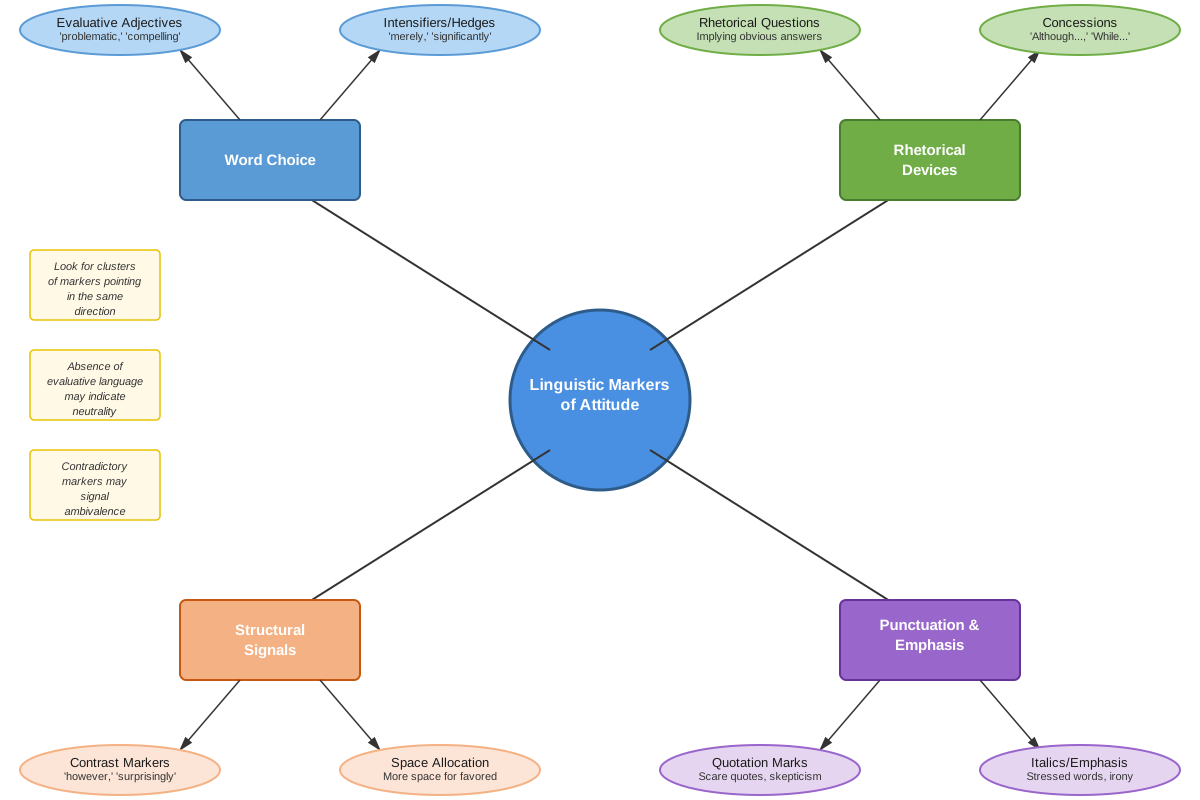
Authors reveal their attitudes through specific linguistic choices that function as textual evidence. Evaluative adjectives represent one of the most direct markers: words like "innovative," "problematic," "compelling," or "misguided" signal clear authorial judgment. When an author describes a theory as "elegant" or a methodology as "flawed," these word choices provide explicit attitude indicators.
Qualifiers and hedging language reveal the degree of certainty or commitment the author has toward a position. Phrases like "may suggest," "appears to indicate," or "could potentially" signal tentative or cautious attitudes, while definitive language like "clearly demonstrates" or "unquestionably proves" indicates stronger conviction. The presence or absence of qualifiers helps determine the intensity dimension of author attitude.
Concessive language often signals nuanced attitudes. When authors use phrases like "although," "despite," "while it is true that," or "admittedly," they typically acknowledge opposing viewpoints or limitations before asserting their own position. The structure "X is true, but Y" usually indicates that the author's real emphasis lies with Y, even while acknowledging X.
Rhetorical questions frequently signal skepticism or disagreement. When an author asks, "But does this theory really account for all the evidence?" the question form itself suggests doubt about the theory's adequacy. Similarly, phrases like "one might wonder" or "it remains unclear" indicate reservations about the position being discussed.
The Attitude Spectrum
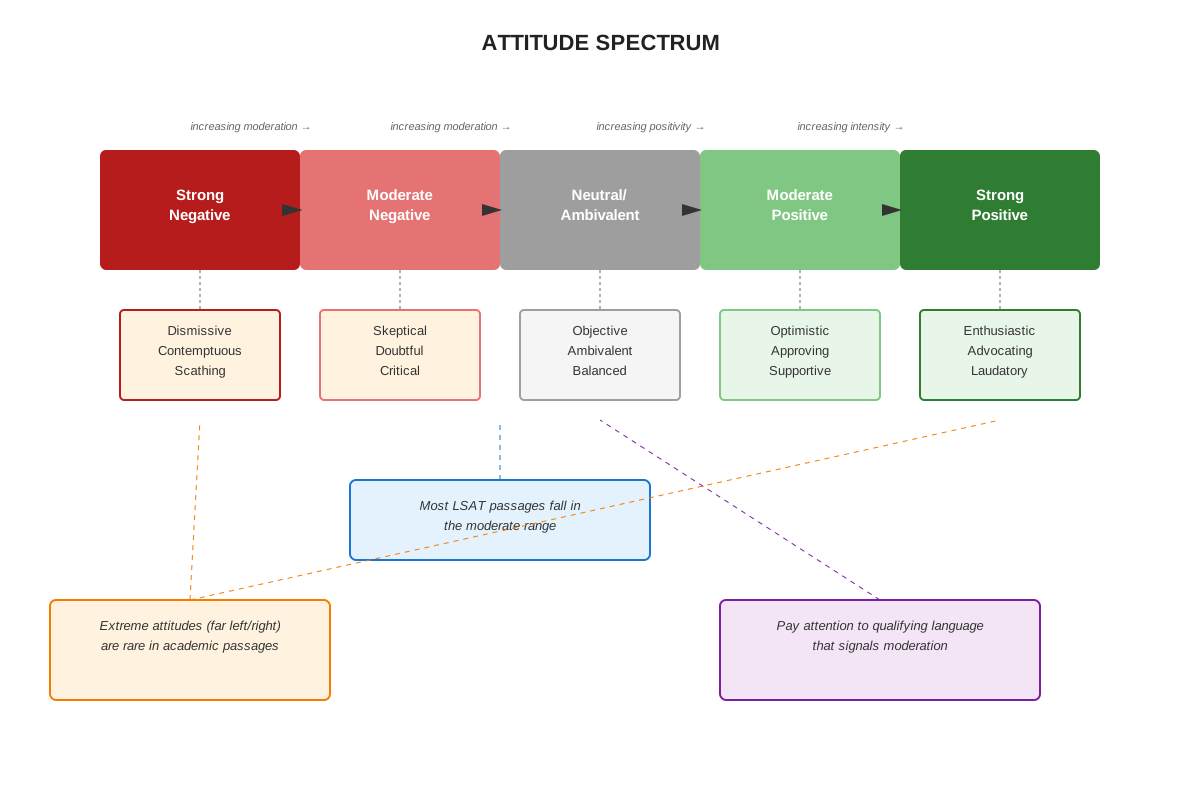
Author attitudes exist along a spectrum rather than in binary categories. Understanding this spectrum is crucial for selecting answer choices that accurately capture both the direction and intensity of the author's position.
| Attitude Category | Intensity | Example Descriptors | Typical Markers |
|---|---|---|---|
| Strong Positive | High | Enthusiastic, laudatory, championing | "Brilliant," "revolutionary," "definitively proves" |
| Moderate Positive | Medium | Approving, optimistic, supportive | "Promising," "valuable contribution," "suggests" |
| Neutral/Balanced | Low | Objective, impartial, analytical | "Describes," "examines," "presents" |
| Moderate Negative | Medium | Skeptical, questioning, concerned | "Problematic," "raises questions," "may overlook" |
| Strong Negative | High | Dismissive, condemning, rejecting | "Fundamentally flawed," "fails to account," "misguided" |
The LSAT frequently includes wrong answer choices that correctly identify the direction of the author's attitude but mischaracterize its intensity. An author who is "cautiously optimistic" might be incorrectly described as "enthusiastically supportive," or an author who is "mildly skeptical" might be wrongly characterized as "completely dismissive."
Distinguishing Author Voice from Other Voices
LSAT passages frequently present multiple perspectives, and a critical skill involves distinguishing the author's own attitude from the attitudes of others discussed in the passage. When a passage states, "Critics argue that the theory is fundamentally flawed," this reveals the critics' attitude, not necessarily the author's. The author might agree with the critics, disagree with them, or remain neutral.
Attribution markers help identify whose attitude is being expressed. Phrases like "according to," "proponents claim," "critics contend," or "researchers believe" signal that the attitude belongs to someone other than the author. Conversely, when the author makes unattributed statements or uses first-person constructions ("I argue," "this essay contends"), the attitude clearly belongs to the author.
The author's attitude toward these other voices provides additional layers of meaning. An author might describe a theory neutrally but reveal skepticism toward that theory through how they present its critics' arguments—giving those criticisms prominent placement, presenting them without rebuttal, or using language that makes the criticisms seem compelling.
Context-Dependent Attitude Shifts
Authors may express different attitudes toward different elements within a single passage. An author might be enthusiastic about a theory's innovative approach while remaining skeptical about its empirical support, or might praise a researcher's methodology while questioning their conclusions. LSAT author attitude questions often specify which aspect of the passage the question addresses: "The author's attitude toward the methodology described in lines 15-20..." This specificity requires careful attention to exactly what the question asks about.
Passage structure often reveals attitude through emphasis and organization. Authors typically devote more space to positions they favor and may place their own position in emphatic locations (the conclusion, immediately after refuting alternatives). The amount of textual real estate devoted to different viewpoints, combined with the language used to describe them, provides evidence for determining author attitude.
Concept Relationships
The concepts within author attitude questions form an interconnected system where each element reinforces and clarifies the others. Linguistic markers serve as the textual evidence that allows test-takers to position the author's attitude along the attitude spectrum. These markers must be interpreted within the context of distinguishing author voice from other voices, since the same evaluative language might describe someone else's position rather than the author's own view. This distinction, in turn, requires understanding context-dependent attitude shifts, as authors may express different attitudes toward different aspects of the subject matter.
The relationship flows as follows: Linguistic markers → Evidence for attitude spectrum placement → Filtered through voice attribution → Contextualized by passage structure → Results in accurate attitude identification.
Author attitude questions connect to prerequisite knowledge of passage structure because authors typically reveal their attitudes most clearly at structural turning points: when introducing their thesis, when transitioning from describing others' views to presenting their own, and in concluding paragraphs. Understanding rhetorical devices enables recognition of the linguistic markers that signal attitude.
Author attitude questions also connect forward to other reading comprehension question types. Accurately identifying author attitude strengthens performance on main point questions (the author's attitude often drives the passage's purpose), inference questions (the author's attitude provides context for what they would likely believe), and application questions (understanding the author's attitude helps predict how they would respond to new scenarios). Author attitude serves as a lens through which other aspects of passage comprehension become clearer.
High-Yield Facts
⭐ Author attitude questions appear 2-4 times per Reading Comprehension section, making them one of the most frequent question types.
⭐ Evaluative adjectives (innovative, problematic, compelling, flawed) provide the most direct evidence of author attitude.
⭐ Wrong answers frequently mischaracterize the intensity rather than the direction of the author's attitude.
⭐ Concessive language ("although," "despite," "while") typically signals that the author's true position follows the concession.
⭐ Neutral, descriptive language without evaluative terms suggests an objective or balanced authorial stance.
- Rhetorical questions in LSAT passages almost always signal skepticism or disagreement with the position being questioned.
- Authors reveal their attitudes through what they emphasize (more space, prominent placement) and what they minimize or omit.
- Attribution markers ("critics argue," "proponents claim") indicate that the attitude belongs to someone other than the author.
- Qualifiers like "may," "might," "appears to," and "suggests" indicate tentative or cautious attitudes, while definitive language indicates stronger conviction.
- The author's attitude toward a theory can differ from their attitude toward the theory's proponents, methodology, or implications.
- Passages describing historical developments or scientific processes often maintain neutral attitudes, while passages arguing for positions typically reveal clear authorial stances.
- The absence of criticism when describing a position often indicates tacit approval, especially when the author criticizes alternative positions.
Quick check — test yourself on Author attitude questions so far.
Try Flashcards →Common Misconceptions
Misconception: If the author describes something in detail, they must have a positive attitude toward it.
Correction: Authors frequently describe theories, positions, or methodologies in detail precisely to analyze their flaws or limitations. Detailed description indicates importance to the passage's argument, not necessarily approval. Look for evaluative language within the description to determine actual attitude.
Misconception: Neutral language means the author has no opinion or doesn't care about the topic.
Correction: Neutral language may indicate an objective, analytical approach rather than lack of opinion. Some passages aim to present balanced analysis rather than advocacy. Additionally, authors may maintain neutral language while revealing attitude through structure, emphasis, and the relative treatment of different positions.
Misconception: If the author presents both sides of an issue, their attitude must be "ambivalent" or "uncertain."
Correction: Presenting multiple perspectives is a rhetorical strategy, not necessarily evidence of ambivalence. Authors often present opposing views to refute them or to demonstrate thorough analysis. Look for how the author treats each perspective—equal weight and neutral language suggests balance, while unequal treatment or evaluative language reveals preference.
Misconception: Strong language always indicates strong attitude.
Correction: Authors may use strong language when describing others' positions without endorsing that intensity themselves. Always check attribution—"Critics vehemently oppose" describes the critics' strong attitude, not necessarily the author's. The author might describe this opposition neutrally or even skeptically.
Misconception: The author's attitude must remain consistent throughout the entire passage.
Correction: Authors frequently express different attitudes toward different aspects of the subject matter. An author might be enthusiastic about a research question while skeptical about proposed answers, or supportive of a theory's goals while critical of its methodology. Author attitude questions often specify which aspect they're asking about for precisely this reason.
Misconception: If the passage is about science or history, the author's attitude must be objective and neutral.
Correction: While some scientific and historical passages maintain objectivity, many argue for specific interpretations, methodologies, or theories. An author might advocate for a particular historical interpretation or argue that one scientific approach is superior to another. Genre doesn't determine attitude—textual evidence does.
Worked Examples
Example 1: Identifying Moderate Skepticism
Passage Excerpt: "While the new archaeological methodology has gained considerable attention in recent years, several aspects of its application remain troubling. Proponents tout its ability to reveal patterns invisible to traditional approaches, and indeed, the technique has produced some intriguing results. However, the methodology's reliance on statistical models that require numerous assumptions about ancient behavior patterns raises questions about the reliability of its conclusions. Without more rigorous validation against known archaeological contexts, the technique's promise may exceed its actual utility."
Question: The author's attitude toward the new archaeological methodology can best be described as:
(A) Enthusiastically supportive
(B) Cautiously optimistic
(C) Moderately skeptical
(D) Completely dismissive
(E) Entirely neutral
Analysis:
First, identify linguistic markers of attitude:
- "remain troubling" (negative evaluation)
- "indeed, the technique has produced some intriguing results" (concession acknowledging positive aspects)
- "raises questions about the reliability" (expression of doubt)
- "promise may exceed its actual utility" (skeptical conclusion)
Next, determine direction and intensity:
- Direction: The author acknowledges some positive aspects but emphasizes concerns, indicating a negative-leaning attitude
- Intensity: The author uses qualified language ("raises questions," "may exceed") rather than absolute condemnation, indicating moderate rather than strong negativity
Evaluate answer choices:
- (A) Enthusiastically supportive: Incorrect direction—the author expresses concerns, not support
- (B) Cautiously optimistic: Incorrect direction—while the author acknowledges positive aspects, the overall thrust is skeptical, not optimistic
- (C) Moderately skeptical: CORRECT—matches both the negative direction and moderate intensity
- (D) Completely dismissive: Correct direction but wrong intensity—the author acknowledges "intriguing results," which is incompatible with complete dismissal
- (E) Entirely neutral: Incorrect—evaluative language like "troubling" and "raises questions" indicates a position, not neutrality
Answer: (C)
This example demonstrates how author attitude questions require synthesizing multiple textual clues and matching both direction and intensity to the correct answer choice.
Example 2: Distinguishing Author Voice from Others' Voices
Passage Excerpt: "Legal scholars have long debated the proper interpretation of the statute. Traditionalists insist that the language must be read according to its original meaning, arguing that any other approach undermines democratic legitimacy. This position, however, fails to account for the inevitable ambiguities that arise when eighteenth-century language is applied to contemporary circumstances. A more flexible interpretive approach, one that considers the statute's underlying purposes alongside its text, better serves the law's function in modern society."
Question: The author's attitude toward the traditionalist position can best be described as:
(A) Strongly supportive
(B) Mildly approving
(C) Analytically neutral
(D) Respectfully disagreeing
(E) Contemptuously dismissive
Analysis:
First, distinguish whose attitude is being expressed:
- "Traditionalists insist" and "arguing that" are attribution markers indicating the traditionalist position
- "This position, however, fails to account" is unattributed, indicating the author's own evaluation
- "A more flexible interpretive approach...better serves" presents the author's preferred alternative
Next, identify the author's attitude toward the traditionalist position:
- The author presents the traditionalist view fairly ("insist," "arguing") without initially dismissive language
- "However" signals a turn to criticism
- "fails to account for" is a clear negative evaluation
- The author advocates for an alternative approach, indicating disagreement
- The criticism is substantive but not personally attacking or contemptuous
Evaluate answer choices:
- (A) Strongly supportive: Incorrect—the author explicitly criticizes the position
- (B) Mildly approving: Incorrect—"fails to account" indicates disapproval, not approval
- (C) Analytically neutral: Incorrect—the author takes a clear position against the traditionalist view
- (D) Respectfully disagreeing: CORRECT—the author presents the view fairly before offering substantive criticism without personal attacks
- (E) Contemptuously dismissive: Wrong intensity—the criticism is measured and substantive, not contemptuous
Answer: (D)
This example illustrates the importance of distinguishing the author's voice from others' voices and recognizing that disagreement can be expressed with varying degrees of respect or dismissiveness.
Exam Strategy
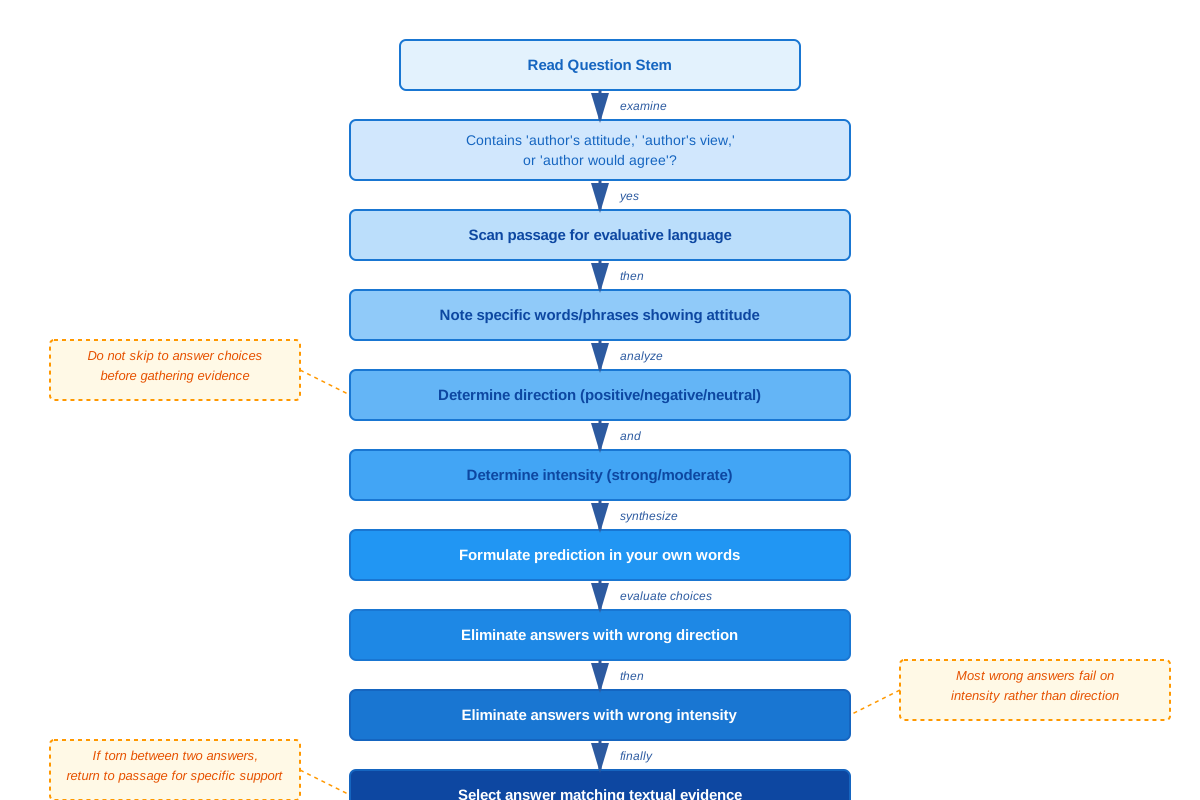
When approaching author attitude questions on the LSAT, implement a systematic process that maximizes accuracy while managing time effectively.
Step 1: Identify the Question Type
Recognize author attitude questions through trigger phrases:
- "The author's attitude toward X can best be described as..."
- "The author's view of X is most likely one of..."
- "The author regards X with..."
- "Which of the following best characterizes the author's opinion of X?"
Step 2: Locate Relevant Passage Content
If the question specifies a particular subject ("the author's attitude toward the new theory"), locate where that subject is discussed. Author attitude is often most clearly revealed:
- In the introduction (establishing the author's thesis)
- Immediately after presenting opposing views (where the author responds)
- In concluding paragraphs (where the author synthesizes their position)
- At structural transitions marked by "however," "but," "yet," or "nevertheless"
Step 3: Collect Textual Evidence
Identify specific linguistic markers:
- Evaluative adjectives and adverbs
- Qualifiers indicating certainty level
- Concessive language
- Rhetorical questions
- Attribution markers (to distinguish author's voice from others')
Step 4: Determine Direction and Intensity
Plot the author's attitude on the spectrum:
- Direction: Positive, negative, or neutral?
- Intensity: Strong, moderate, or mild?
Exam Tip: If you're uncertain between two answer choices, they often differ in intensity rather than direction. Return to the passage and look specifically for qualifiers or absolute language to determine the correct intensity level.
Step 5: Predict Before Looking at Answers
Before examining answer choices, formulate your own description of the author's attitude using the spectrum categories. This prediction helps avoid being swayed by attractive but incorrect options.
Step 6: Eliminate Systematically
Use process of elimination:
- First, eliminate choices with the wrong direction (if the author is critical, eliminate positive attitudes)
- Second, eliminate choices with the wrong intensity (if the author uses qualified language, eliminate extreme attitudes)
- Third, eliminate choices that confuse the author's attitude with someone else's attitude
Time Management
Author attitude questions typically require 60-90 seconds. If you're spending more than 90 seconds, you may be overthinking. Trust clear textual evidence over subtle interpretations. If genuinely uncertain, mark the question for review and move forward—returning with fresh eyes often clarifies the answer.
Common Trap Patterns
- Intensity traps: Answer choices that correctly identify direction but exaggerate or understate intensity
- Attribution traps: Answer choices that describe someone else's attitude rather than the author's
- Partial reading traps: Answer choices that capture the author's attitude toward one aspect but not the aspect the question asks about
- Neutral traps: "Objective" or "impartial" answers are tempting but often incorrect when subtle evaluative language reveals a position
Memory Techniques
The SCALE Mnemonic for Attitude Analysis
- Search for evaluative language (adjectives, adverbs)
- Check for concessions and qualifiers
- Attribution—whose voice is this?
- Locate structural emphasis (what gets more space?)
- Evaluate intensity (strong or moderate?)
The Attitude Spectrum Visualization
Visualize a horizontal line with five points:
Strongly Negative — Moderately Negative — Neutral — Moderately Positive — Strongly PositiveAs you read, mentally place the author's attitude on this line. This visualization helps distinguish between similar answer choices.
The "However" Rule
Remember: "The author's real position usually follows 'however.'" When you see concessive language (although, despite, while, admittedly) followed by "however," "but," or "yet," the author's true attitude typically appears after the transition word.
The Attribution Check
Before selecting an answer, ask: "Is this the AUTHOR's attitude or someone ELSE's attitude that the author is describing?" Visualize the author as a separate person from the theories, critics, and proponents discussed in the passage.
Intensity Keywords
Memorize these intensity indicators:
Strong intensity: revolutionary, fundamentally, completely, entirely, definitively, unquestionably, clearly, obviously
Moderate intensity: problematic, questionable, promising, valuable, suggests, indicates, appears, may, might, could
Neutral intensity: describes, presents, examines, discusses, outlines, surveys
Summary
Author attitude questions test the ability to identify the writer's perspective, stance, or disposition toward subject matter discussed in LSAT Reading Comprehension passages. These questions appear 2-4 times per section and require synthesizing linguistic markers—including evaluative adjectives, qualifiers, concessive language, and rhetorical questions—to determine both the direction (positive, negative, or neutral) and intensity (strong or moderate) of the author's position. Success requires distinguishing the author's own voice from the voices of others described in the passage, recognizing that authors may express different attitudes toward different aspects of the subject matter, and matching textual evidence to answer choices that accurately capture both attitudinal dimensions. The most common error patterns involve mischaracterizing intensity rather than direction, confusing the author's attitude with others' attitudes, and selecting answers based on partial rather than complete reading of relevant passage content. Mastering author attitude questions provides a reliable source of points while developing the critical skill of discerning implicit meaning and evaluating perspective—abilities essential both for LSAT success and for legal reasoning.
Key Takeaways
- Author attitude questions test both direction (positive/negative/neutral) and intensity (strong/moderate/mild) of the author's perspective
- Evaluative adjectives, qualifiers, and concessive language provide the most reliable textual evidence for determining attitude
- Wrong answers typically mischaracterize intensity rather than direction—pay careful attention to whether the author uses qualified or absolute language
- Always distinguish the author's own attitude from the attitudes of others described in the passage using attribution markers
- The author's attitude may vary across different aspects of the subject matter—carefully note what specific element the question asks about
- Concessive language ("although," "despite," "while") typically signals that the author's true position follows the concession
- Systematic evidence collection and prediction before examining answer choices improves accuracy and efficiency
Related Topics
Main Point Questions: Understanding author attitude strengthens performance on main point questions because the author's perspective often drives the passage's central purpose. An author's critical attitude toward a theory, for example, often means the main point involves explaining that theory's limitations.
Inference Questions: Author attitude provides crucial context for inference questions. Knowing the author's attitude helps predict what the author would likely believe about related issues not explicitly discussed in the passage.
Tone Questions: While closely related to attitude questions, tone questions focus more narrowly on the emotional quality or style of the writing. Mastering attitude questions provides the foundation for distinguishing between similar tones (skeptical vs. dismissive, approving vs. enthusiastic).
Function Questions: These questions ask why the author includes specific information or examples. Understanding the author's overall attitude helps explain the function of particular passage elements—an author with a critical attitude might include an example to illustrate a flaw.
Comparative Reading: In comparative passages, identifying each author's attitude enables analysis of how the authors' perspectives relate to each other—whether they agree, disagree, or address different aspects of an issue.
Practice CTA
Now that you've mastered the core concepts of author attitude questions, it's time to put your knowledge into practice. Attempt the practice questions to test your ability to identify linguistic markers, distinguish author voice from other voices, and accurately match attitudes to answer choices. Use the flashcards to reinforce high-yield facts and common trap patterns. Remember: author attitude questions are highly learnable—systematic practice with these strategies will translate directly into points on test day. Each practice question you complete strengthens your pattern recognition and builds the confidence needed for LSAT success.
Sign up free to keep reading
Create a free AnvayaPrep account to finish this LSAT guide on Author attitude questions — plus flashcards and practice questions.