Overview
Author would agree questions represent one of the most frequently tested reading comprehension question types on the LSAT. These questions ask test-takers to identify statements, positions, or viewpoints that align with the author's perspective as expressed in the passage. Unlike inference questions that require drawing conclusions beyond what's explicitly stated, author agreement questions focus on understanding and accurately representing the author's explicitly stated or clearly implied views. Mastering this question type is essential because it tests the fundamental skill of reading comprehension: understanding what an author actually believes and advocates.
On the LSAT, LSAT author would agree questions typically appear in forms such as "The author would most likely agree with which one of the following?" or "Based on the passage, the author's view is most consistent with which statement?" These questions assess whether students can distinguish between the author's actual position and other viewpoints mentioned in the passage, such as those of critics, historical figures, or alternative theories the author discusses but doesn't endorse. The ability to track the author's voice throughout a complex passage—especially in comparative reading passages where multiple perspectives are presented—is crucial for LSAT success.
This topic sits at the intersection of several critical reading comprehension skills. It requires students to identify the author's main point, understand the passage structure, recognize the difference between description and endorsement, and track opinion indicators throughout the text. Author agreement questions build upon basic comprehension skills while serving as a foundation for more complex question types like application questions and reasoning questions. Success with these questions demonstrates that a student can accurately represent an author's position without distortion, a skill that's fundamental to legal reasoning and analysis.
Learning Objectives
- [ ] Identify how Author would agree questions appears in LSAT questions
- [ ] Explain the reasoning pattern behind Author would agree questions
- [ ] Apply Author would agree questions to solve LSAT-style problems accurately
- [ ] Distinguish between the author's position and other viewpoints presented in a passage
- [ ] Recognize language cues that signal the author's opinion versus neutral description
- [ ] Evaluate answer choices for degree of certainty that matches the author's tone
- [ ] Identify common trap answers that misrepresent the author's position
Prerequisites
- Basic passage comprehension skills: Understanding the literal meaning of complex texts is necessary before identifying author viewpoints
- Ability to identify main ideas and supporting details: Author agreement questions often hinge on understanding the passage's central argument
- Familiarity with passage structure: Recognizing how authors organize arguments helps track their position throughout the text
- Understanding of opinion indicators: Words like "unfortunately," "clearly," or "merely" signal the author's stance
- Knowledge of comparative reading format: Some author agreement questions require distinguishing between two authors' positions
Why This Topic Matters
Author would agree questions appear with remarkable consistency on the LSAT, typically comprising 15-25% of all reading comprehension questions. In a standard LSAT reading comprehension section with 27 questions across four passages, students can expect to encounter 4-7 author agreement questions. This frequency makes them one of the highest-yield question types to master, as improvement here directly translates to score increases.
Beyond test performance, the skill of accurately identifying an author's position has profound real-world applications in legal practice. Attorneys must constantly interpret written arguments, judicial opinions, and statutory language to understand what various parties actually advocate. Misrepresenting an opponent's position or a precedent's holding can have serious professional consequences. The LSAT tests this skill because it's fundamental to legal reasoning: before you can critique, apply, or extend an argument, you must first understand it accurately.
On the exam, author agreement questions commonly appear after passages discussing controversial topics where the author evaluates multiple perspectives. They're particularly prevalent in passages about legal theory, social policy, scientific debates, and humanities topics where interpretation matters. The LSAT often uses these questions to test whether students can distinguish between what the author describes (perhaps neutrally presenting others' views) and what the author actually endorses. This distinction becomes especially challenging in comparative reading passages, where students must track two different authors' positions simultaneously while keeping them separate.
Core Concepts
Identifying Author Agreement Questions
Author would agree questions can be recognized by their distinctive question stems. Common formulations include:
- "The author would most likely agree with which one of the following?"
- "Which one of the following is most consistent with the author's position?"
- "Based on the passage, the author would be most likely to endorse which statement?"
- "The author's view suggests that..."
- "It can be inferred that the author believes..."
These questions differ from pure inference questions in that they focus specifically on the author's viewpoint rather than logical conclusions that could be drawn from the passage. The key distinction is that author agreement questions ask what the author thinks, believes, or would support, making the author's perspective the central focus.
The Author's Voice vs. Other Voices
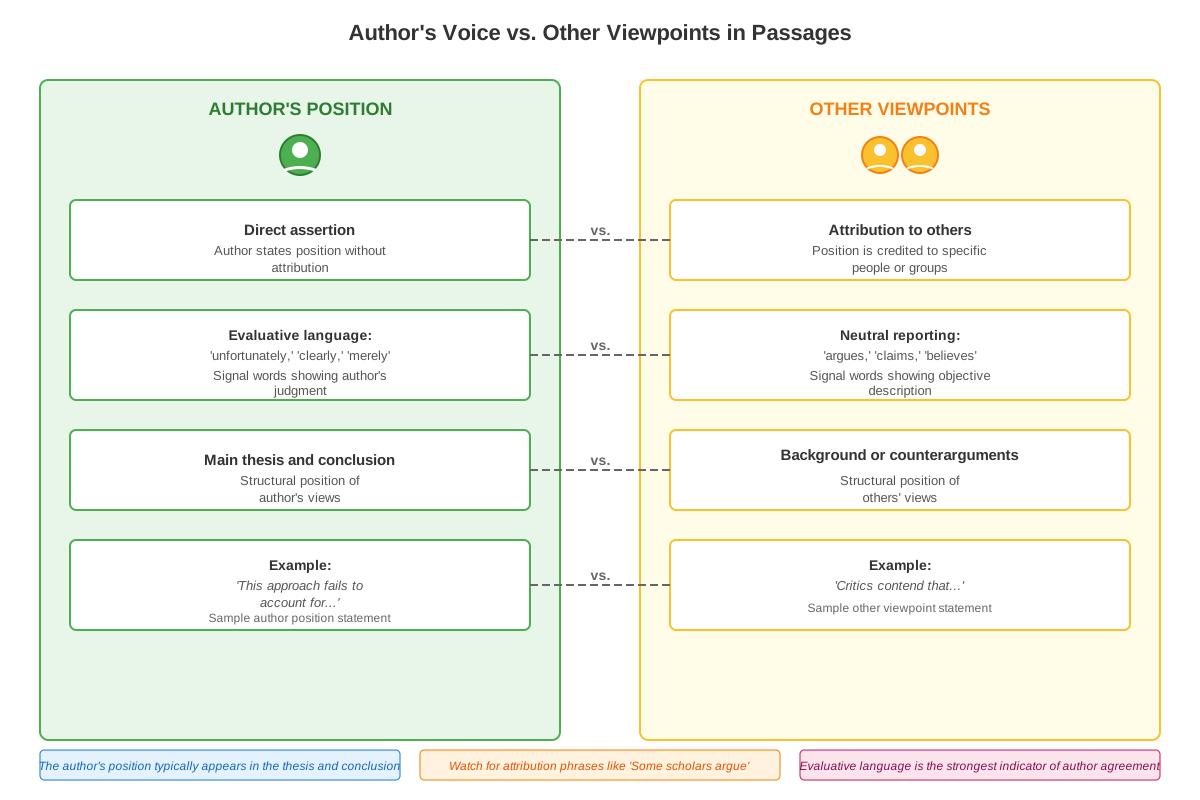
A critical skill for answering these questions is distinguishing between the author's voice and other perspectives presented in the passage. LSAT passages frequently discuss multiple viewpoints:
| Voice Type | Characteristics | Example Language |
|---|---|---|
| Author's position | Endorsed, advocated, or defended | "This approach is misguided," "The evidence clearly shows," "A better explanation would be" |
| Neutral description | Presented without endorsement | "Some scholars argue," "The traditional view holds," "Critics contend" |
| Opposing views | Presented to be refuted | "However, this interpretation fails to account for," "This view is problematic because" |
| Historical/background | Factual context without opinion | "In 1950, the law was enacted," "The theory originated with" |
The author's actual position is revealed through opinion markers, evaluative language, and the overall argumentative structure. Students must track which claims the author presents as their own versus which they merely describe.
Opinion Indicators and Tone Markers
Authors signal their positions through specific linguistic choices. Opinion indicators include:
Strong endorsement markers:
- "Clearly," "obviously," "undoubtedly"
- "The evidence demonstrates," "proves," "establishes"
- "Correctly," "appropriately," "wisely"
- "Must," "should," "ought to"
Criticism markers:
- "Unfortunately," "regrettably," "problematically"
- "Fails to," "neglects," "overlooks"
- "Merely," "simply," "only" (when dismissive)
- "Mistakenly," "erroneously," "incorrectly"
Qualified support:
- "Suggests," "indicates," "tends to show"
- "May," "might," "could"
- "Generally," "typically," "often"
The degree of certainty in the author's language must match the degree of certainty in the correct answer choice. If the author expresses a qualified position ("may be beneficial"), an answer choice stating an absolute position ("is always beneficial") would be incorrect.
Scope and Degree Matching
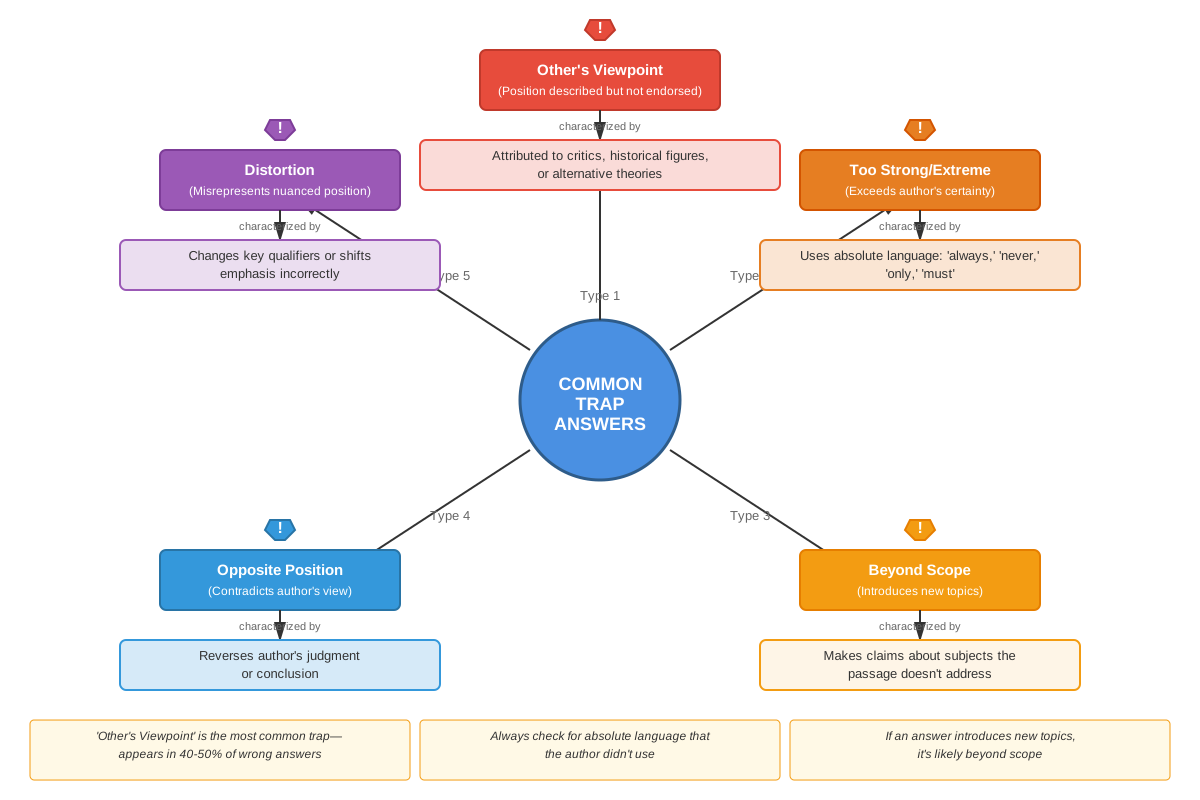
Correct answers to author agreement questions must match both the scope (breadth of the claim) and degree (strength of the claim) of the author's position. This principle creates several common trap answer patterns:
- Too broad: The author discusses a specific case, but the answer generalizes to all cases
- Too narrow: The author makes a general claim, but the answer limits it unnecessarily
- Too strong: The author suggests possibility, but the answer claims certainty
- Too weak: The author firmly advocates a position, but the answer merely suggests possibility
For example, if an author argues that "economic factors often play a significant role in judicial decisions," a correct answer might state that "economic considerations can influence how judges rule." An incorrect answer might claim that "economic factors always determine judicial outcomes" (too strong) or that "economics is the sole factor in judicial decision-making" (too strong and too narrow).
Comparative Reading Complications
In comparative reading passages, author agreement questions become more complex because students must track two authors' positions simultaneously. Questions might ask:
- What Author A would agree with
- What Author B would agree with
- What both authors would agree with
- What distinguishes the authors' positions
The key strategy is to maintain clear mental separation between the two passages. Often, both authors discuss the same topic but reach different conclusions or emphasize different aspects. Students must avoid conflating the positions or attributing Author B's view to Author A.
Implicit vs. Explicit Agreement
While some author agreement questions test explicitly stated positions, others require identifying what the author would implicitly agree with based on their stated views. This requires logical extension of the author's position without making unsupported leaps.
For instance, if an author argues that "mandatory minimum sentences reduce judicial discretion and lead to unjust outcomes," the author would implicitly agree that "judges should have flexibility in sentencing" even if that exact statement never appears in the passage. The implicit agreement follows necessarily from the explicit position.
However, students must be cautious not to extend too far. The same author might not necessarily agree that "all sentencing guidelines should be eliminated," as this goes beyond what's supported by the stated position.
Concept Relationships
The concepts within author agreement questions form an interconnected system. Identifying question stems serves as the entry point, allowing students to recognize when this question type appears. This recognition triggers the need to distinguish the author's voice from other voices, which requires attention to opinion indicators and tone markers. These markers reveal not just what the author believes but how strongly they believe it, which connects directly to scope and degree matching when evaluating answer choices.
The relationship flows as follows:
Question Identification → Voice Distinction → Opinion Marker Recognition → Scope/Degree Analysis → Answer Selection
This topic connects to prerequisite knowledge of passage structure because understanding how authors organize arguments helps predict where opinion markers will appear (often in the introduction, conclusion, or when transitioning from describing others' views to presenting their own). It also relates to main idea questions, as the author's primary position often appears as the correct answer to author agreement questions.
Author agreement questions serve as a foundation for more advanced question types. Application questions (asking how the author would apply their reasoning to a new situation) require first understanding what the author believes. Reasoning questions (asking why the author holds a position) build upon identifying what that position is. Strengthen/Weaken questions require knowing the author's argument before determining what would support or undermine it.
High-Yield Facts
⭐ Author agreement questions typically comprise 15-25% of all LSAT reading comprehension questions, making them one of the most frequently tested question types.
⭐ The correct answer must match both the scope (breadth) and degree (strength) of the author's stated position—answers that are too broad, narrow, strong, or weak are incorrect.
⭐ Opinion indicators like "clearly," "unfortunately," "merely," and "should" signal the author's personal position rather than neutral description.
⭐ In comparative reading passages, students must carefully track which author holds which position and avoid conflating the two perspectives.
⭐ The author's position is often most clearly stated in the introduction, conclusion, or immediately after presenting opposing viewpoints.
- Authors frequently present multiple viewpoints in a passage but endorse only one; distinguishing description from endorsement is critical.
- Correct answers to author agreement questions are always supported by the passage—they never require outside knowledge or assumptions.
- When an author uses qualified language ("may," "suggests," "often"), the correct answer must reflect that same level of qualification.
- Trap answers often take statements from the passage but attribute them to the wrong source (e.g., presenting a critic's view as the author's view).
- The author's tone (critical, supportive, neutral, ambivalent) provides crucial context for determining what they would agree with.
- Author agreement questions can test either explicit statements or necessary implications of the author's position, but never speculative extensions.
- In passages discussing historical or scientific topics, authors often describe facts neutrally while expressing opinions about interpretations or implications.
Quick check — test yourself on Author would agree questions so far.
Try Flashcards →Common Misconceptions
Misconception: If a statement appears in the passage, the author must agree with it.
Correction: Authors frequently present viewpoints they don't endorse, including opposing arguments, historical positions, or others' theories. Students must distinguish between what the author describes and what the author advocates. Look for opinion markers that signal the author's own position.
Misconception: The correct answer must use the same words as the passage.
Correction: Correct answers often paraphrase the author's position using different language. Students should focus on matching the meaning and scope of the author's view rather than looking for identical wording. Conversely, trap answers sometimes use passage language but distort the meaning.
Misconception: If the author doesn't explicitly disagree with something, they must agree with it.
Correction: Authors can remain neutral on issues or simply not address certain claims. The absence of disagreement doesn't constitute agreement. The correct answer must be something the author actively supports or that necessarily follows from their stated position.
Misconception: Author agreement questions are just asking for the main idea.
Correction: While the main idea might be something the author agrees with, author agreement questions can test any aspect of the author's position, including subsidiary points, implications, or applications of their reasoning. These questions are broader than main idea questions.
Misconception: In comparative reading, if both authors discuss the same topic, they must have similar views.
Correction: Comparative passages are often selected specifically because the authors have contrasting perspectives on the same issue. Students must carefully track each author's distinct position and avoid assuming agreement where none exists.
Misconception: Stronger, more definitive answer choices are better because they sound more confident.
Correction: The correct answer must match the author's level of certainty. If the author expresses a qualified or tentative position, a strong, absolute answer choice will be incorrect. Match the degree of certainty in the answer to the degree expressed in the passage.
Worked Examples
Example 1: Single Passage
Passage excerpt:
"The traditional approach to criminal sentencing, which grants judges broad discretion, has been criticized for producing inconsistent outcomes. However, the alternative—mandatory minimum sentences—creates its own problems. While mandatory minimums ensure consistency, they prevent judges from considering individual circumstances that might warrant leniency. The result is often unjust: first-time offenders receive the same sentences as career criminals. A more balanced approach would preserve some judicial discretion while establishing guidelines that promote consistency without rigidity."
Question:
The author would most likely agree with which one of the following?
(A) Mandatory minimum sentences should be eliminated entirely.
(B) Judicial discretion inevitably leads to inconsistent sentencing outcomes.
(C) Sentencing systems should balance consistency with flexibility.
(D) First-time offenders should always receive lighter sentences than repeat offenders.
(E) Traditional sentencing approaches are superior to mandatory minimums.
Analysis:
First, identify the author's position by tracking opinion markers:
- "However" signals a turn from describing criticism to the author's own view
- "Creates its own problems" indicates the author's criticism of mandatory minimums
- "Often unjust" expresses the author's negative evaluation
- "A more balanced approach would" signals the author's recommendation
The author's position: Both traditional discretion and mandatory minimums have flaws; a balanced approach combining elements of both is preferable.
Evaluating each answer:
(A) Too strong and not supported: The author criticizes mandatory minimums but doesn't advocate complete elimination. The author wants balance, not elimination.
(B) Too strong: The author notes that traditional discretion "has been criticized" for inconsistency but doesn't personally endorse the view that it "inevitably" leads to inconsistency. This represents others' criticism, not the author's position.
(C) Correct: This matches the author's explicitly stated position in the final sentence. The author advocates for an approach that "promote[s] consistency without rigidity," which is precisely balancing consistency with flexibility.
(D) Too strong: While the author uses first-time vs. career criminals as an example of mandatory minimums' problems, the author doesn't claim first-time offenders should "always" receive lighter sentences. This overgeneralizes from a specific example.
(E) Contradicts the passage: The author criticizes both approaches and advocates for a third option. The author doesn't claim traditional approaches are "superior."
Answer: (C)
Example 2: Comparative Reading
Passage A excerpt:
"Digital preservation of historical documents ensures accessibility for future generations. Unlike physical documents, which deteriorate over time, digital copies can be reproduced infinitely without degradation. Libraries should prioritize digitization projects to democratize access to rare materials."
Passage B excerpt:
"While digital preservation has merits, it cannot replace physical conservation. Digital formats become obsolete—files from twenty years ago are often unreadable today. Moreover, physical examination of documents reveals details invisible in digital reproductions: paper quality, marginalia, binding techniques. These elements provide crucial historical context that digitization erases."
Question:
The author of Passage B would most likely agree with which one of the following?
(A) Digital preservation offers no benefits for historical research.
(B) Physical documents should be the primary focus of preservation efforts.
(C) Digital formats are more reliable than physical documents for long-term storage.
(D) Libraries should abandon digitization projects entirely.
(E) Digitization is superior to physical conservation for democratizing access.
Analysis:
First, identify Author B's position:
- "While digital preservation has merits" acknowledges some value
- "Cannot replace" indicates limits to digital preservation
- "Moreover" introduces additional support for physical conservation
- The overall tone is critical of over-reliance on digital methods while recognizing their role
Author B's position: Digital preservation has some value but cannot substitute for physical conservation, which provides unique benefits.
Evaluating each answer:
(A) Too strong: Author B acknowledges that digital preservation "has merits," so claiming it offers "no benefits" contradicts the passage.
(B) Correct: This matches Author B's position. The author argues that physical conservation provides unique value that digitization cannot replicate and implies this should be prioritized ("cannot replace physical conservation").
(C) Contradicts the passage: Author B explicitly argues that digital formats become obsolete and are therefore less reliable for long-term storage than physical documents.
(D) Too strong: Author B criticizes over-reliance on digitization but acknowledges it "has merits." Complete abandonment goes beyond what the author advocates.
(E) Contradicts the passage: This represents Author A's position, not Author B's. Students must avoid conflating the two authors' views.
Answer: (B)
Exam Strategy
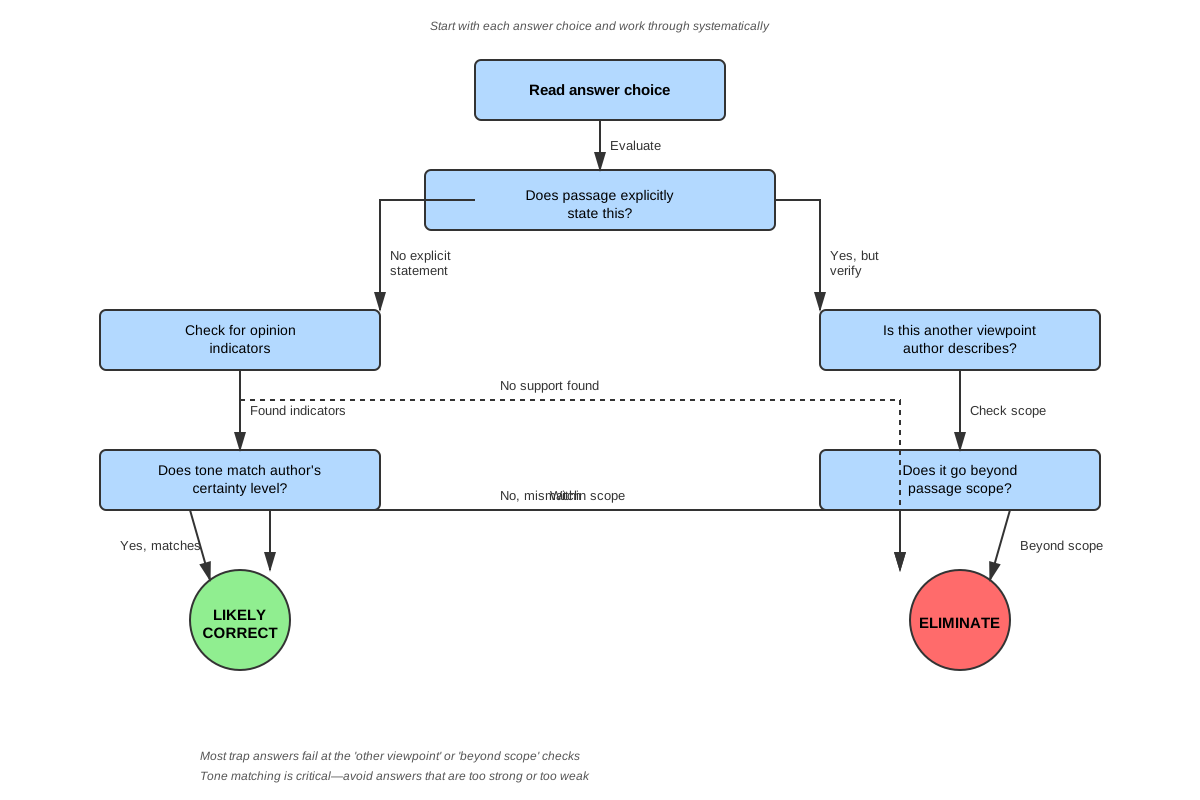
When approaching author agreement questions on the LSAT, implement this systematic process:
Step 1: Identify the question type by recognizing trigger phrases like "the author would agree," "consistent with the author's view," or "the author believes." This identification tells you to focus specifically on the author's position rather than other elements of the passage.
Step 2: Return to the passage and locate where the author expresses their position most clearly. Don't rely on memory alone. Key locations include:
- The thesis statement (often in the first or second paragraph)
- Transitions after presenting others' views ("However," "But," "In fact")
- The conclusion
- Sentences with strong opinion markers
Step 3: Predict an answer before looking at the choices. Ask yourself: "What is the author's main position on this issue?" Having a prediction prevents you from being swayed by attractive but incorrect answer choices.
Step 4: Evaluate each answer choice by asking:
- Is this the author's view or someone else's view mentioned in the passage?
- Does the scope match (not too broad or too narrow)?
- Does the degree of certainty match (not too strong or too weak)?
- Is this explicitly stated or necessarily implied by the author's position?
Step 5: Use process of elimination by actively identifying why wrong answers are incorrect:
- Cross out answers that are too extreme
- Eliminate answers that attribute others' views to the author
- Remove answers that go beyond what the passage supports
- Discard answers that contradict the author's stated position
Exam Tip: In comparative reading, physically note "A" or "B" next to relevant portions of each passage to avoid conflating the authors' positions. This simple technique prevents the most common error on these questions.
Time allocation: Author agreement questions should take approximately 60-75 seconds each. If you're spending more than 90 seconds, you may be overthinking. These questions test comprehension, not complex reasoning, so the answer should be relatively straightforward once you've accurately identified the author's position.
Trigger words to watch for in answer choices:
- Red flags: "always," "never," "all," "none," "only," "must" (unless the author uses equally strong language)
- Safe qualifiers: "often," "generally," "can," "may," "suggests," "typically"
- Scope indicators: "some," "many," "most" (ensure these match the passage's scope)
Memory Techniques
VOICE mnemonic for distinguishing the author's position:
- Verbs of opinion (argues, contends, believes)
- Opinion markers (clearly, unfortunately, merely)
- Introduction and conclusion (where authors state positions most directly)
- Contrast words (however, but, yet—often signal the author's own view)
- Evaluative language (effective, problematic, successful)
The "Attribution Test": When evaluating an answer choice, ask "Can I point to a specific place where the author says or implies this?" If you can't attribute the statement to the author specifically (as opposed to someone the author discusses), it's wrong.
The "Degree Dial" visualization: Imagine a dial ranging from "absolute certainty" to "tentative possibility." When you identify the author's position, note where it falls on this dial. The correct answer must be at the same position on the dial—not stronger or weaker.
SCOPE acronym for checking answer choices:
- Same subject matter as the author discusses
- Consistent with the author's tone and position
- Opinion markers match the author's level of certainty
- Passage support exists for the claim
- Eliminate extreme or absolute statements (unless the author uses them)
The "Comparative Separation" technique: In comparative reading, use your scratch paper to create two columns labeled "Author A" and "Author B." As you read, jot down each author's main position. This physical separation prevents mental conflation.
Summary
Author would agree questions test the fundamental reading comprehension skill of accurately identifying and representing an author's position. These questions appear frequently on the LSAT (15-25% of reading comprehension questions) and require students to distinguish between the author's own views and other perspectives presented in the passage. Success depends on recognizing opinion indicators, tracking the author's voice throughout the passage, and matching both the scope and degree of the author's position when evaluating answer choices. The correct answer must be something the author explicitly states or necessarily implies—never a speculative extension or a view the author merely describes without endorsing. In comparative reading passages, students must carefully maintain separation between the two authors' positions. Common traps include answers that are too strong or weak, that attribute others' views to the author, or that extend beyond what the passage supports. By systematically identifying the author's position, predicting an answer, and using process of elimination to evaluate choices, students can consistently answer these high-yield questions correctly.
Key Takeaways
- Author agreement questions are among the most frequently tested reading comprehension question types, making them essential for LSAT success
- The correct answer must match both the scope (breadth) and degree (strength) of the author's stated or clearly implied position
- Opinion indicators like "clearly," "unfortunately," "should," and "merely" signal the author's personal views rather than neutral description
- Students must distinguish between what the author describes (including others' viewpoints) and what the author actually endorses or advocates
- In comparative reading, maintaining clear separation between the two authors' positions prevents the most common error: conflating their views
- The author's position is typically most clearly expressed in the introduction, conclusion, or immediately after presenting opposing viewpoints
- Systematic process—identify question type, locate author's position, predict answer, evaluate choices, eliminate wrong answers—leads to consistent accuracy
Related Topics
Inference Questions: While author agreement questions focus on what the author believes, inference questions ask what can be logically concluded from the passage. Mastering author agreement questions provides a foundation for inference questions because you must first understand what's stated before drawing conclusions beyond it.
Main Point Questions: These questions ask for the author's primary argument or thesis. Author agreement questions often test subsidiary points or implications of the main argument, so understanding how to identify main points helps with the broader category of author agreement questions.
Tone and Attitude Questions: These questions explicitly ask about the author's attitude or tone toward a subject. The skills for identifying tone overlap significantly with author agreement questions, as both require tracking opinion markers and evaluative language.
Application Questions: These questions ask how the author would apply their reasoning to a new situation. Success requires first understanding what the author believes (author agreement) before extending that reasoning to novel contexts.
Comparative Reading Analysis: For students working with comparative passages, deeper study of how to track multiple authors' positions, identify points of agreement and disagreement, and avoid conflation will enhance performance on author agreement questions in this format.
Practice CTA
Now that you've mastered the core concepts of author agreement questions, it's time to put your knowledge into practice. Attempt the practice questions to reinforce your understanding and build the pattern recognition that leads to automatic, accurate responses on test day. Use the flashcards to memorize key opinion indicators and common trap patterns. Remember: reading about these strategies is valuable, but applying them to actual LSAT passages is what transforms understanding into points. Each practice question you complete strengthens your ability to quickly identify the author's position and select the correct answer with confidence. Your investment in mastering this high-yield question type will pay dividends across the entire reading comprehension section.
Sign up free to keep reading
Create a free AnvayaPrep account to finish this LSAT guide on Author would agree questions — plus flashcards and practice questions.