Overview
Global questions represent one of the most frequently tested reading comprehension question types on the LSAT, appearing in virtually every Reading Comprehension section. These questions ask test-takers to identify overarching themes, primary purposes, main points, or structural elements that characterize an entire passage rather than focusing on specific details or localized arguments. Unlike detail-oriented questions that direct attention to particular lines or paragraphs, global questions require synthesizing information from the entire passage to arrive at a comprehensive understanding of the author's intent, organizational strategy, or central thesis.
Mastering global questions is essential for LSAT success because they test fundamental comprehension skills that underpin all other question types. A student who cannot accurately identify a passage's main point will struggle with inference questions, author's attitude questions, and application questions that build upon that foundational understanding. Global questions typically appear as the first question following a passage, strategically positioned to assess whether test-takers have grasped the passage's essential message before diving into more granular inquiries. These questions reward active reading strategies that prioritize understanding the forest before examining individual trees.
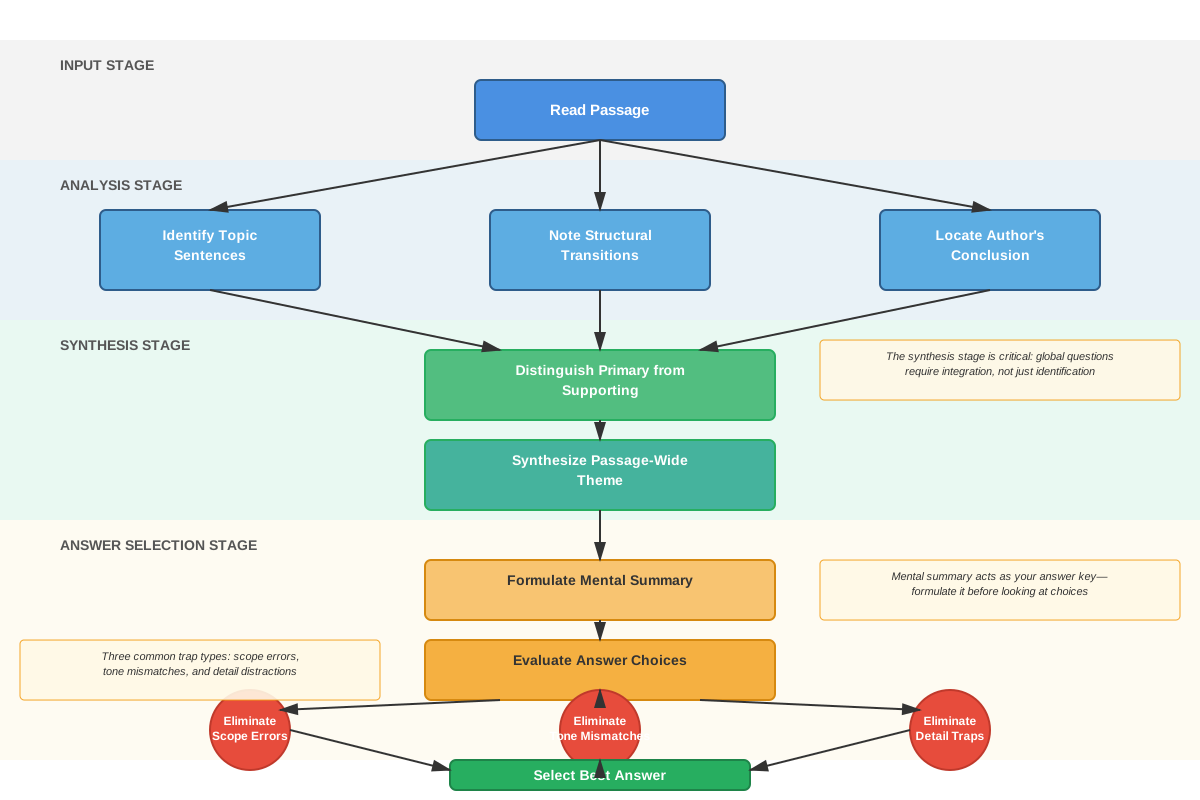
Within the broader landscape of reading comprehension, global questions serve as the cornerstone skill that connects passage analysis to question-answering accuracy. They require integration of multiple reading comprehension competencies: identifying topic sentences, recognizing structural transitions, distinguishing primary arguments from supporting evidence, and synthesizing disparate elements into a coherent whole. Performance on global questions often predicts overall Reading Comprehension section scores, making them a high-priority area for focused study and deliberate practice.
Learning Objectives
- [ ] Identify how Global questions appears in LSAT questions
- [ ] Explain the reasoning pattern behind Global questions
- [ ] Apply Global questions to solve LSAT-style problems accurately
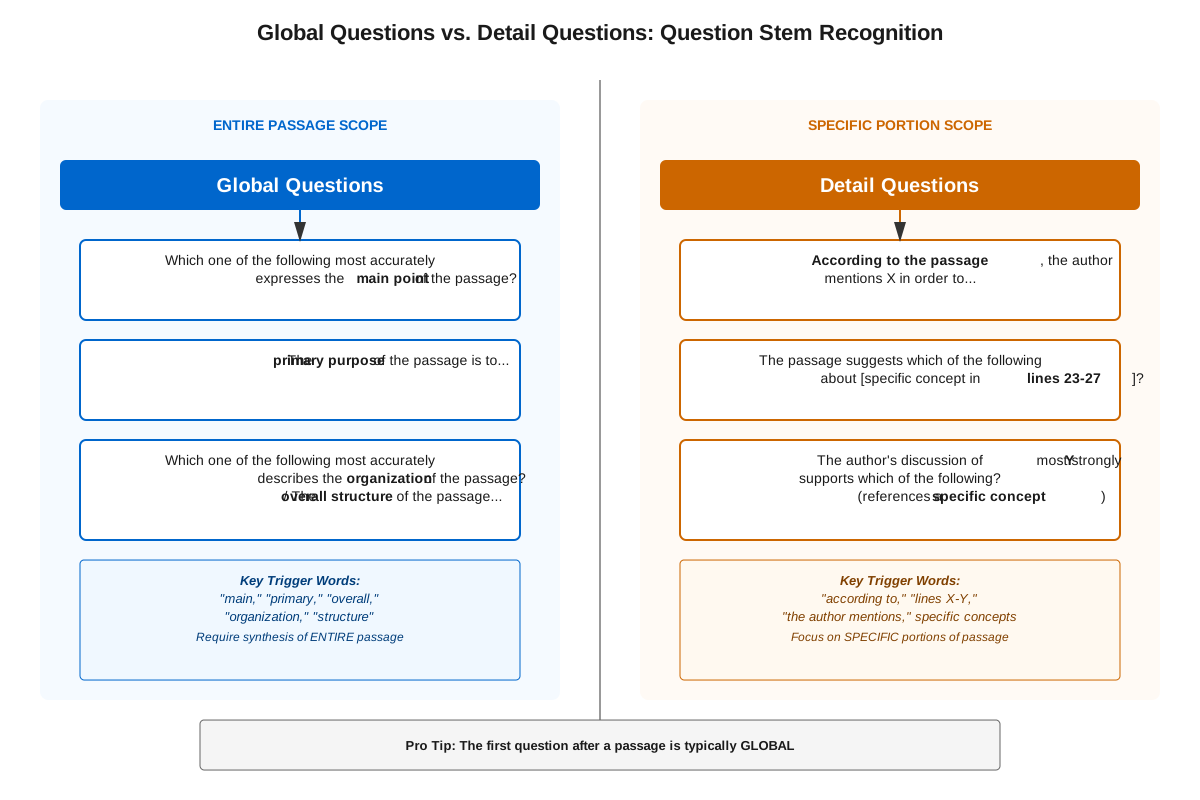
- [ ] Distinguish between global questions and detail-specific questions based on question stem language
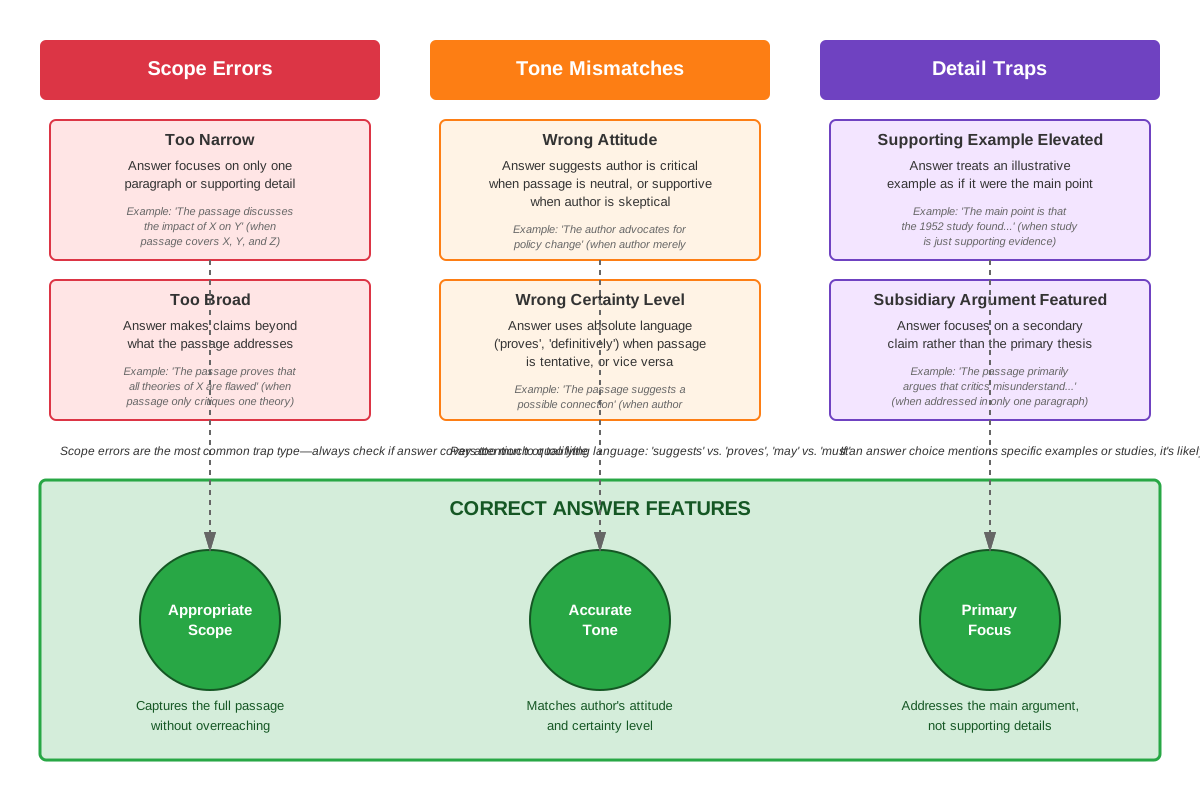
- [ ] Evaluate answer choices for global questions by identifying scope errors, tone mismatches, and detail traps
- [ ] Construct mental summaries of passages that facilitate rapid and accurate responses to global questions
- [ ] Analyze passage structure to predict the most likely correct answer to main point questions
Prerequisites
- Basic passage reading skills: The ability to read complex academic prose is foundational, as global questions require comprehension of sophisticated arguments across multiple paragraphs.
- Understanding of argument structure: Recognizing premises, conclusions, and supporting evidence enables identification of which elements constitute the passage's core message versus peripheral details.
- Familiarity with LSAT question format: Knowledge of how LSAT questions are constructed and how answer choices are presented allows efficient navigation of global question stems and options.
- Active reading strategies: Techniques such as annotation, mental summarization, and structural mapping provide the cognitive framework necessary for synthesizing passage-wide themes.
Why This Topic Matters
Global questions constitute approximately 25-30% of all Reading Comprehension questions on the LSAT, making them the single most common question type test-takers will encounter. Each Reading Comprehension section typically contains four passages, and nearly every passage includes at least one global question—often positioned as the first question to establish baseline comprehension. This frequency translates to roughly 6-8 global questions per test, representing a significant portion of the section's scoring potential.
Beyond their statistical prevalence, global questions assess skills that legal professionals use daily. Attorneys must regularly synthesize complex documents, identify central arguments in lengthy briefs, and distill essential points from voluminous case law. The ability to distinguish primary holdings from dicta, recognize organizational patterns in legal writing, and articulate main points concisely mirrors the cognitive demands of legal practice. Law schools value these competencies because they predict success in case briefing, legal research, and persuasive writing.
On the LSAT, global questions appear in several distinct formats: main point questions ("Which one of the following most accurately expresses the main point of the passage?"), primary purpose questions ("The primary purpose of the passage is to..."), title questions ("Which one of the following titles best captures the content of the passage?"), and organization questions ("Which one of the following most accurately describes the organization of the passage?"). Each format tests the same fundamental skill—comprehensive passage understanding—but emphasizes different aspects of that understanding. Recognizing these variations enables strategic approach adjustments while maintaining focus on the core competency of global comprehension.
Core Concepts
Defining Global Questions
Global questions are LSAT reading comprehension items that require test-takers to identify information, themes, or structural elements that apply to an entire passage rather than isolated segments. These questions assess whether students have constructed an accurate mental model of the passage's overall message, purpose, and organization. The defining characteristic of global questions is their scope: correct answers must be supported by the passage as a whole, not merely by individual paragraphs or sentences.
The term "global" distinguishes these questions from "local" or detail-oriented questions that focus on specific claims, examples, or arguments within limited textual boundaries. While a detail question might ask about the author's discussion of a particular study mentioned in paragraph three, a global question asks about the author's overarching purpose in writing the entire passage. This distinction in scope fundamentally shapes both the reading strategy required and the answer choice evaluation process.
Types of Global Questions
LSAT global questions manifest in four primary formats, each emphasizing different aspects of comprehensive passage understanding:
| Question Type | Focus | Common Stems |
|---|---|---|
| Main Point | Central thesis or conclusion | "Which one of the following most accurately expresses the main point?" |
| Primary Purpose | Author's intent or goal | "The primary purpose of the passage is to..." |
| Title | Comprehensive content summary | "Which title best captures the passage?" |
| Organization/Structure | Passage architecture | "The passage is organized by..." |
Main Point Questions ask test-takers to identify the passage's central claim or thesis—the single most important idea the author seeks to convey. These questions test whether students can distinguish the primary argument from supporting evidence, background information, and tangential discussions. The correct answer to a main point question should be specific enough to capture the passage's unique contribution while broad enough to encompass all major elements.
Primary Purpose Questions shift focus from content to intent, asking why the author wrote the passage rather than what the passage says. Common purposes include: to critique a theory, to propose a solution, to reconcile competing viewpoints, to describe a phenomenon, or to advocate for a position. These questions reward attention to the author's tone, the passage's trajectory, and the relationship between different sections.
Title Questions require selecting the option that best encapsulates the passage's content in a brief, headline-style format. Effective titles balance specificity and comprehensiveness, avoiding both excessive narrowness (focusing on one paragraph's content) and excessive vagueness (applying equally well to dozens of unrelated passages).
Organization Questions assess understanding of passage structure rather than content, asking test-takers to describe how the author arranged ideas. Common organizational patterns include: chronological progression, problem-solution structure, theory-evidence-conclusion format, compare-contrast frameworks, and general-to-specific development.
Identifying Global Questions
Recognizing global questions quickly and accurately enables strategic reading and efficient time management. Reading comprehension question types can be distinguished by analyzing question stem language for scope indicators.
Global question stems typically contain words and phrases that signal passage-wide scope:
- "The passage as a whole..."
- "The author's main point..."
- "The primary purpose..."
- "Which one of the following titles..."
- "The passage is primarily concerned with..."
- "The organization of the passage..."
- "The author's central claim..."
Conversely, detail questions contain scope-limiting language:
- "According to the passage..." (followed by specific content)
- "The author mentions X in order to..." (specific reference)
- "In line 23, the author suggests..." (line reference)
- "The passage states which of the following about Y?" (specific topic)
This linguistic distinction enables rapid question categorization during the initial question review, allowing test-takers to adjust their approach before reading answer choices.
The Reasoning Pattern Behind Global Questions
Understanding the cognitive process required to answer global questions correctly reveals why certain answer choices succeed while others fail. The reasoning pattern follows a hierarchical synthesis model:
- Identify the topic: What general subject matter does the passage address?
- Determine the scope: What specific aspect of that topic does the author examine?
- Recognize the purpose: Why did the author write about this aspect of this topic?
- Articulate the main point: What specific claim or conclusion does the author advance?
This progression moves from broad to specific, from descriptive to analytical. A passage might have the topic "judicial decision-making" (broad), the scope "the role of implicit bias in jury verdicts" (narrower), the purpose "to argue for jury reform" (intent), and the main point "implicit bias training should be mandatory for all jurors because research demonstrates it significantly reduces verdict disparities" (specific claim).
Effective test-takers construct this hierarchical understanding while reading, continuously updating their mental model as new information emerges. The first paragraph often establishes topic and hints at scope; middle paragraphs develop arguments and present evidence; final paragraphs typically crystallize the main point or restate the primary purpose with enhanced clarity.
Common Wrong Answer Patterns
Global questions feature predictable wrong answer types that exploit common reading errors:
Too Narrow (Detail Trap): These answers accurately describe one paragraph or section but fail to encompass the entire passage. They tempt test-takers who fixated on particularly interesting or memorable details rather than maintaining global awareness.
Too Broad (Scope Error): These answers describe a general category that includes the passage's content but could equally apply to dozens of other passages. They lack the specificity necessary to capture what makes this particular passage unique.
Tone Mismatch: These answers mischaracterize the author's attitude, presenting neutral description as advocacy, tentative suggestion as strong criticism, or balanced analysis as one-sided polemic.
Distortion: These answers contain elements mentioned in the passage but combine or characterize them inaccurately, creating a plausible-sounding but ultimately incorrect synthesis.
Reversal: These answers present the opposite of the author's actual position, often by confusing the author's view with a position the author critiques.
Concept Relationships
Global questions exist within a hierarchical relationship structure where comprehensive passage understanding (the global level) provides the foundation for all other question types. Main point identification → enables → inference questions, because valid inferences must align with the passage's central thesis. Similarly, primary purpose recognition → informs → author's attitude questions, since understanding why an author wrote something clarifies their perspective on the subject matter.
Within global questions themselves, the four types form a conceptual cluster with overlapping skills. Main point questions ↔ primary purpose questions represent two sides of the same coin: content versus intent. A passage whose main point is "Policy X should be implemented" likely has the primary purpose "to advocate for Policy X." Title questions → synthesize → both main point and primary purpose, requiring compression of both content and intent into headline format. Organization questions → support → all other global question types by revealing how the author structured their argument to achieve their purpose and establish their main point.
The relationship between global questions and passage structure is bidirectional: understanding structure facilitates answering global questions, while correctly answering global questions confirms accurate structural comprehension. This reciprocal relationship means that students who struggle with organization questions often also struggle with main point questions, suggesting a common underlying deficit in structural awareness.
Global questions also connect to active reading strategies. Annotation practices → generate → raw material for global question answers, as marginal notes about paragraph functions and structural transitions provide the building blocks for comprehensive synthesis. Mental summarization → produces → immediate answer predictions for global questions, reducing reliance on answer choice evaluation and increasing accuracy.
High-Yield Facts
⭐ Global questions appear in approximately 25-30% of all Reading Comprehension questions, making them the most common question type on the LSAT.
⭐ The first question following a passage is typically a global question, usually asking for the main point or primary purpose.
⭐ Correct answers to main point questions must be supported by the passage as a whole, not just by individual paragraphs or sections.
⭐ Wrong answers to global questions most commonly err by being too narrow (describing only part of the passage) or too broad (lacking necessary specificity).
⭐ The author's main point often appears most explicitly in the final paragraph, though it may be foreshadowed in the opening paragraph.
- Primary purpose questions focus on the author's intent (why they wrote) rather than content (what they said).
- Title questions require answers that balance comprehensiveness (covering all major elements) with specificity (distinguishing this passage from others).
- Organization questions assess structural understanding and typically feature answer choices describing common passage architectures.
- Global questions reward active reading strategies that prioritize understanding passage structure and identifying topic sentences.
- Tone mismatches represent a common wrong answer type, presenting neutral analysis as advocacy or vice versa.
- The correct answer to a global question should feel somewhat predictable based on passage structure, while wrong answers often introduce surprising or unexpected characterizations.
- Test-takers should be able to articulate the main point in their own words before reading answer choices, using this prediction to evaluate options.
- Global questions test synthesis skills that predict success in law school case briefing and legal analysis.
Quick check — test yourself on Global questions so far.
Try Flashcards →Common Misconceptions
Misconception: The main point is always stated explicitly in the passage, usually in the first or last sentence.
Correction: While the main point often appears most clearly in the introduction or conclusion, it may be implicit, requiring synthesis of multiple statements. Test-takers must sometimes construct the main point by combining the author's thesis with their ultimate conclusion.
Misconception: If an answer choice contains information from the passage, it must be correct for a global question.
Correction: Correct answers must not only be accurate but also comprehensive and appropriately scoped. An answer describing only paragraph two's content, though factually accurate, fails as a main point answer because it's too narrow.
Misconception: Primary purpose and main point questions are interchangeable and should have essentially the same answer.
Correction: These question types assess different dimensions of comprehension. A passage might have the main point "Theory X better explains phenomenon Y than Theory Z" while having the primary purpose "to evaluate competing theories." Content and intent, though related, require distinct answers.
Misconception: The longest or most detailed answer choice is usually correct for global questions because it's most comprehensive.
Correction: Correct answers balance comprehensiveness with concision. Excessively detailed answers often include scope errors or irrelevant information. The best answer captures all essential elements without introducing extraneous content.
Misconception: Organization questions are less important than other global questions and can be skipped if time is short.
Correction: Organization questions test structural understanding that supports all other question types. Moreover, they often provide relatively quick points because passage structure is typically more apparent than subtle argumentative nuances.
Misconception: If the passage discusses multiple topics, the main point should mention all of them equally.
Correction: Passages often discuss multiple topics in service of a single overarching point. The main point should reflect the hierarchical relationship between primary arguments and supporting discussions, not treat all mentioned topics as equally central.
Worked Examples
Example 1: Main Point Question
Passage Summary: A passage discusses how traditional economic models failed to predict the 2008 financial crisis. The first paragraph introduces this failure. The second paragraph explains that these models assumed rational actors and efficient markets. The third paragraph describes behavioral economics as an alternative framework that accounts for cognitive biases. The fourth paragraph argues that incorporating behavioral insights would improve economic forecasting and policy-making.
Question: Which one of the following most accurately expresses the main point of the passage?
Answer Choices:
(A) Traditional economic models assume rational actors and efficient markets.
(B) The 2008 financial crisis revealed fundamental flaws in economic forecasting.
(C) Behavioral economics offers a superior framework for economic analysis by accounting for cognitive biases.
(D) Economic models should incorporate behavioral insights to improve their predictive accuracy and policy applications.
(E) Cognitive biases affect economic decision-making in ways that traditional models fail to capture.
Analysis:
First, construct a prediction by synthesizing the passage structure. The passage moves from problem (traditional models failed) → explanation (why they failed) → alternative (behavioral economics) → recommendation (incorporate behavioral insights). This trajectory suggests the main point is prescriptive, advocating for a change.
(A) Too narrow: This accurately describes paragraph two's content but represents background information rather than the main point. It explains traditional models without addressing the author's ultimate argument.
(B) Too narrow and incomplete: While the crisis is mentioned, it serves as a motivating example rather than the central focus. The passage is primarily about improving future models, not analyzing past failures.
(C) Scope error: This overstates the author's claim. The passage doesn't argue that behavioral economics is "superior" overall, only that it offers valuable insights that should be incorporated. The word "superior" suggests complete replacement rather than integration.
(D) CORRECT: This captures the passage's prescriptive conclusion while maintaining appropriate scope. It acknowledges both the recommendation (incorporate behavioral insights) and the justification (improve predictive accuracy and policy applications). This answer synthesizes all four paragraphs into a coherent main point.
(E) Too narrow: This accurately describes behavioral economics' contribution but stops short of the author's prescriptive conclusion. It's a supporting point rather than the main point.
Key Takeaway: The correct answer to a main point question should reflect the passage's ultimate destination, not merely describe interesting stops along the way. Prescriptive passages typically have prescriptive main points.
Example 2: Primary Purpose Question
Passage Summary: A passage begins by noting that art historians have long debated whether Renaissance painter Artemisia Gentileschi's work reflects feminist consciousness. The second paragraph presents arguments from scholars who see feminist themes in her paintings of strong female figures. The third paragraph presents counterarguments from scholars who attribute these themes to artistic convention and patronage demands rather than political consciousness. The fourth paragraph concludes that while definitive evidence is lacking, the debate itself has productively expanded understanding of Renaissance women's agency.
Question: The primary purpose of the passage is to
Answer Choices:
(A) argue that Artemisia Gentileschi was a proto-feminist artist whose work challenged patriarchal norms
(B) describe a scholarly debate and suggest that the debate has value regardless of its resolution
(C) criticize art historians for imposing modern political categories on Renaissance art
(D) present evidence that Gentileschi's artistic choices were driven by patronage demands rather than personal conviction
(E) advocate for a new methodology in art historical analysis that considers economic factors
Analysis:
Identify the passage's trajectory and tone. The structure is: introduce debate → present position A → present position B → meta-commentary on the debate's value. The tone is balanced and analytical rather than argumentative or critical.
(A) Takes a side: The passage presents both sides of the debate without endorsing either position. An answer claiming the author argues for Gentileschi's feminism contradicts the balanced presentation.
(B) CORRECT: This accurately captures both the content (describing a debate) and the author's ultimate point (the debate has value). The phrase "regardless of its resolution" aligns with the fourth paragraph's conclusion that the debate's productivity doesn't depend on determining who's right.
(C) Tone mismatch: The passage doesn't criticize either side of the debate. The word "criticize" suggests negative evaluation absent from the balanced, descriptive tone.
(D) Takes a side: Like choice A, this endorses one position in the debate rather than describing the debate itself. The passage presents this view as one perspective, not as the author's conclusion.
(E) Scope error: The passage doesn't advocate for methodological change. While economic factors (patronage) are mentioned, they appear as one scholar's argument, not as the author's prescription for the field.
Key Takeaway: Primary purpose questions reward attention to tone and structure. A passage that presents multiple viewpoints without endorsing any typically has a purpose like "describe," "discuss," or "present," not "argue," "advocate," or "criticize."
Exam Strategy
Pre-Reading Strategy
Before reading the passage, quickly scan all question stems to identify global questions. This preview accomplishes two goals: it alerts you to expect at least one global question (nearly guaranteed), and it reveals which type of global question to anticipate. If you see "The primary purpose of the passage is to," you know to pay special attention to the author's intent and tone while reading.
Active Reading for Global Questions
Implement a structured annotation system that supports global question answering:
- Bracket and label the topic sentence of each paragraph
- Note structural transitions (however, moreover, in contrast) that signal organizational patterns
- Mark the author's voice when it emerges from neutral description
- Identify the conclusion or main claim, often in the final paragraph
After reading each paragraph, mentally summarize its function in one phrase: "introduces problem," "presents solution," "addresses counterargument," "provides supporting evidence." This running structural analysis builds the framework for answering organization questions and predicting main points.
Answer Choice Evaluation Process
For global questions, employ a two-pass evaluation strategy:
First Pass - Elimination: Rapidly eliminate answers with obvious disqualifying features:
- Scope errors (too narrow or too broad)
- Tone mismatches (wrong attitude or strength)
- Factual errors (contradicting passage content)
- Irrelevant content (introducing topics not discussed)
Second Pass - Comparison: Compare remaining contenders by testing each against multiple paragraphs. The correct answer should feel supported by all major sections, while wrong answers typically align well with one section but poorly with others.
Exam Tip: If you're torn between two answers on a main point question, identify which paragraphs each answer best describes. If Answer A perfectly captures paragraphs 1-2 but ignores paragraphs 3-4, while Answer B reasonably captures all four paragraphs, choose Answer B. Comprehensiveness trumps perfect fit with partial content.
Trigger Words and Phrases
Global question stems contain reliable linguistic markers:
Main Point Indicators:
- "main point"
- "central claim"
- "primary conclusion"
- "most accurately expresses"
Primary Purpose Indicators:
- "primary purpose"
- "author's purpose"
- "passage is primarily concerned with"
- "author's main objective"
Title Indicators:
- "most appropriate title"
- "best title"
- "which title"
Organization Indicators:
- "organization of the passage"
- "structured"
- "arranged"
- "proceeds by"
Recognizing these triggers enables instant question categorization and appropriate strategy deployment.
Time Allocation
Global questions typically require 45-60 seconds to answer—slightly less than detail questions because they don't require returning to specific passage locations. However, invest adequate time in careful answer choice evaluation. A hasty global question error is particularly costly because it suggests fundamental misunderstanding that may cascade into errors on subsequent questions about the same passage.
If you're uncertain about a global question, mark it and continue to other questions about the passage. Detail questions often clarify the passage's structure and main point, making global questions easier to answer after engaging with the passage more deeply.
Memory Techniques
The MAPS Acronym for Main Point Prediction
Main topic (What is the passage about?)
Author's attitude (What does the author think about it?)
Primary purpose (Why did the author write this?)
Specific conclusion (What's the ultimate claim?)
After reading, quickly run through MAPS to construct your main point prediction before reading answer choices.
The SCOPE Mnemonic for Answer Evaluation
Specificity: Is the answer specific enough to distinguish this passage from others?
Comprehensiveness: Does it cover all major passage elements?
Omission: Does it leave out crucial components?
Precision: Does it accurately characterize what it includes?
Exaggeration: Does it overstate the author's claims?
Use SCOPE as a mental checklist when evaluating each answer choice.
Visualization Strategy: The Pyramid
Visualize passage structure as a pyramid:
- Base: Supporting details, examples, evidence (widest layer)
- Middle: Key arguments and sub-claims (narrower)
- Peak: Main point or primary purpose (single point)
Global questions ask about the peak, not the base. This visualization helps avoid detail traps by maintaining focus on the hierarchical relationship between supporting content and central claims.
The "Headline Test"
Imagine you're writing a newspaper headline for the passage. Headlines must be:
- Comprehensive enough to indicate the article's content
- Specific enough to distinguish this article from others
- Concise enough to fit in limited space
This mental exercise mirrors the requirements of global question answers and provides an intuitive framework for evaluation.
Summary
Global questions represent the most frequently tested reading comprehension question type on the LSAT, appearing in approximately 25-30% of all Reading Comprehension questions. These questions assess comprehensive passage understanding by asking test-takers to identify main points, primary purposes, appropriate titles, or organizational structures that characterize entire passages rather than isolated details. Success requires synthesizing information across all paragraphs, distinguishing primary arguments from supporting evidence, and recognizing the hierarchical relationship between central claims and peripheral content. The four main types—main point, primary purpose, title, and organization questions—emphasize different aspects of global comprehension but share the fundamental requirement of passage-wide scope. Common wrong answers exploit predictable errors: excessive narrowness (detail traps), excessive breadth (scope errors), tone mismatches, distortions, and reversals. Effective test-takers employ active reading strategies that prioritize structural understanding, construct mental predictions before evaluating answer choices, and systematically eliminate options with disqualifying features before comparing remaining contenders.
Key Takeaways
- Global questions test comprehensive passage understanding and appear more frequently than any other Reading Comprehension question type, making them essential for section success.
- The four primary types—main point, primary purpose, title, and organization—assess different dimensions of global comprehension but all require passage-wide synthesis rather than localized detail recall.
- Correct answers must balance comprehensiveness (covering all major elements) with specificity (distinguishing this passage from others), avoiding both excessive narrowness and excessive breadth.
- The most common wrong answer patterns are detail traps (too narrow), scope errors (too broad), and tone mismatches (mischaracterizing the author's attitude or strength of claim).
- Active reading strategies that emphasize structural awareness—identifying paragraph functions, noting transitions, and tracking the author's argumentative trajectory—provide the foundation for accurate global question answering.
- Predicting answers before reading choices increases accuracy by establishing an independent standard against which to evaluate options, reducing susceptibility to attractive but incorrect answers.
- Global questions typically appear first in question sets and provide foundational understanding that supports accurate answering of subsequent detail, inference, and application questions about the same passage.
Related Topics
Detail Questions: After mastering global questions, students should study detail questions, which ask about specific claims, examples, or arguments within limited textual boundaries. Understanding the global-detail distinction enables strategic reading that balances comprehensive synthesis with attention to important specifics.
Inference Questions: These questions build upon global comprehension by asking what must be true based on passage content. Accurate inference requires understanding the main point and primary purpose, as valid inferences must align with the passage's central thesis.
Author's Attitude Questions: These questions assess understanding of the author's perspective, tone, and evaluative stance. Primary purpose recognition (a global skill) directly supports attitude identification, as understanding why an author wrote something clarifies their perspective on the subject.
Passage Structure and Organization: Deeper study of common passage architectures—problem-solution, compare-contrast, theory-evidence-conclusion—enhances both organization question performance and overall structural awareness that supports all global questions.
Comparative Reading: LSAT Reading Comprehension sections include one comparative reading set featuring two related short passages. Global questions about comparative passages require synthesizing not just within passages but across them, representing an advanced application of global comprehension skills.
Practice CTA
Now that you've mastered the conceptual foundation of global questions, it's time to apply this knowledge through deliberate practice. Attempt the practice questions associated with this topic, focusing on implementing the strategies and evaluation frameworks presented in this guide. Pay special attention to predicting answers before reading choices and systematically identifying wrong answer patterns. Use the flashcards to reinforce high-yield facts and common question stems until recognition becomes automatic. Remember that global questions reward active reading and structural awareness—skills that improve with consistent, focused practice. Each practice question is an opportunity to refine your approach and build the comprehensive comprehension skills that distinguish top LSAT performers. You've built the foundation; now construct mastery through application.
Sign up free to keep reading
Create a free AnvayaPrep account to finish this LSAT guide on Global questions — plus flashcards and practice questions.