Overview
Line reference questions represent one of the most frequently tested reading comprehension question types on the LSAT, appearing in virtually every Reading Comprehension section. These questions direct test-takers to a specific line, sentence, or paragraph within the passage and ask them to interpret, analyze, or apply the information found there. Unlike global questions that require understanding the entire passage, line reference questions focus attention on a discrete portion of text—but the trap lies in thinking the answer can be found by reading only that referenced line. Success requires understanding both the specific content at the line reference and its broader context within the passage's argumentative structure.
The LSAT uses lsat line reference questions to test whether students can accurately comprehend what an author means in a particular section while maintaining awareness of the passage's overall purpose and tone. These questions assess close reading skills, the ability to distinguish between what is explicitly stated versus what is implied, and the capacity to recognize how specific details support larger claims. Test-makers deliberately craft wrong answer choices that either misrepresent the referenced text, introduce information from elsewhere in the passage, or make logical leaps unsupported by the evidence.
Mastering line reference questions provides a foundation for success across all reading comprehension tasks on the LSAT. The skills developed—careful textual analysis, context awareness, and precise interpretation—transfer directly to inference questions, function questions, and author's attitude questions. Because line reference questions typically constitute 30-40% of Reading Comprehension questions, developing a systematic approach to these questions significantly impacts overall LSAT performance and creates a reliable source of points that can be earned efficiently under time pressure.
Learning Objectives
- [ ] Identify how Line reference questions appears in LSAT questions
- [ ] Explain the reasoning pattern behind Line reference questions
- [ ] Apply Line reference questions to solve LSAT-style problems accurately
- [ ] Distinguish between line reference questions that require local versus contextual analysis
- [ ] Recognize common trap answer patterns specific to line reference questions
- [ ] Develop a systematic process for efficiently locating and analyzing referenced text within time constraints
Prerequisites
- Basic passage reading comprehension: Understanding main ideas, paragraph structure, and authorial purpose is essential because line reference questions require contextual understanding beyond the isolated line.
- Familiarity with LSAT question stem formats: Recognizing how questions are phrased helps quickly identify what the question asks and what type of reasoning is required.
- Understanding of inference versus explicit statement: Line reference questions often test the boundary between what is directly stated and what can be reasonably concluded, requiring this foundational distinction.
- Passage annotation skills: The ability to quickly mark key claims, transitions, and structural elements enables faster navigation when returning to specific line references.
Why This Topic Matters
Line reference questions serve as the LSAT's primary tool for assessing whether test-takers can perform close, accurate reading under pressure. In legal practice, attorneys must constantly cite specific statutory language, case precedents, or contractual provisions while understanding their broader legal context—precisely the skill these questions develop. The ability to interpret specific text accurately while maintaining awareness of surrounding context is fundamental to legal analysis, making this question type highly predictive of law school success.
On the LSAT, line reference questions appear with remarkable consistency. Each Reading Comprehension section typically contains 3-5 line reference questions across the four passages, accounting for approximately 30-40% of all Reading Comprehension questions. This frequency makes them the second most common question type after inference questions. The predictability of their appearance makes them high-yield study targets: mastering the approach to these questions provides reliable points on every LSAT administration.
These questions appear in several distinct formats within LSAT passages. The most common presentation includes explicit line citations ("In lines 23-25, the author suggests..."), but they also appear as paragraph references ("In the second paragraph, the author mentions X in order to...") or references to specific quoted material ("The author's use of the phrase 'deliberate ambiguity' most likely refers to..."). Regardless of format, all line reference questions share the common feature of directing attention to a specific textual location while requiring understanding that extends beyond mere word-for-word repetition.
Core Concepts
Definition and Structure of Line Reference Questions
Line reference questions are Reading Comprehension questions that explicitly direct test-takers to a specific location within the passage—identified by line numbers, paragraph numbers, or quoted phrases—and ask about the meaning, purpose, or implications of that specific text. The defining characteristic is the explicit textual anchor: the question stem tells you exactly where to look. However, the LSAT consistently tests whether students understand that the answer requires reading beyond just the referenced lines.
The typical structure includes three components: (1) the location indicator ("In lines 15-18," "The second paragraph," "The phrase 'evolutionary adaptation'"), (2) the question focus (what the text means, why the author included it, what it suggests, or what it illustrates), and (3) the task instruction (identify, suggests, indicates, serves to, most likely means). Understanding each component helps decode what the question actually asks versus what it appears to ask at first glance.
The Context Principle
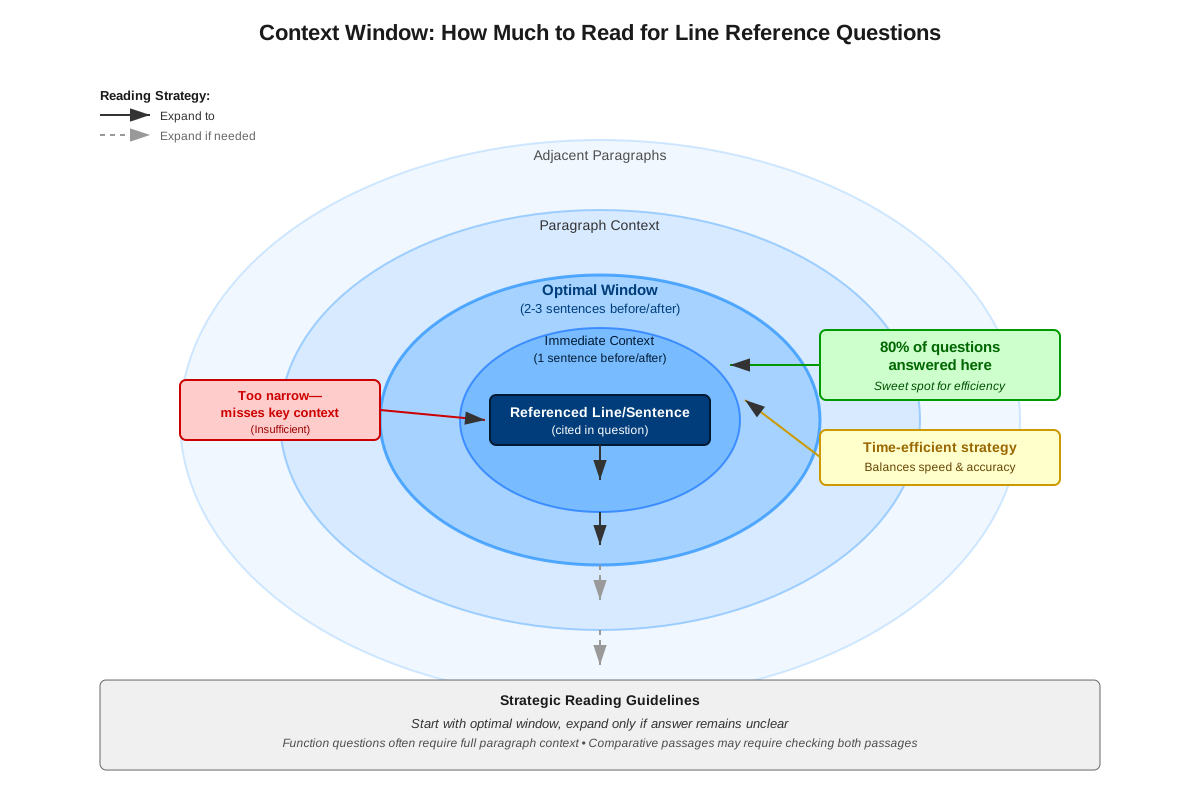
The most critical concept for line reference questions is the context principle: the correct answer almost always requires understanding not just the referenced lines themselves, but also the sentences immediately before and after, plus the paragraph's overall function within the passage. The LSAT exploits the natural tendency to read only the cited lines by creating wrong answers that seem correct based on the isolated text but contradict or misrepresent the broader context.
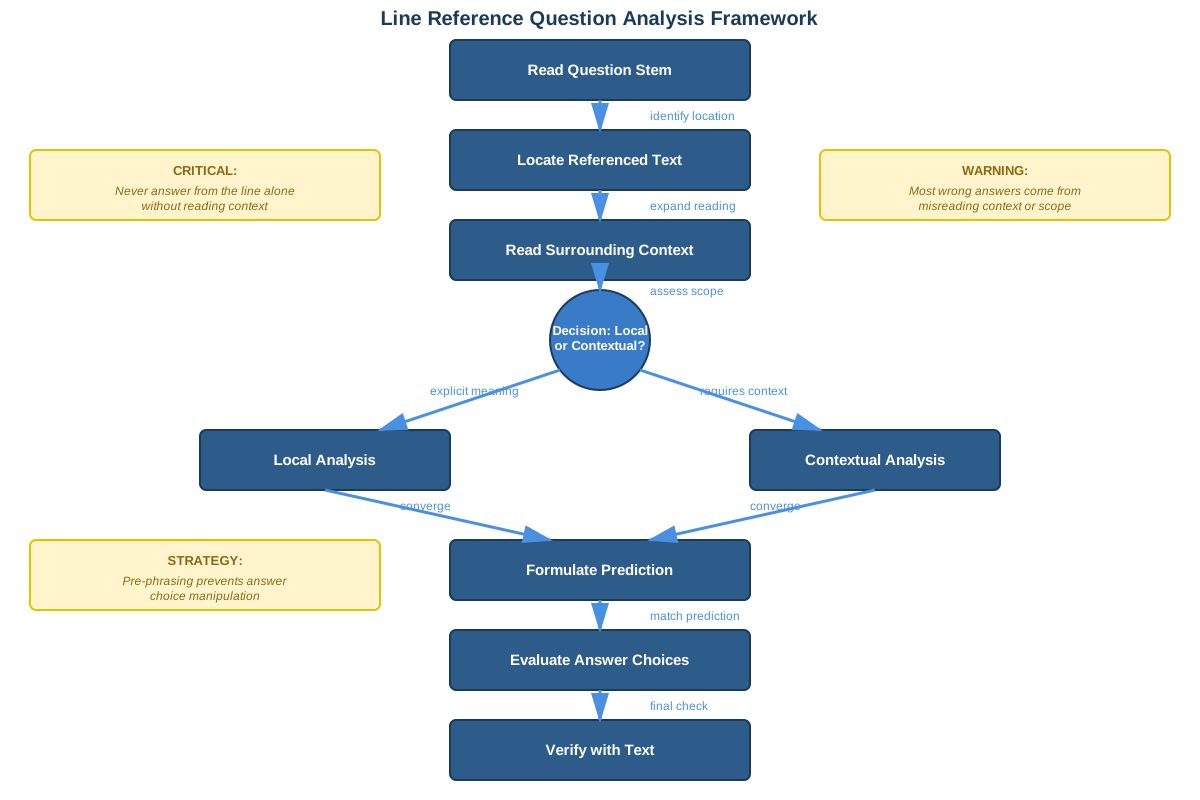
Effective line reference question strategy involves a three-zone reading approach: (1) the target zone—the specifically referenced lines, (2) the context zone—typically 2-3 sentences before and after the reference, and (3) the structural zone—understanding what role this paragraph plays in the passage's overall argument. Most students read only the target zone; high scorers systematically check all three zones before evaluating answer choices.
Types of Line Reference Questions
Line reference questions divide into four functional categories based on what they ask:
Meaning questions ask what the author means by specific language, often testing whether students can distinguish literal from figurative language or recognize technical versus colloquial usage. These questions typically include stems like "most nearly means," "refers to," or "indicates." The trap answers usually provide dictionary definitions that don't fit the passage context or meanings from other parts of the passage.
Purpose questions ask why the author included specific information, testing understanding of argumentative structure. Stems include "in order to," "serves to," or "functions to." These questions require understanding the paragraph's role in the overall argument. Wrong answers often describe what the text says rather than why the author included it, or they attribute purposes that contradict the author's actual stance.
Suggestion/Implication questions ask what can be inferred from the referenced text, requiring students to draw conclusions supported by but not explicitly stated in the lines. Stems include "suggests," "implies," or "most likely indicates." These questions test the boundary between reasonable inference and unsupported speculation. Trap answers either require assumptions beyond the text or state explicit information as if it were an inference.
Example/Illustration questions ask what concept or claim the referenced text exemplifies, requiring students to move from specific detail to general principle. These questions test whether students understand the relationship between evidence and conclusion. Wrong answers typically reverse the relationship, treating the general claim as if it were the example.
The Paraphrase Principle
Correct answers to line reference questions almost never use the exact language from the passage. The LSAT tests comprehension, not memory, so correct answers paraphrase the passage content using different vocabulary while maintaining the same meaning. This principle helps eliminate wrong answers: choices that quote passage language verbatim are usually traps designed to catch students who recognize familiar words without verifying meaning.
The paraphrase principle creates a systematic elimination strategy. When evaluating answer choices, students should translate each choice back into their own words, then compare that meaning to the passage content. Choices that sound sophisticated but mean something different from the passage are wrong, regardless of how "passage-like" they sound. Conversely, choices that use simple language but accurately capture the passage meaning are often correct.
Common Trap Answer Patterns
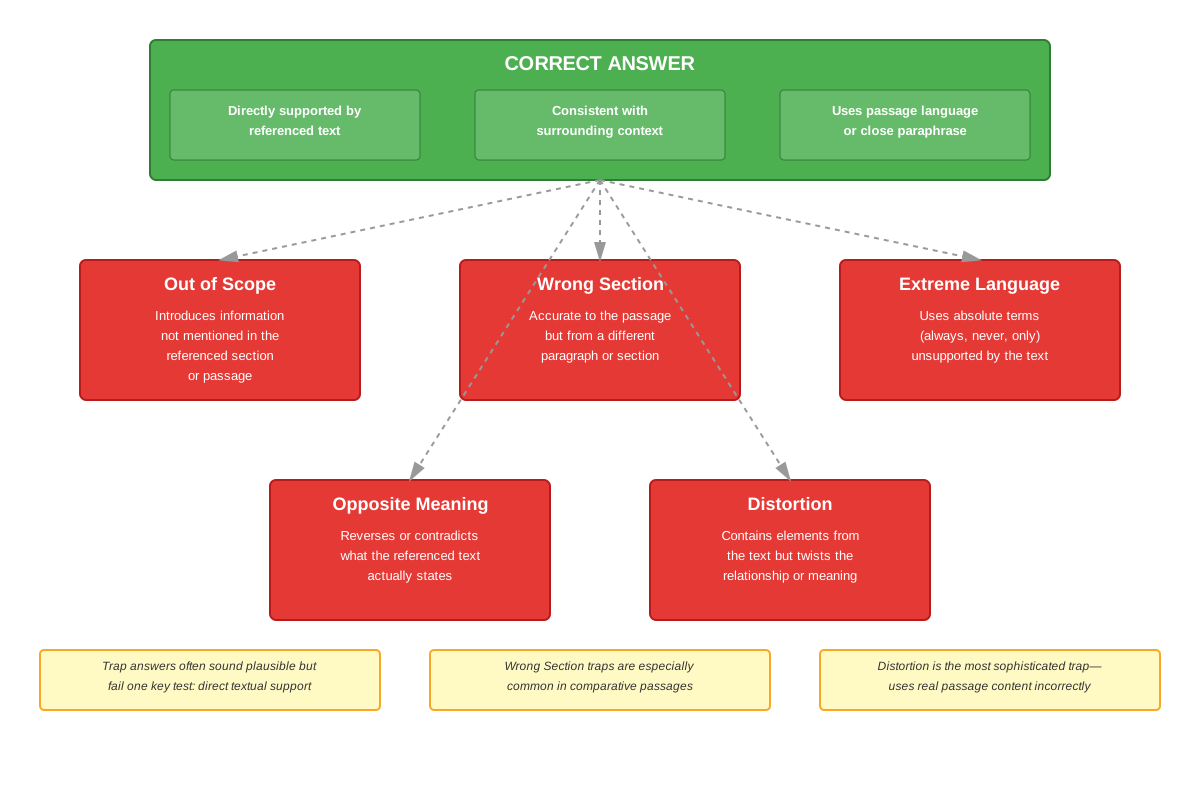
Line reference questions feature predictable wrong answer patterns that appear repeatedly across LSAT administrations:
Out-of-context answers take language from the referenced lines but misrepresent its meaning by ignoring surrounding context. These answers are factually present in the passage but don't answer what the question asks.
Wrong-location answers provide accurate information from the passage but from a different section than the line reference. These test whether students carefully read the referenced location versus relying on general passage memory.
Extreme answers take a moderate claim from the passage and strengthen it beyond what the text supports, using words like "always," "never," "only," or "must." The LSAT rarely supports absolute claims.
Opposite answers state the reverse of what the passage says, often appearing in purpose questions where they attribute an opposing viewpoint to the author.
Half-right answers begin accurately but add unsupported information in the second half, testing whether students verify the entire answer choice versus stopping after recognizing correct initial content.
Concept Relationships
The concepts within line reference questions form an interconnected system where mastery of each element reinforces the others. The context principle serves as the foundation, establishing that isolated reading produces wrong answers. This principle directly enables the three-zone reading approach, which operationalizes context by defining exactly how much surrounding text to review. The three-zone approach then connects to question type identification because different question types (meaning, purpose, suggestion, example) require emphasis on different zones—meaning questions focus more on the target zone, while purpose questions require heavy emphasis on the structural zone.
The paraphrase principle operates as a parallel concept that applies across all question types. It connects to trap answer recognition because understanding that correct answers paraphrase while wrong answers often quote creates a powerful elimination tool. The five trap answer patterns (out-of-context, wrong-location, extreme, opposite, half-right) represent specific applications of both the context principle and paraphrase principle: out-of-context answers violate the context principle, while extreme and opposite answers violate the paraphrase principle by distorting meaning.
These line reference concepts connect backward to prerequisite knowledge of basic passage comprehension—students must understand main ideas and structure before they can effectively use the structural zone. They connect forward to more advanced question types: the skills developed for line reference questions (precise textual analysis, context awareness, paraphrase recognition) transfer directly to inference questions, strengthen questions, and parallel reasoning questions. Mastering line reference questions creates a foundation for all LSAT Reading Comprehension success because these questions isolate and test the fundamental skill of accurate reading in a format where the relevant text is explicitly identified.
High-Yield Facts
⭐ Line reference questions account for 30-40% of all LSAT Reading Comprehension questions, making them the second most common question type.
⭐ The correct answer to a line reference question almost always requires reading 2-3 sentences before and after the referenced lines, not just the cited text itself.
⭐ Correct answers paraphrase passage content using different vocabulary; answer choices that quote passage language verbatim are usually wrong.
⭐ Purpose questions ("in order to," "serves to") require understanding the paragraph's role in the overall argument, not just what the referenced text says.
⭐ Wrong answers frequently take accurate information from the wrong location in the passage, testing whether students read the specific referenced lines.
- Line reference questions appear in all four passage types (natural science, social science, humanities, law) with equal frequency.
- The most common trap answer pattern is the "out-of-context" answer that uses passage language but misrepresents its contextual meaning.
- Extreme language ("always," "never," "only," "must") in answer choices is rarely supported by LSAT passages and usually indicates a wrong answer.
- "Half-right" answers that begin accurately but add unsupported information test whether students verify the entire answer choice.
- Reading only the referenced lines without context leads to wrong answers approximately 70% of the time on difficult line reference questions.
- The three-zone approach (target, context, structural) should take 20-30 seconds for efficient line reference question analysis.
- Suggestion/implication questions require drawing conclusions supported by the text but not explicitly stated, testing the boundary between inference and speculation.
Quick check — test yourself on Line reference questions so far.
Try Flashcards →Common Misconceptions
Misconception: Line reference questions can be answered by reading only the cited lines without reviewing surrounding context.
Correction: The LSAT deliberately creates wrong answers that seem correct based on isolated reading. Correct answers almost always require understanding the 2-3 sentences before and after the reference, plus the paragraph's overall function. Reading only the cited lines leads to wrong answers on approximately 70% of difficult line reference questions.
Misconception: Answer choices that use exact language from the passage are more likely to be correct because they're directly supported by the text.
Correction: The LSAT tests comprehension, not memory, so correct answers paraphrase passage content using different vocabulary. Answer choices that quote passage language verbatim are usually traps designed to catch students who recognize familiar words without verifying meaning. The paraphrase principle is one of the most reliable elimination tools.
Misconception: Purpose questions ("in order to," "serves to") can be answered by describing what the referenced text says.
Correction: Purpose questions ask why the author included specific information, requiring understanding of argumentative structure, not content summary. An answer that accurately describes what the text says but doesn't explain its function in the argument is wrong. Purpose questions require emphasis on the structural zone—understanding how the paragraph advances the passage's overall argument.
Misconception: If an answer choice contains information that appears somewhere in the passage, it's a safe choice.
Correction: Wrong-location answers provide accurate passage information from a different section than the line reference. These answers test whether students carefully read the specific referenced location versus relying on general passage memory. Every answer choice must be verified against the specific referenced lines, not just general passage content.
Misconception: Suggestion/implication questions allow any reasonable inference based on the referenced text.
Correction: The LSAT draws a sharp distinction between inferences directly supported by the text and speculative possibilities that go beyond the evidence. Correct answers to suggestion questions must be provable from the referenced text and its immediate context. If an answer requires assuming information not in the passage or making logical leaps, it's wrong regardless of how plausible it seems.
Worked Examples
Example 1: Purpose Question
Passage excerpt (lines 15-22):
"Traditional economic models assume rational actors making decisions to maximize utility. However, behavioral economists have documented systematic deviations from this assumption. For instance, individuals consistently demonstrate loss aversion, valuing losses approximately twice as heavily as equivalent gains. This asymmetry cannot be explained by standard utility theory."
Question: The author mentions "loss aversion" (line 19) primarily in order to:
(A) illustrate a phenomenon that challenges traditional economic assumptions
(B) explain why individuals make irrational financial decisions
(C) demonstrate that behavioral economics has replaced traditional economic theory
(D) prove that utility theory is fundamentally flawed
(E) suggest that losses are objectively more significant than gains
Analysis:
First, identify the question type: "in order to" signals a purpose question, requiring understanding of why the author included this information, not just what it says.
Second, apply the three-zone approach:
- Target zone: "loss aversion, valuing losses approximately twice as heavily as equivalent gains"
- Context zone: The sentence before introduces behavioral economists documenting "systematic deviations" from rational actor assumptions. The sentence after states this "cannot be explained by standard utility theory."
- Structural zone: This paragraph's function is to present a challenge to traditional economic models, as indicated by "However" at the beginning.
Third, predict the answer before looking at choices: The author uses loss aversion as a specific example of deviations from traditional assumptions that standard theory can't explain.
Fourth, evaluate each choice:
(A) CORRECT: This accurately captures the purpose—loss aversion illustrates (specific example) a phenomenon (deviation from rational actor model) that challenges (cannot be explained by) traditional assumptions. This paraphrases the passage content while using different vocabulary.
(B) Wrong: The passage doesn't characterize these decisions as "irrational"—this is an extreme characterization. The passage says they deviate from traditional models, which is different from being irrational. This is an extreme answer trap.
(C) Wrong: "Replaced" is too strong. The passage presents behavioral economics as documenting deviations, not replacing traditional theory entirely. This is an extreme answer trap.
(D) Wrong: "Fundamentally flawed" is stronger than "cannot explain this phenomenon." The passage suggests limitations, not fundamental flaws. This is an extreme answer trap.
(E) Wrong: This describes what loss aversion is (what the text says) rather than why the author mentions it (the text's purpose). Additionally, "objectively more significant" misrepresents the passage, which describes how individuals value losses, not objective significance. This is a content-instead-of-purpose trap.
Key lesson: Purpose questions require moving from specific content to structural function. The correct answer explains the role the information plays in the argument, not just what the information says.
Example 2: Meaning Question
Passage excerpt (lines 34-40):
"Critics have dismissed the new architectural movement as mere nostalgia, a retreat from modernist principles. Yet this characterization misses the movement's essential innovation: rather than simply reproducing historical forms, architects are engaging in a sophisticated dialogue with the past, selectively incorporating traditional elements while maintaining contemporary functionality and aesthetic sensibility."
Question: In context, the word "dialogue" (line 38) most nearly means:
(A) a conversation between architects and historians
(B) a literal exchange of ideas through written correspondence
(C) a thoughtful engagement that draws upon while transforming historical precedents
(D) an exact replication of traditional architectural techniques
(E) a debate about the merits of modernist versus traditional design
Analysis:
First, identify the question type: "most nearly means" signals a meaning question, requiring understanding of how the word functions in this specific context, not its dictionary definition.
Second, apply the three-zone approach:
- Target zone: "engaging in a sophisticated dialogue with the past"
- Context zone: The sentence before states critics dismiss the movement as "mere nostalgia" and "retreat." The word "Yet" signals the author is contradicting this view. The phrase after "dialogue" explains: "selectively incorporating traditional elements while maintaining contemporary functionality."
- Structural zone: This sentence presents the author's view defending the movement against critics.
Third, understand the metaphorical usage: "Dialogue" is being used figuratively, not literally. The passage explains what this metaphorical dialogue means: selective incorporation while maintaining contemporary elements—a two-way engagement, not simple reproduction.
Fourth, evaluate each choice:
(A) Wrong: This interprets "dialogue" too literally as an actual conversation between people. The passage uses "dialogue with the past," meaning engagement with historical forms, not conversations with historians. This is a literal interpretation trap.
(B) Wrong: This also interprets "dialogue" literally as written exchange. The passage uses the term metaphorically to describe how architects engage with historical forms. This is a literal interpretation trap.
(C) CORRECT: This captures the metaphorical meaning explained in the passage: "thoughtful engagement" paraphrases "sophisticated dialogue," "draws upon" paraphrases "incorporating traditional elements," and "transforming" captures "while maintaining contemporary functionality." This answer paraphrases the passage's explanation of what the metaphorical dialogue means.
(D) Wrong: This contradicts the passage, which explicitly distinguishes the movement from "simply reproducing historical forms." The dialogue involves selective incorporation and transformation, not exact replication. This is an opposite answer trap.
(E) Wrong: This interprets "dialogue" as a debate about competing approaches. However, the passage describes dialogue "with the past" (engagement with historical forms), not a debate between modernist and traditional camps. This is a wrong-location trap—debate between approaches appears earlier in the passage (critics versus the movement) but isn't what "dialogue" means in this context.
Key lesson: Meaning questions require understanding contextual usage, especially when words are used metaphorically. The passage often explains what a metaphorical term means through surrounding context. Correct answers paraphrase this contextual explanation rather than providing dictionary definitions.
Exam Strategy
When approaching line reference questions on the LSAT, implement a systematic five-step process that maximizes accuracy while managing time efficiently:
Step 1: Identify the question type (5 seconds). Determine whether the question asks about meaning, purpose, suggestion, or example. This identification dictates which zone requires emphasis and what type of answer to predict.
Step 2: Return to the passage and read the three zones (20-25 seconds). Read the target zone (referenced lines), context zone (2-3 sentences before and after), and quickly recall the structural zone (paragraph's function). Resist the temptation to read only the cited lines. Mark or mentally note the key claim in the referenced section.
Step 3: Predict the answer in your own words (5-10 seconds). Before looking at answer choices, articulate what the correct answer should say based on your three-zone reading. This prediction prevents wrong answers from seeming attractive.
Step 4: Evaluate answer choices using elimination (20-30 seconds). Eliminate choices that violate the paraphrase principle (quote verbatim), context principle (ignore surrounding text), or contain trap patterns (extreme language, opposite meaning, half-right structure). The correct answer should match your prediction even if it uses different vocabulary.
Step 5: Verify the selected answer (5-10 seconds). Before moving on, quickly confirm the chosen answer against the passage text. Check that it answers what the question asks (not a different question) and that the entire answer choice is supported (not just the beginning).
Trigger words and phrases that signal line reference questions include: "In lines X-Y," "The author mentions," "The phrase," "In the [ordinal] paragraph," "The reference to," and any question stem that quotes specific passage language. When you see these triggers, immediately implement the three-zone reading approach.
Process-of-elimination tips specific to line reference questions:
- Eliminate any answer that uses extreme language ("always," "never," "only," "must") unless the passage itself uses such language
- Eliminate answers that sound passage-like but don't answer the specific question asked
- Eliminate answers that quote passage language verbatim—correct answers paraphrase
- For purpose questions, eliminate any answer that describes content rather than function
- For meaning questions, eliminate literal interpretations of metaphorical language
- Eliminate answers that require information not in the passage or the immediate context
Time allocation: Spend 50-70 seconds per line reference question. This breaks down as: 5 seconds identifying question type, 25 seconds reading three zones, 10 seconds predicting, 25 seconds evaluating choices, and 5 seconds verifying. Line reference questions should be faster than inference questions because the relevant text is explicitly identified. If a question exceeds 90 seconds, make your best elimination-based choice and move forward.
Exam Tip: When time pressure increases, never skip the context zone. Reading only the target zone dramatically increases error rates. If you must save time, reduce time spent on answer choice evaluation by being more aggressive with elimination, but always read the surrounding context.
Memory Techniques
The THREE-ZONE mnemonic: Target (the cited lines), Context (surrounding sentences), Structure (paragraph function). Remember "TCS: The Complete Story" to recall that you need all three zones for the complete story of what the referenced text means.
The POPS framework for question types: Purpose (why included), Opinion/suggestion (what's implied), Phrasing (what it means), Support (what it exemplifies). This acronym helps quickly categorize which type of line reference question you're facing.
The QUOTE trap reminder: If an answer Quotes Using Original Text Exactly, it's usually wrong. Visualize a big red "X" over any answer choice that uses verbatim passage language without paraphrasing.
The "Before, During, After" visualization: Picture the referenced lines as the middle of a sandwich. You need the bread (before and after) to have a complete sandwich—the middle alone isn't enough. This image reinforces the context principle.
The Five Trap Fingers: Associate each finger with a trap pattern: thumb = Out-of-context, index = Wrong-location, middle = Extreme, ring = Opposite, pinky = Half-right. When evaluating answers, mentally "count off" these traps on your fingers to systematically check for each pattern.
The Purpose vs. Content distinction: For purpose questions, remember "WHY not WHAT"—the question asks why the author included information (function), not what the information says (content). Visualize a big "WHY?" to remind yourself to focus on function.
Summary
Line reference questions constitute 30-40% of LSAT Reading Comprehension questions and test whether students can accurately interpret specific textual passages while maintaining awareness of broader context. Success requires understanding the context principle: correct answers almost always demand reading beyond the cited lines to include surrounding sentences and the paragraph's structural function. The LSAT exploits the natural tendency toward isolated reading by creating trap answers that seem correct based on the referenced lines alone but misrepresent meaning when context is considered. Mastery involves implementing a systematic three-zone reading approach (target, context, structural), recognizing the four question types (meaning, purpose, suggestion, example), applying the paraphrase principle (correct answers restate passage content using different vocabulary), and identifying five common trap patterns (out-of-context, wrong-location, extreme, opposite, half-right). Efficient execution requires 50-70 seconds per question, with emphasis on reading context before evaluating answer choices. These skills transfer directly to other Reading Comprehension question types and develop the precise textual analysis fundamental to legal reasoning.
Key Takeaways
- Line reference questions require reading 2-3 sentences before and after the cited lines, not just the referenced text itself—the context principle is the foundation of success
- Correct answers paraphrase passage content using different vocabulary; verbatim quotations from the passage usually indicate wrong answers
- Purpose questions ask why the author included information (function), not what the information says (content)—focus on structural role, not content summary
- The five trap patterns (out-of-context, wrong-location, extreme, opposite, half-right) appear predictably and can be systematically eliminated
- Implement the three-zone approach (target, context, structural) for every line reference question, spending 50-70 seconds total per question
- Question type identification (meaning, purpose, suggestion, example) determines which zone requires emphasis and what type of answer to predict
- Line reference questions are high-yield study targets because they appear consistently (30-40% of Reading Comprehension questions) and reward systematic approaches with reliable points
Related Topics
Inference Questions: After mastering line reference questions, inference questions represent the natural progression. While line reference questions identify the relevant text explicitly, inference questions require students to identify which passage content supports a given conclusion. The close reading and context awareness skills developed for line reference questions transfer directly to inference question success.
Function Questions: These questions ask about the role specific paragraphs or sentences play in the passage's overall structure. Function questions extend the structural zone analysis from line reference questions to entire paragraphs, requiring the same understanding of argumentative purpose at a larger scale.
Author's Attitude Questions: These questions require synthesizing tone and perspective across the passage. The precise textual analysis skills developed for line reference questions—distinguishing between what is stated versus implied, recognizing subtle language choices—enable accurate attitude identification.
Comparative Reading Questions: LSAT Reading Comprehension includes paired passages with questions asking about relationships between them. Line reference skills transfer to comparative questions that cite specific locations in Passage A or B, requiring the same three-zone approach within each passage.
Practice CTA
Now that you understand the systematic approach to line reference questions—the context principle, three-zone reading, question type identification, and trap pattern recognition—it's time to apply these strategies to actual LSAT passages. The practice questions and flashcards will reinforce the concepts covered in this guide and build the automaticity needed for test-day success. Remember: line reference questions reward systematic approaches with reliable points. Each practice question is an opportunity to strengthen your process and build confidence. Start with untimed practice to perfect your three-zone approach, then gradually add time pressure as the method becomes automatic. Your investment in mastering line reference questions will pay dividends across all Reading Comprehension question types!
Sign up free to keep reading
Create a free AnvayaPrep account to finish this LSAT guide on Line reference questions — plus flashcards and practice questions.