Overview
Meaning in context questions represent a critical category within LSAT reading comprehension that tests a student's ability to understand how specific words, phrases, or sentences function within the broader argumentative structure of a passage. Unlike vocabulary questions that simply ask for definitions, these questions require test-takers to analyze how an author uses language strategically to convey nuanced ideas, support claims, or establish relationships between concepts. The LSAT uses these questions to assess whether students can move beyond surface-level reading to grasp the precise communicative intent behind specific textual elements.
These questions typically appear 2-4 times per LSAT exam and are considered medium-to-high difficulty because they demand both careful attention to local context and awareness of the passage's global structure. Students must recognize that words and phrases often carry meanings that differ from their everyday usage when employed within academic or argumentative discourse. The ability to decode meaning in context questions directly correlates with success on other reading comprehension question types, as it develops the analytical reading skills necessary for understanding author's purpose, tone, and argumentative strategy.
Mastering meaning in context questions strengthens overall reading comprehension performance by training students to read actively and precisely. This skill set forms the foundation for tackling inference questions, function questions, and passage structure questions—all of which require understanding how specific textual elements contribute to the author's broader communicative goals. The interpretive precision developed through these questions translates directly into improved performance across all reading comprehension passages, making this topic essential for achieving a competitive LSAT score.
Learning Objectives
- [ ] Identify how Meaning in context questions appears in LSAT questions
- [ ] Explain the reasoning pattern behind Meaning in context questions
- [ ] Apply Meaning in context questions to solve LSAT-style problems accurately
- [ ] Distinguish between literal definitions and contextual meanings in complex passages
- [ ] Analyze how surrounding sentences and paragraph structure inform word/phrase meaning
- [ ] Evaluate answer choices by testing them against the specific context of the passage
- [ ] Recognize common trap answers that rely on dictionary definitions rather than contextual usage
Prerequisites
- Basic reading comprehension skills: Ability to understand main ideas and supporting details in academic prose, which forms the foundation for analyzing specific textual elements
- Familiarity with LSAT passage structure: Understanding how LSAT passages are organized (introduction, development, conclusion) helps locate relevant context for interpretation
- Knowledge of question stem formats: Recognition of how LSAT questions are phrased enables quick identification of what the question is actually asking
- Understanding of author's purpose: Awareness that authors use language strategically to advance arguments provides the framework for interpreting contextual meaning
Why This Topic Matters
Meaning in context questions assess a fundamental legal reasoning skill: the ability to interpret language precisely within its specific context. Legal professionals must constantly analyze how terms are used in statutes, contracts, and judicial opinions, where words often carry specialized meanings that differ from common usage. This question type directly mirrors the interpretive work lawyers perform daily, making it a high-validity assessment of law school readiness.
On the LSAT, meaning in context questions appear with consistent frequency, typically comprising 8-12% of all reading comprehension questions. This translates to approximately 2-4 questions per exam, distributed across the reading comprehension section. Given that reading comprehension constitutes roughly 27% of the total LSAT score, mastering this question type can directly impact overall performance by 2-3 percentile points—a significant margin in competitive law school admissions.
These questions commonly appear in passages discussing complex academic topics, legal theory, scientific explanations, or humanities arguments where authors employ technical terminology, metaphorical language, or discipline-specific jargon. The LSAT frequently tests words or phrases that have both common meanings and specialized contextual meanings, requiring students to demonstrate sophisticated reading skills. Questions may focus on transitional phrases that signal argumentative moves, technical terms that carry specific meanings within a discipline, or figurative language that conveys the author's attitude or evaluative stance.
Core Concepts
Definition and Structure of Meaning in Context Questions
Meaning in context questions ask test-takers to determine what a specific word, phrase, or sentence means as it is used within a particular passage. These questions are distinguished by their focus on contextual usage rather than dictionary definitions. The question stem typically includes phrases such as "as used in line X," "in context, the phrase means," or "the author uses the term to indicate." This phrasing signals that the correct answer must align with how the author employs the language within the specific argumentative or explanatory framework of the passage.
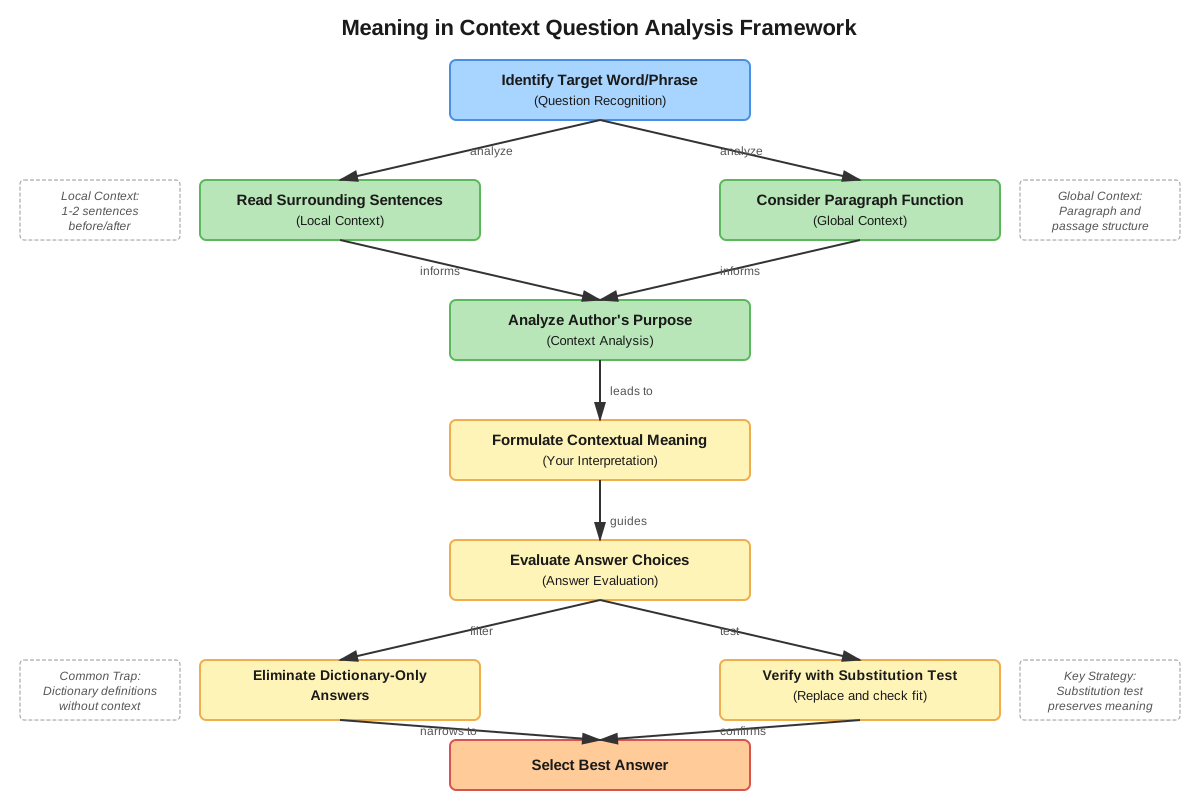
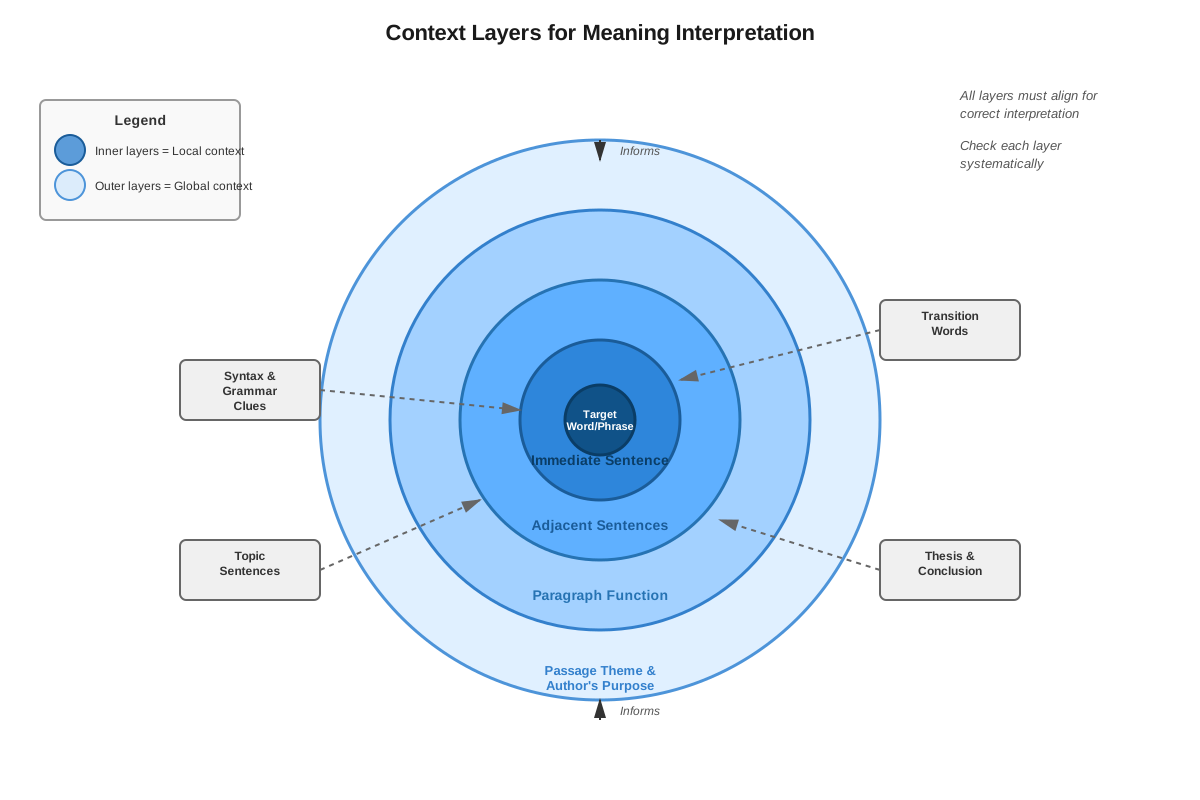
The structure of these questions involves three key components: the reference point (the specific word or phrase being questioned), the local context (the immediate sentence and surrounding sentences), and the global context (the passage's overall purpose and argumentative structure). Successful analysis requires integrating all three levels of context to determine the author's intended meaning.
The Reasoning Pattern Behind Contextual Interpretation
The fundamental reasoning pattern for solving meaning in context questions follows a systematic analytical process. First, students must locate the referenced text and read it within its immediate sentence. Second, they must expand their reading to include the sentences immediately before and after the reference point, as these typically provide crucial interpretive clues. Third, they must consider the paragraph's function within the passage's overall structure—whether it introduces a concept, presents evidence, offers a counterargument, or draws a conclusion.
The LSAT designs these questions to test whether students understand that meaning is context-dependent rather than fixed. A word like "liberal" might mean "generous" in one context, "politically progressive" in another, or "broad/flexible" in yet another. The passage context determines which meaning applies. Similarly, phrases function differently depending on their argumentative role: "on the other hand" might introduce a contrast, a qualification, or an alternative perspective, and the correct interpretation depends on what the author is doing at that point in the argument.
Types of Contextual Meaning
LSAT passages employ several distinct types of contextual meaning that students must recognize:
Technical or Specialized Meaning: Academic and professional discourse often uses common words with specialized meanings. For example, "positive" in legal theory might refer to "positivism" (law as written rules) rather than "good" or "optimistic." The passage context will establish these specialized uses through definition, example, or contrast with other concepts.
Figurative or Metaphorical Meaning: Authors use metaphorical language to make abstract concepts more concrete or to convey evaluative attitudes. A phrase like "the theory collapses under scrutiny" uses spatial/physical metaphor to describe logical failure. Understanding these requires recognizing the conceptual mapping between the literal and figurative domains.
Functional or Rhetorical Meaning: Some questions focus on what a phrase accomplishes rather than what it denotes. A phrase like "to be sure" functions to acknowledge a point before qualifying or contrasting it. Understanding functional meaning requires attention to argumentative structure and rhetorical moves.
Evaluative or Attitudinal Meaning: Words and phrases often carry connotations that reveal the author's stance. Describing a theory as "elegant" versus "simplistic" conveys different evaluations, even though both might refer to the same quality of being uncomplicated. Context reveals which evaluative dimension the author intends.
The Role of Surrounding Context
The immediate context—typically the sentence containing the referenced text plus 1-2 sentences before and after—provides the most direct interpretive clues. Authors often use several techniques to clarify meaning:
- Apposition: Placing explanatory phrases next to the term (e.g., "positivism, the view that law consists only of written rules")
- Contrast: Defining something by what it is not (e.g., "unlike traditional approaches, this method...")
- Example: Illustrating the concept with concrete instances
- Restatement: Expressing the same idea in different words
- Causal explanation: Showing what leads to or follows from the concept
The broader context of the paragraph and passage establishes the conceptual framework within which specific terms operate. Understanding whether a paragraph is presenting the author's view, describing others' positions, or offering critique helps determine how to interpret specific language within that paragraph.
Common Question Stem Formats
| Question Stem Format | What It's Asking | Strategic Approach |
|---|---|---|
| "As used in line X, [word] most nearly means" | Direct synonym in context | Replace the word with each answer choice and see which preserves the sentence's meaning |
| "In context, the phrase [phrase] indicates" | The function or implication of the phrase | Consider what the phrase accomplishes in the argument |
| "The author uses [term] to refer to" | What concept the term designates | Look for definitions or examples in surrounding context |
| "Which of the following best captures the meaning of [phrase]?" | Paraphrase that preserves contextual meaning | Focus on the idea being conveyed, not word-for-word matching |
| "By [phrase], the author means" | The intended sense of potentially ambiguous language | Consider the author's purpose at that point in the passage |
Concept Relationships
The concepts within meaning in context questions form an integrated analytical framework. Contextual interpretation serves as the overarching skill, which depends on understanding both local context (immediate sentences) and global context (passage structure and purpose). These two levels of context work together: local context provides specific interpretive clues, while global context establishes the conceptual framework that determines which interpretation makes sense.
The relationship flows as follows: Question identification → Text location → Local context analysis → Global context consideration → Answer evaluation. Each step builds on the previous one, creating a systematic approach to interpretation.
This topic connects directly to prerequisite knowledge of passage structure because understanding where a paragraph fits in the overall argument helps interpret specific language within that paragraph. It also relates to author's purpose questions, as determining what an author means by specific language requires understanding what the author is trying to accomplish overall.
Meaning in context questions serve as a foundation for more complex question types. Inference questions require similar contextual reading skills but ask students to draw conclusions beyond what's explicitly stated. Function questions build on meaning in context by asking not just what language means but what role it plays in the argument. Tone and attitude questions extend contextual interpretation to evaluate the author's stance. Thus, mastering meaning in context creates a skill base that supports success across multiple reading comprehension question types.
High-Yield Facts
⭐ Meaning in context questions appear 2-4 times per LSAT exam, representing approximately 8-12% of reading comprehension questions
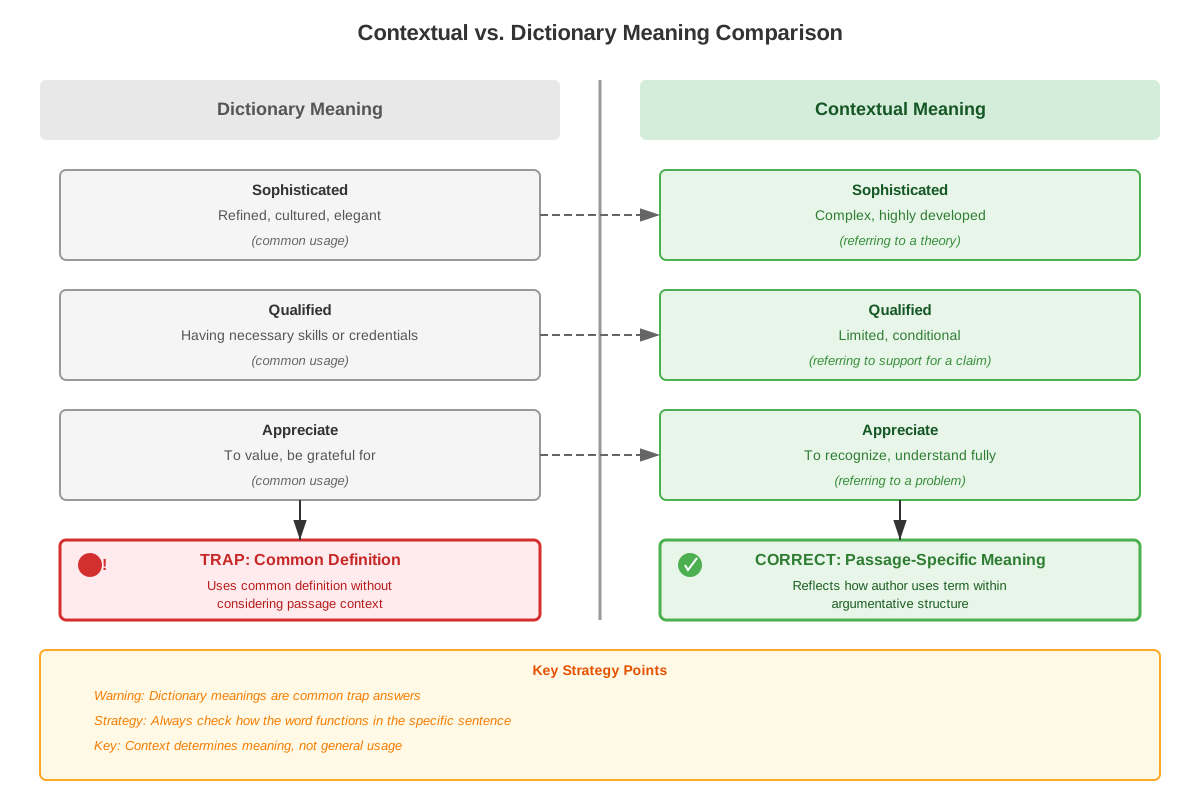
⭐ The correct answer must fit the specific context of the passage, not just provide a valid dictionary definition
⭐ Reading 1-2 sentences before and after the referenced text is essential for accurate interpretation
⭐ Common trap answers include dictionary definitions that don't match the contextual usage
⭐ The passage's overall purpose and structure inform how specific words and phrases should be interpreted
- Question stems typically include phrases like "as used in line X," "in context," or "the author uses the term to"
- Technical or specialized meanings often differ significantly from everyday usage of the same words
- Figurative language requires understanding the conceptual mapping between literal and metaphorical domains
- Functional meanings focus on what language accomplishes rather than what it denotes
- Authors use apposition, contrast, examples, and restatement to clarify meaning in surrounding context
- The correct answer should be substitutable for the original text without changing the passage's meaning
- Evaluative language reveals the author's attitude and should be interpreted in light of the author's overall stance
- Words with multiple common meanings require careful attention to which meaning the context supports
- Transitional phrases signal argumentative moves and should be interpreted based on their rhetorical function
- The difficulty of these questions often lies in distinguishing between plausible meanings rather than identifying an obvious answer
Quick check — test yourself on Meaning in context questions so far.
Try Flashcards →Common Misconceptions
Misconception: The correct answer is always a synonym that could replace the word in any context → Correction: The correct answer must work specifically in the passage's context; a word that's generally synonymous might not fit the particular usage in the passage
Misconception: Dictionary definitions are sufficient for answering meaning in context questions → Correction: LSAT passages often use words in specialized or figurative ways that differ from standard dictionary definitions; contextual usage always takes precedence
Misconception: Only the sentence containing the referenced text needs to be read → Correction: Surrounding sentences provide crucial interpretive clues through contrast, example, restatement, and explanation; reading only one sentence often leads to misinterpretation
Misconception: If an answer choice is true about the topic, it's correct → Correction: The answer must specifically capture what the author means by the referenced language in context, not just state something true about the general topic
Misconception: Meaning in context questions test vocabulary knowledge → Correction: These questions test reading comprehension and contextual interpretation skills; even familiar words may be used in unfamiliar ways that require careful analysis of context
Misconception: The most complex or sophisticated-sounding answer is usually correct → Correction: The correct answer accurately captures the contextual meaning, which may be expressed simply; complexity doesn't indicate correctness
Misconception: Personal interpretation of what a word "should" mean is acceptable → Correction: Only the author's intended meaning as evidenced by the passage context is relevant; personal associations or preferences are irrelevant
Worked Examples
Example 1: Technical Term in Scientific Context
Passage excerpt: "Traditional evolutionary theory emphasized gradual change through natural selection. However, paleontologists noted that the fossil record showed long periods of stasis punctuated by rapid speciation events. This pattern led to the development of punctuated equilibrium theory, which challenged the gradualist orthodoxy by proposing that evolutionary change occurs in relatively brief bursts separated by extended periods of morphological stability."
Question: As used in the passage, "orthodoxy" most nearly means:
A) Religious doctrine
B) Conventional scientific view
C) Rigid methodology
D) Unquestionable truth
E) Historical precedent
Analysis:
Step 1: Locate the term and read the immediate context. "Orthodoxy" appears in the phrase "gradualist orthodoxy," referring to traditional evolutionary theory.
Step 2: Examine surrounding sentences. The passage contrasts "traditional evolutionary theory" with the newer "punctuated equilibrium theory." The word "challenged" indicates that orthodoxy represents the established view being questioned.
Step 3: Consider the passage's purpose. The passage is explaining how a new scientific theory emerged to challenge an existing one, not discussing religion, methodology per se, or historical matters.
Step 4: Evaluate answer choices:
- (A) "Religious doctrine" - This is a common meaning of orthodoxy, but the passage is discussing scientific theory, not religion. Trap answer based on dictionary definition.
- (B) "Conventional scientific view" - This fits perfectly: the gradualist view was the conventional, established scientific position being challenged.
- (C) "Rigid methodology" - The passage discusses theoretical views, not methodological approaches.
- (D) "Unquestionable truth" - Too extreme; the passage shows the view was questioned and challenged.
- (E) "Historical precedent" - While the gradualist view came first historically, "orthodoxy" emphasizes its status as the accepted view, not merely its temporal priority.
Correct Answer: B
This example demonstrates how context determines meaning. While "orthodoxy" can mean religious doctrine (its most common usage), the scientific context and the contrast with a challenging new theory indicate that it means "conventional scientific view" here.
Example 2: Figurative Language in Humanities Passage
Passage excerpt: "Critics have long debated whether literary interpretation should seek the author's intended meaning or whether texts, once published, escape their creators' control. The intentionalist position anchors meaning in authorial purpose, while reader-response theorists argue that meaning emerges from the interaction between text and reader. This debate has proven remarkably resilient, resurfacing in new forms despite repeated attempts to dissolve it through theoretical synthesis."
Question: In context, the phrase "escape their creators' control" suggests that:
A) Authors lose legal rights to their published works
B) Published texts can be interpreted in ways the author didn't intend
C) Writers cannot prevent unauthorized reproductions
D) Literary works develop independently of human agency
E) Authors deliberately relinquish authority over interpretation
Analysis:
Step 1: Identify the figurative nature of the language. "Escape" and "control" are being used metaphorically—texts don't literally run away, and authors don't physically control them.
Step 2: Examine the contrast structure. The sentence presents two opposing positions: intentionalists believe meaning is "anchored in authorial purpose," while the contrasting view (introduced by "while") must hold something different about where meaning resides.
Step 3: Connect to the broader debate. The passage is about whether interpretation should seek the author's intended meaning or not. The phrase "escape their creators' control" describes the anti-intentionalist position.
Step 4: Evaluate answer choices:
- (A) "Legal rights" - The passage discusses interpretation and meaning, not legal or copyright issues. Trap answer from misunderstanding the domain.
- (B) "Interpreted in ways the author didn't intend" - This captures the metaphorical meaning: once published, texts can be understood differently than the author intended, meaning they've "escaped" authorial control over meaning.
- (C) "Unauthorized reproductions" - Again, this is about copyright/legal issues, not interpretation.
- (D) "Develop independently of human agency" - Too extreme and not supported; the passage discusses reader interpretation, not texts acting independently.
- (E) "Deliberately relinquish authority" - The phrase suggests texts escape control, not that authors voluntarily give it up.
Correct Answer: B
This example shows how figurative language must be interpreted based on the conceptual domain being discussed. The metaphor of "escape" and "control" maps onto the debate about whether authors determine textual meaning or whether readers can generate meanings the author didn't intend.
Exam Strategy
Systematic Approach to Meaning in Context Questions
When encountering a meaning in context question, follow this strategic process:
- Identify the question type by looking for trigger phrases: "as used in," "in context," "most nearly means," "the author uses [term] to"
- Return to the passage and locate the referenced text. Never rely on memory—always reread the specific section.
- Read strategically: Start with the sentence containing the referenced text, then expand to 1-2 sentences before and after. This provides sufficient context without consuming excessive time.
- Predict before looking at answers: Based on context, formulate your own understanding of what the word or phrase means. This prevents answer choices from influencing your interpretation.
- Test each answer choice by substituting it for the original text. The correct answer should preserve the sentence's meaning and fit the passage's logic.
Trigger Words and Phrases
High-Yield Exam Tip: Question stems containing "as used in line X" or "in context" are definitive markers of meaning in context questions. These phrases signal that dictionary definitions are insufficient.
Watch for these question stem patterns:
- "As used in line X, [word] most nearly means"
- "In context, the phrase [phrase] indicates"
- "The author uses [term] to refer to"
- "Which of the following best captures the meaning of [phrase]?"
- "By [phrase], the author means"
In the passage itself, pay attention to:
- Appositive phrases (set off by commas or dashes) that define or explain terms
- Contrast markers (however, but, unlike, whereas) that clarify meaning through opposition
- Example indicators (such as, for instance, for example) that illustrate concepts
- Restatement signals (in other words, that is, i.e.) that paraphrase ideas
Process of Elimination Strategy
Eliminate answer choices that:
- Provide dictionary definitions that don't fit the context: Common trap answers offer valid meanings of the word that don't match how it's used in the passage
- Are too broad or too narrow: The correct answer should match the scope of the author's usage—neither overgeneralizing nor being overly specific
- Introduce concepts not present in the passage: If an answer choice brings in ideas not discussed in the relevant section, it's likely incorrect
- Change the passage's meaning when substituted: Mentally replace the original text with the answer choice; if the sentence no longer makes sense or conveys a different idea, eliminate it
- Rely on common associations rather than contextual usage: Words have connotations and associations that may not apply in the specific context
Time Allocation
Meaning in context questions should take approximately 45-60 seconds each. They're generally faster than inference or application questions because they focus on a specific textual element rather than requiring synthesis of multiple passage components. However, don't rush—careful reading of surrounding context is essential.
If a question is taking longer than 75 seconds, employ this triage strategy:
- Eliminate obviously wrong answers
- Make an educated guess between remaining choices
- Flag the question and return if time permits
- Don't let one question consume time needed for other questions
Memory Techniques
The CONTEXT Acronym
Use CONTEXT to remember the systematic approach:
- Confirm the question type (look for "as used in" or "in context")
- Observe the referenced text in the passage
- Note the surrounding sentences (1-2 before and after)
- Think about the passage's overall purpose
- Evaluate what the author is doing at that point
- X-out answers that don't fit the specific usage
- Test remaining answers by substitution
The Three-Level Reading Visualization
Visualize meaning in context questions as requiring three concentric circles of reading:
Inner Circle (Sentence Level): The immediate sentence containing the referenced text
Middle Circle (Paragraph Level): The surrounding sentences that provide direct context
Outer Circle (Passage Level): The overall purpose and structure that frame interpretation
Always read from inner to outer, but let the outer circle inform your interpretation of the inner circle.
The "Substitute and Check" Technique
Remember: "If it fits, it sits" — the correct answer should be substitutable for the original text without changing the passage's meaning. Physically or mentally replace the original word/phrase with each answer choice and see which one preserves the author's intended meaning.
Trap Answer Mnemonic: DICT
Common trap answers follow the DICT pattern:
- Dictionary definitions that don't match context
- Irrelevant associations or connotations
- Common meanings that don't fit the specific usage
- Too extreme or absolute interpretations
When you spot a DICT trap, eliminate it confidently.
Summary
Meaning in context questions assess the ability to interpret words, phrases, and sentences based on their specific usage within LSAT reading comprehension passages rather than relying on dictionary definitions or common associations. These questions appear 2-4 times per exam and require systematic analysis of both local context (surrounding sentences) and global context (passage structure and purpose). Success depends on recognizing that language is context-dependent: technical terms carry specialized meanings, figurative language requires understanding conceptual mappings, and functional phrases must be interpreted based on their rhetorical role. The strategic approach involves locating the referenced text, reading surrounding sentences for interpretive clues, considering the passage's overall purpose, predicting the meaning before examining answer choices, and testing answers through substitution. Common traps include dictionary definitions that don't fit context, answers that are too broad or narrow, and choices that introduce irrelevant concepts. Mastering this question type strengthens overall reading comprehension by developing precise analytical reading skills that transfer to inference, function, and structure questions, making it a high-yield topic for LSAT preparation.
Key Takeaways
- Meaning in context questions test contextual interpretation, not vocabulary knowledge or dictionary definitions
- Always read 1-2 sentences before and after the referenced text to gather sufficient interpretive context
- The correct answer must fit the specific usage in the passage, even if other meanings of the word are valid in different contexts
- Common trap answers provide dictionary definitions or common meanings that don't match the contextual usage
- Technical, figurative, functional, and evaluative meanings all require attention to how the author uses language within the passage's argumentative structure
- The systematic approach—locate, read context, predict, test by substitution—maximizes accuracy and efficiency
- These questions build foundational skills for other reading comprehension question types, making them high-value for overall section performance
Related Topics
Inference Questions: Building on meaning in context skills, inference questions require understanding not just what language means but what logically follows from it. Mastering contextual interpretation provides the foundation for drawing valid inferences.
Function Questions: These questions ask what role specific text plays in the passage's structure. Understanding meaning in context is prerequisite to analyzing function, as you must know what something means before determining what it accomplishes.
Author's Purpose and Attitude: Interpreting evaluative language and tone requires the same contextual reading skills developed through meaning in context questions, extended to assess the author's overall stance.
Main Point and Primary Purpose Questions: These global questions require synthesizing meaning across the entire passage, building on the local interpretation skills practiced in meaning in context questions.
Comparative Reading: When analyzing relationships between paired passages, understanding how each author uses specific language becomes crucial for identifying agreements, disagreements, and different emphases.
Practice CTA
Now that you've mastered the systematic approach to meaning in context questions, it's time to apply these strategies to actual LSAT-style practice questions. The concepts and techniques covered in this guide will become automatic through deliberate practice. Challenge yourself with the practice questions to reinforce your understanding, and use the flashcards to internalize the key concepts and common trap patterns. Remember: every meaning in context question you practice strengthens your overall reading comprehension skills, creating compound benefits across the entire LSAT. Your investment in mastering this question type will pay dividends not just on test day, but throughout law school and your legal career. Start practicing now to transform these strategies from conscious techniques into automatic skills!
Sign up free to keep reading
Create a free AnvayaPrep account to finish this LSAT guide on Meaning in context questions — plus flashcards and practice questions.