Overview
Must be true in RC questions represent one of the most fundamental and frequently tested question types in LSAT Reading Comprehension. These questions ask test-takers to identify answer choices that are directly supported by information explicitly stated or necessarily implied in the passage. Unlike inference questions that may require multiple logical steps or synthesis of disparate information, must be true questions demand precise textual support—the correct answer must be provable using only the information provided in the passage, without requiring additional assumptions or outside knowledge.
Understanding this question type is essential for LSAT success because it tests the foundational skill of careful, accurate reading. The LSAT Reading Comprehension section consistently includes must be true questions across all four passages, making them unavoidable and high-yield for score improvement. These questions assess whether test-takers can distinguish between what the passage actually states versus what they might assume, infer beyond the text's scope, or incorrectly extrapolate. Mastery of must be true questions builds the analytical precision required for legal reasoning, where arguments must be grounded in textual evidence and statutory language.
Within the broader landscape of reading comprehension question types, must be true questions serve as the foundation upon which other question types build. They require the same careful attention to textual support that strengthens performance on main point questions, author's attitude questions, and application questions. The skills developed through practicing must be true questions—particularly the ability to match answer choices precisely to passage content and eliminate choices that go beyond what's stated—transfer directly to nearly every other question type in the Reading Comprehension section, making this topic a cornerstone of effective LSAT preparation.
Learning Objectives
- [ ] Identify how Must be true in RC appears in LSAT questions
- [ ] Explain the reasoning pattern behind Must be true in RC
- [ ] Apply Must be true in RC to solve LSAT-style problems accurately
- [ ] Distinguish between statements that must be true versus those that could be true or are likely true
- [ ] Recognize common wrong answer patterns in must be true questions
- [ ] Develop systematic approaches for verifying answer choices against passage content
- [ ] Evaluate the scope and strength of claims to determine textual support sufficiency
Prerequisites
- Basic reading comprehension skills: The ability to understand complex academic prose is necessary to process LSAT passages before attempting to answer questions about them.
- Understanding of passage structure: Recognizing how passages are organized (introduction, thesis, supporting evidence, counterarguments) helps locate relevant information when verifying answer choices.
- Familiarity with LSAT question stems: Knowing how questions are phrased allows quick identification of what the question is asking and what type of reasoning is required.
- Logical reasoning fundamentals: Understanding basic logical relationships (if-then statements, necessary vs. sufficient conditions) aids in determining what must follow from passage statements.
Why This Topic Matters
Must be true questions appear with remarkable consistency across LSAT administrations, typically comprising 20-30% of all Reading Comprehension questions. On a standard LSAT with 27 Reading Comprehension questions, test-takers can expect to encounter 5-8 must be true questions distributed across the four passages. This frequency makes must be true questions one of the highest-yield question types for focused preparation—improving accuracy on these questions directly translates to measurable score increases.
Beyond exam statistics, must be true questions assess a skill central to legal practice: the ability to determine what can be definitively concluded from written text. Lawyers must constantly evaluate whether evidence supports a particular claim, whether contract language necessitates a specific interpretation, or whether statutory text mandates a certain outcome. The precision required to answer must be true questions correctly mirrors the precision required in legal analysis, making this question type particularly representative of the analytical skills law schools seek in applicants.
In actual LSAT passages, must be true questions commonly appear after passages discussing scientific theories, legal precedents, historical analyses, or comparative perspectives. They often focus on specific details, relationships between concepts, or the logical implications of stated positions. Question stems might ask what "the passage indicates," what "can be inferred from the passage," or what "the author would be most likely to agree with"—all variations that require the same fundamental skill of identifying statements with definitive textual support.
Core Concepts
Defining Must Be True Questions
Must be true in RC questions require test-takers to identify answer choices that are fully supported by the passage text. The correct answer must be provable using only information explicitly stated or necessarily implied by the passage, without requiring additional assumptions, outside knowledge, or speculative reasoning. These questions test whether students can distinguish between what the passage actually establishes versus what might be plausible but unsupported.
The key characteristic distinguishing must be true questions from other question types is the standard of proof required. The correct answer doesn't need to be the most interesting point, the author's main conclusion, or even a particularly important detail—it simply must be demonstrably true based on passage content. This creates a unique challenge: test-takers must resist the temptation to select answers that seem reasonable or likely true, instead focusing exclusively on what the passage definitively supports.
Common Question Stem Formulations
LSAT must be true in RC questions appear with various phrasings, but all share the requirement of definitive textual support. Recognizing these formulations helps test-takers quickly identify the question type and apply appropriate strategies:
| Question Stem Type | Example Phrasing | What It Requires |
|---|---|---|
| Direct statement | "According to the passage..." | Information explicitly stated in the text |
| Inference | "The passage suggests that..." | Information necessarily implied by stated facts |
| Author agreement | "The author would most likely agree with which of the following?" | Statements consistent with the author's expressed views |
| Passage indication | "The passage indicates that..." | Information either stated or clearly implied |
| Information support | "Which of the following is supported by the passage?" | Claims that have textual evidence backing them |
All these formulations, despite their varied wording, require the same fundamental approach: finding the answer choice that has definitive support in the passage text.
The Standard of Proof
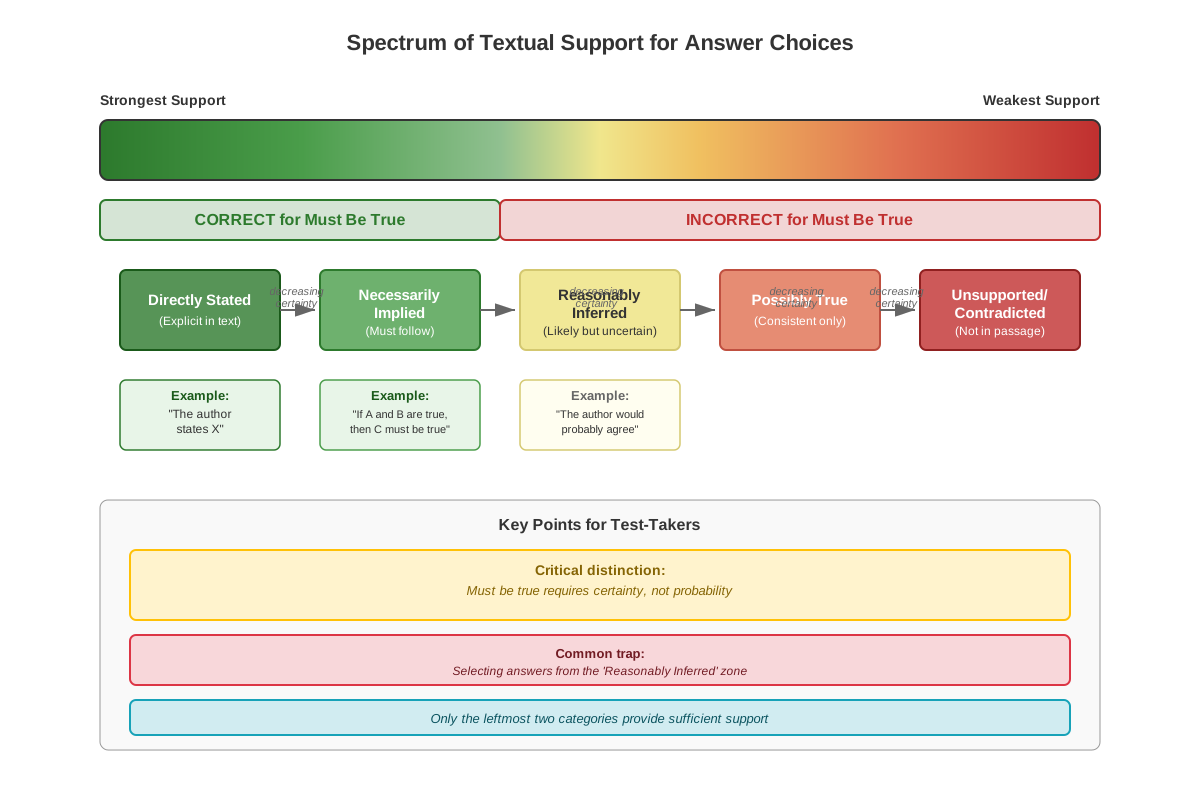
Understanding the precise standard of proof for must be true questions is crucial. The correct answer must be necessarily true based on passage content—meaning it cannot be false if the passage statements are true. This differs from answers that are:
- Possibly true: Consistent with the passage but not proven by it
- Probably true: Likely based on passage information but requiring additional assumptions
- Generally true: Accurate in the real world but not established by the passage
- Partially true: Containing some supported elements but also unsupported claims
The LSAT tests this distinction rigorously. Wrong answers frequently contain statements that seem reasonable or align with common knowledge but lack specific textual support. Test-takers must develop the discipline to reject answers that "make sense" in favor of answers that are provably true from the passage.
Textual Support Types
Must be true questions can be answered using different types of textual support:
- Explicit statements: The passage directly states the information in the answer choice, perhaps using different wording but expressing the same idea.
- Necessary implications: The passage states information from which the answer choice must logically follow. For example, if the passage states "All members of Group X possess characteristic Y," then it must be true that "Any individual with characteristic Y could be a member of Group X" (though not necessarily).
- Definitional relationships: The passage defines terms or concepts in ways that make certain statements necessarily true. If the passage defines "impressionism" as including certain characteristics, statements about those characteristics must be true.
- Comparative relationships: The passage establishes relationships between concepts (X is larger than Y, Theory A preceded Theory B) that make certain comparative statements necessarily true.
Scope Considerations
Reading comprehension questions frequently test whether students recognize the appropriate scope of claims. Must be true answers must match the passage's scope in several dimensions:
- Temporal scope: If the passage discusses events in the 19th century, answers making claims about the 20th century require explicit support
- Categorical scope: If the passage discusses "some scientists," answers claiming "all scientists" or "scientists generally" exceed the supported scope
- Strength of claim: If the passage suggests something "may" occur, answers stating it "will" occur are too strong
- Subject scope: If the passage focuses on Theory X, answers making claims about Theory Y require explicit passage discussion of Theory Y
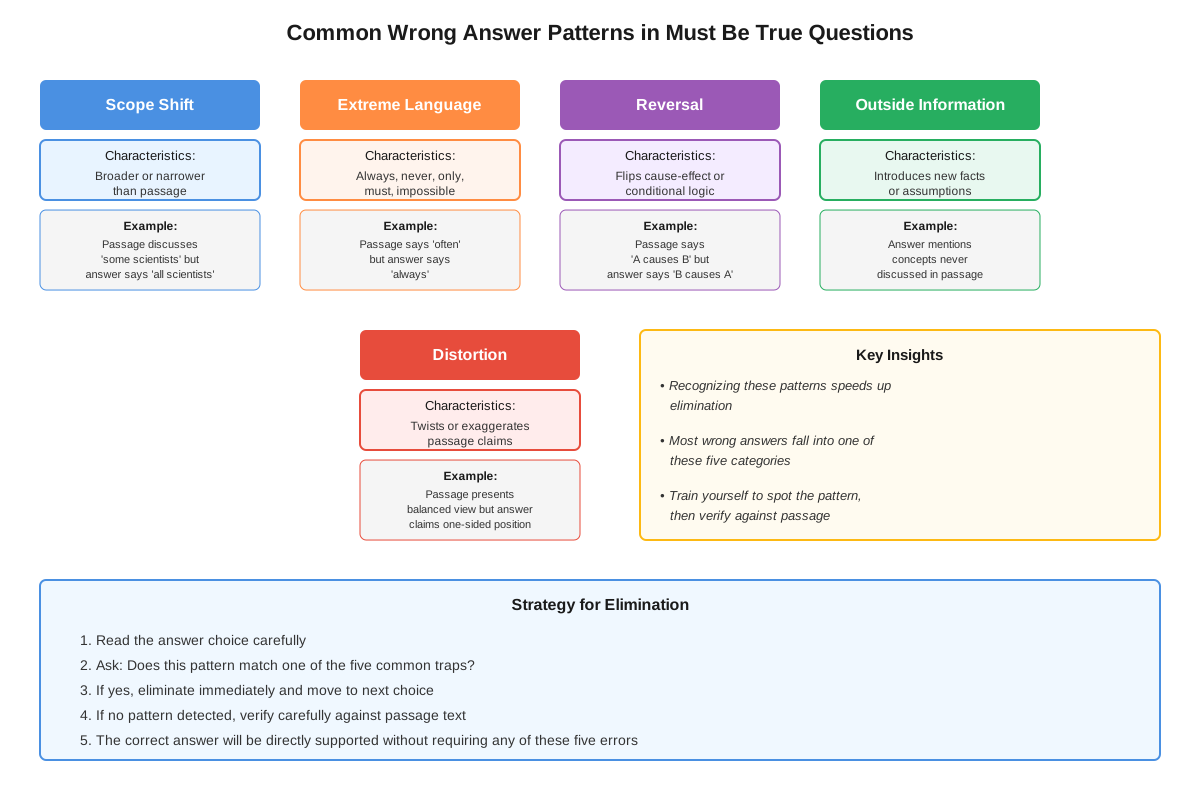
Many wrong answers in must be true questions are wrong specifically because they exceed the passage's scope in one of these dimensions, even though they might be factually accurate or logically related to passage content.
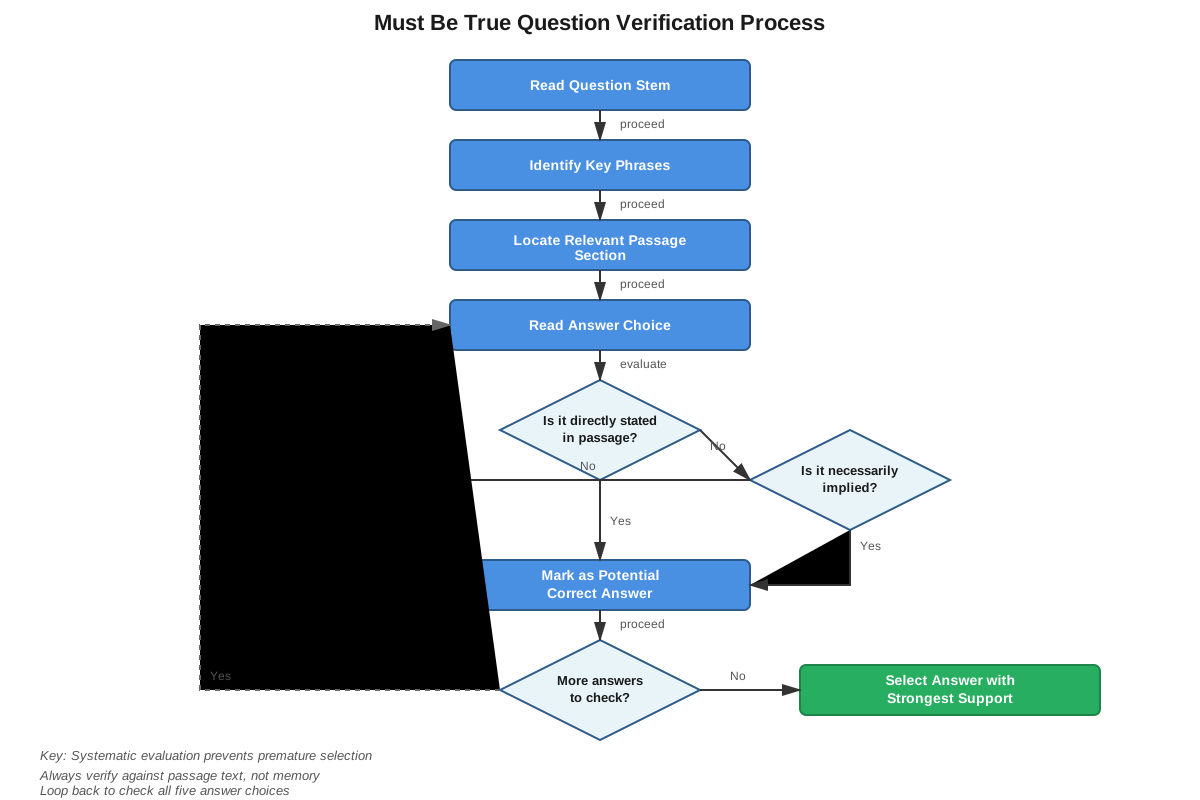
The Verification Process
Answering must be true questions effectively requires a systematic verification process:
- Read the question stem carefully to confirm it's asking for what must be true (not what could be true, what the main point is, etc.)
- Review each answer choice with skepticism, assuming it's wrong until proven right
- For each answer choice, locate the relevant passage section that would support or refute it
- Verify that the passage actually states or necessarily implies the answer choice content
- Check for scope mismatches, unsupported assumptions, or logical gaps between passage content and answer choice
- Eliminate answers that require even small inferential leaps beyond what the passage establishes
- Select the answer with the most direct, unambiguous textual support
This process prioritizes accuracy over speed initially, though with practice it becomes more efficient.
Concept Relationships
Must be true questions connect to other reading comprehension question types through shared skills and overlapping requirements. The textual analysis required for must be true questions—carefully reading, identifying key information, and matching answer choices to passage content—forms the foundation for virtually all other question types. Main point questions, for instance, require identifying what must be true about the passage's central argument. Author's attitude questions require determining what must be true about the author's perspective based on language choices and argumentative structure.
The relationship between must be true questions and inference questions deserves particular attention. While both require drawing conclusions from passage content, inference questions typically require synthesizing multiple pieces of information or taking one additional logical step beyond what's explicitly stated. Must be true questions generally require less inferential distance—the answer should be more directly supported by passage text. However, the boundary between these question types can be subtle, and the same verification process applies to both: ensuring the answer has adequate textual support without requiring unsupported assumptions.
Within the must be true question type itself, concepts build hierarchically: Understanding textual support types → Recognizing scope limitations → Applying the verification process → Distinguishing must be true from could be true → Eliminating wrong answer patterns. Each concept reinforces the others, creating a comprehensive framework for approaching these questions systematically and accurately.
High-Yield Facts
⭐ Must be true questions typically comprise 20-30% of all LSAT Reading Comprehension questions, making them one of the most frequently tested question types.
⭐ The correct answer to a must be true question must be provable using only information stated or necessarily implied in the passage, without requiring additional assumptions.
⭐ Wrong answers frequently contain statements that are possibly true or generally true but lack specific textual support in the passage.
⭐ Common question stems include "According to the passage," "The passage indicates," "The passage suggests," and "The author would most likely agree with."
⭐ Scope mismatches—where answer choices are too broad, too narrow, or address different subjects than the passage supports—are among the most common reasons answers are incorrect.
- Must be true questions can focus on any passage element: specific details, relationships between concepts, author's views, or logical implications of stated positions.
- The verification process should involve locating the specific passage text that supports each answer choice before selecting it.
- Answers using extreme language ("always," "never," "all," "none") require particularly strong textual support and are often incorrect.
- Paraphrasing is common—correct answers rarely use the exact wording from the passage but express the same idea in different terms.
- Time pressure can lead test-takers to select answers that "sound good" rather than answers with definitive textual support; systematic verification prevents this error.
- Must be true questions reward conservative, text-focused reading rather than creative interpretation or synthesis of ideas beyond what the passage establishes.
Quick check — test yourself on Must be true in RC so far.
Try Flashcards →Common Misconceptions
Misconception: If an answer choice is factually accurate in the real world, it's correct for a must be true question.
Correction: Must be true questions require textual support from the passage, not real-world accuracy. An answer can be factually true but incorrect if the passage doesn't establish it. Only passage-based support matters.
Misconception: Must be true questions always focus on the passage's main point or most important ideas.
Correction: Must be true questions can focus on any passage content, including minor details, specific examples, or tangential points. The correct answer simply needs textual support, regardless of its importance to the passage's overall argument.
Misconception: If the passage discusses a topic, any reasonable statement about that topic must be true.
Correction: The passage must specifically support the statement. Even if an answer choice discusses the passage's topic and seems reasonable, it's incorrect without explicit or clearly implied textual support for that specific claim.
Misconception: "The passage suggests" or "the passage indicates" allows for more interpretation than "according to the passage."
Correction: All these phrasings require the same standard of proof—definitive textual support. While "suggests" might allow for necessary implications rather than only explicit statements, it doesn't permit speculation or unsupported inferences.
Misconception: Eliminating four wrong answers is sufficient; the remaining answer must be correct.
Correction: While process of elimination is valuable, the correct answer must have positive textual support. If no answer seems supported, re-read the passage and answers more carefully rather than selecting the "least wrong" option by default.
Misconception: Must be true questions require complex reasoning and synthesis of multiple passage sections.
Correction: While some must be true questions involve connecting information from different parts of the passage, most require relatively straightforward matching of answer choices to specific passage content. Overthinking often leads to errors.
Misconception: The correct answer will always be interesting, significant, or add new insight.
Correction: Correct answers to must be true questions can be mundane restatements of passage content. Test-takers should focus on textual support rather than selecting answers that seem more intellectually engaging or novel.
Worked Examples
Example 1: Scientific Theory Passage
Passage excerpt: "The prevailing theory of continental drift, proposed by Alfred Wegener in 1912, initially faced significant skepticism from the scientific community. Geologists of the era found it difficult to accept that continents could move across the Earth's surface. It wasn't until the 1960s, when seafloor spreading was discovered, that Wegener's theory gained widespread acceptance. The discovery of mid-ocean ridges where new oceanic crust forms provided the mechanism that Wegener's original theory had lacked."
Question: According to the passage, which of the following must be true?
(A) Wegener's theory was immediately accepted by most geologists when proposed.
(B) The theory of continental drift was proven incorrect until seafloor spreading was discovered.
(C) Wegener's original theory did not explain the mechanism by which continents moved.
(D) Mid-ocean ridges were discovered before 1912.
(E) All geologists accepted continental drift theory by the end of the 1960s.
Analysis:
(A) The passage states the theory "initially faced significant skepticism," directly contradicting the claim of immediate acceptance. Eliminate.
(B) The passage indicates the theory gained acceptance after seafloor spreading was discovered, but this doesn't mean it was "proven incorrect" before that discovery—it was simply not widely accepted. This answer mischaracterizes the passage's description. Eliminate.
(C) The passage states that seafloor spreading discovery "provided the mechanism that Wegener's original theory had lacked." This directly supports the claim that the original theory did not explain the mechanism. This matches the passage's explicit statement. Strong candidate.
(D) The passage indicates Wegener proposed his theory in 1912 and that mid-ocean ridges (related to seafloor spreading) were discovered in the 1960s, suggesting they were discovered after 1912, not before. Eliminate.
(E) The passage states the theory "gained widespread acceptance" in the 1960s, but "widespread" doesn't mean "all geologists." This answer exceeds the scope of what the passage establishes. Eliminate.
Correct Answer: (C)
This answer is directly supported by the passage's statement that seafloor spreading "provided the mechanism that Wegener's original theory had lacked." The verification process involves locating this specific sentence and confirming it establishes that the original theory lacked a mechanism explanation.
Example 2: Legal History Passage
Passage excerpt: "The doctrine of stare decisis, which requires courts to follow precedents established in earlier cases, serves multiple functions in common law systems. By promoting consistency in legal rulings, it allows individuals and businesses to predict how courts will rule on similar issues, facilitating planning and reducing uncertainty. However, stare decisis is not absolute. Courts occasionally overturn precedents when they determine that earlier decisions were wrongly decided or that changed circumstances have rendered them obsolete. The Supreme Court has articulated that overturning precedent requires special justification beyond mere disagreement with the precedent's reasoning."
Question: The passage indicates which of the following?
(A) Stare decisis prevents all changes in legal interpretation over time.
(B) The Supreme Court has never overturned any of its precedents.
(C) Predictability in legal rulings is one purpose served by following precedents.
(D) Courts must follow all precedents regardless of whether they were correctly decided.
(E) Changed circumstances are the only acceptable justification for overturning precedent.
Analysis:
(A) The passage explicitly states that "stare decisis is not absolute" and that "courts occasionally overturn precedents," directly contradicting the claim that it prevents all changes. Eliminate.
(B) The passage indicates courts "occasionally overturn precedents," and the Supreme Court is a court, so this answer contradicts passage information. Eliminate.
(C) The passage states that stare decisis "allows individuals and businesses to predict how courts will rule," which is another way of saying predictability is a purpose or function. This directly matches passage content. Strong candidate.
(D) The passage indicates courts can overturn precedents "when they determine that earlier decisions were wrongly decided," meaning courts don't have to follow incorrectly decided precedents. Eliminate.
(E) The passage mentions changed circumstances as one justification but also mentions "wrongly decided" as another justification, so changed circumstances aren't the "only" acceptable justification. This answer is too restrictive. Eliminate.
Correct Answer: (C)
This answer paraphrases the passage's statement that stare decisis "allows individuals and businesses to predict how courts will rule." The passage explicitly identifies this predictability function, making the answer necessarily true. The verification involves recognizing that "predictability in legal rulings" and "allows...to predict how courts will rule" express the same concept.
Exam Strategy
When approaching must be true questions on the LSAT, begin by carefully reading the question stem to confirm what's being asked. Look for trigger phrases like "according to the passage," "the passage indicates," "the passage suggests," or "the author would most likely agree with." These phrases signal that definitive textual support is required, not speculation or creative interpretation.
Develop a systematic approach to answer choices: read each one with skepticism, assuming it's incorrect until you can locate specific passage support. For each answer choice, ask yourself: "Where in the passage does it say or necessarily imply this?" If you cannot identify a specific location, the answer is likely wrong. Avoid the temptation to select answers that seem reasonable or align with your own knowledge—only passage-based support matters.
Exam Tip: When verifying answer choices, physically locate the relevant passage text. Students who point to or mentally note the specific lines supporting an answer are significantly more accurate than those who rely on general memory of passage content.
Pay particular attention to scope and strength of language. Wrong answers frequently use language that's too strong ("always," "never," "all," "must"), too broad (making claims about categories beyond what the passage discusses), or too specific (adding details the passage doesn't provide). Compare the scope and strength of answer choice language to the corresponding passage language.
Time management for must be true questions should balance thoroughness with efficiency. These questions typically require 60-90 seconds each—enough time to verify the correct answer against passage text but not so much that you fall behind. If you're uncertain between two answers, return to the passage to verify each one rather than guessing. The time invested in verification usually prevents errors that would cost more time to correct later.
Process of elimination is particularly powerful for must be true questions because wrong answers often have identifiable flaws: scope mismatches, unsupported assumptions, contradictions of passage content, or claims requiring outside knowledge. Eliminate answers with clear flaws first, then carefully verify remaining answers against passage text. If you can eliminate four answers with confidence, the remaining answer is correct even if you're not entirely certain why.
Memory Techniques
PROVE - A mnemonic for verifying must be true answers:
- Passage location: Find where the passage discusses this topic
- Read carefully: Review the exact passage wording
- Overlap check: Ensure the answer matches passage content
- Verify scope: Confirm the answer doesn't exceed what's stated
- Eliminate assumptions: Reject answers requiring inferential leaps
The "Point to It" technique: For each answer choice you're considering, physically point to or underline the specific passage text that supports it. If you cannot point to supporting text, the answer is likely wrong. This kinesthetic approach prevents the common error of selecting answers based on vague memory or general impressions.
Scope Spectrum Visualization: Imagine a spectrum from "too narrow" to "just right" to "too broad." Visualize where the passage's claim falls on this spectrum, then evaluate where each answer choice falls. Correct answers match the passage's position; wrong answers often fall too far in either direction.
The Paraphrase Match: Remember that correct answers rarely use identical wording to the passage. Train yourself to recognize when different words express the same concept. Create a mental list of common paraphrase patterns: "allows prediction" = "promotes predictability," "initially faced skepticism" = "was not immediately accepted," etc.
Summary
Must be true questions in LSAT Reading Comprehension require test-takers to identify answer choices with definitive textual support from the passage. These questions, comprising 20-30% of all Reading Comprehension questions, test the fundamental skill of distinguishing between what a passage actually establishes versus what might be plausible but unsupported. The correct answer must be provable using only information explicitly stated or necessarily implied in the passage, without requiring additional assumptions or outside knowledge. Success requires systematic verification of each answer choice against passage content, careful attention to scope and strength of language, and discipline to reject answers that seem reasonable but lack specific textual support. Common wrong answers include statements that are possibly true but not proven, claims that exceed the passage's scope, and assertions requiring inferential leaps beyond what the text establishes. Mastering must be true questions builds the analytical precision essential for legal reasoning and strengthens performance across all Reading Comprehension question types.
Key Takeaways
- Must be true questions require definitive textual support—the correct answer must be provable from passage content without additional assumptions
- These questions appear with high frequency (20-30% of RC questions), making them essential for score improvement
- Systematic verification of answer choices against specific passage text prevents the common error of selecting answers that seem reasonable but lack support
- Scope mismatches are among the most frequent reasons answers are incorrect—verify that answer choices don't exceed what the passage establishes
- Wrong answers often contain statements that are possibly true, generally true, or factually accurate but not supported by the passage
- The verification process should involve locating specific passage text for each answer choice before selecting it
- Must be true questions can focus on any passage element, not just main points or important ideas—any statement with textual support can be correct
Related Topics
Inference Questions in Reading Comprehension: While similar to must be true questions, inference questions typically require synthesizing multiple pieces of information or taking one additional logical step beyond explicit statements. Mastering must be true questions provides the foundation for handling inference questions effectively.
Main Point Questions: These questions ask for what must be true about the passage's central argument. The textual verification skills developed through must be true questions transfer directly to identifying and confirming main point answers.
Author's Attitude and Tone Questions: Determining the author's perspective requires identifying what must be true about their viewpoint based on language choices and argumentative structure—a direct application of must be true reasoning.
Strengthen and Weaken Questions in Logical Reasoning: The skill of determining what must follow from given information applies across LSAT sections, making must be true mastery valuable for Logical Reasoning as well.
Practice CTA
Now that you understand the core concepts and strategies for must be true questions in Reading Comprehension, it's time to apply this knowledge through deliberate practice. Attempt the practice questions associated with this topic, focusing on implementing the systematic verification process outlined in this guide. As you work through questions, pay particular attention to why wrong answers are incorrect—understanding common wrong answer patterns accelerates improvement. Review the flashcards to reinforce key concepts and trigger phrases. Remember that accuracy should be your initial priority; speed will develop naturally as you internalize the verification process. Each question you practice with full attention to the reasoning process builds the analytical precision that distinguishes top LSAT performers. You have the knowledge—now develop the skill through focused, strategic practice.
Sign up free to keep reading
Create a free AnvayaPrep account to finish this LSAT guide on Must be true in RC — plus flashcards and practice questions.