Overview
Outside knowledge traps represent one of the most insidious and frequently encountered challenges in LSAT Reading Comprehension. These traps exploit a test-taker's natural tendency to rely on prior knowledge, personal experience, or general understanding of a topic rather than strictly adhering to what the passage explicitly states or directly implies. The LSAT is fundamentally a test of reading comprehension and logical reasoning—not a test of subject matter expertise. When students fall into outside knowledge traps, they select answer choices that may be factually correct in the real world but are not supported by the passage text itself.
Understanding and avoiding lsat outside knowledge traps is essential because the test writers deliberately craft answer choices that appeal to common knowledge or reasonable assumptions that extend beyond the passage's scope. A student might read a passage about climate science and encounter an answer choice that reflects widely accepted scientific consensus—yet if that specific information wasn't presented in the passage, selecting it would be incorrect. The LSAT rewards careful, text-bound reading and punishes those who import external information, however accurate that information might be in reality.
This topic sits at the intersection of multiple critical reading comprehension question types skills: identifying the scope of arguments, distinguishing between what is stated versus what is assumed, and maintaining strict fidelity to textual evidence. Mastering outside knowledge traps enhances performance across all question types—from Main Point and Detail questions to Inference and Application questions—because it instills the fundamental discipline of passage-based reasoning that underlies success on every Reading Comprehension question.
Learning Objectives
- [ ] Identify how outside knowledge traps appear in LSAT questions
- [ ] Explain the reasoning pattern behind outside knowledge traps
- [ ] Apply outside knowledge traps recognition to solve LSAT-style problems accurately
- [ ] Distinguish between passage-supported inferences and unsupported external knowledge
- [ ] Recognize trigger phrases and question stems that increase susceptibility to outside knowledge traps
- [ ] Develop systematic strategies for verifying answer choices against passage text
- [ ] Analyze why incorrect answer choices exploit specific types of outside knowledge
Prerequisites
- Basic passage reading skills: The ability to read and comprehend complex academic prose is necessary to identify what information the passage actually contains versus what the reader assumes.
- Understanding of inference versus assumption: Students must grasp the difference between conclusions logically drawn from stated premises and conclusions that require additional unstated information.
- Familiarity with LSAT question formats: Recognizing different question types helps identify which questions are most vulnerable to outside knowledge traps.
- Scope recognition: Understanding the boundaries of an argument or passage is essential for determining when an answer choice ventures beyond textual support.
Why This Topic Matters
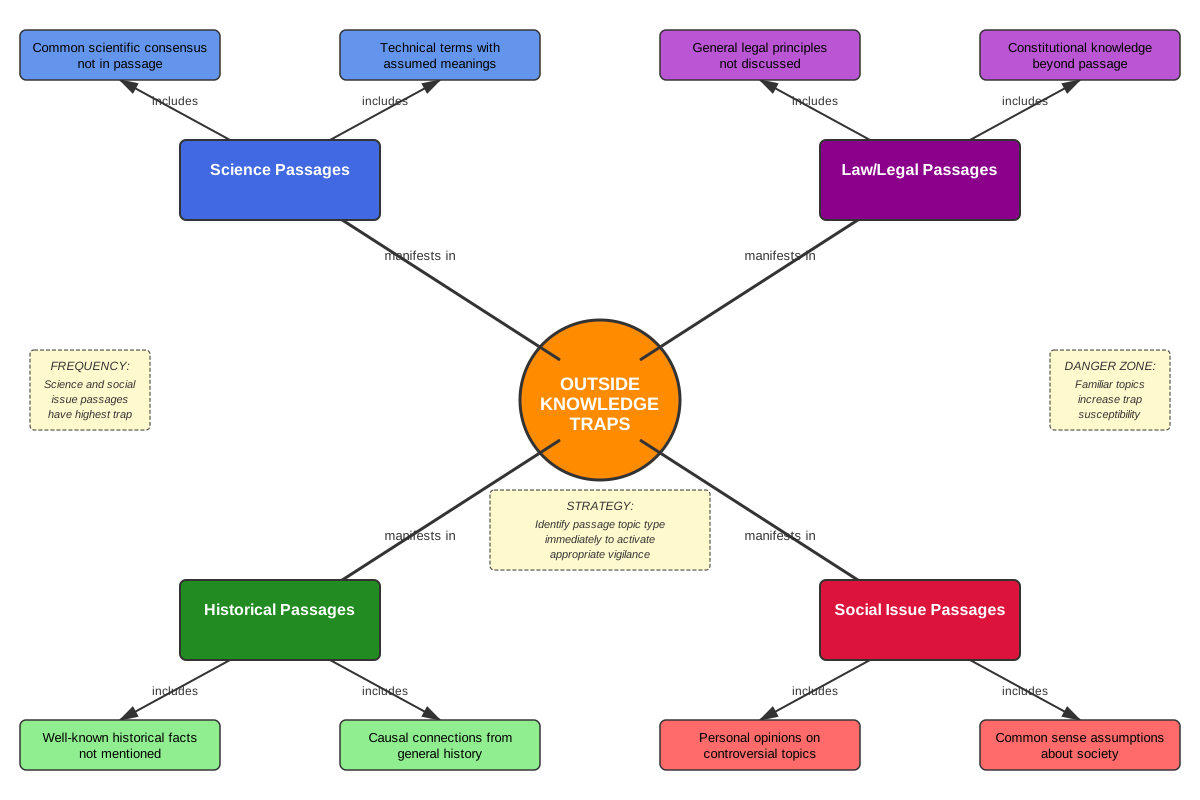
Outside knowledge traps appear with remarkable frequency across LSAT Reading Comprehension sections, affecting approximately 60-70% of test-takers on at least one question per passage. These traps are particularly prevalent in passages covering familiar topics—science, law, history, or social issues—where students naturally possess background knowledge that may or may not align with the passage's specific presentation.
The LSAT deliberately includes passages on topics where educated test-takers likely have prior knowledge precisely to test whether students can set aside that knowledge and reason exclusively from the text. This skill directly parallels the legal reasoning required in law school and legal practice: lawyers must argue from the record, statutes, and precedents—not from what they personally believe to be true or what general knowledge suggests.
In exam passages, outside knowledge traps commonly appear in:
- Inference questions where answer choices present plausible real-world conclusions not supported by passage text
- Application questions where scenarios require extending passage principles without importing external assumptions
- Detail questions where answer choices mix passage information with commonly known facts not mentioned in the text
- Main Point questions where broader interpretations exceed the passage's actual scope
Statistical analysis of released LSAT exams reveals that outside knowledge trap answer choices are selected by incorrect responders at rates 15-25% higher than other distractor types, making them among the most effective wrong answer patterns the test employs.
Core Concepts
The Nature of Outside Knowledge Traps
Outside knowledge traps are incorrect answer choices that seem correct based on real-world knowledge, common sense, or general expertise but lack direct support from the passage text. The LSAT constructs these traps by identifying what test-takers are likely to know about a topic and then crafting answer choices that align with that knowledge while diverging from what the passage actually states.
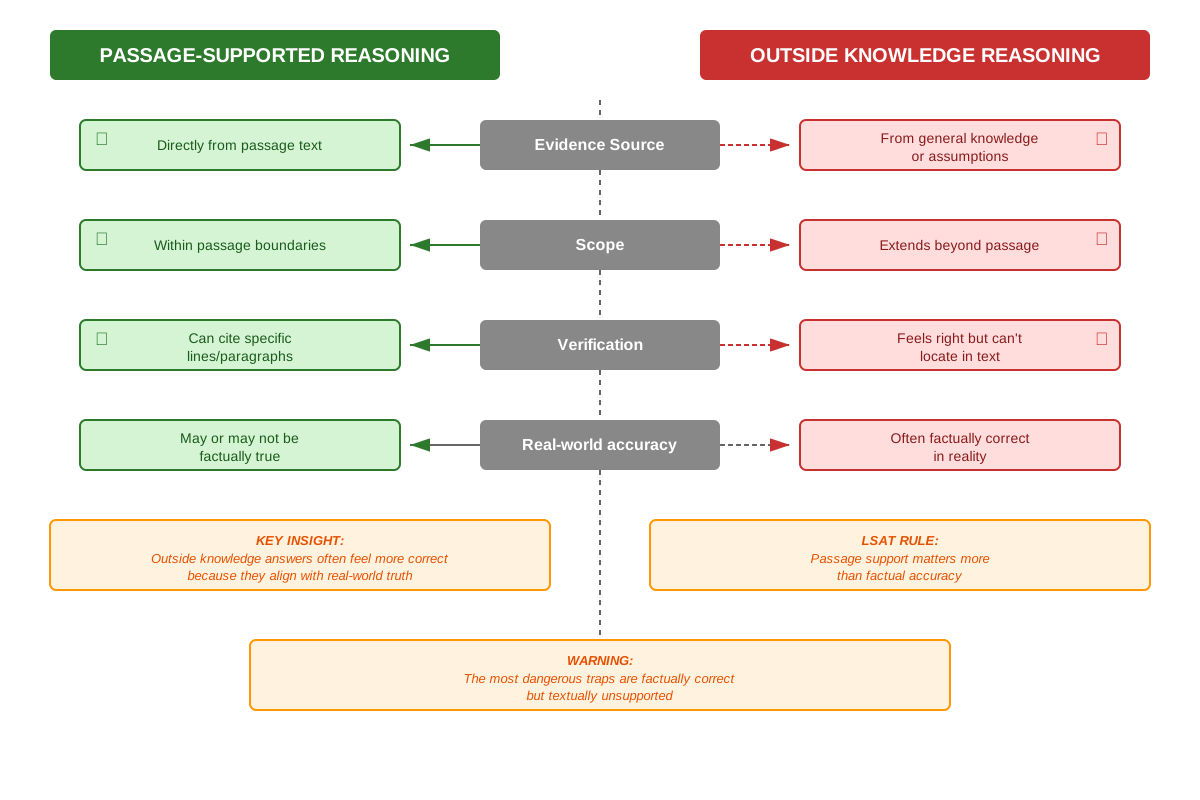
The fundamental principle underlying these traps is the distinction between passage-based reasoning and knowledge-based reasoning. Passage-based reasoning derives conclusions exclusively from information presented in or directly inferable from the text. Knowledge-based reasoning incorporates external information, assumptions, or general understanding that, while potentially accurate, extends beyond the passage's boundaries.
Three Categories of Outside Knowledge Traps
Category 1: Factually Correct but Textually Unsupported
These answer choices present statements that are true in reality but are not mentioned, implied, or supported by the passage. For example, a passage discussing renewable energy might focus exclusively on solar and wind power. An answer choice stating "hydroelectric power is another renewable energy source" would be factually accurate but incorrect if the passage never discusses hydroelectric power.
Category 2: Reasonable Inferences That Require External Assumptions
These traps present conclusions that seem logical but require importing assumptions not established in the passage. The passage might state that "Company X increased marketing spending by 40%," and an answer choice might conclude "Company X's sales likely increased." While this seems reasonable based on general business knowledge, it's a trap unless the passage establishes a connection between marketing spending and sales for this specific company.
Category 3: Scope Expansion Beyond Passage Boundaries
These answer choices take passage information and extend it beyond the scope the author actually addressed. A passage discussing the effects of a policy in one country might be paired with an answer choice about how the policy would work globally. Even if the extension seems logical, it's incorrect if the passage limits its discussion to the single country.
The Psychology Behind Susceptibility
Test-takers fall into outside knowledge traps due to several cognitive tendencies:
- Confirmation bias: Readers naturally favor answer choices that align with their existing beliefs and knowledge
- Familiarity heuristic: Information that "sounds right" based on prior exposure feels more credible
- Cognitive efficiency: The brain automatically fills gaps with assumed information to create coherent understanding
- Topic expertise paradox: Students with more background knowledge in a passage's subject area are sometimes more vulnerable because they have more external information to inadvertently import
Identifying Trap Markers in Answer Choices
Certain linguistic patterns frequently signal outside knowledge traps:
| Trap Marker | Example | Why It's Problematic |
|---|---|---|
| Absolute terms not in passage | "always," "never," "all," "none" | Introduces certainty the passage didn't establish |
| Causal language unsupported by text | "causes," "results in," "leads to" | Implies relationships not demonstrated in passage |
| Comparative statements without basis | "more effective," "better than," "superior" | Makes comparisons the passage didn't make |
| Temporal predictions | "will," "is likely to," "probably" | Projects into future beyond passage scope |
| Universal generalizations | "in all cases," "universally," "everywhere" | Extends limited passage claims inappropriately |
The Correct Answer Standard
To avoid outside knowledge traps, every correct answer must meet the textual support standard: the answer must be directly stated in the passage OR must be a necessary inference from stated information without requiring external assumptions. A necessary inference is one where, given the passage information, the conclusion must be true—not merely could be true or is probably true based on general knowledge.
Concept Relationships
The concept of outside knowledge traps connects directly to several fundamental reading comprehension skills. Scope recognition serves as the foundation: understanding what the passage addresses and what it doesn't determines the boundaries within which correct answers must fall. When students accurately identify scope, they create a mental framework that flags answer choices venturing into unsupported territory.
Textual support verification → Outside knowledge trap avoidance → Correct answer selection
This relationship chain illustrates that the systematic practice of verifying each answer choice against specific passage text naturally prevents outside knowledge trap errors. The verification process forces explicit identification of where the passage supports (or fails to support) each answer component.
Outside knowledge traps also relate inversely to inference skills: strong inference skills help students distinguish between conclusions that necessarily follow from passage information and those that require additional assumptions. The better a student understands what constitutes a valid inference, the more readily they recognize when an answer choice has crossed into unsupported territory.
Additionally, outside knowledge trap recognition enhances wrong answer elimination strategies across all question types. Once students develop sensitivity to these traps, they can quickly eliminate 1-2 answer choices per question, significantly improving accuracy and efficiency.
High-Yield Facts
⭐ The LSAT tests reading comprehension, not subject matter knowledge—correct answers must be supported by passage text regardless of real-world accuracy
⭐ Outside knowledge traps are most common in passages on familiar topics where test-takers possess prior knowledge
⭐ An answer choice can be factually correct in reality but wrong on the LSAT if the passage doesn't support it
⭐ The phrase "according to the passage" in question stems explicitly warns against using outside knowledge
⭐ Inference questions are particularly vulnerable to outside knowledge traps because they require extending passage information—but only within supported boundaries
- Answer choices that introduce new concepts, entities, or relationships not mentioned in the passage are typically outside knowledge traps
- Comparative statements (better, worse, more, less) are traps unless the passage explicitly makes those comparisons
- Causal relationships in answer choices require explicit or strongly implied causal language in the passage
- Temporal predictions about future events are traps unless the passage specifically discusses future projections
- The more confident you feel about an answer based on what you "know" rather than what you "read," the more carefully you should verify textual support
Quick check — test yourself on Outside knowledge traps so far.
Try Flashcards →Common Misconceptions
Misconception: If an answer choice is factually accurate in the real world, it must be correct on the LSAT.
Correction: The LSAT evaluates whether answer choices are supported by the passage, not whether they're true in reality. A factually accurate statement is incorrect if the passage doesn't support it.
Misconception: Inference questions allow you to use general knowledge to extend passage information.
Correction: Inference questions require conclusions that must be true based on passage information alone. Valid inferences don't require importing external knowledge or assumptions.
Misconception: If the passage is about a topic you know well, your expertise will help you answer questions more accurately.
Correction: Subject matter expertise can actually increase vulnerability to outside knowledge traps. The key is to consciously set aside prior knowledge and reason exclusively from the text.
Misconception: "Common sense" reasoning is acceptable when the passage doesn't explicitly address something.
Correction: Common sense often leads to outside knowledge traps. The LSAT requires passage-based reasoning, even when conclusions seem obvious from a common-sense perspective.
Misconception: If an answer choice seems like a reasonable extension of passage ideas, it's probably correct.
Correction: "Reasonable" extensions often constitute outside knowledge traps. Correct answers must be directly supported or necessarily inferred, not merely reasonable or plausible.
Misconception: Passages on scientific or technical topics require background knowledge to understand.
Correction: LSAT passages provide all necessary information to answer questions. If you need outside knowledge to select an answer, you're likely falling into a trap.
Worked Examples
Example 1: Science Passage Trap
Passage excerpt: "Recent studies have shown that certain species of coral can survive in water temperatures up to 2 degrees Celsius higher than previously thought. Researchers attribute this resilience to symbiotic algae that have adapted to warmer conditions. The discovery suggests that some coral reefs may be more resistant to temperature increases than earlier models predicted."
Question: Based on the passage, which of the following can be properly inferred?
Answer choices:
(A) Coral reefs will survive climate change without significant damage
(B) Symbiotic algae play a role in some coral species' temperature tolerance
(C) Ocean acidification poses less threat to coral reefs than temperature increases
(D) All coral species possess symbiotic algae that can adapt to warming waters
(E) Marine biologists should focus research efforts on coral reef preservation
Analysis:
(A) is an outside knowledge trap exploiting scope expansion. While the passage discusses some coral's increased resilience, it explicitly states only that "some coral reefs may be more resistant" than previously thought—not that they will survive without significant damage. This answer imports assumptions about climate change outcomes not supported by the passage.
(B) is the correct answer. The passage directly states that researchers attribute resilience to symbiotic algae adapted to warmer conditions, making this a supported inference about the algae's role in temperature tolerance.
(C) is an outside knowledge trap introducing a comparison the passage never makes. While ocean acidification is a real threat to coral reefs (general knowledge), the passage doesn't mention it at all, making any comparison unsupported.
(D) is an outside knowledge trap using absolute language ("all coral species") that exceeds passage scope. The passage discusses only "certain species" and "some coral reefs."
(E) is an outside knowledge trap presenting a reasonable-sounding conclusion that requires external assumptions about research priorities not addressed in the passage.
Key lesson: The correct answer (B) stays strictly within passage boundaries, while all traps either introduce new information, make unsupported comparisons, use absolute language, or require external assumptions.
Example 2: Historical Passage Trap
Passage excerpt: "The 1920s saw significant changes in urban architecture in the United States. Steel-frame construction techniques enabled buildings to reach unprecedented heights. The Chrysler Building, completed in 1930, exemplified this new architectural ambition. Architects of this era prioritized vertical expansion over horizontal sprawl, fundamentally altering city skylines."
Question: The passage most strongly supports which of the following statements?
Answer choices:
(A) Steel-frame construction was invented in the 1920s
(B) The Chrysler Building was the tallest building in the world when completed
(C) Architectural priorities in the 1920s favored building upward rather than outward
(D) Urban population growth necessitated taller buildings during this period
(E) Modern skyscrapers continue to use the same construction techniques developed in the 1920s
Analysis:
(A) is an outside knowledge trap. While the passage states steel-frame construction "enabled" tall buildings in the 1920s, it doesn't claim the technique was invented then. This trap exploits the assumption that mentioning a technology in a time period means it originated then.
(B) is an outside knowledge trap using real-world facts not in the passage. The Chrysler Building was briefly the world's tallest, but the passage never makes this claim—it only states the building "exemplified" architectural ambition.
(C) is the correct answer, directly supported by the passage's statement that "architects of this era prioritized vertical expansion over horizontal sprawl."
(D) is an outside knowledge trap introducing a causal explanation (population growth necessitating height) that seems logical but isn't mentioned in the passage. The passage discusses architectural priorities and techniques but never addresses why these changes occurred.
(E) is an outside knowledge trap extending passage information into the present day. The passage discusses the 1920s only; any claims about "modern skyscrapers" venture beyond passage scope.
Key lesson: Notice how multiple traps (B, D, E) present information that might be factually accurate but isn't supported by this specific passage. The correct answer requires no external knowledge—only careful reading of what the passage actually states.
Exam Strategy
Pre-Reading Mindset
Before reading any passage, consciously adopt a "blank slate" mentality. Actively remind yourself that your task is to understand what this specific passage says, not to evaluate its claims against your existing knowledge. If you recognize the topic as familiar, heighten your vigilance against importing external information.
Active Reading Techniques
As you read, distinguish between:
- What the passage states explicitly (mark these mentally or with notation)
- What the passage implies or suggests (valid inference territory)
- What you know about the topic (danger zone for outside knowledge traps)
When you notice yourself thinking "I know that..." or "Obviously..." while reading, pause and verify whether the passage actually supports that thought.
Question Stem Analysis
Certain question stems explicitly signal the need for passage-based reasoning:
- "According to the passage..."
- "The passage most strongly supports..."
- "Based on the passage..."
- "The author indicates that..."
These phrases are explicit instructions to use only passage information. When you see them, mentally reinforce your commitment to textual support.
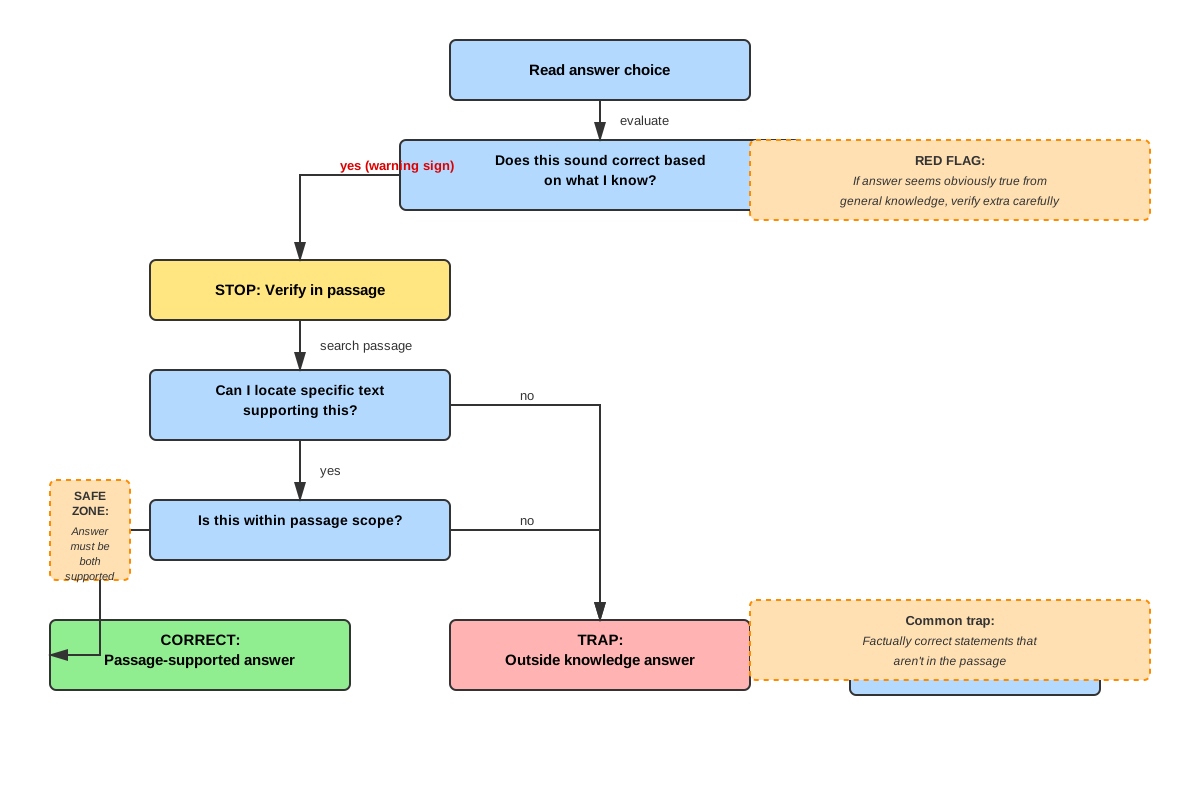
Answer Choice Verification Protocol
For each answer choice, follow this systematic process:
- Identify the claim: What specific assertion does this answer make?
- Locate support: Where in the passage is this claim supported?
- Verify sufficiency: Does the passage support fully justify this claim, or does it require additional assumptions?
- Check scope: Does this answer stay within the passage's boundaries, or does it extend beyond them?
If you cannot complete steps 2-4 successfully, the answer choice is likely an outside knowledge trap.
Trigger Word Recognition
Develop sensitivity to words and phrases that frequently appear in outside knowledge traps:
- Absolute terms: always, never, all, none, every, only
- Causal language: causes, results in, leads to, produces
- Comparative terms: more, less, better, worse, superior
- Temporal predictions: will, is likely to, probably, in the future
- Universal scope: everywhere, in all cases, universally, generally
When these appear in answer choices, verify that the passage uses similar language or clearly supports such strong claims.
Time Management
Paradoxically, taking an extra 10-15 seconds to verify textual support saves time overall by preventing the need to return to questions after initial uncertainty. Build verification into your standard process rather than treating it as an optional extra step.
Memory Techniques
The PASSAGE Acronym
Use PASSAGE to remember the verification process:
- Passage-based only
- Avoid assumptions
- Scope boundaries matter
- Support must be explicit or clearly implied
- Absolute terms need absolute support
- General knowledge is dangerous
- Every claim needs textual evidence
The "Show Me" Technique
Mentally challenge every answer choice with "Show me where the passage says this." If you cannot point to specific text or a clear inference from specific text, eliminate the choice.
The Knowledge Quarantine Visualization
Visualize placing your prior knowledge in a mental "quarantine box" before reading. You can retrieve it after the test, but during the exam, it stays locked away. Only passage information enters your working memory.
The Scope Circle
Draw a mental circle around the passage's scope. Any answer choice that ventures outside this circle is automatically suspect. Visualize correct answers as staying firmly within the circle's boundaries.
Summary
Outside knowledge traps represent a systematic challenge in LSAT Reading Comprehension, exploiting test-takers' natural tendency to rely on prior knowledge rather than strict textual support. These traps appear as answer choices that may be factually accurate in reality but lack support from the passage itself. Success requires developing a disciplined approach to passage-based reasoning: every correct answer must be directly stated or necessarily inferred from passage text without importing external assumptions. The LSAT deliberately includes passages on familiar topics and crafts wrong answers that align with general knowledge precisely to test whether students can set aside what they know and reason exclusively from what they read. Mastering outside knowledge trap recognition requires systematic verification of textual support, heightened awareness of scope boundaries, and conscious suppression of the impulse to use external information. This skill is fundamental to LSAT success because it underlies the type of text-bound reasoning essential to legal analysis.
Key Takeaways
- The LSAT tests reading comprehension, not real-world knowledge—correct answers must be passage-supported regardless of factual accuracy
- Outside knowledge traps are most dangerous in passages on familiar topics where you possess prior expertise
- Systematic verification of textual support for every answer choice component is the most effective defense against these traps
- Valid inferences must be necessary conclusions from passage information, not merely reasonable or plausible extensions
- Absolute terms, causal language, comparisons, and scope expansions in answer choices require explicit passage support
- Developing a "blank slate" mindset and consciously quarantining prior knowledge improves accuracy
- The phrase "according to the passage" in question stems is an explicit instruction to use only passage-based reasoning
Related Topics
Inference Questions: Understanding outside knowledge traps is essential for inference questions, where the line between valid inference and unsupported assumption becomes critical. Mastering trap recognition enables more confident inference question performance.
Scope and Main Point Questions: Outside knowledge trap recognition directly enhances scope identification skills, which are fundamental to Main Point and Primary Purpose questions. Understanding passage boundaries prevents selecting answers that exceed the author's actual focus.
Wrong Answer Patterns: Outside knowledge traps represent one category within the broader taxonomy of wrong answer patterns. Mastering this trap type facilitates recognition of other systematic distractor patterns like extreme language, reversal, and distortion.
Passage Mapping and Annotation: Developing strong passage mapping skills creates a reference framework that makes textual support verification more efficient, reducing susceptibility to outside knowledge traps through better passage organization.
Practice CTA
Now that you understand how outside knowledge traps function and how to avoid them, the next critical step is application. Attempt the practice questions associated with this topic, paying special attention to the verification process for each answer choice. Use the flashcards to reinforce recognition of trap markers and trigger phrases. Remember: recognizing these traps intellectually is only the first step—developing the disciplined habit of passage-based reasoning requires consistent practice. Each practice question you complete with conscious attention to textual support strengthens the mental habits that will serve you on test day. You've built the foundation; now build the skill through deliberate practice.
Sign up free to keep reading
Create a free AnvayaPrep account to finish this LSAT guide on Outside knowledge traps — plus flashcards and practice questions.