Overview
Passage title questions represent a unique and strategically important category within LSAT reading comprehension that tests a student's ability to synthesize an entire passage into its most essential elements. Unlike detail-oriented questions that focus on specific paragraphs or arguments, passage title questions require test-takers to step back and identify the overarching theme, scope, and purpose of the entire text. These questions typically ask students to select which title would be most appropriate for the passage, demanding a comprehensive understanding of both the passage's main idea and its boundaries—what it includes and, equally important, what it excludes.
The significance of mastering lsat passage title questions extends beyond simply answering one question type correctly. These questions serve as an excellent diagnostic tool for assessing whether a student has truly grasped the passage's global structure and central purpose. Students who can accurately identify appropriate titles demonstrate mastery of critical skills including: distinguishing main ideas from supporting details, recognizing the author's primary purpose, understanding scope limitations, and synthesizing multiple paragraphs into a coherent whole. This question type appears with moderate frequency on the LSAT, but its importance is amplified because the skills required to answer it correctly directly support success on other reading comprehension question types such as main point questions, primary purpose questions, and structure questions.
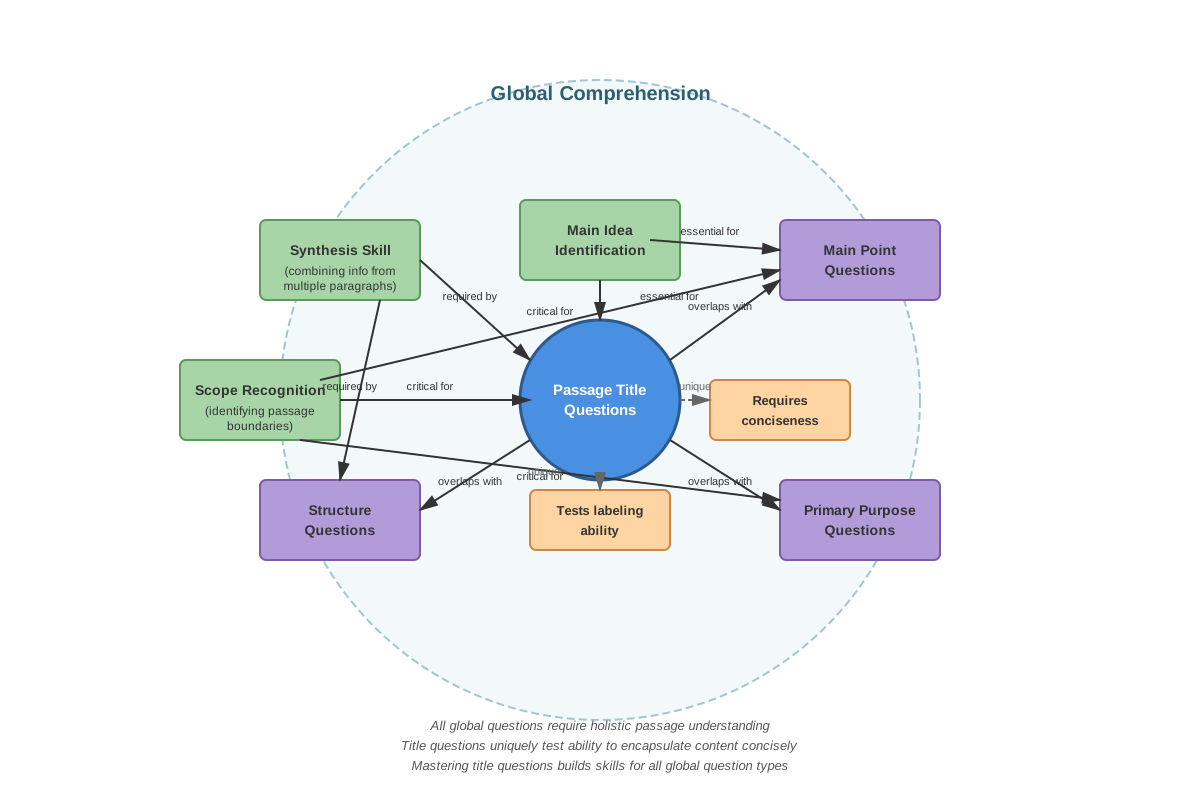
Within the broader landscape of LSAT Reading Comprehension, passage title questions occupy a unique position as "global" questions that require holistic passage understanding. They connect intimately with main point identification, author's tone analysis, and structural comprehension. Students who excel at these questions typically demonstrate strong active reading skills, effective passage mapping techniques, and the ability to resist the temptation of answer choices that are too narrow, too broad, or that emphasize secondary rather than primary concerns. Mastering this question type builds a foundation for approaching the Reading Comprehension section with confidence and strategic precision.
Learning Objectives
- [ ] Identify how Passage title questions appears in LSAT questions
- [ ] Explain the reasoning pattern behind Passage title questions
- [ ] Apply Passage title questions to solve LSAT-style problems accurately
- [ ] Distinguish between titles that are too broad, too narrow, or off-scope for a given passage
- [ ] Evaluate answer choices by assessing their alignment with both the passage's main idea and its specific scope
- [ ] Synthesize information from multiple paragraphs to determine the passage's overarching focus
- [ ] Recognize common trap answer patterns in passage title questions
Prerequisites
- Main idea identification: Understanding how to locate and articulate a passage's central claim is essential because passage titles must reflect this core concept
- Passage structure analysis: Recognizing how paragraphs relate to each other helps determine whether a title captures the entire passage or only portions of it
- Scope recognition: Distinguishing between what a passage discusses in depth versus what it mentions tangentially is crucial for evaluating title appropriateness
- Active reading strategies: The ability to read with purpose and create mental or written passage maps enables efficient title evaluation
- Author's purpose identification: Understanding why an author wrote a passage (to argue, explain, compare, etc.) informs what an appropriate title should emphasize
Why This Topic Matters
Passage title questions serve as a powerful assessment of comprehensive reading skills that extend far beyond standardized testing. In academic and professional contexts, the ability to synthesize complex information into concise, accurate summaries is invaluable—whether writing executive summaries, creating presentation titles, or evaluating whether articles are relevant to research questions. This skill demonstrates critical thinking at its highest level: the capacity to see both the forest and the trees, understanding how details support larger themes without losing sight of either.
On the LSAT specifically, passage title questions appear in approximately 10-15% of Reading Comprehension sections, typically one per test or every other test. While this frequency might seem modest, the strategic importance is substantial. These questions often appear as the first or second question following a passage, and answering them correctly provides momentum and confidence. More importantly, the process of evaluating potential titles reinforces understanding of the passage's structure and main idea, which directly benefits performance on subsequent questions about the same passage. Students who struggle with passage title questions often reveal gaps in their global comprehension that will undermine their performance across multiple question types.
Common manifestations of this topic on the LSAT include passages from diverse fields—law, science, humanities, and social sciences—where students must navigate complex arguments, multiple viewpoints, or technical subject matter. The test makers deliberately craft wrong answer choices that exploit common reading weaknesses: titles that sound sophisticated but emphasize minor points, titles that accurately describe one paragraph but not the entire passage, or titles that use passage vocabulary but misrepresent the author's focus or tone. Recognizing these patterns transforms passage title questions from challenging puzzles into opportunities for confident, strategic point-scoring.
Core Concepts
Understanding Passage Title Question Format
Passage title questions are explicitly worded to ask test-takers which option would serve as the most appropriate or accurate title for the passage. Common phrasings include: "Which one of the following would be the most appropriate title for the passage?", "Which one of the following titles best captures the main idea of the passage?", or "The passage would most likely be titled:". These questions are classified as global questions because they require understanding the entire passage rather than specific details or localized arguments.
The fundamental challenge lies in the fact that an appropriate title must satisfy multiple criteria simultaneously. It must be accurate (reflecting what the passage actually discusses), comprehensive (covering the passage's full scope rather than just one section), specific enough (not so broad that it could apply to hundreds of different passages), and aligned with the author's emphasis and tone. This multi-dimensional requirement makes passage title questions more complex than they initially appear.
The Four Essential Criteria for Evaluating Titles
When approaching passage title questions, successful test-takers apply four critical evaluation criteria to each answer choice:
1. Accuracy: Does the title correctly represent what the passage discusses? A title might sound impressive but fundamentally mischaracterize the passage's content, argument, or conclusions. For example, if a passage discusses various theories about why a historical event occurred without endorsing any particular theory, a title suggesting the passage "proves" one theory would be inaccurate.
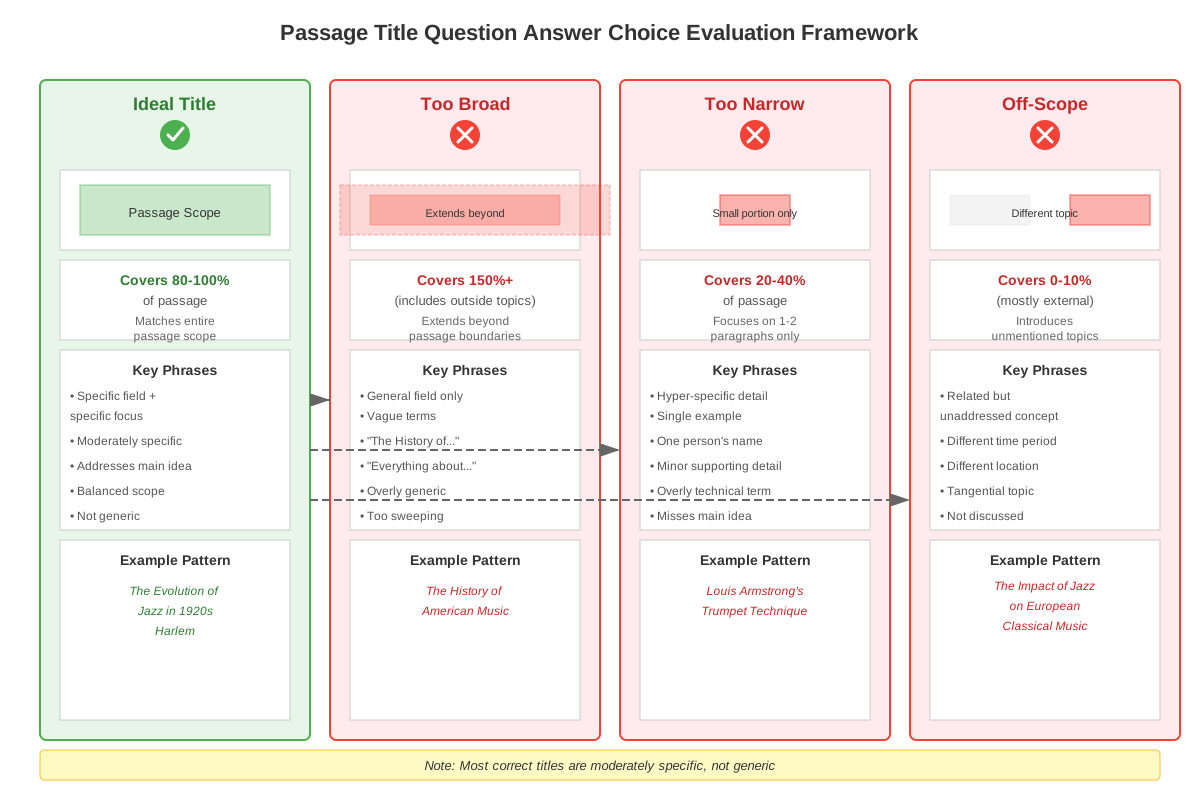
2. Scope: Does the title match the passage's breadth—neither too narrow nor too broad? A title that focuses on content from only one or two paragraphs is too narrow, while a title so general it could apply to countless passages is too broad. If a passage discusses three specific Supreme Court cases regarding free speech, a title about "Constitutional Law in America" would be too broad, while "The Facts of Tinker v. Des Moines" would be too narrow.
3. Emphasis: Does the title reflect what the author emphasizes as most important? Passages often mention multiple topics, but the author devotes more attention, analysis, or argumentative weight to certain elements. An appropriate title highlights the primary focus, not secondary or tangential points. If a passage primarily argues for a new interpretation of an economic theory but briefly mentions the theory's historical development, the title should emphasize the new interpretation.
4. Tone: Does the title match the author's attitude and approach? A neutral, explanatory passage requires a neutral title, while a passage that advocates for a position needs a title reflecting that advocacy. Mismatches in tone—such as a neutral title for an argumentative passage or vice versa—signal incorrect answers.
Common Wrong Answer Patterns
Understanding how the LSAT constructs incorrect answer choices dramatically improves efficiency and accuracy. The test makers employ predictable patterns:
| Wrong Answer Type | Characteristics | Example Scenario |
|---|---|---|
| Too Narrow | Focuses on one paragraph or section; accurate but incomplete | Passage discusses three theories of consciousness; wrong answer focuses only on the first theory mentioned |
| Too Broad | So general it could apply to many passages; lacks specificity | Passage analyzes specific Supreme Court case; wrong answer says "Legal Decision-Making in America" |
| Off-Scope | Introduces topics not discussed or misrepresents the passage's focus | Passage discusses causes of phenomenon; wrong answer emphasizes solutions never mentioned |
| Wrong Emphasis | Highlights secondary or background information rather than main focus | Passage argues for new policy with brief historical context; wrong answer emphasizes the history |
| Tone Mismatch | Suggests advocacy when passage is neutral, or vice versa | Passage neutrally presents competing views; wrong answer suggests author "defends" one view |
| Distortion | Uses passage vocabulary but twists meaning or relationships | Passage discusses how X influences Y; wrong answer claims passage shows Y causes X |
The Relationship Between Main Idea and Title
While closely related, a passage's main idea and its ideal title are not identical concepts. The main idea is typically expressed as a complete thought or claim—what the author wants readers to understand or believe after reading. A title, by contrast, is a concise label that indicates the passage's subject matter and focus without necessarily stating a complete argument.
For example, a passage's main idea might be: "Recent archaeological evidence challenges the traditional timeline for human migration to the Americas." An appropriate title might be: "New Evidence and the Americas Migration Timeline" or "Challenging Traditional Views of Early American Settlement." The title captures the subject and suggests the passage's direction without stating the complete claim.
This distinction matters because wrong answers often present accurate main idea statements that are too detailed or complete to function as titles, or conversely, they present title-like phrases that don't actually capture the main idea. Recognizing this balance—concise yet comprehensive, specific yet not overly detailed—is crucial for success.
Strategic Reading for Title Questions
Effective preparation for passage title questions begins during the initial reading of the passage. Students should actively track:
- Topic progression: What subject does each paragraph address, and how do these subjects relate?
- Author's purpose: Is the author explaining, arguing, comparing, critiquing, or proposing?
- Scope boundaries: What does the passage explicitly discuss versus what it merely mentions or excludes entirely?
- Emphasis signals: Which ideas receive the most development, examples, or argumentative support?
- Structural markers: Words like "however," "primarily," "most importantly," or "the key question" signal what the author considers central
Creating a brief mental or written passage map—a few words summarizing each paragraph's function—provides an invaluable reference when evaluating title options. This map allows quick verification of whether a proposed title accounts for the entire passage or only portions of it.
Process of Elimination Strategy
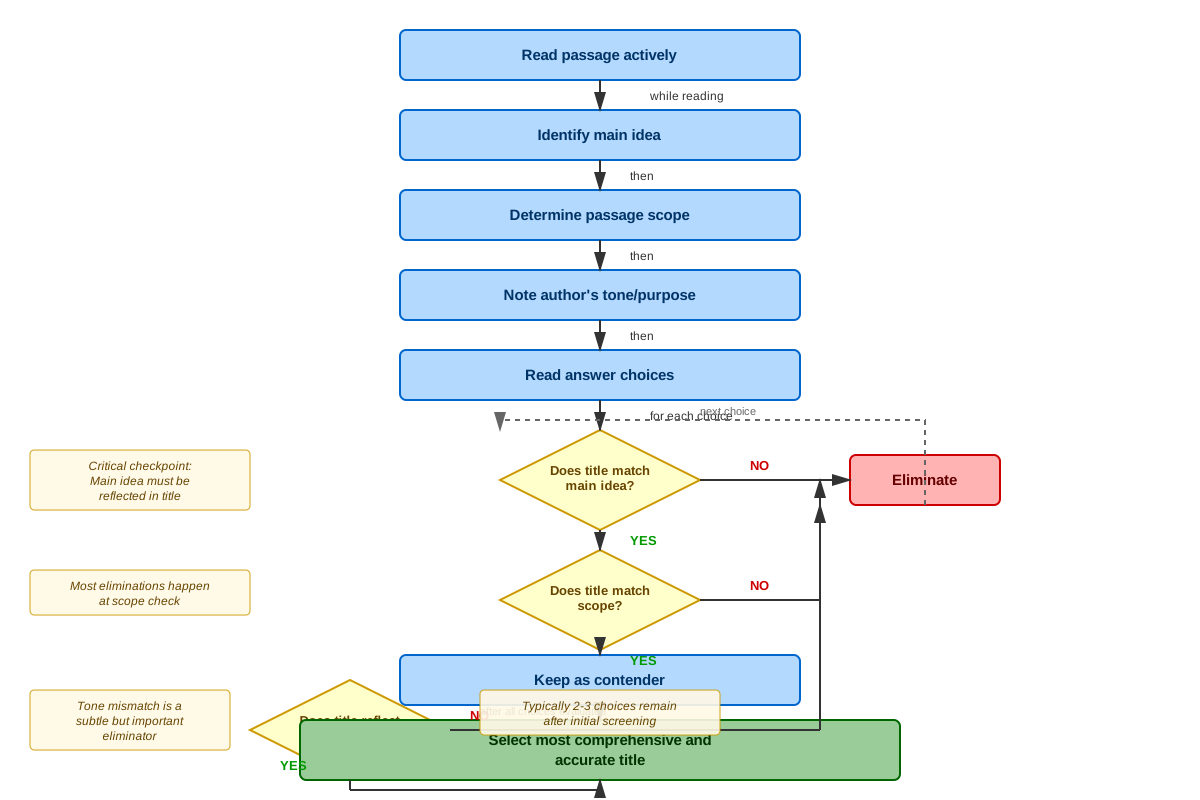
Given the predictable patterns of wrong answers, systematic elimination is highly effective for passage title questions. The recommended approach:
- Quickly eliminate obviously wrong answers: Remove choices that are clearly too broad, too narrow, or that discuss topics not mentioned in the passage
- Check remaining answers against scope: Verify that each surviving answer choice accounts for all major sections of the passage
- Verify emphasis alignment: Ensure the title highlights what the author emphasizes, not peripheral content
- Confirm tone match: Check that the title's tone (neutral, critical, advocating, etc.) matches the passage's approach
- Select the best match: Choose the answer that best satisfies all four criteria (accuracy, scope, emphasis, tone)
This systematic approach prevents the common error of selecting the first answer that "sounds good" without thoroughly evaluating all options against clear criteria.
Concept Relationships
The concepts within passage title questions form an interconnected system where each element reinforces the others. Accuracy serves as the foundation—without correct representation of passage content, no other criteria matter. Building on accuracy, scope determines whether the title is appropriately calibrated to the passage's breadth, neither overshooting nor undershooting its coverage. Emphasis refines scope by ensuring the title highlights what the author considers most important within that scope. Finally, tone ensures the title's approach matches the author's attitude and purpose.
These four criteria connect directly to prerequisite skills: main idea identification informs accuracy and emphasis, passage structure analysis enables scope evaluation, and author's purpose identification guides tone assessment. The relationship flows as: Active Reading → Passage Mapping → Main Idea Identification → Title Evaluation using Four Criteria → Answer Selection.
Passage title questions also connect forward to other reading comprehension question types. Mastery of title questions strengthens performance on primary purpose questions (which ask why the author wrote the passage), main point questions (which ask for the passage's central claim), and structure questions (which ask how the passage is organized). The relationship map looks like:
Passage Title Questions → synthesizes → Main Idea + Scope + Purpose → supports → Global Question Types → strengthens → Overall Passage Comprehension → improves → Detail and Inference Questions
Understanding these connections helps students recognize that time invested in mastering passage title questions yields dividends across the entire Reading Comprehension section.
High-Yield Facts
⭐ Passage title questions are global questions requiring understanding of the entire passage, not just specific paragraphs or details
⭐ The four essential criteria for evaluating titles are: accuracy, scope, emphasis, and tone
⭐ Wrong answers typically fall into predictable categories: too narrow, too broad, off-scope, wrong emphasis, tone mismatch, or distortion
⭐ An appropriate title must account for all major sections of the passage while highlighting what the author emphasizes most
⭐ Titles that focus on introductory background information or concluding remarks alone are typically too narrow
- Passage title questions appear in approximately 10-15% of LSAT Reading Comprehension sections
- Creating a passage map during initial reading dramatically improves title question accuracy
- The most common trap answers are those that are too narrow, focusing on only one or two paragraphs
- Titles should match the author's tone: neutral passages need neutral titles, argumentative passages need titles reflecting advocacy
- Answer choices that use passage vocabulary but misrepresent relationships or emphasis are designed to trap test-takers who recognize familiar words without checking meaning
- Systematic process of elimination is more reliable than trying to identify the "perfect" answer immediately
- If two answer choices seem equally good, the one that better captures the author's emphasis (what receives the most discussion) is typically correct
- Titles that could apply to dozens of different passages are too broad and should be eliminated
- The ideal title is specific enough to distinguish this passage from others on similar topics
- Passage title questions often appear early in the question set for a passage, making them strategically important for building confidence
Quick check — test yourself on Passage title questions so far.
Try Flashcards →Common Misconceptions
Misconception: The correct title must include all topics mentioned in the passage.
Correction: An appropriate title must account for the passage's main focus and major sections, but it doesn't need to explicitly mention every topic discussed. Passages often include brief examples, background information, or tangential points that don't need representation in the title. The title should reflect what the author emphasizes, not create an exhaustive list of everything mentioned.
Misconception: The longest or most detailed answer choice is usually correct because it's most comprehensive.
Correction: Titles should be concise labels, not complete summaries. Overly detailed answer choices often include accurate information but fail to function as effective titles. The LSAT frequently includes wrong answers that are too specific or detailed, essentially presenting mini-summaries rather than appropriate titles. Effective titles balance specificity with conciseness.
Misconception: If an answer choice uses vocabulary directly from the passage, it's more likely to be correct.
Correction: The LSAT deliberately constructs wrong answers using passage vocabulary to create superficial appeal. These answers may sound familiar and relevant but often distort relationships, misrepresent emphasis, or focus on minor points. Test-takers must evaluate the meaning and appropriateness of answer choices, not just recognize familiar words.
Misconception: The correct answer will match the passage's first or last paragraph since those are most important.
Correction: While introductions and conclusions are important, they don't always represent the passage's primary focus. Many passages use the first paragraph for background context and the last for implications or future directions, while the core argument or analysis appears in middle paragraphs. An appropriate title must reflect the passage's overall emphasis, which requires considering all paragraphs' relative importance.
Misconception: Neutral, academic-sounding titles are always safer choices than specific ones.
Correction: Overly general or neutral titles are often too broad to be correct. The LSAT rewards specificity that accurately captures the passage's particular focus. A title like "Legal Issues in Modern Society" is too vague for almost any passage, while "The Evolution of Privacy Rights in Digital Communications Law" might be appropriately specific for a passage on that topic. Test-takers should prefer specific accuracy over generic safety.
Misconception: If the passage discusses multiple viewpoints, the correct title must mention all of them.
Correction: Passages frequently present multiple perspectives, theories, or approaches, but the title should reflect the passage's treatment of these viewpoints, not list them all. If a passage presents three theories primarily to argue for one, the title should emphasize that argument, not neutrally list all theories. The title should capture the author's purpose in discussing multiple viewpoints, not simply catalog them.
Worked Examples
Example 1: Scientific Passage
Passage Summary: A passage discusses how recent genetic studies have revealed unexpected diversity in deep-sea microorganisms. The first paragraph introduces traditional assumptions that deep-sea environments are relatively uniform and would therefore host limited microbial diversity. The second and third paragraphs present new genetic sequencing techniques and the surprising findings they've produced, showing remarkable genetic variation among deep-sea microbes. The fourth paragraph explores potential explanations for this diversity, including isolated microenvironments and extreme evolutionary pressures. The passage maintains a neutral, explanatory tone throughout.
Question: Which one of the following would be the most appropriate title for the passage?
Answer Choices:
(A) Genetic Sequencing Techniques in Marine Biology
(B) Challenging Assumptions: Microbial Diversity in Deep-Sea Environments
(C) The Evolution of Deep-Sea Organisms
(D) Traditional Views of Ocean Ecosystems
(E) Microenvironments and Evolutionary Pressure in Extreme Conditions
Analysis:
(A) Genetic Sequencing Techniques in Marine Biology - This is too narrow and represents wrong emphasis. While the passage mentions new genetic sequencing techniques, they serve as a tool for discovering the main topic (microbial diversity), not as the passage's primary focus. This title would be appropriate for a passage that explains how these techniques work or compares different sequencing methods, but not for this passage where techniques are merely the means to a discovery.
(B) Challenging Assumptions: Microbial Diversity in Deep-Sea Environments - This is the correct answer. It satisfies all four criteria: (1) Accuracy: The passage does discuss how new findings challenge traditional assumptions about limited diversity; (2) Scope: It covers the full passage, including both the traditional assumptions and the new findings; (3) Emphasis: It highlights the main focus—the unexpected diversity and how it contradicts previous beliefs; (4) Tone: The neutral, explanatory tone matches the passage's approach of presenting information rather than advocating.
(C) The Evolution of Deep-Sea Organisms - This is too broad and off-scope. While evolution is mentioned as one potential explanation for diversity, the passage focuses specifically on microbial diversity as revealed by genetic studies, not on evolution broadly. This title could apply to countless passages about deep-sea life and doesn't capture the specific focus on challenging assumptions about microbial diversity.
(D) Traditional Views of Ocean Ecosystems - This is wrong emphasis and too narrow. Traditional views are mentioned only in the first paragraph as background context for understanding why the new findings are significant. The passage's primary focus is the new findings and the diversity they reveal, not an exploration of traditional views themselves.
(E) Microenvironments and Evolutionary Pressure in Extreme Conditions - This is too narrow and wrong emphasis. These concepts appear only in the fourth paragraph as potential explanations for the observed diversity. While accurate as a description of that paragraph, this title ignores the passage's primary focus on the discovery of unexpected diversity and how it challenges previous assumptions.
Key Takeaway: The correct answer captures both the main finding (unexpected microbial diversity) and its significance (challenging traditional assumptions), while wrong answers either focus on tools/methods, background information, or explanatory details rather than the central discovery.
Example 2: Legal/Humanities Passage
Passage Summary: A passage examines how three recent Supreme Court decisions have collectively expanded the interpretation of commercial speech protections under the First Amendment. The first paragraph provides brief historical context about limited protections for commercial speech. The second, third, and fourth paragraphs each analyze one of the three cases, showing how each incrementally broadened protections. The final paragraph discusses implications of this trend for future cases. The author maintains a neutral, analytical tone, explaining the decisions without advocating for or against them.
Question: Which one of the following titles best captures the main idea of the passage?
Answer Choices:
(A) The First Amendment and Freedom of Expression
(B) Historical Development of Commercial Speech Doctrine
(C) Recent Supreme Court Expansion of Commercial Speech Protections
(D) Three Landmark Cases in Constitutional Law
(E) The Future of First Amendment Jurisprudence
Analysis:
(A) The First Amendment and Freedom of Expression - This is too broad. While accurate in that the passage discusses First Amendment issues, this title could apply to thousands of passages about any aspect of First Amendment law. It lacks the specificity needed to distinguish this particular passage's focus on commercial speech and recent expansions of its protections.
(B) Historical Development of Commercial Speech Doctrine - This is wrong emphasis. Historical development is mentioned only briefly in the first paragraph as background context. The passage's primary focus is on recent cases and their collective impact, not on tracing historical development over time. A passage truly focused on historical development would devote substantial attention to earlier cases and evolutionary trends.
(C) Recent Supreme Court Expansion of Commercial Speech Protections - This is the correct answer. It satisfies all criteria: (1) Accuracy: The passage does analyze how recent decisions have expanded protections; (2) Scope: It encompasses all major sections—the three case analyses and their collective significance; (3) Emphasis: It highlights what the author emphasizes most—the expansion trend across recent cases; (4) Tone: The neutral, analytical phrasing matches the passage's explanatory approach.
(D) Three Landmark Cases in Constitutional Law - This is too broad and lacks specificity. While the passage does discuss three cases, this title doesn't indicate what area of constitutional law or what significance these cases share. It could apply to passages about any three important constitutional cases on any topic. The title fails to capture the specific focus on commercial speech or the expansion trend.
(E) The Future of First Amendment Jurisprudence - This is wrong emphasis and too narrow. Future implications are discussed only in the final paragraph. The passage's primary focus is analyzing what the three recent cases have already done, not speculating about future developments. Additionally, this title is too broad (all First Amendment issues) while simultaneously being too narrow (only the future implications portion).
Key Takeaway: The correct answer specifies both the subject matter (commercial speech protections) and the passage's analytical focus (recent expansion by Supreme Court), while wrong answers are either too general, emphasize background or concluding material, or fail to capture the specific legal area discussed.
Exam Strategy
When approaching passage title questions on the LSAT, implement this systematic strategy:
During Initial Reading: As you read the passage, create a brief mental or written map noting each paragraph's main function. Ask yourself: "What is this passage primarily about?" and "What does the author emphasize most?" This preparation makes title evaluation much more efficient.
Trigger Words to Watch For: Question stems will typically include phrases like "most appropriate title," "best title," "would most likely be titled," or "which title best captures." These phrases signal that you need to evaluate global passage characteristics, not specific details.
Immediate Elimination Round: Before carefully analyzing each answer choice, quickly scan all five options and eliminate any that are obviously wrong:
- Cross out titles that mention topics not discussed in the passage (off-scope)
- Eliminate titles so broad they could apply to dozens of passages
- Remove titles that focus on content from only one paragraph
Systematic Evaluation of Remaining Choices: For the 2-3 remaining answer choices, apply the four criteria systematically:
- Check Scope First: Mentally review your passage map. Does this title account for all major sections? If a title ignores 2-3 paragraphs of a 4-paragraph passage, eliminate it.
- Verify Emphasis: Among titles with appropriate scope, which one highlights what the author emphasized most? Look for where the author spent the most time, provided the most analysis, or used emphasis markers like "most importantly" or "the key issue."
- Confirm Accuracy: Ensure the title correctly represents the passage's content and arguments. Watch for subtle distortions where the title uses passage vocabulary but misrepresents relationships or conclusions.
- Match Tone: Finally, verify that the title's tone aligns with the author's approach. Neutral passages need neutral titles; argumentative passages need titles suggesting advocacy or critique.
Time Management: Passage title questions should take approximately 45-60 seconds once you've read the passage. If you find yourself spending more than 90 seconds, you likely haven't adequately understood the passage's main idea and should briefly review your passage map before continuing.
Common Trap Avoidance: Be especially wary of:
- Answers that "sound smart" or use impressive vocabulary but don't match the passage
- Titles focusing on the passage's first paragraph (often just background context)
- Titles that accurately describe one paragraph but ignore the rest
- Answers using passage vocabulary in misleading ways
Confidence Calibration: If you're torn between two answers, the one that better captures what the author emphasized (not just mentioned) is typically correct. When in doubt, prefer specific accuracy over vague generality.
Memory Techniques
The "ASET" Acronym: Remember the four essential criteria for evaluating passage titles:
- Accuracy: Does it correctly represent the passage?
- Scope: Does it cover the full passage, neither too narrow nor too broad?
- Emphasis: Does it highlight what the author emphasizes most?
- Tone: Does it match the author's attitude and approach?
The "Goldilocks Principle": Just as Goldilocks needed porridge that was neither too hot nor too cold, passage titles must be neither too broad nor too narrow—they must be "just right" in scope. Visualize a spectrum from very broad to very narrow, and place each answer choice on that spectrum to identify the one that matches the passage's actual scope.
The "Paragraph Count Test": When evaluating whether a title is too narrow, quickly count how many paragraphs it accounts for. If a title only captures content from 1-2 paragraphs of a 4-paragraph passage, it's too narrow. This provides a quick, concrete check.
The "Emphasis Highlighter" Visualization: Imagine highlighting the passage with different colors—bright yellow for what the author emphasizes most, lighter yellow for secondary points, and no highlighting for background or minor details. The correct title should reflect the bright yellow sections, not the unhighlighted portions.
The "Tone Matching" Technique: Assign simple tone labels to both the passage and each answer choice: Neutral/Explanatory, Argumentative/Advocating, Critical/Challenging, or Comparative/Analytical. The passage and correct answer should have matching labels.
The "Could This Apply to Other Passages?" Test: For each answer choice, ask whether this title could apply to many other passages on similar topics. If yes, it's probably too broad. The correct title should be specific enough that it clearly distinguishes this particular passage from others on related subjects.
Summary
Passage title questions assess the ability to synthesize an entire LSAT reading comprehension passage into its most essential elements, requiring test-takers to identify titles that accurately represent the passage's content, match its scope, reflect the author's emphasis, and align with its tone. Success on these questions depends on strong active reading skills, effective passage mapping, and systematic evaluation using four key criteria: accuracy, scope, emphasis, and tone. Wrong answers follow predictable patterns—too narrow (focusing on one section), too broad (applicable to many passages), off-scope (introducing unmentioned topics), wrong emphasis (highlighting secondary points), tone mismatch (suggesting advocacy when the passage is neutral or vice versa), or distortion (using passage vocabulary misleadingly). The most effective strategy involves creating a passage map during initial reading, quickly eliminating obviously wrong answers, and then systematically evaluating remaining choices against the four criteria. Mastering passage title questions strengthens performance across all global question types and reinforces comprehensive passage understanding that benefits the entire Reading Comprehension section.
Key Takeaways
- Passage title questions are global questions requiring synthesis of the entire passage, not just specific details or sections
- The four essential evaluation criteria—accuracy, scope, emphasis, and tone—must all be satisfied for a title to be correct
- Wrong answers typically fall into predictable categories: too narrow, too broad, off-scope, wrong emphasis, tone mismatch, or distortion
- Creating a passage map during initial reading dramatically improves efficiency and accuracy when evaluating title options
- The most common trap is selecting titles that focus on introductory background information or single paragraphs rather than the passage's primary focus
- Systematic process of elimination using the four criteria is more reliable than trying to identify the perfect answer immediately
- Mastery of passage title questions strengthens performance on all global question types and improves overall passage comprehension
Related Topics
Main Point Questions: These questions ask test-takers to identify the passage's central claim or conclusion. Mastering passage title questions provides excellent preparation for main point questions since both require distinguishing primary from secondary content, though main point questions typically require more complete statements rather than concise labels.
Primary Purpose Questions: These questions focus on why the author wrote the passage (to argue, explain, compare, critique, etc.). The skills developed for passage title questions—particularly tone matching and emphasis identification—directly support success on primary purpose questions.
Passage Structure Questions: These questions ask how the passage is organized or how paragraphs relate to each other. The passage mapping skills essential for title questions are identical to those needed for structure questions, making these topics mutually reinforcing.
Scope Questions: Some LSAT questions explicitly ask about what the passage does or doesn't cover. The scope evaluation skills developed for title questions transfer directly to these questions, as both require clear understanding of the passage's boundaries.
Author's Attitude Questions: These questions assess the author's perspective or tone toward the subject matter. The tone-matching skills practiced in title questions prepare students for these more focused attitude questions.
Practice CTA
Now that you've mastered the core concepts and strategies for passage title questions, it's time to put your knowledge into practice. Attempt the practice questions and flashcards designed specifically for this topic. Remember that passage title questions reward systematic thinking and careful evaluation—skills that improve dramatically with deliberate practice. Each practice question you complete strengthens your ability to quickly identify appropriate scope, recognize emphasis patterns, and avoid common traps. Approach each practice opportunity as a chance to refine your strategy and build the confidence that comes from mastery. Your investment in practicing this question type will pay dividends not only on title questions themselves but across the entire Reading Comprehension section.
Sign up free to keep reading
Create a free AnvayaPrep account to finish this LSAT guide on Passage title questions — plus flashcards and practice questions.