Overview
Principle questions in RC represent a sophisticated question type within LSAT reading comprehension that tests a student's ability to identify, extract, and apply broad rules or generalizations from passage content. Unlike detail-oriented questions that ask about specific facts, principle questions require test-takers to recognize the underlying abstract rules, standards, or generalizations that govern the author's reasoning or the phenomena described in the passage. These questions bridge the gap between concrete textual evidence and abstract conceptual frameworks, demanding both careful reading and analytical thinking.
Understanding principle questions is essential for LSAT success because they appear regularly across all four reading comprehension passages and test multiple cognitive skills simultaneously: comprehension of complex text, abstraction from specific examples to general rules, and application of those rules to new contexts. The LSAT uses principle questions to assess whether students can move beyond surface-level understanding to grasp the foundational ideas that structure an argument or explanation. This skill mirrors the type of reasoning lawyers must employ when identifying legal precedents, extracting governing rules from case law, or applying statutory principles to novel factual situations.
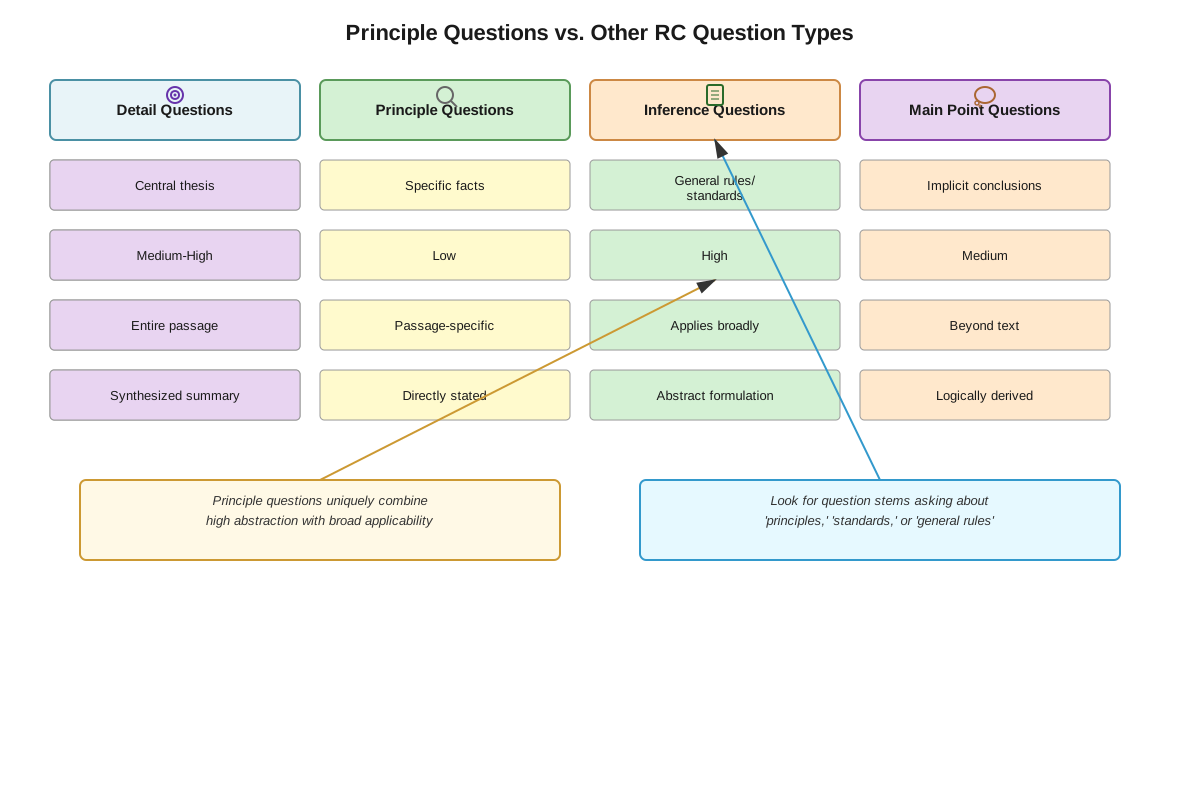
Within the broader landscape of reading comprehension question types, principle questions occupy a unique position. They share characteristics with inference questions (both require going beyond explicit statements) and main point questions (both involve identifying overarching ideas), yet they distinctly focus on extractable rules or standards rather than conclusions or implicit facts. Mastering principle questions strengthens overall RC performance because the analytical skills they require—identifying patterns, recognizing generalizations, and understanding the relationship between specific instances and broader rules—enhance comprehension across all question types.
Learning Objectives
- [ ] Identify how Principle questions in RC appears in LSAT questions
- [ ] Explain the reasoning pattern behind Principle questions in RC
- [ ] Apply Principle questions in RC to solve LSAT-style problems accurately
- [ ] Distinguish principle questions from other question types based on question stem language
- [ ] Extract general principles from specific examples and detailed passage content
- [ ] Evaluate answer choices by testing whether they accurately capture the scope and content of passage principles
Prerequisites
- Basic passage comprehension skills: Understanding main ideas, structure, and author's purpose forms the foundation for identifying principles embedded within passages
- Familiarity with argument structure: Recognizing premises, conclusions, and supporting evidence helps distinguish between specific claims and general principles
- Understanding of inference questions: Principle questions often require similar reasoning skills, moving from stated information to unstated but supported conclusions
- Knowledge of abstraction levels: Distinguishing between concrete examples and abstract generalizations is crucial for principle identification
Why This Topic Matters
Principle questions test a fundamental legal reasoning skill: the ability to extract governing rules from complex texts and apply them consistently. In legal practice, attorneys constantly identify principles from judicial opinions, statutes, and regulations, then apply those principles to client situations. The LSAT uses principle questions to assess this exact capability, making them highly predictive of law school and legal practice success.
LSAT principle questions in RC appear with significant frequency—typically 2-4 questions per test across the four reading comprehension passages. They constitute approximately 8-12% of all RC questions, making them a high-yield topic that can meaningfully impact overall scores. Unlike some question types that cluster in specific passage types, principle questions appear across all content areas: law, science, humanities, and social sciences.
These questions commonly appear in several formats within passages. They may ask test-takers to identify a principle that the author endorses or assumes, to recognize a principle illustrated by a specific example in the passage, to determine which principle would justify a claim made in the text, or to identify a principle that distinguishes between two positions discussed. Passages discussing legal reasoning, ethical frameworks, scientific methodologies, or critical theories particularly lend themselves to principle questions because these topics inherently involve abstract rules governing specific instances.
Core Concepts
Defining Principle Questions
A principle in LSAT reading comprehension is a general rule, standard, guideline, or proposition that governs or explains multiple specific instances. Principles operate at a higher level of abstraction than the particular facts or examples they encompass. For instance, if a passage describes three different court cases where judges ruled that contracts signed under duress were invalid, the principle would be: "Contracts signed under duress lack legal validity." The principle captures what unifies the specific cases.
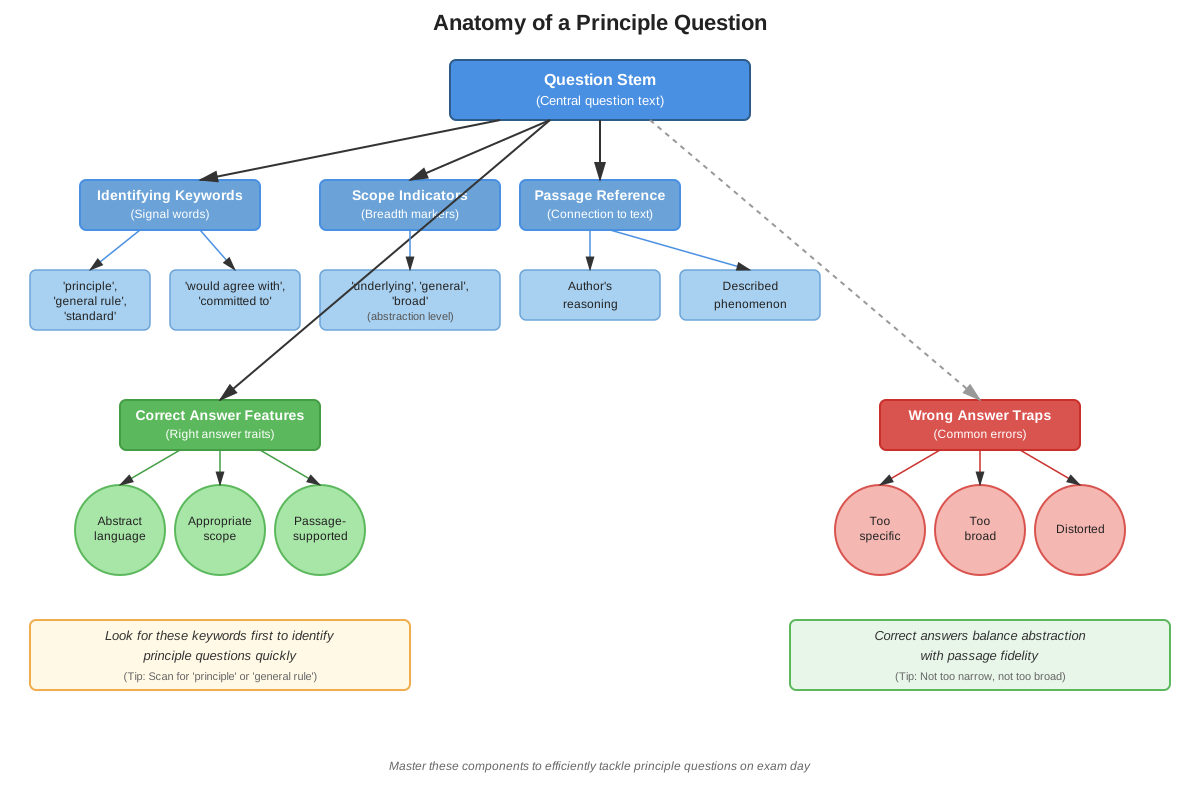
Principle questions in RC ask test-takers to identify these general rules from passage content. The questions may be phrased in various ways, but they all fundamentally test the ability to move from specific textual content to abstract generalizations. Common question stems include:
- "Which one of the following principles is best illustrated by the passage?"
- "The author's argument most closely conforms to which one of the following principles?"
- "The passage provides support for which one of the following principles?"
- "Which one of the following principles underlies the author's reasoning?"
Characteristics of Valid Principles
Valid principles extracted from RC passages share several key characteristics. First, they must be sufficiently general to encompass multiple instances or examples from the passage, not merely restate a single fact. A principle that only applies to one specific situation mentioned in the passage is too narrow. Second, principles must be accurately grounded in passage content—they cannot introduce ideas, values, or standards not supported by the text. Third, effective principles maintain appropriate scope—neither too broad (encompassing situations the passage doesn't address) nor too narrow (missing significant aspects of what the passage discusses).
Consider this distinction: If a passage discusses how three different artists used unconventional materials to challenge aesthetic norms, a valid principle might be "Artists can challenge established aesthetic conventions through unconventional choice of materials." This is general (applies to multiple artists), grounded (supported by passage examples), and appropriately scoped (doesn't overreach to all art or underreach to just one artist).
Types of Principles in RC Passages
LSAT passages contain several types of principles that questions may target:
- Methodological principles: Rules governing how something should be done or studied (e.g., "Scientific theories should be evaluated based on their predictive power")
- Normative principles: Standards for what ought to be or what is valuable (e.g., "Legal systems should prioritize procedural fairness over efficiency")
- Explanatory principles: General rules that explain why phenomena occur (e.g., "Economic actors respond to incentive structures")
- Evaluative principles: Standards for assessing or judging something (e.g., "Literary works should be interpreted within their historical context")
The Abstraction Process
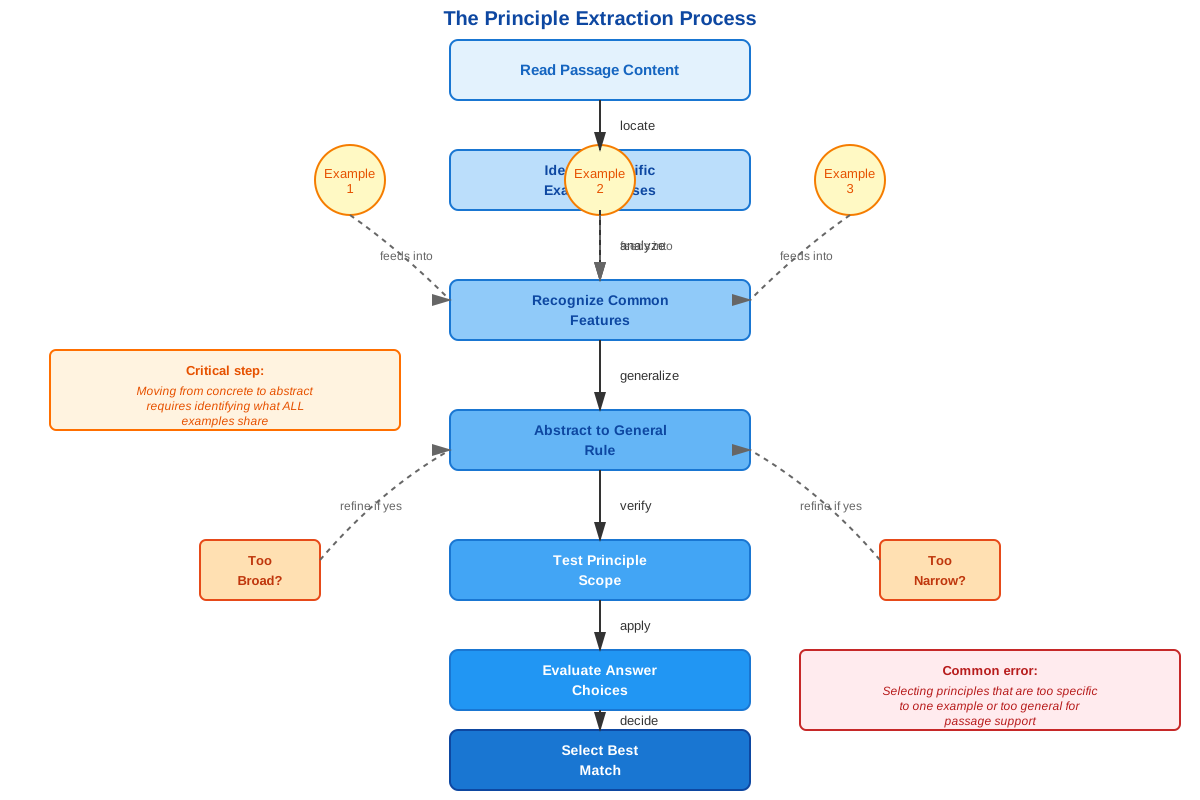
Answering principle questions requires moving up the "ladder of abstraction" from concrete details to general rules. This process involves several cognitive steps:
- Identify relevant passage content: Locate the specific examples, arguments, or claims related to the question
- Recognize patterns: Determine what these specific instances have in common
- Formulate the general rule: Express what governs or unifies these instances at a higher level of abstraction
- Test the principle: Verify that it applies to all relevant passage content without overreaching
For example, if a passage describes how courts in three jurisdictions refused to enforce non-compete agreements that prevented workers from earning a livelihood, the abstraction process moves from these specific cases (concrete) to the principle that "Employment restrictions that prevent individuals from earning a livelihood are unenforceable" (abstract).
Distinguishing Principles from Other Concepts
Understanding what principles are NOT helps clarify what they ARE:
| Concept | Definition | Difference from Principle |
|---|---|---|
| Main Point | The primary conclusion or thesis | May be specific rather than general; a conclusion rather than a rule |
| Supporting Detail | Specific fact or example | Concrete instance rather than abstract rule |
| Inference | Unstated but supported conclusion | May be specific; doesn't necessarily express a general rule |
| Assumption | Unstated premise required for reasoning | May be specific to one argument; not necessarily a general standard |
A principle is specifically a general rule or standard that can govern multiple situations, not merely any conclusion or unstated idea.
Common Principle Question Variations
LSAT principle questions in RC appear in several distinct variations:
Principle Illustrated: These questions ask which principle is demonstrated or exemplified by passage content. The passage provides specific instances, and the correct answer states the general rule they illustrate.
Principle Conformed To: These questions ask which principle the author's reasoning follows or adheres to. The correct answer identifies the general standard governing the author's argument.
Principle Underlying: These questions ask which principle forms the foundation or basis for claims made in the passage. The correct answer reveals the implicit general rule that supports explicit passage statements.
Principle Supporting: These questions ask which principle, if valid, would support or justify a claim from the passage. The correct answer provides a general rule that would strengthen passage reasoning.
Concept Relationships
The concepts within principle questions form an interconnected system. The definition of principles as general rules establishes the foundation, which then determines the characteristics of valid principles (generality, grounding, appropriate scope). These characteristics guide the abstraction process, which test-takers use to move from specific passage content to general rules. Understanding types of principles helps recognize what kind of general rule a passage might contain, while knowing how to distinguish principles from other concepts prevents confusion with similar question types.
This topic connects to prerequisite knowledge in several ways. Basic comprehension skills → enable identification of relevant passage content → which feeds into the abstraction process. Understanding argument structure → helps recognize when specific claims exemplify general rules → which supports identifying principles underlying reasoning. Inference skills → provide practice moving beyond explicit text → which transfers to extracting implicit principles.
Principle questions also relate to other RC question types. They share with inference questions the requirement to go beyond explicit statements, but principles specifically seek general rules rather than any supported conclusion. They overlap with main point questions when the main point is itself a principle, but differ when the main point is a specific conclusion. They connect to application questions because both involve general rules, but application questions typically provide the principle and ask for its application, while principle questions ask test-takers to extract the principle itself.
The relationship map: Specific Passage Content → Abstraction Process → General Principle → Answer Choice Evaluation → Correct Answer Selection
High-Yield Facts
⭐ Principle questions ask for general rules or standards that govern or explain specific instances in the passage, not merely restatements of specific facts
⭐ The correct answer to a principle question must be supported by passage content—it cannot introduce new ideas or values not present in the text
⭐ Common question stem language includes "principle illustrated," "principle conformed to," "principle underlying," and "principle supporting"
⭐ Valid principles must be sufficiently general to apply to multiple instances but not so broad that they extend beyond passage scope
⭐ The abstraction process—moving from specific examples to general rules—is the core skill tested by principle questions
- Principle questions typically appear 2-4 times per LSAT, constituting 8-12% of RC questions
- Wrong answers often fail by being too specific (merely restating one example) or too broad (extending beyond passage content)
- Methodological, normative, explanatory, and evaluative principles are the four main types appearing in passages
- Principle questions differ from main point questions because main points may be specific conclusions rather than general rules
- The correct principle must account for all relevant passage content it purports to govern, not just selected examples
- Author's tone and emphasis often signal which principles the passage endorses versus merely describes
- Comparative passages frequently generate principle questions about what distinguishes the two perspectives
- Legal and philosophical passages have the highest frequency of principle questions due to their inherently rule-based content
Quick check — test yourself on Principle questions in RC so far.
Try Flashcards →Common Misconceptions
Misconception: Principle questions are just asking for the main point of the passage.
Correction: While some main points are principles, many are specific conclusions rather than general rules. Principle questions specifically seek abstract standards or rules that govern multiple instances, whereas main point questions seek the primary conclusion, which may be concrete and specific.
Misconception: The correct answer to a principle question can introduce reasonable ideas not mentioned in the passage as long as they're logical.
Correction: Like all RC questions, principle questions must be answered based solely on passage content. The principle must be supported by what the passage actually says, not by what seems reasonable or logical in general. Every element of the correct principle must have textual support.
Misconception: A principle is valid if it applies to even one example from the passage.
Correction: Valid principles must be sufficiently general to encompass the relevant scope of passage content. If a passage discusses multiple related instances, the principle should account for all of them, not just one. A statement that only applies to a single example is typically too narrow to be the correct principle.
Misconception: The most abstract answer choice is always correct for principle questions.
Correction: While principles are more abstract than specific details, the correct answer must maintain appropriate scope. Overly abstract answers that extend far beyond passage content are wrong. The correct principle balances generality with accurate grounding in the passage's specific subject matter.
Misconception: Principle questions only appear in law-related passages.
Correction: While legal passages frequently contain principle questions due to their rule-based nature, these questions appear across all passage types—science, humanities, and social sciences. Any passage that discusses general standards, methodologies, or rules governing specific instances can generate principle questions.
Misconception: If the passage explicitly states a rule, that rule cannot be the answer to a principle question because principle questions test inference.
Correction: Principle questions may ask about explicitly stated principles or principles that must be inferred from examples. The key distinction is not whether the principle is stated or unstated, but whether the answer choice correctly identifies a general rule that governs passage content.
Worked Examples
Example 1: Methodological Principle
Passage Excerpt: "Historian Chen argues that understanding the French Revolution requires examining not just political events but also economic conditions, cultural attitudes, and social structures of the period. She criticizes earlier historians who focused exclusively on the actions of political leaders, claiming their accounts miss crucial causal factors. In her own work, Chen analyzes grain prices, popular literature, and class relationships alongside governmental decisions, arguing this multifaceted approach reveals patterns invisible to narrower methodologies."
Question: The passage most strongly supports which one of the following principles regarding historical methodology?
Answer Choices:
(A) Historical events can only be understood by examining economic factors
(B) Political history should be subordinated to social and cultural history
(C) Comprehensive historical understanding requires analyzing multiple dimensions of a period
(D) Earlier historical methodologies are invariably flawed and should be rejected
(E) The French Revolution cannot be understood through traditional historical methods
Analysis:
Step 1: Identify what the passage says about methodology. Chen advocates examining multiple factors (economic, cultural, social, political) rather than focusing exclusively on one dimension. She criticizes narrow approaches and practices a "multifaceted approach."
Step 2: Abstract the general principle. The specific case (French Revolution) and specific factors (economic, cultural, social, political) are examples of a broader methodological rule: comprehensive understanding requires multiple analytical dimensions.
Step 3: Evaluate each answer:
(A) Too narrow and extreme—says "only" economic factors, but Chen examines multiple factors including but not limited to economic ones. This fails the scope test.
(B) Introduces a hierarchy ("subordinated") not supported by the passage. Chen advocates including political history alongside other dimensions, not ranking them. This introduces unsupported content.
(C) CORRECT. This captures the general methodological principle: comprehensive understanding requires multiple dimensions. It's sufficiently general (applies beyond just the French Revolution), accurately grounded (supported by Chen's argument and practice), and appropriately scoped (doesn't overreach or underreach).
(D) Too extreme—"invariably flawed" and "should be rejected" go beyond Chen's criticism. She criticizes narrow approaches but doesn't claim all earlier methodologies are completely flawed. This fails the accuracy test.
(E) Too specific—focuses only on the French Revolution rather than expressing a general methodological principle. This fails the generality test.
Connection to Learning Objectives: This example demonstrates how to identify principle questions (objective 1), apply the abstraction process from specific content to general rule (objective 2), and evaluate answers for appropriate scope and grounding (objective 3).
Example 2: Normative Principle
Passage Excerpt: "The debate over genetic privacy has intensified as DNA databases expand. Privacy advocates argue that individuals should control access to their genetic information because such data reveals not only health risks but also ancestry, relationships, and behavioral predispositions. They contend that law enforcement access to genetic databases without individual consent violates personal autonomy, even when such access might solve crimes. The advocates maintain that the potential for misuse—including discrimination and stigmatization—outweighs investigative benefits when individuals haven't explicitly authorized access."
Question: Which one of the following principles underlies the privacy advocates' position?
Answer Choices:
(A) Criminal investigations should never utilize genetic information
(B) Individual autonomy should be prioritized over collective security benefits when personal information is involved
(C) Genetic information is more sensitive than other types of personal data
(D) Law enforcement agencies cannot be trusted with access to personal information
(E) DNA databases should be prohibited entirely
Analysis:
Step 1: Identify the advocates' reasoning structure. They argue against law enforcement access without consent, even acknowledging it "might solve crimes." Their reasoning: personal autonomy is violated, and misuse potential outweighs investigative benefits.
Step 2: Recognize the underlying value judgment. The advocates prioritize individual control (autonomy) over collective benefits (crime solving). This is a normative principle about what should be valued more highly.
Step 3: Evaluate answers:
(A) Too extreme—"never" is absolute, but advocates only oppose access without consent, not all use of genetic information in investigations. This overgeneralizes.
(B) CORRECT. This captures the normative principle: when individual autonomy and collective security conflict regarding personal information, autonomy should prevail. This explains why advocates oppose unconsented access despite crime-solving benefits. It's appropriately general (applies beyond just genetics) and accurately grounded (reflects the value judgment in their reasoning).
(C) Makes a comparative claim not supported by the passage. The passage doesn't compare genetic information to other data types. This introduces unsupported content.
(D) Attributes a motivation (distrust) not stated in the passage. Advocates cite misuse potential, but this doesn't necessarily mean law enforcement "cannot be trusted." This mischaracterizes the reasoning.
(E) Too extreme—advocates oppose unconsented access, not databases entirely. This overstates the position.
Connection to Learning Objectives: This example shows how to identify the reasoning pattern (objective 2) by recognizing the value judgment underlying the advocates' position, and how to distinguish the correct principle from answers that are too extreme, too narrow, or introduce unsupported ideas (objective 3).
Exam Strategy
Recognizing Principle Questions
Trigger words and phrases that signal principle questions include:
- "principle illustrated"
- "principle conformed to"
- "principle underlying"
- "principle supports"
- "general proposition"
- "general rule"
- "standard"
- "which one of the following is most supported by the passage"
When you see these phrases, immediately shift into "abstraction mode"—prepare to move from specific passage content to general rules.
Systematic Approach
Use this four-step process for principle questions:
- Locate relevant content: Identify which passage portion the question targets (specific paragraph, example, or argument)
- Identify the pattern: Determine what multiple instances have in common or what rule governs the specific content
- Predict the principle: Before looking at answers, formulate in your own words what general rule the passage supports
- Evaluate systematically: Test each answer against passage content, eliminating those that are too narrow, too broad, or unsupported
Process of Elimination Strategy
Eliminate answers that exhibit these common flaws:
Too Specific: Merely restates one example without generalizing (e.g., if the passage discusses three cases, the answer only addresses one)
Too Broad: Extends beyond passage scope to situations or domains not discussed (watch for answers that remove qualifications present in passage content)
Unsupported Elements: Introduces ideas, values, or standards not present in the passage (even if they seem reasonable)
Wrong Type: Confuses the type of principle (e.g., provides a methodological principle when the question asks about a normative one)
Reversed Logic: States the opposite of what the passage supports
Exam Tip: The correct answer often preserves key qualifications from the passage. If the passage says "usually" or "in most cases," the correct principle likely includes similar hedging rather than absolute language.
Time Allocation
Principle questions typically require 60-90 seconds—slightly more than detail questions but comparable to inference questions. The abstraction process takes time, but don't get stuck trying to perfectly articulate the principle before looking at answers. If you can't formulate a clear prediction after 15-20 seconds, move to the answers and evaluate them against passage content.
If you're struggling between two answers, return to the passage and test each answer against multiple relevant examples or claims. The correct principle should account for all relevant content, while wrong answers typically fail to encompass something important.
Common Trap Patterns
The "Reasonable but Unsupported" trap: An answer that states a sensible principle related to the passage topic but not actually supported by passage content. Always verify textual support.
The "Too Narrow" trap: An answer that accurately describes one example but fails to capture the general rule governing multiple instances. Check whether the answer encompasses all relevant content.
The "Extreme Language" trap: An answer that uses absolute language (always, never, only, all) when the passage supports a more qualified principle. Compare the answer's strength to passage language.
Memory Techniques
The SAGE Acronym for Principle Evaluation
Scope: Is the principle appropriately general (not too narrow or too broad)?
Accuracy: Is every element supported by passage content?
Generality: Does it apply to multiple instances, not just one?
Exhaustiveness: Does it account for all relevant passage content?
Visualization Strategy
Picture a pyramid with specific examples at the base and the general principle at the apex. As you read answer choices, visualize whether they sit at the apex (appropriately general), at the base (too specific), or floating above the pyramid (too broad/unsupported). The correct answer sits precisely at the apex, encompassing the base without extending beyond it.
The "Three Examples Test"
When a passage provides multiple examples or instances, use this memory technique: The correct principle should explain or govern at least three things from the passage. If an answer only applies to one or two items, it's likely too narrow.
Mnemonic for Principle Types
MENE (pronounced "meanie") for the four main principle types:
- Methodological (how to do something)
- Evaluative (how to judge something)
- Normative (what ought to be)
- Explanatory (why things occur)
Summary
Principle questions in RC test the ability to extract general rules, standards, or propositions from specific passage content, requiring test-takers to move up the ladder of abstraction from concrete examples to governing principles. These questions appear 2-4 times per LSAT and constitute a high-yield topic because they assess fundamental legal reasoning skills: identifying rules from complex texts and understanding the relationship between specific instances and general standards. The correct answer to a principle question must be sufficiently general to encompass multiple relevant instances, accurately grounded in passage content without introducing unsupported ideas, and appropriately scoped—neither too narrow nor too broad. Success requires recognizing principle question stems, systematically applying the abstraction process, and evaluating answers using the SAGE criteria (Scope, Accuracy, Generality, Exhaustiveness). Common wrong answers are too specific (merely restating one example), too broad (extending beyond passage scope), or unsupported (introducing reasonable but textually ungrounded ideas). Mastering principle questions strengthens overall RC performance because the analytical skills they require—pattern recognition, abstraction, and understanding relationships between specific and general—enhance comprehension across all question types.
Key Takeaways
- Principle questions ask for general rules or standards that govern or explain specific passage content, not restatements of specific facts or the main conclusion
- The correct principle must be supported by passage content, sufficiently general to apply to multiple instances, and appropriately scoped to avoid overreaching
- The abstraction process—identifying relevant content, recognizing patterns, formulating the general rule, and testing it—is the core skill for answering principle questions
- Common wrong answers are too narrow (one example only), too broad (beyond passage scope), or introduce unsupported elements
- Trigger phrases include "principle illustrated," "principle conformed to," "principle underlying," and "principle supports"
- Use the SAGE acronym (Scope, Accuracy, Generality, Exhaustiveness) to systematically evaluate answer choices
- Principle questions appear across all passage types and constitute 8-12% of RC questions, making them a high-yield topic for score improvement
Related Topics
Inference Questions in RC: Principle questions are a specialized type of inference question focused specifically on general rules. Mastering principle questions builds skills for all inference questions, while strong inference skills provide the foundation for extracting principles.
Application Questions in RC: These questions provide a principle and ask test-takers to apply it to new situations. Understanding principle questions (which require extracting principles) prepares students for application questions (which require using provided principles).
Main Point Questions: When a passage's main point is itself a general principle, these question types overlap. Distinguishing when a main point is a principle versus a specific conclusion sharpens analytical precision.
Parallel Reasoning in Logical Reasoning: The LR section's parallel reasoning questions require similar abstraction skills—identifying the general logical structure underlying specific arguments. Skills transfer between these question types.
Argument Structure Analysis: Understanding how specific claims support general conclusions in arguments enhances the ability to identify principles that govern or explain specific passage content.
Practice CTA
Now that you understand how to identify, extract, and apply principles in reading comprehension passages, it's time to put these skills into practice. Work through the practice questions and flashcards for this topic, paying special attention to the abstraction process and using the SAGE criteria to evaluate answer choices. Each practice question you complete strengthens your ability to recognize patterns and move efficiently from specific content to general rules—skills that will serve you across all RC passages on test day. Remember: principle questions reward systematic thinking and careful textual analysis. With focused practice, you'll develop the confidence to tackle these high-yield questions efficiently and accurately.
Sign up free to keep reading
Create a free AnvayaPrep account to finish this LSAT guide on Principle questions in RC — plus flashcards and practice questions.