Overview
Strengthen questions in RC represent a critical question type within LSAT reading comprehension that tests a student's ability to identify information that would support or bolster an argument, claim, or position presented in the passage. Unlike Logical Reasoning strengthen questions, which provide a stimulus and ask test-takers to select an answer that strengthens the argument, RC strengthen questions require students to first comprehend a complex passage, identify the relevant argument or claim within that passage, and then determine what additional information would make that argument more convincing or well-supported.
These questions assess multiple cognitive skills simultaneously: passage comprehension, argument identification, logical reasoning, and the ability to recognize what constitutes genuine support versus superficial relevance. Students must understand not only what the author explicitly states but also the underlying logical structure of the argument—its premises, conclusion, and any gaps or assumptions that additional evidence could address. This question type appears regularly on the LSAT and represents a higher-order thinking skill that law schools value highly, as legal practice frequently requires attorneys to identify what evidence would strengthen their case or their client's position.
Within the broader landscape of reading comprehension question types, strengthen questions occupy a unique position. They bridge pure comprehension questions (which ask "what does the passage say?") and inference questions (which ask "what can be concluded?") by requiring students to think beyond the passage itself and consider what external information would enhance the passage's arguments. Mastering strengthen questions in RC builds critical skills for other question types, including weaken questions, evaluate questions, and assumption questions, all of which require understanding argumentative structure within complex texts.
Learning Objectives
- [ ] Identify how Strengthen questions in RC appears in LSAT questions
- [ ] Explain the reasoning pattern behind Strengthen questions in RC
- [ ] Apply Strengthen questions in RC to solve LSAT-style problems accurately
- [ ] Distinguish between information that genuinely strengthens an argument versus information that is merely consistent with it
- [ ] Recognize common argument structures in RC passages that are vulnerable to strengthen questions
- [ ] Evaluate answer choices systematically to identify the most effective strengthening information
- [ ] Connect strengthen questions to the author's purpose and the passage's overall argumentative structure
Prerequisites
- Basic argument structure: Understanding premises, conclusions, and how evidence supports claims is essential because strengthen questions require identifying what would make an argument more convincing
- LSAT Reading Comprehension fundamentals: Familiarity with active reading, passage mapping, and identifying main points provides the foundation for locating the specific arguments that strengthen questions target
- Logical reasoning basics: Knowledge of how evidence relates to conclusions helps students recognize what type of information would genuinely support a claim versus what merely seems relevant
- Common argument patterns: Awareness of causal arguments, comparative claims, and predictive reasoning enables faster identification of what would strengthen these specific argument types
Why This Topic Matters
Strengthen questions in RC appear with significant frequency on the LSAT, typically comprising 5-10% of all reading comprehension questions across a test. This translates to approximately 2-3 strengthen questions per exam, making them a reliable question type that students can expect to encounter. More importantly, the skills required to answer strengthen questions successfully—identifying arguments within complex texts, recognizing logical gaps, and evaluating what would constitute genuine support—are fundamental to legal reasoning and appear across multiple LSAT sections.
In legal practice, attorneys constantly face situations requiring them to identify what evidence would strengthen their arguments, whether preparing for trial, drafting persuasive briefs, or advising clients on the strength of their positions. Law schools recognize that students who excel at strengthen questions demonstrate the analytical thinking essential for legal success. These questions test whether students can move beyond passive comprehension to active engagement with argumentative texts, a skill that distinguishes competent readers from exceptional critical thinkers.
On the LSAT, strengthen questions typically appear in passages discussing scientific research, social science theories, legal or historical arguments, and comparative analyses. They often target the passage's main argument or a significant subsidiary claim, particularly when the author presents a controversial position, proposes a new theory, or challenges conventional wisdom. Common formulations include questions asking what would "most strengthen," "provide the most support for," or "most help to justify" a claim made in the passage. Understanding how to approach these questions efficiently can significantly impact overall Reading Comprehension scores, as they tend to be moderately difficult questions that separate high scorers from average performers.
Core Concepts
Understanding Strengthen Questions in RC
Strengthen questions in RC ask test-takers to identify information that, if true, would make an argument, claim, or position in the passage more convincing, better supported, or more likely to be correct. These questions differ fundamentally from comprehension questions because they require students to think beyond what the passage explicitly states and consider what additional evidence would enhance the passage's arguments. The correct answer provides new information—not stated in the passage—that addresses a potential weakness, fills a logical gap, or provides additional support for the author's reasoning.
The key to recognizing strengthen questions lies in their question stems, which typically include phrases such as:
- "Which of the following, if true, would most strengthen..."
- "The author's argument would be most supported by evidence that..."
- "Which of the following findings would provide the most support for..."
- "The claim that [X] would be most strengthened by..."
The Logical Structure of Arguments in RC Passages
To answer strengthen questions effectively, students must first identify the argument structure within the passage. RC passages contain multiple types of content: background information, factual descriptions, competing viewpoints, and the author's own arguments or the arguments the author discusses. Strengthen questions target specific arguments, so students must distinguish argumentative content from purely descriptive content.
An argument in an RC passage typically consists of:
- Conclusion: The main claim being advanced (what the author or discussed party wants to prove)
- Premises: The evidence, reasons, or support offered for the conclusion
- Assumptions: Unstated connections between premises and conclusion that must be true for the argument to work
- Scope: The boundaries of what the argument claims (specific populations, time periods, conditions)
Strengthen questions most commonly target arguments that have identifiable gaps or vulnerabilities. These include:
| Argument Type | Common Vulnerability | What Strengthens It |
|---|---|---|
| Causal claims | Alternative explanations exist | Evidence ruling out alternative causes |
| Comparative arguments | Differences between compared items | Evidence showing relevant similarity |
| Predictive reasoning | Past may not predict future | Evidence of consistent patterns |
| Representative sampling | Sample may not represent population | Evidence of sample representativeness |
| Analogical reasoning | Analogy may not hold | Evidence of relevant similarities |
Identifying What Genuinely Strengthens vs. What Merely Relates
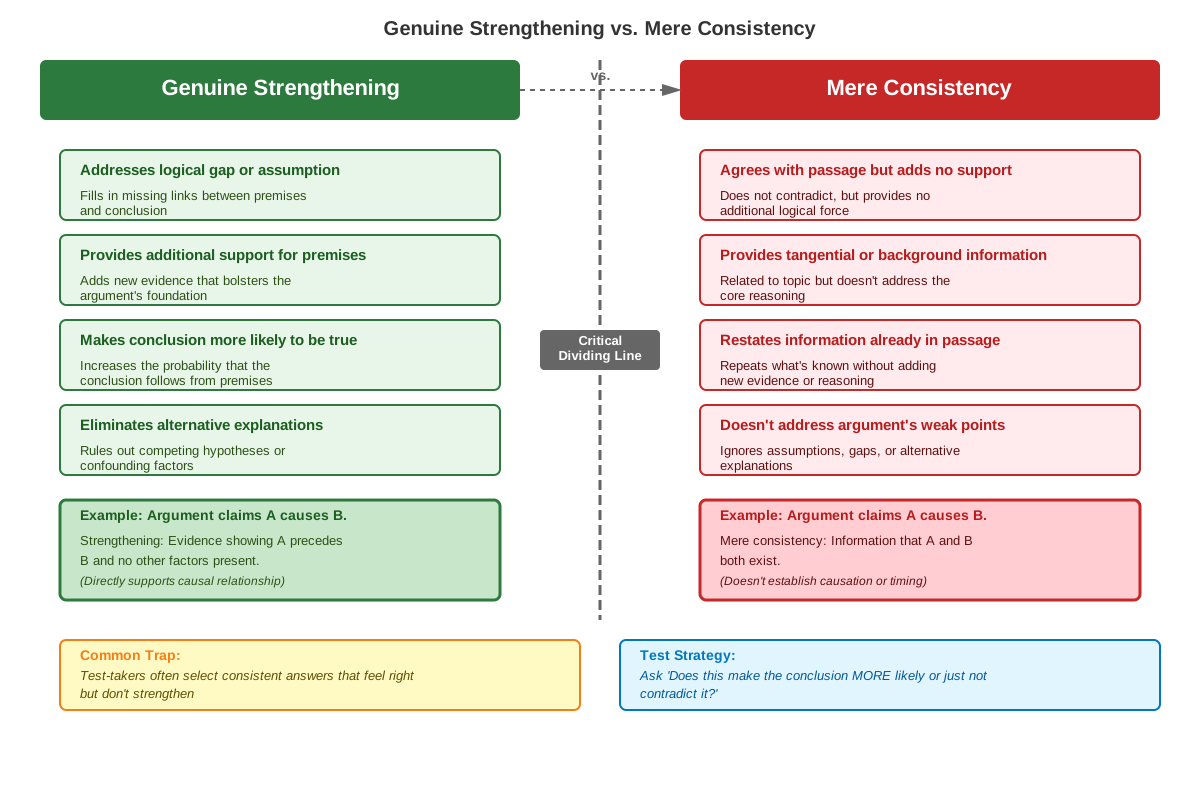
A critical distinction in strengthen questions involves recognizing the difference between information that genuinely strengthens an argument and information that is merely consistent with the conclusion or tangentially related. Genuine strengthening occurs when new information makes the conclusion more likely to be true by:
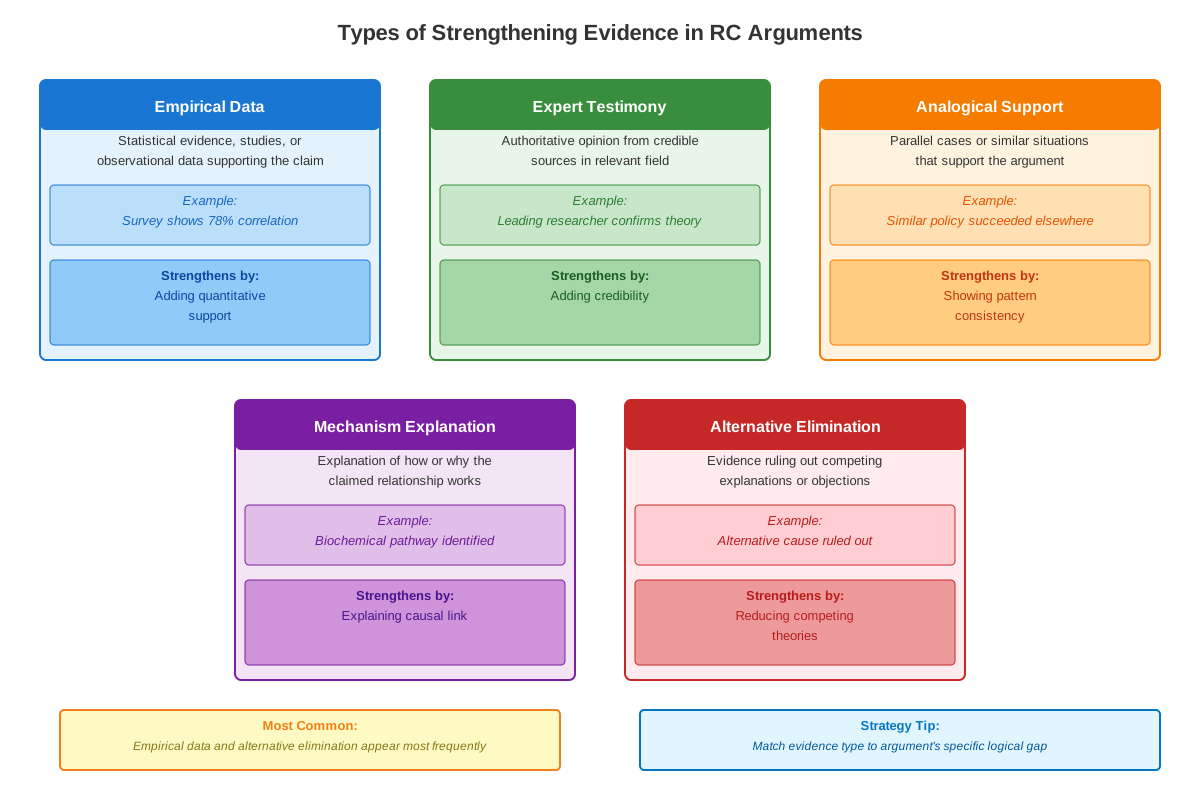
- Addressing assumptions: Confirming that an unstated assumption underlying the argument is actually true
- Eliminating alternative explanations: Ruling out competing theories or rival hypotheses
- Providing additional confirming evidence: Offering new data that independently supports the conclusion
- Establishing necessary conditions: Showing that prerequisites for the argument's validity are met
- Demonstrating representativeness: Confirming that examples or samples accurately represent broader patterns
Information that merely relates to the topic without strengthening the specific argument includes:
- Background information that provides context but doesn't address logical gaps
- Evidence that restates what's already in the passage
- Information about tangential issues that don't affect the argument's core reasoning
- Data that is consistent with the conclusion but doesn't make it more likely to be true
The Reasoning Pattern Behind Strengthen Questions
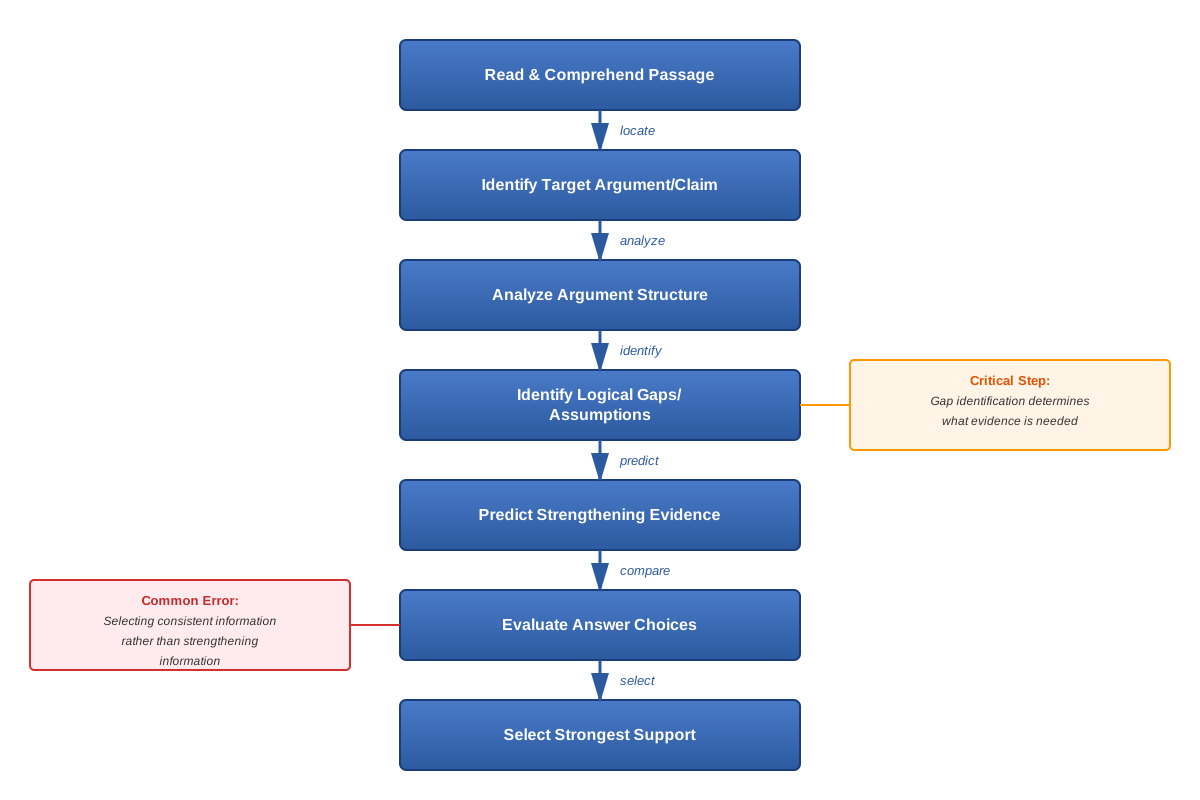
The reasoning pattern for strengthen questions follows a systematic approach:
- Identify the specific argument: Locate the exact claim the question asks about, which may be the passage's main point or a subsidiary argument
- Analyze the argument's structure: Determine the conclusion, premises, and identify any logical gaps or assumptions
- Predict what would strengthen: Before looking at answer choices, consider what type of information would address weaknesses or gaps
- Evaluate each answer choice: Assess whether each option genuinely strengthens the argument or merely relates to it
- Select the strongest support: Choose the answer that most directly and effectively strengthens the argument
This pattern requires active engagement with the passage's logic rather than passive recognition of familiar content. Students must think like attorneys building a case: "What additional evidence would make this argument more convincing to a skeptical audience?"
Common Strengthen Scenarios in RC Passages
Certain argumentative situations appear repeatedly in LSAT reading comprehension passages and are particularly susceptible to strengthen questions:
Scientific research arguments: When a passage describes a study or experiment supporting a particular conclusion, strengthen questions often ask what would make the research findings more convincing. Correct answers typically address concerns about experimental design, sample size, control groups, or alternative explanations for observed results.
Historical or causal explanations: When an author argues that X caused Y or explains a historical phenomenon through a particular lens, strengthen questions test whether students recognize what evidence would make that causal or explanatory claim more credible. Answers often eliminate alternative causes or provide additional examples of the proposed causal relationship.
Theoretical proposals: When a passage presents a new theory or challenges an established view, strengthen questions ask what would support the new perspective. Correct answers frequently provide evidence that the theory successfully explains phenomena that competing theories cannot, or that predictions derived from the theory have been confirmed.
Comparative claims: When an author argues that one approach, method, or interpretation is superior to another, strengthen questions probe what would make that comparative judgment more justified. Answers typically show that relevant comparison factors favor the author's preferred option or that apparent advantages of the alternative are illusory.
Concept Relationships
The concepts within strengthen questions in RC form an interconnected logical framework. Argument identification serves as the foundation, enabling students to locate the specific claim that needs strengthening. This connects directly to argument structure analysis, which reveals the premises, conclusion, and assumptions that determine what type of strengthening would be most effective. Understanding common argument vulnerabilities flows from structure analysis and guides the prediction process, where students anticipate what information would address those vulnerabilities before examining answer choices.
The relationship to prerequisite topics is equally important. Basic argument structure from logical reasoning provides the vocabulary and conceptual framework for analyzing arguments within RC passages. RC fundamentals like active reading and passage mapping enable efficient location of arguments within complex texts. Logical reasoning basics inform the evaluation of whether answer choices genuinely strengthen arguments or merely relate to them superficially.
Strengthen questions also connect to other reading comprehension question types. They share with inference questions the requirement to think beyond explicit passage content, but while inference questions ask what must be true based on the passage, strengthen questions ask what would make passage claims more likely to be true. They form a natural pair with weaken questions, which ask for information that would undermine rather than support arguments. Understanding strengthen questions also builds skills for assumption questions, as identifying what would strengthen an argument often involves recognizing the argument's underlying assumptions.
Textual relationship map:
Passage Comprehension → Argument Identification → Structure Analysis → Gap Recognition → Prediction of Strengthening Information → Answer Choice Evaluation → Selection of Best Strengthener
High-Yield Facts
⭐ Strengthen questions ask for NEW information not stated in the passage that would make an argument more convincing
⭐ The correct answer must address a logical gap, assumption, or vulnerability in the specific argument referenced
⭐ Information that merely restates passage content or is consistent with the conclusion does NOT strengthen the argument
⭐ Common strengthen scenarios include eliminating alternative explanations, confirming assumptions, and providing additional supporting evidence
⭐ Strengthen questions typically target the passage's main argument or significant subsidiary claims, not minor details
- Strengthen questions appear 2-3 times per LSAT exam, representing approximately 5-10% of RC questions
- Question stems containing "if true" indicate that students should accept the answer choice as factual and evaluate its impact
- The strongest answer is not necessarily the one that proves the conclusion true, but the one that makes it MORE likely to be true
- Causal arguments are strengthened by evidence that eliminates alternative causes or provides additional examples of the causal relationship
- Comparative arguments are strengthened by evidence showing relevant similarity between compared items or relevant differences that favor the author's position
- Scientific research claims are strengthened by evidence of proper methodology, representative samples, or replication of results
- Predictive arguments are strengthened by evidence of consistent patterns or stable conditions that make past trends reliable guides to the future
- Wrong answers often provide information that is interesting or related to the topic but doesn't address the argument's logical structure
- The scope of the strengthening information must match the scope of the argument (don't choose an answer that's too broad or too narrow)
Quick check — test yourself on Strengthen questions in RC so far.
Try Flashcards →Common Misconceptions
Misconception: Any information that supports the conclusion strengthens the argument equally.
Correction: Strengthening is not binary but exists on a spectrum. The correct answer provides the MOST support by addressing the argument's most significant vulnerability or gap. Information that provides minor or tangential support is incorrect when a stronger option exists.
Misconception: Information already stated or implied in the passage can strengthen the argument.
Correction: Strengthen questions require NEW information not present in the passage. If an answer choice merely restates passage content, it cannot be correct because it adds no additional support. The passage already contains that information, so it's already factored into the argument's current strength.
Misconception: The correct answer must prove the conclusion is true.
Correction: Strengthen questions ask what makes the conclusion MORE likely or better supported, not what proves it definitively. Even the correct answer may leave room for doubt; it simply needs to provide more support than the other options.
Misconception: Strengthen questions are just asking for information consistent with the passage's viewpoint.
Correction: Consistency is not sufficient for strengthening. Information can be consistent with a conclusion without making it more likely to be true. For example, if a passage argues "increased exercise improves health," the fact that "many people exercise" is consistent but doesn't strengthen the causal claim. Evidence that "controlled studies show health improvements following exercise interventions" actually strengthens by addressing the causal relationship.
Misconception: The longest or most detailed answer choice is usually correct.
Correction: Length and detail do not correlate with correctness in strengthen questions. Wrong answers are often lengthy and detailed but address the wrong aspect of the argument or provide irrelevant information. The correct answer may be concise but precisely targets the argument's logical gap.
Misconception: Strengthen questions in RC work exactly like strengthen questions in Logical Reasoning.
Correction: While the underlying logic is similar, RC strengthen questions require first comprehending a complex passage and identifying the relevant argument within it, then applying strengthening logic. The passage context and the need to locate the specific argument being referenced add layers of complexity not present in LR strengthen questions, which provide a clearly delineated stimulus.
Misconception: Eliminating one alternative explanation is always sufficient to strengthen a causal argument.
Correction: While eliminating alternative explanations does strengthen causal arguments, the degree of strengthening depends on how plausible and significant that alternative was. Eliminating the most likely alternative explanation strengthens more than eliminating an implausible one. Additionally, if multiple plausible alternatives exist, eliminating just one may provide only modest strengthening.
Worked Examples
Example 1: Scientific Research Argument
Passage excerpt: "Researchers studying cognitive decline in elderly populations found that participants who regularly engaged in social activities showed slower rates of memory loss than those who were socially isolated. The researchers concluded that social engagement helps preserve cognitive function in older adults."
Question: Which of the following, if true, would most strengthen the researchers' conclusion?
Answer choices:
(A) Many elderly individuals who are socially isolated also have limited mobility
(B) The socially engaged participants had similar baseline cognitive function to the isolated participants at the study's beginning
(C) Social activities that involve cognitive challenges are particularly popular among elderly populations
(D) Some elderly individuals maintain strong cognitive function despite social isolation
(E) The study included participants from diverse socioeconomic backgrounds
Step-by-step solution:
- Identify the argument: The researchers conclude that social engagement CAUSES preserved cognitive function (causal claim)
- Analyze the structure:
- Premise: Socially engaged elderly show slower memory loss than isolated elderly
- Conclusion: Social engagement helps preserve cognitive function
- Gap/Assumption: The correlation reflects causation; the groups were comparable initially; no confounding variables explain the difference
- Predict what would strengthen: Evidence that eliminates alternative explanations (like pre-existing differences between groups) or confirms the causal relationship would strengthen this argument
- Evaluate each choice:
- (A) Introduces a potential confounding variable (mobility) that could explain cognitive differences, which would actually weaken rather than strengthen
- (B) CORRECT - Confirms that the groups started with similar cognitive function, eliminating the alternative explanation that socially engaged people simply had better cognitive function to begin with. This addresses a major assumption and strengthens the causal claim
- (C) Provides interesting information about activity preferences but doesn't address whether social engagement causes cognitive preservation
- (D) Acknowledges exceptions but doesn't strengthen the general causal claim; if anything, it slightly weakens by showing the relationship isn't universal
- (E) Addresses sample diversity but doesn't address the causal relationship between social engagement and cognitive function
- Select the best answer: (B) most directly strengthens by eliminating a major alternative explanation for the observed correlation
Example 2: Historical Explanation Argument
Passage excerpt: "Historians have long debated why the Renaissance began in Italy rather than elsewhere in Europe. Some scholars argue that Italy's geographic position facilitated trade with the East, bringing wealth and exposure to classical texts preserved in Byzantine and Islamic libraries. This economic prosperity and intellectual cross-pollination, they contend, created the conditions necessary for the Renaissance's artistic and intellectual flourishing."
Question: The historians' explanation for the Renaissance's Italian origins would be most strengthened by evidence that:
Answer choices:
(A) Other European regions also had access to classical texts during this period
(B) Italian city-states invested their trade wealth specifically in artistic patronage and scholarly pursuits
(C) The Renaissance eventually spread from Italy to other parts of Europe
(D) Byzantine scholars were interested in preserving ancient Greek and Roman texts
(E) Trade routes between Italy and the East existed for centuries before the Renaissance
Step-by-step solution:
- Identify the argument: The historians argue that Italy's trade position → wealth + classical texts → Renaissance conditions (causal explanation)
- Analyze the structure:
- Premises: Italy's geography enabled Eastern trade; this brought wealth and classical texts
- Conclusion: These factors created Renaissance conditions
- Gap: The connection between having wealth/texts and actually producing Renaissance culture; whether these factors were unique to Italy
- Predict what would strengthen: Evidence showing that Italians actually used their trade advantages in ways that produced Renaissance culture, or evidence that other regions lacked these advantages
- Evaluate each choice:
- (A) Would weaken by suggesting Italy's access to texts wasn't unique
- (B) CORRECT - Directly connects the proposed cause (trade wealth) to the effect (Renaissance culture) by showing Italians specifically channeled resources into the cultural activities that defined the Renaissance. This fills the logical gap between having resources and producing cultural flourishing
- (C) Describes what happened after the Renaissance began but doesn't explain why it began in Italy
- (D) Provides background about text preservation but doesn't connect to why Italy specifically experienced the Renaissance
- (E) Weakens by suggesting the trade routes existed long before the Renaissance, raising questions about why the Renaissance didn't occur earlier
- Select the best answer: (B) strengthens by showing the causal mechanism actually operated as the historians propose
Exam Strategy
When approaching strengthen questions in RC, employ a systematic process that maximizes accuracy while managing time effectively:
Step 1: Identify the question type immediately by scanning for trigger phrases like "most strengthen," "most support," or "would most help to justify." This activates the appropriate analytical framework before reading the question details.
Step 2: Locate the specific argument referenced in the question stem. Strengthen questions typically cite a particular claim, often by line reference or by describing the argument's content. Return to the passage and identify the exact argument, marking its conclusion and premises.
Step 3: Analyze before predicting. Spend 10-15 seconds identifying the argument's structure, assumptions, and potential vulnerabilities. Ask: "What is this argument assuming?" "What alternative explanations exist?" "What evidence is missing?" This analysis guides prediction and answer evaluation.
Step 4: Predict the type of strengthening needed before examining answer choices. You don't need to predict the exact correct answer, but identifying whether the argument needs "elimination of alternatives," "confirmation of assumptions," or "additional supporting evidence" focuses your evaluation.
Step 5: Evaluate systematically using the "Does it strengthen? Does it strengthen MOST?" framework:
- First pass: Eliminate answers that don't strengthen at all (irrelevant, weaken, or merely restate passage content)
- Second pass: Among remaining choices, identify which strengthens the specific argument most directly and significantly
Exam Tip: Wrong answers in strengthen questions often fall into predictable categories: (1) information that weakens rather than strengthens, (2) information that's relevant to the topic but doesn't address the argument's logic, (3) information that's too narrow or too broad in scope, (4) information that strengthens a different argument than the one referenced, and (5) information that merely restates passage content.
Trigger words and phrases to watch for:
- "If true" signals that you should accept the answer choice as factual
- "Most strengthen" indicates comparative evaluation among options that may all strengthen to some degree
- "Would support the claim that" directs you to a specific claim that may not be the passage's main point
- "Help to justify" suggests looking for information that addresses assumptions or fills logical gaps
Time allocation: Strengthen questions typically warrant 60-90 seconds. Spend approximately:
- 15 seconds identifying and locating the argument
- 15 seconds analyzing structure and predicting
- 30-45 seconds evaluating answer choices
- 10-15 seconds confirming your selection
Process of elimination tips specific to strengthen questions:
- Immediately eliminate any answer that would weaken the argument
- Eliminate answers that restate information already in the passage
- Eliminate answers that address a different argument than the one referenced
- Between remaining choices, select the one that addresses the most significant logical gap or assumption
- Verify that your selected answer's scope matches the argument's scope
Memory Techniques
STRENGTHEN mnemonic for evaluating answer choices:
Scope - Does the answer match the argument's scope (not too broad/narrow)?
Type - Does it provide the type of support the argument needs?
Relevance - Does it address the argument's actual logical structure?
Eliminate - Does it rule out alternative explanations?
New - Is it new information not already in the passage?
Gap - Does it fill a logical gap or confirm an assumption?
Target - Does it target the specific argument referenced?
Help - Does it actually make the conclusion more likely?
Evaluate - Is it the MOST effective strengthener among the options?
Not restate - Does it avoid merely restating passage content?
Visualization strategy: Picture the argument as a bridge spanning from premises to conclusion. Strengthen questions ask you to identify materials that would reinforce the bridge's weakest point. Visualize examining the bridge for gaps, weak supports, or unstable foundations, then selecting the reinforcement that addresses the most critical structural vulnerability.
The "Three A's" of strengthening:
- Address Assumptions: Confirm what the argument takes for granted
- Add Evidence: Provide new supporting data or examples
- Abolish Alternatives: Eliminate competing explanations
Acronym for common strengthen scenarios - CAPER:
- Causal arguments: eliminate alternative causes
- Analogies: establish relevant similarities
- Predictions: show consistent patterns
- Experiments: confirm proper methodology
- Representativeness: verify sample accuracy
Summary
Strengthen questions in RC require students to identify information that would make a passage argument more convincing by addressing logical gaps, confirming assumptions, or eliminating alternative explanations. These questions test multiple skills simultaneously: comprehending complex passages, identifying specific arguments within those passages, analyzing argumentative structure, and evaluating what constitutes genuine support versus mere relevance. The reasoning pattern involves locating the referenced argument, analyzing its structure and vulnerabilities, predicting what type of information would strengthen it, and systematically evaluating answer choices to identify the most effective strengthener. Success requires distinguishing between information that genuinely makes a conclusion more likely to be true and information that is merely consistent with the conclusion or tangentially related. Common strengthen scenarios include causal arguments requiring elimination of alternative explanations, comparative claims needing evidence of relevant similarities, and scientific research requiring confirmation of proper methodology. Mastering strengthen questions builds critical analytical skills essential for law school success and legal practice.
Key Takeaways
- Strengthen questions require NEW information not in the passage that makes an argument more convincing by addressing its logical structure
- The correct answer must target the specific argument referenced, not just relate to the passage's general topic
- Common strengthening mechanisms include eliminating alternative explanations, confirming assumptions, providing additional evidence, and establishing necessary conditions
- Information that merely restates passage content or is consistent with the conclusion does NOT strengthen the argument
- Systematic analysis of argument structure before examining answer choices dramatically improves accuracy
- The strongest answer addresses the argument's most significant vulnerability or logical gap, not necessarily the one that provides the most information
- Strengthen questions bridge comprehension and logical reasoning skills, requiring both passage understanding and analytical evaluation of argumentative support
Related Topics
Weaken Questions in RC: The mirror image of strengthen questions, asking what information would undermine rather than support passage arguments. Mastering strengthen questions provides the foundation for understanding weaken questions, as both require analyzing argument structure and evaluating how new information affects argument strength.
Assumption Questions in RC: Questions that ask what must be true for an argument to work properly. Understanding strengthen questions helps with assumption questions because information that strengthens an argument often confirms one of its underlying assumptions.
Inference Questions in RC: Questions asking what can be concluded from passage information. While inference questions focus on what must be true based on the passage, strengthen questions ask what would make passage claims more likely, developing complementary analytical skills.
Argument Structure in Logical Reasoning: The LR section provides intensive practice in analyzing arguments, identifying premises and conclusions, and recognizing logical gaps—all skills directly applicable to RC strengthen questions.
Causal Reasoning: Understanding how causal claims work, what makes them vulnerable, and what strengthens them is essential for many RC strengthen questions, as passages frequently present causal arguments about historical events, scientific phenomena, or social trends.
Practice CTA
Now that you've mastered the core concepts and strategies for strengthen questions in RC, it's time to apply this knowledge to actual LSAT-style problems. The practice questions and flashcards will reinforce your understanding and build the pattern recognition essential for test-day success. Remember that strengthen questions reward systematic analysis over intuition—trust the process you've learned, and you'll see consistent improvement. Each practice question you complete strengthens your ability to identify arguments, analyze their structure, and recognize what would make them more convincing. Your investment in mastering this high-yield question type will pay dividends across your entire Reading Comprehension performance!
Sign up free to keep reading
Create a free AnvayaPrep account to finish this LSAT guide on Strengthen questions in RC — plus flashcards and practice questions.