Overview
Weaken questions in RC represent a critical question type within the LSAT reading comprehension section that tests a student's ability to identify information that would undermine or cast doubt on claims, arguments, or positions presented in the passage. Unlike the more common Logical Reasoning section where weaken questions appear frequently, these questions in Reading Comprehension require students to work within the constraints of a longer passage while applying similar analytical skills. The fundamental task involves recognizing which answer choice, if true, would make an argument, claim, or position from the passage less convincing or less likely to be true.
Understanding weaken questions is essential for LSAT success because they assess multiple competencies simultaneously: comprehension of complex arguments embedded within dense passages, identification of logical relationships between claims and evidence, and recognition of vulnerabilities in reasoning structures. These questions typically appear 1-2 times per Reading Comprehension section, making them a high-value target for focused preparation. Students who master this question type demonstrate sophisticated analytical abilities that extend beyond mere comprehension to critical evaluation of textual arguments.
Within the broader landscape of reading comprehension question types, weaken questions occupy a unique position. They bridge pure comprehension questions (which ask what the passage states) and inference questions (which ask what follows from the passage) by requiring students to evaluate the logical strength of arguments. Mastery of weaken questions builds directly on understanding argument structure, evidence evaluation, and the distinction between necessary and sufficient conditions—skills that permeate the entire LSAT and legal reasoning more broadly.
Learning Objectives
- [ ] Identify how Weaken questions in RC appears in LSAT questions
- [ ] Explain the reasoning pattern behind Weaken questions in RC
- [ ] Apply Weaken questions in RC to solve LSAT-style problems accurately
- [ ] Distinguish between answer choices that weaken arguments and those that merely introduce irrelevant information
- [ ] Recognize the specific claim or argument within a passage that the question targets for weakening
- [ ] Evaluate the degree to which different answer choices undermine passage arguments
- [ ] Anticipate common weakening strategies before reviewing answer choices
Prerequisites
- Argument structure identification: Understanding premises, conclusions, and evidence is essential because weaken questions target specific argumentative claims within passages, requiring students to isolate the logical structure before evaluating potential weakeners.
- Basic logical reasoning principles: Familiarity with causation, correlation, necessary versus sufficient conditions, and common reasoning patterns enables students to recognize vulnerabilities in passage arguments.
- Reading comprehension fundamentals: The ability to accurately comprehend complex passages, identify main ideas, and track authorial viewpoint provides the foundation for all RC question types, including weaken questions.
- Distinction between facts and arguments: Recognizing when a passage makes a claim versus when it presents established information helps students identify which portions of the passage are vulnerable to weakening.
Why This Topic Matters
Weaken questions in Reading Comprehension assess a lawyer's core competency: the ability to identify vulnerabilities in opposing arguments. Legal practice constantly requires attorneys to anticipate counterarguments, find weaknesses in adversarial positions, and evaluate the strength of reasoning. The LSAT tests this skill in the RC section by embedding arguments within longer passages and asking students to recognize what would undermine those arguments.
Exam statistics indicate that weaken questions appear with moderate frequency in Reading Comprehension—typically 1-2 questions per section, representing approximately 4-8% of RC questions. While less common than main point or inference questions, their consistent appearance and medium-to-high difficulty level make them high-yield targets for preparation. Students who can reliably answer weaken questions correctly gain a measurable advantage, particularly because these questions often separate mid-range scorers from top performers.
These questions commonly appear in passages that present theoretical arguments (scientific theories, historical interpretations, philosophical positions) or policy recommendations (legal reforms, social interventions, economic proposals). The LSAT frequently embeds an author's argument or a position described by the author within passages about law, social sciences, natural sciences, or humanities. Weaken questions then ask students to identify information that would cast doubt on these positions. Recognizing these patterns helps students anticipate when weaken questions are likely and prepare their analytical approach accordingly.
Core Concepts
Understanding Weaken Questions in RC
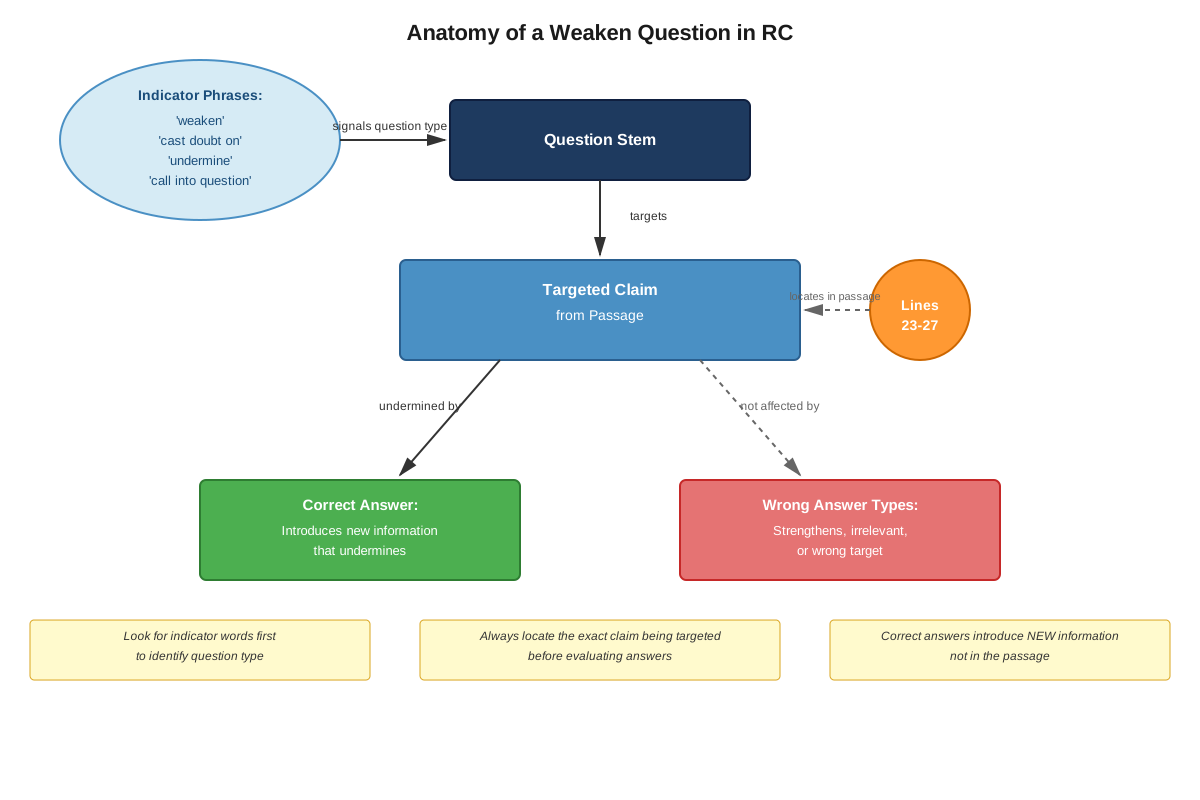
Weaken questions in RC ask students to identify information that would make an argument, claim, or position from the passage less convincing, less likely to be true, or less well-supported. The question stem typically includes language such as "would most weaken," "would cast doubt on," "would undermine," or "would call into question." Unlike strengthen questions, which ask for supporting information, weaken questions require identifying information that creates problems for the passage's reasoning.
The critical distinction between weaken questions in Reading Comprehension versus Logical Reasoning lies in the source material. In RC, students must first locate and understand the specific argument within a longer passage, then evaluate answer choices against that argument. This requires maintaining comprehension of the broader passage context while focusing analytical attention on a specific claim or reasoning chain.
Identifying the Target Argument
Before evaluating answer choices, students must precisely identify what argument or claim the question asks them to weaken. This target might be:
- The author's main argument or thesis
- A position the author describes but doesn't necessarily endorse
- A specific claim made within a larger argument
- An explanation or theory presented in the passage
- A prediction or recommendation based on passage reasoning
The question stem usually provides guidance about which argument to target. Phrases like "the author's argument that..." or "the position described in lines 15-20..." direct students to the relevant portion of the passage. Misidentifying the target argument is the most common error students make on weaken questions—they select answer choices that weaken something in the passage, but not the specific claim the question targets.
Mechanisms of Weakening
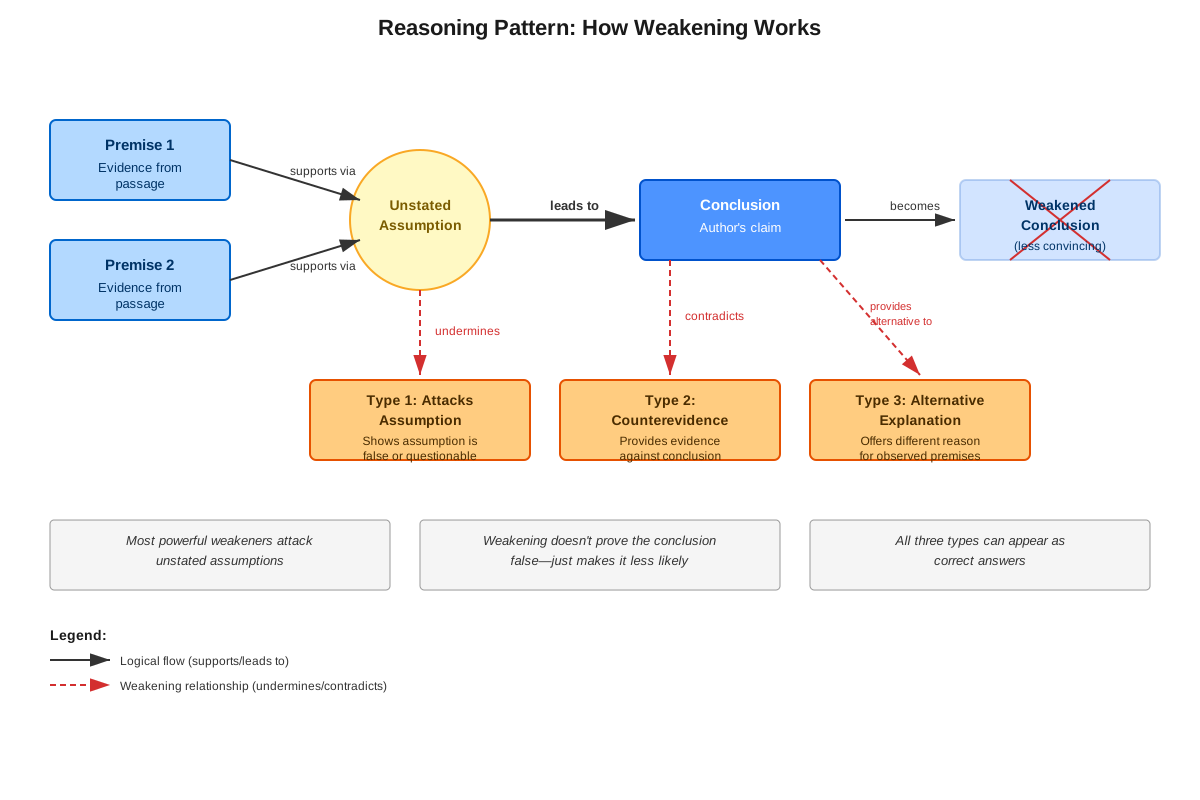
Understanding how answer choices weaken arguments enables students to evaluate options more effectively. Common weakening mechanisms include:
| Weakening Strategy | Description | Example Application |
|---|---|---|
| Attacking assumptions | Identifies unstated premises the argument relies upon and shows they're questionable | If an argument assumes correlation implies causation, showing alternative causes weakens it |
| Providing counterevidence | Introduces facts or data that contradict the argument's claims or predictions | If a passage claims a policy succeeded, evidence of failure weakens the claim |
| Identifying alternative explanations | Shows that phenomena could be explained differently than the passage suggests | If a passage attributes an effect to one cause, showing another plausible cause weakens it |
| Demonstrating logical flaws | Reveals that the conclusion doesn't follow from the premises | Showing that evidence is consistent with multiple conclusions weakens arguments |
| Questioning methodology | Challenges the reliability of evidence or reasoning processes | If a study's design was flawed, its conclusions are weakened |
The Reasoning Pattern
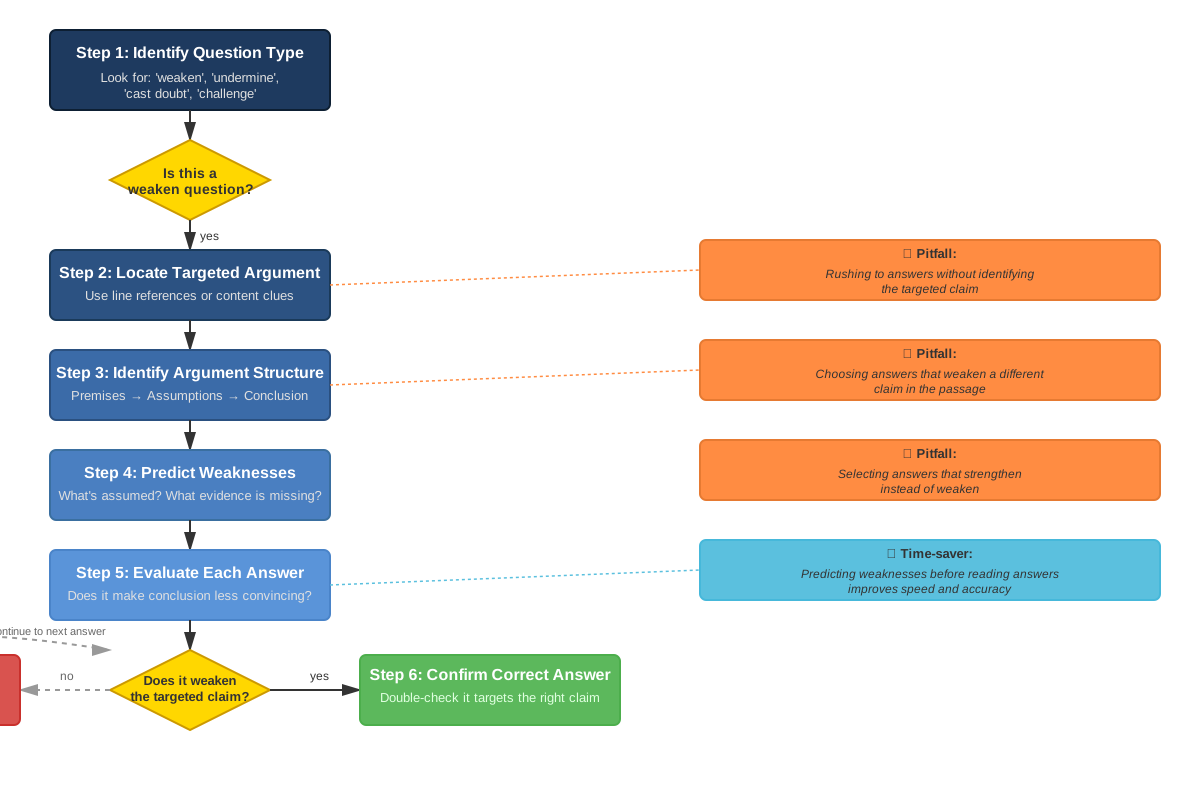
The standard reasoning pattern for approaching LSAT weaken questions in RC follows this sequence:
- Read and understand the question stem carefully: Identify exactly what claim or argument needs to be weakened and note any specific line references.
- Return to the passage and locate the target argument: Reread the relevant section to ensure accurate understanding of the claim, its evidence, and its reasoning structure.
- Identify the argument's assumptions and vulnerabilities: Before looking at answer choices, anticipate what could weaken this argument. What does it assume? What evidence would contradict it? What alternative explanations exist?
- Evaluate each answer choice against the target argument: Ask "If this were true, would it make the argument less convincing?" Eliminate choices that are irrelevant, strengthen the argument, or address the wrong claim.
- Select the answer that most directly and significantly weakens the target: Among potentially weakening answers, choose the one that creates the most serious problem for the argument.
Degrees of Weakening
Not all weakening is equal. The LSAT often includes multiple answer choices that weaken the argument to different degrees. Students must recognize that the correct answer is the one that most weakens the argument, not necessarily the one that completely destroys it. Understanding degrees of weakening involves:
- Direct versus indirect weakening: Direct weakeners attack the argument's core reasoning or main claim; indirect weakeners address peripheral issues
- Significant versus minor impact: Some weakeners create serious doubts; others raise only minor questions
- Relevant scope: Weakeners that address the precise scope of the argument (same time period, population, context) are stronger than those addressing tangential situations
Common Trap Answers
Weaken questions feature predictable wrong answer patterns:
- Irrelevant information: Facts that seem related but don't actually affect the argument's logical strength
- Strengtheners: Answer choices that actually support rather than weaken the argument (included to catch students who misread the question)
- Out-of-scope: Information about different contexts, populations, or time periods than the argument addresses
- Opposite effect: Claims that would weaken a different argument in the passage but not the target argument
- Too weak: Answer choices that create only minimal doubt compared to a stronger alternative
Concept Relationships
The concepts within weaken questions form an interconnected analytical framework. Identifying the target argument must occur before evaluating weakening mechanisms because students cannot assess whether an answer choice weakens an argument without first understanding that argument precisely. The reasoning pattern integrates all other concepts, providing a systematic approach that moves from question interpretation through passage analysis to answer evaluation.
Degrees of weakening and common trap answers represent two sides of the same analytical coin: recognizing degrees of weakening helps students select the strongest answer, while understanding trap answers helps eliminate incorrect options. Both concepts require students to make comparative judgments rather than absolute determinations.
The relationship to prerequisite knowledge is foundational. Argument structure identification enables students to locate and understand target arguments within passages. Basic logical reasoning principles provide the framework for recognizing how answer choices interact with arguments—whether they attack assumptions, provide counterevidence, or introduce alternative explanations. Reading comprehension fundamentals ensure students accurately understand both the passage and answer choices before attempting analytical evaluation.
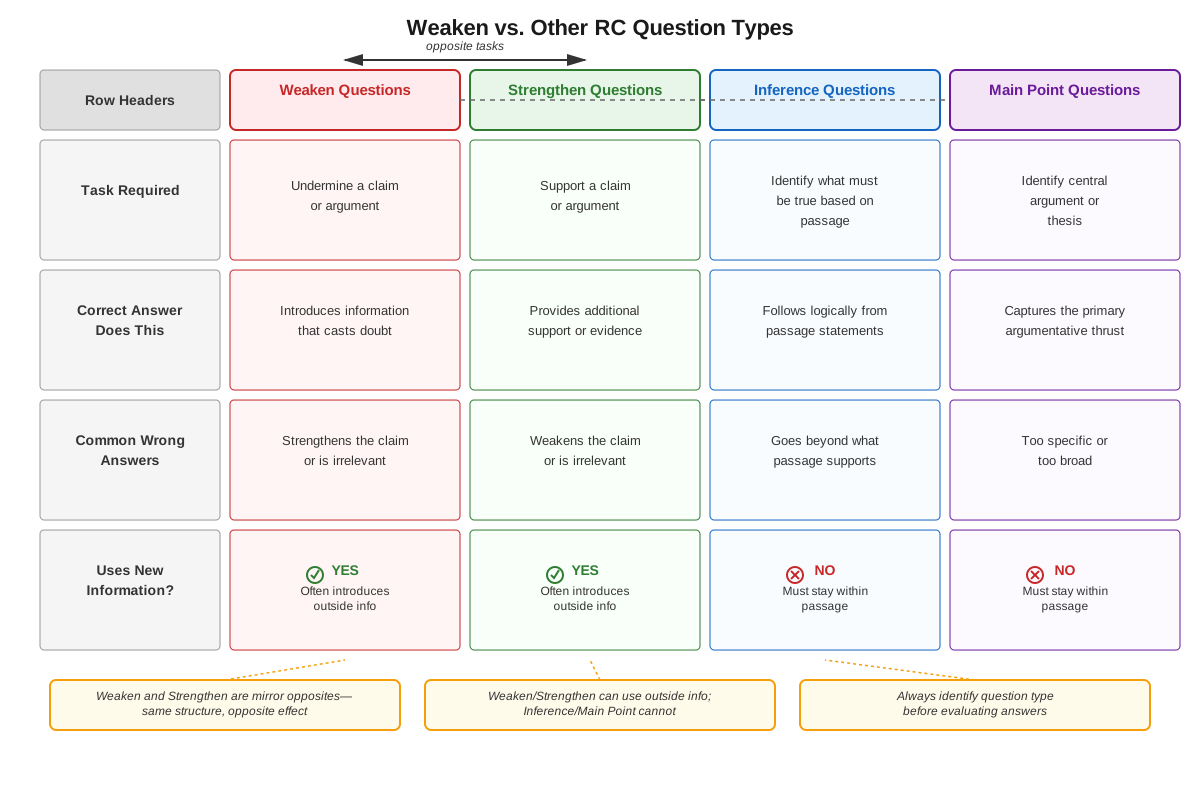
Weaken questions also connect forward to other question types. The skills developed here—identifying arguments, recognizing assumptions, evaluating evidence—transfer directly to strengthen questions (which use the same analytical framework in reverse), inference questions (which require understanding what follows from passage claims), and reasoning questions (which ask students to describe argumentative structure).
Conceptual flow: Question stem analysis → Target argument identification → Assumption and vulnerability recognition → Answer choice evaluation using weakening mechanisms → Comparative assessment of weakening degrees → Selection of strongest weakener
High-Yield Facts
⭐ Weaken questions in Reading Comprehension typically appear 1-2 times per RC section, representing 4-8% of questions.
⭐ The most common error on weaken questions is attacking the wrong argument—students must identify the precise target claim before evaluating answers.
⭐ Correct answers to weaken questions don't need to destroy the argument completely; they only need to make it less convincing than before.
⭐ Question stems containing "most weaken," "cast doubt on," "undermine," or "call into question" signal weaken questions.
⭐ The correct answer to a weaken question is always relevant to the target argument's reasoning or evidence, never tangential information.
- Weaken questions most commonly appear in passages presenting theories, explanations, policy recommendations, or causal arguments.
- Answer choices that introduce alternative explanations are among the most effective weakeners for causal arguments.
- Strengthener answer choices frequently appear as trap answers in weaken questions to catch students who misread the question stem.
- The scope of the correct answer must match the scope of the target argument (same population, time period, context).
- Attacking an argument's unstated assumptions is often more effective than contradicting its explicit premises.
- Weaken questions require students to assume answer choices are true and then evaluate their impact on the argument.
- The reasoning pattern for weaken questions in RC mirrors the pattern for weaken questions in Logical Reasoning, but requires additional passage navigation.
- Passages in law, social sciences, and natural sciences most frequently contain arguments vulnerable to weakening.
- Effective pre-phrasing of potential weakeners before reviewing answer choices significantly improves accuracy.
- Time spent accurately identifying the target argument is more valuable than time spent evaluating answer choices against the wrong target.
Quick check — test yourself on Weaken questions in RC so far.
Try Flashcards →Common Misconceptions
Misconception: Weaken questions ask students to find false information in the passage.
Correction: Weaken questions ask students to identify what would weaken an argument if true, not to find errors in the passage itself. Students must assume answer choices are true and evaluate their impact.
Misconception: The correct answer must completely disprove or destroy the argument.
Correction: Weaken questions ask for the answer that most weakens the argument, which may only cast doubt or make it less convincing rather than completely refuting it. Partial weakening is sufficient if it's stronger than alternatives.
Misconception: Any answer choice that relates to the passage topic is potentially correct.
Correction: Relevance to the passage topic is insufficient; the answer must specifically affect the logical strength of the target argument. Many trap answers discuss passage topics without impacting the argument's reasoning.
Misconception: Weaken questions in RC are fundamentally different from weaken questions in Logical Reasoning.
Correction: The analytical framework is identical; the difference lies only in the need to navigate a longer passage and identify the target argument within it. The same weakening mechanisms and reasoning patterns apply.
Misconception: If an answer choice weakens any argument in the passage, it's correct.
Correction: The answer must weaken the specific argument identified in the question stem. Passages often contain multiple arguments, and weakening the wrong one is a common trap.
Misconception: Emotional or extreme language in an answer choice makes it wrong.
Correction: While extreme language often signals wrong answers in other question types, weaken questions may have correct answers with strong language if that language accurately describes information that would significantly undermine the argument.
Misconception: The correct answer will always introduce completely new information not mentioned in the passage.
Correction: While correct answers often introduce new information, they may also reframe or recontextualize information from the passage in a way that weakens the argument. The key is impact on argument strength, not novelty.
Worked Examples
Example 1: Scientific Theory Passage
Passage excerpt: "Archaeologists have long debated the cause of the Ancestral Puebloan civilization's decline in the 13th century. Recent analysis of tree rings indicates a severe drought occurred during this period. Dr. Martinez argues that this drought was the primary cause of the civilization's collapse, as agricultural failure would have made the region uninhabitable. The tree ring evidence shows precipitation levels dropped to 40% of normal for a 23-year period, which Martinez contends would have devastated the corn-based agriculture that sustained Puebloan society."
Question: Which of the following, if true, would most weaken Dr. Martinez's argument?
Answer choices:
(A) Other civilizations in the region also experienced population decline during the same period
(B) Archaeological evidence shows the Puebloans had developed sophisticated water conservation techniques before the drought
(C) Tree ring analysis from nearby regions confirms the drought affected a wide geographic area
(D) Puebloan settlements in areas with access to permanent water sources were also abandoned during this period
(E) The drought period coincided with increased warfare among Puebloan communities
Step-by-step solution:
- Identify the target argument: Dr. Martinez argues that drought was the primary cause of the civilization's collapse because agricultural failure made the region uninhabitable.
- Identify assumptions and vulnerabilities: The argument assumes (a) the drought would have caused agricultural failure, (b) agricultural failure would have made the region uninhabitable, and (c) no other factors were more significant causes of the collapse.
- Evaluate each answer:
- (A) This actually strengthens the drought explanation by showing regional impact, not weakening it.
- (B) This suggests the Puebloans might have been able to cope with drought, weakening the claim that it made the region uninhabitable, but doesn't directly address whether they actually did cope.
- (C) This strengthens by confirming the drought's extent.
- (D) This significantly weakens the argument because if settlements with permanent water (which would have enabled continued agriculture) were also abandoned, then agricultural failure from drought cannot fully explain the collapse. This suggests other factors were at work.
- (E) This introduces an alternative explanation but doesn't directly weaken the drought argument unless we know the warfare was unrelated to drought.
- Select the strongest weakener: (D) most directly undermines Martinez's reasoning by showing that even where the supposed cause (agricultural failure) wouldn't have occurred, the effect (abandonment) still happened. This breaks the causal link central to the argument.
Connection to learning objectives: This example demonstrates identifying weaken questions (objective 1), applying the reasoning pattern of isolating the argument and evaluating answer choices (objectives 2 and 3), and distinguishing between relevant weakeners and irrelevant information (objective 4).
Example 2: Policy Argument Passage
Passage excerpt: "Legal scholars have proposed mandatory arbitration for medical malpractice claims as a solution to rising healthcare costs. Professor Chen argues that mandatory arbitration would reduce costs by eliminating lengthy jury trials and reducing the unpredictability of jury awards. She points to data showing that arbitration proceedings typically conclude in 8 months compared to 3 years for trials, and that arbitration awards average 30% lower than jury verdicts. Chen concludes that implementing mandatory arbitration would significantly decrease malpractice insurance premiums, thereby reducing overall healthcare costs."
Question: Which of the following, if true, would most seriously undermine Professor Chen's conclusion?
Answer choices:
(A) Some patients prefer the option of a jury trial to arbitration
(B) Arbitration proceedings require hiring specialized arbitrators whose fees are substantial
(C) Studies show that reduced malpractice insurance premiums are rarely passed on to patients as lower healthcare costs
(D) Jury verdicts in malpractice cases have decreased over the past decade
(E) Arbitration awards may be appealed in certain circumstances
Step-by-step solution:
- Identify the target: Chen's conclusion that mandatory arbitration would significantly decrease healthcare costs (through the mechanism of reduced insurance premiums).
- Map the reasoning chain: Arbitration → faster resolution + lower awards → reduced insurance premiums → reduced healthcare costs. The argument assumes each link in this chain holds.
- Evaluate answers:
- (A) Patient preferences don't affect whether the policy would reduce costs; this is irrelevant to the conclusion.
- (B) This weakens the claim that arbitration reduces costs, but only partially—it might still be cheaper than trials despite arbitrator fees.
- (C) This directly attacks the final link in the reasoning chain: even if insurance premiums decrease, if those savings aren't passed to patients, healthcare costs won't decrease. This breaks the connection between Chen's evidence and her conclusion.
- (D) This might slightly weaken the urgency of the proposal but doesn't address whether arbitration would reduce costs.
- (E) This weakens the speed advantage slightly but doesn't fundamentally undermine the cost reduction conclusion.
- Select the strongest: (C) most seriously undermines the conclusion because it shows that even if everything else in Chen's argument is true, the predicted outcome (reduced healthcare costs) wouldn't occur. This is a devastating weakener because it accepts all the argument's evidence but shows the conclusion still doesn't follow.
Connection to learning objectives: This example shows how to identify the specific conclusion being targeted (objective 1), recognize the reasoning chain and its vulnerable links (objective 2), and evaluate degrees of weakening among multiple potentially correct answers (objective 6).
Exam Strategy
Approaching Weaken Questions Systematically
When encountering a weaken question in Reading Comprehension, follow this strategic approach:
First, read the question stem with extreme care. Identify the exact claim or argument you need to weaken. Note any line references or specific language that directs you to a particular portion of the passage. Distinguish between questions asking you to weaken "the author's argument" versus "the position described in paragraph 2" versus "the explanation for X mentioned in lines 25-30."
Second, return to the passage before looking at answer choices. Reread the relevant section with fresh attention, now focused specifically on the target argument. Identify its conclusion, evidence, and reasoning structure. This investment of 15-20 seconds prevents the costly error of evaluating answer choices against the wrong argument.
Third, anticipate weakeners before reviewing answer choices. Ask yourself: "What would make this argument less convincing? What does it assume? What evidence would contradict it?" This pre-phrasing creates a mental filter that helps you recognize the correct answer more quickly and confidently.
Trigger Words and Phrases
Recognize these question stem indicators of weaken questions:
- "would most weaken"
- "would cast doubt on"
- "would undermine"
- "would call into question"
- "would provide evidence against"
- "would challenge"
- "would make less likely"
- "would be problematic for"
Exam Tip: If you see "EXCEPT" combined with weaken language ("All of the following would weaken EXCEPT"), you're looking for the answer that does NOT weaken—it might strengthen, be irrelevant, or simply not affect the argument.
Process of Elimination Strategy
Apply these elimination criteria systematically:
- Eliminate strengtheners first: These are included as traps. If an answer choice makes the argument more convincing, eliminate it immediately.
- Eliminate irrelevant answers: Information that doesn't affect the argument's logical strength, even if related to the passage topic, must go.
- Eliminate out-of-scope answers: If the argument is about population X in time period Y, answers about population Z or time period W are typically wrong unless they're clearly analogous.
- Compare remaining answers for degree of weakening: Among answers that weaken the argument, select the one that creates the most serious problem for the reasoning or conclusion.
Time Allocation
Weaken questions typically require 60-90 seconds to answer accurately:
- 15-20 seconds: Reading question stem and locating target argument in passage
- 10-15 seconds: Understanding the argument and anticipating weakeners
- 30-45 seconds: Evaluating answer choices and eliminating wrong answers
- 5-10 seconds: Confirming the selected answer weakens the target argument
If you find yourself spending more than 90 seconds, you may be overthinking. Return to the basics: Does this answer choice make the argument less convincing? If yes, how much? Select the strongest weakener and move forward.
Strategic Note: Weaken questions are often placed after several easier questions on the same passage. If you're running short on time, these medium-difficulty questions represent good value—they're worth the same point as easier questions but test skills that separate mid-range from high scorers.
Memory Techniques
The WEAKEN Acronym
Remember the systematic approach with WEAKEN:
- What exactly am I weakening? (Identify target argument)
- Evidence and reasoning? (Understand the argument structure)
- Assumptions vulnerable? (Identify what the argument assumes)
- Kill wrong answers (Eliminate strengtheners and irrelevant choices)
- Evaluate remaining options (Compare degrees of weakening)
- Nail the strongest weakener (Select the answer that most undermines the argument)
The Three A's of Weakening
Remember the three most common weakening mechanisms with the Three A's:
- Attack Assumptions: Show that what the argument takes for granted is questionable
- Alternative Explanations: Provide different ways to explain the same phenomena
- Against the Evidence: Introduce facts that contradict the argument's claims
Visualization Strategy
Picture the argument as a bridge connecting evidence (one side) to conclusion (other side). Weaken questions ask you to find the answer choice that:
- Removes a support beam (attacks assumptions)
- Shows the bridge doesn't reach the other side (breaks the logical connection)
- Reveals another bridge to a different destination (provides alternative explanations)
- Demonstrates the bridge is built on unstable ground (questions the evidence)
This visualization helps students remember that weakening isn't about destroying the entire structure—it's about making the connection less stable or reliable.
The Scope Match Reminder
Use the phrase "Same game, same rules" to remember that the correct answer must match the scope of the argument. If the argument is about professional athletes, answers about amateur athletes are playing a different game. If the argument is about 18th-century France, answers about 19th-century Germany are playing by different rules.
Summary
Weaken questions in Reading Comprehension test the critical analytical skill of identifying vulnerabilities in arguments embedded within longer passages. These questions require students to first locate and understand a specific argument within the passage, then evaluate which answer choice would most undermine that argument's reasoning or conclusion. The fundamental approach involves identifying the target argument precisely, recognizing its assumptions and reasoning structure, anticipating potential weakeners, and systematically evaluating answer choices to find the one that most significantly reduces the argument's persuasiveness. Common weakening mechanisms include attacking unstated assumptions, providing counterevidence, introducing alternative explanations, and questioning methodology. Success on these questions depends on avoiding the trap of weakening the wrong argument, distinguishing between answers that are merely relevant versus those that actually impact logical strength, and recognizing that correct answers need only make the argument less convincing rather than completely refuting it. The skills developed through mastering weaken questions—precise argument identification, assumption recognition, and logical evaluation—transfer directly to legal reasoning and other LSAT question types.
Key Takeaways
- Weaken questions require identifying the precise target argument before evaluating answer choices—the most common error is attacking the wrong claim within the passage.
- Correct answers make arguments less convincing but don't need to destroy them completely—look for the answer that most weakens, not the one that definitively disproves.
- The reasoning pattern mirrors Logical Reasoning weaken questions—identify the argument, recognize assumptions, anticipate weakeners, evaluate choices systematically.
- Three primary weakening mechanisms dominate: attacking assumptions, providing counterevidence, and introducing alternative explanations.
- Scope matching is essential—the correct answer must address the same population, time period, and context as the target argument.
- Pre-phrasing potential weakeners before reviewing answer choices significantly improves accuracy and speed.
- Trap answers include strengtheners, irrelevant information, and answers that weaken different arguments in the passage—systematic elimination is crucial.
Related Topics
Strengthen Questions in RC: The mirror image of weaken questions, requiring identification of information that would make passage arguments more convincing. Mastering weaken questions provides the analytical framework for strengthen questions, as both use the same argument evaluation skills in opposite directions.
Assumption Questions: These questions ask students to identify unstated premises that arguments depend upon. Understanding assumptions is crucial for weaken questions because attacking assumptions is a primary weakening mechanism.
Inference Questions: While inference questions ask what follows from passage information, they share with weaken questions the requirement to understand argument structure and logical relationships. The analytical skills transfer bidirectionally.
Argument Structure Questions: These questions ask students to describe how arguments are constructed or how evidence functions. Mastering argument structure provides the foundation for recognizing what would weaken those structures.
Comparative Reading Passages: Weaken questions in comparative passages may ask students to identify how one passage weakens claims in another, requiring application of weakening skills across multiple texts.
Practice CTA
Now that you understand the mechanics and strategy of weaken questions in Reading Comprehension, it's time to apply these concepts to actual LSAT-style problems. The practice questions and flashcards will reinforce your ability to identify target arguments, recognize weakening mechanisms, and systematically eliminate wrong answers. Remember that mastery comes through deliberate practice—each question you work through strengthens your analytical instincts and builds the pattern recognition that separates good performance from great performance. Approach each practice question methodically, using the WEAKEN acronym and the systematic reasoning pattern outlined in this guide. Your investment in mastering this high-yield question type will pay dividends not only on test day but throughout your legal education and career.
Sign up free to keep reading
Create a free AnvayaPrep account to finish this LSAT guide on Weaken questions in RC — plus flashcards and practice questions.