Overview
Author endorsement is a critical concept in LSAT reading comprehension that tests the ability to distinguish between ideas the author merely presents and those the author actively supports or agrees with. In LSAT passages, authors frequently discuss multiple viewpoints, theories, or arguments without necessarily endorsing all of them. The ability to identify which positions the author actually endorses—versus those they simply describe, critique, or remain neutral about—is essential for answering questions about the author's attitude, purpose, and main point.
This topic sits at the heart of viewpoints and argumentation analysis because LSAT passages are constructed to challenge readers' ability to track multiple perspectives simultaneously. A passage might present a traditional theory, introduce critics of that theory, and then offer the author's own position—which may align with one side, synthesize both, or propose something entirely different. Questions testing lsat author endorsement appear frequently across all Reading Comprehension question types, including main point questions, author's attitude questions, inference questions, and purpose questions. Misidentifying what the author endorses versus what they merely report is one of the most common reasons test-takers select incorrect answer choices.
Understanding author endorsement connects directly to broader Reading Comprehension skills such as identifying passage structure, recognizing rhetorical strategies, tracking shifts in perspective, and evaluating the strength of claims. It requires careful attention to language cues, logical relationships between ideas, and the overall argumentative arc of the passage. Mastering this concept enables students to navigate complex passages with confidence and accuracy, particularly those involving scientific debates, legal controversies, or theoretical disagreements where multiple positions receive substantial discussion.
Learning Objectives
- [ ] Identify how Author endorsement appears in LSAT questions
- [ ] Explain the reasoning pattern behind Author endorsement
- [ ] Apply Author endorsement to solve LSAT-style problems accurately
- [ ] Distinguish between neutral presentation and active endorsement in passage text
- [ ] Recognize linguistic markers that signal author agreement or disagreement
- [ ] Evaluate answer choices by determining whether they accurately reflect the author's endorsed position versus merely described positions
Prerequisites
- Basic passage structure recognition: Understanding how LSAT passages are organized (introduction, body paragraphs, conclusion) helps locate where authors typically reveal their positions.
- Vocabulary for describing attitudes: Familiarity with terms like "skeptical," "supportive," "ambivalent," and "critical" enables accurate interpretation of author stance.
- Understanding of argumentative vs. expository writing: Recognizing when an author is arguing for a position versus simply explaining multiple viewpoints is foundational to identifying endorsement.
- Ability to identify claims and evidence: Distinguishing between assertions and their supporting reasons helps determine which ideas the author treats as valid.
Why This Topic Matters
In legal reasoning and critical reading—the core skills the LSAT assesses—distinguishing between what someone reports and what they advocate is fundamental. Lawyers must constantly evaluate which arguments judges endorse versus merely acknowledge, which precedents courts affirm versus distinguish, and which policy positions legal scholars support versus critique. The LSAT tests this skill because it directly predicts success in law school case analysis and legal writing.
Exam statistics reveal that author endorsement appears in approximately 40-50% of Reading Comprehension questions, either as the primary focus or as a necessary component of the correct answer. Questions explicitly asking about the author's attitude, purpose, or main point always require identifying what the author endorses. Additionally, inference questions frequently hinge on distinguishing endorsed claims (which can support valid inferences) from non-endorsed claims (which cannot).
This topic commonly appears in passages featuring:
- Scientific debates where the author presents competing theories before endorsing one or proposing a synthesis
- Historical analyses where the author describes traditional interpretations before offering their own revisionist view
- Legal or philosophical arguments where the author examines multiple positions on a controversial issue
- Critical reviews where the author discusses others' work while revealing their own evaluative stance
- Comparative passages where two authors take different positions on the same topic
Core Concepts
Defining Author Endorsement
Author endorsement refers to the author's active support, agreement with, or advocacy for a particular claim, theory, interpretation, or position presented in the passage. Endorsement goes beyond mere presentation or description—it indicates that the author believes the endorsed idea is correct, valuable, or worthy of acceptance. On the LSAT, identifying what the author endorses requires distinguishing between:
- Endorsed positions: Ideas the author agrees with, supports, or presents as correct
- Neutral presentations: Ideas the author describes without indicating agreement or disagreement
- Criticized positions: Ideas the author explicitly or implicitly disagrees with or finds problematic
- Attributed positions: Ideas belonging to other people or groups that the author reports without endorsing
Linguistic Markers of Endorsement
The LSAT uses specific language patterns to signal author endorsement. Recognizing these markers is essential for accurate identification:
Strong endorsement markers include:
- Evaluative language: "correctly," "rightly," "accurately," "appropriately," "wisely"
- Affirmative statements: "indeed," "in fact," "clearly," "certainly," "undoubtedly"
- Positive characterizations: "compelling," "convincing," "persuasive," "sound," "valid"
- Direct assertions without hedging: "This approach succeeds in..." or "The evidence demonstrates..."
Weak or qualified endorsement markers include:
- Tentative language: "suggests," "may," "appears to," "seems to," "likely"
- Conditional support: "If X is true, then Y follows"
- Partial agreement: "While not without problems, this theory..."
Non-endorsement markers include:
- Attribution phrases: "According to Smith," "Jones argues that," "The traditional view holds"
- Neutral reporting verbs: "describes," "presents," "discusses," "examines," "considers"
- Distancing language: "purportedly," "allegedly," "supposedly," "claims to"
Criticism markers (indicating the author does NOT endorse) include:
- Negative evaluations: "fails to," "overlooks," "ignores," "mistakenly assumes"
- Contrasting transitions: "however," "but," "yet," "nevertheless," "despite"
- Questioning language: "questionable," "dubious," "problematic," "unconvincing"
Structural Patterns of Endorsement
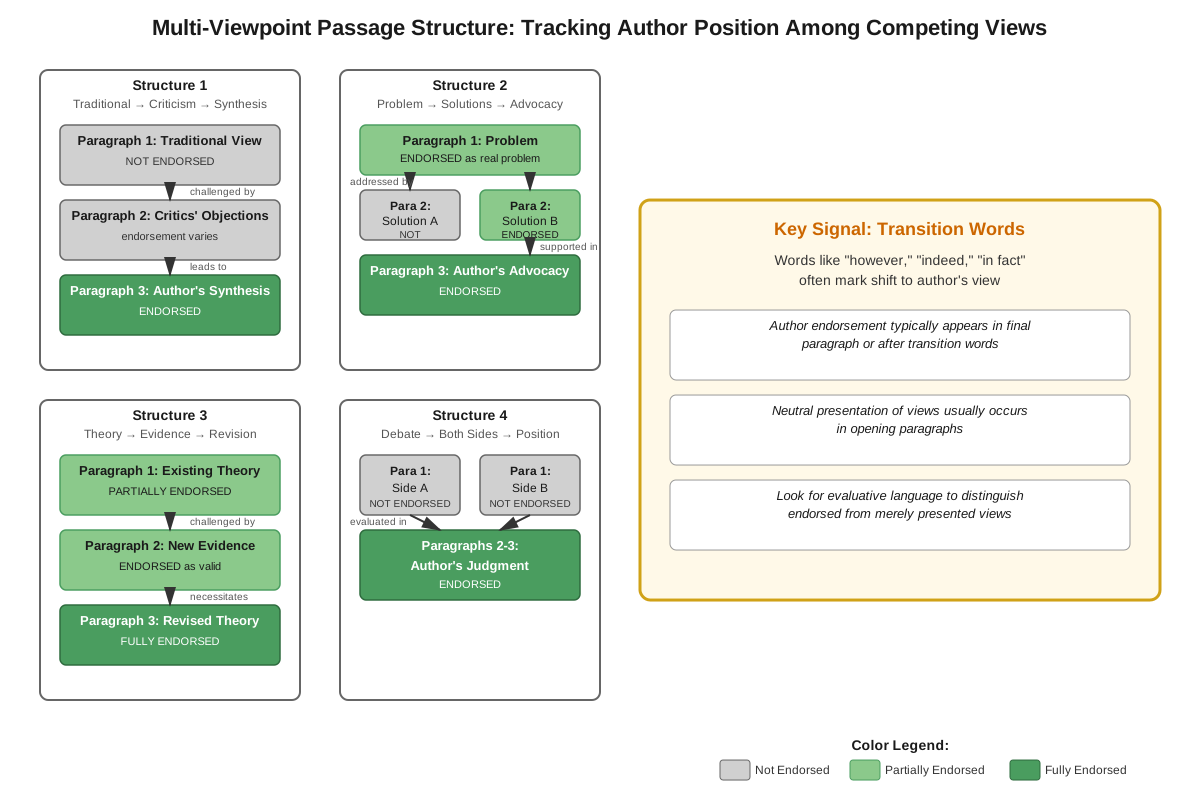
LSAT passages follow predictable structural patterns that reveal author endorsement:
| Passage Structure | Endorsement Pattern | Example Signal |
|---|---|---|
| Problem-Solution | Author endorses the solution presented | "This approach successfully addresses..." |
| Theory-Critique-Alternative | Author endorses the alternative | "A more accurate interpretation..." |
| Multiple Viewpoints-Synthesis | Author endorses the synthesis | "Combining these insights reveals..." |
| Traditional View-Revision | Author endorses the revision | "Recent evidence contradicts..." |
| Phenomenon-Explanation | Author endorses the explanation | "The best account of this phenomenon..." |
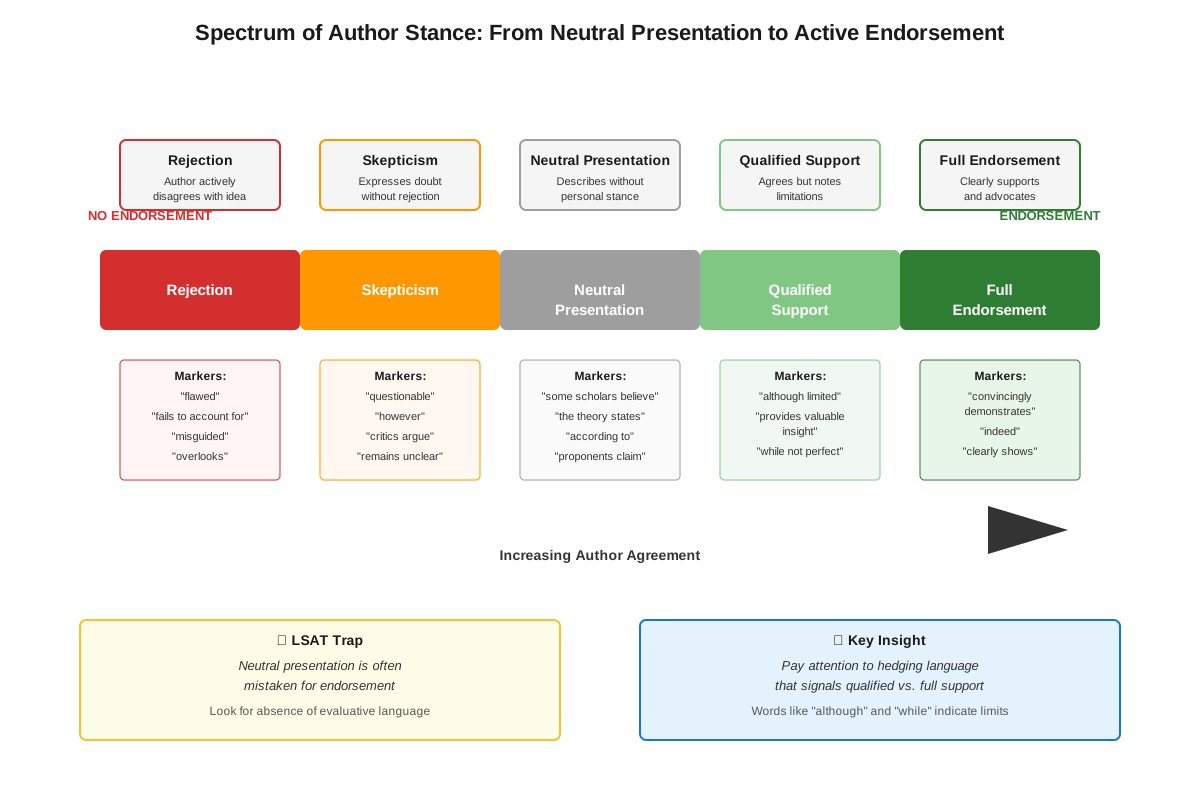
Degrees of Endorsement
Author endorsement exists on a spectrum rather than as a binary:
Full endorsement: The author completely agrees with and advocates for a position without reservation. Example: "This theory correctly identifies the primary cause."
Qualified endorsement: The author supports a position while acknowledging limitations or conditions. Example: "Although incomplete, this framework provides valuable insights."
Partial endorsement: The author agrees with some aspects while disagreeing with others. Example: "While the methodology is sound, the conclusions overreach."
Neutral stance: The author presents information without indicating personal agreement or disagreement. Example: "Researchers have proposed three explanations."
Implicit rejection: The author suggests disagreement through tone or contrast without explicit criticism. Example: "The conventional wisdom, however, fails to account for recent discoveries."
Explicit rejection: The author directly criticizes or refutes a position. Example: "This interpretation fundamentally misunderstands the evidence."
Context-Dependent Endorsement
The same idea may receive different levels of endorsement depending on context within the passage:
- An author might endorse a theory's methodology while rejecting its conclusions
- An author might endorse a critique of one position without endorsing the alternative the critic proposes
- An author might endorse a claim as historically accurate without endorsing it as currently valid
Distinguishing Endorsement from Emphasis
Test-takers often confuse the amount of space devoted to an idea with author endorsement. However:
- Authors may extensively discuss positions they ultimately reject (to explain why they're problematic)
- Authors may briefly mention positions they endorse (assuming readers will accept them)
- The conclusion or final paragraphs often reveal endorsement more reliably than earlier sections
- Contrasting transitions ("however," "but," "yet") frequently signal shifts from non-endorsed to endorsed positions
Concept Relationships
Author endorsement connects to multiple Reading Comprehension concepts in an integrated network:
Author endorsement → determines → Main Point: The main point of a passage is always something the author endorses, not merely describes. Identifying what the author endorses helps distinguish the main point from supporting details or alternative viewpoints discussed.
Passage Structure → reveals → Author Endorsement: The organizational pattern of a passage (problem-solution, comparison-contrast, theory-critique) provides a framework for predicting where and how the author will reveal their endorsed position.
Tone and Attitude → signals → Author Endorsement: The author's tone (critical, supportive, neutral, ambivalent) directly indicates their endorsement level. Recognizing tonal shifts helps track when the author moves from describing others' views to presenting their own.
Attribution and Source Tracking → distinguishes from → Author Endorsement: Carefully tracking which claims are attributed to other sources versus presented in the author's own voice is essential for identifying endorsement. Attributed claims are not automatically endorsed.
Evidence and Support → strengthens → Author Endorsement: Authors typically provide more detailed evidence, examples, and reasoning for positions they endorse. The quality and quantity of support can signal endorsement level.
Rhetorical Purpose → motivates → Author Endorsement: Understanding why the author wrote the passage (to argue, explain, critique, synthesize) helps predict what they will endorse. Argumentative passages have clearer endorsement patterns than purely expository ones.
High-Yield Facts
⭐ The author's endorsed position most commonly appears in the final paragraph or after a contrasting transition word like "however" or "but."
⭐ Attribution phrases ("According to X," "Y argues that") indicate the author is presenting someone else's view, not necessarily endorsing it.
⭐ Evaluative language (correctly, mistakenly, successfully, fails to) is the strongest indicator of author endorsement or rejection.
⭐ The main point of any passage is always something the author endorses, never merely a position they describe neutrally.
⭐ Authors can endorse critiques of a position without endorsing any alternative position.
- Questions asking about the author's "primary purpose" or "main point" always require identifying what the author endorses.
- An author may spend more space discussing a position they reject than one they endorse, especially when explaining why the rejected position is problematic.
- Tentative language (may, might, suggests, appears to) indicates weaker endorsement than definitive language (demonstrates, proves, clearly shows).
- In comparative passages, each author endorses their own position, and questions may ask about points of agreement or disagreement.
- Authors frequently present traditional or conventional views in early paragraphs before introducing their own endorsed position as a correction or refinement.
- The absence of criticism or qualification when presenting an idea often signals implicit endorsement.
- Questions about what the author "would most likely agree with" require identifying positions consistent with what the author endorses in the passage.
Quick check — test yourself on Author endorsement so far.
Try Flashcards →Common Misconceptions
Misconception: If the author discusses an idea extensively, they must endorse it.
Correction: Authors often devote significant space to explaining positions they ultimately reject, especially when those positions are complex or widely held. Length of discussion does not equal endorsement; look for evaluative language and structural cues instead.
Misconception: The author endorses everything they don't explicitly criticize.
Correction: Neutral presentation without criticism does not constitute endorsement. Authors frequently present multiple viewpoints objectively before revealing their endorsed position later in the passage. Absence of criticism indicates neutrality, not agreement.
Misconception: If the author presents evidence for a claim, they endorse that claim.
Correction: Authors often present evidence that others use to support claims the author ultimately rejects. The key is whether the author treats the evidence as genuinely supporting the claim or as inadequate, misinterpreted, or outweighed by contrary evidence.
Misconception: The author's endorsed position is always stated explicitly.
Correction: While LSAT passages typically make the author's position identifiable, endorsement is sometimes conveyed through tone, emphasis, structural placement, or contrast with rejected alternatives rather than explicit statements like "I believe" or "The correct view is."
Misconception: Authors endorse all aspects of any position they support.
Correction: Authors frequently offer qualified or partial endorsement, agreeing with some elements of a theory while rejecting others. Phrases like "although," "while," and "despite" signal these nuanced positions.
Misconception: In passages presenting multiple viewpoints, the author doesn't endorse any particular position.
Correction: Even in passages that present multiple perspectives, the author typically endorses one position, synthesizes elements from multiple positions, or endorses a critique of all presented positions. Truly neutral passages are rare on the LSAT.
Misconception: The first position presented in a passage is the one the author endorses.
Correction: LSAT passages frequently follow a pattern of presenting conventional wisdom or traditional views first, then introducing the author's endorsed position as a correction, refinement, or alternative. The endorsed position often appears after contrasting transitions.
Worked Examples
Example 1: Scientific Theory Passage
Passage Excerpt:
"For decades, researchers attributed the decline of coral reefs primarily to rising ocean temperatures caused by climate change. This explanation, while identifying a genuine contributing factor, overlooks the significant role of agricultural runoff. Recent studies demonstrate that nutrient pollution from fertilizers creates algal blooms that suffocate coral systems. Indeed, in regions where agricultural practices have been modified to reduce runoff, coral recovery has occurred even as ocean temperatures continued to rise."
Question: The author's attitude toward the traditional explanation for coral reef decline is best described as:
Analysis:
- Identify what's attributed vs. endorsed: "Researchers attributed" signals this is others' view, not necessarily the author's.
- Look for evaluative language: "while identifying a genuine contributing factor" shows partial endorsement—the author agrees temperature matters.
- Identify criticism markers: "overlooks" is a criticism marker indicating the traditional view is incomplete.
- Identify endorsement markers: "Recent studies demonstrate" and "Indeed" are strong endorsement markers for the agricultural runoff explanation.
- Determine the author's position: The author endorses a more complex explanation that includes both temperature and agricultural runoff, but emphasizes that the traditional view underestimated the importance of runoff.
Answer: The author views the traditional explanation as partially correct but incomplete. The author endorses the agricultural runoff factor as significantly important and perhaps more important than previously recognized.
Connection to Learning Objectives: This example demonstrates how to identify endorsement through structural patterns (traditional view followed by "however" type correction), recognize evaluative language ("overlooks," "demonstrate," "indeed"), and distinguish between partial endorsement and full endorsement.
Example 2: Legal Theory Passage
Passage Excerpt:
"Legal scholars have long debated whether judicial interpretation should focus on the original intent of lawmakers or evolve with contemporary values. Originalists argue that constitutional stability requires adherence to historical meaning. Critics contend that this approach produces unjust outcomes in modern contexts. A more nuanced position recognizes that while some constitutional provisions embody specific historical compromises that should be respected, others articulate broad principles that necessarily require interpretation in light of changing circumstances. This approach avoids both the rigidity of strict originalism and the instability of unconstrained interpretation."
Question: Which of the following best describes the author's position on judicial interpretation?
Analysis:
- Identify the structure: The passage presents two opposing views (originalism vs. evolving interpretation) then introduces a third position.
- Track attribution: "Originalists argue" and "Critics contend" clearly attribute these positions to others, not the author.
- Identify the author's voice: "A more nuanced position recognizes" introduces a new position without attribution—this signals the author's own view.
- Look for endorsement markers: "This approach avoids both..." provides positive evaluation of the nuanced position, indicating endorsement.
- Note what's NOT endorsed: The author doesn't endorse either pure originalism or completely unconstrained interpretation; both are implicitly criticized as too extreme.
Answer: The author endorses a middle-ground position that applies different interpretive approaches depending on the nature of the constitutional provision being interpreted. The author rejects both strict originalism and completely flexible interpretation as inadequate.
Connection to Learning Objectives: This example shows how to apply author endorsement analysis to passages with multiple viewpoints, recognize when the author introduces their own position (lack of attribution + evaluative language), and understand that authors can endorse positions that synthesize or transcend the alternatives initially presented.
Exam Strategy
Approaching Author Endorsement Questions
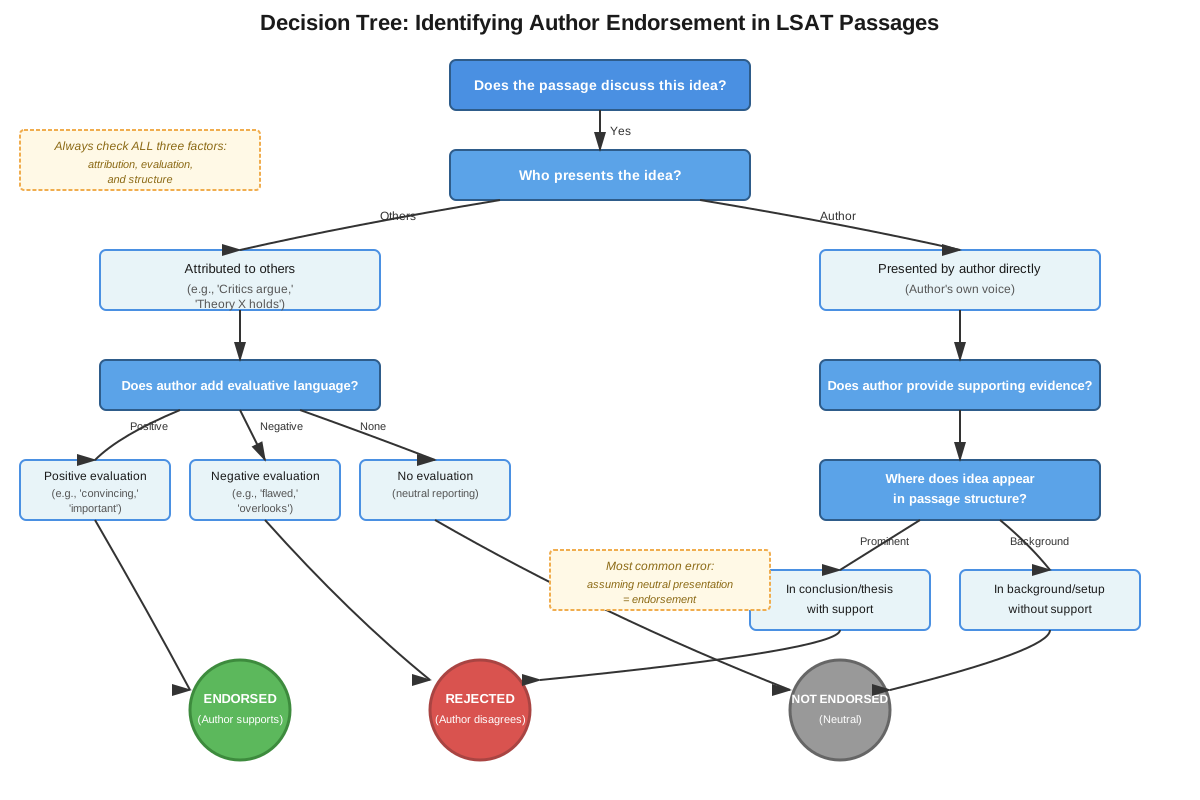
Step 1: Pre-read for structure
Before diving into details, quickly identify the passage structure. Is it presenting a problem and solution? Comparing multiple theories? Critiquing a traditional view? This framework helps predict where the author's endorsed position will appear.
Step 2: Track attribution carefully
As you read, mentally note which claims are attributed to sources ("Smith argues," "According to the study") versus presented in the author's own voice. Attributed claims require additional evidence of endorsement.
Step 3: Mark evaluative language
Circle or mentally note words that signal evaluation: "correctly," "mistakenly," "successfully," "fails to," "compelling," "unconvincing." These are your strongest clues to endorsement.
Step 4: Pay special attention after contrasting transitions
When you encounter "however," "but," "yet," "nevertheless," or "in contrast," the author is likely shifting from a non-endorsed to an endorsed position (or vice versa).
Step 5: Identify the conclusion
The final paragraph or concluding sentences most reliably reveal what the author endorses. If you're uncertain about the author's position, focus your attention here.
Trigger Words and Phrases
Watch for these endorsement triggers:
- "In fact," "Indeed," "Clearly," "Certainly" → strong endorsement
- "Correctly," "Rightly," "Accurately" → endorsement of correctness
- "Compelling," "Convincing," "Persuasive" → positive evaluation
- "The best explanation," "The most accurate account" → comparative endorsement
Watch for these non-endorsement triggers:
- "According to," "X argues that," "The traditional view" → attribution
- "Purportedly," "Allegedly," "Claims to" → skeptical distance
- "Some researchers believe," "It has been suggested" → neutral reporting
Watch for these rejection triggers:
- "However," "But," "Yet" → contrast with previous (often non-endorsed) claim
- "Fails to," "Overlooks," "Ignores" → criticism
- "Mistakenly," "Incorrectly," "Erroneously" → explicit rejection
Process of Elimination Tips
When evaluating answer choices:
- Eliminate choices that describe non-endorsed positions: If an answer choice describes a view the author merely presents or attributes to others without endorsing, eliminate it.
- Eliminate choices that overstate endorsement: If the author offers qualified support but an answer choice suggests full endorsement, eliminate it.
- Eliminate choices that understate endorsement: If the author clearly endorses a position but an answer choice suggests they're merely neutral, eliminate it.
- Check for scope accuracy: The author might endorse a narrow claim but not the broader generalization in an answer choice.
- Verify with passage evidence: For remaining choices, locate specific passage language that supports the endorsement level described.
Time Allocation Advice
- Spend 3-4 minutes on initial passage reading, actively tracking endorsement markers
- For author attitude/purpose questions, allocate 45-60 seconds
- If uncertain about endorsement, invest 15-20 seconds re-reading the conclusion
- Don't spend more than 90 seconds on any single question; if you're stuck between two choices, make your best judgment and move on
Exam Tip: Questions asking about the author's "primary purpose" or "main point" ALWAYS require identifying what the author endorses. If you're choosing between an answer that describes what the author discusses versus what the author advocates, choose the advocacy answer.
Memory Techniques
The TRACE Acronym for Identifying Endorsement
Tone: What's the author's tone toward this idea? (positive, negative, neutral)
Reporting vs. Arguing: Is the author reporting others' views or arguing their own?
Attribution: Is the claim attributed to a source or presented in the author's voice?
Contrast: Does the author contrast this idea with others, and which side of the contrast do they favor?
Evaluation: What evaluative language does the author use about this idea?
The "However Test"
When uncertain about what the author endorses, find the word "however" (or similar contrasting transition) in the passage. What comes AFTER "however" is more likely to be endorsed than what comes before it. LSAT passages frequently follow this pattern: [traditional/others' view] + HOWEVER + [author's endorsed view].
Visualization Strategy: The Attribution Map
As you read, mentally create a simple map:
- Left column: Ideas attributed to others or presented neutrally
- Right column: Ideas presented in the author's voice with evaluative language
- Center: Ideas receiving qualified or partial endorsement
This mental organization helps you quickly identify what the author endorses when answering questions.
The "Would the Author Say This?" Test
For inference and application questions, imagine the author as a person you're having a conversation with. Based on what they endorsed in the passage, would they agree with the statement in the answer choice? This personalization helps activate your intuition about endorsement.
Summary
Author endorsement is the cornerstone of LSAT reading comprehension, requiring test-takers to distinguish between ideas authors merely present and those they actively support. Mastering this concept involves recognizing linguistic markers (evaluative language, attribution phrases, contrasting transitions), understanding structural patterns (where endorsed positions typically appear in passages), and appreciating degrees of endorsement (full, qualified, partial, or absent). The LSAT tests this skill across multiple question types because it mirrors the critical reading abilities essential for legal analysis: distinguishing between what a court holds versus dicta, what a scholar advocates versus describes, what evidence supports versus contradicts. Success requires careful attention to the author's voice versus attributed sources, sensitivity to tone and evaluation, and awareness that endorsed positions often appear after contrasting transitions or in concluding paragraphs. Students who master author endorsement gain a decisive advantage in identifying main points, evaluating answer choices, and making valid inferences—skills that translate directly to higher Reading Comprehension scores.
Key Takeaways
- Author endorsement refers to positions the author actively supports, not merely describes; identifying it is essential for main point, attitude, and inference questions
- Attribution phrases ("According to X," "Y argues") signal others' views that require additional evidence before assuming author endorsement
- Evaluative language (correctly, mistakenly, compelling, fails to) provides the strongest evidence of endorsement or rejection
- The author's endorsed position most commonly appears after contrasting transitions (however, but, yet) or in concluding paragraphs
- Authors can endorse critiques without endorsing alternatives, offer partial or qualified endorsement, and discuss extensively what they ultimately reject
- Questions about the author's purpose or main point always require identifying what the author endorses, not what they merely discuss
- Tracking the distinction between neutral presentation and active endorsement is the single most important skill for avoiding wrong answer choices in Reading Comprehension
Related Topics
Author's Tone and Attitude: Building on author endorsement, this topic explores the full spectrum of authorial attitudes (skeptical, enthusiastic, ambivalent, critical) and how tone reveals endorsement levels. Mastering endorsement provides the foundation for nuanced tone analysis.
Passage Structure and Organization: Understanding how LSAT passages are structured (problem-solution, theory-critique-alternative, comparison-contrast) helps predict where authors will reveal their endorsed positions and how they'll signal transitions between others' views and their own.
Main Point and Primary Purpose Questions: These question types directly test author endorsement, requiring identification of the author's central endorsed claim or argumentative goal. Mastery of endorsement makes these questions significantly more manageable.
Inference and Application Questions: Valid inferences must be consistent with what the author endorses, not merely with what they describe. Understanding endorsement helps distinguish between supported and unsupported inferences.
Comparative Passages: In paired passages, identifying what each author endorses enables analysis of points of agreement, disagreement, and how one author would respond to the other's position.
Practice CTA
Now that you understand the critical concept of author endorsement, it's time to apply these skills to actual LSAT passages. Work through the practice questions and flashcards to reinforce your ability to identify endorsement markers, distinguish between attributed and endorsed positions, and accurately answer questions about the author's viewpoint. Remember: every passage you practice is an opportunity to sharpen your endorsement-tracking skills. The more you actively identify what authors endorse versus merely describe, the more automatic this essential skill becomes. You're building the foundation for Reading Comprehension mastery—keep practicing!
Sign up free to keep reading
Create a free AnvayaPrep account to finish this LSAT guide on Author endorsement — plus flashcards and practice questions.