Overview
Debate structure is a critical pattern in LSAT Reading Comprehension passages that presents two or more opposing viewpoints on a central issue. Unlike passages that simply describe a single perspective or narrative, debate structure passages deliberately juxtapose contrasting positions, theories, or interpretations. These passages typically introduce a traditional or established view, then present a challenger or alternative perspective, often with the author weighing in on which position holds more merit. Understanding how to navigate these argumentative frameworks is essential for success on the LSAT, as they appear frequently and generate multiple question types that test your ability to distinguish between viewpoints, track the logical relationships between arguments, and identify the author's stance.
The importance of mastering lsat debate structure cannot be overstated. These passages form the backbone of the viewpoints and argumentation unit within reading comprehension, and they directly test your ability to perform the kind of analytical reasoning that law school demands. When you encounter a debate structure passage, you're not just reading for information—you're mapping the logical architecture of disagreement, identifying the evidence each side marshals, and understanding how arguments respond to and undermine each other. This skill translates directly to legal practice, where attorneys must understand opposing arguments, anticipate counterarguments, and construct persuasive responses.
Within the broader landscape of LSAT Reading Comprehension, debate structure passages connect to several fundamental skills: identifying main points, understanding author's purpose and attitude, recognizing logical structure, and making inferences about unstated implications. These passages often serve as the foundation for the most challenging question types, including those that ask you to identify points of agreement or disagreement between parties, determine what would strengthen or weaken a position, or predict how one party would respond to the other's evidence. Mastering debate structure provides a framework for approaching approximately 25-30% of all Reading Comprehension passages on any given LSAT.
Learning Objectives
By the end of this study guide, you should be able to:
- [ ] Identify how debate structure appears in LSAT questions
- [ ] Explain the reasoning pattern behind debate structure
- [ ] Apply debate structure to solve LSAT-style problems accurately
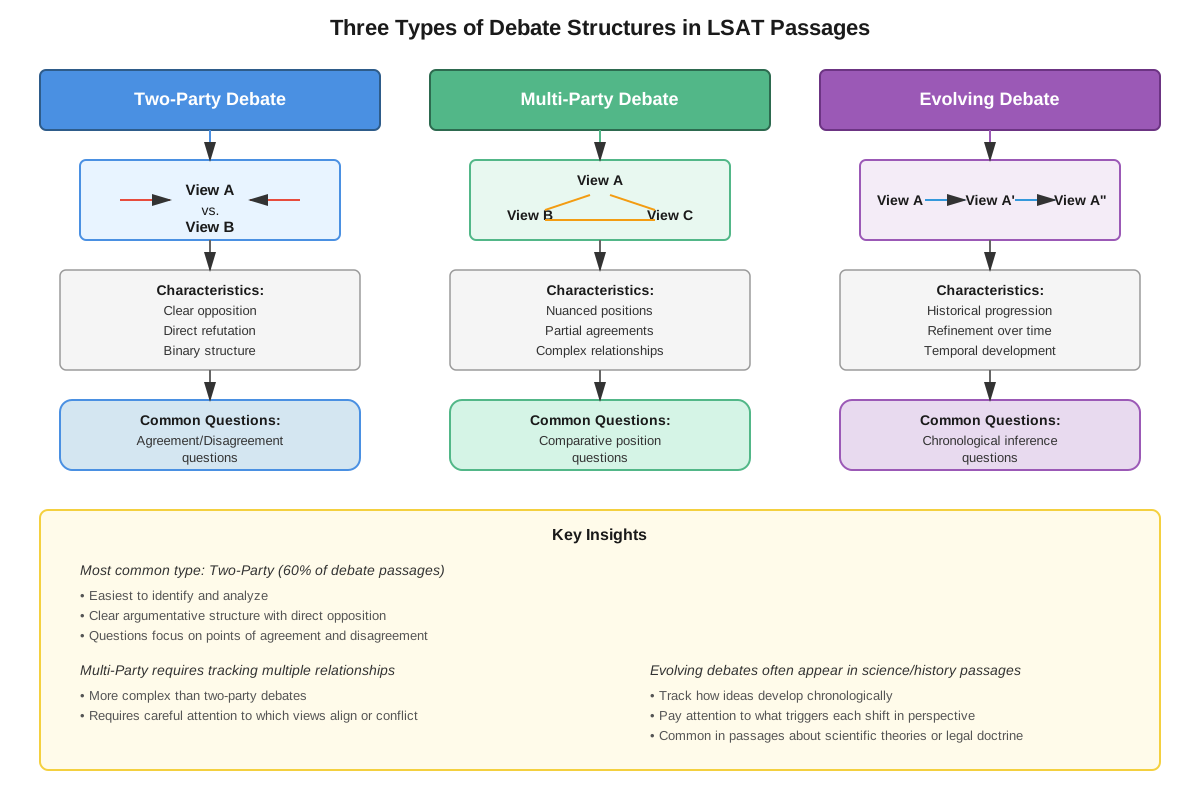
- [ ] Distinguish between different types of debate structures (two-party debates, multi-party debates, and evolving debates)
- [ ] Map the logical relationships between opposing viewpoints in a passage
- [ ] Determine the author's position relative to the debating parties
- [ ] Predict question types that commonly accompany debate structure passages
Prerequisites
Students should have foundational knowledge in the following areas:
- Basic argument structure: Understanding premises, conclusions, and how evidence supports claims is essential because debate passages are built from competing arguments
- Author's tone and attitude: Recognizing whether an author is neutral, supportive, or critical helps identify their stance in a debate
- Main point identification: The ability to distill the central claim of a paragraph or passage enables tracking each side's core position
- Inference skills: Debate passages often require understanding what's implied rather than explicitly stated about each position's strengths and weaknesses
Why This Topic Matters
Real-World Significance
Debate structure passages mirror the fundamental nature of legal reasoning and academic discourse. In legal practice, attorneys constantly engage with opposing viewpoints—whether in adversarial proceedings, scholarly debates about legal interpretation, or policy discussions. The ability to accurately represent an opponent's position, identify its weaknesses, and construct effective counterarguments is central to legal advocacy. Beyond law, this skill applies to any field requiring critical analysis: scientific debates about competing theories, policy discussions weighing different approaches, or business decisions evaluating alternative strategies.
Exam Statistics and Frequency
Debate structure passages appear with remarkable consistency on the LSAT. Approximately 25-30% of Reading Comprehension passages feature explicit debate structures, making them one of the most common passage types. These passages generate an average of 5-7 questions per passage, with certain question types appearing almost exclusively with debate structures:
- Point of agreement/disagreement questions: 60-70% of these questions appear with debate passages
- Response questions (how would X respond to Y's claim): 80-90% appear with debate passages
- Strengthen/weaken questions: 40-50% appear with debate passages
- Author's attitude toward each position: 50-60% appear with debate passages
Common Manifestations in LSAT Passages
Debate structure appears in several recognizable forms on the LSAT:
- Traditional vs. Revisionist: An established scholarly consensus is challenged by new evidence or interpretation
- Two competing theories: Scientists or scholars propose different explanations for the same phenomenon
- Policy debates: Different approaches to solving a social, legal, or economic problem are contrasted
- Interpretive disagreements: Scholars disagree about how to interpret a text, artwork, or historical event
- Methodological disputes: Researchers debate which approach or methodology is most appropriate for studying a subject
Core Concepts
The Fundamental Architecture of Debate Structure
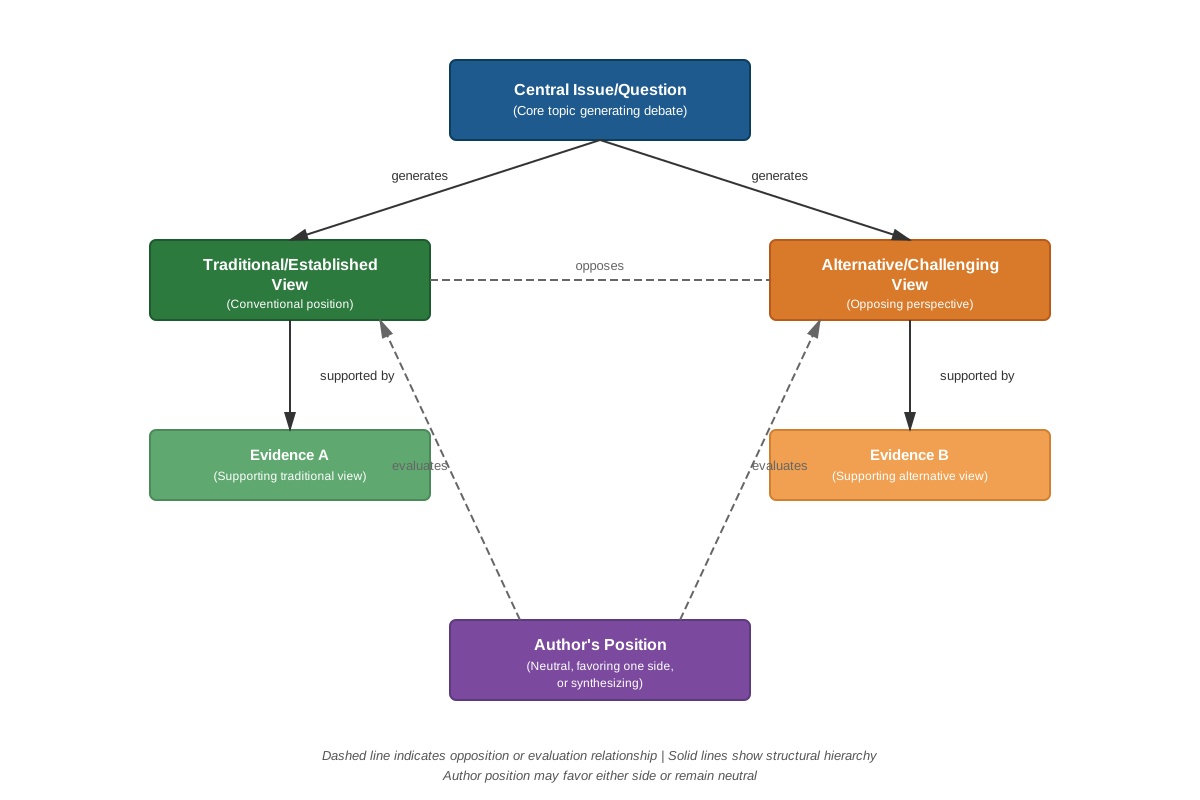
A debate structure passage organizes information around competing positions on a central question or issue. Unlike descriptive passages that present information sequentially or analytical passages that develop a single argument, debate passages create a dialectical framework where ideas are defined in opposition to each other. The core architecture typically includes:
- The central question or issue: What is being debated
- Position A: The first viewpoint, often traditional or established
- Position B: The opposing or alternative viewpoint
- Evidence and reasoning: Support for each position
- Author's perspective: The author's evaluation, if present
This structure creates a logical map that students must navigate carefully, tracking not just what each side believes, but why they believe it and how their arguments interact.
Types of Debate Structures
Binary Debates (Two-Party Structure)
The most common form presents exactly two opposing positions. These passages typically follow a predictable pattern:
- Paragraph 1: Introduces the issue and Position A (often the traditional view)
- Paragraph 2: Develops Position A's evidence and reasoning
- Paragraph 3: Introduces Position B as a challenge or alternative
- Paragraph 4: Develops Position B's evidence and reasoning
- Paragraph 5 (optional): Author's evaluation or synthesis
Example framework: "Traditional historians have argued X based on evidence Y. However, revisionist scholars now contend Z, pointing to overlooked evidence W."
Multi-Party Debates
Some passages present three or more distinct positions. These are more complex and require careful tracking of which evidence supports which position. The LSAT typically limits these to three positions to maintain readability.
Example framework: "Economists disagree about the cause of the recession. Keynesians attribute it to insufficient demand, monetarists blame monetary policy errors, while supply-side theorists point to regulatory burdens."
Evolving Debates
These passages show how a debate has developed over time, with positions shifting or new evidence changing the terms of discussion. The temporal dimension adds complexity.
Example framework: "Early scholars believed X. Mid-century research challenged this with Y. Recent discoveries have led to a synthesis position Z that incorporates elements of both earlier views."
Identifying Debate Markers in Passages
Certain linguistic signals reliably indicate debate structure:
| Signal Type | Examples | Function |
|---|---|---|
| Contrast markers | however, but, yet, nevertheless, in contrast | Introduce opposing viewpoint |
| Attribution phrases | "X argues," "Y contends," "according to Z" | Identify whose position is being presented |
| Evaluative language | "more convincing," "fails to account for," "overlooks" | Signal author's judgment |
| Concession markers | "although," "while it's true that," "granted" | Acknowledge opposing point before rebuttal |
| Challenge language | "challenges," "disputes," "questions," "undermines" | Indicate one position attacking another |
The Role of Evidence in Debate Passages
Each position in a debate structure is supported by specific evidence. Understanding how evidence functions is crucial:
- Direct evidence: Facts, data, or observations that directly support a claim
- Interpretive evidence: How the same facts can be interpreted differently by opposing sides
- Methodological evidence: Arguments about which research methods are most reliable
- Analogical evidence: Comparisons to similar cases or situations
A key skill is recognizing when both sides accept the same facts but interpret them differently versus when they dispute the facts themselves.
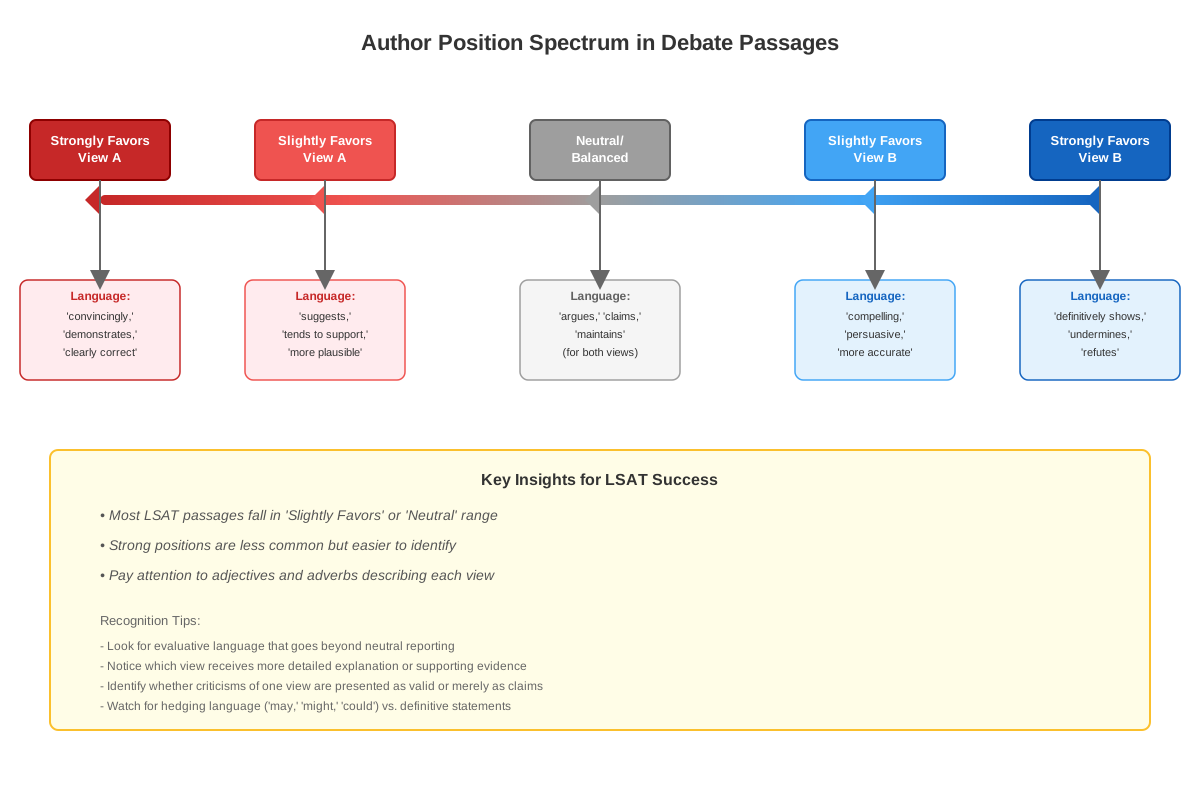
Author's Stance in Debate Passages
The author's position relative to the debate is critical for answering questions. Authors can adopt several stances:
- Neutral reporter: Presents both sides without evaluation (least common on LSAT)
- Subtle preference: Favors one side through word choice and emphasis
- Explicit evaluation: Directly states which position is more convincing
- Synthesis position: Suggests both sides have merit or proposes a middle ground
- Critical of both: Points out flaws in all presented positions
Identifying the author's stance requires attention to:
- Evaluative adjectives and adverbs
- Amount of space devoted to each position
- Placement of criticisms and support
- Concluding statements or summary paragraphs
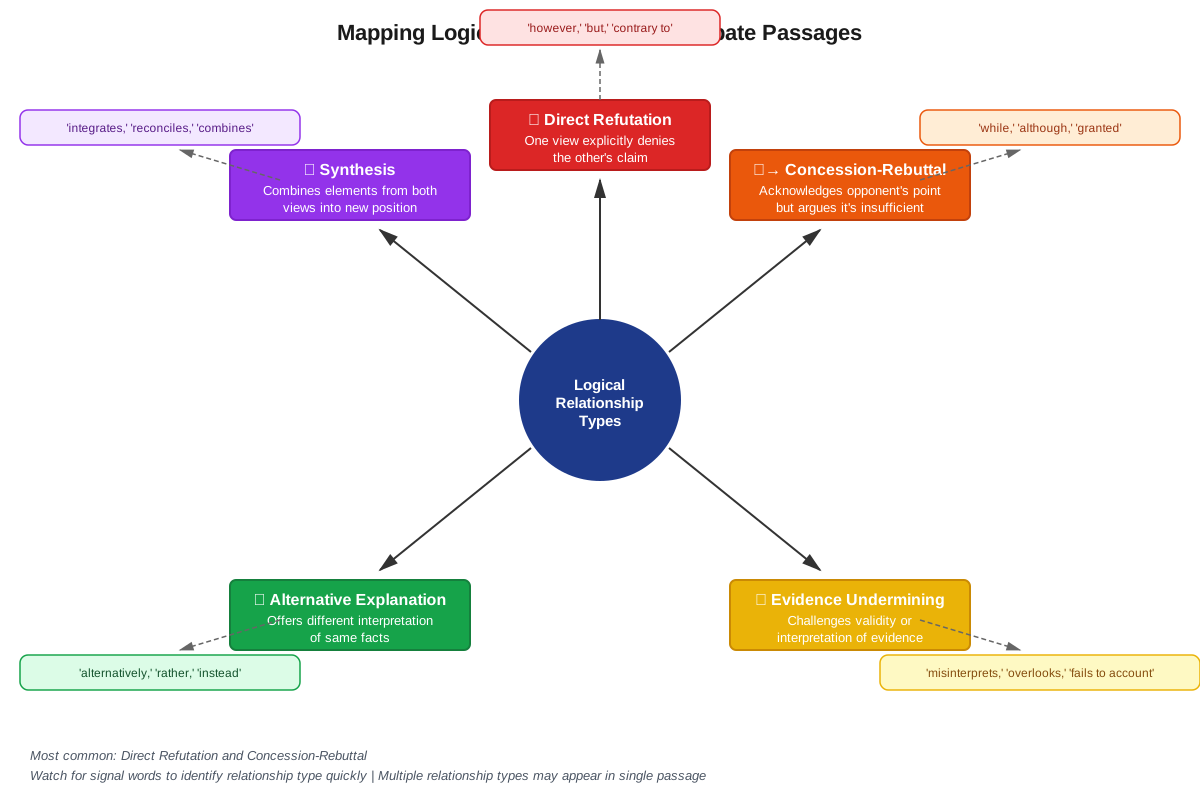
Logical Relationships Between Positions
Debate positions relate to each other in specific ways:
- Direct contradiction: Position B denies Position A's central claim
- Alternative explanation: Both positions explain the same phenomenon differently
- Scope disagreement: Positions agree on some cases but disagree on others
- Methodological dispute: Positions disagree about how to approach the question
- Hierarchical relationship: One position is a subset or special case of another
Understanding these relationships helps predict how each side would respond to the other's arguments.
Concept Relationships
The concepts within debate structure form an interconnected system. The fundamental architecture provides the framework that determines which type of debate structure you're encountering. Once you've identified the type, you can use debate markers to track transitions between positions. These markers help you follow the logical relationships between positions, which in turn helps you understand how evidence functions within each argument. Throughout this process, attention to author's stance indicators reveals the passage's ultimate perspective on the debate.
This topic connects to prerequisite knowledge in several ways:
- Basic argument structure → Evidence in debates: Understanding how premises support conclusions enables you to evaluate the strength of each position's evidence
- Author's tone → Author's stance in debates: General tone-reading skills become more specific when applied to identifying which side the author favors
- Main point identification → Central question in debates: The skill of finding main points extends to identifying what issue is actually being debated
The relationship map flows as follows:
Central Issue → generates → Competing Positions → supported by → Evidence and Reasoning → evaluated through → Logical Relationships → interpreted by → Author's Stance → tested via → Specific Question Types
High-Yield Facts
⭐ Debate structure passages appear in approximately 25-30% of all LSAT Reading Comprehension passages, making them one of the most frequent passage types.
⭐ The author's stance is rarely completely neutral—even subtle word choices reveal preferences that are tested in questions.
⭐ Contrast markers (however, but, yet, nevertheless) are the most reliable signals that a passage is transitioning from one position to another.
⭐ Questions asking how one party would respond to another's evidence appear almost exclusively with debate structure passages.
⭐ The position introduced second often receives more favorable treatment from the author, though this is not universal.
- Binary debates (two positions) are more common than multi-party debates (three or more positions) on the LSAT.
- Both sides in a debate may accept the same facts but interpret them differently—this distinction is frequently tested.
- The central question being debated is often stated explicitly in the first paragraph but sometimes must be inferred.
- Evidence that undermines one position simultaneously strengthens the opposing position in binary debates.
- Author's stance can be determined by examining which position's weaknesses are highlighted and which position's strengths are emphasized.
- Temporal markers (traditionally, recently, in the past, currently) often signal evolving debates where positions have changed over time.
- The most detailed position in a passage is not necessarily the one the author favors—sometimes authors elaborate on a position to critique it more thoroughly.
Quick check — test yourself on Debate structure so far.
Try Flashcards →Common Misconceptions
Misconception: The first position presented is always the one the author disagrees with.
Correction: While passages often present a traditional view first before introducing a challenge, the author may support either position or neither. The author's stance must be determined by evaluative language, not presentation order.
Misconception: If both sides agree on something, it must be true or correct.
Correction: Points of agreement between debating parties are facts or assumptions accepted within the passage's context, but the passage may later reveal these shared assumptions are flawed. Questions may test whether you recognize what both sides accept versus what is actually established as true.
Misconception: Debate structure passages always present exactly two positions.
Correction: While binary debates are most common, passages may present three or more distinct positions, or show how a debate has evolved through multiple stages with different positions emerging over time.
Misconception: The author's position is always stated explicitly in the final paragraph.
Correction: Authors often reveal their stance through subtle cues throughout the passage—word choice, emphasis, amount of detail, and placement of criticisms. The final paragraph may summarize without explicit evaluation.
Misconception: Evidence presented for a position proves that position is correct within the passage.
Correction: Evidence shows what each side uses to support their argument, but the passage may indicate that evidence is misinterpreted, insufficient, or countered by other evidence. The presence of evidence doesn't equal the correctness of the position.
Misconception: All debate passages are about academic or scholarly disagreements.
Correction: While many debate passages involve scholarly disputes, debates can also concern policy decisions, legal interpretations, artistic movements, or practical approaches to problems. The structure remains the same regardless of subject matter.
Worked Examples
Example 1: Binary Debate with Author Preference
Passage excerpt:
"For decades, linguists explained language acquisition in children through behaviorist principles, arguing that children learn language through imitation and reinforcement. B.F. Skinner's influential work suggested that parents reward correct utterances and correct errors, gradually shaping the child's linguistic competence. This view dominated the field until the 1960s.
However, Noam Chomsky challenged this behaviorist orthodoxy, pointing out that children produce novel sentences they have never heard before—sentences that are grammatically correct but could not have been learned through simple imitation. Moreover, children acquire language rapidly and uniformly despite widely varying environmental conditions and parental input. Chomsky proposed instead that humans possess an innate language acquisition device, a biological endowment that enables children to extract grammatical rules from limited exposure to language. This nativist perspective has proven far more capable of explaining the speed, uniformity, and creativity of child language acquisition."
Analysis:
- Identify the structure: This is a binary debate (two positions)
- Position A: Behaviorist explanation (Skinner)
- Position B: Nativist explanation (Chomsky)
- Locate the central question: How do children acquire language?
- Track the evidence:
- Behaviorist evidence: Imitation and reinforcement mechanisms
- Nativist evidence: Novel sentence production, rapid acquisition, uniformity across conditions
- Determine author's stance: The author favors the nativist position
- Evidence: "challenged this behaviorist orthodoxy" (negative framing of Position A)
- "has proven far more capable" (explicit positive evaluation of Position B)
- More space devoted to explaining why nativism is superior
- Predict question types:
- "The author's attitude toward behaviorist theory is most accurately described as..."
- "Which of the following, if true, would most strengthen Chomsky's position?"
- "According to the passage, Chomsky would most likely respond to Skinner's emphasis on reinforcement by..."
Connection to learning objectives: This example demonstrates how to identify debate structure (Objective 1), explains the reasoning pattern of challenge-and-response (Objective 2), and shows how to map the passage for answering questions (Objective 3).
Example 2: Multi-Party Debate with Synthesis
Passage excerpt:
"Art historians have long debated the primary purpose of prehistoric cave paintings. Early scholars like Abbé Breuil argued these images served magical or religious functions, helping hunters ensure successful hunts through sympathetic magic. The placement of paintings deep within caves, far from living areas, supported this ritualistic interpretation.
Later researchers, influenced by structuralist anthropology, proposed that cave art represented a symbolic system for organizing social knowledge. André Leroi-Gourhan suggested the paintings depicted a cosmological order, with different animals representing complementary principles arranged according to a sophisticated conceptual scheme.
More recently, David Lewis-Williams has synthesized elements of both earlier theories while adding neuropsychological insights. He argues that shamans created these images during trance states, and the paintings served both ritualistic purposes and as records of visionary experiences. The deep cave locations, previously explained only by ritual secrecy, now also make sense as sensory-deprivation environments conducive to altered states of consciousness. This integrated approach accounts for evidence that neither earlier theory fully explained."
Analysis:
- Identify the structure: Multi-party evolving debate with synthesis
- Position A: Magical/religious (Breuil)
- Position B: Symbolic/structuralist (Leroi-Gourhan)
- Position C: Synthesis with neuropsychological elements (Lewis-Williams)
- Track temporal development: "Early scholars... Later researchers... More recently"
- Identify evidence for each position:
- Position A: Deep cave placement suggests ritual
- Position B: Systematic arrangement suggests symbolic organization
- Position C: Same evidence reinterpreted through neuropsychology
- Determine author's stance: Favors the synthesis position
- "accounts for evidence that neither earlier theory fully explained"
- Presents Position C as resolving limitations of earlier views
- Note the logical relationships:
- Position C doesn't completely reject A or B but incorporates elements
- Same evidence (deep cave placement) is reinterpreted by each theory
Connection to learning objectives: This example shows a more complex debate structure (Objective 4), demonstrates how to track logical relationships between multiple positions (Objective 5), and illustrates how evidence can be reinterpreted rather than disputed (Objective 2).
Exam Strategy
Approaching Debate Structure Passages
When you identify a debate structure passage, implement this systematic approach:
- First reading—map the structure (2-3 minutes):
- Identify the central question or issue
- Mark where each position begins (bracket or underline)
- Note the author's evaluative language
- Don't get lost in details; focus on the argumentative framework
- Create a mental or physical map:
`
Issue: [What's being debated]
Position A: [Who/What] → [Main claim] → [Key evidence]
Position B: [Who/What] → [Main claim] → [Key evidence]
Author: [Neutral/Favors A/Favors B/Synthesis]
`
- Anticipate questions before reading them:
- What does each side believe?
- What would strengthen/weaken each position?
- How would one side respond to the other's evidence?
- What's the author's attitude toward each position?
Trigger Words and Phrases
Watch for these high-yield signals:
Debate introduction triggers:
- "Scholars disagree about..."
- "Two competing theories..."
- "While X argues... Y contends..."
- "The traditional view... has been challenged by..."
Position shift triggers:
- "However," "Nevertheless," "In contrast," "On the other hand"
- "Challenging this view..."
- "An alternative explanation..."
Author evaluation triggers:
- "More convincing," "fails to account for," "overlooks"
- "Persuasively demonstrates," "unconvincing," "problematic"
- "Successfully explains," "inadequately addresses"
Process of Elimination Tips
For point of agreement/disagreement questions:
- Eliminate answers that only one side discusses
- Eliminate answers that misrepresent either position
- The correct answer must be something both sides explicitly or implicitly address
For response questions ("How would X respond to Y's claim?"):
- Eliminate responses inconsistent with X's stated position
- Eliminate responses that agree with Y (unless the question asks about points of agreement)
- The correct answer should reflect X's reasoning pattern, not just oppose Y
For author's attitude questions:
- Eliminate extreme answers unless the author uses strong evaluative language
- Match the tone of the answer to the author's tone in the passage
- If the author presents both sides fairly, eliminate answers suggesting strong bias
Time Allocation
- Initial reading and mapping: 2.5-3 minutes (slightly longer than non-debate passages)
- Per question: 45-60 seconds
- Return to passage: Budget time to verify answers by checking specific positions
Exam Tip: Debate structure passages often generate more questions than other passage types (6-7 vs. 5-6), so the extra time spent mapping the structure pays dividends across multiple questions.
Memory Techniques
The DEBATE Acronym
Use DEBATE to remember the key elements to track:
- Distinct positions: How many viewpoints are presented?
- Evidence: What supports each position?
- Boundaries: Where does one position end and another begin?
- Author's stance: Which side does the author favor?
- Transitions: What markers signal shifts between positions?
- Evaluation: What criticisms does each side face?
The Traffic Light Visualization
Visualize debate passages as a traffic light system:
- Red zone (Position A): First viewpoint, often traditional—mark mentally in red
- Yellow zone (Transition): Contrast markers and shifts—mark in yellow
- Green zone (Position B): Alternative viewpoint, often favored—mark in green
- Blue zone (Author): Author's evaluation—mark in blue
This color-coding helps you quickly locate information when answering questions.
The Courtroom Analogy
Think of debate passages as courtroom proceedings:
- Plaintiff = Position A (first position presented)
- Defendant = Position B (challenging position)
- Evidence = Support for each side
- Judge = Author (evaluating the arguments)
- Verdict = Author's conclusion or preference
This analogy helps remember that you need to track what each "side" argues and what the "judge" thinks about those arguments.
The Response Prediction Technique
For any debate passage, practice predicting: "If Position A heard Position B's main evidence, they would probably say..." This mental exercise prepares you for response questions and deepens your understanding of each position's logic.
Summary
Debate structure passages present two or more competing viewpoints on a central issue, creating an argumentative framework that tests your ability to distinguish positions, track evidence, and identify the author's stance. These passages appear in approximately 25-30% of LSAT Reading Comprehension sections and generate specific question types including points of agreement/disagreement, response questions, and author's attitude questions. Success requires mapping the passage's architecture: identifying the central question, distinguishing each position's claims and evidence, recognizing logical relationships between positions, and determining the author's evaluation. Key signals include contrast markers (however, but, nevertheless), attribution phrases (X argues, Y contends), and evaluative language that reveals the author's preferences. The most effective approach involves creating a mental map during the first reading that tracks who believes what and why, then using this map to efficiently answer questions. Understanding that evidence can be interpreted differently by opposing sides, that the author's stance may be subtle rather than explicit, and that positions relate to each other in specific logical patterns (contradiction, alternative explanation, synthesis) enables accurate and efficient question answering.
Key Takeaways
- Debate structure passages appear in 25-30% of Reading Comprehension sections and generate predictable question types that test your ability to distinguish and evaluate competing viewpoints
- Map the passage during first reading: Identify the central question, mark where each position begins, note the author's evaluative language, and track the evidence supporting each side
- Contrast markers (however, but, yet, nevertheless) are the most reliable signals that the passage is transitioning from one position to another
- The author's stance is revealed through subtle cues—evaluative adjectives, emphasis, space devoted to each position, and placement of criticisms—not just explicit statements
- Evidence can function differently in debates: Both sides may accept the same facts but interpret them differently, or they may dispute the facts themselves
- Response questions and point of agreement/disagreement questions appear almost exclusively with debate passages, making these question types high-yield for focused practice
- Use the DEBATE acronym (Distinct positions, Evidence, Boundaries, Author's stance, Transitions, Evaluation) to ensure you've tracked all essential elements during your first reading
Related Topics
Comparative Reading Passages: These passages present two related texts that often debate or discuss the same issue from different perspectives. Mastering debate structure within single passages provides the foundation for analyzing relationships between paired passages.
Author's Purpose and Tone: Understanding why an author presents multiple viewpoints and how their tone reveals their stance builds directly on debate structure skills. This topic deepens your ability to identify subtle authorial preferences.
Strengthen and Weaken Questions in Logical Reasoning: The skill of evaluating how evidence affects competing positions transfers directly to Logical Reasoning questions that ask you to strengthen or weaken arguments.
Main Point and Primary Purpose Questions: Debate passages require identifying not just what the passage discusses, but what argumentative work it performs—whether presenting a challenge, defending a position, or synthesizing views.
Inference Questions with Multiple Viewpoints: Advanced inference questions often require understanding what each position in a debate would accept, reject, or predict, building on your debate structure mapping skills.
Practice CTA
Now that you've mastered the core concepts of debate structure, it's time to apply this knowledge to actual LSAT passages. The practice questions and flashcards will reinforce your ability to quickly identify debate structures, map competing positions, and efficiently answer the question types that accompany these passages. Remember: debate structure passages are highly predictable once you understand their architecture, making them an excellent opportunity to gain points through systematic preparation. Approach each practice passage by implementing the DEBATE framework, and you'll develop the automatic recognition patterns that lead to confident, accurate performance on test day. Your investment in mastering this high-yield topic will pay dividends across multiple questions in every Reading Comprehension section.
Sign up free to keep reading
Create a free AnvayaPrep account to finish this LSAT guide on Debate structure — plus flashcards and practice questions.