Overview
D and L sugars represent one of the most fundamental concepts in Carbohydrates and Biochemistry, forming the basis for understanding stereochemistry in biological molecules. This nomenclature system, developed by Emil Fischer, classifies monosaccharides based on the configuration of the chiral carbon farthest from the carbonyl group. The distinction between D and L forms is not merely academic—it has profound implications for biological function, as nearly all naturally occurring sugars in human metabolism exist in the D-form, while amino acids predominantly exist in the L-form. This selectivity reflects the evolutionary optimization of enzymatic machinery and the stereospecificity of biological recognition.
For the MCAT, understanding D and L sugars is essential because it bridges multiple high-yield topics: stereochemistry, carbohydrate metabolism, enzyme specificity, and the structural basis of biological molecules. Questions frequently test the ability to identify D versus L configurations in Fischer projections, predict which forms are biologically relevant, and explain why organisms exhibit such strong stereochemical preferences. This topic appears in both passage-based and discrete questions, often integrated with glycolysis, gluconeogenesis, or structural biochemistry passages.
The broader significance of D and L sugar nomenclature extends throughout biochemistry. It connects directly to optical activity and polarimetry, enantiomers and diastereomers, mutarotation, and the three-dimensional structure of complex carbohydrates like glycogen and cellulose. Mastery of this topic provides the foundation for understanding how subtle stereochemical differences create dramatic functional consequences in biological systems, a recurring theme throughout the MCAT Biochemistry curriculum.
Learning Objectives
- [ ] Define D and L sugars using accurate Biochemistry terminology
- [ ] Explain why D and L sugars matters for the MCAT
- [ ] Apply D and L sugars to exam-style questions
- [ ] Identify common mistakes related to D and L sugars
- [ ] Connect D and L sugars to related Biochemistry concepts
- [ ] Determine the D or L configuration of any monosaccharide from its Fischer projection
- [ ] Explain the biological significance of D-sugar predominance in human metabolism
- [ ] Distinguish between D/L nomenclature and (+)/(-) or d/l optical rotation designations
Prerequisites
- Fischer projections: Understanding how to read and interpret these two-dimensional representations of three-dimensional molecules is essential for determining D/L configuration
- Chirality and stereoisomers: Knowledge of chiral centers, enantiomers, and diastereomers provides the conceptual foundation for understanding why D and L forms exist
- Basic carbohydrate structure: Familiarity with aldoses, ketoses, and the numbering system for carbon atoms in sugars enables proper identification of the reference carbon
- Functional groups: Recognition of aldehydes, ketones, and hydroxyl groups allows correct identification of the carbonyl carbon and subsequent carbon numbering
Why This Topic Matters
Clinical and Real-World Significance
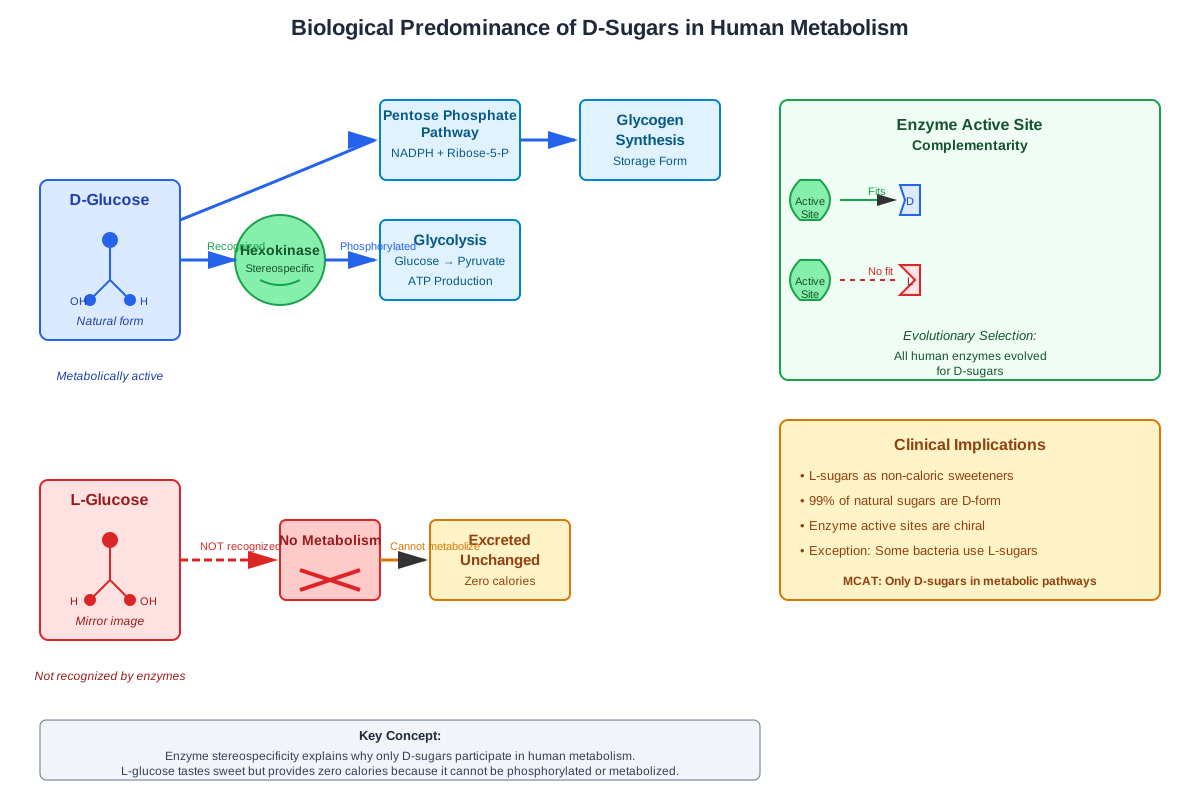
The predominance of D-sugars in human metabolism has profound clinical implications. Enzymes involved in glycolysis, gluconeogenesis, and the pentose phosphate pathway are stereospecific for D-sugars, meaning they cannot process L-sugars. This specificity explains why L-glucose, though chemically similar to D-glucose, cannot be metabolized for energy and passes through the digestive system unchanged. Some artificial sweeteners exploit this principle—L-sugars taste sweet but provide no calories because they cannot be metabolized. Additionally, certain rare genetic disorders involve defects in enzymes that process specific D-sugar configurations, leading to accumulation of toxic intermediates.
MCAT Exam Statistics
D and L sugar configuration appears in approximately 15-20% of carbohydrate-related questions on the MCAT. The topic most commonly appears in:
- Passage-based questions involving experimental data on sugar metabolism or enzyme specificity
- Discrete questions testing Fischer projection interpretation
- Integrated questions combining stereochemistry with metabolic pathways
- Structural analysis questions requiring identification of biologically relevant sugar forms
Common Exam Presentations
The MCAT presents D and L sugars through several recurring formats:
- Fischer projections requiring configuration determination
- Passages describing enzyme specificity experiments with different sugar stereoisomers
- Questions about why certain sugars are metabolically active while others are not
- Structural comparison questions involving multiple monosaccharides
- Integration with glycosidic bond formation and polysaccharide structure
Core Concepts
The Fischer Convention and D/L Nomenclature
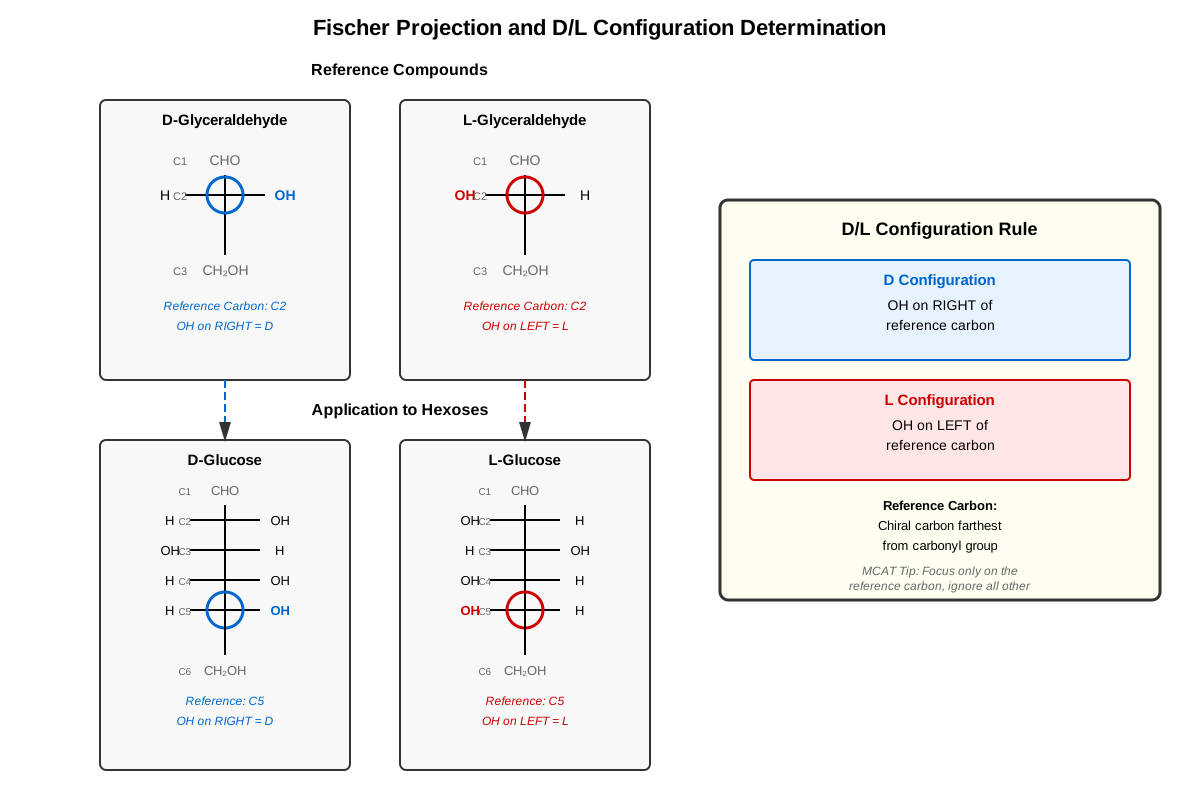
The D and L sugars classification system, developed by Emil Fischer in the late 19th century, provides a standardized method for describing the absolute configuration of monosaccharides. This system focuses on the configuration of the chiral carbon farthest from the carbonyl group (the highest-numbered chiral carbon). In a Fischer projection, if the hydroxyl group on this reference carbon points to the right, the sugar is designated as D (from Latin dexter, meaning right). If it points to the left, the sugar is designated as L (from Latin laevus, meaning left).
This reference carbon is critical: for aldoses, it is the penultimate carbon (second-to-last carbon in the chain), while for ketoses, it is also the penultimate carbon. The designation applies regardless of the configuration of other chiral centers in the molecule. For example, D-glucose and D-mannose are both D-sugars despite having different configurations at C-2, because they share the same configuration at C-5 (the reference carbon in these hexoses).
Fischer Projections and Configuration Determination
Fischer projections represent three-dimensional sugar molecules in two dimensions using specific conventions. Vertical lines represent bonds going into the page (away from the viewer), while horizontal lines represent bonds coming out of the page (toward the viewer). The carbonyl carbon is positioned at or near the top of the projection, with carbon atoms numbered from top to bottom.
To determine whether a sugar is D or L:
- Draw or identify the Fischer projection
- Number the carbons from top to bottom, starting with the carbonyl carbon as C-1 (for aldoses)
- Locate the penultimate carbon (second from bottom)
- Examine the position of the hydroxyl group on this carbon
- If the -OH is on the right, the sugar is D; if on the left, it is L
Biological Significance of D-Sugars
Nearly all monosaccharides in human metabolism exist in the D-configuration. This includes D-glucose, D-fructose, D-galactose, D-ribose, and D-deoxyribose. This universal preference reflects the stereospecificity of enzymes that evolved to recognize and process D-sugars exclusively. The active sites of metabolic enzymes are chiral environments that bind D-sugars with high affinity while excluding L-sugars.
This stereospecificity has several important consequences:
- Metabolic efficiency: Cells can rapidly process D-sugars without wasting energy on non-metabolizable L-forms
- Regulatory precision: Metabolic pathways can be tightly controlled because only specific stereoisomers are substrates
- Evolutionary conservation: The universal use of D-sugars across all domains of life suggests this preference arose early in evolution
D/L Versus (+)/(-) Nomenclature
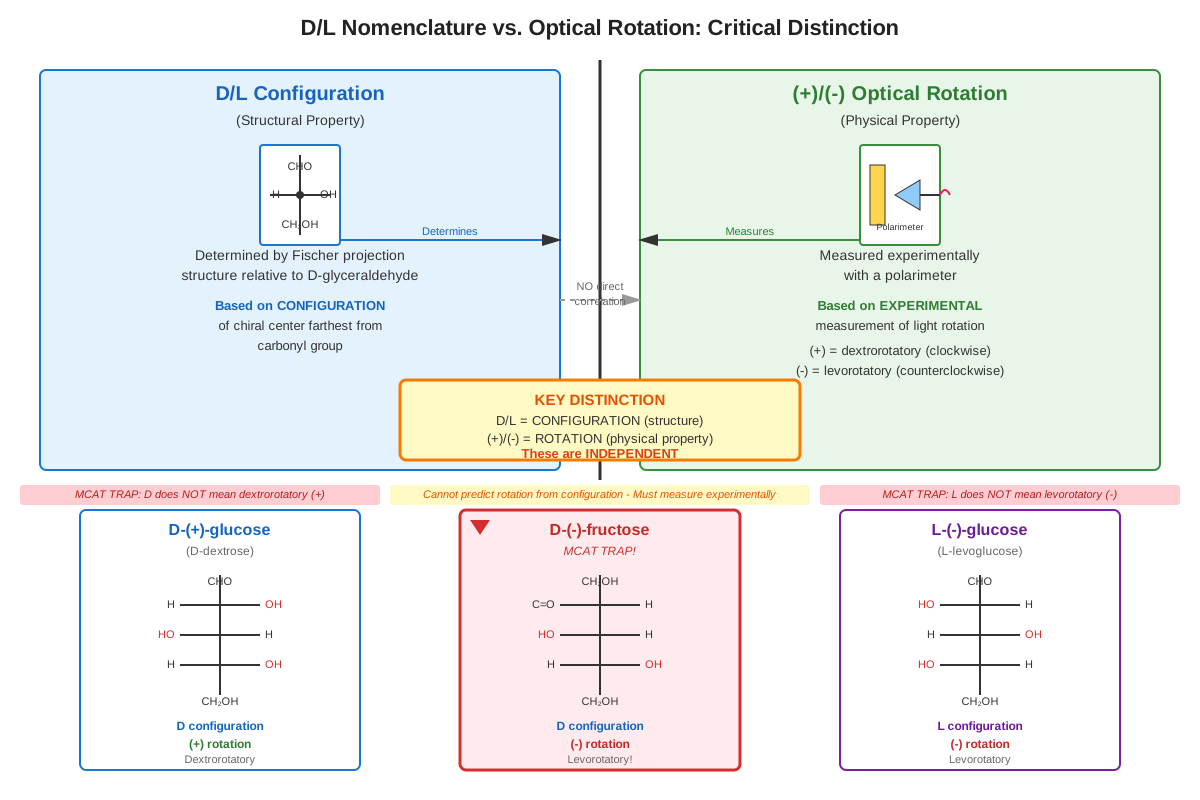
A critical distinction for the MCAT is that D/L nomenclature does NOT indicate the direction of optical rotation. The D/L system describes absolute configuration (the spatial arrangement of atoms), while (+)/(-) or d/l describes optical activity (the direction plane-polarized light is rotated). These are independent properties:
| Sugar | Configuration | Optical Rotation | Full Name |
|---|---|---|---|
| Glucose | D | + (dextrorotatory) | D-(+)-glucose |
| Fructose | D | - (levorotatory) | D-(-)-fructose |
| Glucose | L | - (levorotatory) | L-(-)-glucose |
D-glucose rotates plane-polarized light to the right (+), but D-fructose rotates it to the left (-), despite both being D-sugars. The optical rotation must be determined experimentally and cannot be predicted from the Fischer projection alone.
Enantiomers and Diastereomers in Sugar Chemistry
D and L forms of the same sugar are enantiomers—non-superimposable mirror images. D-glucose and L-glucose are enantiomers, having opposite configurations at every chiral center. Enantiomers have identical physical properties (melting point, solubility) except for the direction they rotate plane-polarized light.
However, D-glucose and D-mannose are diastereomers—stereoisomers that are not mirror images. They differ at only one chiral center (C-2) while maintaining the same configuration at the reference carbon (C-5). Diastereomers have different physical and chemical properties, including different melting points, solubilities, and reactivities. This distinction is crucial for understanding why enzymes can discriminate between different D-sugars.
Common Monosaccharides and Their Configurations
| Monosaccharide | Type | Configuration | Biological Role |
|---|---|---|---|
| D-Glucose | Aldohexose | D | Primary energy source; blood sugar |
| D-Fructose | Ketohexose | D | Fruit sugar; glycolysis intermediate |
| D-Galactose | Aldohexose | D | Component of lactose; glycolipids |
| D-Ribose | Aldopentose | D | Component of RNA and ATP |
| D-Deoxyribose | Aldopentose | D | Component of DNA |
| D-Mannose | Aldohexose | D | Glycoprotein component |
All these sugars share the D-configuration at their reference carbon, making them substrates for human metabolic enzymes.
Glyceraldehyde as the Reference Compound
D-glyceraldehyde and L-glyceraldehyde serve as the reference compounds for the entire D/L system. Glyceraldehyde is the simplest aldose with a chiral center (a three-carbon sugar). All other sugars are classified as D or L based on whether their configuration at the reference carbon matches D-glyceraldehyde or L-glyceraldehyde. This creates a systematic relationship across all monosaccharides, regardless of chain length or the number of chiral centers.
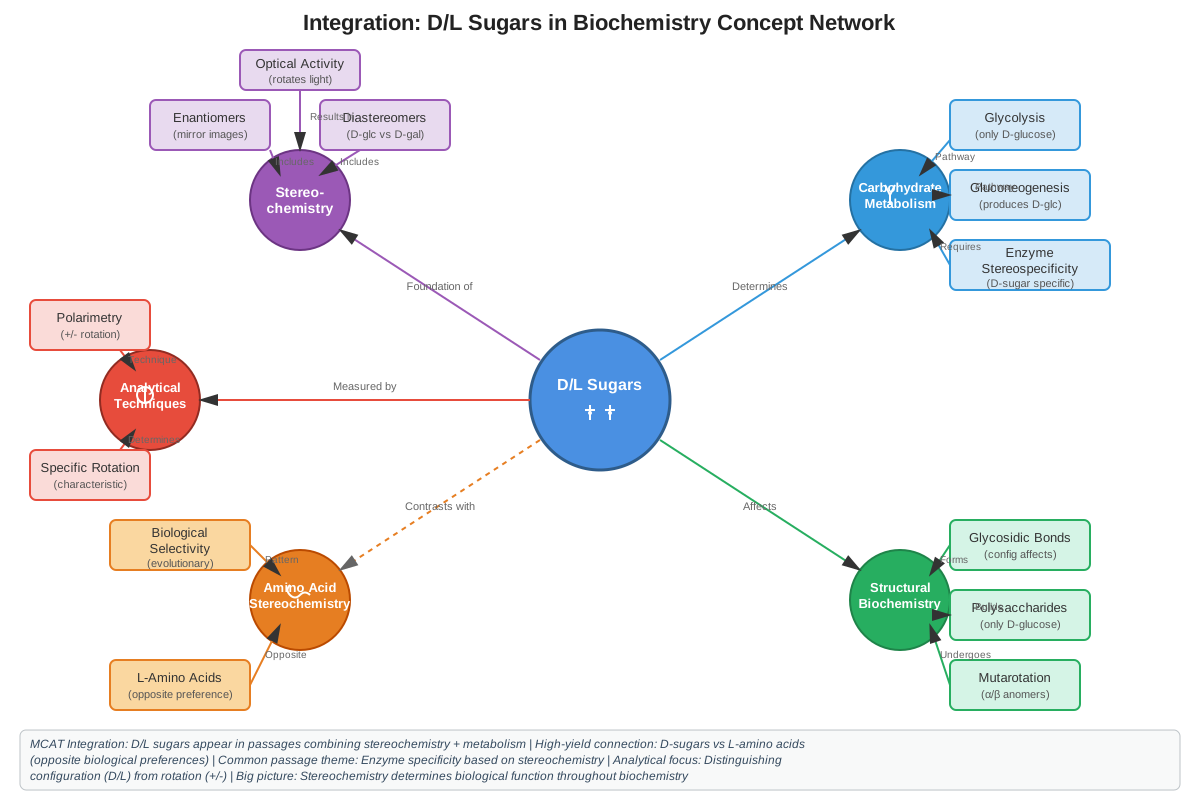
Concept Relationships
The D/L nomenclature system connects multiple biochemistry concepts in a hierarchical network. At the foundation lies stereochemistry and chirality, which define why D and L forms exist. This leads to Fischer projections, the representational tool that makes configuration determination possible. The D/L system then enables understanding of enzyme specificity, as the three-dimensional shape of active sites determines which stereoisomers can bind and react.
Moving upward in complexity, D/L configuration connects to carbohydrate metabolism. The exclusive use of D-sugars in glycolysis, gluconeogenesis, and the pentose phosphate pathway reflects enzyme stereospecificity. This connects to energy metabolism and metabolic regulation, as cells can control flux through pathways by regulating enzymes that recognize specific configurations.
Horizontally, D/L sugars relate to optical activity and polarimetry, though these are independent properties. The relationship also extends to amino acid stereochemistry, where L-amino acids predominate in proteins, creating an interesting mirror image to the D-sugar preference in carbohydrates. Finally, D/L configuration influences glycosidic bond formation and polysaccharide structure, as the stereochemistry of individual monosaccharides determines the three-dimensional architecture of complex carbohydrates.
Relationship Map:
Chirality → Fischer Projections → D/L Configuration → Enzyme Specificity → Metabolic Pathways → Energy Production
D/L Configuration → Enantiomers/Diastereomers → Physical Properties → Biological Function
D/L Configuration ↔ Optical Activity (independent but related)
D-Sugars ↔ L-Amino Acids (complementary biological preferences)
Quick check — test yourself on D and L sugars so far.
Try Flashcards →High-Yield Facts
⭐ D-sugars have the hydroxyl group on the penultimate carbon pointing to the right in Fischer projections; L-sugars have it pointing to the left
⭐ Nearly all naturally occurring sugars in human metabolism are D-sugars (D-glucose, D-fructose, D-galactose, D-ribose)
⭐ D/L configuration is independent of optical rotation direction; D-glucose is (+) but D-fructose is (-)
⭐ Enzymes in human metabolic pathways are stereospecific for D-sugars and cannot process L-sugars
⭐ D and L forms of the same sugar are enantiomers (mirror images), while D-glucose and D-mannose are diastereomers
- The reference carbon for D/L determination is the chiral carbon farthest from the carbonyl group (penultimate carbon)
- D-glyceraldehyde serves as the reference compound for the entire D/L classification system
- L-sugars taste sweet but provide no calories because they cannot be metabolized by human enzymes
- All amino acids in human proteins are L-amino acids, creating a complementary pattern to D-sugar predominance
- The D/L system describes absolute configuration, while (+)/(-) or d/l describes optical rotation measured by polarimetry
- Epimers are diastereomers that differ at only one chiral center (e.g., D-glucose and D-galactose are C-4 epimers)
Common Misconceptions
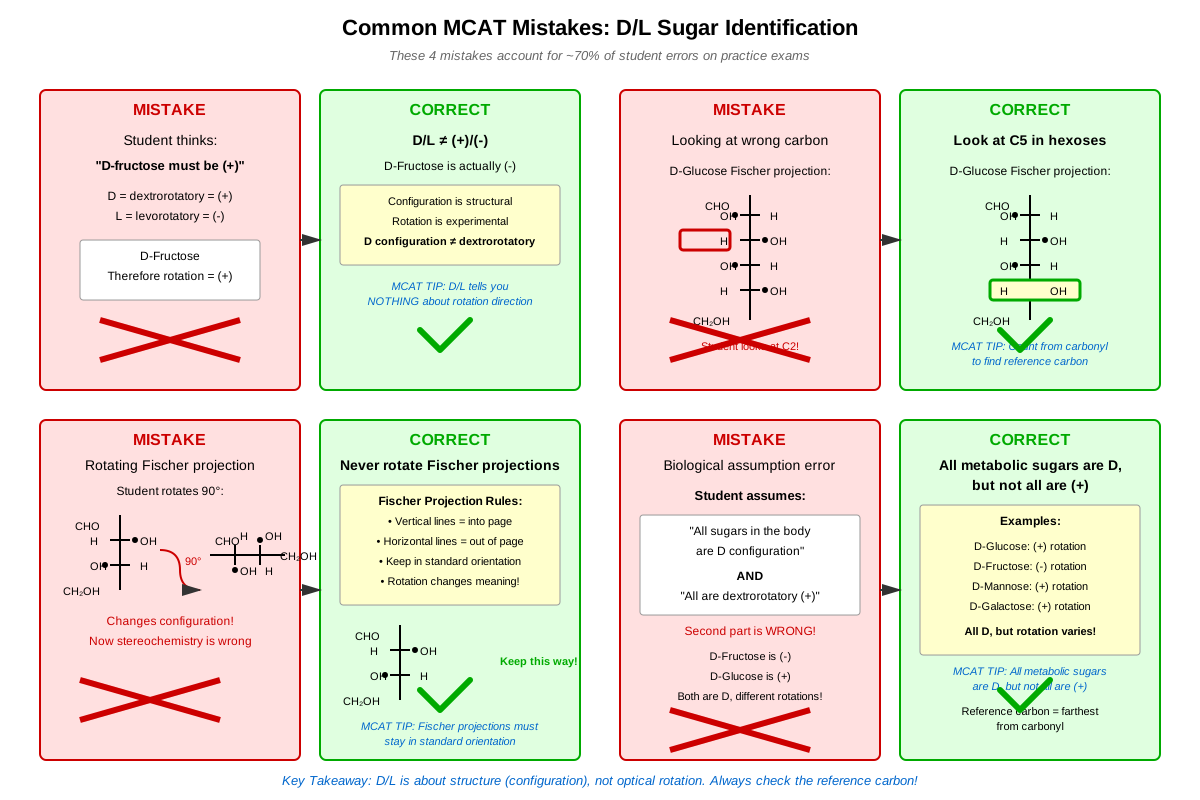
Misconception: D-sugars always rotate plane-polarized light to the right (dextrorotatory).
Correction: D/L nomenclature refers to absolute configuration, not optical rotation. D-fructose is levorotatory (-) despite being a D-sugar. The direction of optical rotation must be determined experimentally and is indicated by (+)/(-) or d/l, not D/L.
Misconception: The D/L designation depends on the configuration at all chiral centers in the molecule.
Correction: Only the configuration at the reference carbon (penultimate carbon, farthest from the carbonyl) determines D/L classification. D-glucose and D-mannose differ at C-2 but are both D-sugars because they have the same configuration at C-5.
Misconception: L-sugars are toxic or harmful to humans.
Correction: L-sugars are not toxic; they simply cannot be metabolized because human enzymes are stereospecific for D-sugars. L-sugars pass through the digestive system unchanged and are eliminated. Some are even used as non-caloric sweeteners.
Misconception: In Fischer projections, horizontal bonds go into the page and vertical bonds come out.
Correction: The opposite is true. Horizontal bonds come out of the page (toward the viewer), while vertical bonds go into the page (away from the viewer). This convention is essential for correctly determining configuration.
Misconception: D and L sugars are the same as α and β anomers.
Correction: D/L refers to the configuration at the penultimate carbon and is fixed for a given sugar. α/β refers to the configuration at the anomeric carbon (C-1 for aldoses) and can interconvert through mutarotation in solution. These are completely different classification systems.
Misconception: All D-sugars have the same configuration at every chiral center.
Correction: D-sugars only share the same configuration at the reference carbon. They can differ at all other chiral centers. D-glucose, D-mannose, D-galactose, and D-allose are all D-sugars but have different configurations at C-2, C-3, and/or C-4.
Worked Examples
Example 1: Determining D/L Configuration from a Fischer Projection
Question: Examine the following Fischer projection of a hexose. Determine whether it is a D-sugar or L-sugar.
        CHO
        |
    H—C—OH
        |
   HO—C—H
        |
    H—C—OH
        |
   HO—C—H
        |
CH₂OHSolution:
Step 1: Identify the type of sugar. The CHO group at the top indicates this is an aldose. The six carbons make it an aldohexose.
Step 2: Number the carbons from top to bottom. The CHO carbon is C-1, and the CH₂OH carbon is C-6.
Step 3: Identify the penultimate carbon (reference carbon). For this hexose, the penultimate carbon is C-5, which is the second carbon from the bottom.
Step 4: Examine the configuration at C-5. Looking at the second carbon from the bottom:
   HO—C—H
        |
The hydroxyl group (-OH) is on the LEFT side of the Fischer projection.
Step 5: Apply the D/L rule. Since the -OH on the penultimate carbon points to the left, this is an L-sugar.
Key Insight: This sugar is L-glucose. Even though it has the same molecular formula as D-glucose and differs only in the three-dimensional arrangement of atoms, it cannot be metabolized by human enzymes. This example demonstrates why stereochemistry is crucial for biological function.
Example 2: Enzyme Specificity and D/L Sugars
Question: A researcher conducts an experiment measuring glucose uptake by cells. She prepares three solutions: one containing D-glucose, one containing L-glucose, and one containing a 50:50 mixture of both. After incubating cells with each solution and measuring intracellular glucose concentration, she finds:
- D-glucose solution: High intracellular glucose
- L-glucose solution: No detectable intracellular glucose
- Mixed solution: Moderate intracellular glucose (approximately half of D-glucose alone)
Explain these results in terms of D/L sugar biochemistry and enzyme specificity.
Solution:
Step 1: Recall that glucose transporters (GLUTs) and metabolic enzymes are stereospecific for D-glucose. The active sites of these proteins evolved to recognize the specific three-dimensional structure of D-glucose.
Step 2: Analyze the D-glucose result. High intracellular glucose indicates that D-glucose is efficiently transported across the cell membrane by glucose transporters and can be detected inside cells. This is expected because D-glucose is the natural substrate.
Step 3: Analyze the L-glucose result. No detectable intracellular glucose indicates that L-glucose cannot bind to glucose transporters effectively. Even though L-glucose is the mirror image of D-glucose with identical molecular formula, its three-dimensional structure does not fit the transporter's binding site. This demonstrates absolute stereospecificity.
Step 4: Analyze the mixed solution result. Approximately half the uptake of pure D-glucose makes sense because only the D-glucose in the mixture (50% of total sugar) can be transported. The L-glucose remains in the extracellular solution. This confirms that the two enantiomers do not interfere with each other's transport—the transporter simply ignores L-glucose.
Step 5: Connect to broader concepts. This experiment illustrates why D-sugars predominate in metabolism: biological systems evolved molecular recognition machinery (transporters, enzymes) that is exquisitely sensitive to stereochemistry. The "lock and key" model of enzyme-substrate interaction requires precise three-dimensional complementarity.
Key Insight: This example demonstrates that D/L configuration is not just a naming convention—it has profound functional consequences. The inability to metabolize L-glucose explains why it has been investigated as a non-caloric sweetener and why certain metabolic disorders cannot be treated simply by providing mirror-image sugars.
Exam Strategy
Approaching MCAT Questions on D/L Sugars
When encountering D/L sugar questions on the MCAT, follow this systematic approach:
- Identify the question type: Is it asking for configuration determination, biological relevance, or enzyme specificity?
- Locate the reference carbon: Always find the penultimate carbon (farthest from carbonyl) before making any determination
- Check Fischer projection orientation: Ensure the carbonyl is at or near the top; if not, mentally reorient the structure
- Apply the right-hand rule: Right = D, Left = L for the -OH on the reference carbon
- Consider biological context: If the question involves metabolism, assume D-sugars unless explicitly stated otherwise
Trigger Words and Phrases
Watch for these high-yield terms that signal D/L sugar content:
- "Stereospecificity" or "stereoselectivity" → Think about D-sugar preference in enzymes
- "Optical activity" or "plane-polarized light" → Remember D/L is independent of (+)/(-)
- "Enantiomers" → D and L forms of the same sugar
- "Penultimate carbon" → The reference carbon for D/L determination
- "Naturally occurring" → Almost always D-sugars in human metabolism
- "Mirror image" → Signals enantiomeric relationship between D and L forms
Process of Elimination Tips
When unsure about D/L questions:
- Eliminate answers that confuse D/L with optical rotation: If an answer claims all D-sugars are dextrorotatory, eliminate it
- Eliminate answers that ignore the reference carbon: If an answer bases D/L on C-2 or C-3 configuration, it's wrong
- Eliminate answers suggesting L-sugars are toxic: L-sugars are non-metabolizable, not toxic
- Eliminate answers that confuse D/L with α/β: These are completely different classification systems
- Choose answers emphasizing enzyme stereospecificity: This is the most important functional consequence
Time Allocation
For discrete D/L questions: Spend 30-45 seconds identifying the reference carbon and determining configuration. Don't overthink—the system is straightforward once you locate the correct carbon.
For passage-based questions: Allocate 1-2 minutes to understand how D/L configuration relates to the experimental setup or clinical scenario. Often, the passage provides context that makes the question easier than it initially appears.
Memory Techniques
Mnemonics
"Right is Dexter": Remember that D comes from Latin dexter (right). If the -OH on the reference carbon points right, it's D.
"D for Delicious": Nearly all metabolizable, "delicious" sugars in human diet are D-sugars (D-glucose, D-fructose, D-galactose).
"L-amino acids, D-sugars": This complementary pattern helps remember that while sugars are predominantly D, amino acids in proteins are predominantly L.
"Penultimate = Reference": The penultimate (second-to-last) carbon is always the reference for D/L determination. "Pen-ultimate" sounds like "pen-reference."
Visualization Strategies
Mental Rotation: Practice mentally rotating Fischer projections to verify D/L configuration. Imagine holding the molecule with the carbonyl at the top and looking at the bottom chiral center.
Mirror Image Visualization: When thinking about enantiomers, visualize holding your hands up as mirror images. Your right hand is D, your left hand is L—they're mirror images but not superimposable.
Color Coding: When studying Fischer projections, use one color for D-sugars and another for L-sugars. This visual association strengthens memory.
Acronyms
DRIP: D-sugars are Right, In Projections (the -OH points right in Fischer projections)
LEAP: L-sugars are Enantiomers And Point left (in Fischer projections)
Summary
D and L sugars represent a fundamental classification system in carbohydrate biochemistry based on the configuration of the penultimate carbon in Fischer projections. D-sugars have the hydroxyl group on this reference carbon pointing to the right, while L-sugars have it pointing to the left. This seemingly simple distinction has profound biological consequences: nearly all naturally occurring sugars in human metabolism are D-sugars because enzymes evolved stereospecific active sites that recognize only this configuration. The D/L system describes absolute configuration and is independent of optical rotation direction, which must be determined experimentally. Understanding D/L nomenclature is essential for the MCAT because it connects stereochemistry to metabolic function, explains enzyme specificity, and provides the foundation for understanding carbohydrate structure and reactivity. Mastery requires the ability to determine configuration from Fischer projections, recognize the biological significance of D-sugar predominance, and distinguish D/L nomenclature from other classification systems like α/β anomers and (+)/(-) optical rotation.
Key Takeaways
- D and L configuration is determined solely by the position of the -OH group on the penultimate carbon: right = D, left = L
- Nearly all metabolically active sugars in humans are D-sugars due to enzyme stereospecificity
- D/L nomenclature describes absolute configuration, not optical rotation; D-fructose is levorotatory despite being a D-sugar
- D and L forms of the same sugar are enantiomers (mirror images), while sugars differing at other carbons are diastereomers
- Enzymes cannot process L-sugars because their active sites are stereospecific for D-sugar three-dimensional structure
- Fischer projections use the convention that horizontal bonds come out of the page and vertical bonds go into the page
- The biological preference for D-sugars (and L-amino acids) reflects evolutionary optimization of molecular recognition systems
Related Topics
Mutarotation and Anomers: Understanding D/L configuration provides the foundation for learning about α and β anomers, which describe the configuration at the anomeric carbon after ring closure. Mastering D/L nomenclature first prevents confusion between these different classification systems.
Carbohydrate Metabolism: Glycolysis, gluconeogenesis, and the pentose phosphate pathway all process D-sugars exclusively. Understanding why requires knowledge of D/L stereochemistry and enzyme specificity.
Amino Acid Stereochemistry: The complementary pattern of L-amino acids in proteins and D-sugars in carbohydrates reveals fundamental principles of biological molecular recognition and evolutionary biochemistry.
Glycosidic Bonds and Disaccharides: The stereochemistry of individual monosaccharides determines how they link together and the three-dimensional structure of resulting polysaccharides.
Optical Activity and Polarimetry: While independent of D/L configuration, optical rotation provides experimental methods for characterizing sugars and understanding their physical properties.
Practice CTA
Now that you've mastered the core concepts of D and L sugars, it's time to reinforce your understanding through active practice. Attempt the practice questions and flashcards to test your ability to determine configuration from Fischer projections, explain enzyme stereospecificity, and apply D/L concepts to MCAT-style scenarios. Remember, the difference between passive reading and active mastery lies in deliberate practice. Each question you work through strengthens the neural pathways that will serve you on test day. You've built the foundation—now construct the expertise that will earn you points on the MCAT!
Sign up free to keep reading
Create a free AnvayaPrep account to finish this MCAT guide on D and L sugars — plus flashcards and practice questions.