Overview
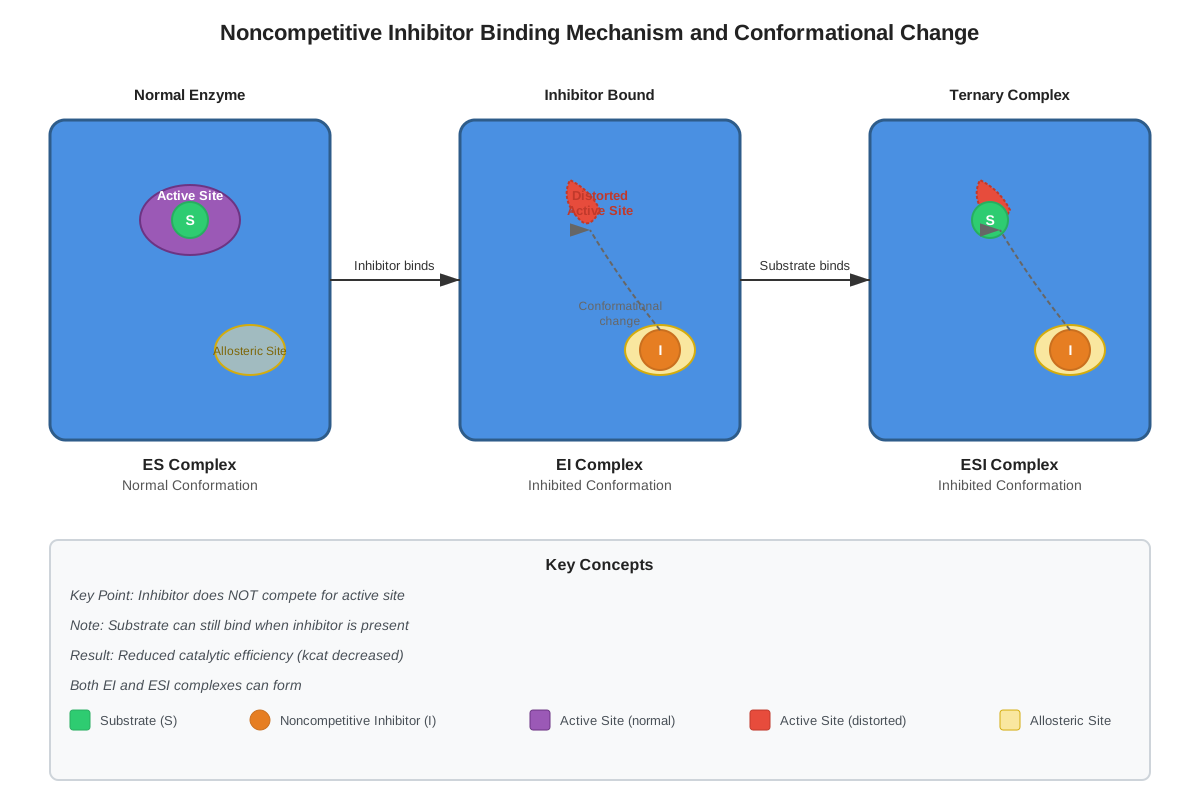
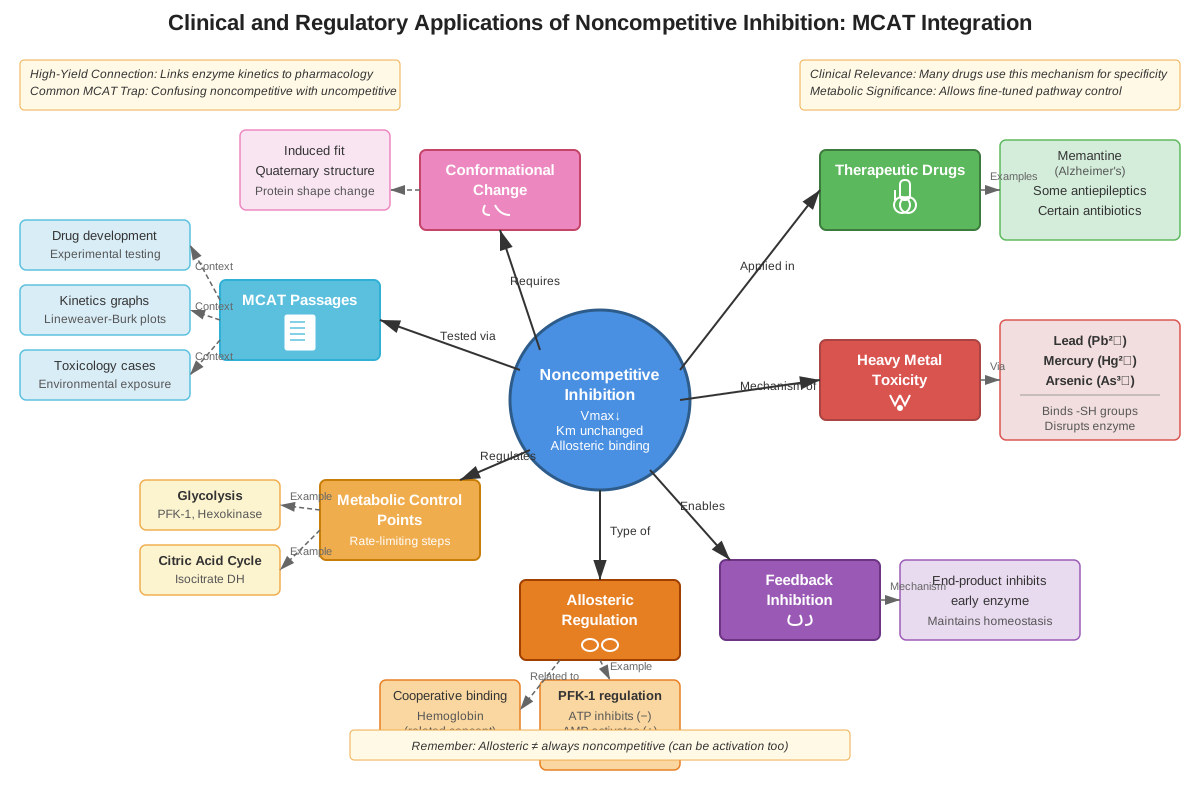
Noncompetitive inhibition represents one of the most clinically and biochemically significant mechanisms by which enzyme activity can be regulated. Unlike competitive inhibitors that vie for the active site, noncompetitive inhibitors bind to an allosteric site—a location distinct from the enzyme's active site—causing a conformational change that reduces the enzyme's catalytic efficiency. This mechanism is fundamental to understanding drug action, metabolic regulation, and cellular signaling pathways that appear frequently on the MCAT.
For the MCAT, noncompetitive inhibition is a high-yield topic that bridges multiple disciplines: Biochemistry, pharmacology, and cellular biology. Questions often present enzyme kinetics data, Lineweaver-Burk plots, or clinical scenarios involving drugs or toxins that act as noncompetitive inhibitors. Understanding this concept requires mastery of enzyme kinetics parameters (Vmax and Km), the ability to interpret graphical data, and the capacity to distinguish between different inhibition mechanisms—skills that are tested extensively in both passage-based and discrete questions.
Within the broader context of Enzymes and enzyme regulation, noncompetitive inhibition represents a critical control mechanism that cells use to fine-tune metabolic pathways. This topic connects directly to allosteric regulation, feedback inhibition, and cooperative binding—all essential concepts for understanding how biological systems maintain homeostasis. The principles learned here extend beyond enzymes to receptor pharmacology, making this knowledge applicable across multiple MCAT sections, including the Biological and Biochemical Foundations of Living Systems.
Learning Objectives
- [ ] Define noncompetitive inhibition using accurate Biochemistry terminology
- [ ] Explain why noncompetitive inhibition matters for the MCAT
- [ ] Apply noncompetitive inhibition to exam-style questions
- [ ] Identify common mistakes related to noncompetitive inhibition
- [ ] Connect noncompetitive inhibition to related Biochemistry concepts
- [ ] Distinguish noncompetitive inhibition from competitive, uncompetitive, and mixed inhibition using kinetic parameters
- [ ] Interpret Lineweaver-Burk and Michaelis-Menten plots to identify noncompetitive inhibition patterns
- [ ] Predict the effects of noncompetitive inhibitors on enzyme kinetics in various substrate concentration scenarios
Prerequisites
- Michaelis-Menten kinetics: Understanding Vmax, Km, and the hyperbolic relationship between substrate concentration and reaction velocity is essential for recognizing how noncompetitive inhibitors alter these parameters
- Enzyme structure and function: Knowledge of active sites, substrate binding, and catalytic mechanisms provides the foundation for understanding how allosteric binding affects enzyme activity
- Basic enzyme kinetics graphs: Familiarity with Michaelis-Menten plots and Lineweaver-Burk (double reciprocal) plots is necessary for interpreting kinetic data presented in MCAT questions
- Protein structure and conformational changes: Understanding how ligand binding can induce structural changes in proteins explains the mechanism by which noncompetitive inhibitors reduce enzyme activity
- Chemical equilibrium and binding: Knowledge of reversible binding and equilibrium constants helps explain inhibitor-enzyme interactions
Why This Topic Matters
Noncompetitive inhibition has profound clinical significance, as many therapeutic drugs and toxins operate through this mechanism. Heavy metal poisoning (lead, mercury) often involves noncompetitive inhibition of essential enzymes. Numerous medications, including certain antihypertensives, anticonvulsants, and chemotherapeutic agents, function as noncompetitive inhibitors. Understanding this mechanism is crucial for predicting drug effects, side effects, and drug-drug interactions—concepts that appear in both biochemistry and physiology passages on the MCAT.
From an exam perspective, noncompetitive inhibition appears in approximately 15-20% of enzyme kinetics questions on the MCAT, making it a high-yield topic. Questions typically fall into three categories: (1) interpretation of kinetic plots showing the effects of inhibitors, (2) passage-based questions describing experimental enzyme studies with various inhibitors, and (3) clinical vignettes requiring students to predict the effects of drugs or toxins on enzyme function. The MCAT frequently tests the ability to distinguish between inhibition types based on changes in Vmax and Km, making this a critical skill for achieving a competitive score.
In MCAT passages, noncompetitive inhibition commonly appears in contexts involving: metabolic pathway regulation (feedback inhibition), drug mechanism studies, toxicology scenarios, experimental enzyme characterization, and allosteric regulation of key metabolic enzymes like phosphofructokinase or pyruvate kinase. The ability to quickly identify noncompetitive inhibition from graphical data and predict its effects on enzyme kinetics can save valuable time during the exam and improve accuracy on related questions.
Core Concepts
Definition and Mechanism of Noncompetitive Inhibition
Noncompetitive inhibition occurs when an inhibitor binds to an enzyme at a site other than the active site (an allosteric site), regardless of whether substrate is bound. This binding induces a conformational change in the enzyme that reduces its catalytic efficiency without preventing substrate binding. The hallmark of pure noncompetitive inhibition is that the inhibitor can bind to both the free enzyme (E) and the enzyme-substrate complex (ES) with equal affinity.
The binding equilibrium can be represented as:
E + S ⇌ ES → E + P
+I ↕    +I ↕
EI + S ⇌ EIS (inactive)
In this mechanism, both EI and EIS complexes are catalytically inactive or significantly less active than the uninhibited enzyme. The key distinction from competitive inhibition is that increasing substrate concentration cannot overcome noncompetitive inhibition because the inhibitor does not compete for the active site.
Kinetic Parameters: Vmax and Km Changes
The defining characteristic of noncompetitive inhibition in Biochemistry is its effect on kinetic parameters:
- Vmax decreases: Because some enzyme molecules are bound to inhibitor and rendered inactive (or less active), the maximum velocity achievable even at saturating substrate concentrations is reduced
- Km remains unchanged: Since the inhibitor does not affect substrate binding affinity at the active site, the substrate concentration required to reach half-maximal velocity remains constant
This pattern creates a distinctive signature on kinetic plots that is frequently tested on the MCAT. The apparent Vmax in the presence of inhibitor (Vmax,app) can be calculated as:
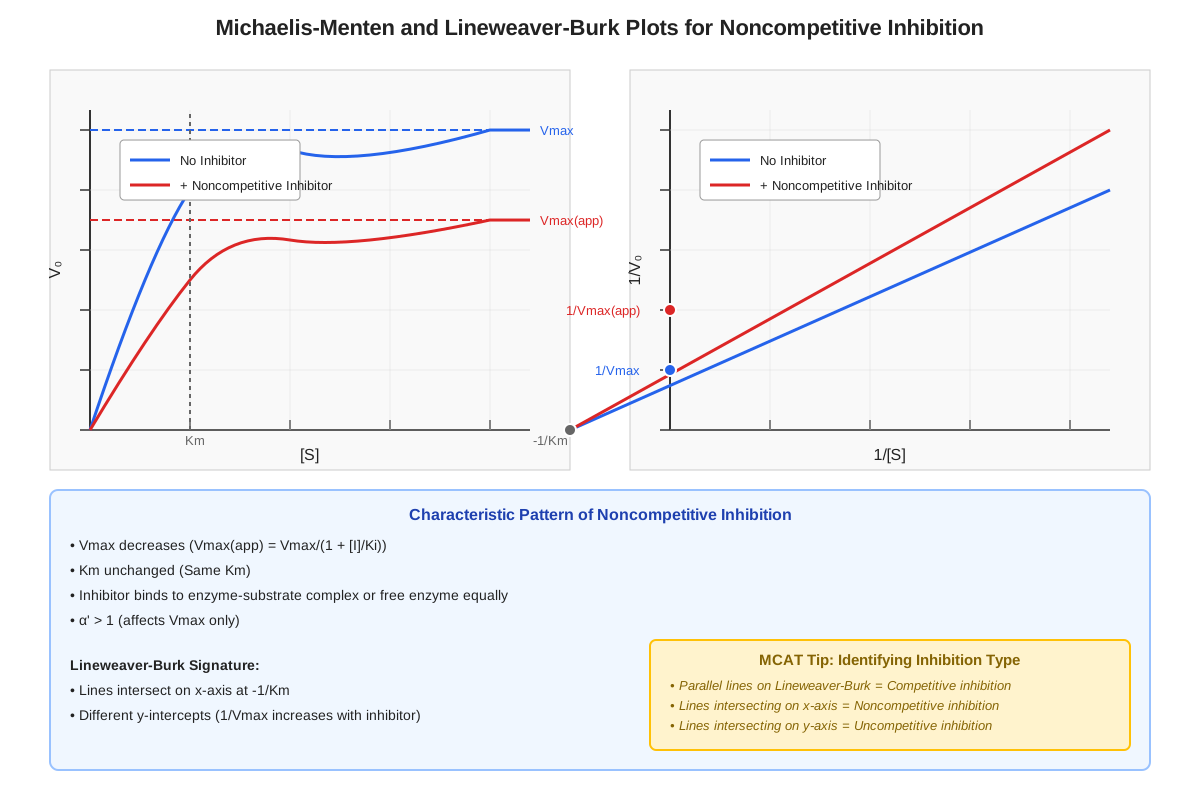
Vmax,app = Vmax / (1 + [I]/Ki)Where [I] is inhibitor concentration and Ki is the inhibitor dissociation constant. As inhibitor concentration increases, Vmax,app decreases proportionally, while Km remains constant.
Graphical Representation
Understanding how noncompetitive inhibition appears on different plot types is essential for MCAT success:
Michaelis-Menten Plot:
- The uninhibited curve shows the typical hyperbolic relationship between [S] and velocity
- With noncompetitive inhibitor present, the curve maintains the same shape but has a lower plateau (reduced Vmax)
- The curve still reaches half of its maximum velocity at the same substrate concentration (unchanged Km)
- Multiple inhibitor concentrations produce a family of curves with progressively lower Vmax values
Lineweaver-Burk Plot (Double Reciprocal):
- This plot graphs 1/V versus 1/[S], converting the hyperbola to straight lines
- Uninhibited enzyme: a single line with y-intercept = 1/Vmax and x-intercept = -1/Km
- With noncompetitive inhibitor: the line has a steeper slope and higher y-intercept (reflecting decreased Vmax)
- Critical feature: All lines intersect at the x-axis at the same point (-1/Km), indicating unchanged Km
- This intersection pattern is the diagnostic hallmark of noncompetitive inhibition on Lineweaver-Burk plots
Molecular Basis of Allosteric Inhibition
The molecular mechanism underlying noncompetitive inhibition involves conformational changes transmitted through the protein structure. When an inhibitor binds to an allosteric site, it stabilizes a protein conformation that is less catalytically efficient. This may involve:
- Active site distortion: The conformational change subtly alters the geometry of the active site, reducing catalytic efficiency without completely preventing substrate binding
- Reduced flexibility: The inhibitor may restrict conformational changes necessary for the catalytic cycle
- Altered transition state stabilization: The enzyme may bind substrate normally but be less effective at stabilizing the transition state
- Disrupted cofactor positioning: For enzymes requiring cofactors, allosteric inhibitors may misalign these essential components
Comparison with Other Inhibition Types
Understanding noncompetitive inhibition requires distinguishing it from other inhibition mechanisms:
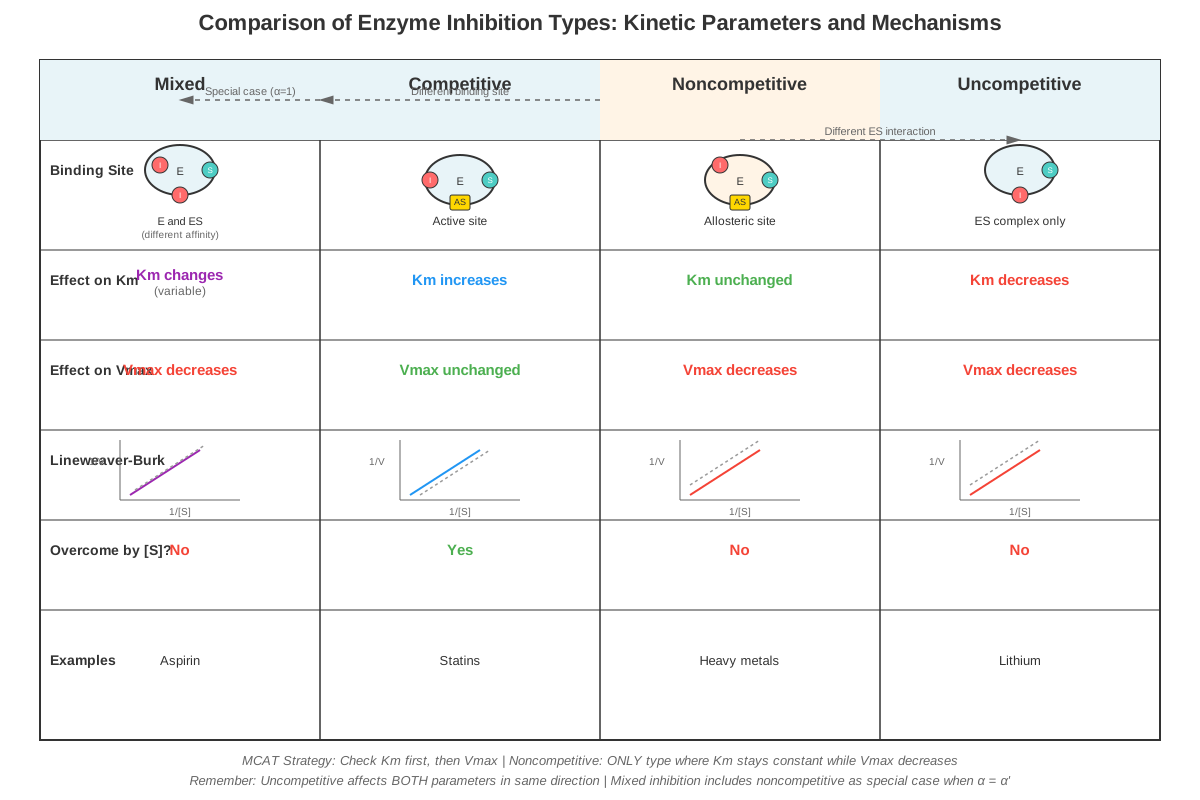
| Inhibition Type | Vmax | Km | Inhibitor Binding Site | Overcome by [S]? | Lineweaver-Burk Pattern |
|---|---|---|---|---|---|
| Competitive | Unchanged | Increases | Active site | Yes | Lines intersect on y-axis |
| Noncompetitive | Decreases | Unchanged | Allosteric site | No | Lines intersect on x-axis |
| Uncompetitive | Decreases | Decreases | ES complex only | No | Parallel lines |
| Mixed | Decreases | Increases or decreases | Allosteric site | Partially | Lines intersect above/below x-axis |
Mixed inhibition is often confused with noncompetitive inhibition. The key difference is that in pure noncompetitive inhibition, the inhibitor binds E and ES with equal affinity, while in mixed inhibition, the inhibitor has different affinities for E versus ES, resulting in changes to both Vmax and Km.
Physiological and Pharmacological Examples
Several clinically relevant examples illustrate noncompetitive inhibition:
- Heavy metal poisoning: Lead and mercury bind to sulfhydryl groups on enzymes at sites distant from the active site, causing conformational changes that reduce activity
- Aspirin and cyclooxygenase: While aspirin is primarily an irreversible inhibitor, some NSAIDs act as noncompetitive inhibitors of COX enzymes
- Ketamine and NMDA receptors: Though technically a receptor rather than an enzyme, ketamine's mechanism illustrates allosteric inhibition principles
- Feedback inhibition: Many biosynthetic pathways use end products as noncompetitive inhibitors of early pathway enzymes (e.g., CTP inhibition of aspartate transcarbamoylase)
Reversibility and Binding Kinetics
Most noncompetitive inhibitors discussed on the MCAT are reversible, meaning they bind through non-covalent interactions and can dissociate from the enzyme. The equilibrium between bound and unbound states is described by the inhibitor constant (Ki):
Ki = [E][I] / [EI]A lower Ki indicates tighter binding and more potent inhibition. The fraction of enzyme activity remaining in the presence of inhibitor depends on the ratio [I]/Ki. When [I] = Ki, enzyme activity is reduced to 50% of maximum.
Irreversible noncompetitive inhibitors also exist, forming covalent bonds with amino acid residues at allosteric sites. These are less common but include certain toxins and some therapeutic agents. The distinction between reversible and irreversible inhibition affects treatment strategies for poisoning and drug overdose.
Quantitative Analysis and Calculations
For MCAT purposes, students should be comfortable with basic calculations involving noncompetitive inhibition:
The Michaelis-Menten equation in the presence of noncompetitive inhibitor becomes:
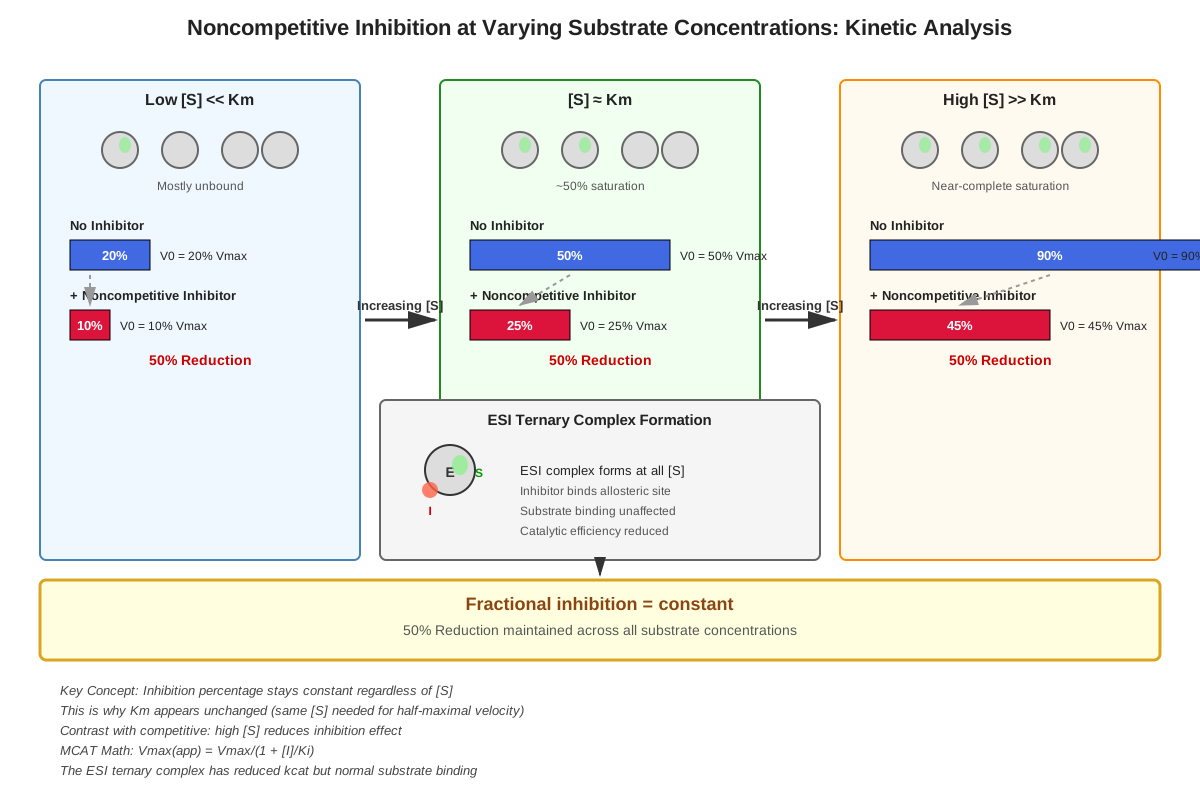
V = (Vmax / (1 + [I]/Ki)) × [S] / (Km + [S])This equation shows that the inhibitor affects only the Vmax term, leaving the Km term unchanged. At very high substrate concentrations ([S] >> Km), the equation simplifies to:
V = Vmax / (1 + [I]/Ki)This demonstrates that even at saturating substrate concentrations, velocity is reduced proportionally to inhibitor concentration—a key concept for understanding why increasing substrate cannot overcome noncompetitive inhibition.
Concept Relationships
The concepts within noncompetitive inhibition are interconnected through a logical framework. Allosteric binding → causes conformational changes → which lead to reduced catalytic efficiency → manifesting as decreased Vmax → while substrate binding affinity remains unchanged → resulting in constant Km. This cascade explains why the graphical signatures on Lineweaver-Burk plots show intersecting lines at the x-axis.
Noncompetitive inhibition connects to prerequisite knowledge of Michaelis-Menten kinetics by modifying the fundamental equation that describes enzyme behavior. Understanding how Vmax and Km are defined and measured is essential for recognizing how noncompetitive inhibitors alter these parameters. The concept builds on protein structure knowledge, as allosteric regulation depends on the ability of proteins to adopt multiple conformational states.
Within the broader topic of Enzymes, noncompetitive inhibition relates to allosteric regulation, cooperative binding, and feedback inhibition. Many allosterically regulated enzymes can be inhibited noncompetitively by regulatory molecules. The concept also connects to metabolic pathway regulation, where end products often act as noncompetitive inhibitors of rate-limiting enzymes, providing negative feedback control.
Looking forward, mastery of noncompetitive inhibition enables understanding of more complex topics: drug-receptor interactions (many drugs act as allosteric modulators), signal transduction (where allosteric changes propagate signals), and metabolic integration (where multiple pathways are coordinated through allosteric regulation). The principles learned here apply directly to understanding how cells respond to changing metabolic demands and how pharmaceutical interventions can modulate enzyme activity.
Quick check — test yourself on Noncompetitive inhibition so far.
Try Flashcards →High-Yield Facts
⭐ Noncompetitive inhibition decreases Vmax while leaving Km unchanged—this is the single most important distinguishing feature for MCAT questions
⭐ On Lineweaver-Burk plots, noncompetitive inhibition produces lines that intersect on the x-axis at -1/Km, indicating unchanged Km
⭐ Increasing substrate concentration cannot overcome noncompetitive inhibition because the inhibitor does not compete for the active site
⭐ Noncompetitive inhibitors bind to allosteric sites (sites distinct from the active site) on either the free enzyme or the enzyme-substrate complex
⭐ Pure noncompetitive inhibitors bind E and ES with equal affinity, distinguishing them from mixed inhibitors
- The apparent Vmax decreases proportionally to inhibitor concentration according to the relationship Vmax,app = Vmax/(1 + [I]/Ki)
- Heavy metals like lead and mercury commonly act as noncompetitive inhibitors by binding to sulfhydryl groups
- Noncompetitive inhibition is a key mechanism for feedback inhibition in biosynthetic pathways
- The inhibitor constant (Ki) describes the affinity of the inhibitor for the enzyme; lower Ki means more potent inhibition
- Noncompetitive inhibition can be reversible (non-covalent binding) or irreversible (covalent modification)
- On Michaelis-Menten plots, noncompetitive inhibition produces curves with the same shape but lower maximum velocity
- The fraction of active enzyme in the presence of noncompetitive inhibitor is 1/(1 + [I]/Ki)
Common Misconceptions
Misconception: Noncompetitive inhibitors prevent substrate from binding to the enzyme.
Correction: Noncompetitive inhibitors do NOT prevent substrate binding; they bind to an allosteric site and reduce catalytic efficiency. Substrate can still bind normally to the active site, which is why Km remains unchanged. The enzyme-substrate complex forms but is less effective at converting substrate to product.
Misconception: Increasing substrate concentration can eventually overcome noncompetitive inhibition.
Correction: Unlike competitive inhibition, noncompetitive inhibition CANNOT be overcome by increasing substrate concentration. Since the inhibitor binds to a different site than the substrate, adding more substrate does not displace the inhibitor. The Vmax is fundamentally reduced, and no amount of substrate can restore it to the uninhibited level.
Misconception: All allosteric inhibitors are noncompetitive inhibitors.
Correction: While noncompetitive inhibitors are allosteric (binding outside the active site), not all allosteric inhibitors are noncompetitive. Uncompetitive inhibitors bind allosterically but only to the ES complex, and mixed inhibitors bind allosterically with different affinities for E versus ES. The term "noncompetitive" specifically refers to inhibitors that bind E and ES with equal affinity.
Misconception: Noncompetitive inhibition and mixed inhibition are the same thing.
Correction: Noncompetitive inhibition is a special case of mixed inhibition where the inhibitor has equal affinity for E and ES. In general mixed inhibition, the inhibitor binds E and ES with different affinities, causing changes in both Vmax and Km. Pure noncompetitive inhibition changes only Vmax, leaving Km constant.
Misconception: On Lineweaver-Burk plots, noncompetitive inhibition produces parallel lines.
Correction: Parallel lines indicate uncompetitive inhibition, not noncompetitive inhibition. Noncompetitive inhibition produces lines that intersect on the x-axis at -1/Km. This intersection pattern reflects the unchanged Km and decreased Vmax characteristic of noncompetitive inhibition.
Misconception: Noncompetitive inhibitors completely inactivate the enzyme.
Correction: Noncompetitive inhibitors reduce enzyme activity but typically do not eliminate it entirely. The enzyme-inhibitor complex (EI) and enzyme-substrate-inhibitor complex (ESI) may retain some catalytic activity, just at a reduced rate. Complete inactivation would require saturating concentrations of a very high-affinity inhibitor.
Misconception: The Km value tells you about the strength of inhibitor binding.
Correction: The inhibitor constant (Ki), not Km, describes inhibitor binding affinity. Km describes substrate binding affinity and remains unchanged in noncompetitive inhibition. Ki is analogous to Km but specifically for the inhibitor-enzyme interaction; a lower Ki indicates stronger inhibitor binding.
Worked Examples
Example 1: Interpreting Kinetic Data
Question: An enzyme has a Vmax of 100 μmol/min and a Km of 5 mM in the absence of inhibitor. When inhibitor X is added at a concentration equal to its Ki, the enzyme shows a Vmax of 50 μmol/min and a Km of 5 mM. What type of inhibition does inhibitor X display? If the substrate concentration is 20 mM, what is the reaction velocity with and without inhibitor?
Solution:
Step 1: Identify the inhibition type based on kinetic parameter changes.
- Vmax decreased from 100 to 50 μmol/min
- Km remained constant at 5 mM
- This pattern (decreased Vmax, unchanged Km) is diagnostic of noncompetitive inhibition
Step 2: Calculate velocity without inhibitor using the Michaelis-Menten equation.
V = Vmax × [S] / (Km + [S])
V = 100 × 20 / (5 + 20)
V = 100 × 20 / 25 = 80 μmol/min
Step 3: Calculate velocity with inhibitor.
Since [I] = Ki, the denominator (1 + [I]/Ki) = (1 + 1) = 2
V = (Vmax / 2) × [S] / (Km + [S])
V = 50 × 20 / (5 + 20)
V = 50 × 20 / 25 = 40 μmol/min
Key Insight: Notice that the velocity with inhibitor is exactly half the velocity without inhibitor. This makes sense because when [I] = Ki, the effective Vmax is reduced by 50%, and since Km is unchanged, the velocity at any substrate concentration is also reduced by 50%. This relationship holds true at all substrate concentrations for noncompetitive inhibition when [I] = Ki.
Example 2: Analyzing a Lineweaver-Burk Plot
Question: A research team studies an enzyme and generates a Lineweaver-Burk plot. The uninhibited enzyme produces a line with a y-intercept of 0.01 min/μmol and an x-intercept of -0.2 mM⁻¹. When compound Z is added, a new line appears with a y-intercept of 0.02 min/μmol and an x-intercept of -0.2 mM⁻¹. What type of inhibitor is compound Z? What are the Vmax and Km values with and without inhibitor?
Solution:
Step 1: Identify the inhibition pattern.
- Both lines have the same x-intercept (-0.2 mM⁻¹)
- The inhibited line has a higher y-intercept (0.02 vs 0.01)
- Lines intersecting at the x-axis indicate noncompetitive inhibition
Step 2: Calculate Km (same for both conditions).
- x-intercept = -1/Km
- -0.2 mM⁻¹ = -1/Km
- Km = 5 mM (for both uninhibited and inhibited conditions)
Step 3: Calculate Vmax without inhibitor.
- y-intercept = 1/Vmax
- 0.01 min/μmol = 1/Vmax
- Vmax = 100 μmol/min
Step 4: Calculate Vmax with inhibitor.
- y-intercept = 1/Vmax,app
- 0.02 min/μmol = 1/Vmax,app
- Vmax,app = 50 μmol/min
Key Insight: The doubling of the y-intercept corresponds to a halving of Vmax, which is characteristic of noncompetitive inhibition. The unchanged x-intercept confirms that Km is unaffected. This graphical analysis allows rapid identification of inhibition type without needing to know inhibitor concentration or Ki—a valuable skill for quickly answering MCAT questions.
Exam Strategy
When approaching MCAT questions on noncompetitive inhibition, employ a systematic strategy:
Step 1: Identify the question type
- Kinetic plot interpretation (most common): Look for Lineweaver-Burk or Michaelis-Menten plots
- Passage-based experimental design: Focus on how researchers test different inhibitors
- Clinical vignette: Connect drug/toxin mechanism to enzyme kinetics
- Discrete questions: Often test direct knowledge of kinetic parameter changes
Step 2: Look for trigger words and phrases
- "Allosteric site" or "site distinct from active site" → suggests noncompetitive
- "Cannot be overcome by substrate" → rules out competitive, suggests noncompetitive
- "Vmax decreases, Km unchanged" → definitive for noncompetitive
- "Lines intersect on x-axis" (for Lineweaver-Burk) → diagnostic for noncompetitive
- "Feedback inhibition" or "end product inhibition" → often noncompetitive mechanism
Step 3: Use process of elimination
- If Vmax is unchanged → eliminate noncompetitive, uncompetitive, and mixed
- If Km is unchanged → eliminate competitive, uncompetitive, and most mixed
- If lines are parallel on Lineweaver-Burk → eliminate all except uncompetitive
- If increasing [S] overcomes inhibition → eliminate noncompetitive and uncompetitive
Step 4: Verify your answer
For noncompetitive inhibition, ALL of these must be true:
- Vmax decreases (or y-intercept increases on Lineweaver-Burk)
- Km unchanged (or x-intercept unchanged on Lineweaver-Burk)
- Inhibitor binds to allosteric site
- Cannot be overcome by increasing substrate concentration
Time allocation advice:
- Spend 15-20 seconds identifying the inhibition pattern from graphs
- Don't waste time on complex calculations unless specifically asked
- If a passage describes multiple inhibitors, create a quick comparison table
- For discrete questions, recall the Vmax/Km pattern first, then work backward to mechanism
Exam Tip: If you see a Lineweaver-Burk plot with multiple lines, immediately check where they intersect. X-axis intersection = noncompetitive; Y-axis intersection = competitive; parallel lines = uncompetitive. This single check can answer the question in seconds.
Memory Techniques
Mnemonic for Kinetic Parameters: "NonCompetitive = No Change in Km"
- The "NC" in noncompetitive reminds you that Km does Not Change
- By elimination, Vmax must be what changes (decreases)
Visualization Strategy: Picture a lock (enzyme) with two keyholes:
- The main keyhole (active site) accepts the correct key (substrate)
- A secondary keyhole (allosteric site) accepts a different key (inhibitor)
- When the inhibitor key is inserted, it jams the lock mechanism so the main key can still enter but can't turn as effectively
- This represents how substrate can still bind (unchanged Km) but catalysis is impaired (decreased Vmax)
Acronym for Lineweaver-Burk Intersections: "X-axis = NonCompetitive" (X-NC)
- X marks the spot where noncompetitive lines meet
- Competitive lines meet on the Y-axis (think "Y compete?")
- Uncompetitive lines are parallel (think "U" for "Uniform slope")
Allosteric Site Memory Aid: "Allosteric = Away from active site"
- The repeated "A" sound reinforces that allosteric sites are spatially separated
- This helps distinguish noncompetitive (allosteric) from competitive (active site) inhibition
Substrate Concentration Rule: "Noncompetitive inhibition is non-negotiable"
- No amount of substrate negotiation (increasing concentration) can overcome it
- This contrasts with competitive inhibition, where substrate can "compete" and win with high enough concentration
Summary
Noncompetitive inhibition represents a crucial enzyme regulation mechanism where inhibitors bind to allosteric sites, causing conformational changes that reduce catalytic efficiency without preventing substrate binding. The hallmark of this inhibition type is decreased Vmax with unchanged Km, reflecting the fact that substrate affinity remains normal while maximum catalytic capacity is diminished. On Lineweaver-Burk plots, noncompetitive inhibition produces lines that intersect on the x-axis, providing a rapid diagnostic tool for MCAT questions. Unlike competitive inhibition, noncompetitive inhibition cannot be overcome by increasing substrate concentration, making it an effective regulatory mechanism in biological systems and a common mode of action for drugs and toxins. Understanding the molecular basis—allosteric binding inducing conformational changes—connects this topic to broader themes of protein structure-function relationships and metabolic regulation. For MCAT success, students must master the ability to identify noncompetitive inhibition from kinetic data, distinguish it from other inhibition types, and apply these principles to clinical and experimental scenarios.
Key Takeaways
- Noncompetitive inhibition decreases Vmax while keeping Km constant, distinguishing it from all other inhibition types
- Inhibitors bind to allosteric sites (not the active site), allowing simultaneous substrate and inhibitor binding to the enzyme
- Increasing substrate concentration cannot overcome noncompetitive inhibition because the inhibitor doesn't compete for the active site
- Lineweaver-Burk plots show lines intersecting on the x-axis (-1/Km) for noncompetitive inhibition—a key diagnostic feature
- Pure noncompetitive inhibitors bind E and ES with equal affinity, differentiating them from mixed inhibitors that show Km changes
- Clinical relevance includes heavy metal poisoning, drug mechanisms, and feedback inhibition in metabolic pathways
- Quantitative relationships involve the inhibitor constant Ki, with enzyme activity decreasing according to 1/(1 + [I]/Ki)
Related Topics
Competitive Inhibition: Understanding how inhibitors that compete for the active site differ from noncompetitive inhibitors is essential for comprehensive enzyme kinetics mastery. Competitive inhibition increases Km while leaving Vmax unchanged—the opposite pattern of noncompetitive inhibition.
Uncompetitive Inhibition: This less common inhibition type involves inhibitors that bind only to the ES complex, decreasing both Vmax and Km. Mastering noncompetitive inhibition provides the foundation for understanding this related mechanism.
Allosteric Regulation: Noncompetitive inhibition is one example of allosteric regulation. Expanding to allosteric activators and cooperative binding in multi-subunit enzymes builds on these principles.
Enzyme Regulation in Metabolic Pathways: The principles of noncompetitive inhibition apply directly to understanding feedback inhibition, feedforward activation, and hormonal regulation of metabolism—high-yield topics for MCAT biochemistry passages.
Pharmacology and Drug-Receptor Interactions: Many drugs act as allosteric modulators of receptors, applying the same principles as noncompetitive enzyme inhibition. This connection bridges biochemistry and pharmacology for the MCAT.
Practice CTA
Now that you've mastered the core concepts of noncompetitive inhibition, it's time to reinforce your understanding through active practice. Attempt the practice questions to test your ability to identify inhibition patterns from kinetic data, interpret Lineweaver-Burk plots, and apply these concepts to clinical scenarios. Use the flashcards to drill the high-yield facts until you can instantly recall the kinetic parameter changes and graphical signatures. Remember: understanding enzyme inhibition mechanisms is not just about memorizing patterns—it's about developing the analytical skills to interpret experimental data and predict biological outcomes, skills that will serve you throughout the MCAT and your medical career. You've got this!
Sign up free to keep reading
Create a free AnvayaPrep account to finish this MCAT guide on Noncompetitive inhibition — plus flashcards and practice questions.