Overview
Tonicity is a fundamental concept in Cell Biology that describes the relative concentration of solutes in two solutions separated by a selectively permeable membrane, specifically as it relates to the movement of water and the resulting effect on cell volume. Unlike osmolarity, which measures the absolute concentration of solute particles, tonicity is a functional term that predicts the direction of water movement and the consequent changes in cell shape and volume. Understanding tonicity is essential for predicting cellular responses to different extracellular environments—a skill tested extensively on the MCAT through both discrete questions and passage-based scenarios.
For the MCAT, tonicity represents a high-yield topic that bridges multiple disciplines. It appears in Biology passages involving cellular physiology, homeostasis, and membrane transport, but also connects to biochemistry (protein function in different osmotic environments), physiology (kidney function and fluid balance), and even organic chemistry (properties of polar versus nonpolar solutes). The MCAT frequently tests tonicity through experimental passages where students must predict cellular responses to various solutions, interpret data from osmotic experiments, or explain clinical scenarios involving fluid imbalances. Questions may present red blood cells in different solutions, plant cells undergoing plasmolysis, or patients receiving intravenous fluids.
The concept of tonicity is inseparable from understanding membrane permeability, osmosis, and cellular homeostasis. It provides the framework for understanding how cells maintain their shape and volume despite being in constantly changing environments. This topic connects directly to more advanced concepts such as action potential propagation (which depends on maintaining proper ion gradients), kidney physiology (which regulates body fluid tonicity), and even evolutionary adaptations (how organisms survive in marine versus freshwater environments). Mastering tonicity enables students to approach MCAT questions with confidence, as it forms the foundation for understanding virtually all aspects of cellular water balance and volume regulation.
Learning Objectives
- [ ] Define Tonicity using accurate Biology terminology
- [ ] Explain why Tonicity matters for the MCAT
- [ ] Apply Tonicity to exam-style questions
- [ ] Identify common mistakes related to Tonicity
- [ ] Connect Tonicity to related Biology concepts
- [ ] Distinguish between tonicity and osmolarity in biological contexts
- [ ] Predict cellular responses (crenation, lysis, turgor) to hypertonic, hypotonic, and isotonic solutions
- [ ] Analyze experimental data involving osmotic changes and interpret graphical representations of cell volume changes
- [ ] Explain the role of cell walls and contractile vacuoles in managing osmotic stress
Prerequisites
- Osmosis and diffusion: Understanding passive transport mechanisms is essential because tonicity describes the consequences of osmotic water movement across membranes
- Cell membrane structure: Knowledge of the phospholipid bilayer and selective permeability explains why water moves freely while many solutes do not
- Concentration gradients: Familiarity with how concentration differences drive molecular movement provides the foundation for understanding water movement in response to solute concentration
- Basic cell structure: Recognizing differences between animal and plant cells is necessary to predict different responses to osmotic stress
- Molarity and solution chemistry: Understanding concentration units enables calculation and comparison of solution strengths
Why This Topic Matters
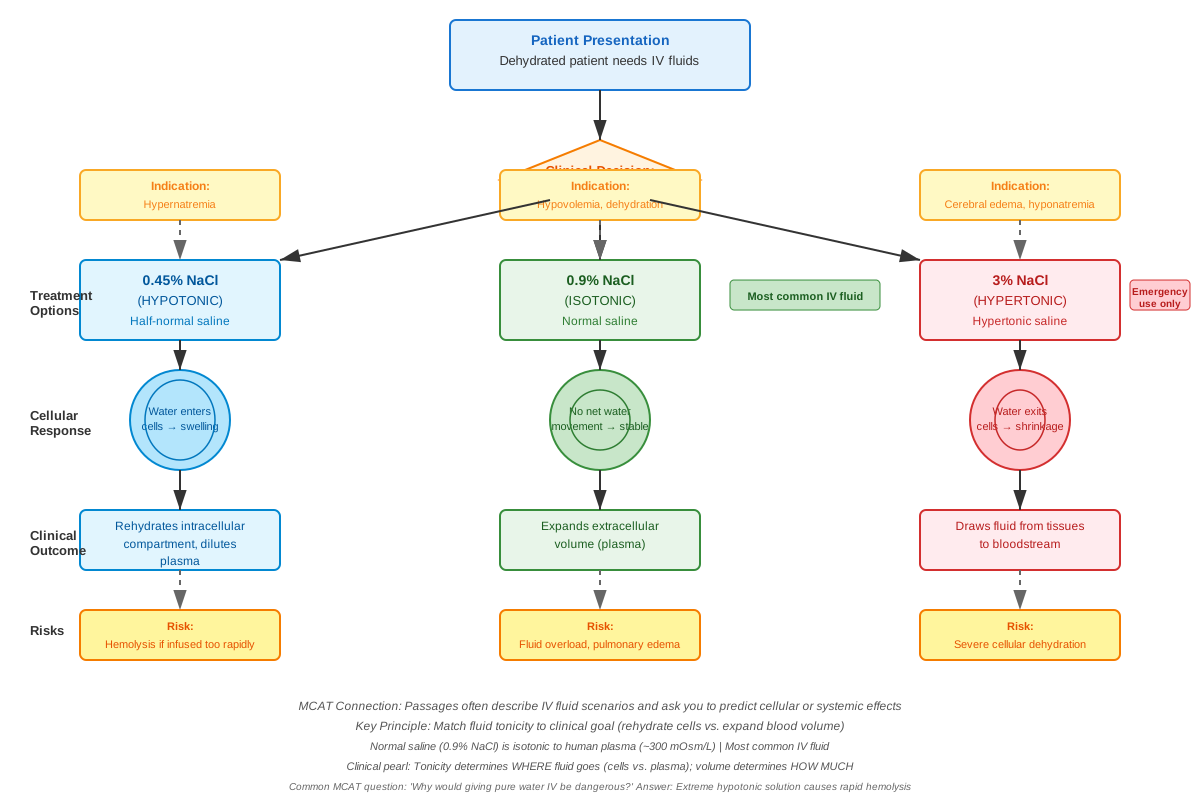
Tonicity has profound clinical significance that extends far beyond theoretical biology. In medical practice, understanding tonicity is critical for fluid resuscitation, intravenous therapy, and managing electrolyte imbalances. When a patient receives IV fluids, the tonicity of that solution determines whether cells will swell, shrink, or maintain their volume. Administering a hypotonic solution too rapidly can cause cerebral edema (brain swelling), while hypertonic solutions can be used therapeutically to reduce intracranial pressure. Red blood cells are particularly sensitive to tonicity changes—placing them in pure water causes hemolysis (cell rupture), while hypertonic solutions cause crenation (cell shrinkage), both of which impair oxygen transport.
On the MCAT, tonicity appears with moderate to high frequency across multiple question formats. According to AAMC data, approximately 3-5% of Biology/Biochemistry section questions directly test osmotic concepts, with additional questions incorporating tonicity as part of larger experimental passages. The topic appears most commonly in passages involving cellular physiology experiments, kidney function, plant biology, and clinical scenarios. Questions typically ask students to predict outcomes, interpret graphs showing cell volume changes over time, or explain why certain solutions are used clinically. The MCAT particularly favors questions that require distinguishing between tonicity and osmolarity, or that test understanding of why certain solutes (like urea) don't contribute to tonicity despite contributing to osmolarity.
Common MCAT passage contexts include: experiments measuring red blood cell volume in various solutions, plant cell responses to salt stress, kidney collecting duct function and ADH effects, marine organism adaptations, and clinical vignettes involving dehydration or overhydration. Discrete questions often present straightforward scenarios asking students to classify solutions or predict cellular responses, while passage-based questions require deeper analysis of experimental design and data interpretation.
Core Concepts
Definition of Tonicity
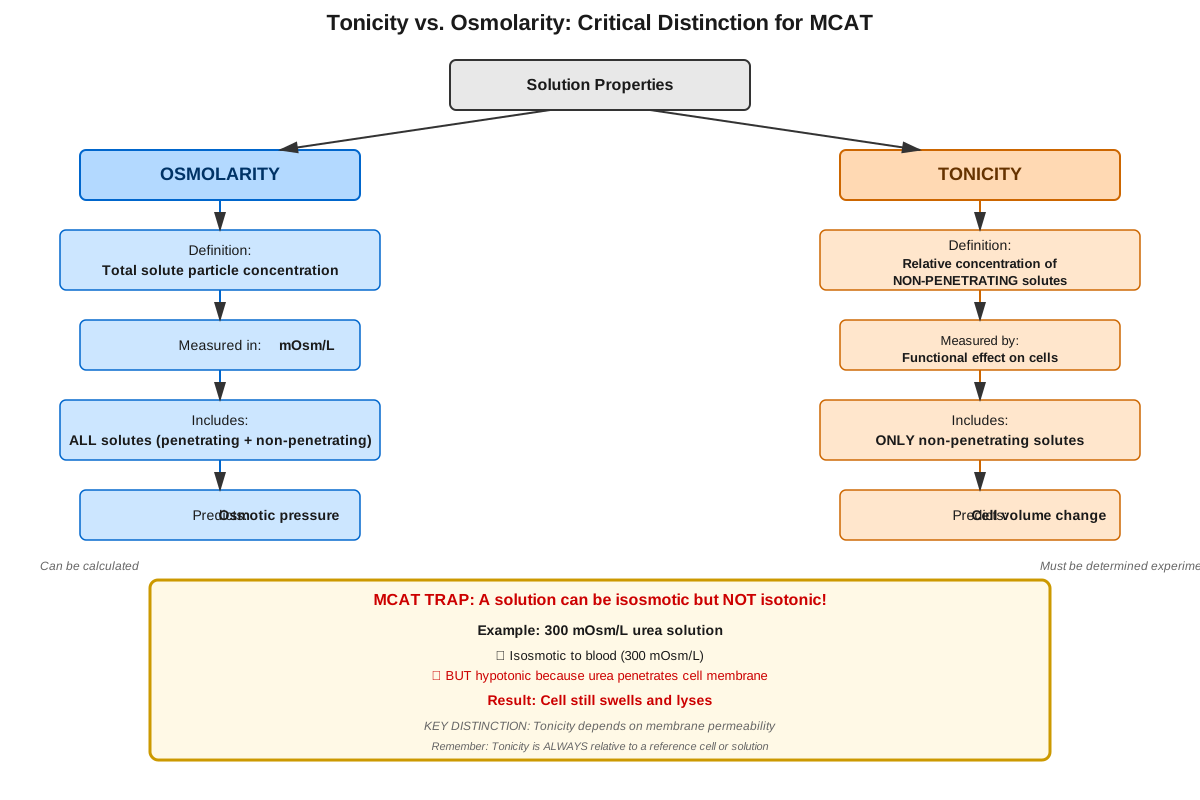
Tonicity refers to the relative concentration of non-penetrating solutes in two solutions separated by a selectively permeable membrane, and specifically describes the effect that bathing a cell in a solution will have on the cell's volume. The critical distinction is that tonicity only considers solutes that cannot cross the membrane freely. This functional definition makes tonicity different from osmolarity, which measures the total concentration of all solute particles regardless of membrane permeability.
A solution's tonicity is always described relative to another solution—most commonly, relative to the cytoplasm of a cell. The three categories of tonicity are:
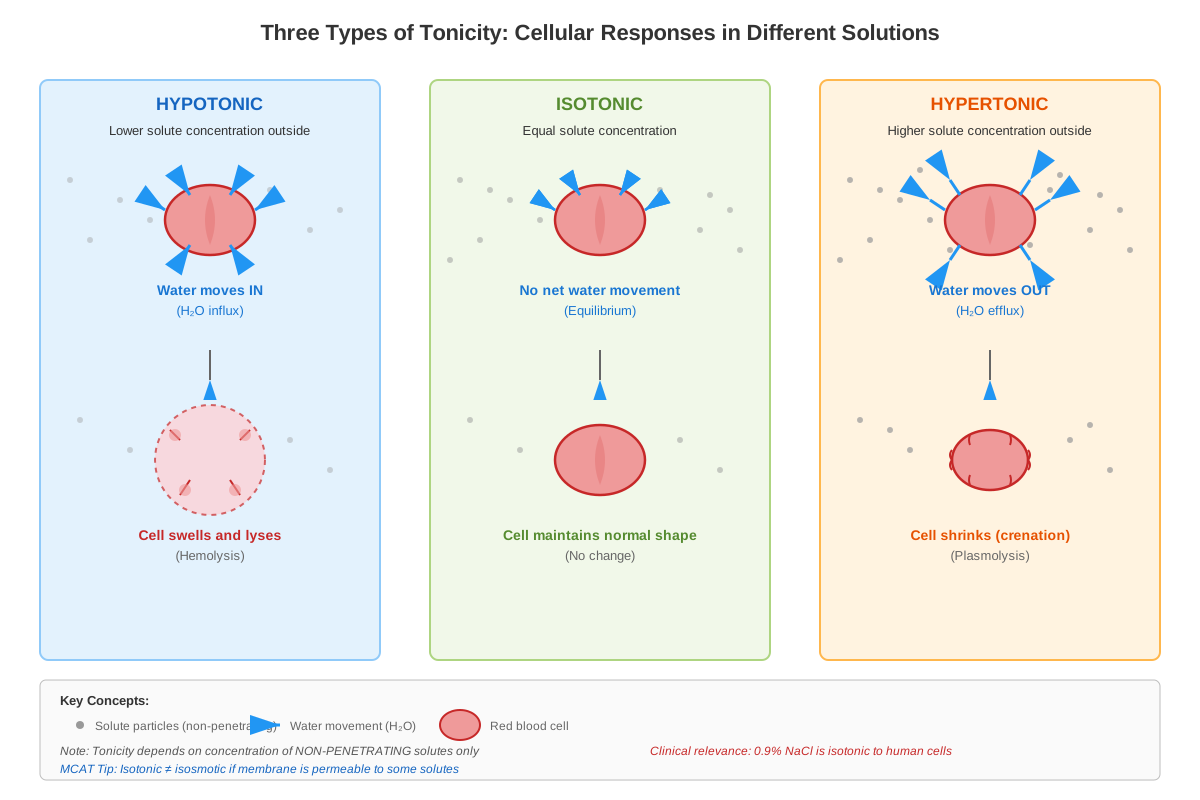
- Isotonic: The solution has the same concentration of non-penetrating solutes as the cell's cytoplasm, resulting in no net water movement and no change in cell volume
- Hypotonic: The solution has a lower concentration of non-penetrating solutes than the cytoplasm, causing net water movement into the cell and cell swelling
- Hypertonic: The solution has a higher concentration of non-penetrating solutes than the cytoplasm, causing net water movement out of the cell and cell shrinkage
Tonicity versus Osmolarity
This distinction is crucial for MCAT success. Osmolarity measures the total concentration of all dissolved particles in a solution, expressed in osmoles per liter (Osm/L). Two solutions can have identical osmolarities but different tonicities if they contain different proportions of penetrating versus non-penetrating solutes.
Consider urea: it contributes to osmolarity because it's a dissolved particle, but it readily crosses most cell membranes. A solution containing 300 mOsm/L of urea would be hypotonic to a typical mammalian cell (which has an internal osmolarity of ~300 mOsm/L) because urea will equilibrate across the membrane, leaving an osmotic gradient that draws water into the cell. In contrast, a solution containing 300 mOsm/L of NaCl would be isotonic because Na⁺ and Cl⁻ ions cannot freely penetrate the membrane.
| Property | Osmolarity | Tonicity |
|---|---|---|
| Definition | Total solute particle concentration | Concentration of non-penetrating solutes |
| Measurement | Absolute value (mOsm/L) | Relative term (hypo-, iso-, hypertonic) |
| Includes penetrating solutes | Yes | No |
| Predicts water movement | Only if solutes can't cross membrane | Yes, always |
| Clinical measurement | Can be measured directly | Must be assessed functionally |
Mechanisms of Water Movement
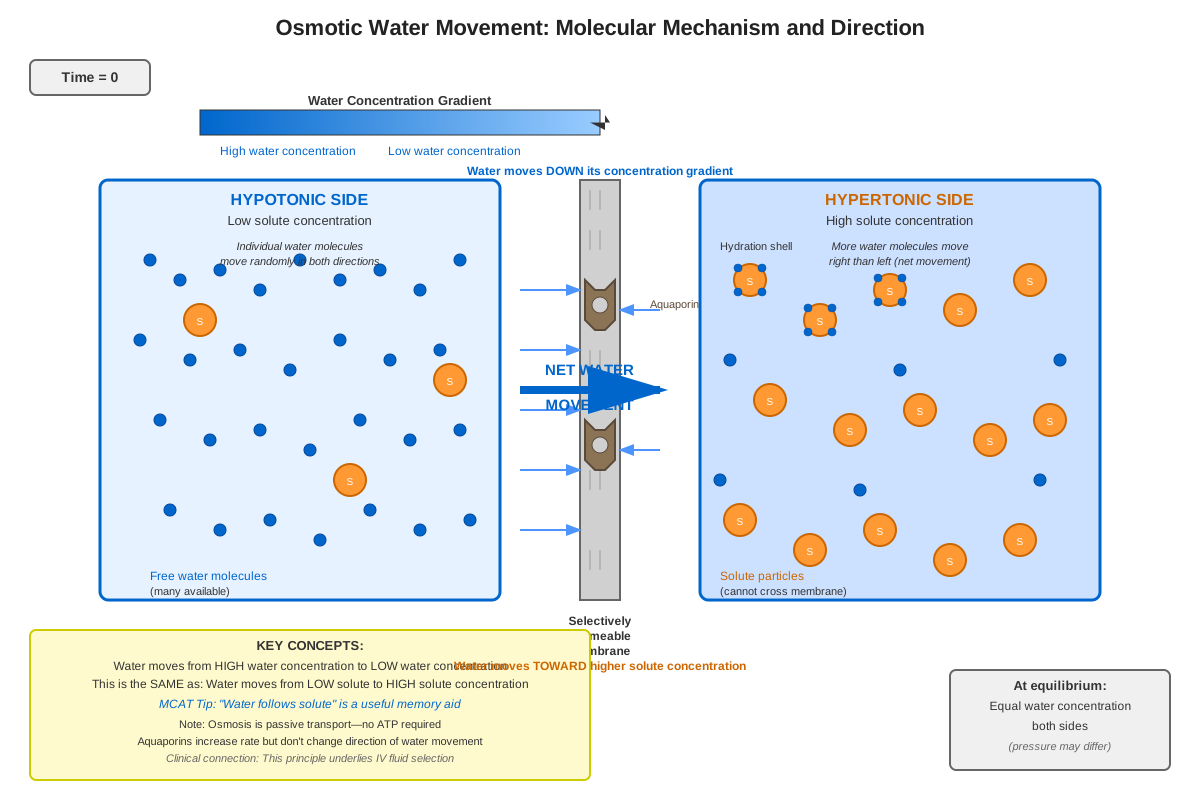
Water moves across cell membranes through osmosis, the passive diffusion of water from regions of high water concentration (low solute concentration) to regions of low water concentration (high solute concentration). While water can cross the lipid bilayer directly due to its small size and polarity, most rapid water movement occurs through specialized protein channels called aquaporins.
The driving force for osmosis is the osmotic pressure gradient, which depends on the concentration difference of non-penetrating solutes. The van't Hoff equation describes osmotic pressure:
π = iMRTWhere:
- π = osmotic pressure
- i = van't Hoff factor (number of particles per molecule)
- M = molar concentration
- R = gas constant
- T = absolute temperature
For MCAT purposes, the key principle is that water moves toward the solution with higher non-penetrating solute concentration, which is the solution with lower water concentration.
Cellular Responses to Tonicity Changes
Animal Cells
Animal cells lack rigid cell walls and are therefore highly susceptible to volume changes:
- In isotonic solutions: Cells maintain normal volume and shape. Red blood cells appear as biconcave discs. The rate of water entering equals the rate of water leaving, establishing dynamic equilibrium.
- In hypotonic solutions: Water enters the cell faster than it leaves, causing the cell to swell. If swelling continues, the cell membrane may rupture in a process called lysis (or hemolysis specifically for red blood cells). The cell membrane has limited elasticity and cannot accommodate unlimited volume increases.
- In hypertonic solutions: Water leaves the cell faster than it enters, causing the cell to shrink and become wrinkled or spiky in appearance—a process called crenation in red blood cells or plasmolysis in plant cells. The cell membrane pulls away from its normal position, and the cytoplasm becomes more concentrated.
Plant Cells
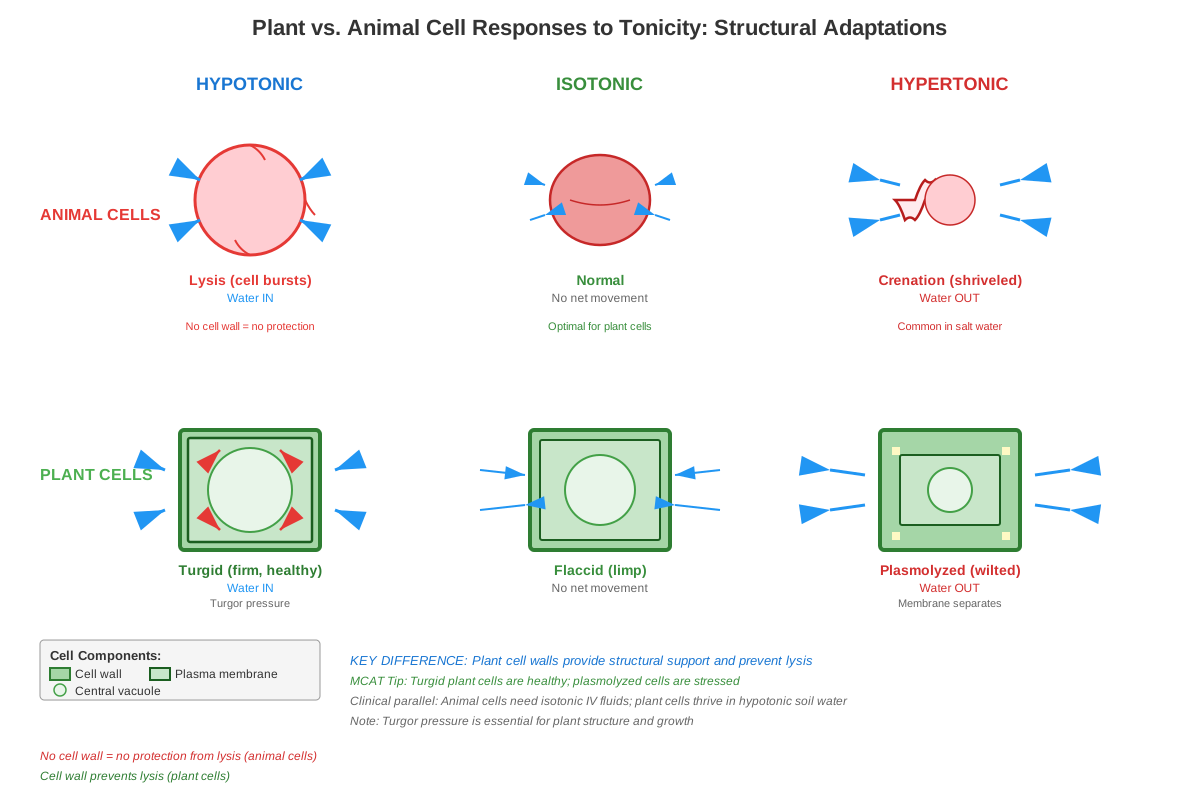
Plant cells possess rigid cell walls made of cellulose that provide structural support and protection against osmotic lysis:
- In isotonic solutions: Plant cells are flaccid (limp) with no turgor pressure. The cell membrane is not pressed against the cell wall.
- In hypotonic solutions: Water enters the cell, and the cell swells until the cell membrane presses firmly against the rigid cell wall. This creates turgor pressure, which provides structural support to the plant. Turgor pressure prevents further water entry and protects against lysis. This is the normal, healthy state for most plant cells.
- In hypertonic solutions: Water leaves the cell, causing the cell membrane to pull away from the cell wall in a process called plasmolysis. The plant wilts as turgor pressure is lost. This is why plants wilt when soil salinity is too high or when they're dehydrated.
Penetrating versus Non-Penetrating Solutes
The distinction between penetrating and non-penetrating solutes is fundamental to understanding tonicity:
Non-penetrating solutes cannot cross the cell membrane freely and therefore create sustained osmotic gradients:
- Ions (Na⁺, K⁺, Cl⁻, Ca²⁺) - blocked by the hydrophobic membrane core
- Large polar molecules (glucose in most cells, though it enters via specific transporters)
- Proteins and other macromolecules
- Any solute for which the membrane lacks specific transport proteins
Penetrating solutes can cross the membrane and therefore do not contribute to tonicity:
- Small nonpolar molecules (O₂, CO₂)
- Urea (crosses via urea transporters)
- Ethanol and other small alcohols
- Water itself (via aquaporins and direct diffusion)
When a penetrating solute is added to a solution, it initially creates an osmotic gradient, but as the solute equilibrates across the membrane, the gradient disappears. The net effect on cell volume depends only on the non-penetrating solutes present.
Clinical and Physiological Applications
Understanding tonicity is essential for several physiological processes:
Intravenous fluid therapy:
- 0.9% NaCl (normal saline) is isotonic to blood and maintains cell volume
- 5% dextrose in water (D5W) is initially isotonic but becomes hypotonic after glucose is metabolized
- 3% NaCl is hypertonic and used to treat severe hyponatremia or reduce cerebral edema
Kidney function: The kidney regulates body fluid tonicity through the countercurrent multiplication system in the loop of Henle, creating a hypertonic medullary interstitium that allows water reabsorption in the collecting duct under ADH influence.
Oral rehydration therapy: Solutions must be carefully formulated to be isotonic or slightly hypotonic to maximize water absorption without causing cellular damage.
Concept Relationships
The concepts within tonicity form an interconnected network centered on membrane permeability and water movement. At the foundation lies osmosis, the passive movement of water across membranes, which is driven by differences in non-penetrating solute concentration. This concentration difference defines tonicity, which in turn predicts cellular volume changes. The relationship flows: membrane permeability characteristics → determines which solutes are non-penetrating → establishes tonicity → drives osmotic water movement → produces cellular responses (lysis, crenation, or turgor).
Tonicity connects backward to prerequisite topics through several pathways. Cell membrane structure (phospholipid bilayer with embedded proteins) determines which molecules can penetrate, establishing the foundation for distinguishing penetrating from non-penetrating solutes. Diffusion and concentration gradients provide the thermodynamic basis for osmosis—water moves down its concentration gradient, which is inversely related to solute concentration. Solution chemistry enables calculation of solute concentrations and comparison between solutions.
Forward connections link tonicity to advanced topics in Biology and physiology. Homeostasis mechanisms, particularly those involving the kidney and hormones like ADH and aldosterone, function to maintain appropriate body fluid tonicity. Action potential propagation depends on maintaining proper ion gradients, which requires cells to regulate their volume and prevent dilution of intracellular ions. Evolutionary adaptations in marine versus freshwater organisms reflect different strategies for managing osmotic stress—marine fish face hypertonic environments while freshwater fish face hypotonic environments.
The relationship map can be visualized as:
Membrane selective permeability → determines → Non-penetrating solutes → defines → Tonicity → drives → Osmotic water movement → produces → Cell volume changes → triggers → Homeostatic responses → maintains → Physiological function
Parallel to this main pathway, cell wall presence (in plants and bacteria) → modifies → Response to osmotic stress → enables → Survival in hypotonic environments
High-Yield Facts
⭐ Tonicity describes only non-penetrating solutes; penetrating solutes like urea contribute to osmolarity but not tonicity
⭐ 0.9% NaCl (normal saline) is isotonic to human blood and maintains red blood cell volume
⭐ Animal cells undergo lysis in hypotonic solutions and crenation in hypertonic solutions
⭐ Plant cells develop turgor pressure in hypotonic solutions due to rigid cell walls, preventing lysis
⭐ Two solutions can have equal osmolarity but different tonicity if they contain different proportions of penetrating solutes
- Isotonic solutions produce no net change in cell volume because water influx equals water efflux
- Hypertonic solutions have higher non-penetrating solute concentrations than the cell interior, causing water to leave the cell
- Hypotonic solutions have lower non-penetrating solute concentrations than the cell interior, causing water to enter the cell
- Aquaporins facilitate rapid water movement across membranes but do not change the direction of water movement
- The van't Hoff factor (i) accounts for ionic dissociation: NaCl has i=2, while glucose has i=1
- Plasmolysis in plant cells occurs when the cell membrane pulls away from the cell wall in hypertonic solutions
- Red blood cells are commonly used in tonicity experiments because they lack internal compartments and respond predictably to osmotic stress
- Marine organisms often maintain internal osmolarity slightly hypertonic to seawater to ensure water influx for metabolic needs
- The blood-brain barrier carefully regulates tonicity to prevent cerebral edema or dehydration
- Contractile vacuoles in freshwater protists actively pump out excess water that enters due to the hypotonic environment
Quick check — test yourself on Tonicity so far.
Try Flashcards →Common Misconceptions
Misconception: Tonicity and osmolarity are the same thing.
Correction: Osmolarity measures total solute concentration (all particles), while tonicity measures only non-penetrating solute concentration. A solution can be isosmotic (same osmolarity) but hypotonic if it contains penetrating solutes. For example, a 300 mOsm/L urea solution is isosmotic to blood but hypotonic because urea crosses cell membranes.
Misconception: Water always moves from hypotonic to hypertonic solutions.
Correction: Water moves from regions of high water concentration to low water concentration, which means from hypotonic (low solute) to hypertonic (high solute) solutions. The terminology can be confusing, but remember that "hypotonic" means "lower solute concentration," which corresponds to "higher water concentration."
Misconception: Plant cells can undergo lysis just like animal cells when placed in hypotonic solutions.
Correction: Plant cells have rigid cell walls that prevent lysis. When placed in hypotonic solutions, plant cells swell until the cell membrane presses against the cell wall, creating turgor pressure that opposes further water entry. This pressure prevents the membrane from rupturing.
Misconception: If a solution has a higher concentration of any solute, it's hypertonic.
Correction: Only non-penetrating solutes determine tonicity. A solution with high concentrations of penetrating solutes (like urea or ethanol) but low concentrations of non-penetrating solutes would be hypotonic. The key is whether the solute can cross the membrane.
Misconception: Isotonic solutions contain the same concentration of every solute as the cell interior.
Correction: Isotonic solutions have the same total concentration of non-penetrating solutes, but the specific solutes can differ. For example, a cell might have high K⁺ and low Na⁺ internally, while an isotonic extracellular solution has high Na⁺ and low K⁺. What matters is the total non-penetrating solute concentration, not the identity of individual solutes.
Misconception: Adding any solute to pure water makes it hypertonic.
Correction: Tonicity is always relative. Adding a small amount of solute to pure water makes it less hypotonic relative to cells, but it may still be hypotonic if the solute concentration remains lower than the cell's internal non-penetrating solute concentration. A solution is only hypertonic if its non-penetrating solute concentration exceeds that of the reference solution.
Misconception: Osmosis requires energy (active transport).
Correction: Osmosis is passive transport—water moves down its concentration gradient without requiring ATP. However, cells may use active transport to pump solutes and thereby indirectly control water movement. The water movement itself is always passive.
Worked Examples
Example 1: Predicting Red Blood Cell Response
Question: A researcher places red blood cells (RBCs) in three different solutions:
- Solution A: 300 mOsm/L NaCl
- Solution B: 300 mOsm/L urea
- Solution C: 150 mOsm/L NaCl + 150 mOsm/L glucose
Normal RBC internal osmolarity is approximately 300 mOsm/L. Predict the response of RBCs in each solution and explain your reasoning.
Solution:
Step 1: Identify which solutes are penetrating vs. non-penetrating.
- NaCl: Non-penetrating (Na⁺ and Cl⁻ ions cannot freely cross the membrane)
- Urea: Penetrating (crosses via urea transporters)
- Glucose: Non-penetrating in RBCs (requires GLUT1 transporter, but for this analysis, treat as non-penetrating initially)
Step 2: Determine tonicity of each solution.
Solution A (300 mOsm/L NaCl):
- NaCl dissociates into Na⁺ and Cl⁻, but the osmolarity already accounts for this
- All 300 mOsm/L are non-penetrating solutes
- This equals RBC internal osmolarity
- Verdict: Isotonic → No net volume change
Solution B (300 mOsm/L urea):
- Urea is penetrating, so it doesn't contribute to tonicity
- Effective non-penetrating solute concentration = 0 mOsm/L
- This is much less than RBC internal osmolarity
- Verdict: Hypotonic → RBCs will swell and may undergo hemolysis
Solution C (150 mOsm/L NaCl + 150 mOsm/L glucose):
- Both NaCl and glucose are non-penetrating in RBCs
- Total non-penetrating solute concentration = 150 + 150 = 300 mOsm/L
- This equals RBC internal osmolarity
- Verdict: Isotonic → No net volume change
Step 3: Describe cellular responses.
- Solution A: RBCs maintain normal biconcave disc shape
- Solution B: RBCs swell, become spherical, and eventually undergo hemolysis (rupture)
- Solution C: RBCs maintain normal biconcave disc shape
Key Insight: Even though all three solutions are isosmotic (300 mOsm/L), only Solutions A and C are isotonic. Solution B is hypotonic despite being isosmotic because urea doesn't contribute to tonicity. This example illustrates the critical distinction between osmolarity and tonicity.
Example 2: Clinical Vignette - IV Fluid Selection
Question: A 45-year-old patient presents to the emergency department with severe dehydration following prolonged vomiting and diarrhea. Laboratory values show:
- Serum sodium: 152 mEq/L (normal: 135-145 mEq/L)
- Serum osmolality: 320 mOsm/kg (normal: 275-295 mOsm/kg)
The physician must choose between three IV fluid options:
- Option 1: 0.9% NaCl (normal saline, ~308 mOsm/L)
- Option 2: 0.45% NaCl (half-normal saline, ~154 mOsm/L)
- Option 3: 5% dextrose in water (D5W, ~278 mOsm/L initially)
Which fluid should be administered and why? What would happen to the patient's cells with each option?
Solution:
Step 1: Analyze the patient's condition.
- Elevated serum sodium (hypernatremia) indicates hypertonic dehydration
- Elevated serum osmolality confirms the blood is hypertonic
- The patient's cells are likely crenated (shrunken) due to water loss to the hypertonic extracellular environment
Step 2: Evaluate each IV fluid option.
Option 1: 0.9% NaCl (normal saline)
- This solution is isotonic to normal blood (~300 mOsm/L)
- However, the patient's blood is currently hypertonic (~320 mOsm/L)
- Administering normal saline would be relatively hypotonic to the patient's current state
- This would help, but correction would be slow
- Effect on cells: Gradual rehydration, slow return to normal volume
Option 2: 0.45% NaCl (half-normal saline)
- This solution is hypotonic (~154 mOsm/L)
- It would be significantly hypotonic relative to the patient's hypertonic blood
- Water would move into cells, rehydrating them
- Risk: Too rapid correction could cause cerebral edema (brain swelling)
- Effect on cells: Rapid rehydration, but risk of overcorrection
Option 3: 5% dextrose in water (D5W)
- Initially ~278 mOsm/L, but dextrose is rapidly metabolized
- After metabolism, this becomes essentially free water (very hypotonic)
- Would be extremely hypotonic relative to patient's current state
- High risk of rapid overcorrection and cerebral edema
- Effect on cells: Very rapid water influx, high risk of cell swelling and lysis
Step 3: Make the clinical decision.
Best choice: Option 2 (0.45% NaCl), but administered slowly with careful monitoring.
Reasoning:
- The patient needs hypotonic fluid to correct hypernatremia
- Half-normal saline provides both water (to correct dehydration) and some sodium (to prevent too-rapid correction)
- The rate of administration must be controlled—serum sodium should decrease no faster than 10-12 mEq/L per 24 hours to avoid osmotic demyelination syndrome
- Option 1 would work but would correct too slowly
- Option 3 would correct too rapidly and risks cerebral edema
Key Insight: This example demonstrates that tonicity is relative and context-dependent. A solution that is normally hypotonic (half-normal saline) might be the appropriate choice when the patient's blood is hypertonic. Clinical decisions about IV fluids require understanding both the tonicity of the fluid and the patient's current state, as well as the risks of too-rapid correction.
Exam Strategy
When approaching MCAT questions on tonicity, follow this systematic strategy:
1. Identify the question type:
- Prediction questions: "What will happen to cells in Solution X?"
- Comparison questions: "Which solution is hypertonic relative to Y?"
- Experimental interpretation: "Explain the results shown in Figure 1"
- Clinical application: "Which IV fluid should be administered?"
2. Trigger words to watch for:
- "Non-penetrating" or "impermeable" → These solutes determine tonicity
- "Freely permeable" or "penetrating" → These solutes do NOT contribute to tonicity
- "Relative to" → Tonicity is always comparative
- "Osmolarity" vs. "tonicity" → These are different; don't confuse them
- "Net movement" → Indicates equilibrium hasn't been reached
- "Cell wall" → Suggests plant cells, which respond differently than animal cells
3. Step-by-step approach:
Step 1: Identify all solutes present and classify each as penetrating or non-penetrating
- If not explicitly stated, assume ions and large polar molecules are non-penetrating
- Assume small nonpolar molecules and urea are penetrating
Step 2: Calculate or compare the concentration of non-penetrating solutes only
- Ignore penetrating solutes for tonicity determination
- Remember that NaCl dissociates into two particles
Step 3: Determine relative tonicity
- Higher non-penetrating solute concentration = hypertonic
- Lower non-penetrating solute concentration = hypotonic
- Equal non-penetrating solute concentration = isotonic
Step 4: Predict water movement
- Water moves toward higher non-penetrating solute concentration (lower water concentration)
- Water moves into cells in hypotonic solutions
- Water moves out of cells in hypertonic solutions
Step 5: Predict cellular response
- Animal cells: swell/lyse (hypotonic) or shrink/crenate (hypertonic)
- Plant cells: turgor pressure (hypotonic) or plasmolysis (hypertonic)
4. Process of elimination tips:
- Eliminate answers that confuse osmolarity with tonicity
- Eliminate answers that ignore penetrating vs. non-penetrating distinction
- Eliminate answers that predict water movement in the wrong direction
- Eliminate answers that suggest plant cells will lyse in hypotonic solutions
- Eliminate answers that claim isotonic solutions cause net water movement
5. Time allocation:
- Discrete questions: 60-90 seconds
- Passage-based questions: 90-120 seconds after reading the passage
- If a question requires calculations, budget an extra 30 seconds
- Don't get stuck on distinguishing penetrating vs. non-penetrating if it's not clear—make your best guess and move on
6. Common MCAT traps:
- Presenting isosmotic solutions with different tonicities (e.g., NaCl vs. urea)
- Asking about "osmotic pressure" when they mean "tonicity"
- Showing graphs where cell volume changes over time, requiring you to recognize equilibration
- Clinical scenarios where the "normal" reference point has changed (like the dehydrated patient example)
Exam Tip: If you're unsure whether a solute is penetrating or non-penetrating, consider its chemical properties. Charged molecules (ions) and large polar molecules typically cannot cross lipid bilayers without transporters. Small nonpolar molecules typically can cross freely.
Memory Techniques
Mnemonic for tonicity effects on animal cells: "HYPO-HYPER-ISO"
- HYPO = Higher water Yields Popped (lysed) cells Outside→inside water flow
- HYPER = Higher solute Yields Puckered (crenated) cells, Exiting water, Reduced volume
- ISO = Identical Solute, Original volume maintained
Mnemonic for remembering penetrating vs. non-penetrating solutes: "UREA GOES, IONS NO"
- UREA and other small neutral molecules GO across membranes (penetrating)
- IONS say NO to crossing membranes without help (non-penetrating)
Visualization strategy for water movement:
Picture water molecules as crowds of people and solute molecules as obstacles. People (water) move freely toward areas with fewer obstacles (lower solute concentration). The obstacles that matter are only the ones that can't move (non-penetrating solutes). Obstacles that can move with the crowd (penetrating solutes) don't affect the crowd's direction.
Acronym for plant cell responses: "TURP"
- Turgid in hypotonic (normal, healthy state)
- Under pressure from water influx
- Rigid cell wall prevents lysis
- Plasmolyzed in hypertonic (wilted state)
Memory aid for clinical IV fluids:
- 0.9% NaCl = "Normal saline" = Normal tonicity (isotonic)
- 0.45% NaCl = "Half-normal saline" = Half the concentration = hypotonic
- 3% NaCl = "Hypertonic saline" = Hyper means high concentration
Conceptual visualization for tonicity vs. osmolarity:
Imagine a cell membrane as a fence with gates. Osmolarity counts all particles on each side of the fence. Tonicity only counts particles that can't fit through the gates. Even if total particle counts are equal (isosmotic), if one side has more particles that can't pass through (non-penetrating), water will flow toward that side.
Mnemonic for remembering which direction water moves: "SALT SUCKS"
- SALT (solute) SUCKS water toward it
- Higher solute concentration attracts water
- Water moves toward hypertonic solutions
Summary
Tonicity is a fundamental concept in cell biology that describes the relative concentration of non-penetrating solutes between two solutions separated by a selectively permeable membrane, predicting the direction of water movement and resulting changes in cell volume. Unlike osmolarity, which measures total solute concentration, tonicity considers only solutes that cannot freely cross the membrane. Solutions are classified as isotonic (equal non-penetrating solute concentration, no net water movement), hypotonic (lower non-penetrating solute concentration, water enters cells), or hypertonic (higher non-penetrating solute concentration, water exits cells). Animal cells respond to tonicity changes by swelling and potentially undergoing lysis in hypotonic solutions, or shrinking and crenating in hypertonic solutions. Plant cells, protected by rigid cell walls, develop turgor pressure in hypotonic solutions and undergo plasmolysis in hypertonic solutions. The distinction between penetrating solutes (like urea) and non-penetrating solutes (like ions) is critical for predicting cellular responses. Understanding tonicity is essential for clinical applications including IV fluid therapy, interpreting experimental data, and explaining physiological adaptations to osmotic stress.
Key Takeaways
- Tonicity measures only non-penetrating solutes, while osmolarity measures all solutes—this distinction is frequently tested on the MCAT
- Water always moves toward higher non-penetrating solute concentration (lower water concentration), from hypotonic to hypertonic solutions
- Animal cells lyse in hypotonic solutions and crenate in hypertonic solutions due to lack of cell walls, while plant cells develop turgor pressure or undergo plasmolysis respectively
- Two solutions can be isosmotic but have different tonicities if they contain different proportions of penetrating versus non-penetrating solutes
- 0.9% NaCl (normal saline) is isotonic to human blood and is the standard reference for clinical IV fluid therapy
- Tonicity is always relative—a solution's tonicity must be described in comparison to another solution or to the cell interior
- Cell walls in plant cells prevent osmotic lysis and allow plants to thrive in hypotonic environments by generating turgor pressure for structural support
Related Topics
Osmosis and Water Potential: Building on tonicity, water potential (Ψ) provides a more quantitative framework for predicting water movement in plant systems, incorporating both solute potential and pressure potential. Mastering tonicity provides the conceptual foundation for understanding water potential calculations.
Membrane Transport Mechanisms: Tonicity connects to active transport systems like the Na⁺/K⁺-ATPase pump, which maintains ion gradients that establish cellular tonicity. Understanding how cells actively regulate their internal solute composition enables deeper comprehension of volume regulation.
Kidney Physiology and Osmoregulation: The kidney's ability to produce urine of varying tonicity through the countercurrent multiplier system represents a sophisticated application of tonicity principles. This topic extends tonicity concepts to organ-system level physiology.
Action Potentials and Neurophysiology: Maintaining proper cell volume through tonicity regulation is essential for preserving ion gradients necessary for action potential propagation. Changes in extracellular tonicity can affect neuronal excitability.
Evolutionary Adaptations to Osmotic Stress: Marine versus freshwater organisms have evolved different strategies for managing osmotic challenges, from osmoconformers to osmoregulators. This topic applies tonicity principles to comparative physiology and evolution.
Practice CTA
Now that you've mastered the core concepts of tonicity, it's time to solidify your understanding through active practice. Challenge yourself with MCAT-style practice questions that test your ability to distinguish between osmolarity and tonicity, predict cellular responses to various solutions, and apply these concepts to clinical scenarios. Work through the flashcards to reinforce high-yield facts and ensure rapid recall during the exam. Remember, understanding tonicity isn't just about memorizing definitions—it's about developing the analytical skills to approach novel scenarios with confidence. The more you practice applying these principles, the more automatic your reasoning will become, allowing you to tackle even the most complex MCAT passages efficiently. You've built a strong foundation—now strengthen it through deliberate practice!
Sign up free to keep reading
Create a free AnvayaPrep account to finish this MCAT guide on Tonicity — plus flashcards and practice questions.