Overview
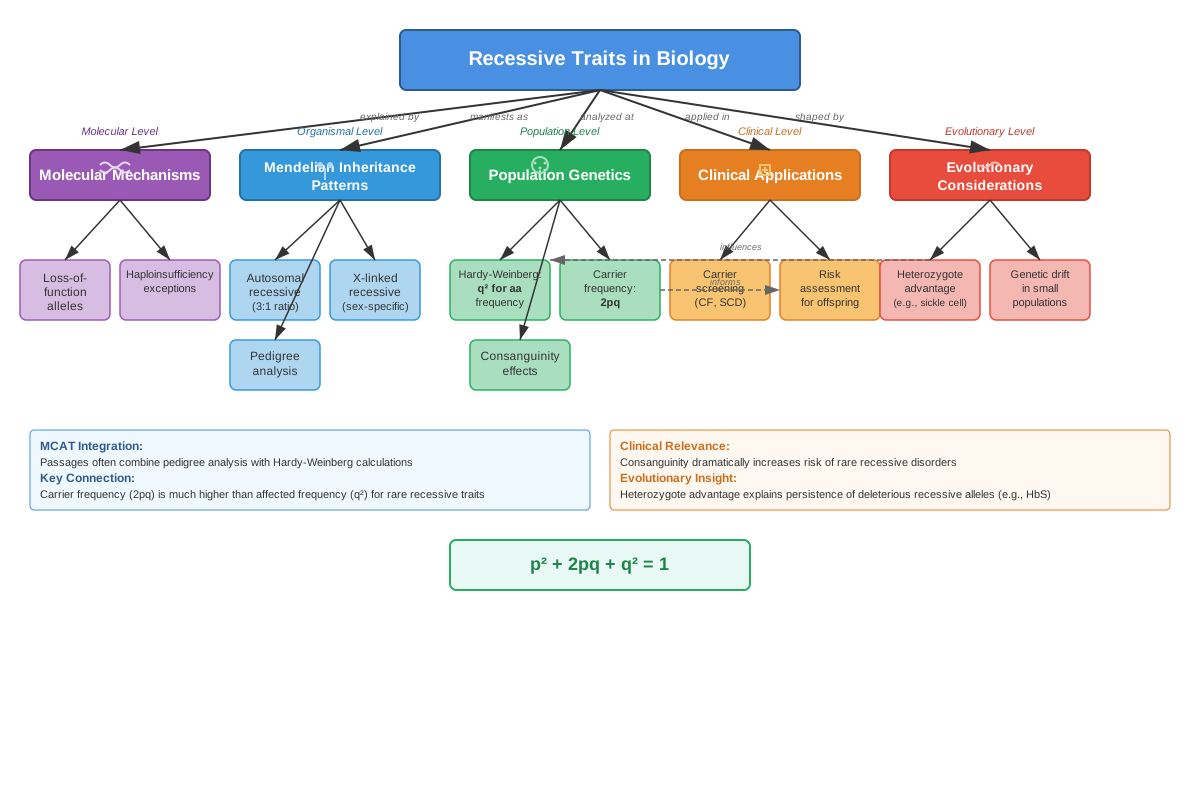
Recessive traits represent one of the foundational principles in Molecular Biology and Genetics, forming the cornerstone of Mendelian inheritance patterns that appear consistently across MCAT examinations. A recessive trait is a phenotypic characteristic that manifests only when an individual possesses two copies of the recessive allele—one inherited from each parent. This concept extends far beyond simple pea plant experiments, encompassing critical human genetic conditions, population genetics calculations, and evolutionary biology principles that the MCAT tests extensively.
Understanding recessive traits requires mastery of multiple interconnected concepts including allelic relationships, genotype-phenotype correlations, pedigree analysis, and probability calculations. The MCAT frequently presents recessive trait questions within passage-based scenarios involving human genetic disorders, experimental crosses, or population-level inheritance patterns. These questions assess not only memorized definitions but also the ability to apply genetic principles to novel situations, interpret experimental data, and predict inheritance outcomes across multiple generations.
The significance of recessive traits in Biology extends to numerous related topics including dominant traits, codominance, incomplete dominance, sex-linked inheritance, Hardy-Weinberg equilibrium, and genetic counseling applications. Mastery of recessive inheritance patterns provides the foundation for understanding more complex genetic phenomena such as epistasis, polygenic traits, and gene-environment interactions. For MCAT success, students must develop fluency in translating between molecular mechanisms (allele expression at the DNA/protein level), cellular processes (how recessive alleles function), and organismal outcomes (observable phenotypes and inheritance patterns).
Learning Objectives
- [ ] Define recessive traits using accurate Biology terminology
- [ ] Explain why recessive traits matters for the MCAT
- [ ] Apply recessive traits to exam-style questions
- [ ] Identify common mistakes related to recessive traits
- [ ] Connect recessive traits to related Biology concepts
- [ ] Calculate probability of recessive trait expression in monohybrid and dihybrid crosses
- [ ] Analyze pedigrees to determine recessive inheritance patterns and carrier status
- [ ] Distinguish between autosomal recessive and X-linked recessive inheritance patterns
- [ ] Predict genotypic and phenotypic ratios in multi-generation crosses involving recessive alleles
Prerequisites
- Basic Mendelian genetics: Understanding of genes, alleles, and inheritance forms the foundation for distinguishing recessive from dominant patterns
- Chromosome structure and function: Knowledge of homologous chromosomes and allele locations enables comprehension of how two recessive alleles must be present for trait expression
- Meiosis and sexual reproduction: Familiarity with gamete formation and fertilization explains how offspring inherit one allele from each parent
- Genotype versus phenotype: Distinguishing between genetic composition and observable characteristics is essential for understanding recessive trait expression
- Punnett square construction: Basic probability tool used to predict offspring genotypes and phenotypes in genetic crosses
Why This Topic Matters
Recessive traits appear in approximately 15-20% of MCAT genetics questions, making this a medium-to-high yield topic that students cannot afford to overlook. The MCAT tests recessive inheritance through multiple question formats: discrete questions requiring probability calculations, passage-based questions analyzing experimental crosses or human pedigrees, and data interpretation questions involving population genetics.
Clinically, recessive traits encompass numerous significant human genetic disorders including cystic fibrosis, sickle cell disease (when considering the homozygous recessive genotype), Tay-Sachs disease, phenylketonuria (PKU), and albinism. Understanding recessive inheritance patterns enables genetic counselors to assess disease risk, helps explain why consanguineous marriages increase genetic disorder frequency, and underlies carrier screening programs. The MCAT frequently presents clinical vignettes where students must determine carrier probabilities, predict offspring disease risk, or explain why two phenotypically normal parents can produce affected children.
Common MCAT passage contexts include: experimental genetics studies with model organisms (fruit flies, mice), human pedigree analysis requiring inheritance pattern identification, population genetics scenarios involving Hardy-Weinberg calculations with recessive alleles, and molecular biology passages explaining the biochemical basis of recessive loss-of-function mutations. Questions often require multi-step reasoning, combining probability calculations with pedigree interpretation or connecting molecular mechanisms to phenotypic outcomes.
Core Concepts
Definition and Molecular Basis of Recessive Traits
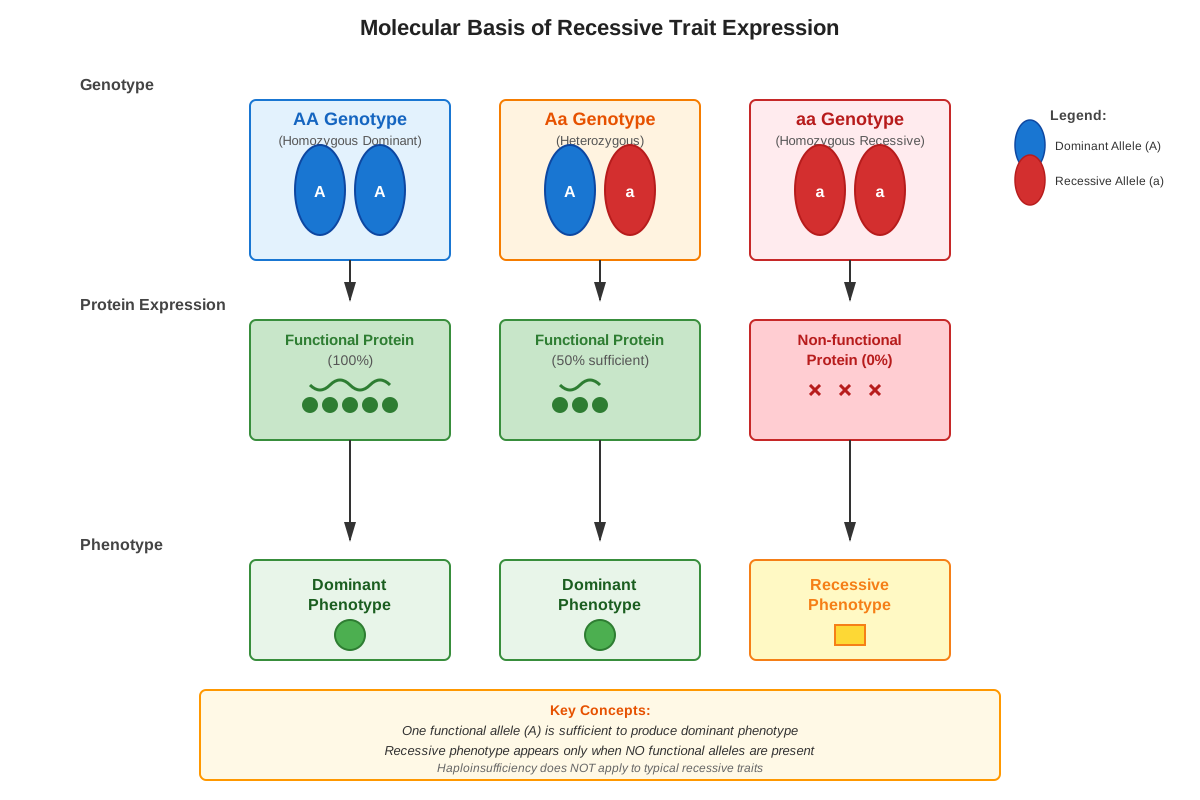
A recessive trait is a phenotypic characteristic that appears only when an organism possesses two copies of the recessive allele (homozygous recessive genotype). At the molecular level, recessive alleles typically represent loss-of-function or reduced-function variants that produce insufficient gene product (protein) to generate the dominant phenotype. The recessive allele is conventionally represented by a lowercase letter (e.g., a), while the dominant allele uses an uppercase letter (e.g., A).
The molecular mechanism underlying most recessive traits involves haploinsufficiency considerations. In many cases, one functional copy of a gene (heterozygous Aa genotype) produces enough functional protein (typically 50% of normal levels) to maintain the dominant phenotype. Only when both alleles are nonfunctional (homozygous recessive aa genotype) does protein production fall below the threshold required for normal function, resulting in the recessive phenotype.
Genotype-Phenotype Relationships
The relationship between genotype and phenotype for recessive traits follows predictable patterns:
| Genotype | Allele Composition | Phenotype | Description |
|---|---|---|---|
| AA | Homozygous dominant | Dominant trait | Two functional alleles produce dominant phenotype |
| Aa | Heterozygous | Dominant trait | One functional allele sufficient; individual is a carrier |
| aa | Homozygous recessive | Recessive trait | No functional alleles; recessive phenotype expressed |
The carrier status (heterozygous individuals) represents a critical concept for MCAT questions. Carriers possess one recessive allele but display the dominant phenotype, making them phenotypically indistinguishable from homozygous dominant individuals without genetic testing. This explains how recessive traits can "skip generations" in pedigrees—two carrier parents can produce affected offspring despite both parents appearing normal.
Autosomal Recessive Inheritance Patterns
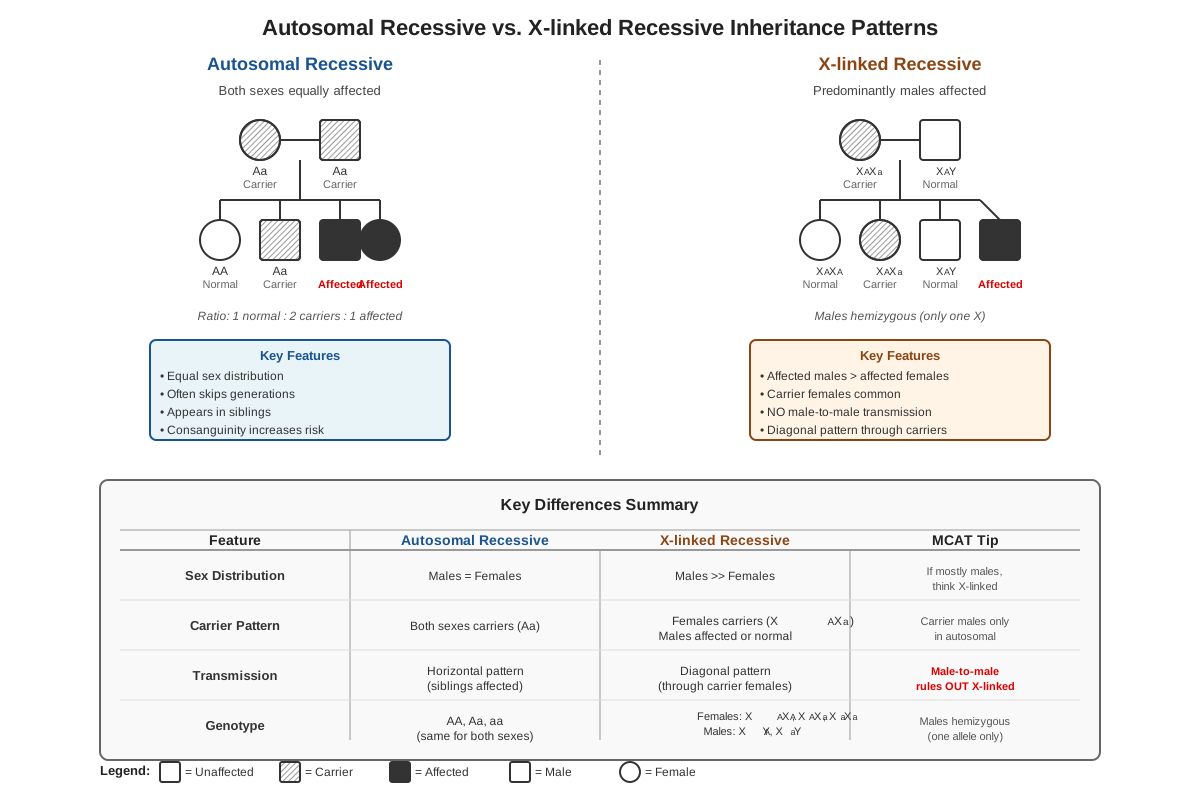
Autosomal recessive traits involve genes located on non-sex chromosomes (autosomes 1-22 in humans). These traits exhibit characteristic inheritance patterns:
- Affected individuals typically have two unaffected (carrier) parents
- The trait appears in both males and females with equal frequency
- The trait often skips generations
- Consanguineous (related) parents show increased risk of affected offspring
- Approximately 25% of offspring from two carrier parents will be affected
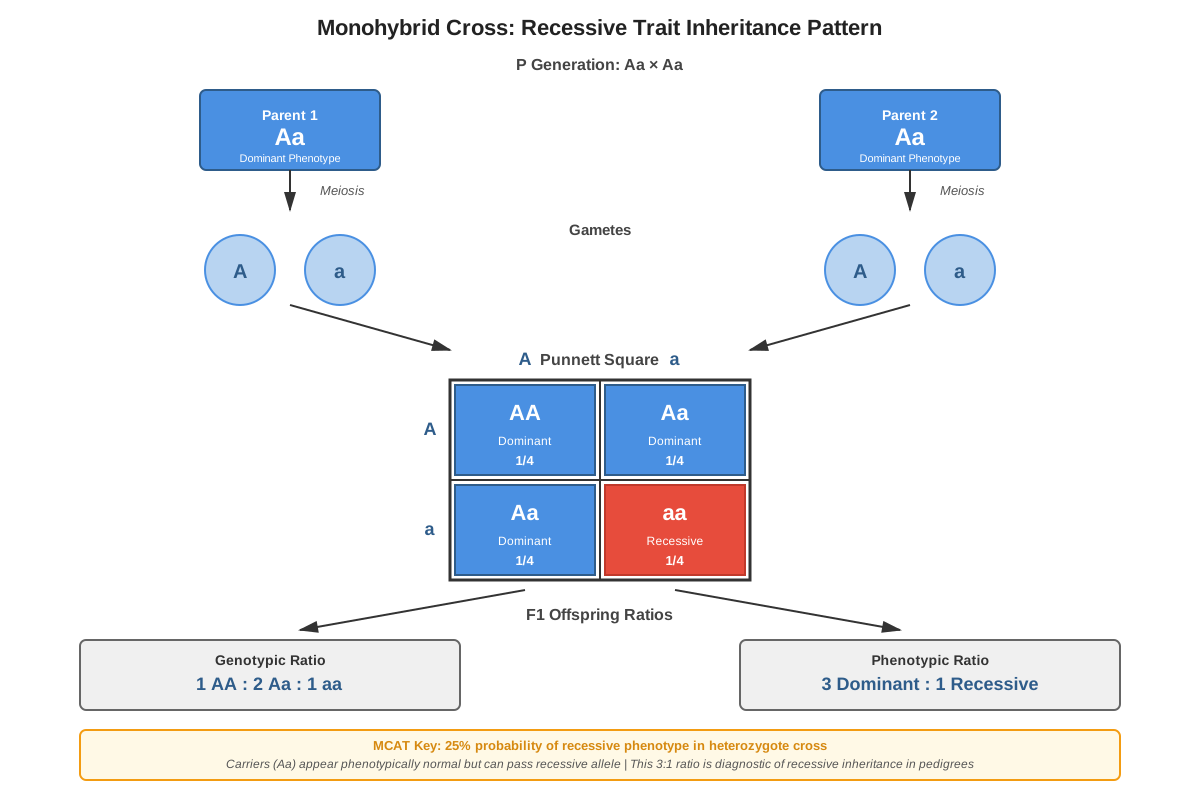
The classic monohybrid cross between two heterozygous parents (Aa × Aa) produces the famous 3:1 phenotypic ratio (3 dominant : 1 recessive) and 1:2:1 genotypic ratio (1 AA : 2 Aa : 1 aa). This ratio appears repeatedly in MCAT questions and forms the basis for more complex probability calculations.
X-Linked Recessive Inheritance
X-linked recessive traits involve genes on the X chromosome and display distinct inheritance patterns from autosomal recessive traits:
- Males (XY) require only one recessive allele to express the trait (hemizygous condition)
- Females (XX) require two recessive alleles to express the trait (homozygous recessive)
- Affected males typically have carrier mothers and unaffected fathers
- The trait predominantly affects males
- Affected males cannot pass the trait to sons (no male-to-male transmission)
- All daughters of affected males are carriers
Common X-linked recessive conditions include hemophilia A, Duchenne muscular dystrophy, and red-green color blindness. The MCAT frequently tests the ability to distinguish X-linked from autosomal recessive patterns in pedigree analysis.
Probability Calculations and Punnett Squares
Calculating probabilities for recessive trait inheritance requires systematic application of probability rules:
Multiplication Rule: The probability of independent events occurring together equals the product of their individual probabilities. For example, the probability that two carrier parents (Aa × Aa) produce an affected child (aa) is 1/2 × 1/2 = 1/4.
Addition Rule: The probability that one of several mutually exclusive events occurs equals the sum of their individual probabilities. For example, the probability of producing either AA or Aa offspring from Aa × Aa cross is 1/4 + 2/4 = 3/4.
For dihybrid crosses involving two independently assorting genes, the probability of being homozygous recessive for both traits (aabb) from AaBb × AaBb parents is 1/4 × 1/4 = 1/16, producing the classic 9:3:3:1 phenotypic ratio.
Pedigree Analysis for Recessive Traits
Pedigree analysis represents a high-yield MCAT skill. Key features identifying autosomal recessive inheritance:
- Horizontal transmission pattern (affects siblings in same generation)
- Affected individuals with unaffected parents
- Both sexes equally affected
- Increased incidence with consanguinity
- Trait may skip multiple generations
When analyzing pedigrees, students must determine genotypes using logical deduction: affected individuals must be homozygous recessive (aa), parents of affected individuals must each carry at least one recessive allele, and unaffected individuals with affected offspring must be carriers (Aa).
Carrier Frequency and Population Genetics
In populations, the carrier frequency for recessive traits often far exceeds the frequency of affected individuals. Using Hardy-Weinberg equilibrium principles, if the frequency of the recessive allele (a) is q, then:
- Frequency of aa (affected) = q²
- Frequency of Aa (carriers) = 2pq
- Frequency of AA (homozygous dominant) = p²
Where p + q = 1 (total allele frequency)
For rare recessive diseases where q is small, the carrier frequency (2pq) is approximately 2q, meaning carriers outnumber affected individuals substantially. This explains why recessive disease alleles persist in populations despite selection against affected individuals.
Concept Relationships
The understanding of recessive traits builds hierarchically from molecular to population levels. At the molecular level, recessive alleles typically represent loss-of-function mutations → these mutations produce insufficient functional protein → this protein deficiency manifests as the recessive phenotype only when both alleles are nonfunctional.
Recessive traits connect directly to dominant traits as complementary inheritance patterns, both governed by Mendelian principles. The distinction between recessive and dominant depends on the molecular mechanism: recessive traits usually involve loss-of-function where one functional copy suffices (haploinsufficiency), while dominant traits may involve gain-of-function mutations or dominant-negative effects.
The concept extends to incomplete dominance and codominance, which represent variations on simple dominance-recessive relationships. In incomplete dominance, heterozygotes display intermediate phenotypes, while in codominance, both alleles contribute equally to the phenotype. Understanding these variations requires first mastering the baseline recessive trait concept.
Pedigree analysis serves as the practical application tool, translating theoretical knowledge of recessive inheritance into real-world problem-solving. Pedigree interpretation → genotype determination → probability calculations form a common question sequence on the MCAT.
At the population level, recessive traits connect to Hardy-Weinberg equilibrium, enabling calculations of allele frequencies, carrier frequencies, and disease prevalence. This relationship bridges Mendelian genetics with population genetics and evolution.
High-Yield Facts
⭐ Recessive traits require two copies of the recessive allele (homozygous recessive genotype) for phenotypic expression
⭐ Carriers (heterozygotes) possess one recessive allele but display the dominant phenotype, making them phenotypically indistinguishable from homozygous dominant individuals
⭐ Two carrier parents (Aa × Aa) have a 25% chance of producing an affected child, 50% chance of producing a carrier child, and 25% chance of producing a homozygous dominant child
⭐ Autosomal recessive traits affect males and females equally and often skip generations in pedigrees
⭐ X-linked recessive traits predominantly affect males because males require only one recessive allele (hemizygous) while females require two
- Consanguineous marriages increase the probability of offspring with autosomal recessive disorders because related individuals share more alleles
- Affected individuals in autosomal recessive pedigrees typically have two unaffected (carrier) parents
- X-linked recessive traits show no male-to-male transmission because fathers pass Y chromosomes to sons
- The carrier frequency for recessive alleles in populations typically far exceeds the frequency of affected individuals (approximately 2q vs. q² for rare alleles)
- Most recessive alleles represent loss-of-function mutations where one functional copy produces sufficient gene product for normal phenotype
- Recessive lethal alleles can persist in populations because heterozygous carriers have normal fitness
- The molecular basis of recessive traits often involves enzyme deficiencies where 50% enzyme activity (in heterozygotes) maintains normal function
Quick check — test yourself on Recessive traits so far.
Try Flashcards →Common Misconceptions
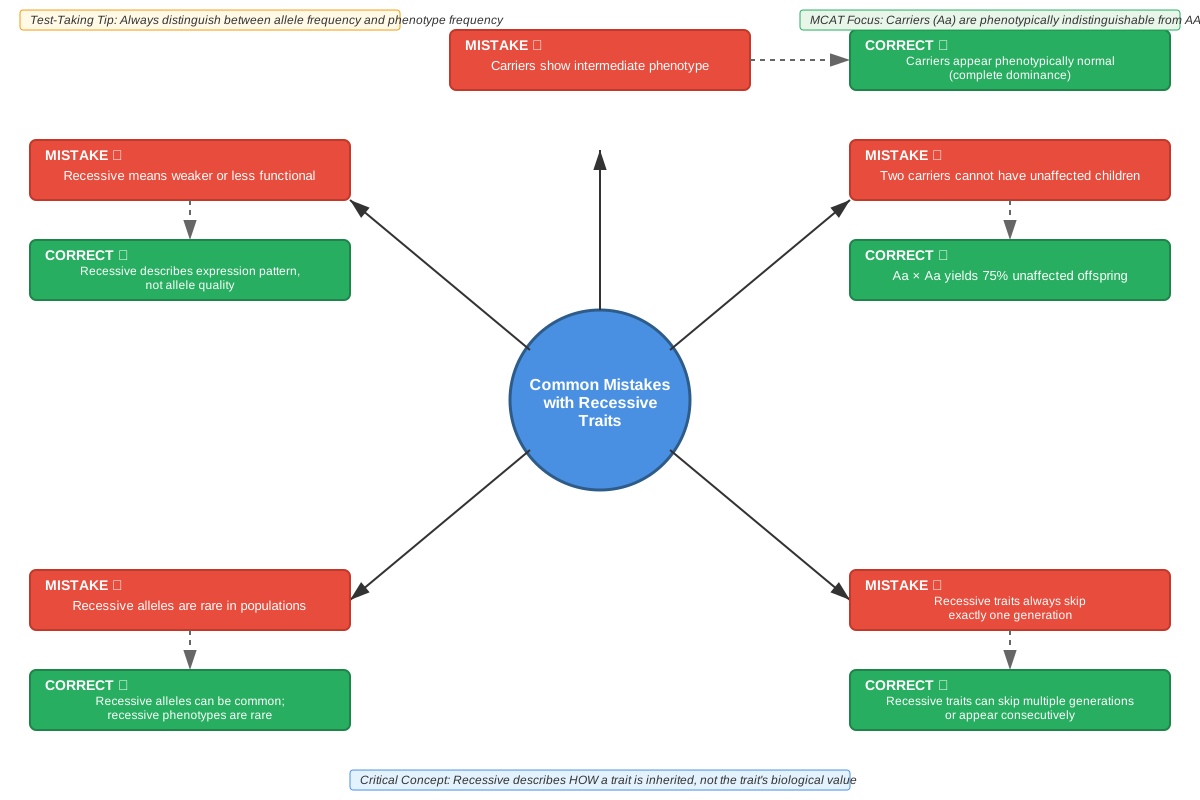
Misconception: Recessive traits are rare in populations → Correction: Recessive alleles can be quite common in populations; it is the homozygous recessive genotype (and thus the recessive phenotype) that may be rare. For example, the sickle cell allele has high frequency in certain populations, with many carriers, even though the disease phenotype is less common.
Misconception: If both parents have a dominant phenotype, all offspring must have the dominant phenotype → Correction: Two heterozygous (carrier) parents with dominant phenotypes can produce offspring with the recessive phenotype. The Aa × Aa cross produces 25% aa offspring with the recessive trait.
Misconception: Recessive means weak or less common → Correction: "Recessive" describes the inheritance pattern (requiring two copies for expression), not the strength, severity, or frequency of the trait. Some recessive traits produce severe phenotypes, and recessive alleles can be common in populations.
Misconception: In X-linked recessive inheritance, affected fathers always pass the trait to their sons → Correction: Affected fathers (XʳY) pass their X chromosome only to daughters (making all daughters carriers) and pass the Y chromosome to sons (making sons unaffected unless the mother is a carrier or affected). There is no male-to-male transmission of X-linked traits.
Misconception: Carriers of recessive traits have a mild form of the condition → Correction: Carriers (heterozygotes) typically have completely normal phenotypes and are indistinguishable from homozygous dominant individuals. The one functional allele usually produces sufficient gene product for normal function. (Note: Some conditions show incomplete dominance where carriers have intermediate phenotypes, but this is not the typical recessive pattern.)
Misconception: The 3:1 ratio always appears in crosses involving recessive traits → Correction: The 3:1 phenotypic ratio specifically results from a monohybrid cross between two heterozygotes (Aa × Aa). Other crosses produce different ratios: Aa × aa produces 1:1, AA × aa produces all dominant phenotype, and dihybrid crosses produce 9:3:3:1 ratios.
Worked Examples
Example 1: Autosomal Recessive Pedigree Analysis
Question: In the pedigree below, a genetic condition affects several family members. Individual II-1 and II-2 are unaffected but have an affected child (III-2). Individual II-3 is unaffected and marries an unaffected individual (II-4) from outside the family. They want to know the probability their next child will be affected.
Generation I:    ○—○
                 |
Generation II:   ○—○  ○—○
                 1 2  3 4
                   |
Generation III:  ○ ■ ○
                 1 2 3
(○ = unaffected, ■ = affected)
Solution:
Step 1: Determine the inheritance pattern. The affected individual (III-2) has two unaffected parents, suggesting autosomal recessive inheritance. Let A = normal allele, a = disease allele.
Step 2: Determine known genotypes. Individual III-2 is affected, so genotype = aa. Parents II-1 and II-2 must each have contributed one a allele, so both are carriers: II-1 = Aa, II-2 = Aa.
Step 3: Determine II-3 genotype. Individual II-3 is unaffected and has the same parents as II-1, who is a carrier. The possible genotypes for II-3 are AA or Aa. From the Aa × Aa parental cross, the offspring ratio is 1 AA : 2 Aa : 1 aa. Since II-3 is unaffected (not aa), we use conditional probability: P(II-3 is Aa | II-3 is unaffected) = 2/3.
Step 4: Determine II-4 genotype. Individual II-4 is from outside the family and unaffected. Without additional information, we assume II-4 is from the general population. For rare recessive diseases, the probability of being a carrier is approximately 2q (where q is the disease allele frequency). However, if no population frequency is given, MCAT questions typically either provide this information or ask students to assume II-4 is homozygous dominant (AA) for simplicity.
Assuming II-4 = AA:
- If II-3 = AA (probability 1/3), then AA × AA → 0% chance of affected child
- If II-3 = Aa (probability 2/3), then Aa × AA → 0% chance of affected child
Answer: The probability of an affected child is 0% if II-4 is homozygous dominant.
If the question specified II-4 has carrier probability of 1/50 (for example):
- Probability both are carriers: 2/3 × 1/50 = 2/150 = 1/75
- Probability of affected child if both carriers: 1/4
- Overall probability: 1/75 × 1/4 = 1/300
Example 2: X-Linked Recessive Inheritance
Question: Hemophilia A is an X-linked recessive disorder. A woman whose father had hemophilia marries an unaffected man. What is the probability their first son will have hemophilia? What is the probability their first daughter will have hemophilia?
Solution:
Step 1: Assign alleles. Let X^H = normal allele, X^h = hemophilia allele.
Step 2: Determine parental genotypes.
- The woman's father had hemophilia: X^h Y
- The woman's father must have passed X^h to his daughter
- The woman's mother must have passed X^H (since the woman is unaffected)
- Therefore, the woman is a carrier: X^H X^h
- The unaffected man: X^H Y
Step 3: Set up the cross: X^H X^h (woman) × X^H Y (man)
Step 4: Determine offspring probabilities.
Possible offspring:
- X^H X^H (daughter, unaffected): 1/4
- X^H X^h (daughter, carrier): 1/4
- X^H Y (son, unaffected): 1/4
- X^h Y (son, affected): 1/4
Step 5: Calculate conditional probabilities.
For sons specifically:
- P(affected | son) = P(X^h Y) / P(son) = (1/4) / (1/2) = 1/2
For daughters specifically:
- P(affected | daughter) = P(X^h X^h) / P(daughter) = 0 / (1/2) = 0
Answer: The probability their first son will have hemophilia is 50% (1/2). The probability their first daughter will have hemophilia is 0% because she would need to inherit X^h from both parents, but the father has X^H.
Exam Strategy
When approaching MCAT questions on recessive traits, follow this systematic strategy:
Step 1: Identify the inheritance pattern. Look for clues: Does the trait skip generations? Are both sexes equally affected? Is there male-to-male transmission? These observations distinguish autosomal recessive from X-linked recessive and from dominant patterns.
Step 2: Assign genotypes systematically. Start with affected individuals (must be homozygous recessive for autosomal or hemizygous for X-linked), then work backward to parents and forward to offspring. Use conditional probability when genotypes are ambiguous.
Step 3: Watch for trigger words:
- "Carrier" indicates heterozygous genotype with dominant phenotype
- "Unaffected parents with affected child" strongly suggests recessive inheritance
- "Consanguineous" or "related parents" increases suspicion for rare recessive traits
- "Skips generations" indicates recessive pattern
- "No male-to-male transmission" indicates X-linked inheritance
Step 4: Use process of elimination. For inheritance pattern questions, eliminate options systematically:
- If both sexes are equally affected, eliminate X-linked options
- If male-to-male transmission occurs, eliminate X-linked options
- If affected individuals have affected parents, eliminate recessive options
- If the trait appears in every generation, eliminate recessive options (unless consanguinity is involved)
Step 5: Set up probability calculations carefully. Break complex problems into steps using multiplication rule for independent events and addition rule for mutually exclusive outcomes. For carrier probability questions, remember to use conditional probability when individuals are known to be unaffected.
Time allocation: Spend 30-45 seconds identifying the inheritance pattern, 30-60 seconds determining genotypes, and 30-60 seconds calculating probabilities. Pedigree questions typically require 90-120 seconds total. If a calculation becomes too complex, check whether the question asks for an exact answer or allows estimation.
Exam Tip: When pedigree analysis seems ambiguous between autosomal recessive and X-linked recessive, look at the sex distribution. If significantly more males are affected, favor X-linked recessive. If sexes are equal, favor autosomal recessive.
Memory Techniques
Mnemonic for Autosomal Recessive Features: "CHESS"
- Consanguinity increases risk
- Horizontal transmission (affects siblings)
- Equal sex distribution
- Skips generations
- Same generation affected (horizontal pattern)
Mnemonic for X-Linked Recessive Features: "MOMS PASS"
- Males predominantly affected
- Obligatory carrier daughters of affected fathers
- Mother-to-son transmission typical
- Skips generations
- Passes through carrier females
- Affected males have unaffected parents
- Sons of affected males are unaffected
- Sons cannot inherit from fathers (no male-to-male)
Visualization for Carrier Concept: Picture a heterozygote as a person carrying a backpack (the recessive allele) that's hidden under a coat (the dominant phenotype). The backpack is there but invisible from the outside. Only when two people with hidden backpacks have children can the backpacks become visible (homozygous recessive offspring).
Ratio Memory Aid: "3-1 for one, 9-3-3-1 for two"
- Monohybrid cross (one gene): 3:1 phenotypic ratio
- Dihybrid cross (two genes): 9:3:3:1 phenotypic ratio
Pedigree Symbol Memory:
- Circles = females (think: Circle = Chromosome XX)
- Squares = males (think: Square = Straight lines like Y chromosome)
- Filled = affected (think: Filled = Functionally impaired)
Summary
Recessive traits represent phenotypic characteristics expressed only in individuals with two copies of the recessive allele (homozygous recessive genotype). The molecular basis typically involves loss-of-function mutations where one functional allele produces sufficient gene product for normal phenotype, making heterozygous carriers phenotypically normal. Autosomal recessive traits affect both sexes equally, often skip generations, and show horizontal transmission patterns in pedigrees, with affected individuals typically having two unaffected carrier parents. X-linked recessive traits predominantly affect males (who are hemizygous), show no male-to-male transmission, and typically involve carrier mothers transmitting the trait to affected sons. MCAT questions test recessive trait concepts through pedigree analysis, probability calculations, and application to human genetic disorders. Success requires systematic genotype determination, proper application of probability rules, and recognition of characteristic inheritance patterns. Understanding recessive traits provides the foundation for more complex genetics topics including Hardy-Weinberg equilibrium, population genetics, and multifactorial inheritance.
Key Takeaways
- Recessive traits require homozygous recessive genotype (aa) for expression; heterozygotes (Aa) are phenotypically normal carriers
- Two carrier parents have 25% probability of affected offspring, 50% probability of carrier offspring, and 25% probability of homozygous dominant offspring
- Autosomal recessive inheritance shows equal sex distribution, horizontal transmission, and generation skipping; X-linked recessive shows male predominance and no male-to-male transmission
- Pedigree analysis requires systematic genotype determination starting with affected individuals and using conditional probability for ambiguous cases
- Carrier frequency in populations (2pq) typically far exceeds affected individual frequency (q²) for rare recessive alleles
- The molecular basis of most recessive traits involves loss-of-function mutations where 50% gene product (in heterozygotes) maintains normal function
- MCAT questions integrate recessive trait concepts with probability calculations, pedigree interpretation, and population genetics applications
Related Topics
Dominant Traits: Understanding the complementary inheritance pattern where one copy of the dominant allele produces the dominant phenotype; essential for distinguishing inheritance patterns in pedigrees and crosses.
Incomplete Dominance and Codominance: Variations on simple dominance-recessive relationships where heterozygotes show intermediate or combined phenotypes; builds on recessive trait foundation.
Hardy-Weinberg Equilibrium: Population genetics principle enabling calculation of allele and genotype frequencies; directly applies recessive trait concepts to population-level predictions.
Sex-Linked Inheritance: Expanded coverage of X-linked and Y-linked traits; deepens understanding of how chromosome location affects inheritance patterns.
Pedigree Analysis: Comprehensive study of inheritance pattern identification and genotype determination; practical application of recessive trait principles.
Genetic Disorders: Clinical applications including cystic fibrosis, sickle cell disease, Tay-Sachs disease, and phenylketonuria; connects molecular mechanisms to disease phenotypes.
Practice CTA
Now that you've mastered the core concepts of recessive traits, it's time to solidify your understanding through active practice. Work through the practice questions and flashcards to test your ability to identify inheritance patterns, calculate probabilities, and analyze pedigrees under timed conditions. Remember, genetics questions on the MCAT reward systematic thinking and careful attention to detail—skills that improve dramatically with deliberate practice. Each practice problem you solve strengthens the neural pathways that will serve you on test day. You've built the foundation; now build the confidence through application!
Sign up free to keep reading
Create a free AnvayaPrep account to finish this MCAT guide on Recessive traits — plus flashcards and practice questions.