Overview
The resting membrane potential is one of the most fundamental concepts in cellular physiology and organ systems, representing the electrical potential difference across a cell membrane when the cell is not actively transmitting signals. This voltage difference, typically around -70 mV in neurons (with the inside negative relative to the outside), arises from the unequal distribution of ions across the plasma membrane and the selective permeability of that membrane to different ions. Understanding resting membrane potential is essential for comprehending how excitable cells like neurons and muscle cells function, as it establishes the baseline electrical state from which action potentials and other electrical signals originate.
For the MCAT, resting membrane potential Biology represents a critical bridge between molecular biology, biochemistry, and physiology. Questions on this topic frequently appear in both passage-based and discrete questions within the Biological and Biochemical Foundations of Living Systems section. The MCAT tests not only the ability to recall the numerical value of resting potential but also requires students to understand the underlying mechanisms involving ion gradients, membrane permeability, and the sodium-potassium pump. This topic integrates concepts from cell biology (membrane structure and transport), biochemistry (ATP-dependent processes), and physics (electrical potential and charge separation).
The resting membrane potential MCAT content connects directly to action potentials, synaptic transmission, muscle contraction, and sensory transduction—all high-yield topics for the exam. Mastery of this foundational concept enables students to predict how changes in ion concentrations, membrane permeability, or pump activity will affect cellular excitability and signal transmission. This understanding is frequently tested through experimental passages that manipulate these variables and ask students to predict outcomes or explain observed phenomena.
Learning Objectives
- [ ] Define resting membrane potential using accurate Biology terminology
- [ ] Explain why resting membrane potential matters for the MCAT
- [ ] Apply resting membrane potential to exam-style questions
- [ ] Identify common mistakes related to resting membrane potential
- [ ] Connect resting membrane potential to related Biology concepts
- [ ] Calculate the contribution of individual ions to membrane potential using the Nernst equation
- [ ] Predict how changes in ion concentrations or membrane permeability affect resting potential
- [ ] Distinguish between the roles of passive ion channels and active transport in establishing and maintaining resting potential
Prerequisites
- Cell membrane structure: Understanding phospholipid bilayers and membrane proteins is essential because the resting potential depends on selective membrane permeability
- Ion gradients and concentration: Knowledge of how concentration differences create chemical gradients is necessary to understand the driving forces for ion movement
- Passive and active transport: Familiarity with diffusion, facilitated diffusion, and active transport mechanisms explains how ions move across membranes
- Basic electrochemistry: Understanding charge, voltage, and electrical potential differences provides the foundation for comprehending membrane potential
- ATP and cellular energy: Knowledge of ATP hydrolysis is required to understand how the sodium-potassium pump maintains ion gradients
Why This Topic Matters
Clinical and Real-World Significance
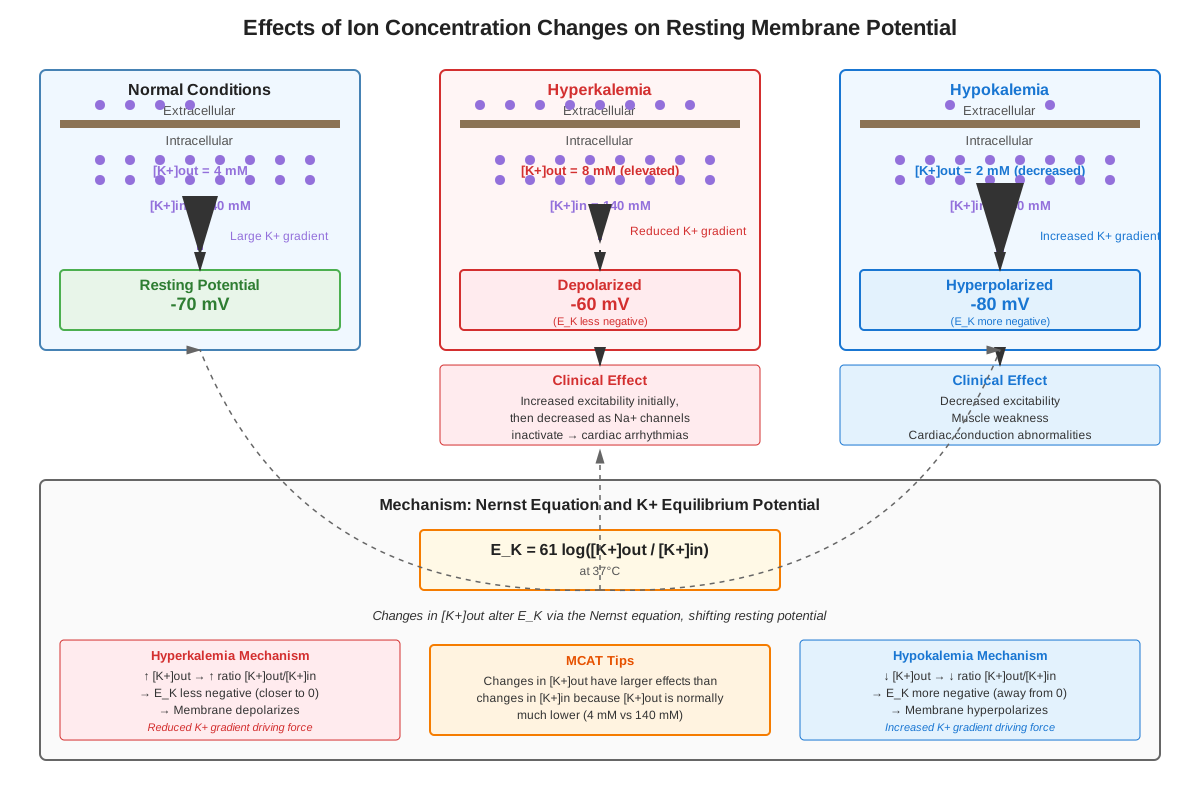
The resting membrane potential is fundamental to virtually all nervous system function and many other physiological processes. Disruptions in resting potential underlie numerous clinical conditions, including cardiac arrhythmias, epilepsy, and neuromuscular disorders. For example, hyperkalemia (elevated extracellular potassium) depolarizes cells by reducing the potassium gradient, which can lead to cardiac arrest. Many medications, including local anesthetics, antiarrhythmics, and anticonvulsants, work by modulating membrane potential or the ion channels that maintain it. Understanding resting potential is also crucial for comprehending how toxins like tetrodotoxin (which blocks sodium channels) or drugs like digoxin (which inhibits the sodium-potassium pump) exert their effects.
MCAT Exam Statistics
Resting membrane potential appears on the MCAT with moderate to high frequency, typically in 2-4 questions per exam. This topic most commonly appears in passage-based questions (approximately 70% of the time) where experimental manipulations of ion concentrations, channel blockers, or pump inhibitors are described. The remaining 30% appears as discrete questions testing fundamental knowledge. Questions often integrate this topic with action potentials, synaptic transmission, or muscle physiology, requiring students to apply their understanding across multiple related concepts.
Common Exam Presentations
The MCAT presents resting membrane potential through several recurring formats: (1) experimental passages describing the effects of changing extracellular ion concentrations on cellular excitability, (2) pharmacology passages involving drugs that affect ion channels or pumps, (3) comparative physiology passages examining differences in membrane potential across cell types, and (4) disease-state passages describing conditions that disrupt normal ion homeostasis. Questions frequently ask students to predict the direction of potential change, identify which ions contribute most to resting potential, or explain why certain manipulations produce specific effects on cellular function.
Core Concepts
Definition and Magnitude of Resting Membrane Potential
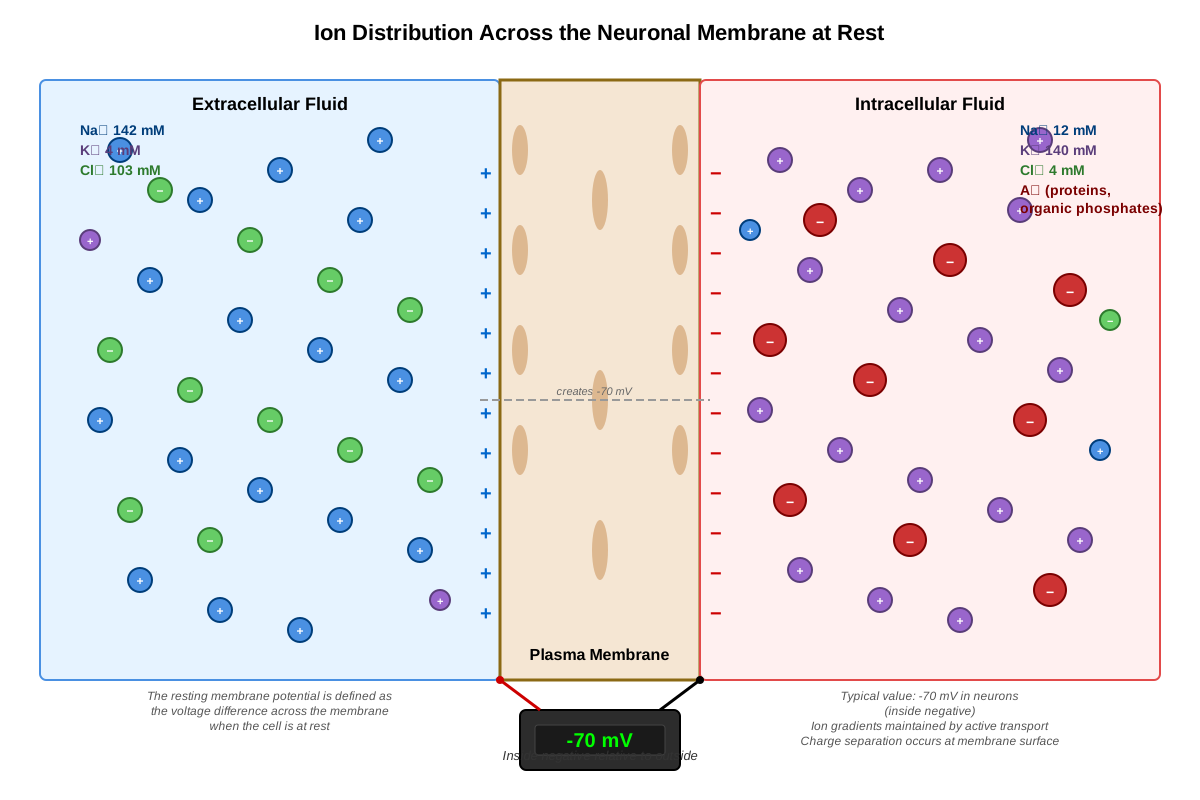
The resting membrane potential is defined as the electrical potential difference across the plasma membrane of a cell at rest, measured as the voltage inside the cell relative to the outside. By convention, the extracellular fluid is assigned a reference value of 0 mV, and the intracellular potential is expressed relative to this reference. In most neurons, the resting membrane potential is approximately -70 mV, meaning the inside of the cell is 70 millivolts more negative than the outside. This value varies somewhat across cell types: skeletal muscle cells typically rest at -90 mV, cardiac muscle cells at -80 to -90 mV, and smooth muscle cells at -50 to -60 mV.
The negative resting potential results from an unequal distribution of charged particles (ions) across the membrane and the selective permeability of the membrane to these ions. The membrane is not equally permeable to all ions; at rest, it is most permeable to potassium ions (K⁺), moderately permeable to chloride ions (Cl⁻), and relatively impermeable to sodium ions (Na⁺) and large intracellular anions like proteins and organic phosphates.
Ion Distribution and Concentration Gradients
The establishment of resting membrane potential depends critically on the unequal distribution of ions across the plasma membrane. The typical ion concentrations for a mammalian neuron are:
| Ion | Intracellular Concentration | Extracellular Concentration | Concentration Gradient |
|---|---|---|---|
| K⁺ | ~140 mM | ~5 mM | High inside |
| Na⁺ | ~12 mM | ~145 mM | High outside |
| Cl⁻ | ~4 mM | ~110 mM | High outside |
| Ca²⁺ | ~0.0001 mM | ~2 mM | High outside |
These concentration gradients create both chemical gradients (based on concentration differences) and electrical gradients (based on charge differences) that drive ion movement. For each ion, the net driving force is the sum of these two gradients, called the electrochemical gradient.
The Sodium-Potassium Pump (Na⁺/K⁺-ATPase)
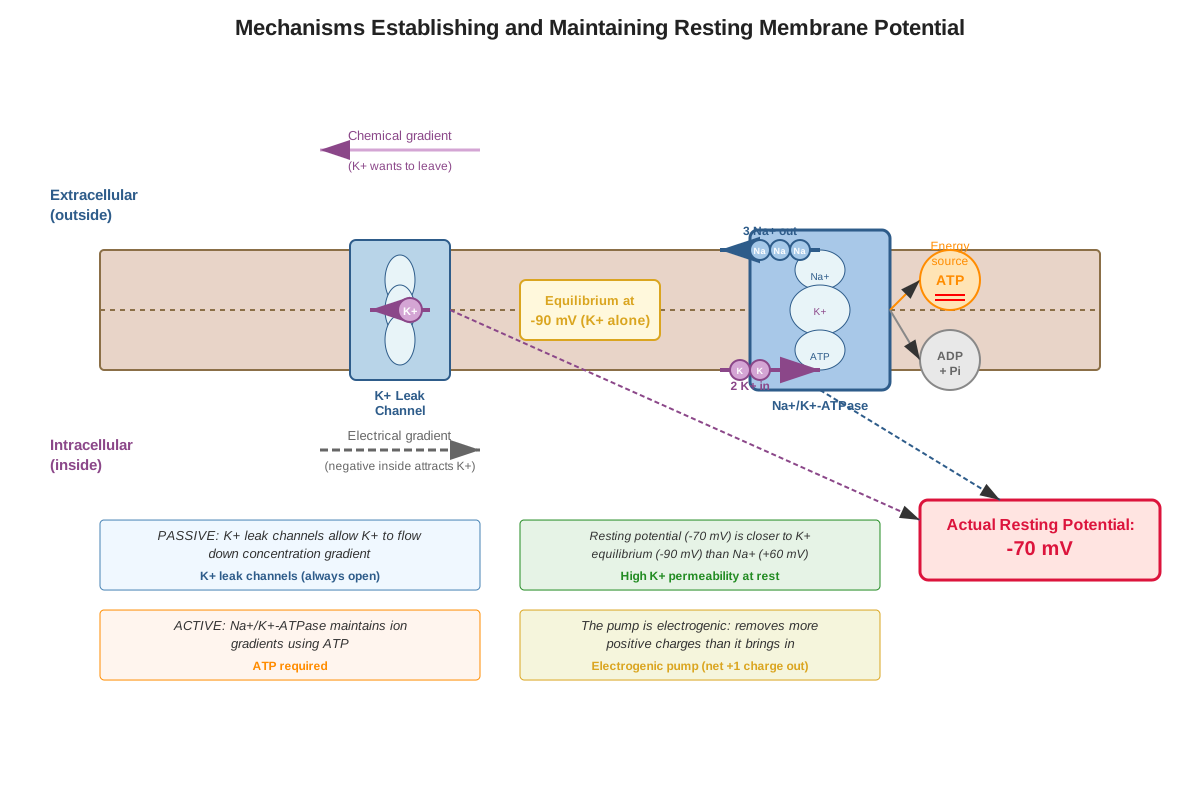
The sodium-potassium pump is an active transport protein that uses ATP hydrolysis to maintain the ion concentration gradients essential for resting potential. This pump is electrogenic, meaning it directly contributes to the membrane potential because it moves unequal numbers of charges across the membrane.
The pump operates through the following cycle:
- Three sodium ions (Na⁺) bind to the pump on the intracellular side
- ATP is hydrolyzed to ADP + Pi, phosphorylating the pump
- Phosphorylation causes a conformational change that exposes the Na⁺ binding sites to the extracellular side
- The three Na⁺ ions are released outside the cell
- Two potassium ions (K⁺) bind to the pump on the extracellular side
- Dephosphorylation occurs, causing another conformational change
- The two K⁺ ions are released inside the cell
- The cycle repeats
Because the pump moves three positive charges out for every two positive charges in, it creates a net loss of one positive charge from the intracellular space with each cycle. This electrogenic activity contributes approximately -5 to -10 mV to the overall resting potential. However, the pump's primary role is maintaining the concentration gradients that allow passive ion movement to generate most of the resting potential.
Potassium Leak Channels and the Potassium Equilibrium Potential
At rest, the membrane contains many potassium leak channels—always-open channels that allow K⁺ to move freely across the membrane according to its electrochemical gradient. Because the intracellular K⁺ concentration is much higher than the extracellular concentration, K⁺ tends to diffuse out of the cell down its concentration gradient. As positive charges leave the cell, the inside becomes increasingly negative.
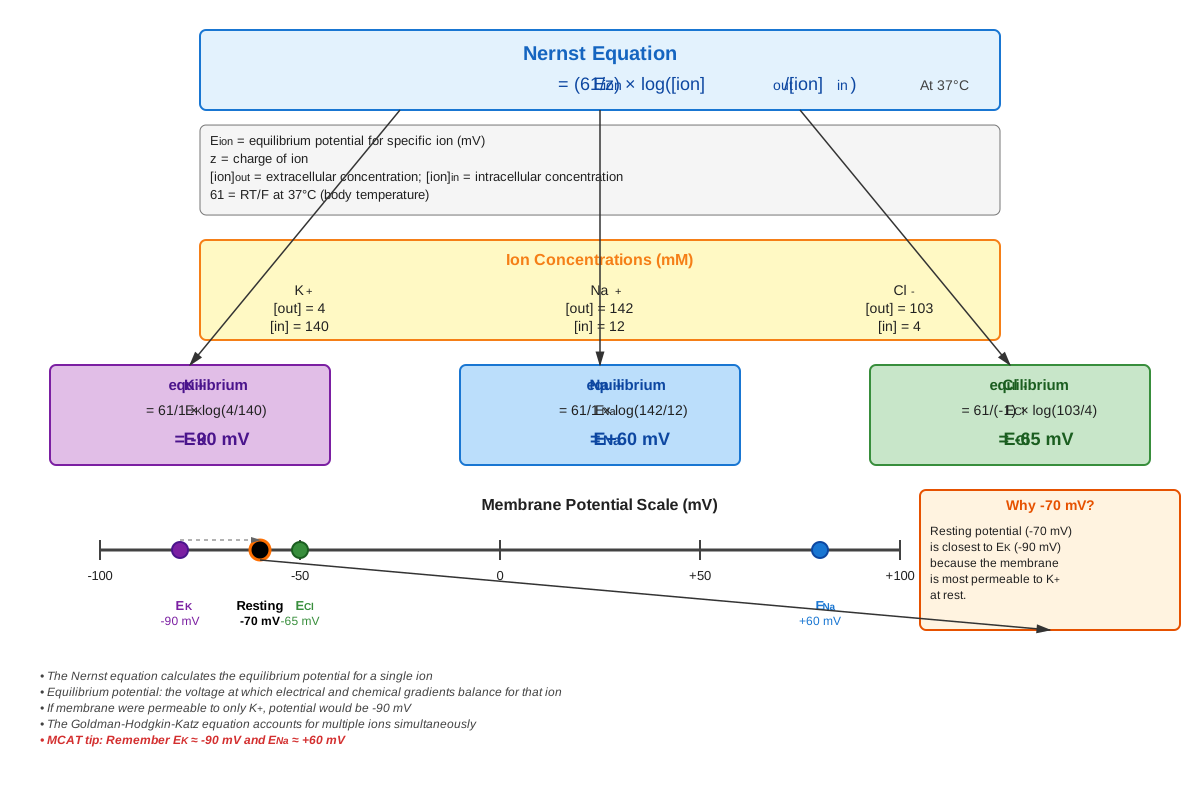
However, this electrical gradient (negative inside) eventually opposes further K⁺ efflux. The potassium equilibrium potential (E_K) is the membrane potential at which the electrical force pulling K⁺ into the cell exactly balances the chemical force pushing K⁺ out of the cell, resulting in no net K⁺ movement. For typical mammalian neurons, E_K is approximately -90 mV.
The equilibrium potential for any ion can be calculated using the Nernst equation:
E_ion = (RT/zF) × ln([ion]_out/[ion]_in)Where:
- R = gas constant (8.314 J/(mol·K))
- T = absolute temperature (K)
- z = valence of the ion
- F = Faraday's constant (96,485 C/mol)
- [ion]_out = extracellular concentration
- [ion]_in = intracellular concentration
At body temperature (37°C), this simplifies to:
E_ion = (61.5 mV/z) × log([ion]_out/[ion]_in)For potassium: E_K = 61.5 × log(5/140) ≈ -90 mV
Sodium Equilibrium Potential and Limited Sodium Permeability
The sodium equilibrium potential (E_Na) can be calculated similarly. With extracellular Na⁺ at ~145 mM and intracellular Na⁺ at ~12 mM:
E_Na = 61.5 × log(145/12) ≈ +60 mV
This positive value indicates that both the concentration gradient and the electrical gradient favor Na⁺ entry into the cell. However, at rest, the membrane has relatively few open sodium channels, so sodium permeability is low. The small amount of Na⁺ that does leak into the cell makes the resting potential slightly less negative than E_K.
The Goldman-Hodgkin-Katz Equation
The actual resting membrane potential reflects the combined influence of all permeable ions, weighted by their relative permeabilities. The Goldman-Hodgkin-Katz (GHK) equation calculates this:
V_m = (RT/F) × ln[(P_K[K⁺]_out + P_Na[Na⁺]_out + P_Cl[Cl⁻]_in)/(P_K[K⁺]_in + P_Na[Na⁺]_in + P_Cl[Cl⁻]_out)]Where P represents the permeability coefficient for each ion. At rest, P_K >> P_Na, so potassium dominates the resting potential, pulling it close to (but not exactly at) E_K. The small sodium permeability depolarizes the membrane slightly from E_K, resulting in the typical -70 mV resting potential.
Chloride's Role in Resting Potential
Chloride ions (Cl⁻) are also permeable across the membrane through chloride channels. In many neurons, chloride is passively distributed according to the membrane potential established by K⁺ and Na⁺, meaning E_Cl is close to the resting potential (-70 mV). In these cells, chloride movement does not significantly change the resting potential but rather follows it. However, in some cells, active chloride transport creates a chloride gradient that contributes to setting the resting potential.
Maintenance of Resting Potential
The resting membrane potential is a steady-state condition, not an equilibrium. Ions continuously leak across the membrane down their electrochemical gradients: K⁺ slowly leaks out, and Na⁺ slowly leaks in. The sodium-potassium pump continuously works to restore these ions to their proper compartments, using ATP to pump Na⁺ out and K⁺ in. This ongoing process requires constant energy expenditure—approximately 70% of a neuron's ATP consumption at rest goes to maintaining the sodium-potassium pump.
If the pump is inhibited (by cooling, metabolic poisons, or drugs like ouabain), the ion gradients gradually dissipate, and the resting potential slowly depolarizes toward 0 mV. This demonstrates that the resting potential depends on both passive ion permeability and active ion pumping.
Concept Relationships
The resting membrane potential serves as the foundation for understanding all electrical signaling in excitable cells. The ion concentration gradients established by the sodium-potassium pump create the potential energy that drives both the resting potential (through passive K⁺ efflux) and action potentials (through rapid Na⁺ influx). The relationship can be mapped as:
ATP hydrolysis → Na⁺/K⁺-ATPase activity → Ion concentration gradients → Electrochemical gradients → Passive ion movement through leak channels → Resting membrane potential
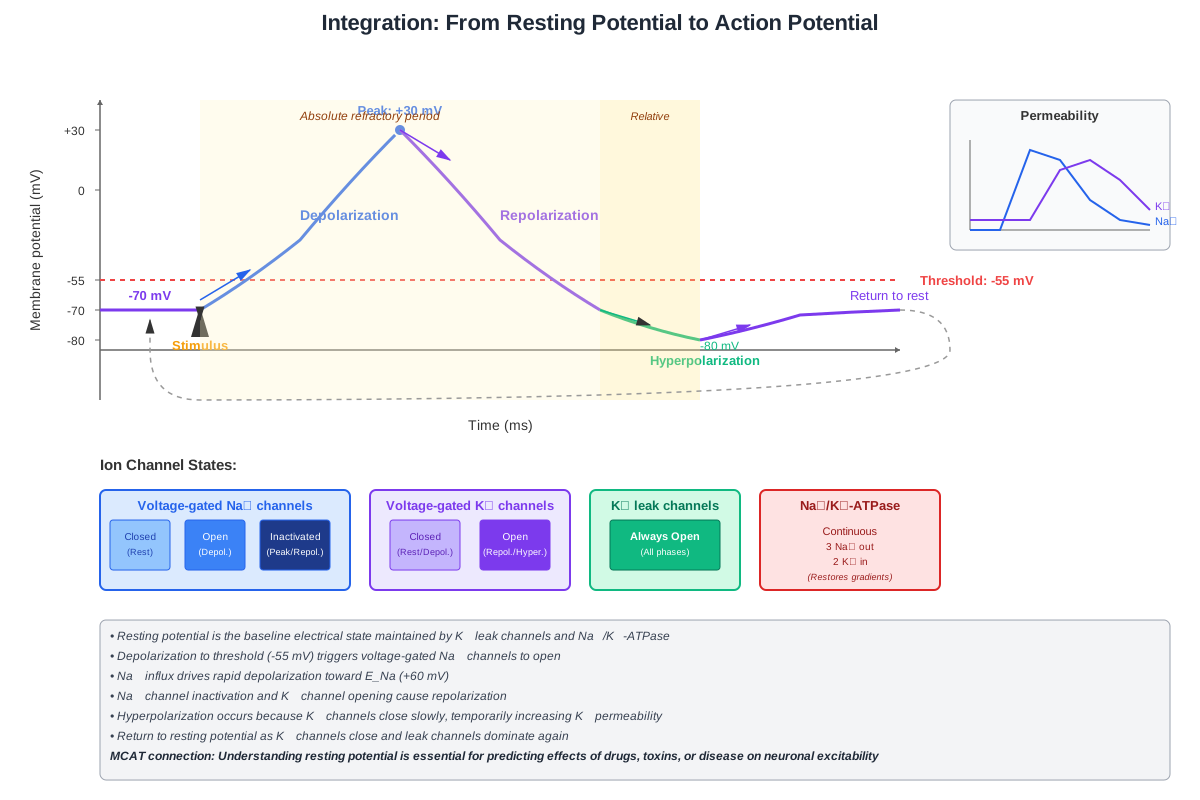
The resting potential then serves as the baseline from which depolarization and hyperpolarization are measured. When voltage-gated sodium channels open during an action potential, the membrane potential moves from the resting value (-70 mV) toward the sodium equilibrium potential (+60 mV). When voltage-gated potassium channels open, the membrane potential moves toward the potassium equilibrium potential (-90 mV), causing repolarization and sometimes hyperpolarization.
The concept also connects to synaptic transmission: neurotransmitter-gated ion channels cause local changes in membrane potential (EPSPs and IPSPs) that sum to determine whether the membrane reaches threshold for action potential generation. Understanding resting potential is essential for predicting whether a given synaptic input will be excitatory or inhibitory.
Furthermore, resting potential relates to osmotic balance: the high concentration of intracellular proteins and organic anions creates an osmotic imbalance that would cause cells to swell and burst if not counteracted by the sodium-potassium pump, which maintains lower intracellular Na⁺ and higher extracellular Na⁺ to balance osmotic pressure.
Quick check — test yourself on Resting membrane potential so far.
Try Flashcards →High-Yield Facts
⭐ The typical resting membrane potential of a neuron is approximately -70 mV, with the inside negative relative to the outside.
⭐ The sodium-potassium pump (Na⁺/K⁺-ATPase) moves 3 Na⁺ out and 2 K⁺ in per ATP hydrolyzed, making it electrogenic and contributing -5 to -10 mV to the resting potential.
⭐ At rest, the membrane is most permeable to K⁺, moderately permeable to Cl⁻, and least permeable to Na⁺, which is why the resting potential is closest to the potassium equilibrium potential.
⭐ The potassium equilibrium potential (E_K) is approximately -90 mV, while the sodium equilibrium potential (E_Na) is approximately +60 mV.
⭐ The Nernst equation calculates the equilibrium potential for a single ion: E_ion = (61.5 mV/z) × log([ion]_out/[ion]_in) at body temperature.
- The Goldman-Hodgkin-Katz equation accounts for multiple ions and their relative permeabilities to calculate the actual membrane potential.
- Increasing extracellular K⁺ concentration depolarizes the cell (makes the inside less negative) by reducing the K⁺ concentration gradient.
- Decreasing extracellular Na⁺ concentration hyperpolarizes the cell (makes the inside more negative) by reducing Na⁺ influx.
- Inhibiting the sodium-potassium pump causes gradual depolarization as ion gradients dissipate.
- The resting potential is a steady-state condition requiring continuous ATP expenditure, not a true equilibrium.
- Approximately 70% of neuronal ATP consumption at rest is used to power the sodium-potassium pump.
- The high intracellular K⁺ concentration (~140 mM) compared to extracellular K⁺ (~5 mM) creates a 28-fold concentration gradient.
Common Misconceptions
Misconception: The sodium-potassium pump directly creates the entire resting membrane potential through its electrogenic activity.
Correction: The pump's electrogenic contribution is only -5 to -10 mV. The pump's primary role is maintaining the ion concentration gradients that allow passive K⁺ efflux through leak channels to generate most of the resting potential (-60 to -65 mV of the total -70 mV).
Misconception: The resting membrane potential equals the potassium equilibrium potential.
Correction: The resting potential (-70 mV) is close to but not equal to E_K (-90 mV) because the membrane has some permeability to other ions, particularly Na⁺. The small sodium leak depolarizes the membrane from E_K toward E_Na, resulting in a resting potential between these two equilibrium potentials but much closer to E_K.
Misconception: Increasing extracellular K⁺ always makes the cell more excitable.
Correction: Moderate increases in extracellular K⁺ do depolarize the cell toward threshold, initially increasing excitability. However, large increases in extracellular K⁺ can inactivate voltage-gated sodium channels, paradoxically decreasing excitability despite depolarization. This is why severe hyperkalemia can cause cardiac arrest.
Misconception: The resting potential is an equilibrium state where no ions are moving.
Correction: The resting potential is a steady-state condition where ions continuously move across the membrane, but the net flux of charge is zero. K⁺ continuously leaks out and Na⁺ continuously leaks in, while the sodium-potassium pump continuously restores these ions, requiring constant ATP expenditure.
Misconception: All cells have the same resting membrane potential.
Correction: Different cell types have different resting potentials depending on their ion channel expression and pump activity. Neurons typically rest at -70 mV, skeletal muscle at -90 mV, cardiac muscle at -80 to -90 mV, and smooth muscle at -50 to -60 mV. Non-excitable cells may have resting potentials ranging from -20 to -40 mV.
Misconception: Chloride always contributes significantly to establishing the resting potential.
Correction: In many neurons, chloride is passively distributed according to the membrane potential established by K⁺ and Na⁺, so it follows rather than determines the resting potential. However, in some cells (particularly in developing neurons or certain mature neurons), active chloride transport does contribute to setting the resting potential.
Worked Examples
Example 1: Predicting the Effect of Changing Extracellular Potassium
Question: A neuron with a normal resting potential of -70 mV is placed in a solution where the extracellular K⁺ concentration is increased from 5 mM to 10 mM. The intracellular K⁺ concentration remains at 140 mM. Predict the effect on the resting membrane potential and explain the physiological consequences.
Solution:
Step 1: Calculate the new potassium equilibrium potential using the Nernst equation.
Original E_K = 61.5 × log(5/140) = 61.5 × log(0.0357) = 61.5 × (-1.45) = -89 mV
New E_K = 61.5 × log(10/140) = 61.5 × log(0.0714) = 61.5 × (-1.15) = -71 mV
Step 2: Determine the direction of change.
The potassium equilibrium potential has become less negative (depolarized) by approximately 18 mV. Since the resting potential is dominated by potassium permeability and sits close to E_K, the actual resting potential will also depolarize.
Step 3: Estimate the new resting potential.
The resting potential won't change by the full 18 mV because it's not exactly at E_K (due to sodium permeability). However, it will move significantly in that direction. A reasonable estimate would be a depolarization of 12-15 mV, bringing the resting potential from -70 mV to approximately -55 to -58 mV.
Step 4: Predict physiological consequences.
This depolarization brings the membrane potential closer to the threshold for action potential generation (typically around -55 mV). The cell becomes more excitable because less additional depolarization is needed to reach threshold. This is why moderate hyperkalemia can initially increase neuromuscular excitability, potentially causing muscle cramps or cardiac arrhythmias.
Connection to learning objectives: This example demonstrates the application of the Nernst equation to predict changes in membrane potential and connects the concept to clinical scenarios involving electrolyte imbalances.
Example 2: Analyzing an Experimental Manipulation
Question: Researchers studying neurons apply ouabain, a specific inhibitor of the Na⁺/K⁺-ATPase pump. Initially, they observe a small depolarization of about 8 mV within seconds. Over the next 30 minutes, they observe continued gradual depolarization until the membrane potential reaches approximately -10 mV. Explain both phases of this response.
Solution:
Step 1: Analyze the immediate effect (first 8 mV depolarization).
The sodium-potassium pump is electrogenic, contributing approximately -5 to -10 mV to the resting potential by moving 3 positive charges out for every 2 positive charges in. When ouabain immediately blocks the pump, this electrogenic contribution is lost, causing an immediate depolarization of about 8 mV (from -70 mV to approximately -62 mV).
Step 2: Analyze the gradual effect (continued depolarization to -10 mV).
Even with the pump blocked, the ion concentration gradients initially remain intact, so passive ion movement through leak channels continues. However, without the pump to restore ions to their proper compartments, K⁺ gradually accumulates outside the cell (from leak channels), and Na⁺ gradually accumulates inside the cell (from sodium leak). As the K⁺ gradient decreases, E_K becomes less negative. As the Na⁺ gradient decreases, E_Na becomes less positive. Both changes cause the membrane potential to depolarize toward 0 mV.
Step 3: Explain why the potential approaches but doesn't reach 0 mV immediately.
The gradual nature of this depolarization reflects the time required for passive ion leak to dissipate the concentration gradients. The membrane potential approaches 0 mV (the point where concentration gradients are eliminated) but takes considerable time because leak channels have relatively low conductance.
Step 4: Connect to broader physiological principles.
This experiment demonstrates that the resting potential depends on both active transport (the pump) and passive permeability (leak channels). It also shows that the resting potential is a steady-state condition requiring continuous energy expenditure, not a true equilibrium. Without ATP to power the pump, the cell cannot maintain its resting potential.
Connection to learning objectives: This example requires understanding the dual role of the sodium-potassium pump (electrogenic contribution and gradient maintenance), demonstrates how to analyze experimental manipulations, and illustrates the distinction between steady-state and equilibrium conditions.
Exam Strategy
Approaching MCAT Questions on Resting Membrane Potential
When encountering questions about resting membrane potential, first identify what is being manipulated: ion concentrations, membrane permeability, or pump activity. Each manipulation has predictable effects:
- Increasing extracellular K⁺: Depolarizes (less negative inside)
- Decreasing extracellular K⁺: Hyperpolarizes (more negative inside)
- Increasing extracellular Na⁺: Slight depolarization (small effect at rest)
- Decreasing extracellular Na⁺: Slight hyperpolarization (small effect at rest)
- Blocking K⁺ channels: Depolarizes (reduces K⁺ efflux)
- Blocking Na⁺ channels: Slight hyperpolarization (reduces Na⁺ influx)
- Inhibiting Na⁺/K⁺ pump: Immediate small depolarization, then gradual larger depolarization
Trigger Words and Phrases
Watch for these key phrases that signal resting potential questions:
- "At rest" or "resting state" → Consider baseline ion permeabilities
- "Equilibrium potential" → Use the Nernst equation
- "Membrane potential" without qualification → Usually refers to resting potential
- "Electrogenic pump" → Remember the 3:2 ratio and direct voltage contribution
- "Leak channels" → Think about potassium's dominant role at rest
- "Steady-state" → Indicates continuous ion movement balanced by pumping
Process of Elimination Tips
When multiple answer choices involve changes in membrane potential:
- Eliminate options that move the potential in the wrong direction (depolarization vs. hyperpolarization)
- Eliminate options that suggest the potential equals an equilibrium potential for a single ion (it's always between E_K and E_Na)
- Eliminate options that ignore the dominant role of potassium at rest
- Eliminate options that suggest the resting potential doesn't require ATP (it does, for the pump)
Exam Tip: If a question asks about the effect of changing ion concentrations, quickly calculate or estimate the direction of change in the relevant equilibrium potential using the Nernst equation. The actual membrane potential will move in the same direction but by a smaller magnitude.
Time Allocation
For discrete questions on resting potential, allocate 60-90 seconds. These typically test straightforward recall or simple application of the Nernst equation. For passage-based questions, allocate 90-120 seconds per question, as you'll need to integrate information from the passage with your background knowledge. If a question requires detailed Nernst equation calculations, don't spend more than 2 minutes—estimate if necessary and move on.
Memory Techniques
Mnemonic for Ion Distribution
"K⁺ IN, Na⁺ OUT" - Remember that potassium is high inside (IN), sodium is high outside (OUT). This is the opposite of their positions in the alphabet (Na comes before K), which makes it memorable.
Mnemonic for Pump Stoichiometry
"3-2-1 Pump" - 3 sodium out, 2 potassium in, 1 net positive charge removed (making the inside more negative).
Visualization Strategy for Equilibrium Potentials
Visualize a number line from -90 mV (E_K) to +60 mV (E_Na). The resting potential (-70 mV) sits much closer to the potassium end because the membrane is much more permeable to K⁺ at rest. During an action potential, the membrane potential rapidly moves toward the sodium end as sodium channels open.
Acronym for Factors Affecting Resting Potential
"PICC" - Permeability, Ion concentrations, Channel activity, Carrier (pump) activity. These four factors determine the resting membrane potential.
Memory Aid for Nernst Equation
Remember "61.5 divided by z" for the simplified Nernst equation at body temperature. The number 61.5 can be remembered as approximately 60 (easy to remember) plus a little more. For monovalent ions (z = 1), you use the full 61.5. For divalent ions (z = 2), you use 30.75 (approximately 31).
Summary
The resting membrane potential is the electrical potential difference across a cell membrane at rest, typically -70 mV in neurons, with the inside negative relative to the outside. This potential arises from the unequal distribution of ions across the membrane, particularly the high intracellular K⁺ and high extracellular Na⁺ concentrations maintained by the ATP-dependent sodium-potassium pump. At rest, the membrane is most permeable to K⁺ through leak channels, causing K⁺ efflux that makes the inside negative. The resting potential approaches but does not equal the potassium equilibrium potential (-90 mV) because of small sodium permeability that depolarizes the membrane slightly. The sodium-potassium pump contributes both by maintaining concentration gradients and through its electrogenic activity (3 Na⁺ out, 2 K⁺ in per ATP). The Nernst equation calculates equilibrium potentials for individual ions, while the Goldman-Hodgkin-Katz equation accounts for multiple ions and their relative permeabilities. Understanding resting potential is essential for predicting cellular responses to changes in ion concentrations, channel activity, or pump function—all common MCAT question types.
Key Takeaways
- The resting membrane potential of neurons is approximately -70 mV (inside negative), established primarily by potassium efflux through leak channels
- The sodium-potassium pump maintains ion gradients by moving 3 Na⁺ out and 2 K⁺ in per ATP, contributing both to concentration gradients and directly to membrane potential through electrogenic activity
- The Nernst equation (E = 61.5/z × log([out]/[in])) calculates equilibrium potentials: E_K ≈ -90 mV, E_Na ≈ +60 mV
- Increasing extracellular K⁺ depolarizes cells by reducing the K⁺ gradient; decreasing extracellular K⁺ hyperpolarizes cells
- The resting potential is a steady-state condition requiring continuous ATP expenditure, not a true equilibrium
- At rest, membrane permeability follows: P_K >> P_Cl > P_Na, which is why the resting potential is closest to E_K
- Changes in ion concentrations, membrane permeability, or pump activity predictably alter resting potential and cellular excitability
Related Topics
Action Potentials: Understanding resting potential is essential for comprehending how voltage-gated channels generate action potentials. The action potential represents a rapid, transient deviation from the resting potential caused by sequential opening of sodium and potassium channels.
Synaptic Transmission: Neurotransmitter-gated channels cause local changes in membrane potential (EPSPs and IPSPs) that sum to determine whether the postsynaptic cell reaches threshold. These graded potentials are measured relative to the resting potential.
Muscle Contraction: Both skeletal and cardiac muscle cells have resting potentials that must be depolarized to threshold to trigger action potentials and subsequent contraction. Understanding resting potential helps explain how neuromuscular transmission initiates contraction.
Sensory Transduction: Sensory receptors convert stimuli into changes in membrane potential (receptor potentials or generator potentials) that are measured relative to the resting potential. Mastering resting potential enables understanding of how sensory information is encoded.
Cardiac Electrophysiology: The heart's pacemaker cells have unstable resting potentials that spontaneously depolarize to threshold, while contractile cardiac cells have stable resting potentials. Understanding these differences requires mastery of the factors controlling resting potential.
Practice CTA
Now that you've mastered the foundational concepts of resting membrane potential, it's time to reinforce your understanding through active practice. Attempt the practice questions and flashcards associated with this topic to test your ability to apply these concepts to MCAT-style questions. Focus particularly on questions involving experimental manipulations of ion concentrations or pump activity, as these frequently appear on the exam. Remember that understanding resting potential is your gateway to mastering all of neurophysiology—invest the time now to build a solid foundation, and you'll find action potentials, synaptic transmission, and sensory physiology much more intuitive. You've got this!
Sign up free to keep reading
Create a free AnvayaPrep account to finish this MCAT guide on Resting membrane potential — plus flashcards and practice questions.