Overview
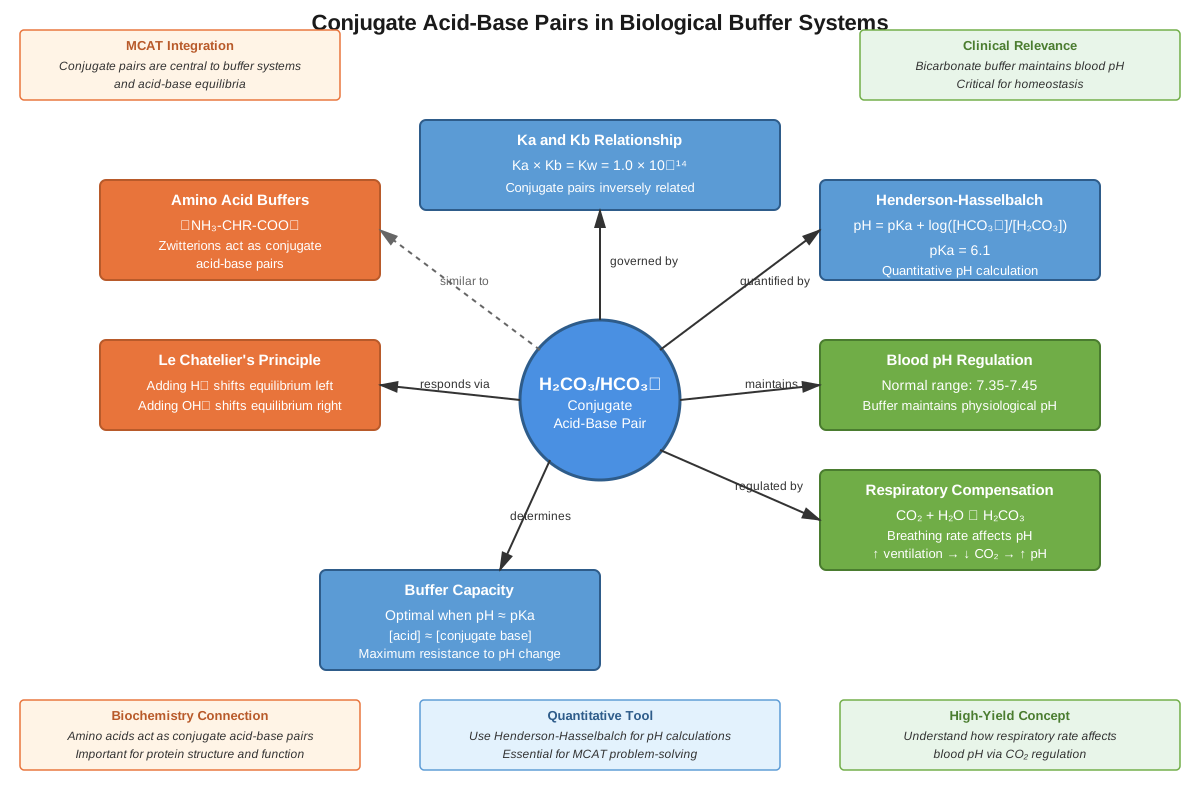
Conjugate acid base pairs represent one of the most fundamental concepts in General Chemistry and are essential for understanding acid-base chemistry on the MCAT. A conjugate acid-base pair consists of two species that differ by exactly one proton (H⁺). When an acid donates a proton, it becomes its conjugate base; conversely, when a base accepts a proton, it becomes its conjugate acid. This reciprocal relationship is central to the Brønsted-Lowry theory of acids and bases, which defines acids as proton donors and bases as proton acceptors. Understanding these pairs allows students to predict the direction of acid-base reactions, calculate pH and pKa values, and analyze buffer systems—all high-yield topics for the MCAT.
The concept of conjugate acid base pairs extends far beyond simple memorization. It provides a framework for understanding chemical equilibria, buffer capacity, titration curves, and physiological pH regulation. On the MCAT, questions involving conjugate pairs frequently appear in both standalone questions and passage-based contexts, particularly in passages discussing biochemical systems, drug mechanisms, or laboratory procedures. The ability to quickly identify conjugate pairs and predict their relative strengths is a critical skill that separates high-scoring students from average performers.
Mastery of conjugate acid-base pairs connects directly to broader Acids and Bases concepts including pH calculations, Henderson-Hasselbalch equation applications, buffer systems, and acid-base equilibria. This topic also bridges to biochemistry (amino acid ionization states), organic chemistry (reaction mechanisms), and physiology (blood buffering systems). The MCAT frequently tests the ability to integrate these concepts across disciplines, making conjugate acid-base pairs a cornerstone of interdisciplinary reasoning on test day.
Learning Objectives
- [ ] Define conjugate acid base pairs using accurate General Chemistry terminology
- [ ] Explain why conjugate acid base pairs matters for the MCAT
- [ ] Apply conjugate acid base pairs to exam-style questions
- [ ] Identify common mistakes related to conjugate acid base pairs
- [ ] Connect conjugate acid base pairs to related General Chemistry concepts
- [ ] Predict the relative strengths of conjugate acids and bases given Ka or Kb values
- [ ] Identify conjugate pairs in complex multi-step acid-base reactions
- [ ] Apply the inverse relationship between acid strength and conjugate base strength to solve equilibrium problems
Prerequisites
- Brønsted-Lowry acid-base theory: Understanding that acids donate protons and bases accept protons is essential for identifying conjugate pairs
- Chemical equilibrium fundamentals: Conjugate pairs exist in equilibrium systems, requiring knowledge of equilibrium constants and Le Chatelier's principle
- pH and pOH calculations: Quantitative analysis of conjugate pairs requires facility with logarithmic pH scales
- Molecular structure and charge: Recognizing how proton transfer affects molecular charge and structure is necessary for identifying conjugate relationships
- Ka and Kb equilibrium constants: These constants quantify acid and base strength, which directly relates to conjugate pair behavior
Why This Topic Matters
Conjugate acid-base pairs appear with remarkable frequency on the MCAT, showing up in approximately 3-5 questions per exam either directly or as foundational knowledge for more complex problems. The Chemical and Physical Foundations of Biological Systems section regularly features passages on buffer systems, amino acid chemistry, and drug ionization—all of which require fluent understanding of conjugate pairs. Additionally, the Biological and Biochemical Foundations of Living Systems section tests conjugate pair concepts in the context of physiological buffering, enzyme catalysis, and metabolic pathways.
Clinically, conjugate acid-base pairs are fundamental to understanding drug absorption and distribution. Many pharmaceutical compounds exist in equilibrium between their acidic and basic forms, and the ratio of these forms determines whether a drug can cross biological membranes. For example, aspirin (acetylsalicylic acid) and its conjugate base exist in different proportions depending on the pH of the stomach versus the small intestine, affecting absorption rates. Blood pH regulation through the carbonic acid-bicarbonate buffer system represents another critical clinical application that appears frequently in MCAT passages.
On the exam, conjugate pairs typically appear in three contexts: (1) standalone questions asking students to identify conjugate pairs or predict relative strengths, (2) passage-based questions involving buffer systems and the Henderson-Hasselbalch equation, and (3) integrated questions connecting acid-base chemistry to biochemical processes like amino acid ionization or enzyme function. The ability to rapidly identify conjugate pairs and apply their properties saves valuable time and improves accuracy across multiple question types.
Core Concepts
Definition and Identification of Conjugate Acid-Base Pairs
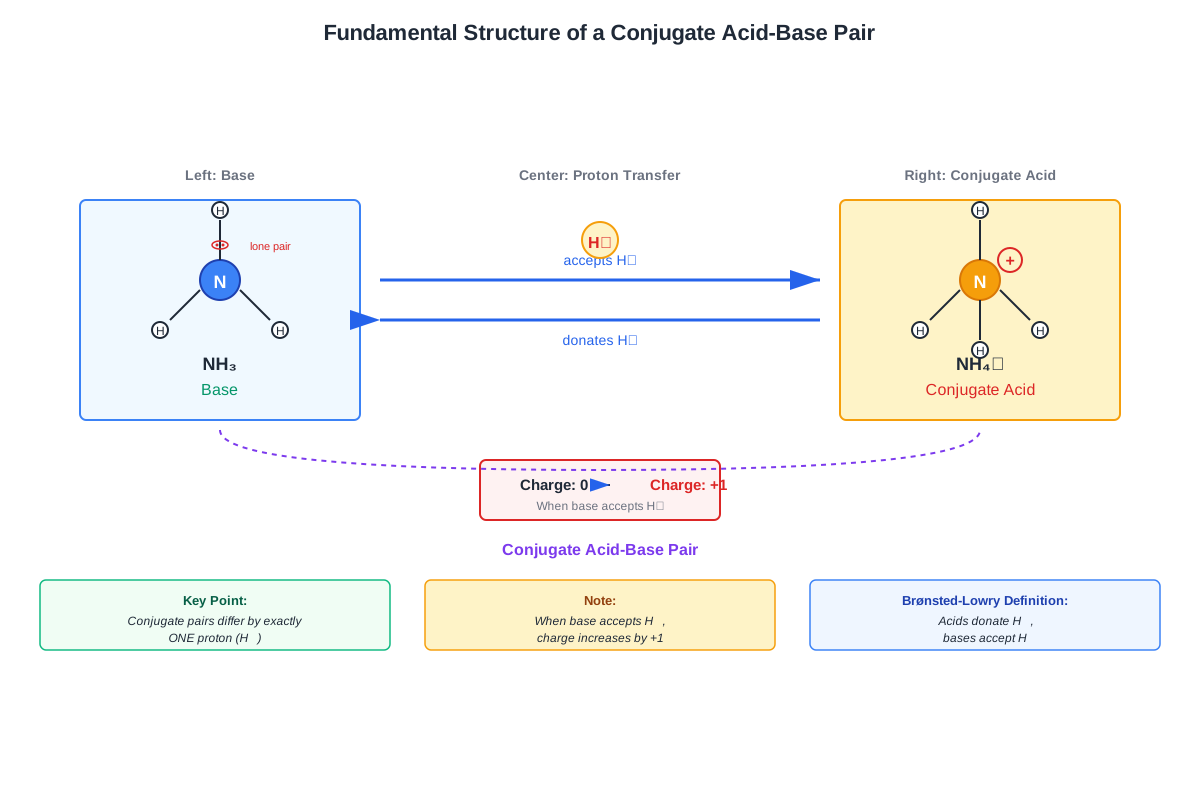
A conjugate acid-base pair consists of two chemical species that differ by exactly one proton (H⁺). The species that has the additional proton is the conjugate acid, while the species lacking that proton is the conjugate base. This relationship is bidirectional: every acid has a conjugate base formed when it donates a proton, and every base has a conjugate acid formed when it accepts a proton.
The general relationship can be expressed as:
HA ⇌ H⁺ + A⁻
(acid)    (conjugate base)

B + H⁺ ⇌ BH⁺
(base)    (conjugate acid)
To identify conjugate pairs, examine the chemical formulas and look for a difference of exactly one H⁺. For example:
- HCl and Cl⁻ form a conjugate pair (HCl is the acid, Cl⁻ is the conjugate base)
- NH₃ and NH₄⁺ form a conjugate pair (NH₃ is the base, NH₄⁺ is the conjugate acid)
- H₂O and OH⁻ form a conjugate pair (H₂O is the acid, OH⁻ is the conjugate base)
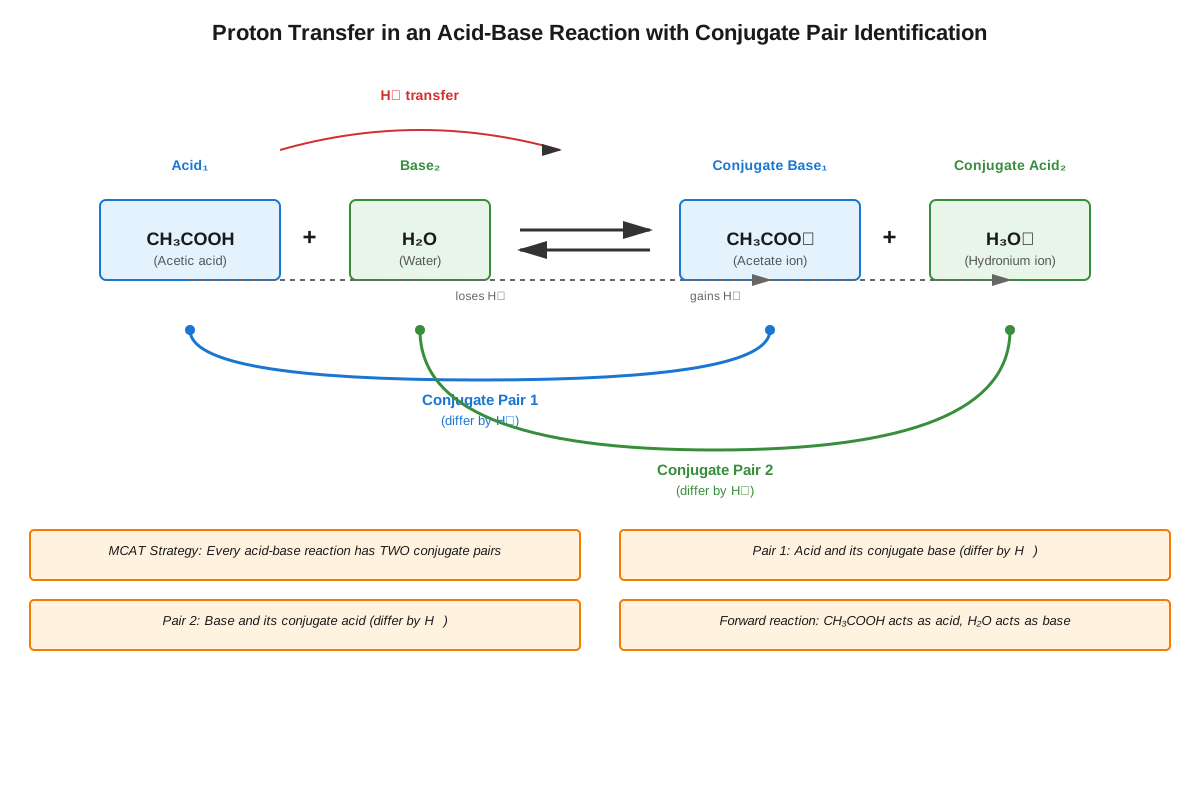
- H₂O and H₃O⁺ form a conjugate pair (H₂O is the base, H₃O⁺ is the conjugate acid)
Note that water is amphoteric, meaning it can act as either an acid or a base, and therefore participates in two different conjugate pairs.
The Inverse Strength Relationship
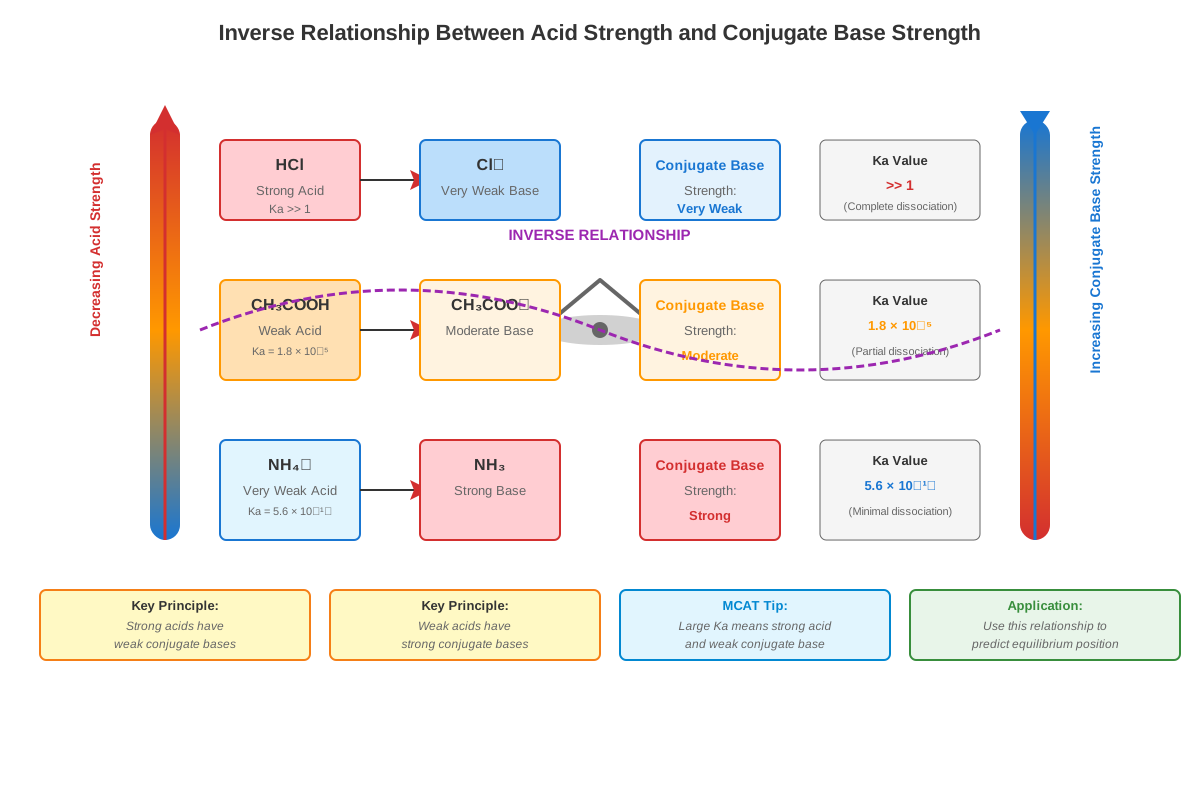
One of the most important principles governing conjugate acid-base pairs is the inverse strength relationship: the stronger an acid, the weaker its conjugate base, and vice versa. This relationship exists because a strong acid readily donates its proton, meaning its conjugate base has little tendency to reaccept that proton. Conversely, a weak acid holds onto its proton relatively tightly, so its conjugate base has a stronger tendency to accept protons.
This relationship can be quantified using equilibrium constants:
Ka × Kb = Kw = 1.0 × 10⁻¹⁴ (at 25°C)Where:
- Ka is the acid dissociation constant of the acid
- Kb is the base dissociation constant of its conjugate base
- Kw is the ion product constant for water
This mathematical relationship demonstrates that as Ka increases (stronger acid), Kb must decrease (weaker conjugate base) to maintain the constant product.
| Acid Strength | Ka Range | Conjugate Base Strength | Kb Range |
|---|---|---|---|
| Very Strong | Ka > 1 | Very Weak | Kb < 10⁻¹⁴ |
| Strong | Ka = 10⁻¹ to 1 | Weak | Kb = 10⁻¹⁴ to 10⁻¹³ |
| Weak | Ka = 10⁻⁷ to 10⁻¹ | Moderate | Kb = 10⁻¹³ to 10⁻⁷ |
| Very Weak | Ka < 10⁻¹⁴ | Strong | Kb > 1 |
Conjugate Pairs in Acid-Base Reactions
In any acid-base reaction, there are always two conjugate pairs present. Consider the reaction between acetic acid (CH₃COOH) and ammonia (NH₃):
CH₃COOH + NH₃ ⇌ CH₃COO⁻ + NH₄⁺The two conjugate pairs are:
- CH₃COOH (acid) and CH₃COO⁻ (conjugate base)
- NH₄⁺ (conjugate acid) and NH₃ (base)
The direction of equilibrium favors formation of the weaker acid and weaker base. Since acetic acid (Ka ≈ 1.8 × 10⁻⁵) is a stronger acid than ammonium ion (Ka ≈ 5.6 × 10⁻¹⁰), and ammonia is a stronger base than acetate ion, the equilibrium lies to the right, favoring product formation.
Polyprotic Acids and Multiple Conjugate Pairs
Polyprotic acids can donate more than one proton, creating a series of conjugate pairs. Phosphoric acid (H₃PO₄) provides an excellent example:
H₃PO₄ ⇌ H⁺ + H₂PO₄⁻    (Ka1 = 7.5 × 10⁻³)
H₂PO₄⁻ ⇌ H⁺ + HPO₄²⁻   (Ka2 = 6.2 × 10⁻⁸)
HPO₄²⁻ ⇌ H⁺ + PO₄³⁻    (Ka3 = 4.8 × 10⁻¹³)
Each successive deprotonation creates a new conjugate pair:
- H₃PO₄/H₂PO₄⁻ (first conjugate pair)
- H₂PO₄⁻/HPO₄²⁻ (second conjugate pair)
- HPO₄²⁻/PO₄³⁻ (third conjugate pair)
Notice that Ka values decrease with each successive deprotonation because removing a proton from an increasingly negative species becomes progressively more difficult. This pattern is universal for polyprotic acids.
Conjugate Pairs and Buffer Systems
Buffer systems consist of a weak acid and its conjugate base (or a weak base and its conjugate acid) in appreciable concentrations. The presence of both members of a conjugate pair allows the buffer to resist pH changes when small amounts of strong acid or base are added. When strong acid is added, the conjugate base neutralizes it; when strong base is added, the weak acid neutralizes it.
The Henderson-Hasselbalch equation directly relates the pH of a buffer to the ratio of conjugate base to acid:
pH = pKa + log([A⁻]/[HA])Where [A⁻] is the concentration of the conjugate base and [HA] is the concentration of the acid. This equation is derived from the Ka expression and is essential for MCAT buffer calculations.
Amphoteric Species and Conjugate Relationships
Amphoteric or amphiprotic species can act as either acids or bases, participating in multiple conjugate pairs. Water is the most common example, but amino acids and bicarbonate (HCO₃⁻) are also important amphoteric species on the MCAT.
For bicarbonate:
- As an acid: HCO₃⁻ ⇌ H⁺ + CO₃²⁻ (conjugate base is CO₃²⁻)
- As a base: HCO₃⁻ + H⁺ ⇌ H₂CO₃ (conjugate acid is H₂CO₃)
This dual nature makes bicarbonate an effective physiological buffer, as it can respond to both acidosis and alkalosis.
Concept Relationships
The concept of conjugate acid-base pairs serves as the foundation for understanding acid-base equilibria in General Chemistry. The identification of conjugate pairs → enables prediction of reaction direction → which determines equilibrium position → which allows calculation of pH and buffer capacity. This logical progression demonstrates how conjugate pair concepts cascade through increasingly complex applications.
Conjugate pairs connect directly to Ka and Kb calculations through the relationship Ka × Kb = Kw. This mathematical connection → enables interconversion between acid and base strength → which facilitates comparison of different acid-base systems → which is essential for predicting reaction outcomes. Understanding this quantitative relationship eliminates the need to memorize separate Ka and Kb values for conjugate pairs.
The inverse strength relationship between acids and their conjugate bases → explains buffer behavior → which underlies physiological pH regulation → which connects to biochemistry and physiology topics on the MCAT. For example, the carbonic acid-bicarbonate buffer system in blood relies on the moderate strength of both H₂CO₃ (weak acid) and HCO₃⁻ (weak base), making it effective at physiological pH.
Conjugate pair concepts also bridge to organic chemistry through understanding of reaction mechanisms. Proton transfer steps in organic reactions → involve formation of conjugate pairs → which determines reaction feasibility → which predicts product formation. Recognizing these connections allows students to apply acid-base principles across multiple MCAT sections.
High-Yield Facts
⭐ Every acid-base reaction involves exactly two conjugate acid-base pairs: one pair on the reactant side and one on the product side.
⭐ The stronger the acid, the weaker its conjugate base: This inverse relationship is quantified by Ka × Kb = Kw = 1.0 × 10⁻¹⁴.
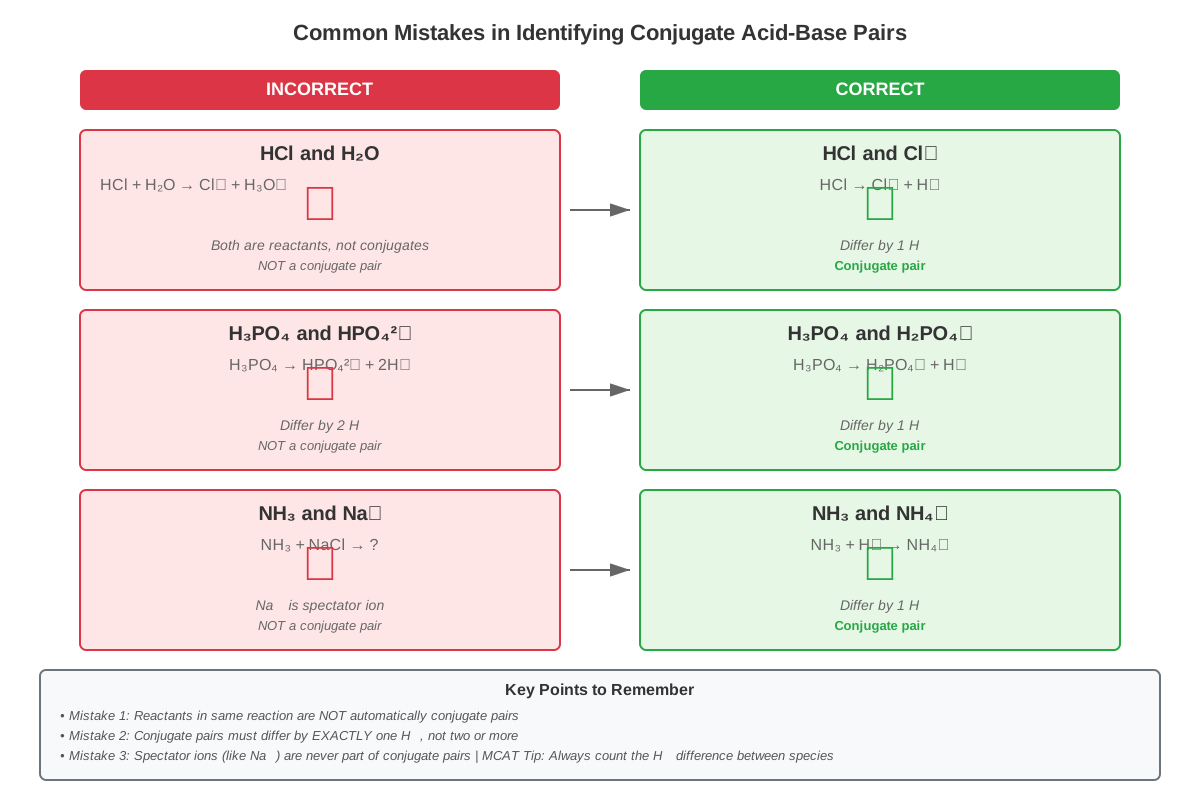
⭐ Conjugate pairs differ by exactly one proton (H⁺): If the difference is more or less than one H⁺, the species are not conjugates.
⭐ Equilibrium favors formation of the weaker acid and weaker base: Compare Ka values to predict reaction direction.
⭐ Water is amphoteric: H₂O can act as an acid (conjugate base OH⁻) or as a base (conjugate acid H₃O⁺).
- Strong acids (like HCl, HNO₃, H₂SO₄) have extremely weak conjugate bases that are essentially non-basic in aqueous solution.
- The pKa of an acid and the pKb of its conjugate base always sum to 14 at 25°C: pKa + pKb = pKw = 14.
- For polyprotic acids, each successive Ka is smaller than the previous one because removing a proton from an increasingly negative species is more difficult.
- Buffer systems require both members of a conjugate pair in appreciable concentrations (typically within a factor of 10 of each other).
- Amino acids contain both acidic (carboxyl) and basic (amino) groups, creating multiple conjugate pairs and zwitterionic forms at different pH values.
- The bicarbonate buffer system (H₂CO₃/HCO₃⁻) is the primary pH buffer in human blood, with a pKa of 6.1.
- Conjugate bases of neutral acids carry a negative charge, while conjugate acids of neutral bases carry a positive charge.
Quick check — test yourself on Conjugate acid base pairs so far.
Try Flashcards →Common Misconceptions
Misconception: Conjugate pairs must have opposite charges.
Correction: While many conjugate pairs differ in charge by one unit, this is not universal. For example, NH₄⁺ (charge +1) and NH₃ (charge 0) are conjugates, but H₂PO₄⁻ (charge -1) and HPO₄²⁻ (charge -2) are also conjugates. The defining feature is the difference of one proton, not a specific charge relationship.
Misconception: A strong acid has a strong conjugate base.
Correction: The opposite is true due to the inverse strength relationship. Strong acids like HCl have extremely weak conjugate bases (Cl⁻) that show virtually no basic properties in aqueous solution. This is because HCl so readily gives up its proton that Cl⁻ has almost no tendency to reaccept it.
Misconception: In a buffer solution, the acid and base are conjugates of each other.
Correction: This is correct for buffers, but students sometimes confuse this with thinking that any acid-base mixture forms a buffer. A buffer specifically requires a weak acid and its conjugate base (or weak base and its conjugate acid) in appreciable amounts. Mixing a strong acid with a strong base does not create a buffer.
Misconception: The conjugate acid of a polyprotic acid's fully deprotonated form is the species with one fewer proton.
Correction: While technically true, students must be careful to identify which specific conjugate pair is relevant. For H₃PO₄, the conjugate base is H₂PO₄⁻, but H₂PO₄⁻ itself is also an acid with its own conjugate base (HPO₄²⁻). Each deprotonation step creates a distinct conjugate pair.
Misconception: Water is always neutral (pH 7) because it's amphoteric.
Correction: While pure water at 25°C has pH 7, water's amphoteric nature means it can act as either an acid or base depending on what it reacts with. In the presence of a strong acid, water acts as a base (accepting protons to form H₃O⁺). In the presence of a strong base, water acts as an acid (donating protons to form OH⁻). The pH of water changes based on what's dissolved in it.
Misconception: If you know the Ka of an acid, you can calculate the pH directly.
Correction: Ka alone is insufficient; you also need the concentration of the acid. Additionally, for buffer solutions, you need both the Ka and the ratio of conjugate base to acid concentrations (Henderson-Hasselbalch equation). Students often forget that equilibrium constants must be combined with concentration information to calculate pH.
Misconception: Conjugate pairs only exist in aqueous solution.
Correction: While most MCAT questions involve aqueous systems, conjugate acid-base pairs exist in any solvent system and even in gas-phase reactions. The Brønsted-Lowry definition of acids and bases (and therefore conjugate pairs) is solvent-independent, though the specific Ka and Kb values are solvent-dependent.
Worked Examples
Example 1: Identifying Conjugate Pairs and Predicting Reaction Direction
Question: Consider the reaction between hydrogen sulfide (H₂S) and methylamine (CH₃NH₂). Identify both conjugate acid-base pairs and predict the direction of equilibrium. Given: Ka(H₂S) = 9.5 × 10⁻⁸ and Kb(CH₃NH₂) = 4.4 × 10⁻⁴.
Solution:
Step 1: Write the balanced equation.
H₂S + CH₃NH₂ ⇌ HS⁻ + CH₃NH₃⁺Step 2: Identify the conjugate pairs.
- First pair: H₂S (acid) and HS⁻ (conjugate base)
- Second pair: CH₃NH₃⁺ (conjugate acid) and CH₃NH₂ (base)
Step 3: Determine relative acid strengths to predict equilibrium direction.
We need to compare H₂S with CH₃NH₃⁺. We know Ka(H₂S) = 9.5 × 10⁻⁸.
For CH₃NH₃⁺, we can calculate Ka using the relationship Ka × Kb = Kw:
Ka(CH₃NH₃⁺) = Kw / Kb(CH₃NH₂)
Ka(CH₃NH₃⁺) = (1.0 × 10⁻¹⁴) / (4.4 × 10⁻⁴)
Ka(CH₃NH₃⁺) = 2.3 × 10⁻¹¹
Step 4: Compare Ka values.
Since Ka(H₂S) = 9.5 × 10⁻⁸ > Ka(CH₃NH₃⁺) = 2.3 × 10⁻¹¹, H₂S is the stronger acid.
Step 5: Apply the principle that equilibrium favors formation of the weaker acid.
The equilibrium will lie to the right (toward products) because the reaction converts the stronger acid (H₂S) into the weaker acid (CH₃NH₃⁺).
Answer: The two conjugate pairs are H₂S/HS⁻ and CH₃NH₃⁺/CH₃NH₂. The equilibrium favors products because H₂S is a stronger acid than CH₃NH₃⁺.
Connection to Learning Objectives: This example demonstrates the application of conjugate pair concepts to predict reaction outcomes, integrating Ka/Kb relationships and equilibrium principles—all high-yield MCAT skills.
Example 2: Buffer System Analysis Using Conjugate Pairs
Question: A buffer is prepared by mixing 0.50 M acetic acid (CH₃COOH, Ka = 1.8 × 10⁻⁵) with 0.30 M sodium acetate (CH₃COONa). Calculate the pH of this buffer. If 0.10 moles of HCl are added to 1.0 L of this buffer, what is the new pH?
Solution:
Step 1: Identify the conjugate pair.
The buffer consists of CH₃COOH (weak acid) and CH₃COO⁻ (conjugate base from sodium acetate).
Step 2: Calculate initial pH using Henderson-Hasselbalch equation.
pH = pKa + log([A⁻]/[HA])
pKa = -log(1.8 × 10⁻⁵) = 4.74
pH = 4.74 + log(0.30/0.50)
pH = 4.74 + log(0.60)
pH = 4.74 + (-0.22)
pH = 4.52
Step 3: Determine the effect of adding HCl.
When HCl (strong acid) is added, it reacts completely with the conjugate base:
CH₃COO⁻ + H⁺ → CH₃COOHInitial moles: CH₃COO⁻ = 0.30 mol, CH₃COOH = 0.50 mol
H⁺ added = 0.10 mol
After reaction:
- CH₃COO⁻ = 0.30 - 0.10 = 0.20 mol
- CH₃COOH = 0.50 + 0.10 = 0.60 mol
Step 4: Calculate new pH.
pH = 4.74 + log(0.20/0.60)
pH = 4.74 + log(0.33)
pH = 4.74 + (-0.48)
pH = 4.26Answer: The initial pH is 4.52. After adding 0.10 mol HCl, the pH decreases to 4.26, demonstrating the buffer's ability to resist large pH changes (only 0.26 pH unit change despite adding significant acid).
Connection to Learning Objectives: This example shows how conjugate pairs function in buffer systems, applies the Henderson-Hasselbalch equation, and demonstrates the practical importance of conjugate pair chemistry in maintaining pH—a concept that extends to physiological buffering systems frequently tested on the MCAT.
Exam Strategy
When approaching MCAT questions on conjugate acid-base pairs, begin by identifying all species present and systematically looking for pairs that differ by exactly one H⁺. This methodical approach prevents errors and saves time. If a question asks about reaction direction, immediately compare Ka values (or calculate them from Kb values using Ka × Kb = Kw) to determine which acid is stronger—equilibrium always favors the weaker acid side.
Trigger words and phrases to watch for include:
- "Conjugate" (obviously signals this topic)
- "Buffer system" (always involves a conjugate pair)
- "Proton transfer" (creates conjugate pairs)
- "Amphoteric" or "amphiprotic" (species that form multiple conjugate pairs)
- "Polyprotic" (multiple conjugate pairs in sequence)
- "Henderson-Hasselbalch" (requires identifying the conjugate pair)
For process-of-elimination strategies, remember that:
- Answer choices suggesting a strong acid has a strong conjugate base are always wrong
- If two species differ by more or less than one H⁺, they cannot be conjugates
- In buffer questions, if the pH equals the pKa, the concentrations of acid and conjugate base must be equal
- Conjugate bases of neutral acids must carry negative charges (eliminate positive or neutral options)
Time allocation: Straightforward conjugate pair identification questions should take 30-45 seconds. Buffer calculations using Henderson-Hasselbalch typically require 60-90 seconds. Complex passage-based questions integrating conjugate pairs with other concepts may need 2-3 minutes, but the conjugate pair component itself should be quickly identifiable, allowing you to focus time on the more complex aspects.
Exam Tip: If you're stuck on a Ka vs. Kb question, remember that you can always interconvert using Ka × Kb = 10⁻¹⁴. Write this relationship at the top of your scratch paper at the start of the exam—it's one of the highest-yield equations for acid-base questions.
Memory Techniques
Mnemonic for the inverse relationship: "Strong Acids Weak Conjugate Bases" (SAWCB, pronounced "saw-cub"). When you see a strong acid, immediately think of its weak conjugate base, and vice versa.
Visualization strategy: Picture conjugate pairs as a seesaw or balance. When the acid side is "heavy" (strong), the conjugate base side must be "light" (weak) to maintain balance. This visual reinforces the inverse relationship and helps with Ka/Kb comparisons.
Acronym for polyprotic acids: "Each Successive Deprotonation Decreases Ka" (ESDDK). This reminds you that Ka1 > Ka2 > Ka3 for polyprotic acids, which is essential for predicting which proton comes off first.
Memory aid for amphoteric species: "WAB" - Water, Amino acids, Bicarbonate are the three most important amphoteric species for the MCAT. Each can act as either an acid or a base depending on the environment.
Henderson-Hasselbalch quick check: Remember "PH Equals PKa At Equal concentrations" (PEPAE). When [A⁻] = [HA], the log term equals zero, so pH = pKa. This provides a quick sanity check for buffer calculations.
Charge pattern memory aid: For conjugate pairs, remember "Acid Loses Proton, Charge Increases" (ALPCI, pronounced "alp-see"). Wait—that's backwards! Actually, when an acid loses a proton, its charge becomes more negative (or less positive). The correct pattern is: losing H⁺ makes the charge more negative by 1, gaining H⁺ makes it more positive by 1. Visualize H⁺ as carrying a +1 charge that it takes with it when it leaves.
Summary
Conjugate acid-base pairs are fundamental to understanding acid-base chemistry on the MCAT. These pairs consist of two species differing by exactly one proton, with the protonated form being the acid and the deprotonated form being the conjugate base. The critical inverse relationship—stronger acids have weaker conjugate bases—governs reaction direction and buffer behavior. Every acid-base reaction involves two conjugate pairs, and equilibrium favors formation of the weaker acid and weaker base. The quantitative relationship Ka × Kb = Kw allows interconversion between acid and base strength constants. Conjugate pairs are essential for understanding buffer systems, which resist pH changes through the presence of both a weak acid and its conjugate base. The Henderson-Hasselbalch equation directly relates buffer pH to the ratio of conjugate base to acid concentrations. Polyprotic acids create multiple conjugate pairs with successively smaller Ka values. Amphoteric species like water, amino acids, and bicarbonate participate in multiple conjugate pairs, acting as either acids or bases depending on the reaction partner. Mastery of conjugate pair concepts enables prediction of reaction outcomes, pH calculations, and understanding of physiological buffering systems—all high-yield topics for MCAT success.
Key Takeaways
- Conjugate acid-base pairs differ by exactly one proton (H⁺), with the protonated form being the acid and the deprotonated form being the conjugate base
- The inverse strength relationship (strong acids have weak conjugate bases) is quantified by Ka × Kb = Kw = 1.0 × 10⁻¹⁴
- Every acid-base reaction involves exactly two conjugate pairs, and equilibrium favors formation of the weaker acid and weaker base
- Buffer systems require both members of a conjugate pair in appreciable concentrations to resist pH changes
- Polyprotic acids create multiple conjugate pairs with Ka1 > Ka2 > Ka3 due to increasing difficulty of removing protons from increasingly negative species
- Amphoteric species (water, amino acids, bicarbonate) can act as either acids or bases, participating in multiple conjugate pairs
- The Henderson-Hasselbalch equation (pH = pKa + log([A⁻]/[HA])) directly connects conjugate pair ratios to pH in buffer systems
Related Topics
Ka and Kb Calculations: Understanding equilibrium constants for acids and bases builds directly on conjugate pair concepts, as Ka and Kb are inversely related for conjugate pairs through the relationship Ka × Kb = Kw.
Buffer Systems and Capacity: Buffers consist of conjugate acid-base pairs, and mastering conjugate pair chemistry is prerequisite to understanding how buffers resist pH changes and calculating buffer capacity.
Titration Curves: The shape of titration curves reflects the equilibrium between conjugate pairs at different pH values, with the equivalence point representing complete conversion of one member of the pair to the other.
Amino Acid Ionization: Amino acids contain multiple ionizable groups that form conjugate pairs, creating zwitterionic forms and determining protein charge at physiological pH—a high-yield topic bridging general chemistry to biochemistry.
Physiological pH Regulation: The carbonic acid-bicarbonate buffer system (a conjugate pair) is the primary pH buffer in blood, connecting conjugate pair chemistry to physiology and clinical medicine.
Practice CTA
Now that you've mastered the fundamentals of conjugate acid-base pairs, it's time to reinforce your understanding through active practice. Work through the practice questions to test your ability to identify conjugate pairs, predict reaction direction, and solve buffer problems under timed conditions. Use the flashcards to drill high-yield facts until they become automatic—this fluency will save you valuable time on test day. Remember, understanding conjugate pairs unlocks a huge portion of acid-base chemistry on the MCAT, so the time you invest in mastering this topic will pay dividends across multiple question types and passages. You've got this!
Sign up free to keep reading
Create a free AnvayaPrep account to finish this MCAT guide on Conjugate acid base pairs — plus flashcards and practice questions.