Overview
The acid dissociation constant, or Ka, represents one of the most fundamental quantitative measures in acid-base chemistry and appears frequently throughout the MCAT General Chemistry section. Ka provides a numerical value that describes the strength of an acid in solution—specifically, how readily an acid donates a proton (H⁺) to water. Understanding Ka is not merely about memorizing a formula; it requires comprehending the equilibrium dynamics between an acid and its conjugate base, interpreting logarithmic relationships through pKa, and applying these concepts to predict chemical behavior in biological systems. The MCAT tests Ka in multiple contexts: buffer systems, titration curves, amino acid chemistry, and physiological pH regulation.
Mastery of Ka is essential because it bridges qualitative acid-base concepts with quantitative problem-solving. Students must be able to convert between Ka and pKa values, compare acid strengths using these constants, predict the direction of acid-base reactions, and calculate pH values in various scenarios. The MCAT frequently presents passages involving buffer systems in biological contexts—such as blood pH regulation or enzyme active sites—where understanding Ka becomes critical for answering both discrete questions and passage-based items. Additionally, Ka connects directly to the Henderson-Hasselbalch equation, a high-yield tool for MCAT success.
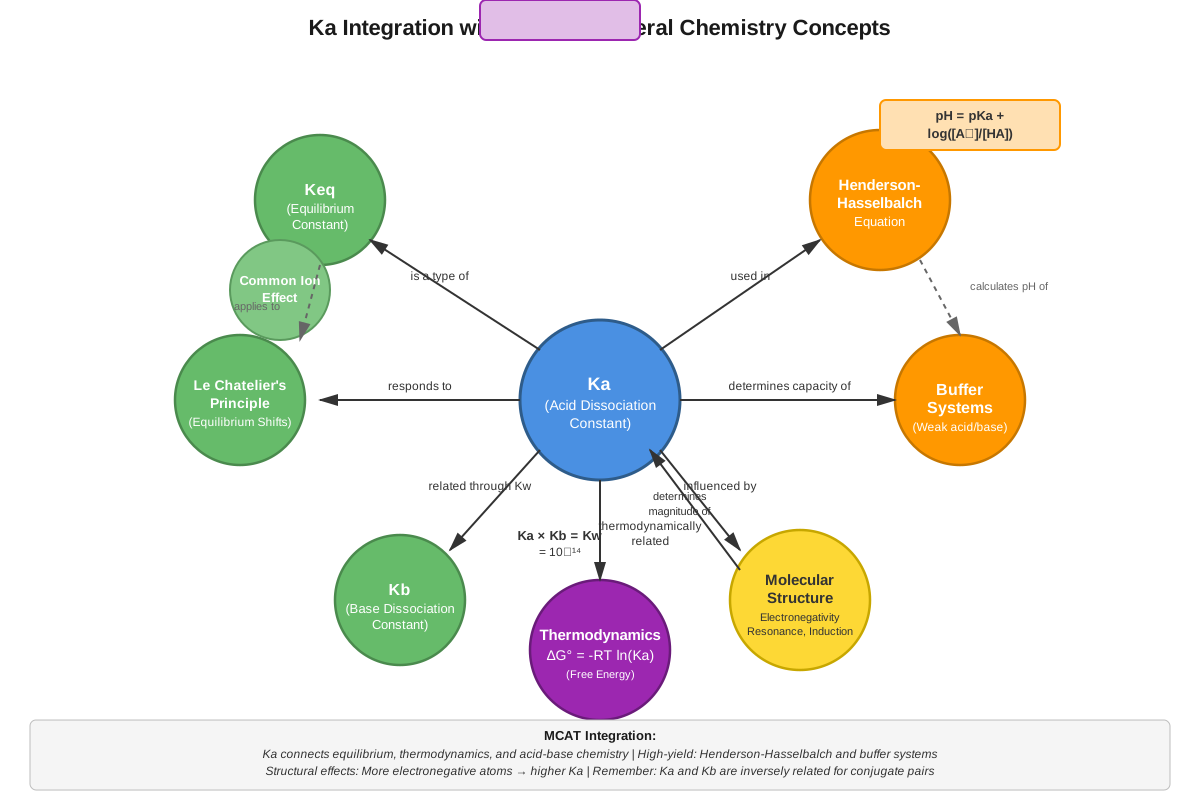
Within the broader landscape of General Chemistry, Ka serves as a cornerstone concept that integrates equilibrium principles, thermodynamics, and molecular structure. It connects to Le Chatelier's principle, the common ion effect, and solubility equilibria. For the Acids and Bases unit specifically, Ka provides the quantitative foundation upon which buffer capacity, titration endpoints, and pH calculations rest. This topic also extends into Organic Chemistry (acidity of functional groups) and Biochemistry (amino acid ionization states), making it one of the most cross-disciplinary concepts students will encounter on the MCAT.
Learning Objectives
- [ ] Define Ka using accurate General Chemistry terminology
- [ ] Explain why Ka matters for the MCAT
- [ ] Apply Ka to exam-style questions
- [ ] Identify common mistakes related to Ka
- [ ] Connect Ka to related General Chemistry concepts
- [ ] Convert between Ka and pKa values and interpret their significance
- [ ] Predict relative acid strengths by comparing Ka or pKa values
- [ ] Calculate pH, pOH, or concentrations using Ka in equilibrium problems
- [ ] Analyze the relationship between molecular structure and Ka values
Prerequisites
- Equilibrium concepts and the equilibrium constant (Keq): Ka is a specific type of equilibrium constant, so understanding how to write equilibrium expressions and interpret their magnitude is foundational
- Logarithmic functions and properties: Converting between Ka and pKa requires facility with logarithms, including the relationship log(1/x) = -log(x)
- Acid-base definitions (Brønsted-Lowry): Ka specifically measures proton donation, which requires understanding acids as proton donors and bases as proton acceptors
- Molarity and concentration calculations: All Ka expressions involve molar concentrations, so comfort with molarity is essential
- ICE tables and equilibrium problem-solving: Calculating pH from Ka typically requires setting up ICE (Initial, Change, Equilibrium) tables
Why This Topic Matters
Clinical and Real-World Significance: The concept of Ka underlies virtually every pH-dependent biological process. Blood pH is maintained at 7.4 through the carbonic acid-bicarbonate buffer system, which operates based on the Ka of carbonic acid. Drug absorption in the gastrointestinal tract depends on whether medications exist in their protonated or deprotonated forms, determined by comparing the local pH to the drug's pKa. Enzyme catalysis often requires specific ionization states of amino acid residues in the active site, with Ka values determining which forms predominate at physiological pH. Understanding Ka allows medical professionals to predict drug distribution, design buffer systems for intravenous solutions, and comprehend metabolic acidosis and alkalosis.
Exam Statistics and Frequency: Ka appears in approximately 15-20% of MCAT General Chemistry questions, either directly or through related concepts like pKa, buffers, and titrations. The Chemical and Physical Foundations of Biological Systems section frequently includes passages about buffer systems in biological contexts, enzyme mechanisms involving proton transfers, or amino acid chemistry—all requiring Ka knowledge. Discrete questions commonly test the ability to rank acids by strength, calculate pH from Ka, or predict the predominant species at a given pH. The MCAT particularly favors questions that integrate Ka with other concepts rather than testing it in isolation.
Common Exam Presentations: Ka appears in MCAT passages in several characteristic ways. Biochemistry passages may present enzyme kinetics data where pH affects activity, requiring students to identify which ionization state is active based on pKa values. Physiology passages about respiratory or metabolic disorders often require understanding the carbonic acid-bicarbonate equilibrium. Organic chemistry passages may ask students to predict reaction mechanisms where proton transfers occur, necessitating comparison of pKa values to determine favorable proton donation. Discrete questions frequently present scenarios requiring pH calculations from Ka or asking students to identify the strongest acid from a list of Ka or pKa values.
Core Concepts
Definition and Equilibrium Expression
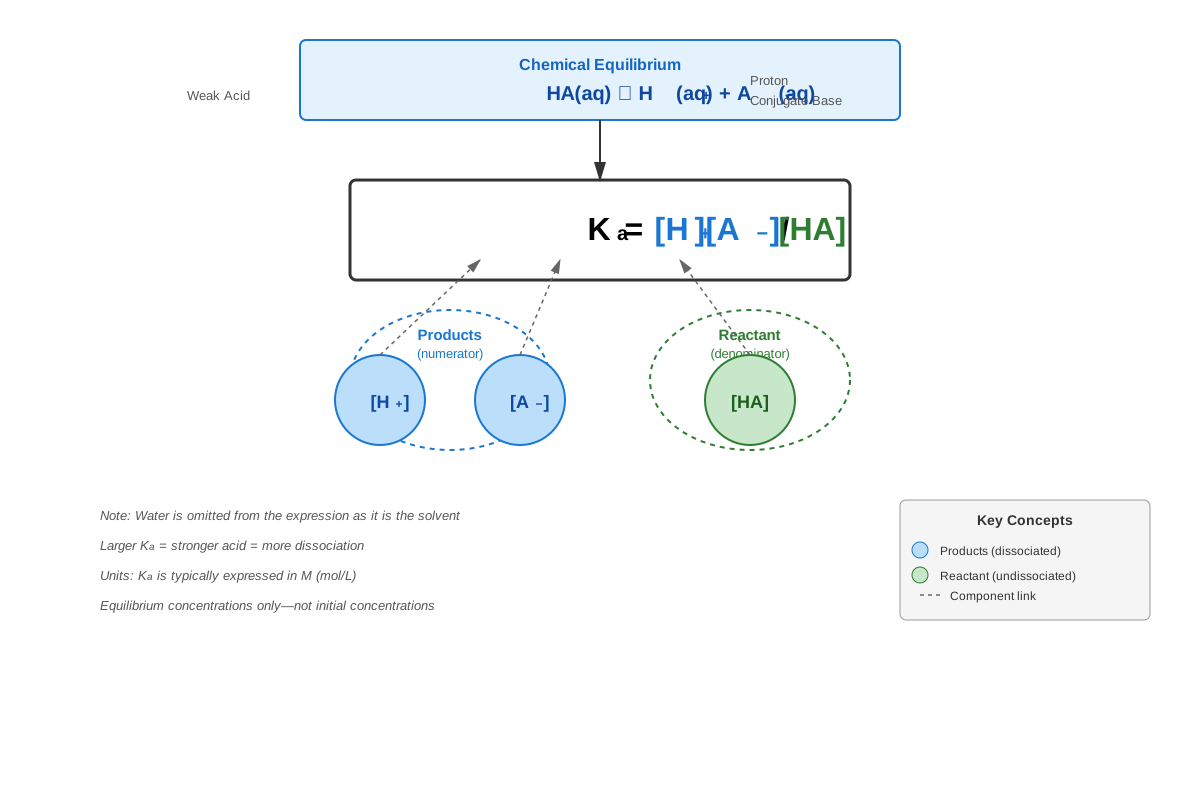
The acid dissociation constant, Ka, is the equilibrium constant for the dissociation of an acid (HA) in aqueous solution. When an acid dissolves in water, it establishes an equilibrium between the undissociated acid and its dissociated ions:
HA(aq) + H₂O(l) ⇌ H₃O⁺(aq) + A⁻(aq)The Ka expression follows the standard equilibrium constant format, with products over reactants:
Ka = [H₃O⁺][A⁻] / [HA]Note that water does not appear in the expression because it is the solvent and its concentration remains essentially constant. The hydronium ion (H₃O⁺) is often simplified to H⁺ in calculations, though H₃O⁺ is more chemically accurate. The magnitude of Ka indicates acid strength: larger Ka values correspond to stronger acids that dissociate more completely, while smaller Ka values indicate weaker acids that remain largely undissociated at equilibrium.
The pKa Scale
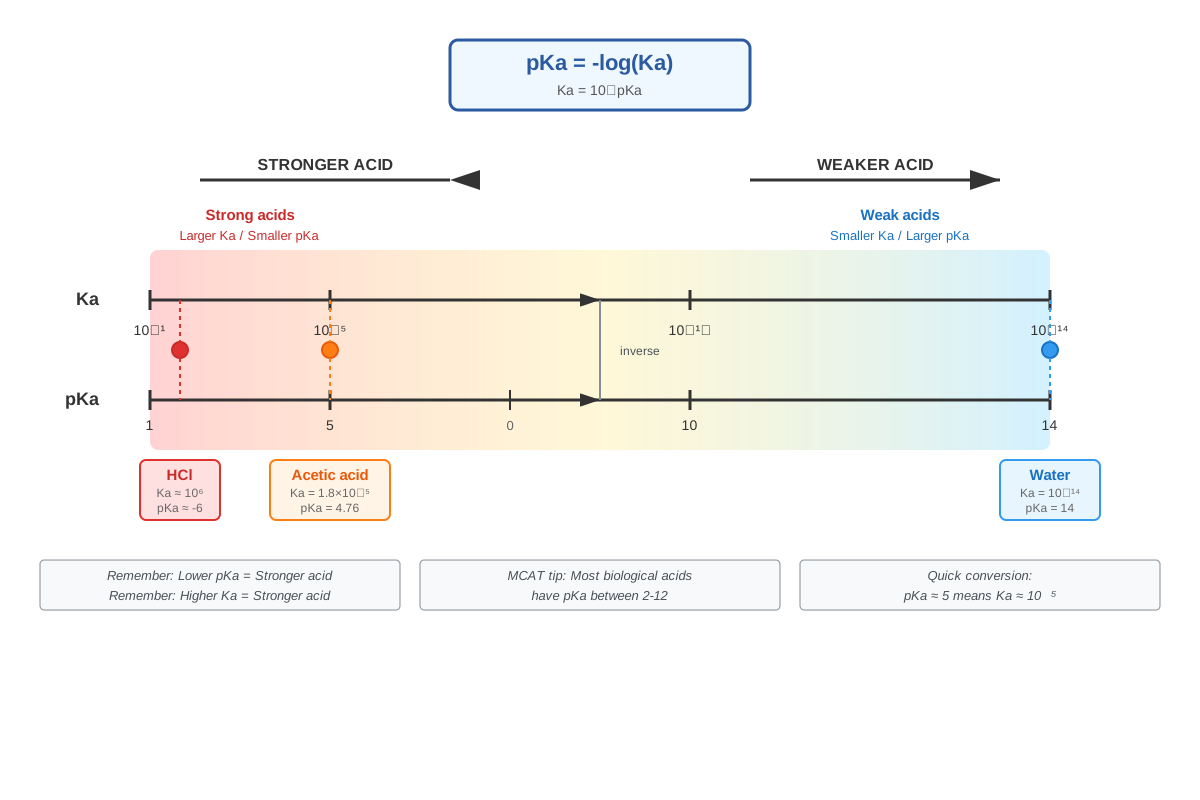
Because Ka values span many orders of magnitude (from greater than 10⁶ for strong acids to less than 10⁻¹⁴ for extremely weak acids), chemists use the pKa scale for convenience:
pKa = -log(Ka)This logarithmic transformation compresses the wide range of Ka values into a more manageable scale. The relationship is inverse: strong acids have large Ka values but small pKa values, while weak acids have small Ka values but large pKa values. For example, hydrochloric acid (HCl) has a Ka of approximately 10⁶ and a pKa of approximately -6, while acetic acid (CH₃COOH) has a Ka of 1.8 × 10⁻⁵ and a pKa of 4.74.
Converting between Ka and pKa is a high-yield MCAT skill:
- To find pKa from Ka: take the negative logarithm
- To find Ka from pKa: use Ka = 10⁻ᵖᴷᵃ
Interpreting Ka and pKa Values
Understanding what Ka and pKa values reveal about acid behavior is crucial for MCAT success:
| Ka Value | pKa Value | Acid Strength | Degree of Dissociation | Example |
|---|---|---|---|---|
| > 1 | < 0 | Very strong | Nearly complete | HCl, H₂SO₄ |
| 10⁻² to 1 | 0 to 2 | Strong | Substantial | H₃PO₄ (first proton) |
| 10⁻⁵ to 10⁻² | 2 to 5 | Moderately weak | Partial | Acetic acid, formic acid |
| 10⁻¹⁰ to 10⁻⁵ | 5 to 10 | Weak | Limited | Ammonium ion, carbonic acid |
| < 10⁻¹⁰ | > 10 | Very weak | Minimal | Water, alcohols |
A critical MCAT concept: at pH = pKa, exactly 50% of the acid exists in the protonated form (HA) and 50% exists in the deprotonated form (A⁻). This relationship derives from the Henderson-Hasselbalch equation and is essential for understanding buffer systems and titration curves.
Calculating pH from Ka
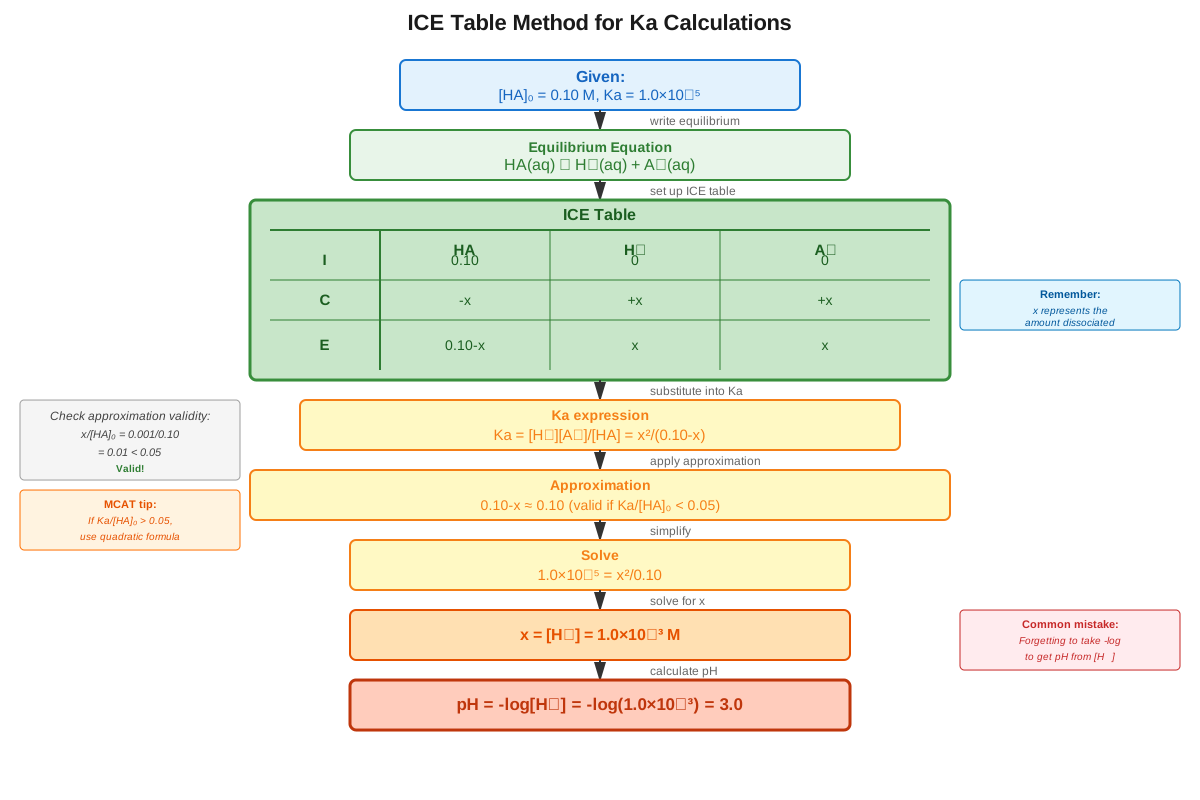
For a weak acid solution, calculating pH requires using the Ka expression with an ICE table. Consider a solution of weak acid HA with initial concentration C:
Initial: [HA] = C, [H⁺] = 0, [A⁻] = 0
Change: [HA] = -x, [H⁺] = +x, [A⁻] = +x
Equilibrium: [HA] = C - x, [H⁺] = x, [A⁻] = x
Substituting into the Ka expression:
Ka = x² / (C - x)For weak acids where Ka is small and C is relatively large (typically when C/Ka > 100), the approximation C - x ≈ C simplifies the calculation:
Ka ≈ x² / C
x = √(Ka × C)
pH = -log(x)
This approximation saves significant time on the MCAT but should be verified by checking that x < 5% of C. If the approximation fails, the quadratic formula must be used.
Polyprotic Acids and Multiple Ka Values
Polyprotic acids can donate more than one proton and therefore have multiple Ka values. Each successive proton removal is characterized by its own dissociation constant (Ka1, Ka2, Ka3, etc.). For example, phosphoric acid (H₃PO₄) has three Ka values:
- Ka1 = 7.5 × 10⁻³ (pKa1 = 2.1)
- Ka2 = 6.2 × 10⁻⁸ (pKa2 = 7.2)
- Ka3 = 4.8 × 10⁻¹³ (pKa3 = 12.3)
An important pattern: Ka1 > Ka2 > Ka3 for all polyprotic acids. Each successive proton is harder to remove because it must be pulled away from an increasingly negative species. This pattern appears frequently on the MCAT, particularly in questions about amino acids (which have at least two ionizable groups) and in passages about biological buffers.
Relationship Between Ka and Kb
For any conjugate acid-base pair, the relationship between the acid dissociation constant (Ka) and the base dissociation constant (Kb) is:
Ka × Kb = Kw = 1.0 × 10⁻¹⁴ (at 25°C)This relationship also holds for pKa and pKb:
pKa + pKb = pKw = 14 (at 25°C)This connection is essential for solving problems involving weak bases. If given the Kb of a base, students can find the Ka of its conjugate acid, and vice versa. For example, ammonia (NH₃) has Kb = 1.8 × 10⁻⁵, so its conjugate acid (NH₄⁺) has Ka = 5.6 × 10⁻¹⁰.
Structural Factors Affecting Ka
The magnitude of Ka depends on molecular structure, and the MCAT tests the ability to predict relative acid strengths based on structure:
- Electronegativity: More electronegative atoms stabilize the conjugate base by better accommodating negative charge, increasing Ka. HF is more acidic than H₂O, which is more acidic than NH₃.
- Atom size: Larger atoms form weaker bonds to hydrogen and better stabilize negative charge through diffusion over a larger volume. HI > HBr > HCl > HF in acid strength (though all are strong acids).
- Resonance stabilization: Conjugate bases stabilized by resonance are more stable, making their parent acids stronger. Carboxylic acids (pKa ≈ 4-5) are much more acidic than alcohols (pKa ≈ 15-16) because the carboxylate anion is resonance-stabilized.
- Inductive effects: Electron-withdrawing groups increase acidity by stabilizing the conjugate base. Trichloroacetic acid (pKa ≈ 0.7) is much more acidic than acetic acid (pKa = 4.74) due to the electron-withdrawing chlorine atoms.
- Hybridization: Greater s-character increases acidity because s-orbitals hold electrons closer to the nucleus. Alkynes (sp hybridization, pKa ≈ 25) are more acidic than alkenes (sp² hybridization, pKa ≈ 44) or alkanes (sp³ hybridization, pKa ≈ 50).
Concept Relationships
The Ka concept sits at the center of a web of interconnected acid-base topics. Ka directly defines acid strength, which determines the position of equilibrium in acid-base reactions. This equilibrium position connects to Le Chatelier's principle—adding common ions (like acetate to an acetic acid solution) shifts equilibrium and affects the degree of dissociation, though Ka itself remains constant.
The logarithmic transformation of Ka produces pKa, which connects directly to the Henderson-Hasselbalch equation: pH = pKa + log([A⁻]/[HA]). This equation is the mathematical foundation for understanding buffer systems, where the ratio of conjugate base to acid determines pH. Buffer capacity is maximized when pH = pKa, making pKa values critical for buffer selection.
Ka values determine the shape of titration curves. The equivalence point occurs when all acid has been neutralized, while the half-equivalence point (where pH = pKa) occurs at half the equivalence point volume. The buffering region of a titration curve extends approximately ±1 pH unit from the pKa.
The relationship Ka × Kb = Kw connects acid and base equilibria, allowing calculation of conjugate base strength from acid strength. This relationship also explains why strong acids have extremely weak conjugate bases and vice versa.
In biological systems, Ka values determine ionization states of amino acids and proteins. At physiological pH (7.4), comparing this pH to the pKa of ionizable groups predicts which form predominates. This affects protein folding, enzyme catalysis, and drug absorption.
Relationship Map:
Equilibrium principles → Ka definition → pKa transformation → Henderson-Hasselbalch equation → Buffer systems → Titration curves → Biological pH regulation
Molecular structure → Conjugate base stability → Ka magnitude → Acid strength ranking → Predicting reaction direction
Quick check — test yourself on Ka so far.
Try Flashcards →High-Yield Facts
⭐ Ka is the equilibrium constant for acid dissociation: Ka = [H⁺][A⁻]/[HA], with larger values indicating stronger acids
⭐ pKa = -log(Ka), creating an inverse relationship where strong acids have low pKa values and weak acids have high pKa values
⭐ At pH = pKa, the concentrations of protonated and deprotonated forms are equal ([HA] = [A⁻])
⭐ For polyprotic acids, Ka1 > Ka2 > Ka3 because each successive proton is harder to remove from an increasingly negative species
⭐ Ka × Kb = Kw = 1.0 × 10⁻¹⁴ at 25°C for any conjugate acid-base pair, and pKa + pKb = 14
- Strong acids (Ka > 1) dissociate completely in water, while weak acids (Ka < 1) establish equilibrium with significant undissociated acid present
- The approximation x² ≈ Ka × C is valid when the initial concentration is at least 100 times larger than Ka (C/Ka > 100)
- Carboxylic acids typically have pKa values between 4 and 5, while phenols have pKa values around 10, and alcohols have pKa values around 15-16
- Electron-withdrawing groups increase acidity (decrease pKa) by stabilizing the conjugate base through inductive effects
- Resonance stabilization of the conjugate base increases acid strength, which is why carboxylic acids are much more acidic than alcohols
- The buffering capacity of a solution is greatest when pH is within ±1 unit of the pKa
- For amino acids, the isoelectric point (pI) is the pH where the molecule has no net charge, calculated as the average of the relevant pKa values
Common Misconceptions
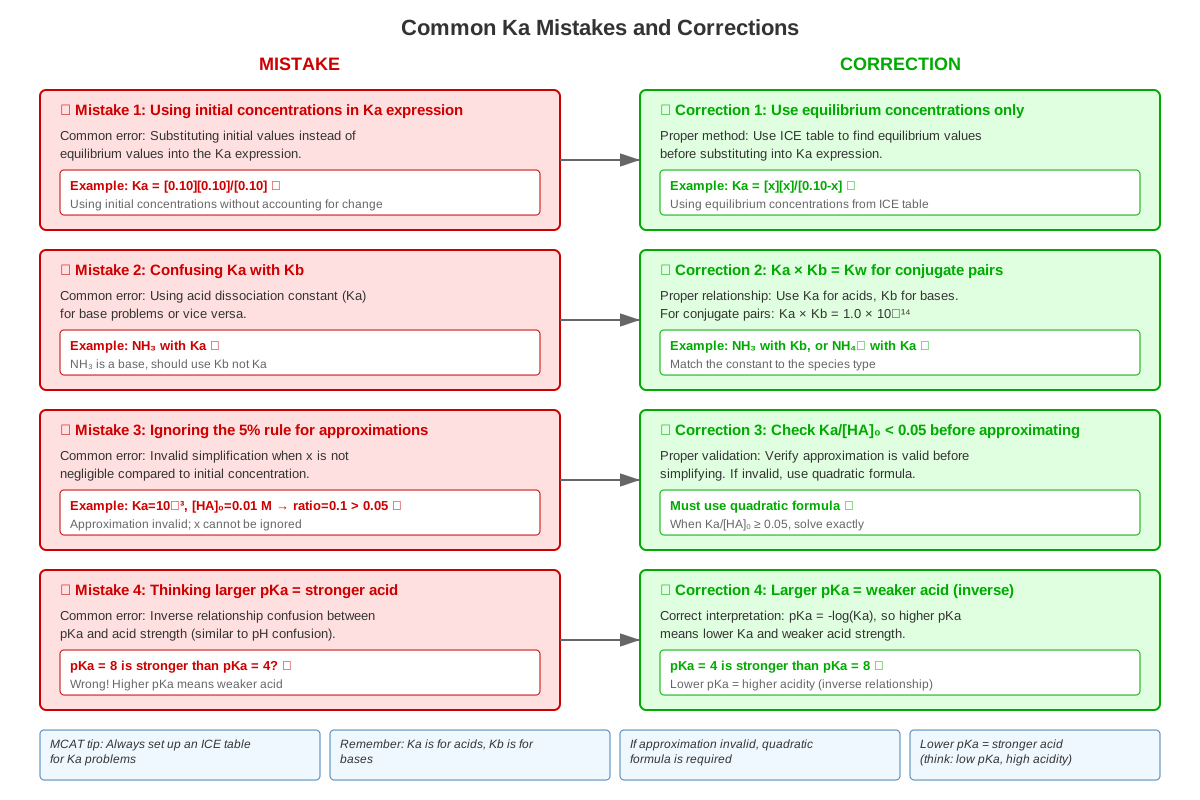
Misconception: A larger pKa value means a stronger acid.
Correction: The relationship is inverse—larger pKa values indicate weaker acids. The "p" notation means "negative logarithm," so pKa = -log(Ka). Strong acids have large Ka values but small (even negative) pKa values. For example, HCl has pKa ≈ -6, while acetic acid has pKa = 4.74, making HCl the much stronger acid.
Misconception: Ka changes when the concentration of acid changes or when common ions are added.
Correction: Ka is an equilibrium constant that depends only on temperature, not on concentrations. Adding more acid or adding common ions shifts the equilibrium position (changes the amounts of HA, H⁺, and A⁻) but does not change the value of Ka itself. This is a fundamental property of equilibrium constants.
Misconception: At pH values below the pKa, the deprotonated form (A⁻) predominates.
Correction: The opposite is true. When pH < pKa, the protonated form (HA) predominates. When pH > pKa, the deprotonated form (A⁻) predominates. This can be remembered through the Henderson-Hasselbalch equation: when pH < pKa, the log term is negative, meaning [A⁻]/[HA] < 1, so [HA] > [A⁻].
Misconception: The pH of a weak acid solution equals the pKa of the acid.
Correction: The pH of a weak acid solution is always higher (less acidic) than what would be calculated if the acid dissociated completely, but it is not equal to the pKa. The pH equals the pKa only in a buffer solution where [HA] = [A⁻], such as at the half-equivalence point of a titration. For a solution of only weak acid, pH must be calculated using the Ka expression and an ICE table.
Misconception: All protons in a polyprotic acid dissociate simultaneously.
Correction: Polyprotic acids lose protons sequentially, with each step characterized by its own Ka value. The first proton is always easiest to remove (largest Ka), and each subsequent proton is progressively harder to remove. In most cases, the first dissociation dominates the pH calculation because Ka1 >> Ka2 >> Ka3.
Misconception: Strong acids have Ka values that can be measured and used in calculations the same way as weak acids.
Correction: Strong acids dissociate completely in water, so their Ka values are extremely large (Ka >> 1) and are not typically used in equilibrium calculations. For strong acids, assume 100% dissociation: [H⁺] = [acid]initial. The concept of Ka is most useful for weak acids where equilibrium calculations are necessary.
Misconception: A compound with a lower pKa is always a better base.
Correction: Lower pKa indicates a stronger acid, not a stronger base. The conjugate base of a strong acid (low pKa) is a weak base. To assess base strength, look at pKb or consider that the conjugate base of a weak acid (high pKa) is a stronger base. For example, acetate (conjugate base of acetic acid, pKa = 4.74) is a stronger base than chloride (conjugate base of HCl, pKa ≈ -6).
Worked Examples
Example 1: Calculating pH from Ka
Question: A 0.10 M solution of acetic acid (CH₃COOH) has Ka = 1.8 × 10⁻⁵. Calculate the pH of this solution.
Solution:
Step 1: Write the dissociation equation and Ka expression.
CH₃COOH ⇌ H⁺ + CH₃COO⁻
Ka = [H⁺][CH₃COO⁻] / [CH₃COOH] = 1.8 × 10⁻⁵
Step 2: Set up an ICE table.
- Initial: [CH₃COOH] = 0.10 M, [H⁺] = 0, [CH₃COO⁻] = 0
- Change: [CH₃COOH] = -x, [H⁺] = +x, [CH₃COO⁻] = +x
- Equilibrium: [CH₃COOH] = 0.10 - x, [H⁺] = x, [CH₃COO⁻] = x
Step 3: Check if the approximation is valid.
C/Ka = 0.10 / (1.8 × 10⁻⁵) = 5,556, which is >> 100, so the approximation 0.10 - x ≈ 0.10 is valid.
Step 4: Solve for x using the approximation.
Ka = x² / 0.10
1.8 × 10⁻⁵ = x² / 0.10
x² = 1.8 × 10⁻⁶
x = 1.34 × 10⁻³ M = [H⁺]
Step 5: Verify the approximation.
x/C = (1.34 × 10⁻³) / 0.10 = 0.0134 = 1.34%, which is < 5%, so the approximation is valid.
Step 6: Calculate pH.
pH = -log[H⁺] = -log(1.34 × 10⁻³) = 2.87Answer: The pH is approximately 2.9.
Connection to learning objectives: This problem demonstrates applying Ka to calculate pH (learning objective 3) and shows the proper use of the approximation method, avoiding the common mistake of using the quadratic formula unnecessarily.
Example 2: Comparing Acid Strengths and Predicting Reaction Direction
Question: Consider the following acids and their pKa values:
- Formic acid (HCOOH): pKa = 3.75
- Ammonium ion (NH₄⁺): pKa = 9.25
- Bicarbonate ion (HCO₃⁻): pKa = 10.33
(a) Rank these acids from strongest to weakest.
(b) Will the following reaction proceed forward or reverse?
HCOOH + NH₃ ⇌ HCOO⁻ + NH₄⁺Solution:
Part (a): Ranking acid strengths.
Step 1: Recall that lower pKa values indicate stronger acids.
Step 2: Arrange in order of increasing pKa (decreasing acid strength):
- Formic acid (pKa = 3.75) - strongest acid
- Ammonium ion (pKa = 9.25) - intermediate
- Bicarbonate ion (pKa = 10.33) - weakest acid
Answer (a): HCOOH > NH₄⁺ > HCO₃⁻ in acid strength.
Part (b): Predicting reaction direction.
Step 1: Identify the acids and bases on each side.
- Left side: HCOOH (acid, pKa = 3.75) and NH₃ (base)
- Right side: HCOO⁻ (base) and NH₄⁺ (acid, pKa = 9.25)
Step 2: Apply the principle that acid-base reactions favor formation of the weaker acid and weaker base.
Step 3: Compare the acids. HCOOH (pKa = 3.75) is a stronger acid than NH₄⁺ (pKa = 9.25).
Step 4: The reaction will proceed forward because it converts the stronger acid (HCOOH) into the weaker acid (NH₄⁺).
Step 5: Calculate Keq to confirm (optional but thorough):
Keq = Ka(HCOOH) / Ka(NH₄⁺)Since pKa(HCOOH) = 3.75, Ka(HCOOH) = 10⁻³·⁷⁵ = 1.78 × 10⁻⁴
Since pKa(NH₄⁺) = 9.25, Ka(NH₄⁺) = 10⁻⁹·²⁵ = 5.62 × 10⁻¹⁰
Keq = (1.78 × 10⁻⁴) / (5.62 × 10⁻¹⁰) = 3.17 × 10⁵Since Keq >> 1, the reaction strongly favors products.
Answer (b): The reaction proceeds forward (toward products) because it favors formation of the weaker acid.
Connection to learning objectives: This problem demonstrates connecting Ka to related concepts (learning objective 5), specifically the relationship between Ka values and reaction spontaneity. It also shows how to apply Ka to predict chemical behavior (learning objective 3) and illustrates the proper interpretation of pKa values to rank acid strengths (learning objective 7).
Exam Strategy
Approaching MCAT Questions on Ka:
- Identify the question type first: Is this asking for a calculation (pH, concentration), a comparison (which acid is stronger), or a conceptual understanding (what happens at pH = pKa)? This determines your approach.
- Watch for trigger words:
- "Acid dissociation constant" or "Ka" → set up equilibrium expression
- "pKa" → think about logarithmic relationships and the Henderson-Hasselbalch equation
- "Stronger acid" or "more acidic" → compare Ka values (larger = stronger) or pKa values (smaller = stronger)
- "Buffer" or "buffering capacity" → pH should be near pKa
- "Half-equivalence point" → pH = pKa
- "Predominant form" or "major species" → compare pH to pKa
- Process of elimination for Ka questions:
- Eliminate answers that reverse the Ka/pKa relationship (if Ka increases, pKa must decrease)
- Eliminate pH values that are impossible (pH of weak acid solution cannot be higher than 7 unless it's extremely dilute)
- For ranking questions, eliminate any answer that places a strong acid as weaker than a weak acid
- Check units and magnitude—Ka values for weak acids are typically between 10⁻² and 10⁻¹⁴
- Time allocation:
- Simple comparison questions (which acid is stronger): 30-45 seconds
- pH calculations with approximation: 60-90 seconds
- Complex equilibrium problems requiring quadratic formula: 2-3 minutes (consider flagging and returning if time is tight)
- Passage-based questions integrating Ka with other concepts: 90-120 seconds
- Common MCAT traps:
- Confusing Ka with Kb (always check whether you're dealing with an acid or base)
- Forgetting to take the negative logarithm when converting Ka to pKa
- Assuming pH = pKa for a solution of pure weak acid (this is only true for buffers with equal concentrations)
- Using Ka for strong acids (they dissociate completely; no equilibrium calculation needed)
- Quick checks: After solving, verify that your answer makes chemical sense. A weak acid solution should have pH between 2 and 6 (depending on concentration and Ka). If you calculate pH = 1 for a 0.01 M weak acid, you've made an error.
Memory Techniques
Mnemonic for Ka vs. pKa relationship: "Powerful acids have Puny pKa values" (strong acids have low pKa)
Mnemonic for pH vs. pKa: "Below pKa, Before deprotonation" (when pH < pKa, the protonated form HA predominates)
Visualization for acid strength: Picture Ka as a "dissociation eagerness meter." A large Ka means the acid is eager to dissociate (strong acid), like a spring under high tension ready to release. A small Ka means the acid reluctantly dissociates (weak acid), like a spring with little tension.
Acronym for factors affecting acidity - ERISH:
- Electronegativity (more electronegative = more acidic)
- Resonance (resonance stabilization = more acidic)
- Inductive effects (electron-withdrawing groups = more acidic)
- Size (larger atom = more acidic, for same group)
- Hybridization (more s-character = more acidic)
Memory aid for polyprotic acids: "First proton first to leave" (Ka1 is always largest because the first proton is easiest to remove)
Relationship reminder: "Ka times Kb equals Kw" can be remembered as "Keep adding Keep balancing, Keeps water" (Ka × Kb = Kw)
Henderson-Hasselbalch quick reference: When the log term equals zero (meaning [A⁻]/[HA] = 1), pH = pKa. Visualize a balanced scale: equal amounts on both sides means you're at the pKa.
Summary
The acid dissociation constant (Ka) quantifies acid strength by measuring the equilibrium concentration of dissociated ions relative to undissociated acid. Larger Ka values indicate stronger acids that dissociate more completely, while smaller Ka values characterize weaker acids. The logarithmic pKa scale (pKa = -log Ka) provides a more convenient way to express acid strength, with the inverse relationship meaning strong acids have low pKa values. Understanding Ka is essential for MCAT success because it underlies buffer systems, titration curves, amino acid chemistry, and physiological pH regulation. Students must be able to convert between Ka and pKa, compare acid strengths, calculate pH from Ka using ICE tables and appropriate approximations, and predict the predominant ionization state by comparing pH to pKa. The relationship Ka × Kb = Kw connects acid and base equilibria for conjugate pairs. Molecular structure affects Ka through electronegativity, resonance stabilization, inductive effects, atom size, and hybridization. Mastery of Ka requires both quantitative problem-solving skills and qualitative understanding of how acid strength influences chemical and biological systems.
Key Takeaways
- Ka = [H⁺][A⁻]/[HA] quantifies acid strength; larger Ka means stronger acid, more complete dissociation
- pKa = -log(Ka) creates an inverse relationship: strong acids have low pKa values (even negative), weak acids have high pKa values
- At pH = pKa, exactly 50% of molecules are protonated and 50% are deprotonated, making this the optimal pH for buffer systems
- Ka × Kb = Kw = 1.0 × 10⁻¹⁴ for conjugate acid-base pairs, allowing calculation of base strength from acid strength
- Polyprotic acids have multiple Ka values with Ka1 > Ka2 > Ka3 because each successive proton is harder to remove
- Molecular structure determines Ka: electronegativity, resonance, inductive effects, atom size, and hybridization all affect acid strength
- When pH < pKa, the protonated form (HA) predominates; when pH > pKa, the deprotonated form (A⁻) predominates—critical for predicting ionization states in biological systems
Related Topics
Henderson-Hasselbalch Equation: This equation (pH = pKa + log([A⁻]/[HA])) directly applies Ka concepts to buffer calculations and is essential for understanding how pH relates to the ratio of conjugate base to acid. Mastering Ka provides the foundation for using this equation effectively.
Buffer Systems: Buffers resist pH changes and work best when pH ≈ pKa. Understanding Ka is prerequisite to comprehending buffer capacity, buffer range, and buffer selection for specific pH targets—all high-yield MCAT topics.
Titration Curves: The shape of titration curves, including the location of the half-equivalence point (where pH = pKa) and the buffering region, depends entirely on Ka values. This topic extends Ka concepts to dynamic systems where acid is progressively neutralized.
Amino Acid Chemistry: Amino acids have multiple ionizable groups, each with its own pKa. Predicting the charge state of amino acids at different pH values (essential for understanding protein structure and isoelectric focusing) requires comparing pH to pKa values.
Solubility Equilibria (Ksp): The solubility product constant is conceptually similar to Ka—both are equilibrium constants for dissociation processes. Understanding Ka facilitates learning Ksp and predicting precipitation reactions.
Organic Acid-Base Chemistry: Predicting reaction mechanisms in organic chemistry often requires comparing pKa values to determine which proton transfers are favorable. Ka concepts from general chemistry directly apply to understanding organic reactivity.
Practice CTA
Now that you've mastered the fundamental concepts of Ka and its applications, it's time to solidify your understanding through active practice. Work through the practice questions to test your ability to calculate pH from Ka, compare acid strengths, and apply these concepts to MCAT-style scenarios. Use the flashcards to reinforce the relationships between Ka, pKa, acid strength, and molecular structure. Remember, the MCAT rewards not just knowledge but the ability to apply concepts quickly and accurately under time pressure—practice is what builds that skill. You've built a strong foundation; now make it automatic through repetition and application. Your investment in mastering Ka will pay dividends across multiple sections of the MCAT, from General Chemistry through Biochemistry and Organic Chemistry. Keep pushing forward!
Sign up free to keep reading
Create a free AnvayaPrep account to finish this MCAT guide on Ka — plus flashcards and practice questions.