Overview
The equivalence point is a fundamental concept in Acids and Bases chemistry that represents the precise moment in a titration when the amount of titrant added is stoichiometrically equal to the amount of analyte present in the solution. This critical juncture occurs when moles of acid equal moles of base (or vice versa), regardless of the resulting pH. Understanding the equivalence point is essential for General Chemistry mastery because it forms the theoretical foundation for quantitative acid-base analysis, buffer systems, and pH calculations that appear frequently on standardized examinations.
For the MCAT, the equivalence point concept integrates multiple high-yield topics including stoichiometry, pH calculations, titration curves, and the behavior of weak versus strong acids and bases. The MCAT tests not only the ability to identify the equivalence point on a titration curve but also to predict the pH at this point based on the nature of the acid-base pair involved. Questions may present experimental data, require interpretation of graphical information, or ask students to apply theoretical knowledge to laboratory scenarios or physiological contexts such as blood buffering systems.
The equivalence point General Chemistry principles connect directly to broader concepts including chemical equilibrium, Le Chatelier's principle, and solution chemistry. Mastery of this topic enables deeper understanding of buffer capacity, Henderson-Hasselbalch applications, and the distinction between equivalence point and endpoint (the observable color change in an indicator). This knowledge proves particularly valuable when analyzing passage-based questions that describe experimental procedures or when solving discrete questions requiring multi-step calculations involving acid-base reactions.
Learning Objectives
- [ ] Define equivalence point using accurate General Chemistry terminology
- [ ] Explain why equivalence point matters for the MCAT
- [ ] Apply equivalence point to exam-style questions
- [ ] Identify common mistakes related to equivalence point
- [ ] Connect equivalence point to related General Chemistry concepts
- [ ] Calculate the pH at the equivalence point for strong acid-strong base, weak acid-strong base, and strong acid-weak base titrations
- [ ] Distinguish between equivalence point and endpoint in titration experiments
- [ ] Predict the number of equivalence points for polyprotic acid titrations
- [ ] Interpret titration curves to identify equivalence points and buffer regions
Prerequisites
- Stoichiometry and mole calculations: Essential for determining when moles of acid equal moles of base during titration
- pH and pOH calculations: Required to calculate the pH value at the equivalence point
- Strong vs. weak acids and bases: Necessary to predict whether the equivalence point pH will be acidic, basic, or neutral
- Acid-base equilibrium and Ka/Kb values: Needed to perform calculations involving weak acid or weak base conjugates at equivalence
- Hydrolysis reactions: Critical for understanding why weak acid-strong base titrations have basic equivalence points
- Titration fundamentals: Background knowledge of the titration process and curve interpretation
Why This Topic Matters
The equivalence point concept appears in approximately 3-5% of MCAT General Chemistry questions, making it a high-yield topic that warrants thorough preparation. Questions involving equivalence points frequently appear in passage-based formats where experimental titration data is presented, requiring students to interpret graphs, perform calculations, or predict outcomes based on acid-base properties. Discrete questions may test conceptual understanding by asking students to compare different titration scenarios or identify the appropriate indicator for a specific titration.
In clinical and research contexts, equivalence point principles underlie numerous analytical techniques used in medical laboratories. Blood gas analysis, drug formulation, quality control in pharmaceutical manufacturing, and environmental testing all rely on acid-base titrations. Understanding equivalence points helps explain physiological buffering systems, particularly the bicarbonate buffer system that maintains blood pH within the narrow range necessary for survival. The kidneys and lungs work together to regulate acid-base balance, and disruptions manifest as metabolic or respiratory acidosis/alkalosis—conditions frequently tested on the MCAT.
Common MCAT question formats include: identifying the equivalence point on an unlabeled titration curve; calculating the volume of titrant needed to reach equivalence; determining the pH at equivalence for different acid-base combinations; selecting an appropriate indicator based on equivalence point pH; and analyzing polyprotic acid titrations with multiple equivalence points. Passages may describe experimental procedures where students must identify errors in technique or interpret unexpected results based on equivalence point theory.
Core Concepts
Definition and Fundamental Principles
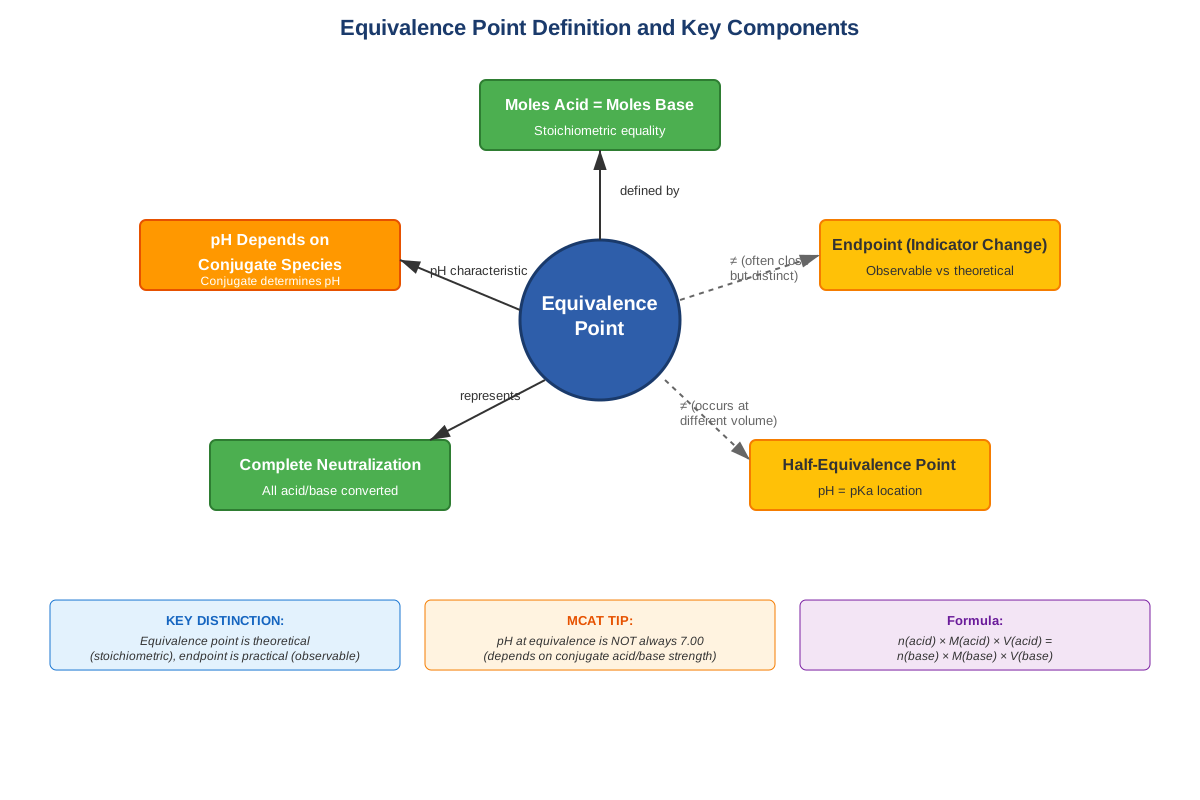
The equivalence point is defined as the point in a titration at which the number of moles of titrant added equals the number of moles of analyte originally present, according to the stoichiometry of the balanced neutralization reaction. This represents complete neutralization from a stoichiometric perspective, though the resulting solution pH depends on the strength of the acid and base involved. The equivalence point is a theoretical concept based on stoichiometric calculations, distinct from the endpoint (the observable indicator color change).
For a simple monoprotic acid-base reaction:
HA + BOH → BA + H₂OThe equivalence point occurs when moles of HA initially present equal moles of BOH added. This relationship allows calculation of the volume of titrant required:
n(acid) = n(base)
M(acid) × V(acid) = M(base) × V(base)
pH at Equivalence Point: Strong Acid-Strong Base
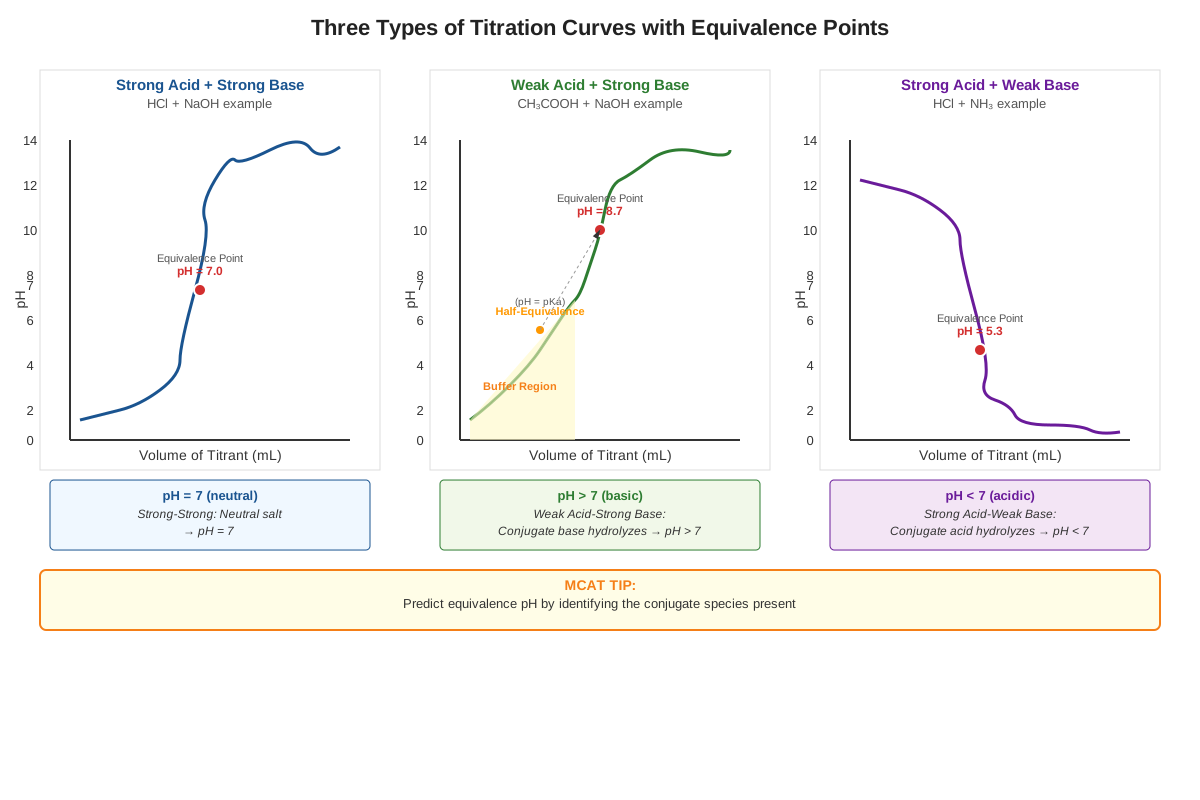
When a strong acid is titrated with a strong base (or vice versa), the equivalence point pH equals 7.00 at 25°C. This occurs because both the acid and base completely dissociate, and the resulting salt does not undergo hydrolysis. For example, titrating HCl with NaOH produces NaCl and water:
HCl + NaOH → NaCl + H₂OAt equivalence, all H⁺ ions have reacted with OH⁻ ions, leaving only Na⁺ and Cl⁻ ions in solution. Since neither ion hydrolyzes (they are conjugates of strong acids/bases), the solution pH is determined solely by water autoionization, yielding pH = 7.00. This neutral equivalence point is unique to strong acid-strong base titrations.
pH at Equivalence Point: Weak Acid-Strong Base
When a weak acid is titrated with a strong base, the equivalence point pH is greater than 7 (basic). This occurs because the conjugate base of the weak acid undergoes hydrolysis, accepting protons from water and generating hydroxide ions. For example, titrating acetic acid (CH₃COOH) with NaOH:
CH₃COOH + NaOH → CH₃COONa + H₂OAt equivalence, all acetic acid has been converted to acetate ion (CH₃COO⁻), which acts as a weak base:
CH₃COO⁻ + H₂O ⇌ CH₃COOH + OH⁻To calculate the pH at equivalence, determine the concentration of the conjugate base, then use the Kb value (derived from Ka using Kw = Ka × Kb) to find [OH⁻], and finally calculate pOH and pH. The equivalence point pH typically ranges from 8-10 depending on the weak acid's Ka value and the solution concentration.
pH at Equivalence Point: Strong Acid-Weak Base
When a strong acid is titrated with a weak base, the equivalence point pH is less than 7 (acidic). The conjugate acid of the weak base undergoes hydrolysis, donating protons to water and generating hydronium ions. For example, titrating HCl with ammonia (NH₃):
HCl + NH₃ → NH₄ClAt equivalence, all ammonia has been converted to ammonium ion (NH₄⁺), which acts as a weak acid:
NH₄⁺ + H₂O ⇌ NH₃ + H₃O⁺Calculate the pH using the concentration of NH₄⁺ and its Ka value (derived from Kb of ammonia). The equivalence point pH typically ranges from 4-6 depending on the weak base's Kb value.
Titration Curves and Equivalence Point Identification
A titration curve plots pH versus volume of titrant added, with the equivalence point appearing as the steepest portion (inflection point) of the curve. The shape of the curve provides information about the acid-base strength:
| Titration Type | Initial pH | Equivalence Point pH | Curve Shape |
|---|---|---|---|
| Strong acid-Strong base | Low (~1-3) | 7.00 | Steep rise through pH 7 |
| Weak acid-Strong base | Moderate (~3-5) | >7 (8-10) | Buffer region before steep rise |
| Strong acid-Weak base | Low (~1-3) | <7 (4-6) | Steep rise to acidic pH |
| Weak acid-Weak base | Variable | Variable | Poorly defined, gradual |
The buffer region appears before the equivalence point in weak acid-strong base titrations, where pH changes slowly because the solution contains significant amounts of both the weak acid and its conjugate base. At the half-equivalence point (halfway to equivalence), pH = pKa for the weak acid.
Polyprotic Acids and Multiple Equivalence Points
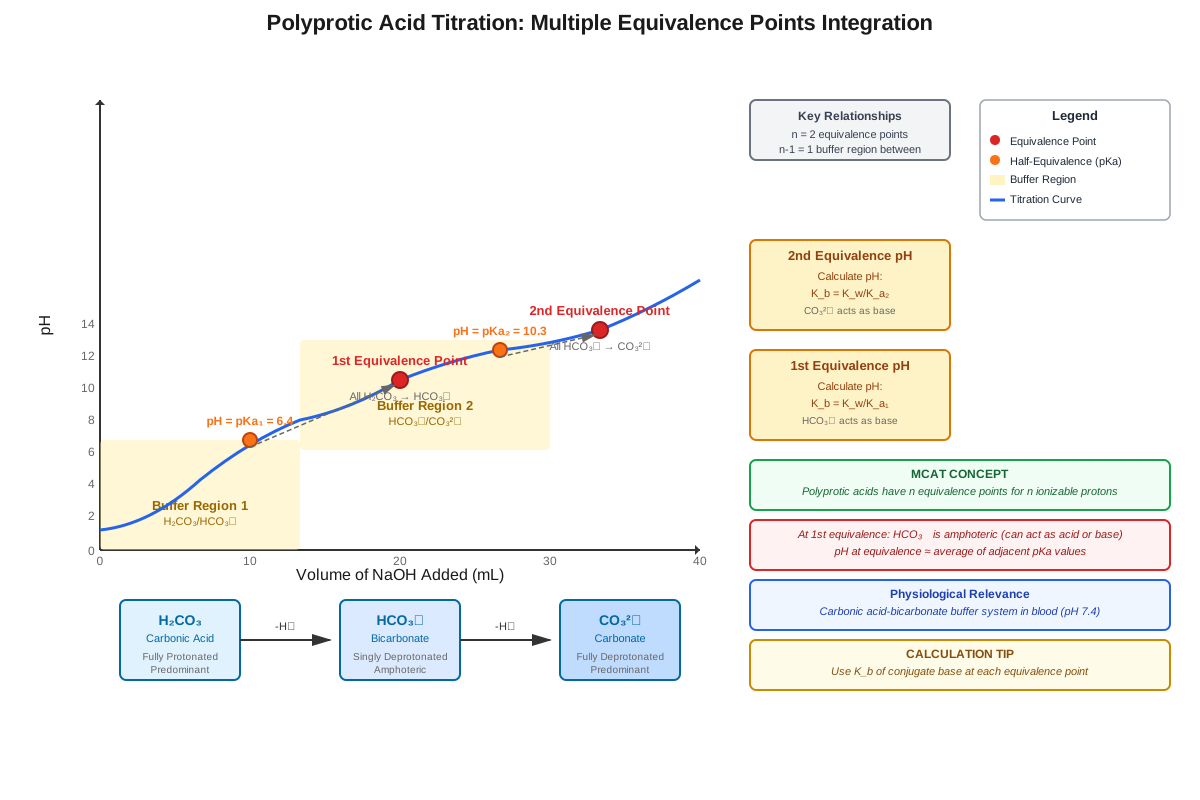
Polyprotic acids contain multiple ionizable protons and exhibit multiple equivalence points, one for each proton. For example, phosphoric acid (H₃PO₄) has three equivalence points:
- First equivalence point: H₃PO₄ → H₂PO₄⁻ (pH ~4.7)
- Second equivalence point: H₂PO₄⁻ → HPO₄²⁻ (pH ~9.8)
- Third equivalence point: HPO₄²⁻ → PO₄³⁻ (pH ~12.4)
Each equivalence point corresponds to complete neutralization of one acidic proton. The pH at each equivalence point depends on the Ka values and the hydrolysis behavior of the resulting species. Titration curves for polyprotic acids show multiple inflection points, with buffer regions between equivalence points.
Equivalence Point vs. Endpoint
The endpoint is the point at which an indicator changes color, signaling the approximate location of the equivalence point. While ideally these coincide, they are distinct concepts:
- Equivalence point: Theoretical point based on stoichiometry (moles acid = moles base)
- Endpoint: Practical observation based on indicator color change
Selecting an appropriate indicator requires matching the indicator's pKa (where it changes color) to the expected equivalence point pH. For strong acid-strong base titrations, phenolphthalein (color change at pH 8.2-10) or bromothymol blue (pH 6.0-7.6) work well. For weak acid-strong base titrations with basic equivalence points, phenolphthalein is ideal. For strong acid-weak base titrations with acidic equivalence points, methyl orange (pH 3.1-4.4) is appropriate.
Concept Relationships
The equivalence point concept serves as a central hub connecting multiple acid-base chemistry principles. Stoichiometry provides the mathematical foundation for determining when equivalence occurs, as the mole ratio from the balanced equation dictates the relationship between acid and base quantities. This stoichiometric relationship → leads to → volume calculations that predict how much titrant is needed to reach equivalence.
The strength of acids and bases (strong vs. weak) → determines → the pH at equivalence point, which in turn → influences → indicator selection for experimental titrations. Weak acid behavior → connects to → equilibrium calculations and Ka/Kb values, which are essential for calculating equivalence point pH when hydrolysis occurs.
Buffer systems relate closely to equivalence points because the region before equivalence in weak acid-strong base titrations represents a buffer zone where pH = pKa at the half-equivalence point. Understanding this relationship → enables → prediction of titration curve shapes and identification of buffer capacity regions.
Polyprotic acid behavior → extends → the basic equivalence point concept to systems with multiple neutralization steps, connecting to sequential equilibria and speciation diagrams. Each equivalence point → represents → complete deprotonation of one acidic group, with intermediate species acting as amphiprotic substances.
The practical distinction between equivalence point and endpoint → connects to → experimental technique and error analysis, as indicator selection affects titration accuracy. This relationship → extends to → analytical chemistry applications in clinical and research settings where precise acid-base measurements are critical.
Quick check — test yourself on Equivalence point so far.
Try Flashcards →High-Yield Facts
⭐ The equivalence point occurs when moles of acid equal moles of base according to reaction stoichiometry, regardless of the resulting pH
⭐ Strong acid-strong base titrations have equivalence points at pH = 7.00; weak acid-strong base titrations have basic equivalence points (pH > 7); strong acid-weak base titrations have acidic equivalence points (pH < 7)
⭐ At the half-equivalence point of a weak acid-strong base titration, pH = pKa of the weak acid
⭐ The equivalence point appears as the steepest portion (inflection point) of a titration curve
⭐ Polyprotic acids exhibit multiple equivalence points, one for each ionizable proton
- The pH at equivalence for weak acid-strong base titrations is calculated using the Kb of the conjugate base formed
- The pH at equivalence for strong acid-weak base titrations is calculated using the Ka of the conjugate acid formed
- The buffer region on a titration curve occurs before the equivalence point when significant amounts of both weak acid and conjugate base are present
- Equivalence point (theoretical, stoichiometric) differs from endpoint (practical, indicator-based)
- The volume of titrant needed to reach equivalence can be calculated using M₁V₁ = M₂V₂ for monoprotic acids
- Indicators should be chosen so their pKa matches the expected equivalence point pH
- For diprotic acids like H₂SO₄, only the first proton may be considered strong, affecting equivalence point calculations
- The equivalence point represents the point of maximum pH change per unit volume of titrant added
Common Misconceptions
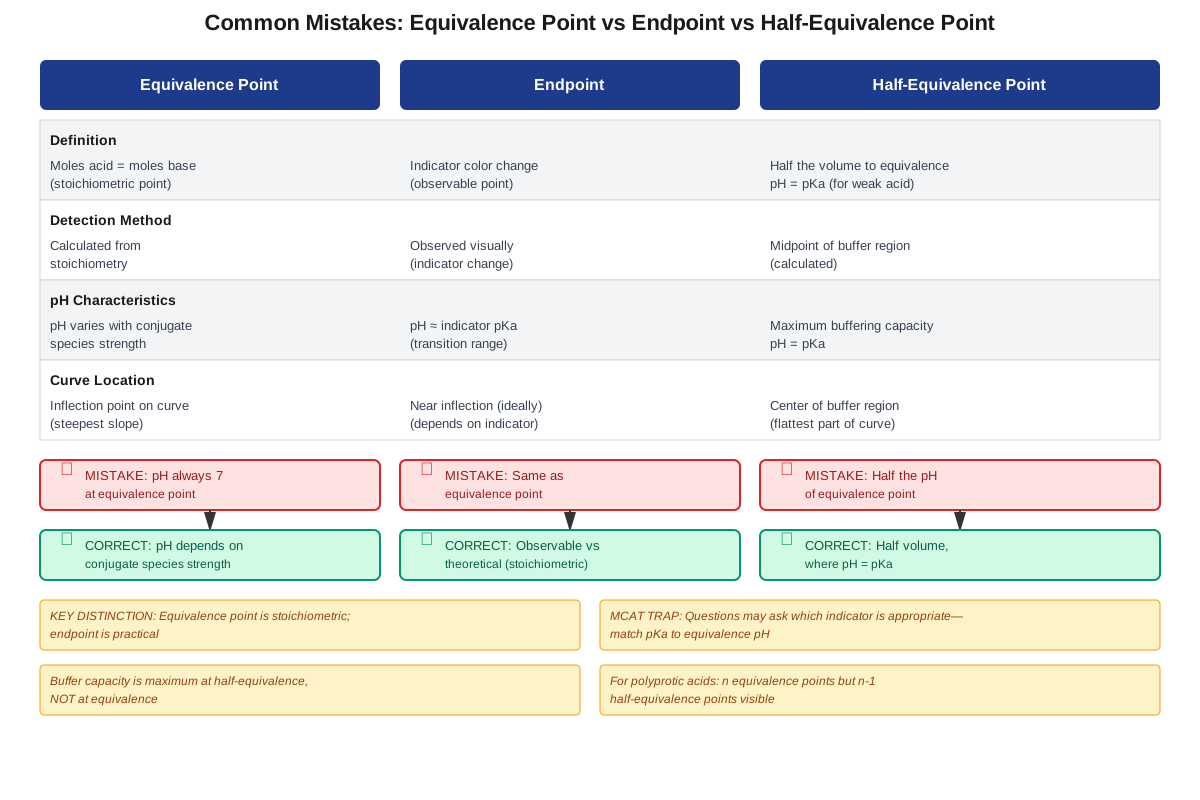
Misconception: The equivalence point always occurs at pH 7.
Correction: Only strong acid-strong base titrations have equivalence points at pH 7. Weak acid-strong base titrations have basic equivalence points (pH > 7) due to conjugate base hydrolysis, while strong acid-weak base titrations have acidic equivalence points (pH < 7) due to conjugate acid hydrolysis.
Misconception: Equivalence point and endpoint are the same thing.
Correction: The equivalence point is the theoretical stoichiometric point where moles of acid equal moles of base, while the endpoint is the practical observation of indicator color change. These should be close but are conceptually distinct; proper indicator selection minimizes the difference.
Misconception: At the equivalence point, the solution contains only water and neutral salt ions.
Correction: While the acid and base have completely reacted, the resulting ions may undergo hydrolysis. In weak acid-strong base titrations, the conjugate base hydrolyzes to produce OH⁻ ions, making the solution basic. The solution composition includes the salt ions, water, and products of hydrolysis reactions.
Misconception: The steepest part of the titration curve represents the buffer region.
Correction: The steepest part (vertical rise) represents the equivalence point where pH changes dramatically with small additions of titrant. The buffer region appears before the equivalence point as a relatively flat portion of the curve where pH changes slowly.
Misconception: All polyprotic acids show equally distinct equivalence points.
Correction: Multiple equivalence points are only clearly distinguishable when successive Ka values differ by at least 10³-10⁴. If Ka values are too similar, equivalence points overlap and cannot be separately identified on a titration curve.
Misconception: Adding more titrant after reaching equivalence point will not change the pH significantly.
Correction: After equivalence, excess strong base (or acid) is being added to the solution, causing rapid pH changes. The solution is no longer buffered, and pH changes dramatically with additional titrant, though in the opposite direction from the pre-equivalence region.
Misconception: The equivalence point volume can be estimated by finding where pH = 7 on the curve.
Correction: The equivalence point is located at the inflection point (steepest slope) of the titration curve, not necessarily at pH 7. For weak acid-strong base titrations, this occurs at pH > 7; for strong acid-weak base titrations, at pH < 7.
Worked Examples
Example 1: Calculating Equivalence Point Volume and pH
Problem: A 25.0 mL sample of 0.100 M acetic acid (CH₃COOH, Ka = 1.8 × 10⁻⁵) is titrated with 0.150 M NaOH. Calculate (a) the volume of NaOH required to reach equivalence, and (b) the pH at the equivalence point.
Solution:
(a) Volume calculation
At equivalence, moles of acid = moles of base:
n(CH₃COOH) = M × V = 0.100 M × 0.0250 L = 2.50 × 10⁻³ molSince the reaction is 1:1 stoichiometry:
n(NaOH) needed = 2.50 × 10⁻³ mol
V(NaOH) = n/M = (2.50 × 10⁻³ mol)/(0.150 M) = 0.01667 L = 16.7 mL
(b) pH at equivalence
At equivalence, all acetic acid has been converted to acetate ion (CH₃COO⁻). The total volume is:
V(total) = 25.0 mL + 16.7 mL = 41.7 mL = 0.0417 LConcentration of acetate:
[CH₃COO⁻] = (2.50 × 10⁻³ mol)/(0.0417 L) = 0.0599 MAcetate undergoes hydrolysis as a weak base:
CH₃COO⁻ + H₂O ⇌ CH₃COOH + OH⁻Calculate Kb from Ka:
Kb = Kw/Ka = (1.0 × 10⁻¹⁴)/(1.8 × 10⁻⁵) = 5.56 × 10⁻¹⁰Set up ICE table and solve for [OH⁻]:
Kb = [CH₃COOH][OH⁻]/[CH₃COO⁻] = x²/(0.0599 - x) ≈ x²/0.0599
5.56 × 10⁻¹⁰ = x²/0.0599
x² = 3.33 × 10⁻¹¹
x = [OH⁻] = 5.77 × 10⁻⁶ M
Calculate pOH and pH:
pOH = -log(5.77 × 10⁻⁶) = 5.24
pH = 14.00 - 5.24 = 8.76Answer: (a) 16.7 mL of NaOH required; (b) pH = 8.76 at equivalence
This example demonstrates the key principle that weak acid-strong base titrations have basic equivalence points due to conjugate base hydrolysis.
Example 2: Polyprotic Acid Titration Analysis
Problem: A titration curve for phosphoric acid (H₃PO₄) shows three equivalence points at 12.5 mL, 25.0 mL, and 37.5 mL of added NaOH. If the initial volume of H₃PO₄ was 25.0 mL and the NaOH concentration is 0.200 M, calculate the initial concentration of H₃PO₄.
Solution:
For a triprotic acid, the first equivalence point represents complete neutralization of the first proton:
H₃PO₄ + NaOH → H₂PO₄⁻ + H₂OAt the first equivalence point (12.5 mL):
n(NaOH) = M × V = 0.200 M × 0.0125 L = 2.50 × 10⁻³ molSince the stoichiometry is 1:1 for the first proton:
n(H₃PO₄) initial = 2.50 × 10⁻³ molInitial concentration of H₃PO₄:
M(H₃PO₄) = n/V = (2.50 × 10⁻³ mol)/(0.0250 L) = 0.100 MVerification: Notice that the second equivalence point occurs at exactly twice the first (25.0 mL vs. 12.5 mL), and the third at three times the first (37.5 mL vs. 12.5 mL). This confirms that each successive proton requires an equal amount of base, consistent with the 1:1:1 stoichiometry for each deprotonation step.
Answer: Initial [H₃PO₄] = 0.100 M
This example illustrates how polyprotic acid titrations show multiple equivalence points at regular intervals, with each interval representing neutralization of one additional proton.
Exam Strategy
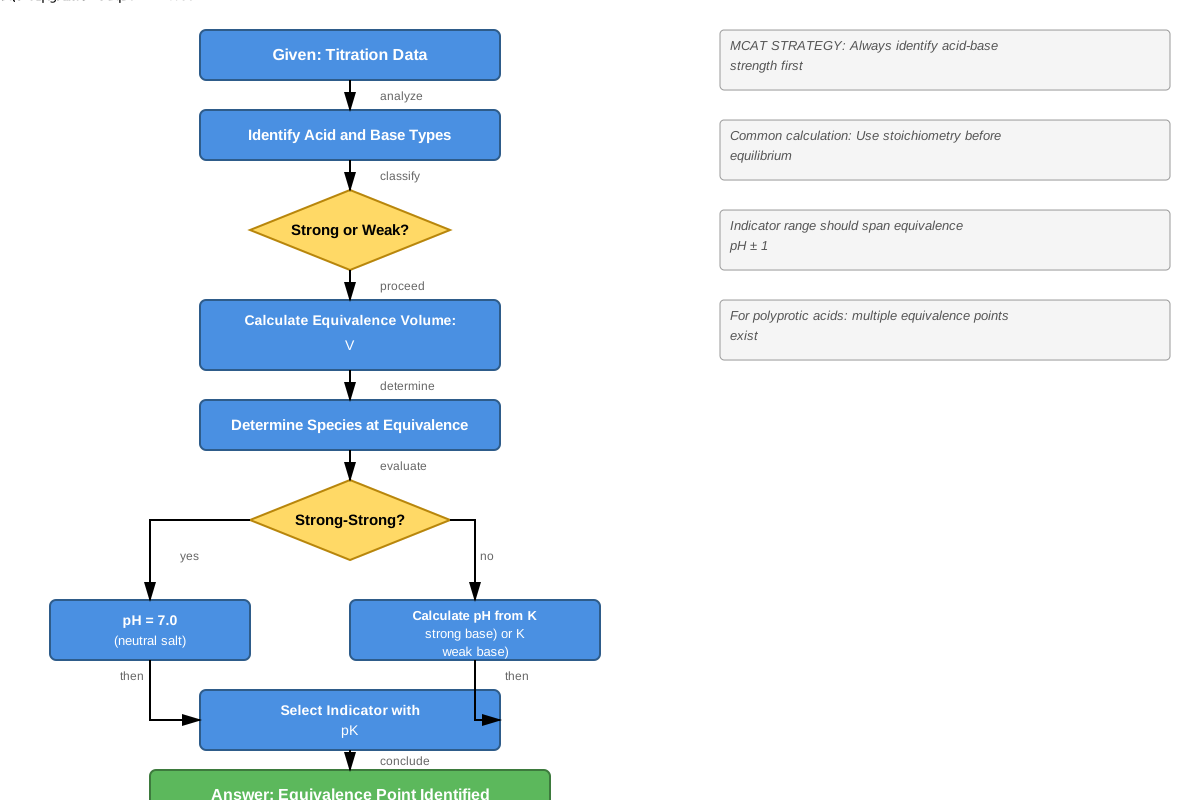
When approaching MCAT questions about equivalence points, first identify the type of titration (strong-strong, weak-strong, strong-weak) as this immediately determines whether the equivalence point pH will be neutral, basic, or acidic. Look for trigger words like "completely neutralized," "stoichiometric point," or "inflection point" that signal equivalence point questions.
For calculation-based questions, write out the balanced equation and use stoichiometry to determine mole relationships before attempting pH calculations. Remember that at equivalence, you're dealing with the conjugate species (conjugate base for weak acid titrations, conjugate acid for weak base titrations), not the original acid or base. This is a critical distinction that prevents calculation errors.
When interpreting titration curves, locate the equivalence point at the steepest portion (maximum slope), not necessarily at pH 7. The half-equivalence point appears at half the volume of the equivalence point and represents where pH = pKa. If a question asks about buffer capacity or resistance to pH change, focus on the region before equivalence, not at equivalence.
For indicator selection questions, eliminate choices with pKa values far from the expected equivalence point pH. The indicator should change color within ±1 pH unit of the equivalence point for accurate results. If given multiple indicators, choose the one whose transition range best matches the steep portion of the titration curve.
Time management tip: Equivalence point calculations often involve multiple steps (stoichiometry → concentration → equilibrium → pH). If a question seems time-consuming, check whether you can eliminate wrong answers using conceptual knowledge (e.g., weak acid-strong base must have pH > 7) before committing to full calculations. Many MCAT questions test conceptual understanding rather than computational ability.
Process of elimination strategy: For questions about equivalence point pH, immediately eliminate any answer showing pH = 7 for weak acid or weak base titrations. For volume calculations, eliminate answers that don't respect stoichiometric ratios. For polyprotic acids, eliminate answers suggesting only one equivalence point.
Memory Techniques
"SWAN" for Equivalence Point pH:
- Strong acid + Strong base = Seven (pH = 7)
- Weak acid + Strong base = Whopping high (pH > 7, basic)
- Acid (strong) + Weak base = Acidic (pH < 7)
- Never assume pH = 7 unless both are strong
"Half-Way to pKa": At the half-equivalence point (halfway to equivalence volume), pH equals pKa of the weak acid. Visualize climbing a hill—halfway up, you're at the pKa marker.
"STEEP = Equivalence": The STeepest part of the titration curve Equals Equivalence Point. Visualize a cliff face on the curve—that's where equivalence occurs.
"Conjugate Confusion Cure": At equivalence in weak acid-strong base titrations, remember "ACID GONE, BASE BORN"—the weak acid is completely converted to its conjugate base, which then hydrolyzes to make the solution basic.
Polyprotic Equivalence Points: Use your fingers to count protons. For H₃PO₄ (hold up three fingers), you'll see three equivalence points. Each finger represents one proton being neutralized.
Indicator Selection: "Match the pKa to the pH at E" (equivalence). The indicator's pKa should match the equivalence point pH for accurate endpoint detection.
Summary
The equivalence point represents the fundamental stoichiometric milestone in acid-base titrations where moles of acid equal moles of base according to the balanced neutralization equation. While this point can be calculated using stoichiometry and identified as the inflection point on titration curves, the resulting pH depends critically on the strength of the acid and base involved. Strong acid-strong base titrations yield neutral equivalence points (pH = 7), weak acid-strong base titrations produce basic equivalence points (pH > 7) due to conjugate base hydrolysis, and strong acid-weak base titrations result in acidic equivalence points (pH < 7) due to conjugate acid hydrolysis. Polyprotic acids exhibit multiple equivalence points corresponding to sequential proton neutralizations. Understanding these principles enables accurate pH predictions, appropriate indicator selection, and correct interpretation of experimental titration data—all high-yield skills for MCAT success in General Chemistry.
Key Takeaways
- The equivalence point occurs when moles of acid equal moles of base stoichiometrically, identified as the steepest portion of a titration curve
- Equivalence point pH depends on acid-base strength: pH = 7 for strong-strong, pH > 7 for weak acid-strong base, pH < 7 for strong acid-weak base
- At equivalence, the solution contains the conjugate species (conjugate base or conjugate acid), which may undergo hydrolysis to affect pH
- The half-equivalence point occurs at half the equivalence volume, where pH = pKa for weak acid titrations
- Polyprotic acids show multiple equivalence points, one for each ionizable proton, with distinct buffer regions between them
- Equivalence point (theoretical, stoichiometric) differs from endpoint (practical, indicator-based); proper indicator selection minimizes this difference
- Calculating equivalence point pH requires identifying the dominant species present and applying appropriate equilibrium expressions
Related Topics
Buffer Systems and Henderson-Hasselbalch Equation: Understanding equivalence points provides context for buffer behavior, particularly the buffer region before equivalence where pH = pKa at the half-equivalence point. Mastering equivalence points enables deeper comprehension of buffer capacity and pH resistance.
Acid-Base Indicators: Equivalence point knowledge directly informs indicator selection, as indicators must change color near the equivalence point pH. This connection extends to spectrophotometric analysis and experimental design.
Solubility Equilibria and Precipitation Titrations: The stoichiometric principles underlying equivalence points apply to precipitation titrations where equivalence occurs when moles of precipitating ions are stoichiometrically equal.
Electrochemistry and pH Meters: Modern titrations use pH meters to precisely identify equivalence points, connecting acid-base chemistry to electrochemical measurements and the Nernst equation.
Biochemical Buffering Systems: Physiological applications of equivalence point principles include understanding blood pH regulation, amino acid titrations, and protein isoelectric points—all relevant to MCAT biological sciences passages.
Practice CTA
Now that you've mastered the theoretical foundations of equivalence points, it's time to solidify your understanding through active practice. Challenge yourself with the accompanying practice questions that simulate real MCAT scenarios, including passage-based questions with titration curves and discrete questions requiring multi-step calculations. Use the flashcards to reinforce high-yield facts and test your ability to quickly distinguish between different titration types. Remember, equivalence point questions frequently appear on the MCAT, and your ability to rapidly identify titration types and predict pH outcomes will save valuable time on test day. Consistent practice transforms theoretical knowledge into the automatic pattern recognition that leads to top scores!
Sign up free to keep reading
Create a free AnvayaPrep account to finish this MCAT guide on Equivalence point — plus flashcards and practice questions.