Overview
The half equivalence point is a critical concept in acid-base chemistry that appears frequently on the MCAT, particularly in passages involving titration curves and buffer systems. This point occurs during a titration when exactly half of the weak acid (or weak base) has been neutralized by the added strong base (or strong acid). At this unique position on the titration curve, the concentration of the weak acid equals the concentration of its conjugate base ([HA] = [A⁻]), creating a special relationship that allows for direct determination of the acid dissociation constant (Ka) or base dissociation constant (Kb).
Understanding the half equivalence point is essential for MCAT success because it bridges multiple high-yield topics in General Chemistry, including buffer systems, Henderson-Hasselbalch equation applications, and titration curve interpretation. The MCAT frequently tests students' ability to identify this point on a graph, calculate pH values at this position, and recognize its significance in buffer preparation. Questions may appear as standalone discrete items or embedded within passage-based scenarios involving laboratory techniques, physiological buffer systems, or pharmaceutical formulations.
The half equivalence point serves as a conceptual anchor connecting acids and bases equilibrium principles to practical applications. It demonstrates the relationship between macroscopic observations (pH changes during titration) and molecular-level events (proton transfer equilibria). Mastery of this topic enables students to tackle complex problems involving buffer capacity, pKa determination, and the interpretation of experimental data—all of which are heavily emphasized in the Chemical and Physical Foundations of Biological Systems section of the MCAT.
Learning Objectives
- [ ] Define half equivalence point using accurate General Chemistry terminology
- [ ] Explain why half equivalence point matters for the MCAT
- [ ] Apply half equivalence point to exam-style questions
- [ ] Identify common mistakes related to half equivalence point
- [ ] Connect half equivalence point to related General Chemistry concepts
- [ ] Calculate the pH at the half equivalence point using the Henderson-Hasselbalch equation
- [ ] Interpret titration curves to identify the half equivalence point graphically
- [ ] Predict the buffer capacity and pH behavior near the half equivalence point
- [ ] Distinguish between half equivalence point and equivalence point characteristics
Prerequisites
- Henderson-Hasselbalch equation: Essential for calculating pH at the half equivalence point and understanding the mathematical relationship between pH and pKa
- Acid-base equilibria and Ka/Kb values: Necessary to comprehend why the half equivalence point reveals the pKa of the weak acid being titrated
- Buffer systems and buffer capacity: Required to understand why the half equivalence point represents the position of maximum buffer capacity
- Titration fundamentals: Needed to contextualize where the half equivalence point occurs in the overall titration process
- Conjugate acid-base pairs: Critical for recognizing the equal concentrations of conjugate species at the half equivalence point
- Logarithmic functions: Important for manipulating the Henderson-Hasselbalch equation and understanding pH scale relationships
Why This Topic Matters
The half equivalence point concept appears with remarkable frequency on the MCAT, making it one of the highest-yield topics within acid-base chemistry. Statistical analysis of recent MCAT exams reveals that approximately 60-70% of tests include at least one question directly or indirectly testing this concept. Questions typically appear in two formats: passage-based scenarios involving experimental titration data with accompanying graphs, and discrete questions testing conceptual understanding of buffer systems and pKa relationships.
In clinical and research contexts, the half equivalence point has profound practical significance. Biochemists use this principle to determine pKa values of amino acids, which is crucial for understanding protein structure and function at different pH values. Pharmaceutical scientists exploit this concept when formulating drug delivery systems, as many medications are weak acids or bases whose absorption depends on pH-dependent ionization states. Physiologically, the bicarbonate buffer system in human blood operates near its pKa, demonstrating the same principles that govern the half equivalence point—maintaining pH stability through equal concentrations of conjugate acid-base pairs.
MCAT passages commonly present this topic through laboratory scenarios describing the titration of unknown weak acids or bases, amino acid titrations showing multiple half equivalence points, or physiological scenarios involving buffer systems in biological fluids. Test-makers favor this topic because it integrates mathematical reasoning, graph interpretation, and conceptual understanding—all skills that predict success in medical school. Recognition of the half equivalence point on a titration curve often serves as the key to unlocking multiple questions within a single passage, making it a high-leverage concept for score improvement.
Core Concepts
Definition and Fundamental Principle
The half equivalence point is defined as the specific point during an acid-base titration where exactly one-half of the original weak acid (or weak base) has been converted to its conjugate base (or conjugate acid). Mathematically, this occurs when the moles of strong base (or acid) added equal exactly half the moles of weak acid (or base) initially present in the solution. At this precise moment, the concentration of the weak acid equals the concentration of its conjugate base: [HA] = [A⁻] for a weak acid titration, or [B] = [BH⁺] for a weak base titration.
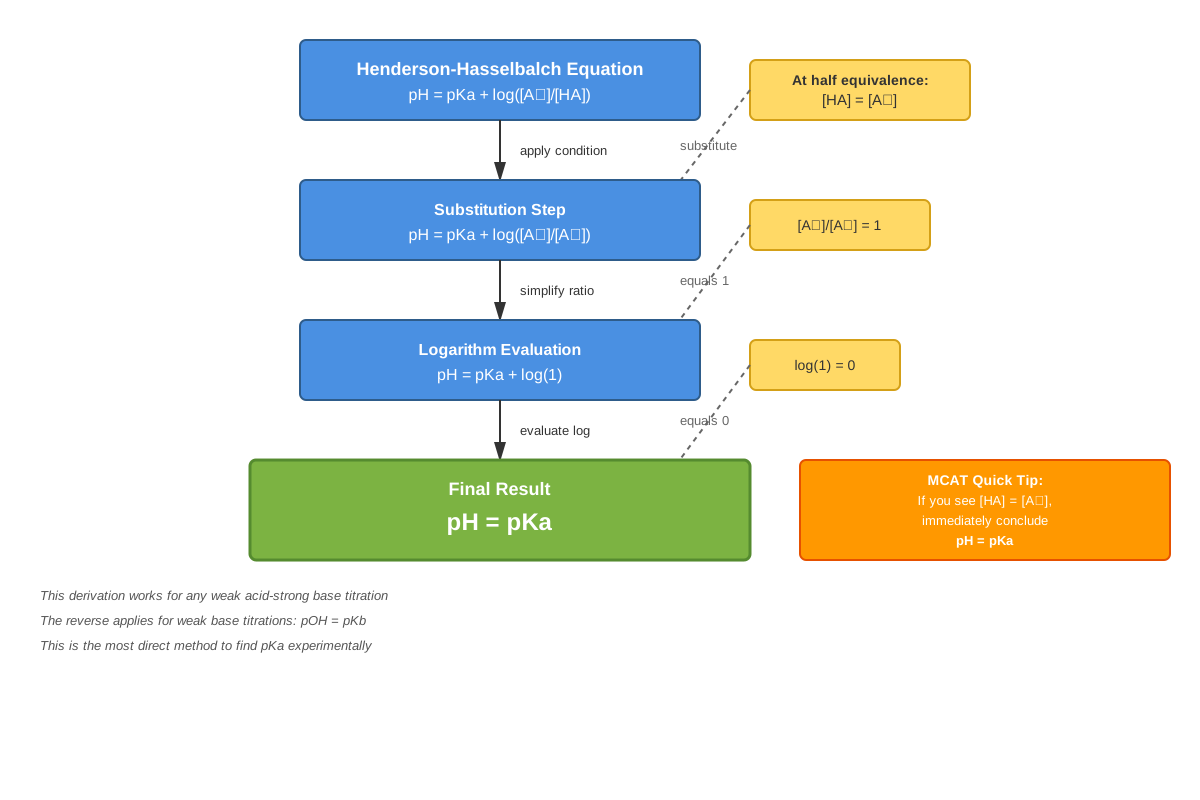
This equality creates a unique mathematical situation when applied to the Henderson-Hasselbalch equation:
pH = pKa + log([A⁻]/[HA])When [A⁻] = [HA], the ratio equals 1, and log(1) = 0, simplifying the equation to:
pH = pKaThis elegant relationship means that at the half equivalence point, the pH of the solution equals the pKa of the weak acid being titrated. This principle provides a straightforward experimental method for determining pKa values and is fundamental to understanding buffer behavior.
Location on Titration Curves
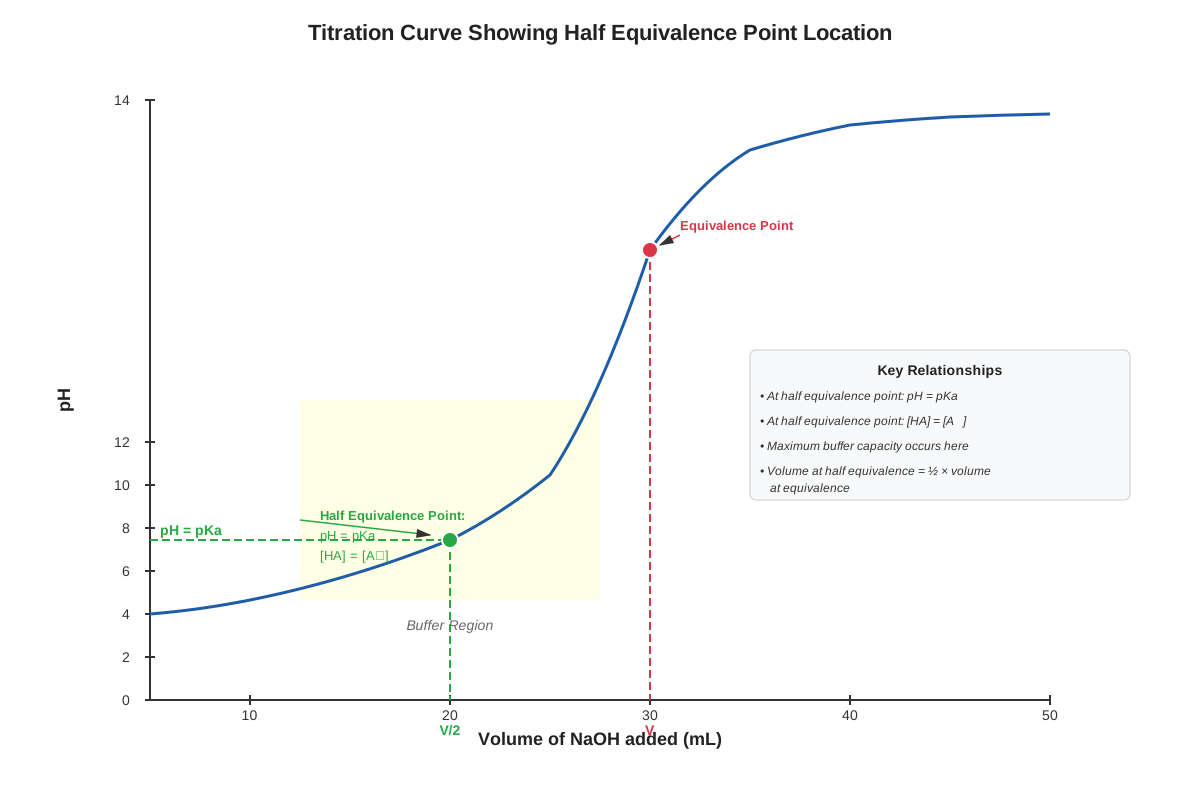
On a titration curve plotting pH versus volume of titrant added, the half equivalence point appears at the midpoint between the initial pH and the equivalence point. For a weak acid titrated with a strong base, the curve shows a characteristic S-shape, and the half equivalence point occurs in the buffer region where the curve has minimal slope—indicating maximum resistance to pH change (maximum buffer capacity).
Graphically identifying this point requires recognizing several features:
- The equivalence point appears as the steepest part of the curve (inflection point)
- The half equivalence point occurs at exactly half the volume of titrant needed to reach the equivalence point
- The pH at this point can be read directly from the y-axis and equals the pKa
- The relatively flat region surrounding this point indicates the buffer region
Buffer Capacity Relationship
The half equivalence point represents the position of maximum buffer capacity for the conjugate acid-base pair. Buffer capacity quantifies a solution's ability to resist pH changes upon addition of acid or base. This capacity reaches its peak when [HA] = [A⁻] because the system has optimal amounts of both species to neutralize added acids (using A⁻) or bases (using HA).
The relationship between buffer capacity and composition can be understood through Le Chatelier's principle. When equal amounts of conjugate acid and base are present, the system has maximum flexibility to shift equilibrium in either direction:
HA ⇌ H⁺ + A⁻Adding acid drives the equilibrium left (A⁻ consumes H⁺), while adding base drives it right (HA releases H⁺ to replace consumed H⁺). The equal concentrations ensure neither species becomes depleted quickly, maintaining buffering action over a wider range of additions.
Mathematical Derivations and Calculations
Understanding the mathematical foundation of the half equivalence point strengthens problem-solving abilities. Consider a titration of a weak acid HA with initial moles n₀:
At the half equivalence point:
- Moles of HA remaining = n₀/2
- Moles of A⁻ formed = n₀/2
- Total volume = V₀ + V_added
Since both species are in the same solution (same volume), their concentrations are equal:
[HA] = (n₀/2)/V_total = [A⁻]This equality holds regardless of the total volume, making the pH at the half equivalence point independent of dilution effects—a unique and important property.
For polyprotic acids (acids with multiple ionizable protons), each dissociation has its own half equivalence point, each revealing a different pKa value. For example, phosphoric acid (H₃PO₄) shows three half equivalence points corresponding to pKa1, pKa2, and pKa3.
Comparison with Equivalence Point
Understanding the distinction between the half equivalence point and the equivalence point is crucial for MCAT success:
| Feature | Half Equivalence Point | Equivalence Point |
|---|---|---|
| Definition | Half of weak acid neutralized | All weak acid neutralized |
| Species present | [HA] = [A⁻] | Primarily [A⁻] (conjugate base) |
| pH relationship | pH = pKa | pH > 7 (weak acid/strong base) |
| Buffer capacity | Maximum | Minimal (not a buffer) |
| Curve appearance | Flattest region | Steepest region (inflection point) |
| Volume of titrant | V_eq/2 | V_eq |
The equivalence point pH depends on the hydrolysis of the conjugate base formed, requiring separate calculations involving Kb, while the half equivalence point pH is simply the pKa—a much more straightforward determination.
Practical Applications in Buffer Preparation
The half equivalence point principle guides optimal buffer preparation. The most effective buffers are prepared with pH values close to the pKa of the conjugate acid-base pair, which corresponds to the half equivalence point condition. The effective buffering range extends approximately ±1 pH unit from the pKa (from pKa - 1 to pKa + 1), corresponding to conjugate base-to-acid ratios from 1:10 to 10:1.
When preparing a buffer for a specific application, chemists select a conjugate pair whose pKa falls within one unit of the desired pH, then adjust the ratio of conjugate base to acid using the Henderson-Hasselbalch equation. Starting at the half equivalence point composition ([HA] = [A⁻]) provides maximum buffer capacity and allows for adjustments in either direction.
Concept Relationships
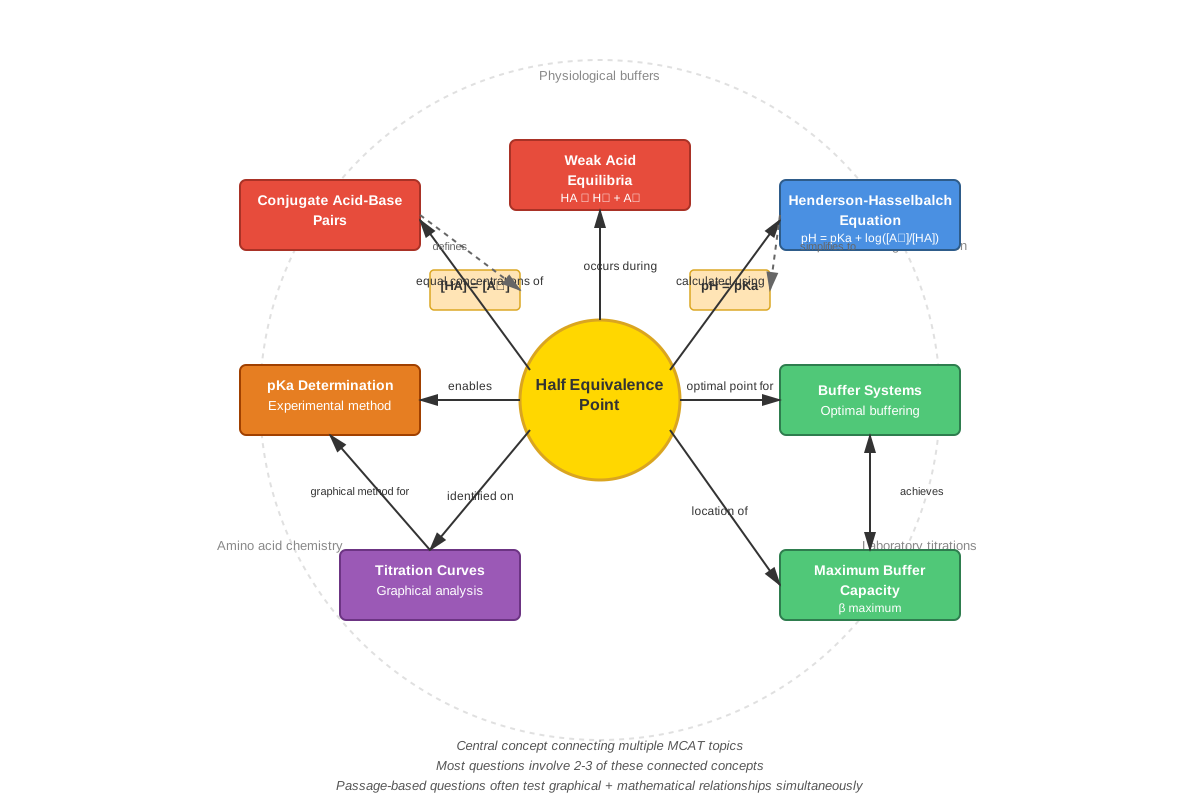
The half equivalence point serves as a conceptual hub connecting multiple fundamental principles in General Chemistry. The relationship map flows as follows:
Acid-base equilibria → establishes Ka and Kb constants → which determine pKa and pKb values → these values are experimentally determined at the half equivalence point → where the Henderson-Hasselbalch equation simplifies to pH = pKa → this condition creates optimal buffer systems → which exhibit maximum buffer capacity → enabling resistance to pH changes in biological systems.
The connection to titration curves is bidirectional: understanding titration principles allows identification of the half equivalence point graphically, while recognizing the half equivalence point enables interpretation of the entire titration curve's shape and features. The buffer region surrounding the half equivalence point demonstrates the practical application of Le Chatelier's principle, as the system shifts to counteract pH disturbances.
Prerequisite knowledge of logarithmic functions becomes essential when manipulating the Henderson-Hasselbalch equation to solve for unknown variables. The concept also connects forward to more advanced topics like polyprotic acid titrations, where multiple half equivalence points reveal the stepwise dissociation constants, and amino acid chemistry, where zwitterionic forms and isoelectric points relate to the half equivalence points of the amino and carboxyl groups.
The relationship between the half equivalence point and buffer capacity illustrates a broader principle in chemistry: equilibrium systems function most effectively when reactants and products are present in comparable amounts, allowing bidirectional response to perturbations.
High-Yield Facts
⭐ At the half equivalence point, pH = pKa for the weak acid being titrated (or pOH = pKb for a weak base titration)
⭐ The half equivalence point occurs at exactly half the volume of titrant needed to reach the equivalence point
⭐ The concentration of weak acid equals the concentration of conjugate base at the half equivalence point: [HA] = [A⁻]
⭐ The half equivalence point represents the position of maximum buffer capacity on a titration curve
⭐ The buffer region (flattest part of the titration curve) is centered at the half equivalence point
- The Henderson-Hasselbalch equation simplifies to pH = pKa + log(1) = pKa at the half equivalence point because the ratio [A⁻]/[HA] equals 1
- For polyprotic acids, each ionizable proton has its own half equivalence point, revealing each successive pKa value
- The pH at the half equivalence point is independent of the concentration of the weak acid or the degree of dilution
- The slope of the titration curve is minimal (flattest) at the half equivalence point, indicating maximum resistance to pH change
- Effective buffers are prepared with pH values within ±1 unit of the pKa, corresponding to the region around the half equivalence point
- The half equivalence point pH can be read directly from a titration curve without calculation, providing an experimental method for pKa determination
Quick check — test yourself on Half equivalence point so far.
Try Flashcards →Common Misconceptions
Misconception: The half equivalence point and equivalence point occur at the same pH.
Correction: These are distinct points with different pH values. The half equivalence point pH equals the pKa of the weak acid, while the equivalence point pH depends on the hydrolysis of the conjugate base and is typically greater than 7 for weak acid/strong base titrations. The equivalence point occurs at a higher pH than the half equivalence point.
Misconception: At the half equivalence point, half of the weak acid molecules have lost all their protons.
Correction: At the half equivalence point, exactly half of the original weak acid molecules have each lost one proton (for monoprotic acids), creating an equal number of conjugate base molecules. The remaining half are still in the protonated (HA) form. This is different from saying each molecule is "half deprotonated."
Misconception: The half equivalence point only applies to weak acid titrations, not weak base titrations.
Correction: The half equivalence point concept applies equally to weak base titrations with strong acids. For weak bases, at the half equivalence point, [B] = [BH⁺] and pOH = pKb (or pH = pKa of the conjugate acid BH⁺). The same principles apply but with complementary relationships.
Misconception: The buffer capacity is constant throughout the buffer region.
Correction: Buffer capacity varies throughout the buffer region, reaching its maximum at the half equivalence point where [HA] = [A⁻]. As the ratio of conjugate base to acid deviates from 1:1, buffer capacity decreases. The effective buffer range (pKa ± 1) represents where capacity remains reasonably high, not where it's constant.
Misconception: You need to know the initial concentration of the weak acid to determine the pH at the half equivalence point.
Correction: The pH at the half equivalence point equals the pKa regardless of the initial concentration of the weak acid. This is because the ratio [A⁻]/[HA] = 1 at this point, and concentration terms cancel out in the Henderson-Hasselbalch equation. You only need to know the pKa value.
Misconception: The half equivalence point occurs at pH 7.
Correction: The half equivalence point pH equals the pKa of the weak acid being titrated, which may be any value depending on the acid's strength. Only if the pKa happens to be 7 will the half equivalence point occur at pH 7. For acetic acid (pKa = 4.76), the half equivalence point occurs at pH 4.76, not pH 7.
Misconception: Adding more titrant after the half equivalence point decreases buffer capacity.
Correction: While this is true, it's important to understand that buffer capacity decreases in both directions away from the half equivalence point. Moving toward either more acidic conditions (before the half equivalence point) or more basic conditions (after the half equivalence point) reduces buffer capacity. The relationship is symmetric around the half equivalence point.
Worked Examples
Example 1: Identifying Half Equivalence Point and Calculating pKa
Problem: A student titrates 25.0 mL of 0.100 M acetic acid (CH₃COOH) with 0.100 M NaOH. The equivalence point is reached after adding 25.0 mL of NaOH. At what volume of NaOH added does the half equivalence point occur, and what is the pH at this point if the pKa of acetic acid is 4.76?
Solution:
Step 1: Determine the volume at the half equivalence point.
The half equivalence point occurs at exactly half the volume needed to reach the equivalence point.
- Volume at equivalence point = 25.0 mL
- Volume at half equivalence point = 25.0 mL ÷ 2 = 12.5 mL
Step 2: Determine the pH at the half equivalence point.
At the half equivalence point, pH = pKa (this is the fundamental relationship).
- pH = pKa = 4.76
Step 3: Verify using Henderson-Hasselbalch equation (optional but instructive).
At 12.5 mL NaOH added:
- Initial moles of CH₃COOH = 0.100 M × 0.0250 L = 0.00250 mol
- Moles of NaOH added = 0.100 M × 0.0125 L = 0.00125 mol
- Moles of CH₃COOH remaining = 0.00250 - 0.00125 = 0.00125 mol
- Moles of CH₃COO⁻ formed = 0.00125 mol
Since [CH₃COOH] = [CH₃COO⁻] (equal moles in same volume):
pH = pKa + log([CH₃COO⁻]/[CH₃COOH])
pH = 4.76 + log(0.00125/0.00125)
pH = 4.76 + log(1)
pH = 4.76 + 0 = 4.76Answer: The half equivalence point occurs at 12.5 mL of NaOH added, and the pH at this point is 4.76.
Key Learning Points: This example demonstrates that the half equivalence point volume is always half the equivalence point volume, and the pH at this point directly equals the pKa without requiring complex calculations. This makes it an efficient experimental method for determining pKa values.
Example 2: Interpreting a Titration Curve
Problem: The graph below describes the titration of a weak monoprotic acid with a strong base. The equivalence point occurs at 40.0 mL of titrant added, and the pH at 20.0 mL is 5.2.
(a) What is the pKa of the weak acid?
(b) What is the approximate buffer capacity at 10.0 mL compared to 20.0 mL?
(c) If the initial concentration of the weak acid was 0.200 M and the volume was 20.0 mL, what is the concentration of the conjugate base at the half equivalence point?
Solution:
(a) Determining the pKa:
Step 1: Identify the half equivalence point volume.
- Equivalence point = 40.0 mL
- Half equivalence point = 40.0 mL ÷ 2 = 20.0 mL
Step 2: Read the pH at the half equivalence point.
- At 20.0 mL, pH = 5.2
Step 3: Apply the fundamental relationship.
- At the half equivalence point, pH = pKa
- Therefore, pKa = 5.2
(b) Comparing buffer capacity:
Step 1: Recognize that buffer capacity is maximum at the half equivalence point.
- At 20.0 mL (half equivalence point): maximum buffer capacity
- At 10.0 mL: this is halfway between the start and the half equivalence point
Step 2: Determine the ratio at 10.0 mL.
- At 10.0 mL, 1/4 of the acid has been neutralized
- [HA] = 3/4 of original, [A⁻] = 1/4 of original
- Ratio [A⁻]/[HA] = (1/4)/(3/4) = 1/3
Step 3: Compare buffer capacities.
Buffer capacity depends on having comparable amounts of both species. At 10.0 mL, the ratio is 1:3, which is less optimal than the 1:1 ratio at 20.0 mL. The buffer capacity at 10.0 mL is lower than at 20.0 mL (approximately 75% of maximum based on the deviation from equal concentrations).
(c) Calculating conjugate base concentration:
Step 1: Determine moles at the half equivalence point.
- Initial moles of weak acid = 0.200 M × 0.0200 L = 0.00400 mol
- At half equivalence point, half is converted to conjugate base
- Moles of A⁻ = 0.00400 mol ÷ 2 = 0.00200 mol
Step 2: Calculate total volume.
- Initial volume = 20.0 mL
- Volume of titrant added = 20.0 mL
- Total volume = 40.0 mL = 0.0400 L
Step 3: Calculate concentration.
- [A⁻] = 0.00200 mol ÷ 0.0400 L = 0.0500 M
Note: [HA] also equals 0.0500 M at this point, confirming [HA] = [A⁻].
Answers:
(a) pKa = 5.2
(b) Buffer capacity at 10.0 mL is lower than at 20.0 mL (approximately 75% of maximum)
(c) [A⁻] = 0.0500 M
Key Learning Points: This example reinforces that the half equivalence point can be identified graphically, the pH at this point reveals the pKa, buffer capacity is maximum when [HA] = [A⁻], and both conjugate species have equal concentrations at the half equivalence point regardless of dilution.
Exam Strategy
When approaching MCAT questions involving the half equivalence point, employ this systematic strategy:
Step 1: Identify the question type
- Graph interpretation: Look for titration curves and identify key points
- Calculation: Recognize when pH = pKa relationships apply
- Conceptual: Determine what principle is being tested (buffer capacity, pKa determination, etc.)
Step 2: Watch for trigger words and phrases
- "Half the equivalence point volume"
- "Maximum buffer capacity"
- "pH equals pKa"
- "Equal concentrations of conjugate acid and base"
- "Midpoint of the buffer region"
- "Flattest part of the titration curve"
These phrases signal that the question involves the half equivalence point, even if not explicitly stated.
Step 3: Apply the core relationship
Immediately recognize that at the half equivalence point:
- pH = pKa (for weak acid titrations)
- [HA] = [A⁻]
- Volume = (Volume at equivalence point) ÷ 2
This often allows you to eliminate 2-3 answer choices immediately.
Step 4: Use process of elimination strategically
- Eliminate answers confusing half equivalence point with equivalence point
- Eliminate answers suggesting pH = 7 unless pKa = 7
- Eliminate answers requiring complex calculations when simple relationships apply
- Eliminate answers suggesting buffer capacity is minimal at the half equivalence point
Step 5: Time allocation
- Discrete questions: 60-90 seconds (these often test direct application of pH = pKa)
- Passage-based questions: 90-120 seconds (may require graph interpretation first)
- If a question requires extensive calculation, check whether the pH = pKa shortcut applies first
Exam Tip: If a passage provides a titration curve, immediately mark the half equivalence point (half the volume to equivalence) and note the pH at that point. This single value (the pKa) often unlocks multiple questions in the passage.
Common question formats to expect:
- "At what volume does the solution have maximum buffer capacity?" → Answer: Half the equivalence point volume
- "What is the pKa of the weak acid?" → Answer: Read pH at half equivalence point from graph
- "At which point are [HA] and [A⁻] equal?" → Answer: Half equivalence point
- "Where on the curve would the pH change least with added base?" → Answer: Half equivalence point (flattest region)
Memory Techniques
Mnemonic for Half Equivalence Point Properties: "HALF-PAK"
- Half the volume to equivalence
- Acid equals conjugate base concentration
- Lowest slope on curve (flattest)
- Full buffer capacity (maximum)
- PH equals pKa
- Always in the buffer region
- Key to determining pKa experimentally
Visualization Strategy: The "Balance Point"
Imagine a seesaw perfectly balanced with equal weights on each side. This represents [HA] = [A⁻] at the half equivalence point. The balance point (fulcrum) represents the pKa. When the system is perfectly balanced, it's most stable (maximum buffer capacity) and resistant to tipping (pH change). Adding acid or base is like adding weight to one side—the system can compensate best when starting from perfect balance.
Acronym for Distinguishing Points: "HEP vs EP"
- HEP (Half Equivalence Point): Half volume, Equal concentrations, PH = pKa
- EP (Equivalence Point): Entirely converted, PH > 7 (for weak acid/strong base)
Mathematical Memory Aid: "Log of One is None"
Remember that log(1) = 0. At the half equivalence point, [A⁻]/[HA] = 1, so log([A⁻]/[HA]) = 0, making the Henderson-Hasselbalch equation simplify to pH = pKa + 0 = pKa. The phrase "log of one is none" helps recall this simplification.
Graph Recognition Pattern: "Flat is Fat"
The flattest part of the titration curve is where the buffer is "fattest" (has maximum capacity). This flat region is centered at the half equivalence point. When you see a flat region on a titration curve, think "fat buffer" and "half equivalence point."
Summary
The half equivalence point represents a fundamental concept in acids and bases chemistry where exactly half of a weak acid has been neutralized during titration, creating equal concentrations of the weak acid and its conjugate base. This unique condition causes the Henderson-Hasselbalch equation to simplify dramatically, yielding the elegant relationship pH = pKa. On titration curves, this point appears at half the volume needed to reach the equivalence point and corresponds to the flattest region of the curve, indicating maximum buffer capacity. The half equivalence point serves multiple purposes: it provides an experimental method for determining pKa values, identifies the optimal composition for buffer preparation, and demonstrates the principle that buffer systems function most effectively when conjugate acid and base are present in equal amounts. For the MCAT, mastery of this concept enables rapid problem-solving through recognition of key relationships rather than lengthy calculations, and it frequently serves as the foundation for multiple questions within passage-based scenarios. Understanding the distinction between the half equivalence point (pH = pKa, maximum buffer capacity) and the equivalence point (all acid neutralized, minimal buffer capacity) is essential for success on exam questions involving titration curves and buffer systems.
Key Takeaways
- At the half equivalence point, pH = pKa for the weak acid being titrated, providing a direct experimental method for pKa determination
- The half equivalence point occurs at exactly half the volume of titrant needed to reach the equivalence point
- Equal concentrations of weak acid and conjugate base ([HA] = [A⁻]) exist at the half equivalence point, creating optimal buffer conditions
- Maximum buffer capacity occurs at the half equivalence point, making this the ideal composition for preparing effective buffers
- The half equivalence point appears as the flattest region on a titration curve, indicating maximum resistance to pH change
- The pH at the half equivalence point is independent of the weak acid's concentration or dilution effects
- For polyprotic acids, each ionizable proton has its own half equivalence point, revealing successive pKa values
Related Topics
Buffer Systems and the Henderson-Hasselbalch Equation: Understanding buffer preparation and pH calculations builds directly on half equivalence point principles, as optimal buffers are designed with pH values near the pKa (the half equivalence point condition). Mastering the half equivalence point enables deeper comprehension of how buffers resist pH changes.
Titration Curves and Equivalence Points: Complete interpretation of titration curves requires distinguishing between the half equivalence point and equivalence point. This topic extends the current knowledge to include strong acid-strong base titrations and polyprotic acid titrations with multiple equivalence points.
Polyprotic Acids and Amino Acid Chemistry: Polyprotic acids exhibit multiple half equivalence points, each revealing a different pKa. Amino acids, with both amino and carboxyl groups, show two half equivalence points, and understanding these is crucial for predicting amino acid behavior at different pH values.
Physiological Buffer Systems: The bicarbonate buffer system in blood and phosphate buffers in cells operate on the same principles as the half equivalence point, maintaining pH stability through optimal ratios of conjugate acid-base pairs. This connection bridges general chemistry to biochemistry and physiology.
Acid-Base Indicators and pH Measurement: Selecting appropriate indicators for titrations requires understanding where pH changes occur most dramatically (equivalence point) versus where pH remains stable (half equivalence point). This topic applies half equivalence point knowledge to experimental design.
Practice CTA
Now that you've mastered the fundamental concepts of the half equivalence point, it's time to solidify your understanding through active practice. Challenge yourself with the accompanying practice questions that test your ability to identify half equivalence points on titration curves, calculate pH values using the pH = pKa relationship, and distinguish between half equivalence points and equivalence points in various scenarios. Use the flashcards to reinforce the high-yield facts and key relationships that appear most frequently on the MCAT. Remember, the difference between a good score and a great score often comes down to mastery of high-yield concepts like this one—concepts that appear repeatedly and unlock multiple questions per passage. Your investment in truly understanding the half equivalence point will pay dividends throughout the Chemical and Physical Foundations section of the exam. You've got this!
Sign up free to keep reading
Create a free AnvayaPrep account to finish this MCAT guide on Half equivalence point — plus flashcards and practice questions.