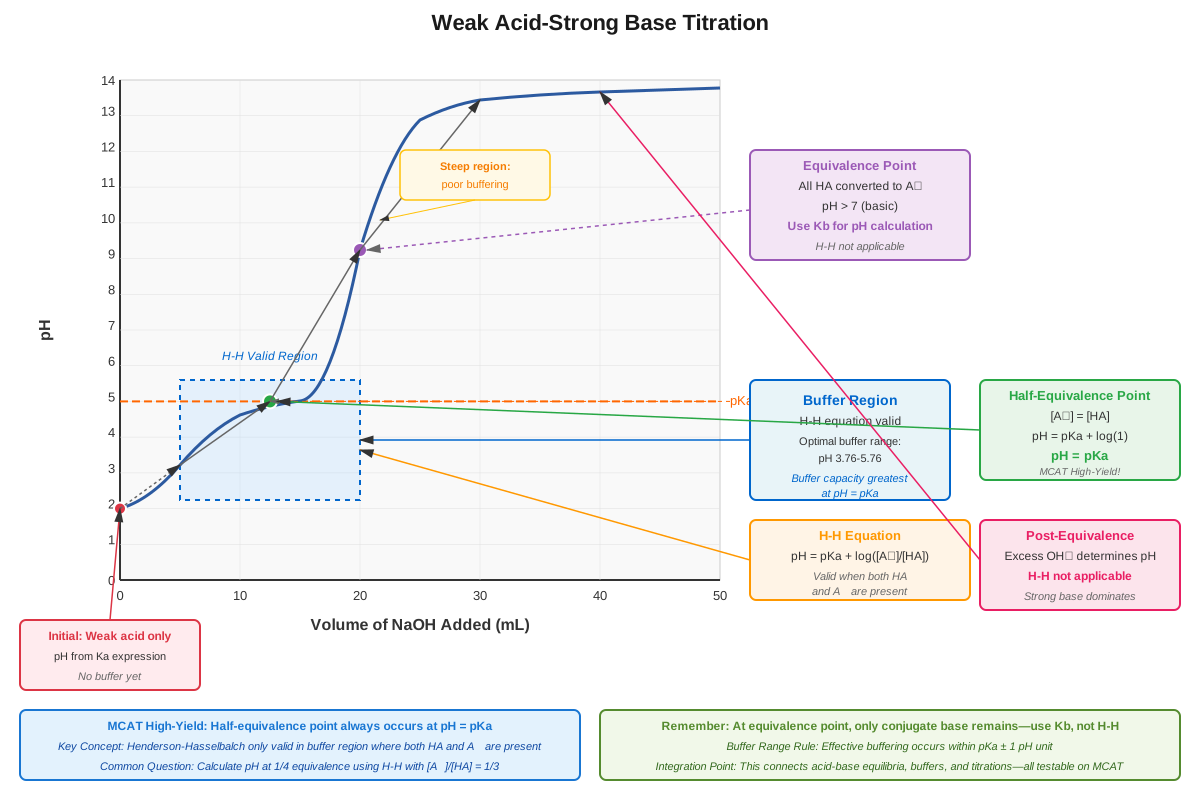
Overview
The Henderson Hasselbalch equation stands as one of the most powerful and frequently tested tools in General Chemistry for the MCAT. This elegant mathematical relationship connects pH, pKa, and the ratio of conjugate base to weak acid in buffer solutions, providing students with a rapid method to calculate pH values and understand buffer behavior. Mastery of this equation transcends simple memorization—it requires deep conceptual understanding of acid-base equilibria, logarithmic relationships, and the dynamic interplay between proton donors and acceptors in aqueous solutions.
For MCAT success, the Henderson Hasselbalch equation serves as a bridge between theoretical acid-base chemistry and practical applications in biological systems. The equation appears not only in standalone General Chemistry questions but also in biochemistry passages involving amino acids, proteins, and physiological buffer systems. Students who can rapidly deploy this equation while understanding its limitations and assumptions gain a significant competitive advantage on test day. The equation's versatility extends to titration curve analysis, buffer capacity predictions, and isoelectric point calculations—all high-yield topics for the MCAT.
Within the broader landscape of Acids and Bases in General Chemistry, the Henderson Hasselbalch equation represents the quantitative culmination of equilibrium concepts. It synthesizes knowledge of Ka, Kb, pH, pOH, and buffer chemistry into a single, actionable formula. Understanding this equation requires solid grounding in logarithmic functions, equilibrium expressions, and Le Chatelier's principle, while simultaneously preparing students for advanced topics in biochemistry and physiology that dominate the Biological and Biochemical Foundations section of the MCAT.
Learning Objectives
- [ ] Define Henderson Hasselbalch equation using accurate General Chemistry terminology
- [ ] Explain why Henderson Hasselbalch equation matters for the MCAT
- [ ] Apply Henderson Hasselbalch equation to exam-style questions
- [ ] Identify common mistakes related to Henderson Hasselbalch equation
- [ ] Connect Henderson Hasselbalch equation to related General Chemistry concepts
- [ ] Derive the Henderson Hasselbalch equation from the Ka expression for weak acids
- [ ] Predict the effect of adding strong acids or bases to buffer solutions using the equation
- [ ] Calculate the ratio of conjugate base to weak acid needed to achieve a target pH
- [ ] Analyze titration curves using Henderson Hasselbalch principles to identify buffer regions and equivalence points
Prerequisites
- pH and pOH calculations: Essential for understanding the logarithmic scale that the Henderson Hasselbalch equation employs
- Acid dissociation constants (Ka and pKa): The equation directly incorporates pKa as a measure of acid strength
- Conjugate acid-base pairs: The equation requires identification of which species acts as the acid and which as the conjugate base
- Buffer solution fundamentals: Understanding what buffers are and how they resist pH changes provides context for the equation's application
- Logarithmic functions: Facility with log and antilog operations is necessary for manipulating the equation
- Equilibrium expressions: The Henderson Hasselbalch equation derives from equilibrium principles
Why This Topic Matters
The Henderson Hasselbalch equation MCAT relevance cannot be overstated. This topic appears in approximately 8-12% of General Chemistry questions and features prominently in biochemistry passages involving protein structure, enzyme kinetics, and metabolic pathways. The equation provides the quantitative foundation for understanding physiological buffer systems—particularly the bicarbonate buffer system that maintains blood pH—making it a natural bridge between chemistry and biology sections.
Clinically, the Henderson Hasselbalch equation underpins the diagnosis and treatment of acid-base disorders. Physicians use this relationship to interpret arterial blood gas results, adjust ventilation parameters, and correct metabolic acidosis or alkalosis. Medical students and physicians regularly apply this equation when managing diabetic ketoacidosis, respiratory failure, and renal tubular acidosis. For MCAT test-takers pursuing medical careers, this equation represents one of the first truly clinical tools encountered in undergraduate chemistry.
On the MCAT, the Henderson Hasselbalch equation typically appears in three contexts: (1) discrete questions asking for direct pH calculations given concentrations, (2) passage-based questions involving experimental buffer preparation or protein purification, and (3) integrated questions connecting amino acid chemistry to pH-dependent charge states. The equation frequently appears alongside titration curves, requiring students to identify the pKa from the curve's inflection point and then apply the Henderson Hasselbalch relationship. High-scoring students recognize these patterns instantly and execute calculations efficiently, often estimating answers using the equation's logarithmic properties rather than performing tedious arithmetic.
Core Concepts
The Henderson Hasselbalch Equation Defined
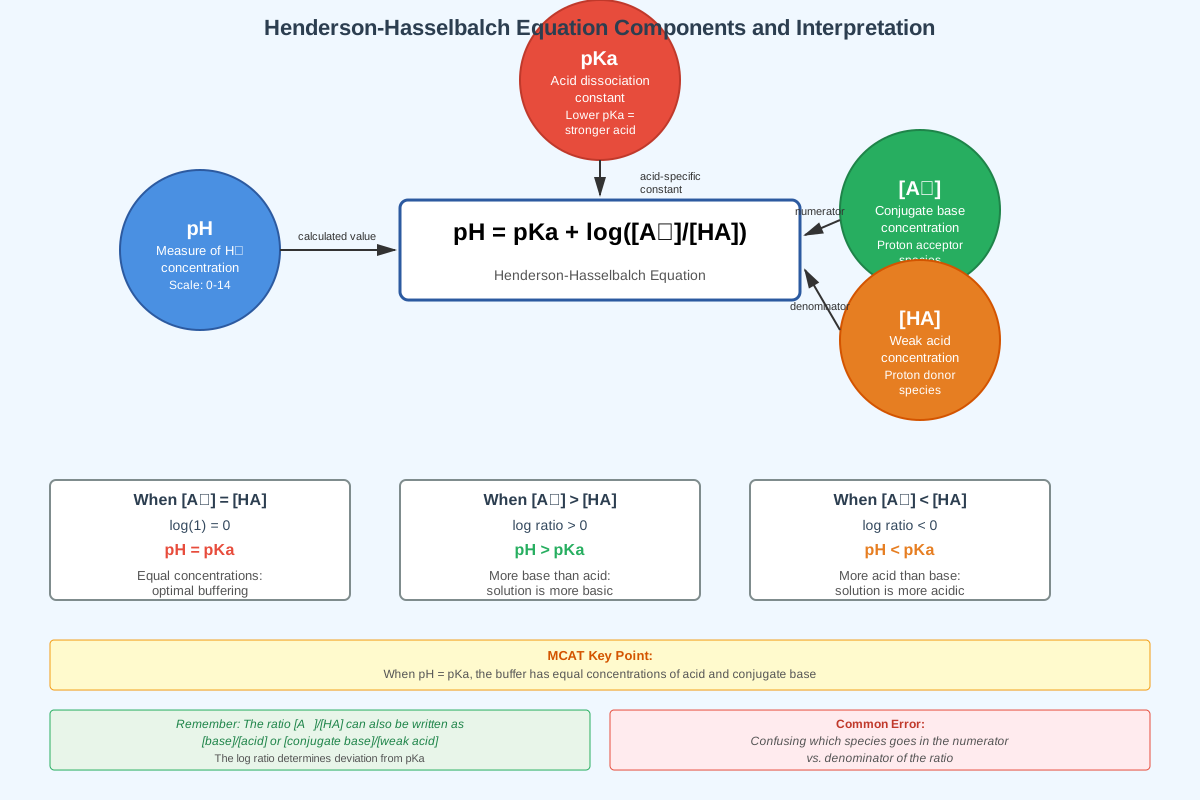
The Henderson Hasselbalch equation is a mathematical relationship that describes the pH of a buffer solution in terms of the pKa of the weak acid and the ratio of conjugate base to weak acid concentrations. The equation takes the form:
pH = pKa + log([A⁻]/[HA])Where:
- pH represents the negative logarithm of hydrogen ion concentration
- pKa represents the negative logarithm of the acid dissociation constant (Ka)
- [A⁻] represents the molar concentration of the conjugate base
- [HA] represents the molar concentration of the weak acid
This elegant formulation allows rapid pH calculation without solving quadratic equations or making simplifying assumptions about the extent of dissociation. The equation applies specifically to buffer solutions containing a weak acid and its conjugate base (or a weak base and its conjugate acid).
Derivation from the Ka Expression
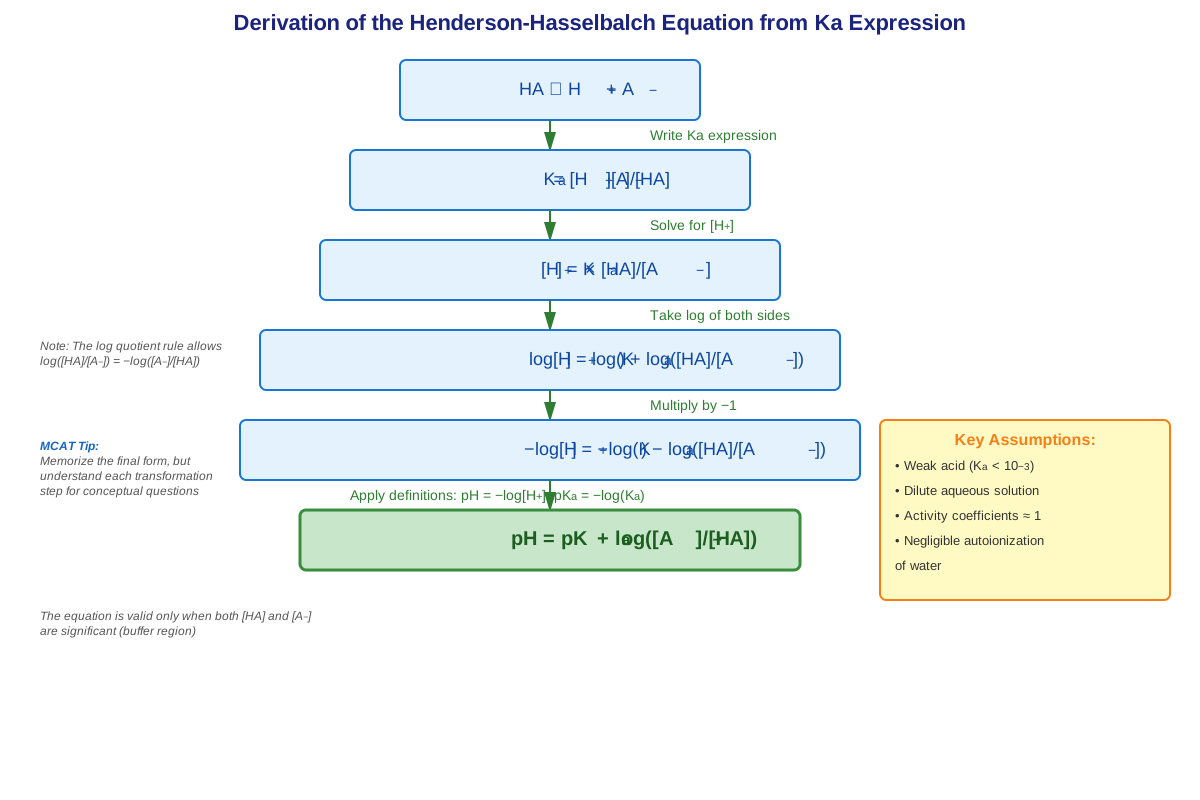
Understanding the derivation reinforces conceptual mastery. Beginning with the equilibrium expression for a weak acid:
HA ⇌ H⁺ + A⁻The acid dissociation constant is:
Ka = [H⁺][A⁻]/[HA]Rearranging to solve for [H⁺]:
[H⁺] = Ka × [HA]/[A⁻]Taking the negative logarithm of both sides:
-log[H⁺] = -log(Ka × [HA]/[A⁻])Using logarithm properties:
pH = pKa - log([HA]/[A⁻])Which simplifies to:
pH = pKa + log([A⁻]/[HA])This derivation reveals that the Henderson Hasselbalch equation is simply a rearranged equilibrium expression—not a separate principle but a convenient reformulation of fundamental acid-base chemistry.
Special Cases and Interpretations
Several special cases provide insight into buffer behavior:
When pH = pKa: The log term equals zero, meaning [A⁻] = [HA]. At this point, the buffer has equal concentrations of acid and conjugate base, representing maximum buffer capacity. This occurs at the half-equivalence point during titration.
When pH > pKa: The log term is positive, meaning [A⁻] > [HA]. The solution contains more conjugate base than acid, making it more basic than the pKa value.
When pH < pKa: The log term is negative, meaning [A⁻] < [HA]. The solution contains more acid than conjugate base, making it more acidic than the pKa value.
When pH = pKa ± 1: The ratio of [A⁻]/[HA] is either 10:1 or 1:10, representing the effective buffering range. Outside this range, buffer capacity diminishes significantly.
Application to Weak Bases
For weak base buffer systems, the Henderson Hasselbalch equation requires modification. Starting with a weak base B and its conjugate acid BH⁺:
pOH = pKb + log([BH⁺]/[B])Since pH + pOH = 14, this converts to:
pH = 14 - pKb - log([BH⁺]/[B])Or equivalently:
pH = pKa + log([B]/[BH⁺])Where pKa refers to the conjugate acid BH⁺. This formulation maintains the same structure: pH equals pKa plus the log of the base form over the acid form.
Assumptions and Limitations
The Henderson Hasselbalch equation makes several critical assumptions:
- Equilibrium conditions: The system must be at equilibrium
- Dilute solutions: Activity coefficients approximate unity
- Weak acid/base: The acid or base must be weak (Ka or Kb between 10⁻³ and 10⁻¹¹)
- Buffer present: Both acid and conjugate base must be present in significant amounts
- No side reactions: No other equilibria significantly affect concentrations
The equation fails for strong acids, very dilute solutions, or systems far from equilibrium. It also becomes less accurate when the ratio [A⁻]/[HA] exceeds 100:1 or falls below 1:100.
Quantitative Problem-Solving Strategies
Efficient MCAT problem-solving requires recognizing equation variations:
| Given Information | Solve For | Rearranged Equation |
|---|---|---|
| pH, pKa, [HA] | [A⁻] | [A⁻] = [HA] × 10^(pH - pKa) |
| pH, pKa, [A⁻] | [HA] | [HA] = [A⁻] × 10^(pKa - pH) |
| pKa, [A⁻], [HA] | pH | pH = pKa + log([A⁻]/[HA]) |
| pH, [A⁻], [HA] | pKa | pKa = pH - log([A⁻]/[HA]) |
For MCAT purposes, recognizing when the ratio [A⁻]/[HA] equals simple values (1, 10, 100, 0.1, 0.01) allows mental calculation without a calculator.
Buffer Capacity and the Henderson Hasselbalch Equation
Buffer capacity (β) represents the amount of strong acid or base a buffer can neutralize before significant pH change occurs. The Henderson Hasselbalch equation reveals that buffer capacity maximizes when pH = pKa (ratio = 1:1) and decreases as the ratio deviates from unity. Mathematically, buffer capacity relates to the total buffer concentration and the ratio:
β = 2.303 × C × ([HA][A⁻])/([HA] + [A⁻])²Where C represents total buffer concentration. This expression maximizes when [HA] = [A⁻], confirming that buffers work best within one pH unit of their pKa.
Application to Polyprotic Systems
Polyprotic acids possess multiple ionizable protons, each with its own pKa. For a diprotic acid H₂A with pKa1 and pKa2, three Henderson Hasselbalch equations apply:
- Region 1 (pH < pKa1): pH = pKa1 + log([HA⁻]/[H₂A])
- Region 2 (pKa1 < pH < pKa2): pH = pKa2 + log([A²⁻]/[HA⁻])
- Region 3 (pH > pKa2): Dominated by A²⁻
Amino acids represent the most MCAT-relevant polyprotic systems, with carboxyl (pKa ≈ 2), amino (pKa ≈ 9), and sometimes side chain ionizable groups. The isoelectric point (pI) occurs when the molecule carries no net charge, calculated as the average of the two pKa values surrounding the zwitterionic form.
Concept Relationships
The Henderson Hasselbalch equation sits at the nexus of multiple General Chemistry concepts, serving as an integrative tool that synthesizes equilibrium, logarithmic functions, and acid-base theory. The equation derives directly from Ka expressions, which themselves emerge from equilibrium constant principles. Understanding that pKa = -log(Ka) connects the equation to logarithmic scales and the concept that each unit change in pH represents a tenfold change in [H⁺].
The equation's primary application involves buffer solutions, which resist pH changes through the equilibrium between weak acids and their conjugate bases. This connects to Le Chatelier's principle: adding H⁺ shifts equilibrium toward HA, while adding OH⁻ shifts toward A⁻, with the Henderson Hasselbalch equation quantifying these shifts. The concept of conjugate acid-base pairs becomes operational through the equation, as students must identify which species represents the acid and which the base.
Relationship map:
Equilibrium constants → Ka and Kb → pKa and pKb → Henderson Hasselbalch equation → Buffer solutions → Titration curves → Biological pH regulation
The equation also connects forward to biochemistry topics: amino acid chemistry (calculating charge states at different pH values), protein structure (understanding pH-dependent folding), and enzyme kinetics (recognizing pH-dependent activity). In physiology, the equation underpins the bicarbonate buffer system (pH = 6.1 + log([HCO₃⁻]/[CO₂])), connecting chemistry to respiratory and renal physiology.
Quick check — test yourself on Henderson Hasselbalch equation so far.
Try Flashcards →High-Yield Facts
⭐ The Henderson Hasselbalch equation is pH = pKa + log([A⁻]/[HA]), where A⁻ is the conjugate base and HA is the weak acid
⭐ When pH = pKa, the concentrations of acid and conjugate base are equal ([A⁻] = [HA]), representing the half-equivalence point and maximum buffer capacity
⭐ Effective buffer range extends from pH = pKa - 1 to pH = pKa + 1, corresponding to base:acid ratios from 1:10 to 10:1
⭐ For amino acids, the isoelectric point (pI) equals the average of the two pKa values surrounding the zwitterionic form: pI = (pKa1 + pKa2)/2
⭐ The bicarbonate buffer system uses pH = 6.1 + log([HCO₃⁻]/[CO₂]) to maintain blood pH at 7.4, with a normal ratio of 20:1
- When the ratio [A⁻]/[HA] = 10, the pH is exactly one unit above the pKa (log 10 = 1)
- When the ratio [A⁻]/[HA] = 0.1, the pH is exactly one unit below the pKa (log 0.1 = -1)
- The equation assumes that the concentrations of acid and conjugate base remain essentially unchanged from their initial values (valid when buffer capacity is not exceeded)
- For weak base buffers, the equation becomes pH = pKa + log([base]/[conjugate acid]), where pKa refers to the conjugate acid
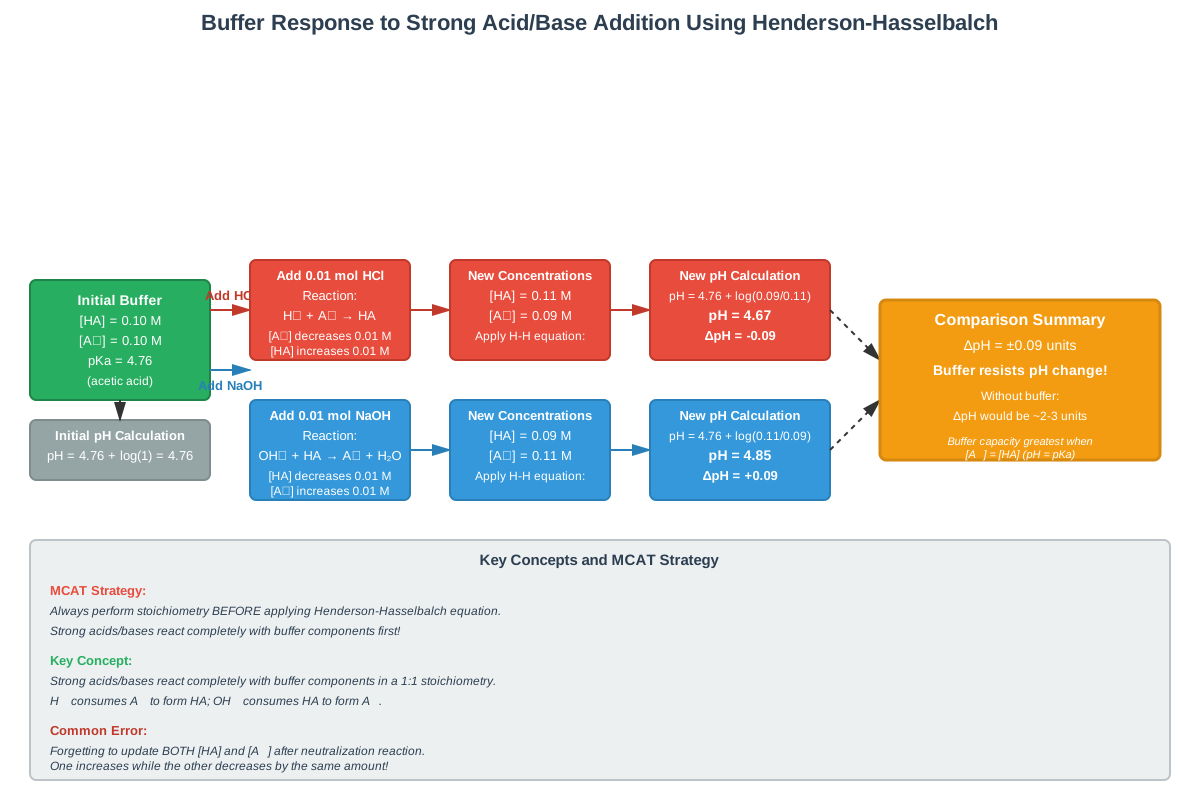
- Adding strong acid to a buffer decreases [A⁻] and increases [HA] by equal amounts, shifting pH according to the new ratio
- The Henderson Hasselbalch equation fails for strong acids, very dilute solutions, or when the acid/base ratio exceeds 100:1 or falls below 1:100
- At the equivalence point of a weak acid-strong base titration, the Henderson Hasselbalch equation does not apply because only conjugate base is present
- Buffer capacity (β) is proportional to total buffer concentration and maximizes when pH = pKa
Common Misconceptions
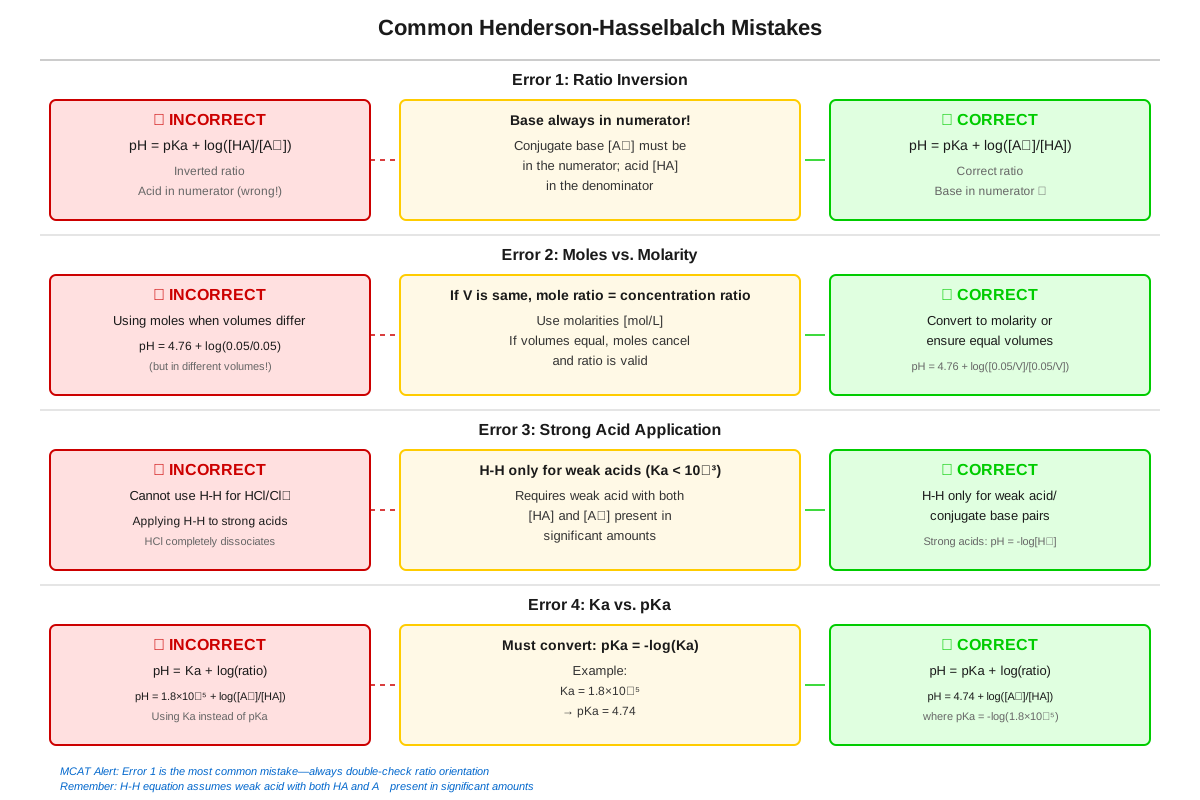
Misconception: The Henderson Hasselbalch equation can be used for strong acids like HCl.
Correction: The equation applies only to weak acids and their conjugate bases. Strong acids dissociate completely, eliminating the equilibrium between HA and A⁻ that the equation requires. For strong acids, pH = -log[H⁺] directly.
Misconception: In the equation pH = pKa + log([A⁻]/[HA]), the concentrations can be replaced with moles without considering volume.
Correction: This is actually correct when both species are in the same solution. Since concentration = moles/volume, the ratio [A⁻]/[HA] = (moles A⁻/V)/(moles HA/V) = (moles A⁻)/(moles HA), so volume cancels. However, this only works when both species share the same volume.
Misconception: When pH is two units above pKa, the solution contains twice as much conjugate base as acid.
Correction: When pH = pKa + 2, the ratio [A⁻]/[HA] = 10² = 100, not 2. Each pH unit represents a tenfold change in the ratio due to the logarithmic relationship. Students often forget that log relationships are exponential, not linear.
Misconception: The pKa value changes when you add acid or base to a buffer solution.
Correction: The pKa is an intrinsic property of the weak acid that depends only on temperature and the specific acid-base pair. Adding acid or base changes the ratio [A⁻]/[HA], which changes pH, but pKa remains constant. This is why the equation works—pKa serves as a reference point.
Misconception: At the equivalence point of a titration, pH = pKa.
Correction: At the half-equivalence point, pH = pKa. At the equivalence point, all weak acid has been converted to conjugate base, so the Henderson Hasselbalch equation doesn't apply. Instead, the pH is determined by the hydrolysis of the conjugate base, typically resulting in pH > 7 for weak acid-strong base titrations.
Misconception: The Henderson Hasselbalch equation can predict pH changes when large amounts of strong acid or base are added.
Correction: The equation assumes buffer capacity is not exceeded. When strong acid or base additions consume most of one buffer component, the assumptions break down. The equation works best when the ratio [A⁻]/[HA] remains between 0.1 and 10 (within one pH unit of pKa).
Misconception: For a weak base buffer, you use the pKb in the Henderson Hasselbalch equation.
Correction: For weak base buffers, you must use the pKa of the conjugate acid, not the pKb of the base. The equation becomes pH = pKa + log([base]/[conjugate acid]), where pKa = 14 - pKb. Alternatively, you can calculate pOH using pKb and then convert to pH.
Worked Examples
Example 1: Buffer pH Calculation
Question: A buffer solution contains 0.50 M acetic acid (CH₃COOH, pKa = 4.76) and 0.75 M sodium acetate (CH₃COO⁻Na⁺). What is the pH of this buffer?
Solution:
Step 1: Identify the components. Acetic acid is the weak acid (HA), and acetate ion is the conjugate base (A⁻).
Step 2: Write the Henderson Hasselbalch equation:
pH = pKa + log([A⁻]/[HA])Step 3: Substitute the known values:
pH = 4.76 + log(0.75/0.50)Step 4: Calculate the ratio:
0.75/0.50 = 1.5Step 5: Calculate the logarithm:
log(1.5) ≈ 0.18Step 6: Calculate final pH:
pH = 4.76 + 0.18 = 4.94Answer: The pH of the buffer is approximately 4.94.
Key insights: The pH is slightly above the pKa because there is more conjugate base than acid. The buffer would effectively resist pH changes from added acid or base because the ratio is close to 1:1 and within the effective buffering range. This problem demonstrates the direct application of the Henderson Hasselbalch equation when concentrations are given.
Example 2: Amino Acid Charge State
Question: Glycine has two ionizable groups: a carboxyl group (pKa1 = 2.34) and an amino group (pKa2 = 9.60). At pH 7.0, what is the predominant form of glycine, and what is the ratio of zwitterionic form to the form with a protonated amino group?
Solution:
Step 1: Identify the relevant equilibrium. At pH 7.0 (between the two pKa values), we're examining the equilibrium between the zwitterion (⁺H₃N-CH₂-COO⁻) and the form with protonated amino group (⁺H₃N-CH₂-COOH).
Step 2: Recognize that the carboxyl group (pKa1 = 2.34) is deprotonated at pH 7.0 because pH >> pKa1. The relevant equilibrium involves the amino group (pKa2 = 9.60).
Step 3: Apply Henderson Hasselbalch for the amino group:
pH = pKa2 + log([deprotonated amino]/[protonated amino])At pH 7.0:
7.0 = 9.60 + log([H₂N-CH₂-COO⁻]/[⁺H₃N-CH₂-COO⁻])Step 4: Solve for the ratio:
log([H₂N-CH₂-COO⁻]/[⁺H₃N-CH₂-COO⁻]) = 7.0 - 9.60 = -2.60[H₂N-CH₂-COO⁻]/[⁺H₃N-CH₂-COO⁻] = 10^(-2.60) ≈ 0.0025Step 5: Invert to find the desired ratio:
[⁺H₃N-CH₂-COO⁻]/[H₂N-CH₂-COO⁻] = 1/0.0025 = 400Answer: At pH 7.0, the predominant form is the zwitterion (⁺H₃N-CH₂-COO⁻), which is present at approximately 400 times the concentration of the fully deprotonated form. The ratio of zwitterion to the form with protonated amino group is approximately 400:1.
Key insights: This problem requires recognizing which equilibrium is relevant at the given pH. Since pH 7.0 is much closer to pKa2 than pKa1, the amino group equilibrium dominates. The large ratio (400:1) indicates that at physiological pH, glycine exists almost entirely as the zwitterion. This type of problem frequently appears in MCAT biochemistry passages involving amino acid separation or protein charge calculations.
Exam Strategy
When approaching Henderson Hasselbalch equation MCAT questions, begin by identifying whether the question asks for pH, pKa, or a concentration ratio. This determines which form of the equation to use. Look for trigger phrases like "buffer solution," "weak acid and its conjugate base," "half-equivalence point," or "amino acid at pH X" as signals that the Henderson Hasselbalch equation applies.
Exam Tip: If the ratio [A⁻]/[HA] equals 1, 10, or 0.1, you can solve the problem mentally. Log(1) = 0, log(10) = 1, and log(0.1) = -1, making calculations trivial.
For process of elimination, recognize that pH must fall between the pKa and the pH of pure water (7.0) for acidic buffers, or between pKa and 14 for basic buffers. If an answer choice places pH more than 2 units away from pKa, it's likely incorrect unless the ratio is extreme. Also eliminate answers that suggest pH = pKa when unequal concentrations are given.
Time management is crucial. Simple Henderson Hasselbalch calculations should take 30-45 seconds. If you find yourself performing complex logarithm calculations, you're likely missing a shortcut. The MCAT rarely requires precise logarithm evaluation—usually, recognizing whether pH is above or below pKa suffices, or the ratio simplifies to a power of 10.
Watch for questions that require multiple steps: first using stoichiometry to determine how much acid/base remains after a reaction, then applying Henderson Hasselbalch to the resulting buffer. These two-step problems appear frequently in titration contexts. Also be alert for questions asking about buffer capacity or effective range—these test conceptual understanding rather than calculation ability.
Common trigger words and phrases:
- "Buffer solution" → Henderson Hasselbalch likely applies
- "Half-equivalence point" → pH = pKa
- "Equal concentrations" → pH = pKa
- "Isoelectric point" → Average of relevant pKa values
- "Predominant form at pH X" → Compare pH to pKa values
- "Effective buffering range" → pKa ± 1
Memory Techniques
Mnemonic for the equation structure: "Happy Henry Always Adds" reminds you that pH = pKa + log([A⁻]/[HA]). The "adds" emphasizes the plus sign, and the two A's remind you that the conjugate base (A⁻) goes in the numerator.
Visualization for pH vs. pKa: Picture a seesaw balanced at pKa. When there's more conjugate base (A⁻), the pH side tips up (pH > pKa). When there's more acid (HA), the pH side tips down (pH < pKa). Equal amounts keep it balanced (pH = pKa).
Acronym for buffer range: "TENacious buffers" reminds you that the effective range is pKa ± 1, corresponding to ratios from 1:10 to 10:1 (TEN).
Logarithm shortcuts memory aid: Remember "1-10-100" for log values:
- log(1) = 0 (one zero)
- log(10) = 1 (one in ten)
- log(100) = 2 (two zeros)
- log(0.1) = -1 (negative one)
- log(0.01) = -2 (negative two)
For amino acids: "Carboxyl Comes first" reminds you that the carboxyl group has the lower pKa (around 2) and deprotonates first during titration, while the amino group has the higher pKa (around 9-10).
Buffer capacity maximum: "Equal = Effective" reminds you that buffer capacity maximizes when concentrations are equal (pH = pKa).
Summary
The Henderson Hasselbalch equation (pH = pKa + log([A⁻]/[HA])) represents a cornerstone of acid-base chemistry for the MCAT, providing a rapid method to calculate pH in buffer solutions and understand the relationship between pH, pKa, and the ratio of conjugate base to weak acid. Derived from the Ka expression, this equation applies specifically to weak acid-conjugate base buffer systems and assumes equilibrium conditions with both components present in significant amounts. The equation reveals that pH equals pKa when acid and conjugate base concentrations are equal (the half-equivalence point), and that effective buffering occurs within one pH unit of the pKa. For MCAT success, students must master not only the mathematical application but also the conceptual implications: recognizing when the equation applies, understanding its limitations, and connecting it to titration curves, amino acid chemistry, and physiological buffer systems. The equation's versatility extends from simple pH calculations to complex polyprotic systems, making it an indispensable tool for both General Chemistry and biochemistry sections of the exam.
Key Takeaways
- The Henderson Hasselbalch equation (pH = pKa + log([A⁻]/[HA])) quantifies the relationship between pH, pKa, and the ratio of conjugate base to weak acid in buffer solutions
- When pH = pKa, the concentrations of acid and conjugate base are equal, representing the half-equivalence point and maximum buffer capacity
- Effective buffering occurs within the range pH = pKa ± 1, corresponding to base:acid ratios from 1:10 to 10:1
- The equation derives from the Ka expression and applies only to weak acid-conjugate base systems, not strong acids or bases
- For amino acids and polyprotic systems, multiple Henderson Hasselbalch equations apply, with the isoelectric point calculated as the average of relevant pKa values
- Common mistakes include confusing equivalence point with half-equivalence point, forgetting that pKa is constant, and misapplying the equation outside its valid range
- MCAT questions frequently test the equation in contexts involving buffer preparation, titration curve analysis, amino acid charge states, and physiological pH regulation
Related Topics
Titration Curves: Understanding how pH changes during acid-base titrations requires Henderson Hasselbalch analysis of buffer regions, identification of half-equivalence points where pH = pKa, and recognition of equivalence points where the equation no longer applies. Mastering the Henderson Hasselbalch equation enables rapid interpretation of titration curve features.
Amino Acid Chemistry: The ionization states of amino acids at different pH values depend on the Henderson Hasselbalch equation applied to carboxyl, amino, and side chain groups. This connects to protein structure, isoelectric focusing, and electrophoresis—all high-yield MCAT topics.
Physiological Buffer Systems: The bicarbonate buffer system (pH = 6.1 + log([HCO₃⁻]/[CO₂])) maintains blood pH at 7.4 and represents the most clinically relevant application of the Henderson Hasselbalch equation, bridging chemistry to respiratory and renal physiology.
Solubility Equilibria: The Henderson Hasselbalch equation connects to solubility through pH-dependent ionization of weak acids and bases, affecting drug absorption, precipitation reactions, and separation techniques.
Enzyme Kinetics: Many enzymes exhibit pH-dependent activity due to ionizable residues in the active site, with optimal activity occurring when specific groups are protonated or deprotonated according to Henderson Hasselbalch principles.
Practice CTA
Now that you've mastered the Henderson Hasselbalch equation conceptually, it's time to cement your understanding through practice. Attempt the practice questions and flashcards to test your ability to apply this equation under timed conditions, identify when it applies versus when alternative approaches are needed, and connect it to broader MCAT topics. Remember: understanding the equation is just the beginning—speed and accuracy come from deliberate practice. Each problem you solve strengthens your pattern recognition and builds the confidence you'll need on test day. You've got this!
Sign up free to keep reading
Create a free AnvayaPrep account to finish this MCAT guide on Henderson Hasselbalch equation — plus flashcards and practice questions.