Overview
Kb, or the base dissociation constant, is a fundamental quantitative measure in General Chemistry that describes the strength of a base in aqueous solution. This equilibrium constant specifically measures the extent to which a base accepts protons (H⁺) or donates hydroxide ions (OH⁻) when dissolved in water. Understanding Kb is essential for predicting the behavior of basic solutions, calculating pH and pOH values, and solving complex equilibrium problems that frequently appear on the MCAT. The concept sits at the intersection of equilibrium chemistry, acid-base theory, and solution chemistry—three pillars of the Chemical and Physical Foundations of Biological Systems section.
For MCAT success, mastery of Kb extends beyond simple memorization of the definition. Students must develop fluency in manipulating the base dissociation constant to solve multi-step problems involving weak bases, buffer systems, and titrations. The MCAT frequently tests the relationship between Kb and its conjugate acid's Ka through the water dissociation constant (Kw = 1.0 × 10⁻¹⁴ at 25°C), requiring students to seamlessly convert between acid and base perspectives. Additionally, understanding how Kb relates to pKb, and how both connect to pH calculations, forms the foundation for interpreting biochemical systems where amino acids, proteins, and other biological molecules exhibit amphoteric behavior.
The Kb concept integrates directly with broader Acids and Bases principles, including the Brønsted-Lowry theory, Lewis acid-base theory, and buffer chemistry. On the MCAT, Kb appears in standalone calculation questions, passage-based problems involving experimental data interpretation, and questions requiring qualitative predictions about solution behavior. The ability to quickly assess whether a base is strong or weak based on its Kb value, and to use this information to predict reaction direction and extent, represents a high-yield skill that distinguishes top-scoring students from average performers.
Learning Objectives
- [ ] Define Kb using accurate General Chemistry terminology
- [ ] Explain why Kb matters for the MCAT
- [ ] Apply Kb to exam-style questions
- [ ] Identify common mistakes related to Kb
- [ ] Connect Kb to related General Chemistry concepts
- [ ] Calculate pH and pOH of weak base solutions using Kb values
- [ ] Interconvert between Kb, pKb, Ka, and pKa using the relationship Kw = Ka × Kb
- [ ] Predict the relative strength of bases by comparing Kb values and determine the position of equilibrium in acid-base reactions
Prerequisites
- Equilibrium constants (K, Keq): Understanding how equilibrium expressions are written and interpreted is essential because Kb is a specific type of equilibrium constant
- Acid-base definitions (Brønsted-Lowry, Lewis): Recognizing that bases are proton acceptors or electron pair donors provides the conceptual foundation for understanding base dissociation
- pH and pOH calculations: Familiarity with logarithmic scales and the relationship pH + pOH = 14 enables conversion between concentration and pH values
- ICE tables (Initial, Change, Equilibrium): This systematic approach to solving equilibrium problems is the primary method for Kb calculations
- Conjugate acid-base pairs: Understanding that every base has a conjugate acid is crucial for applying the Ka-Kb relationship
- Molarity and solution concentration: Calculating and manipulating molar concentrations is necessary for all quantitative Kb problems
Why This Topic Matters
Kb appears with remarkable frequency on the MCAT, showing up in approximately 15-20% of General Chemistry questions within the Chemical and Physical Foundations section. The concept is particularly high-yield because it integrates multiple testable skills: equilibrium calculations, logarithmic manipulations, acid-base theory, and quantitative reasoning. MCAT questions involving Kb typically appear in three formats: (1) direct calculation problems requiring students to determine pH, pOH, or percent ionization from a given Kb value; (2) passage-based questions where experimental data must be interpreted to determine or compare base strengths; and (3) conceptual questions testing understanding of the inverse relationship between conjugate acid-base pair strengths.
From a clinical and biochemical perspective, Kb is essential for understanding physiological buffer systems, drug design, and protein chemistry. Many pharmaceutical compounds function as weak bases, and their absorption, distribution, and efficacy depend on their protonation state at physiological pH. The Henderson-Hasselbalch equation, which students must master for the MCAT, directly incorporates pKa and pKb values to predict the ionization state of drugs and biomolecules. Amino acids, the building blocks of proteins, contain basic amino groups with characteristic Kb values that determine their charge state and reactivity at different pH values. Understanding Kb enables prediction of protein folding, enzyme active site chemistry, and the behavior of neurotransmitters and hormones.
In MCAT passages, Kb commonly appears in experimental contexts involving titrations, buffer preparation, or the analysis of unknown compounds. Students may encounter data tables listing base dissociation constants and be asked to predict relative base strengths, calculate equilibrium concentrations, or determine the pH at various points in a titration curve. The ability to quickly recognize when to use Kb versus Ka, and to apply the relationship pKa + pKb = 14 for conjugate pairs, represents a critical time-saving skill on test day.
Core Concepts
Definition and Expression of Kb
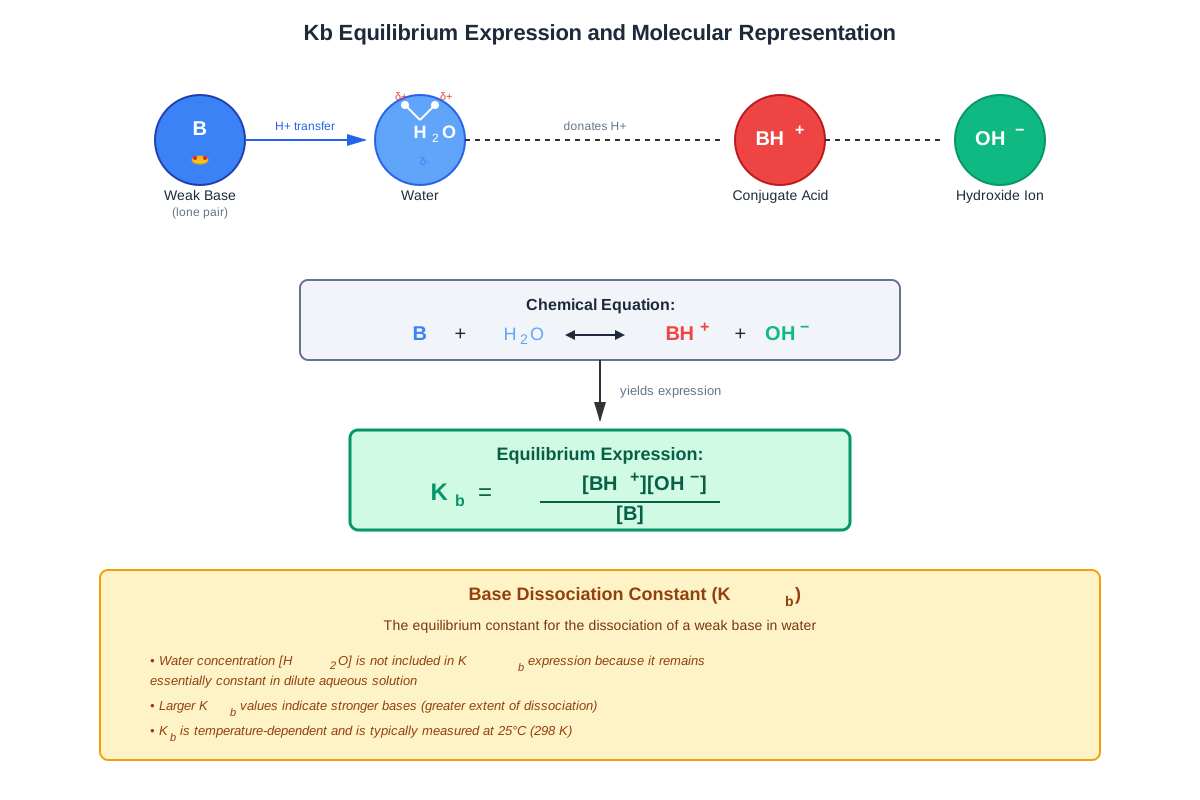
The base dissociation constant (Kb) quantifies the equilibrium position for the reaction of a base with water. For a generic weak base B, the dissociation reaction in water is:
B(aq) + H₂O(l) ⇌ BH⁺(aq) + OH⁻(aq)The Kb expression is written as:
Kb = [BH⁺][OH⁻] / [B]Note that water does not appear in the equilibrium expression because it is the solvent and its concentration remains essentially constant. The magnitude of Kb indicates base strength: larger Kb values correspond to stronger bases that dissociate more completely, while smaller Kb values indicate weaker bases that remain largely undissociated in solution.
For MCAT purposes, bases with Kb > 1 are considered relatively strong (though still weak compared to strong bases like NaOH), while bases with Kb < 10⁻⁴ are quite weak. Most biologically relevant bases, including ammonia (Kb = 1.8 × 10⁻⁵) and organic amines, fall in the weak base category with Kb values between 10⁻³ and 10⁻¹⁰.
The pKb Scale
Just as pH provides a convenient logarithmic scale for hydrogen ion concentration, pKb offers a more manageable way to express base dissociation constants:
pKb = -log(Kb)The inverse relationship means that stronger bases have smaller pKb values (more negative logarithm of a larger number), while weaker bases have larger pKb values. This inverse relationship often confuses students, so it's critical to internalize: as base strength increases, Kb increases but pKb decreases.
For the MCAT, the pKb scale typically ranges from 0 to 14, with most weak bases falling between pKb = 3 and pKb = 11. The relationship between pKb and base strength mirrors the relationship between pKa and acid strength, creating a parallel framework that students can leverage for both acidic and basic systems.
The Ka-Kb Relationship
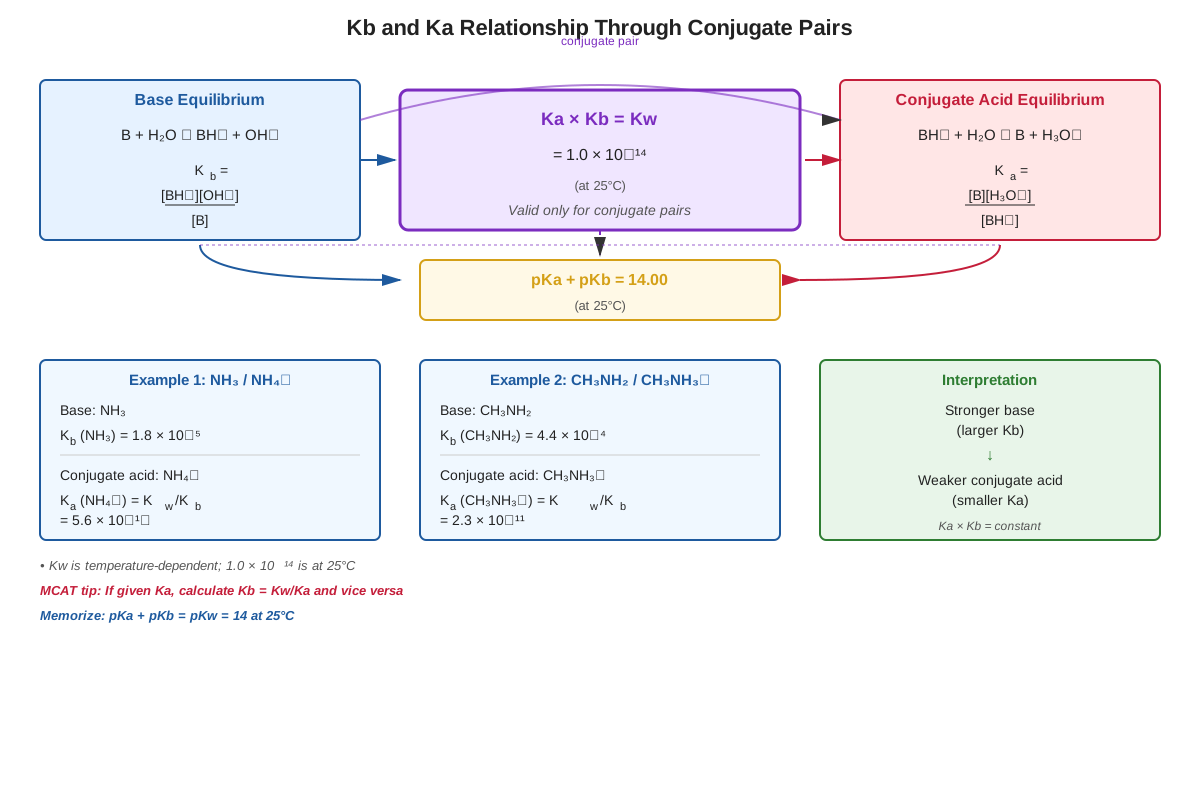
One of the most powerful and frequently tested concepts in Acids and Bases chemistry is the mathematical relationship between a conjugate acid-base pair. For any conjugate pair at 25°C:
Ka × Kb = Kw = 1.0 × 10⁻¹⁴This relationship allows rapid interconversion between acid and base perspectives. If you know the Ka of an acid, you can immediately calculate the Kb of its conjugate base, and vice versa. Taking the negative logarithm of both sides yields the equally important relationship:
pKa + pKb = pKw = 14This equation is extraordinarily high-yield for the MCAT because it enables students to solve problems from either the acid or base perspective, whichever is more convenient. For example, when given the Ka of acetic acid (1.8 × 10⁻⁵), you can instantly determine that the Kb of acetate ion is (1.0 × 10⁻¹⁴)/(1.8 × 10⁻⁵) = 5.6 × 10⁻¹⁰.
Calculating pH from Kb
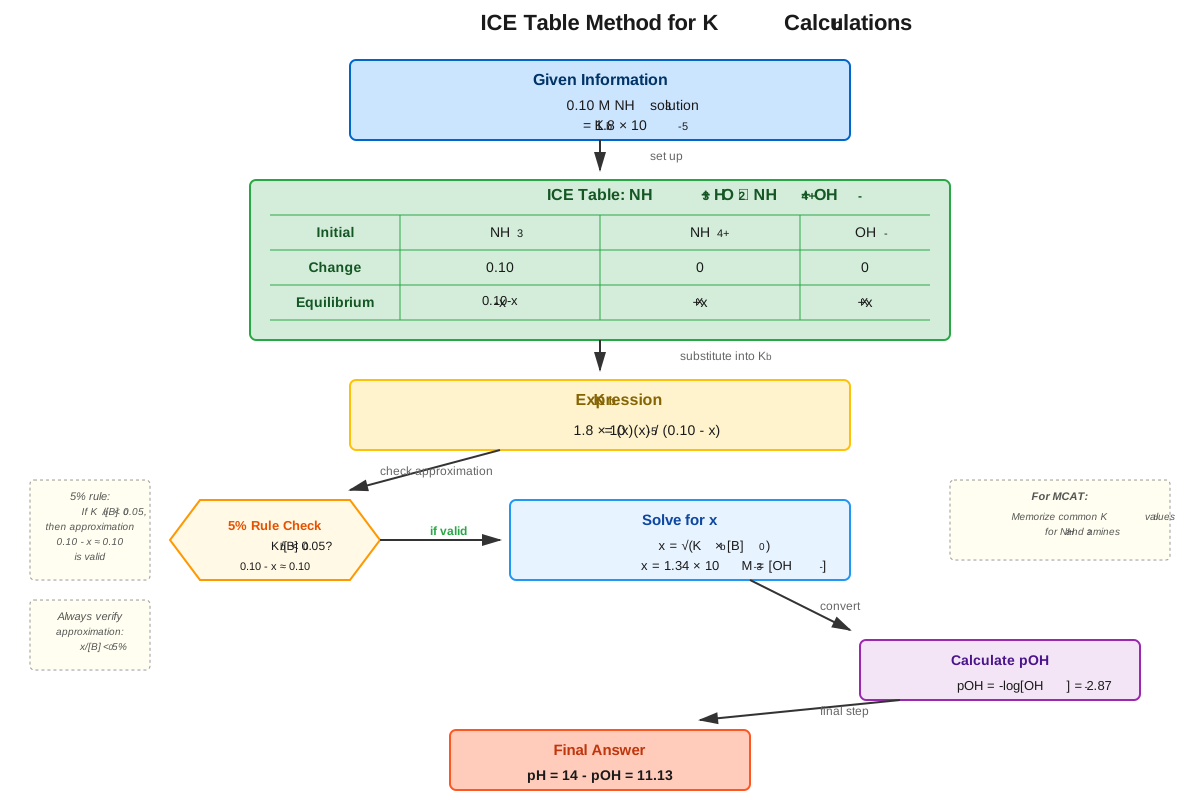
Determining the pH of a weak base solution requires a systematic approach using ICE tables. Consider a solution of ammonia (NH₃) with concentration C and Kb = 1.8 × 10⁻⁵:
Step 1: Write the equilibrium reaction and expression
NH₃ + H₂O ⇌ NH₄⁺ + OH⁻
Kb = [NH₄⁺][OH⁻] / [NH₃]
Step 2: Set up an ICE table
| Species | Initial (M) | Change (M) | Equilibrium (M) |
|---|---|---|---|
| NH₃ | C | -x | C - x |
| NH₄⁺ | 0 | +x | x |
| OH⁻ | 0 | +x | x |
Step 3: Substitute into the Kb expression
Kb = x² / (C - x)Step 4: Apply the 5% approximation if valid (when C/Kb > 100)
Kb ≈ x² / C
x = √(Kb × C)
Step 5: Calculate pOH and then pH
pOH = -log[OH⁻] = -log(x)
pH = 14 - pOH
This systematic approach works for any weak base problem on the MCAT, and recognizing when the approximation is valid saves valuable time during the exam.
Percent Ionization of Bases
Percent ionization (or percent dissociation) quantifies what fraction of the base molecules have accepted protons at equilibrium:
% ionization = ([OH⁻]eq / [B]initial) × 100%For weak bases, percent ionization typically ranges from less than 1% to about 10%, depending on the Kb value and initial concentration. An important principle: percent ionization increases as the solution becomes more dilute. This occurs because Le Châtelier's principle favors the side with more particles (the products) when the overall concentration decreases.
Comparing Base Strengths
The MCAT frequently asks students to rank bases by strength or predict which base will predominate in a mixture. The rules are straightforward:
- Larger Kb = stronger base (more complete dissociation)
- Smaller pKb = stronger base (inverse logarithmic relationship)
- Stronger bases have weaker conjugate acids (Ka × Kb = Kw)
- In competition, the stronger base wins (equilibrium favors formation of the weaker base)
When comparing bases, students should be able to quickly assess relative strengths from a table of Kb or pKb values and predict the direction of proton transfer reactions.
Strong Bases vs. Weak Bases
While Kb specifically applies to weak bases, understanding the distinction between strong and weak bases is essential for MCAT General Chemistry:
| Property | Strong Bases | Weak Bases |
|---|---|---|
| Dissociation | Complete (100%) | Partial (< 10%) |
| Kb value | Very large (>> 1) | Small (< 1) |
| Examples | NaOH, KOH, Ca(OH)₂ | NH₃, amines, F⁻ |
| pH calculation | Direct from [OH⁻] | Requires Kb and ICE table |
| Conjugate acid | Very weak (negligible Ka) | Weak acid (measurable Ka) |
For strong bases, the Kb concept is less useful because dissociation is essentially complete. The MCAT focuses primarily on weak base calculations where Kb is the critical parameter.
Concept Relationships
The Kb concept serves as a central hub connecting multiple areas of General Chemistry. At its foundation, Kb derives from general equilibrium principles → specifically, it represents a specialized equilibrium constant for base dissociation reactions. This connection means that all Le Châtelier's principle applications, temperature effects on equilibrium, and thermodynamic considerations apply to base dissociation systems.
Moving outward, Kb connects directly to the conjugate acid-base pair concept → through the relationship Ka × Kb = Kw. This mathematical bridge allows seamless conversion between acid and base perspectives, which is particularly valuable when solving buffer problems or analyzing amphoteric species. The conjugate relationship also connects to the Brønsted-Lowry acid-base theory → where every base must have a conjugate acid formed by accepting a proton.
The pKb scale connects to logarithmic functions and pH/pOH calculations → creating a parallel framework to the more commonly encountered pKa scale. Both scales ultimately connect to the water dissociation constant (Kw) → which serves as the fundamental reference point for all aqueous acid-base chemistry at 25°C.
In terms of problem-solving methodology, Kb calculations require ICE tables → which connect back to general equilibrium problem-solving strategies. The approximation methods used in Kb calculations (the 5% rule) → connect to mathematical reasoning about when simplifications are valid, a skill tested across multiple MCAT topics.
For biological applications, Kb values of amino acid side chains → determine protein structure and function, connecting to biochemistry. The Kb of drug molecules → influences their absorption and distribution, connecting to pharmacology and physiology. Buffer systems, which rely on conjugate acid-base pairs → depend on the relationship between Ka and Kb to maintain pH homeostasis in biological systems.
Quick check — test yourself on Kb so far.
Try Flashcards →High-Yield Facts
⭐ Kb = [BH⁺][OH⁻] / [B] is the fundamental expression for base dissociation constant, with water excluded from the expression
⭐ Ka × Kb = Kw = 1.0 × 10⁻¹⁴ at 25°C for any conjugate acid-base pair, enabling rapid interconversion
⭐ pKa + pKb = 14 for conjugate pairs at 25°C, providing a quick calculation shortcut
⭐ Larger Kb values indicate stronger bases; the relationship is direct, not inverse
⭐ Smaller pKb values indicate stronger bases; the relationship is inverse due to the logarithm
- The 5% approximation (C - x ≈ C) is valid when C/Kb > 100, simplifying calculations significantly
- Percent ionization of weak bases increases with dilution due to Le Châtelier's principle
- Ammonia (NH₃) has Kb = 1.8 × 10⁻⁵, making it a classic weak base example on the MCAT
- For weak bases, [OH⁻] = √(Kb × C) when the approximation is valid
- Strong bases (NaOH, KOH) dissociate completely and don't require Kb calculations
- The conjugate acid of a strong base is an extremely weak acid with negligible Ka
- Organic amines (R-NH₂) are common weak bases with Kb values typically between 10⁻⁴ and 10⁻¹⁰
Common Misconceptions
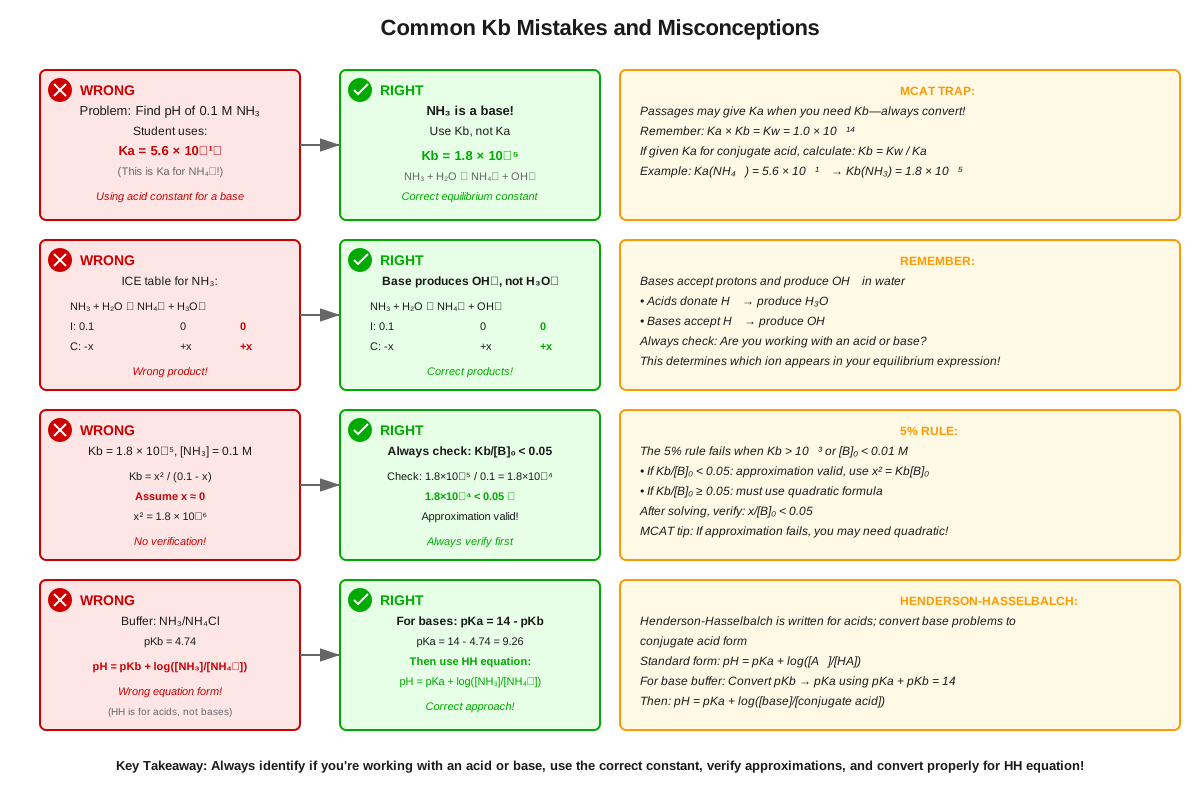
Misconception: Kb and pKb are directly proportional—larger Kb means larger pKb.
Correction: Kb and pKb are inversely related through the logarithmic relationship pKb = -log(Kb). A stronger base has a larger Kb but a smaller pKb. This mirrors the Ka/pKa relationship for acids.
Misconception: The water concentration should be included in the Kb expression.
Correction: Water is the solvent and its concentration remains essentially constant (~55.5 M), so it is incorporated into the Kb constant itself. The equilibrium expression only includes aqueous solutes: Kb = [BH⁺][OH⁻] / [B].
Misconception: Strong bases have Kb values that can be looked up in tables.
Correction: Strong bases dissociate completely, so the concept of an equilibrium constant is not meaningful for them. Kb values are only relevant for weak bases that establish equilibrium between dissociated and undissociated forms.
Misconception: When calculating pH from Kb, you can directly use [OH⁻] to find pH.
Correction: The [OH⁻] calculated from Kb gives you pOH = -log[OH⁻]. You must then use pH = 14 - pOH to find the pH. Skipping this step is one of the most common calculation errors on the MCAT.
Misconception: The 5% approximation always works for weak base problems.
Correction: The approximation (C - x ≈ C) is only valid when C/Kb > 100. If this condition isn't met, you must solve the quadratic equation. Always check the validity of your approximation by calculating x/C × 100%; if it exceeds 5%, the approximation fails.
Misconception: A base with a larger pKb is stronger than one with a smaller pKb.
Correction: This is backwards. Because pKb = -log(Kb), a larger pKb corresponds to a smaller Kb, which means a weaker base. Stronger bases have smaller pKb values (and larger Kb values).
Misconception: Ka and Kb for a conjugate pair should be equal.
Correction: Ka and Kb for conjugate pairs are inversely related, not equal. Their product equals Kw (1.0 × 10⁻¹⁴). A strong acid has a weak conjugate base, so Ka will be large while Kb will be small, and vice versa.
Worked Examples
Example 1: Calculating pH of a Weak Base Solution
Problem: Calculate the pH of a 0.15 M solution of methylamine (CH₃NH₂), which has Kb = 4.4 × 10⁻⁴.
Solution:
Step 1: Write the equilibrium reaction and expression
CH₃NH₂ + H₂O ⇌ CH₃NH₃⁺ + OH⁻
Kb = [CH₃NH₃⁺][OH⁻] / [CH₃NH₂] = 4.4 × 10⁻⁴
Step 2: Check if the approximation is valid
C/Kb = 0.15 / (4.4 × 10⁻⁴) = 341Since 341 > 100, the approximation is valid.
Step 3: Set up the simplified equation
Kb = x² / C
4.4 × 10⁻⁴ = x² / 0.15
x² = (4.4 × 10⁻⁴)(0.15) = 6.6 × 10⁻⁵
x = √(6.6 × 10⁻⁵) = 8.1 × 10⁻³ M
Step 4: Verify the approximation
(8.1 × 10⁻³ / 0.15) × 100% = 5.4%This is slightly above 5%, but acceptable for MCAT purposes. For greater accuracy, we could solve the quadratic, but the approximation gives us the right order of magnitude.
Step 5: Calculate pOH and pH
pOH = -log(8.1 × 10⁻³) = 2.09
pH = 14 - 2.09 = 11.91Answer: The pH is approximately 11.9, which makes sense for a weak base solution (pH > 7, but not extremely basic).
Learning objective connection: This problem demonstrates the application of Kb to exam-style questions and reinforces the systematic approach to weak base calculations.
Example 2: Using the Ka-Kb Relationship
Problem: The Ka of acetic acid (CH₃COOH) is 1.8 × 10⁻⁵.
(a) Calculate the Kb of acetate ion (CH₃COO⁻).
(b) Determine the pH of a 0.20 M sodium acetate solution.
Solution:
Part (a): Use the conjugate pair relationship
Ka × Kb = Kw
Kb = Kw / Ka = (1.0 × 10⁻¹⁴) / (1.8 × 10⁻⁵)
Kb = 5.6 × 10⁻¹⁰
Part (b): Calculate pH of the acetate solution
Acetate ion acts as a weak base:
CH₃COO⁻ + H₂O ⇌ CH₃COOH + OH⁻Check the approximation:
C/Kb = 0.20 / (5.6 × 10⁻¹⁰) = 3.6 × 10⁸ >> 100 ✓Calculate [OH⁻]:
[OH⁻] = √(Kb × C) = √[(5.6 × 10⁻¹⁰)(0.20)]
[OH⁻] = √(1.12 × 10⁻¹⁰) = 1.06 × 10⁻⁵ M
Calculate pOH and pH:
pOH = -log(1.06 × 10⁻⁵) = 4.97
pH = 14 - 4.97 = 9.03Answer: (a) Kb = 5.6 × 10⁻¹⁰; (b) pH ≈ 9.0
Learning objective connection: This problem demonstrates the critical connection between Ka and Kb for conjugate pairs, a relationship that appears frequently on the MCAT. It also shows how salts of weak acids act as weak bases in solution, a concept that bridges multiple acid-base topics.
Exam Strategy
When approaching Kb questions on the MCAT, implement this systematic strategy:
Recognition Phase: Identify that you're dealing with a base dissociation problem by looking for trigger words: "weak base," "amine," "ammonia," "hydroxide concentration," or the presence of a Kb value in the passage or question stem. If you see a salt of a weak acid (like sodium acetate or potassium fluoride), recognize that the anion will act as a weak base.
Decision Tree: Determine whether you need to (1) calculate pH/pOH from Kb, (2) calculate Kb from pH/pOH data, (3) compare base strengths, or (4) use the Ka-Kb relationship. This decision determines your approach. For pH calculations, you'll need an ICE table. For comparisons, you'll evaluate Kb or pKb values directly. For conjugate pair problems, you'll use Ka × Kb = Kw.
Approximation Assessment: Before diving into calculations, check whether C/Kb > 100. If yes, use the simplified equation [OH⁻] = √(Kb × C), which saves significant time. If no, you'll need the quadratic formula, but this is rare on the MCAT. The test writers usually design problems where the approximation works.
Process of Elimination: When faced with multiple choice answers for pH calculations:
- Eliminate any pH < 7 for base solutions (unless it's a very weak base in very dilute solution)
- Eliminate pH values that would require complete dissociation (pH > 13 for weak bases)
- For weak bases, expect pH between 8 and 12 for typical concentrations
- Use order-of-magnitude estimation: if Kb ≈ 10⁻⁵ and C ≈ 0.1 M, then [OH⁻] ≈ 10⁻³ M, giving pOH ≈ 3 and pH ≈ 11
Time Management: Allocate approximately 1.5-2 minutes for straightforward Kb calculation problems. If a problem requires both Ka-Kb conversion AND a full pH calculation, budget 2.5-3 minutes. If you find yourself spending more time, flag the question and move on—you can return if time permits.
Common Trigger Phrases:
- "Calculate the pH of a solution of..." → ICE table and Kb calculation
- "Which base is strongest?" → Compare Kb values (larger is stronger) or pKb values (smaller is stronger)
- "The Ka of HA is... what is the Kb of A⁻?" → Use Ka × Kb = Kw
- "Percent ionization" or "percent dissociation" → Calculate [OH⁻]/[B]initial × 100%
Memory Techniques
Mnemonic for Ka-Kb relationship: "Keep Adding Konstants Before Writing" reminds you that Ka × Kb = Kw (Keep Adding Konstants Before Writing).
Mnemonic for pKa + pKb: "Perfect Kids Add to 14" helps you remember that pKa + pKb = 14 for conjugate pairs.
Visualization for Kb expression: Picture a base "B" reaching up to grab an H⁺ from water, creating "BH⁺" (the conjugate acid) and releasing "OH⁻". The products (what you create) go on top of the fraction: [BH⁺][OH⁻] / [B].
Acronym for problem-solving steps: "RICE" (Reaction, ICE table, Calculate, Evaluate)
- Reaction: Write the equilibrium equation
- ICE: Set up Initial, Change, Equilibrium table
- Calculate: Solve for x using Kb expression
- Evaluate: Check approximation validity and calculate pH
Memory aid for strong vs. weak: "Strong bases are GONE" (Group 1 and 2 hydroxides, Oxide ions, No equilibrium, Essentially complete dissociation). Everything else is weak and needs Kb.
Inverse relationship reminder: For both acids and bases, remember "Big K, Small p" (large K values correspond to small pK values). This works for both Ka/pKa and Kb/pKb.
Approximation validity: "100 times bigger, approximation's a winner" reminds you that C/Kb must be greater than 100 for the approximation to work.
Summary
The base dissociation constant (Kb) quantifies the equilibrium position for weak base dissociation in water, expressed as Kb = [BH⁺][OH⁻] / [B]. Larger Kb values indicate stronger bases that dissociate more completely, while the logarithmic pKb scale (pKb = -log Kb) provides an inverse measure where smaller pKb values correspond to stronger bases. The fundamental relationship Ka × Kb = Kw = 1.0 × 10⁻¹⁴ (or pKa + pKb = 14) connects conjugate acid-base pairs and enables rapid interconversion between acid and base perspectives. Calculating pH from Kb requires systematic use of ICE tables, with the approximation [OH⁻] = √(Kb × C) valid when C/Kb > 100. For MCAT success, students must master not only the computational aspects of Kb problems but also the conceptual understanding of base strength comparisons, the inverse relationship between conjugate acid-base pair strengths, and the qualitative predictions about equilibrium position. The ability to quickly recognize when to apply Kb calculations, efficiently execute the mathematical steps, and connect base dissociation to broader acid-base principles represents essential competency for the General Chemistry section.
Key Takeaways
- Kb = [BH⁺][OH⁻] / [B] defines the base dissociation constant; larger Kb means stronger base
- Ka × Kb = 1.0 × 10⁻¹⁴ and pKa + pKb = 14 for conjugate acid-base pairs at 25°C
- The 5% approximation simplifies calculations when C/Kb > 100, yielding [OH⁻] = √(Kb × C)
- Always calculate pOH first from [OH⁻], then use pH = 14 - pOH to find pH
- Stronger bases have larger Kb values but smaller pKb values (inverse logarithmic relationship)
- Percent ionization increases with dilution for weak bases
- Kb applies only to weak bases; strong bases dissociate completely and don't establish equilibrium
Related Topics
Buffer Systems: Understanding Kb is essential for analyzing basic buffers (weak base + conjugate acid), which maintain pH through the Henderson-Hasselbalch equation. Mastery of Kb enables prediction of buffer capacity and pH changes upon addition of acids or bases.
Titration Curves: The equivalence point and buffer regions in titrations of weak acids with strong bases depend on the Kb of the conjugate base formed. Interpreting titration curves requires understanding how Kb affects pH at various points.
Amino Acid Chemistry: Amino acids contain basic amino groups (-NH₂) with characteristic Kb values that determine their protonation state at physiological pH. This connects to protein structure, enzyme mechanisms, and biochemical buffer systems.
Solubility Equilibria: The Kb of basic anions (like OH⁻, CO₃²⁻, or PO₄³⁻) affects the solubility of ionic compounds through common ion effects and pH-dependent solubility, bridging acid-base and solubility concepts.
Organic Chemistry Reactions: The basicity of organic amines, measured by Kb, determines their reactivity as nucleophiles and their behavior in acid-base reactions, connecting General Chemistry to Organic Chemistry mechanisms.
Practice CTA
Now that you've mastered the fundamental concepts of Kb and its applications in MCAT General Chemistry, it's time to solidify your understanding through active practice. Challenge yourself with the practice questions and flashcards designed specifically for this topic—they'll help you identify any remaining gaps in your knowledge and build the speed and confidence you need for test day. Remember, understanding the theory is just the first step; applying these concepts under timed conditions is what transforms good students into top scorers. You've built a strong foundation—now put it to work!
Sign up free to keep reading
Create a free AnvayaPrep account to finish this MCAT guide on Kb — plus flashcards and practice questions.