Overview
pOH is a fundamental quantitative measure in General Chemistry that expresses the basicity of a solution on a logarithmic scale. Just as pH quantifies the concentration of hydrogen ions (H⁺) in solution, pOH quantifies the concentration of hydroxide ions (OH⁻). Understanding pOH is essential for the MCAT because it provides a complementary perspective to pH when analyzing acids and bases, and the relationship between these two values is governed by the water dissociation constant (Kw). The MCAT frequently tests students' ability to interconvert between pH, pOH, [H⁺], and [OH⁻], making this topic a high-yield area for both discrete questions and passage-based problems.
The concept of pOH extends beyond simple calculation—it represents a critical tool for understanding solution chemistry, buffer systems, and acid-base equilibria. On the MCAT, pOH appears in contexts ranging from physiological buffer systems to laboratory titrations and chemical equilibrium problems. The ability to rapidly calculate pOH from given information and to understand its inverse relationship with pH distinguishes high-scoring test-takers from those who struggle with quantitative acid-base problems.
pOH General Chemistry concepts integrate seamlessly with broader topics in the Acids and Bases unit, including the Brønsted-Lowry theory, conjugate acid-base pairs, buffer systems, and titration curves. Mastery of pOH calculations and conceptual understanding enables students to approach complex MCAT passages involving biological systems (such as blood pH regulation), environmental chemistry scenarios, and pharmaceutical applications with confidence. The mathematical relationship between pH and pOH (pH + pOH = 14 at 25°C) serves as a cornerstone equation that appears repeatedly throughout the exam.
Learning Objectives
- [ ] Define pOH using accurate General Chemistry terminology
- [ ] Explain why pOH matters for the MCAT
- [ ] Apply pOH to exam-style questions
- [ ] Identify common mistakes related to pOH
- [ ] Connect pOH to related General Chemistry concepts
- [ ] Calculate pOH from hydroxide ion concentration and vice versa with precision
- [ ] Interconvert between pH and pOH using the relationship pH + pOH = 14
- [ ] Determine whether a solution is acidic, basic, or neutral using pOH values
- [ ] Apply pOH concepts to analyze titration curves and buffer systems
Prerequisites
- Logarithms and exponential functions: Essential for understanding the mathematical relationship between pOH and [OH⁻], as pOH = -log[OH⁻]
- pH and hydrogen ion concentration: pOH is the complementary measure to pH, requiring fluency with pH = -log[H⁺]
- Water autoionization (Kw): The equilibrium constant Kw = [H⁺][OH⁻] = 1.0 × 10⁻¹⁴ at 25°C connects pH and pOH
- Molarity and concentration units: pOH calculations require understanding molar concentrations of hydroxide ions
- Acid-base definitions: Familiarity with Arrhenius, Brønsted-Lowry, and Lewis definitions provides context for when pOH is most useful
- Scientific notation: Hydroxide concentrations often appear in exponential form (e.g., 1.0 × 10⁻⁵ M)
Why This Topic Matters
Clinical and Real-World Significance
The concept of pOH has direct applications in physiological systems, pharmaceutical formulations, and environmental monitoring. Blood pH is tightly regulated between 7.35 and 7.45, which corresponds to pOH values between 6.55 and 6.65. Understanding both pH and pOH allows healthcare professionals to interpret acid-base disorders such as metabolic acidosis or respiratory alkalosis. Pharmaceutical scientists use pOH calculations when formulating basic medications, ensuring proper solubility and stability. Environmental chemists monitor pOH in aquatic systems where alkaline conditions may indicate pollution or ecological imbalance.
MCAT Exam Statistics
pOH MCAT questions appear with high frequency across multiple contexts. Approximately 15-20% of General Chemistry questions on the Chemical and Physical Foundations of Biological Systems section involve acid-base calculations, and pOH appears in roughly one-third of these problems. The MCAT tests pOH through discrete questions requiring direct calculation, passage-based questions involving titrations or buffer systems, and integrated problems connecting acid-base chemistry to biological systems. Questions may ask students to calculate pOH from given hydroxide concentrations, determine pH from pOH, or analyze the relative acidity/basicity of solutions.
Common Exam Contexts
The MCAT presents pOH in several recurring scenarios: (1) titration curves where students must identify equivalence points and calculate pOH at various stages; (2) buffer system problems requiring analysis of weak bases and their conjugate acids; (3) physiological passages discussing blood chemistry, kidney function, or respiratory compensation; (4) laboratory scenarios involving strong base dilutions; and (5) comparative problems asking students to rank solutions by basicity. Recognizing these contexts helps students anticipate when pOH calculations will be necessary and which formulas to apply.
Core Concepts
Definition and Mathematical Foundation
pOH is defined as the negative base-10 logarithm of the hydroxide ion concentration in a solution:
pOH = -log[OH⁻]This logarithmic scale compresses a wide range of hydroxide concentrations into a manageable numerical range, typically between 0 and 14. A solution with [OH⁻] = 1.0 × 10⁻³ M has a pOH of 3, while a solution with [OH⁻] = 1.0 × 10⁻¹¹ M has a pOH of 11. The negative sign ensures that as hydroxide concentration increases (making the solution more basic), the pOH value decreases—a pattern that mirrors the pH scale but in reverse.
The inverse relationship allows calculation of hydroxide concentration from pOH:
[OH⁻] = 10^(-pOH)This exponential relationship is crucial for MCAT problem-solving, as questions frequently provide pOH and require determination of actual hydroxide concentration for subsequent calculations.
The pH-pOH Relationship
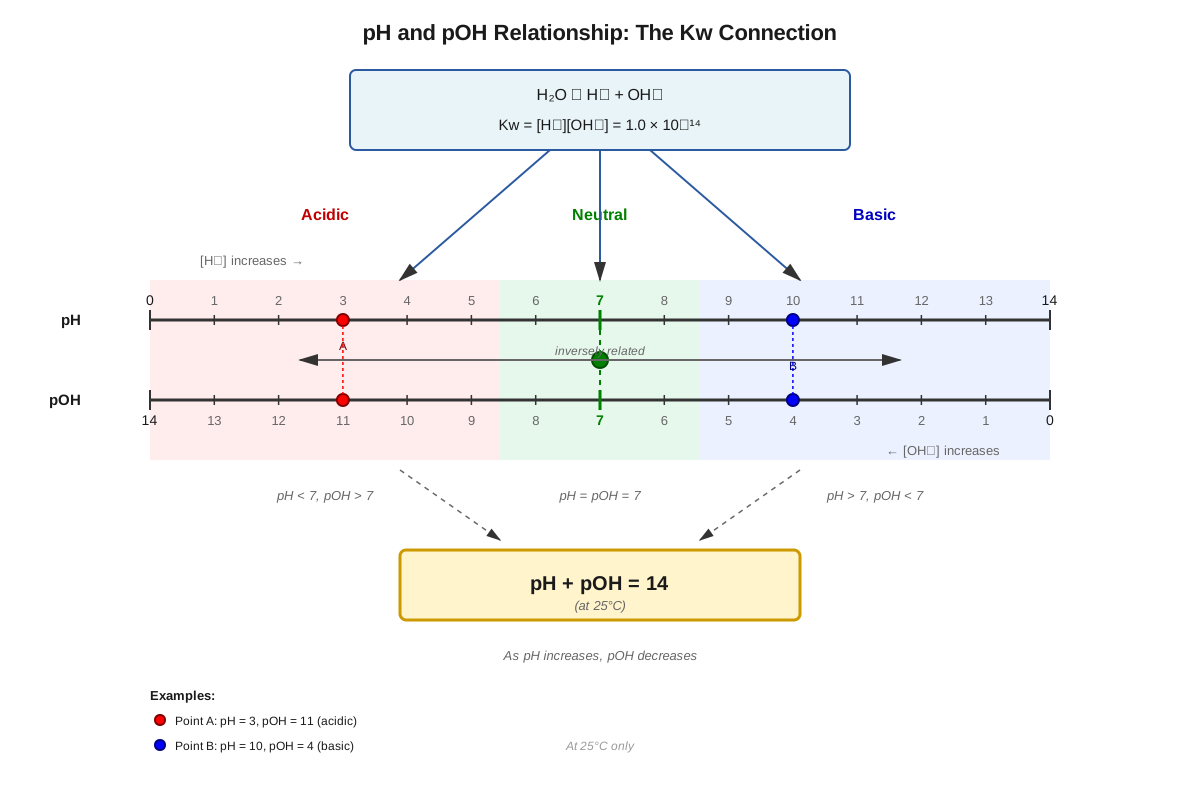
At 25°C, water undergoes autoionization according to the equilibrium:
H₂O(l) ⇌ H⁺(aq) + OH⁻(aq)The equilibrium constant for this process, Kw (the ion product of water), equals 1.0 × 10⁻¹⁴:
Kw = [H⁺][OH⁻] = 1.0 × 10⁻¹⁴Taking the negative logarithm of both sides yields the fundamental relationship:
pH + pOH = 14This equation is among the most important for the MCAT, enabling rapid interconversion between pH and pOH. If a solution has pH = 9, its pOH must equal 5. If pOH = 3, then pH = 11. This relationship holds true for all aqueous solutions at 25°C, regardless of whether they contain acids, bases, or both.
MCAT Exam Tip: The equation pH + pOH = 14 assumes standard temperature (25°C). While the MCAT rarely tests temperature effects on Kw, be aware that this relationship changes at different temperatures.
Interpreting pOH Values
The pOH scale provides immediate information about solution basicity:
| pOH Range | Solution Type | [OH⁻] Range | pH Range |
|---|---|---|---|
| pOH < 7 | Basic | [OH⁻] > 1.0 × 10⁻⁷ M | pH > 7 |
| pOH = 7 | Neutral | [OH⁻] = 1.0 × 10⁻⁷ M | pH = 7 |
| pOH > 7 | Acidic | [OH⁻] < 1.0 × 10⁻⁷ M | pH < 7 |
Notice that acidic solutions have high pOH values (greater than 7), while basic solutions have low pOH values (less than 7). This inverse relationship compared to pH often confuses students initially but becomes intuitive with practice. A strongly basic solution like 0.1 M NaOH has [OH⁻] = 0.1 M = 1.0 × 10⁻¹ M, giving pOH = 1 and pH = 13.
Calculating pOH from Strong Bases
For strong bases that dissociate completely in water (such as NaOH, KOH, Ba(OH)₂, and Ca(OH)₂), calculating pOH follows a straightforward process:
- Determine the initial concentration of the strong base
- Account for stoichiometry (e.g., Ba(OH)₂ produces 2 OH⁻ per formula unit)
- Calculate [OH⁻] in solution
- Apply pOH = -log[OH⁻]
- If needed, calculate pH using pH = 14 - pOH
For example, a 0.01 M solution of Ca(OH)₂:
- Ca(OH)₂ → Ca²⁺ + 2OH⁻
- [OH⁻] = 2 × 0.01 M = 0.02 M = 2.0 × 10⁻² M
- pOH = -log(2.0 × 10⁻²) = -log(2.0) - log(10⁻²) = -0.30 + 2 = 1.70
- pH = 14 - 1.70 = 12.30
Calculating pOH from Weak Bases
Weak bases (such as ammonia, amines, and conjugate bases of weak acids) do not dissociate completely, requiring equilibrium calculations. The base dissociation constant Kb governs this equilibrium:
B + H₂O ⇌ BH⁺ + OH⁻
Kb = [BH⁺][OH⁻]/[B]
For weak base calculations:
- Set up an ICE table (Initial, Change, Equilibrium)
- Apply the Kb expression
- Make approximations if Kb is small (typically Kb < 10⁻⁵ and initial concentration > 100 × Kb)
- Solve for [OH⁻]
- Calculate pOH = -log[OH⁻]
The approximation [B]equilibrium ≈ [B]initial simplifies calculations when less than 5% of the base dissociates, a condition the MCAT frequently designs into problems to avoid requiring the quadratic formula.
pOH in Buffer Systems
Buffer systems containing a weak base and its conjugate acid maintain relatively constant pH (and therefore pOH) when small amounts of acid or base are added. The Henderson-Hasselbalch equation can be adapted for base buffers:
pOH = pKb + log([BH⁺]/[B])Where pKb = -log(Kb). Since pH + pOH = 14, this can also be expressed as:
pH = 14 - pKb - log([BH⁺]/[B])Or, using the relationship pKa + pKb = 14 for conjugate pairs:
pH = pKa + log([B]/[BH⁺])Understanding pOH in buffer contexts helps analyze biological systems like the bicarbonate buffer in blood or the ammonia-ammonium buffer in kidney tubules.
pOH Changes During Titrations
During acid-base titrations, pOH changes systematically as titrant is added. In a strong acid-strong base titration:
- Before equivalence point: Excess acid present, high pOH (low pH)
- At equivalence point: pH = 7, pOH = 7 (neutral solution)
- After equivalence point: Excess base present, low pOH (high pH)
For weak acid-strong base titrations:
- At equivalence point: pH > 7, pOH < 7 (basic due to conjugate base hydrolysis)
- At half-equivalence point: pH = pKa, allowing pOH calculation via pH + pOH = 14
Recognizing these patterns helps students quickly analyze titration curves and identify key points without extensive calculation.
Concept Relationships
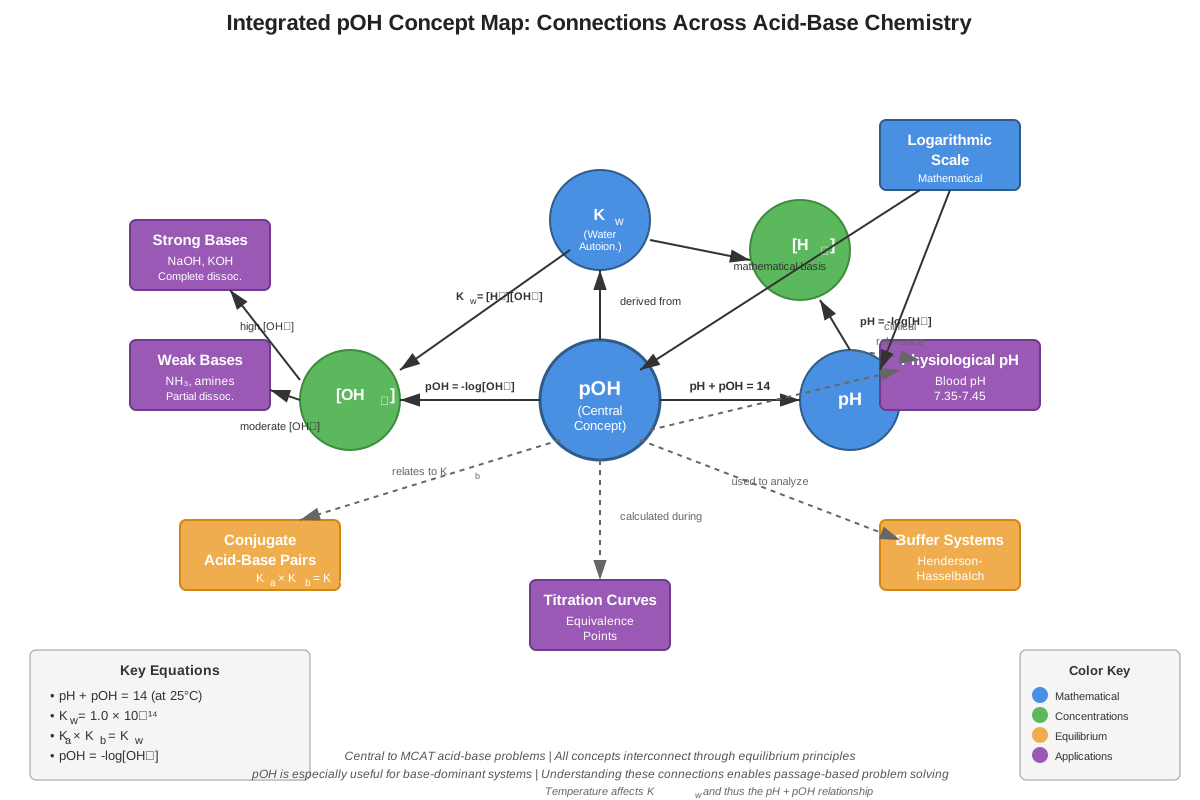
The concept of pOH sits at the intersection of multiple fundamental General Chemistry principles. pOH directly derives from the autoionization of water (Kw), which establishes the inverse relationship between [H⁺] and [OH⁻] in all aqueous solutions. This relationship creates the mathematical bridge: Kw → pH + pOH = 14 → enables interconversion between acidity and basicity measures.
pOH connects to pH through complementary logarithmic scales—as one increases, the other decreases by an equal amount. Both concepts rely on logarithmic functions, which compress exponential concentration ranges into linear scales. Understanding scientific notation and logarithm properties (particularly that log(10⁻ⁿ) = -n) enables rapid mental calculation of pOH values.
The relationship flows: Strong base concentration → [OH⁻] calculation → pOH determination → pH calculation → solution characterization. For weak bases, the pathway includes: Kb equilibrium → ICE table analysis → [OH⁻] at equilibrium → pOH → pH.
Buffer systems integrate pOH through the Henderson-Hasselbalch equation, connecting weak bases, conjugate acids, Kb values, and pKb to create the complete picture of pH/pOH regulation. Titration curves demonstrate dynamic pOH changes, linking stoichiometry, equivalence points, and indicator selection to pOH calculations at various stages.
The broader context connects: Brønsted-Lowry acid-base theory → defines bases as proton acceptors → base strength → determines Kb → influences pOH in weak base solutions → affects biological systems where pH/pOH regulation is critical for enzyme function and metabolic processes.
High-Yield Facts
⭐ pOH is defined as -log[OH⁻], where [OH⁻] is the molar concentration of hydroxide ions in solution
⭐ pH + pOH = 14 at 25°C for all aqueous solutions, enabling rapid interconversion between these values
⭐ A solution with pOH < 7 is basic, pOH = 7 is neutral, and pOH > 7 is acidic (inverse of pH interpretation)
⭐ Strong bases like NaOH and KOH dissociate completely, so [OH⁻] equals the base concentration (accounting for stoichiometry)
⭐ For Ba(OH)₂ and Ca(OH)₂, [OH⁻] = 2 × [base] because each formula unit produces two hydroxide ions
- [OH⁻] = 10^(-pOH) allows calculation of hydroxide concentration from pOH
- pKb = -log(Kb) and pKa + pKb = 14 for conjugate acid-base pairs
- At the equivalence point of a strong acid-strong base titration, pH = 7 and pOH = 7
- Weak base solutions require Kb equilibrium calculations to determine [OH⁻] before calculating pOH
- In pure water at 25°C, [H⁺] = [OH⁻] = 1.0 × 10⁻⁷ M, giving pH = pOH = 7
- The Henderson-Hasselbalch equation for bases is pOH = pKb + log([BH⁺]/[B])
- Diluting a basic solution increases pOH (decreases pH) as [OH⁻] decreases
- Temperature affects Kw, so the pH + pOH = 14 relationship only holds exactly at 25°C
- Common strong bases to memorize: Group 1 hydroxides (LiOH, NaOH, KOH, RbOH, CsOH) and some Group 2 hydroxides (Ca(OH)₂, Sr(OH)₂, Ba(OH)₂)
Quick check — test yourself on pOH so far.
Try Flashcards →Common Misconceptions
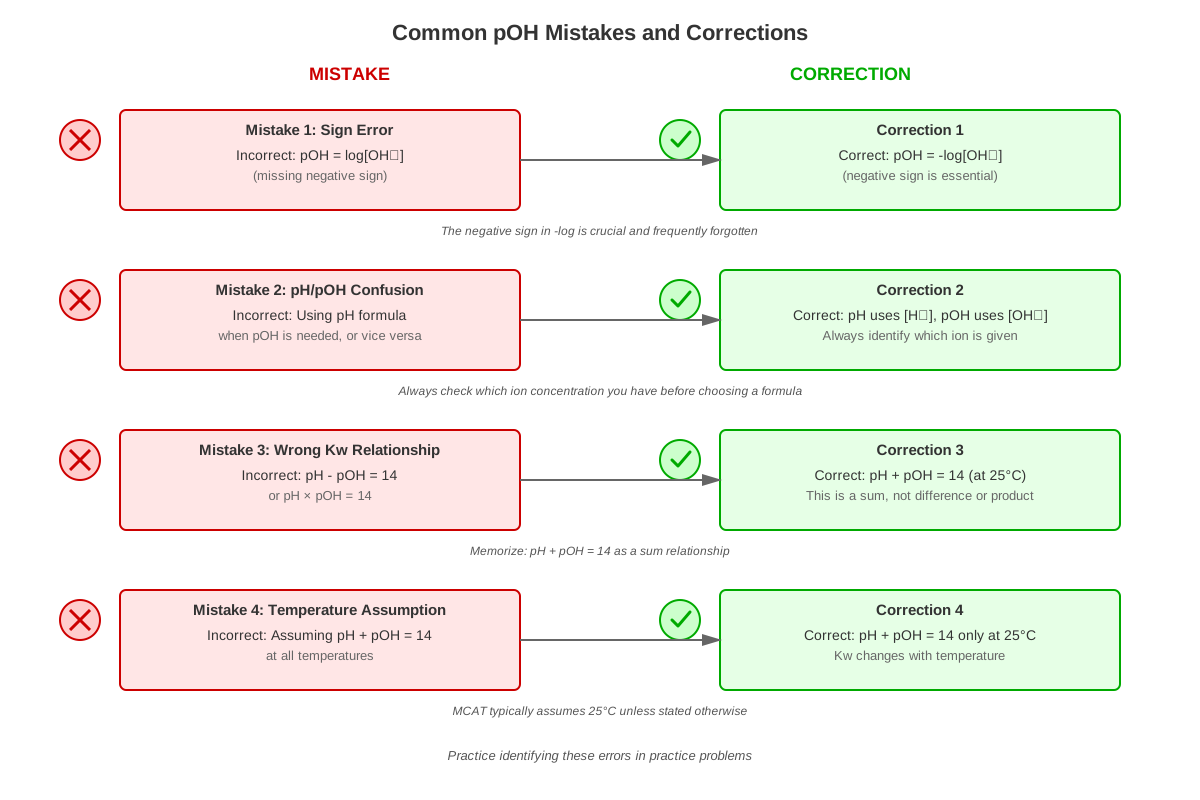
Misconception: pOH and pH mean the same thing and can be used interchangeably.
Correction: pOH measures hydroxide ion concentration while pH measures hydrogen ion concentration. They are complementary but distinct measures related by pH + pOH = 14. A solution with pH = 3 has pOH = 11, not pOH = 3.
Misconception: A high pOH value indicates a basic solution.
Correction: High pOH values (>7) indicate acidic solutions with low hydroxide concentrations. Basic solutions have low pOH values (<7). This inverse relationship compared to pH frequently causes confusion—remember that basic solutions have high pH and low pOH.
Misconception: For a 0.01 M NaOH solution, pOH = 0.01.
Correction: pOH is the negative logarithm of [OH⁻], not the concentration itself. For 0.01 M NaOH, [OH⁻] = 0.01 M = 1.0 × 10⁻² M, so pOH = -log(10⁻²) = 2, not 0.01.
Misconception: pH + pOH always equals 14 under all conditions.
Correction: The relationship pH + pOH = 14 specifically applies at 25°C where Kw = 1.0 × 10⁻¹⁴. At different temperatures, Kw changes (increases with temperature), altering this sum. However, the MCAT typically assumes 25°C unless otherwise stated.
Misconception: All bases have pOH values less than 7.
Correction: While basic solutions have pOH < 7, the conjugate bases of very weak acids can exist in solutions with pOH > 7 if the solution is overall acidic. The pOH value describes the hydroxide concentration, not necessarily the identity of species present.
Misconception: When calculating pOH for Ca(OH)₂, use the molarity of Ca(OH)₂ directly as [OH⁻].
Correction: Ca(OH)₂ produces two hydroxide ions per formula unit, so [OH⁻] = 2 × [Ca(OH)₂]. For 0.05 M Ca(OH)₂, [OH⁻] = 0.10 M, giving pOH = 1, not pOH = 1.3.
Misconception: pOH can be negative or greater than 14.
Correction: While mathematically possible for extremely concentrated solutions, pOH typically ranges from 0 to 14 for solutions encountered on the MCAT. A pOH of 0 corresponds to [OH⁻] = 1 M, and pOH of 14 corresponds to [OH⁻] = 1.0 × 10⁻¹⁴ M.
Misconception: Weak bases have higher pOH than strong bases at the same concentration.
Correction: Weak bases produce fewer hydroxide ions than strong bases at equal concentrations, resulting in higher pOH values (less basic). A 0.1 M solution of ammonia (weak base, Kb = 1.8 × 10⁻⁵) has pOH ≈ 2.9, while 0.1 M NaOH (strong base) has pOH = 1.
Worked Examples
Example 1: Calculating pOH and pH from Strong Base Concentration
Problem: A laboratory technician prepares a solution by dissolving 0.74 g of Ca(OH)₂ (molar mass = 74 g/mol) in water to make 500 mL of solution. Calculate the pOH and pH of this solution.
Solution:
Step 1: Calculate moles of Ca(OH)₂
moles = mass / molar mass = 0.74 g / 74 g/mol = 0.010 molStep 2: Calculate molarity of Ca(OH)₂
Molarity = moles / volume (L) = 0.010 mol / 0.500 L = 0.020 MStep 3: Determine [OH⁻] accounting for stoichiometry
Ca(OH)₂ → Ca²⁺ + 2OH⁻
Each Ca(OH)₂ produces 2 hydroxide ions:
[OH⁻] = 2 × 0.020 M = 0.040 M = 4.0 × 10⁻² MStep 4: Calculate pOH
pOH = -log[OH⁻] = -log(4.0 × 10⁻²)
pOH = -log(4.0) - log(10⁻²)
pOH = -0.60 + 2 = 1.40
Step 5: Calculate pH
pH = 14 - pOH = 14 - 1.40 = 12.60Answer: pOH = 1.40, pH = 12.60
Key Takeaway: This problem tests stoichiometry awareness (the factor of 2 for Ca(OH)₂), unit conversions, and the complete calculation pathway from mass to pOH to pH. Missing the stoichiometric factor is a common error that would yield pOH = 1.70 instead of 1.40.
Example 2: Determining Hydroxide Concentration from pOH
Problem: During a titration experiment, a solution is found to have a pOH of 4.25. Calculate the hydroxide ion concentration and determine whether the solution is acidic, basic, or neutral. What is the pH?
Solution:
Step 1: Calculate [OH⁻] from pOH
pOH = -log[OH⁻]
4.25 = -log[OH⁻]
[OH⁻] = 10^(-4.25)
Step 2: Evaluate 10^(-4.25)
10^(-4.25) = 10^(-4) × 10^(-0.25)
10^(-4) = 1.0 × 10⁻⁴
10^(-0.25) ≈ 0.56 (since 10^(-0.25) = 1/10^(0.25) ≈ 1/1.78 ≈ 0.56)
[OH⁻] ≈ 5.6 × 10⁻⁵ M
Step 3: Determine solution character
Since pOH = 4.25 < 7, the solution is basic (hydroxide concentration exceeds hydrogen ion concentration).
Step 4: Calculate pH
pH = 14 - pOH = 14 - 4.25 = 9.75Since pH = 9.75 > 7, this confirms the solution is basic.
Step 5: Verify using Kw
[H⁺] = Kw / [OH⁻] = (1.0 × 10⁻¹⁴) / (5.6 × 10⁻⁵) = 1.8 × 10⁻¹⁰ M
pH = -log(1.8 × 10⁻¹⁰) ≈ 9.75 ✓Answer: [OH⁻] = 5.6 × 10⁻⁵ M, the solution is basic, pH = 9.75
Key Takeaway: This problem demonstrates the reverse calculation (pOH → [OH⁻]) and reinforces that pOH < 7 indicates a basic solution. The verification step using Kw shows the internal consistency of acid-base calculations and provides a useful check for exam problems.
Example 3: Weak Base Equilibrium and pOH
Problem: Calculate the pOH of a 0.15 M solution of ammonia (NH₃), given that Kb = 1.8 × 10⁻⁵.
Solution:
Step 1: Write the equilibrium expression
NH₃ + H₂O ⇌ NH₄⁺ + OH⁻
Kb = [NH₄⁺][OH⁻] / [NH₃] = 1.8 × 10⁻⁵
Step 2: Set up ICE table
           NH₃    NH₄⁺   OH⁻
Initial    0.15    0      0
Change     -x      +x     +x
Equilibrium 0.15-x  x      x
Step 3: Check if approximation is valid
0.15 / (1.8 × 10⁻⁵) = 8,333 > 100The approximation 0.15 - x ≈ 0.15 is valid.
Step 4: Solve for x = [OH⁻]
Kb = x² / 0.15 = 1.8 × 10⁻⁵
x² = (1.8 × 10⁻⁵)(0.15) = 2.7 × 10⁻⁶
x = √(2.7 × 10⁻⁶) = 1.64 × 10⁻³ M
[OH⁻] = 1.64 × 10⁻³ M
Step 5: Verify approximation
(1.64 × 10⁻³ / 0.15) × 100% = 1.1% < 5% ✓Step 6: Calculate pOH
pOH = -log(1.64 × 10⁻³)
pOH = -log(1.64) - log(10⁻³)
pOH = -0.21 + 3 = 2.79
Step 7: Calculate pH (optional but useful)
pH = 14 - 2.79 = 11.21Answer: pOH = 2.79
Key Takeaway: This problem integrates equilibrium concepts with pOH calculations. The approximation check is crucial—MCAT problems are typically designed so approximations work, but verifying this demonstrates mastery. The low pOH (2.79) correctly indicates a basic solution, consistent with ammonia being a weak base.
Exam Strategy
Approaching pOH Questions
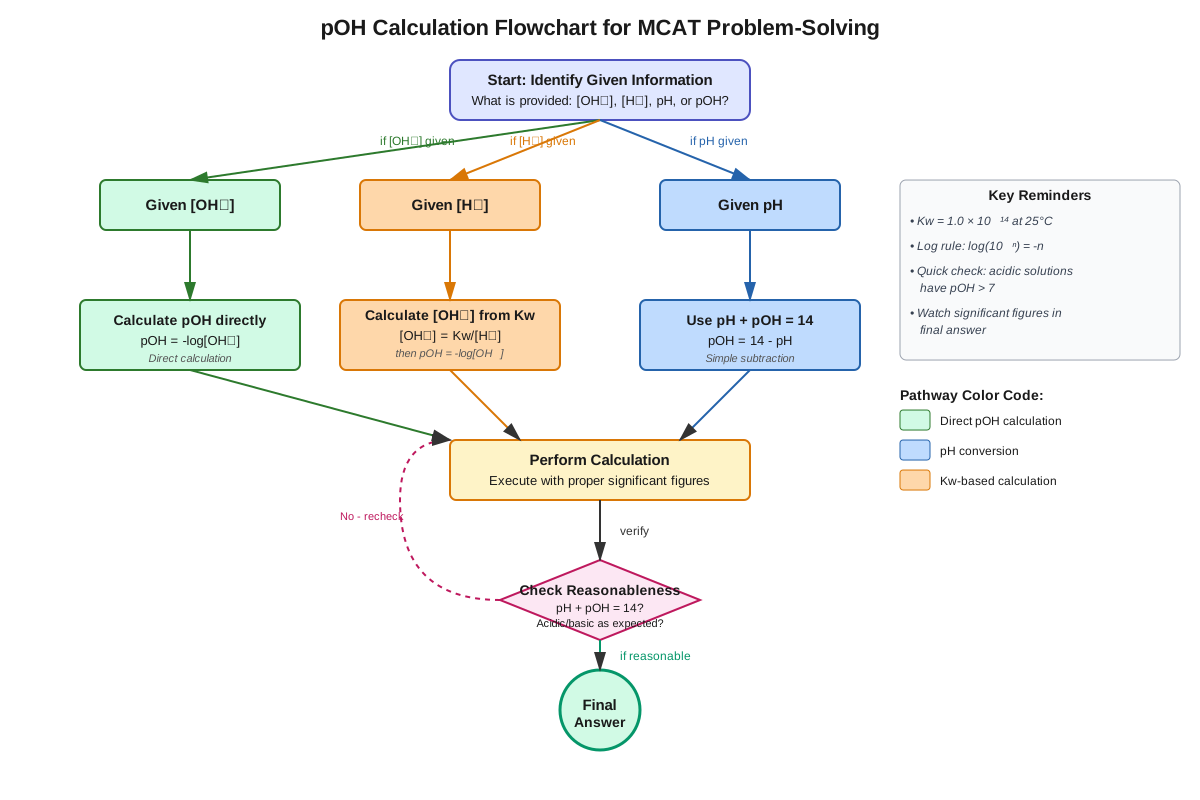
When encountering pOH MCAT questions, follow this systematic approach:
- Identify what's given and what's requested: Determine whether you're starting with concentration, pH, pOH, or Kb/Ka values
- Classify the species: Strong acid, strong base, weak acid, weak base, or salt solution
- Choose the appropriate pathway: Direct calculation for strong bases, equilibrium for weak bases
- Check for stoichiometry: Remember that Ca(OH)₂ and Ba(OH)₂ produce 2 OH⁻ per formula unit
- Use pH + pOH = 14 as a bridge: This relationship enables rapid interconversion
Trigger Words and Phrases
Watch for these exam triggers that signal pOH calculations:
- "Calculate the basicity" or "determine the hydroxide concentration" → likely requires pOH
- "Strong base" (NaOH, KOH, Ca(OH)₂, Ba(OH)₂) → direct pOH calculation
- "Weak base" or "Kb is given" → equilibrium calculation before pOH
- "At 25°C" or "standard conditions" → confirms pH + pOH = 14
- "Equivalence point" in titration → consider whether pH = 7 or pH ≠ 7
- "Buffer containing a weak base" → may require Henderson-Hasselbalch for bases
Process of Elimination Tips
When using POE (process of elimination) on pOH questions:
- Eliminate answers where pH + pOH ≠ 14 (assuming 25°C)
- For strong bases, eliminate pOH values > 7 (strong bases always produce basic solutions)
- Check magnitude: 0.1 M NaOH should give pOH = 1, not pOH = 0.1 or pOH = 10
- For weak bases, pOH should be higher (less basic) than for strong bases at equal concentration
- Verify that basic solutions have pOH < 7 and acidic solutions have pOH > 7
Time Allocation
For discrete pOH questions, allocate 60-90 seconds. Most calculations involve straightforward logarithms that can be estimated quickly. For passage-based questions involving pOH, allocate 90-120 seconds, as these typically require extracting information from the passage and performing multi-step calculations.
MCAT Exam Tip: Practice mental math for common logarithms: log(2) ≈ 0.3, log(3) ≈ 0.48, log(5) ≈ 0.7. This enables rapid estimation of pOH values without a calculator.
Common Question Formats
The MCAT presents pOH in these formats:
- Direct calculation: "What is the pOH of 0.05 M NaOH?"
- Reverse calculation: "A solution has pOH = 3.5. What is [OH⁻]?"
- Comparison: "Rank these solutions by increasing pOH"
- Titration analysis: "At what point in the titration does pOH = 7?"
- Buffer problems: "Calculate the pOH of a buffer containing 0.1 M NH₃ and 0.15 M NH₄Cl"
Memory Techniques
Mnemonics
"POH Drops When Bases Pop": Remember that pOH decreases (drops) as base concentration increases (pops up). This reinforces the inverse relationship between pOH and basicity.
"Seven Heaven, Neutral Leaven": At pH = 7 and pOH = 7, solutions are neutral—this "heaven" point represents perfect balance between acids and bases.
"Fourteen's the Door Between pH and pOH": The sum pH + pOH = 14 acts as the "door" connecting these two measures.
Visualization Strategy
Visualize a seesaw with pH on one side and pOH on the other, balanced at the pivot point of 14. When pH goes up (more basic), pOH must go down by an equal amount to maintain balance. When pH drops (more acidic), pOH rises. This mental image reinforces the complementary relationship.
Acronym for Strong Bases
"Like No King Rules Completely, Some Bases Are Strong":
- LiOH
- NaOH
- KOH
- RbOH
- CsOH
- Sr(OH)₂
- Ba(OH)₂
- Also Ca(OH)₂ (partially)
Calculation Shortcuts
For quick estimation:
- pOH of 10⁻ⁿ M OH⁻ = n (e.g., 10⁻³ M gives pOH = 3)
- For 2 × 10⁻ⁿ M, pOH ≈ n - 0.3 (e.g., 2 × 10⁻³ M gives pOH ≈ 2.7)
- For 5 × 10⁻ⁿ M, pOH ≈ n - 0.7 (e.g., 5 × 10⁻³ M gives pOH ≈ 2.3)
Summary
pOH represents a fundamental quantitative measure of solution basicity, defined as the negative logarithm of hydroxide ion concentration: pOH = -log[OH⁻]. This concept is inextricably linked to pH through the relationship pH + pOH = 14 at 25°C, derived from the water autoionization constant Kw = 1.0 × 10⁻¹⁴. Understanding pOH enables complete characterization of acid-base systems, as solutions with pOH < 7 are basic, pOH = 7 are neutral, and pOH > 7 are acidic—an inverse pattern compared to pH interpretation. For strong bases like NaOH and KOH, pOH calculations are straightforward, requiring only attention to stoichiometry (particularly for Ca(OH)₂ and Ba(OH)₂, which produce two hydroxide ions per formula unit). Weak base systems require equilibrium analysis using Kb before determining [OH⁻] and subsequently calculating pOH. The MCAT frequently tests pOH in contexts including titrations, buffer systems, and physiological scenarios, making mastery of interconversion between pH, pOH, [H⁺], and [OH⁻] essential for success on the Chemical and Physical Foundations section.
Key Takeaways
- pOH = -log[OH⁻] defines the logarithmic scale for hydroxide concentration, complementing the pH scale
- pH + pOH = 14 at 25°C enables rapid interconversion and is among the most important equations for MCAT acid-base problems
- Basic solutions have pOH < 7, neutral solutions have pOH = 7, and acidic solutions have pOH > 7 (inverse of pH)
- Strong bases dissociate completely, making pOH calculations straightforward, but remember stoichiometry for Ca(OH)₂ and Ba(OH)₂
- Weak bases require Kb equilibrium calculations to determine [OH⁻] before calculating pOH
- [OH⁻] = 10^(-pOH) allows reverse calculation from pOH to hydroxide concentration
- pOH appears frequently on the MCAT in titrations, buffers, and physiological contexts, making it a high-yield topic for exam preparation
Related Topics
pH and Hydrogen Ion Concentration: The complementary measure to pOH, essential for complete understanding of acid-base chemistry. Mastering pOH naturally enhances pH comprehension through their mathematical relationship.
Water Autoionization and Kw: The equilibrium constant Kw = [H⁺][OH⁻] = 1.0 × 10⁻¹⁴ provides the foundation for the pH + pOH = 14 relationship and explains why pure water has pH = pOH = 7.
Strong Acids and Bases: Understanding complete dissociation of strong bases (NaOH, KOH, Ca(OH)₂, Ba(OH)₂) enables straightforward pOH calculations and provides contrast with weak base behavior.
Weak Bases and Kb: Equilibrium calculations for weak bases like ammonia and amines require Kb values and ICE table analysis before determining pOH, integrating equilibrium concepts with acid-base chemistry.
Buffer Systems: Solutions containing weak bases and their conjugate acids maintain stable pH/pOH values, with applications in biological systems and laboratory settings.
Acid-Base Titrations: Dynamic changes in pOH throughout titrations reveal equivalence points, buffer regions, and solution composition, connecting stoichiometry with acid-base equilibria.
Henderson-Hasselbalch Equation: This equation relates pH, pKa, and buffer component ratios, with adaptations for base buffers using pOH and pKb.
Practice CTA
Now that you've mastered the core concepts of pOH, it's time to solidify your understanding through active practice. Work through the practice questions and flashcards to test your ability to calculate pOH from various starting points, interconvert between pH and pOH, and apply these concepts to MCAT-style scenarios. Focus particularly on problems involving strong bases with different stoichiometries and weak base equilibrium calculations. Remember that consistent practice with these calculations builds the speed and accuracy essential for success on test day. Each problem you solve strengthens your conceptual understanding and prepares you for the diverse ways the MCAT can test pOH. You've built a strong foundation—now reinforce it through deliberate practice!
Sign up free to keep reading
Create a free AnvayaPrep account to finish this MCAT guide on pOH — plus flashcards and practice questions.