Overview
Polyprotic acids are acids capable of donating more than one proton (H⁺) per molecule in aqueous solution. Unlike monoprotic acids such as HCl or HNO₃, which release only a single proton, polyprotic acids undergo multiple, sequential dissociation steps, each characterized by its own equilibrium constant (Ka). Common examples include sulfuric acid (H₂SO₄), phosphoric acid (H₃PO₄), and carbonic acid (H₂CO₃). Understanding polyprotic acid behavior is fundamental to General Chemistry because these compounds exhibit complex pH-dependent speciation, meaning the predominant form of the acid changes as solution pH varies. This concept bridges acid-base equilibria, buffer systems, and titration curves—all high-yield topics for standardized examinations.
For the MCAT, polyprotic acids represent a critical intersection of conceptual understanding and quantitative problem-solving. The exam frequently tests students' ability to predict the predominant species at a given pH, calculate pH at various points during titration, and interpret multi-step titration curves with multiple equivalence points. Questions may appear in both discrete format and within passage-based scenarios involving physiological buffer systems (such as the bicarbonate buffer in blood) or laboratory titrations. Mastery of Polyprotic acids MCAT content requires not only memorizing Ka values and formulas but also developing intuition about how successive deprotonations become progressively more difficult due to electrostatic effects.
Within the broader Acids and Bases unit, polyprotic acids connect directly to concepts such as pH calculations, buffer capacity, Henderson-Hasselbalch equation applications, and titration analysis. They also relate to solubility equilibria (when polyprotic anions form insoluble salts) and biochemical systems (amino acids and proteins are polyprotic). This topic serves as a bridge between introductory acid-base chemistry and more advanced applications in biological and analytical chemistry, making it indispensable for achieving a competitive MCAT score.
Learning Objectives
- [ ] Define polyprotic acids using accurate General Chemistry terminology
- [ ] Explain why polyprotic acids matter for the MCAT
- [ ] Apply polyprotic acids concepts to exam-style questions
- [ ] Identify common mistakes related to polyprotic acids
- [ ] Connect polyprotic acids to related General Chemistry concepts
- [ ] Calculate pH at any point during the titration of a polyprotic acid
- [ ] Predict the predominant species of a polyprotic acid at a given pH using Ka values
- [ ] Interpret and sketch multi-equivalence point titration curves for diprotic and triprotic acids
Prerequisites
- Brønsted-Lowry acid-base theory: Understanding proton donors and acceptors is essential for comprehending sequential deprotonation
- Equilibrium constants and Le Chatelier's principle: Ka expressions and equilibrium shifts govern each dissociation step
- pH and pKa calculations: Quantitative analysis of polyprotic systems builds directly on monoprotic acid calculations
- Henderson-Hasselbalch equation: This equation applies to each conjugate acid-base pair in polyprotic systems
- Titration fundamentals: Polyprotic titrations extend monoprotic titration concepts to multiple equivalence points
- Buffer systems: Each deprotonation step of a polyprotic acid can create a buffer region
Why This Topic Matters
Clinical and Real-World Significance
Polyprotic acids are ubiquitous in biological systems and clinical medicine. The carbonic acid-bicarbonate buffer system (H₂CO₃/HCO₃⁻) maintains blood pH within the narrow physiological range of 7.35–7.45, and disruptions cause acidosis or alkalosis. Phosphoric acid derivatives form the backbone of DNA and RNA, while phosphate buffers regulate intracellular pH. Amino acids contain both carboxylic acid and amino groups, making them polyprotic and enabling their role as biological buffers. Citric acid, a triprotic acid, is central to the Krebs cycle. Understanding polyprotic behavior is therefore essential for interpreting physiological pH regulation, drug design (many pharmaceuticals are polyprotic), and environmental chemistry (acid rain involves polyprotic sulfuric and carbonic acids).
MCAT Exam Statistics
Polyprotic acids appear in approximately 3–5% of General Chemistry questions on the MCAT, but their importance extends beyond direct questions. They frequently appear in:
- Passage-based questions involving physiological buffers or laboratory experiments
- Titration curve interpretation questions requiring identification of equivalence points and buffer regions
- Calculation questions testing pH determination at various stages of neutralization
- Conceptual questions about predominant species, buffer capacity, or the relationship between structure and acidity
Questions often integrate polyprotic acids with other topics such as solubility equilibria, thermodynamics, or biochemistry, making this a high-yield topic for interdisciplinary reasoning.
Common Exam Presentations
The MCAT presents polyprotic acids through:
- Titration curves showing multiple inflection points with questions about pH at specific volumes of titrant
- Physiological passages describing blood pH regulation requiring application of the Henderson-Hasselbalch equation
- Laboratory scenarios involving phosphate or citrate buffers
- Amino acid isoelectric point calculations
- Environmental chemistry passages about acid rain or ocean acidification
Core Concepts
Definition and Fundamental Properties
Polyprotic acids are acids that can donate more than one proton per molecule in sequential dissociation reactions. Each dissociation step is characterized by its own acid dissociation constant (Ka), with successive Ka values decreasing in magnitude. A diprotic acid donates two protons (e.g., H₂SO₄, H₂CO₃), while a triprotic acid donates three protons (e.g., H₃PO₄, citric acid).
The general dissociation pattern for a diprotic acid H₂A follows:
First dissociation:  H₂A ⇌ H⁺ + HA⁻     Ka1 = [H⁺][HA⁻]/[H₂A]
Second dissociation: HA⁻ ⇌ H⁺ + A²⁻     Ka2 = [H⁺][A²⁻]/[HA⁻]
For triprotic acids like H₃PO₄:
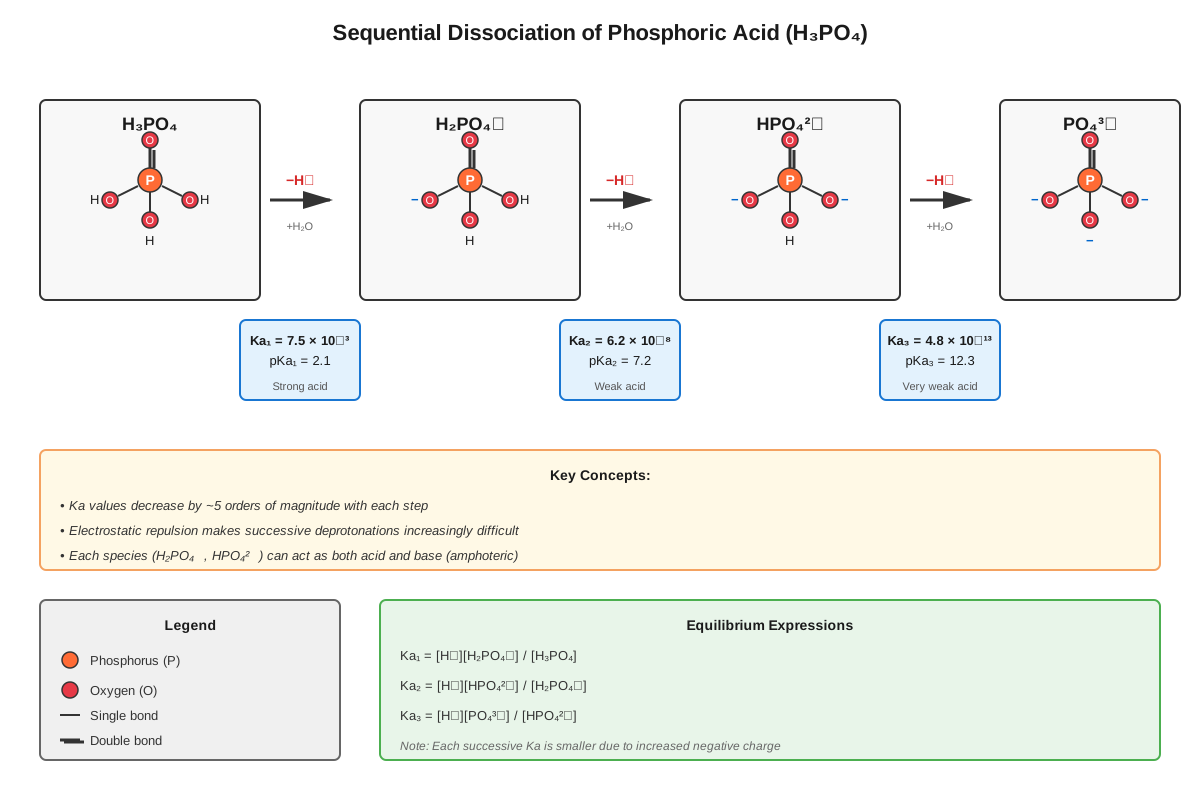
H₃PO₄ ⇌ H⁺ + H₂PO₄⁻    Ka1 = 7.5 × 10⁻³   (pKa1 = 2.12)
H₂PO₄⁻ ⇌ H⁺ + HPO₄²⁻   Ka2 = 6.2 × 10⁻⁸   (pKa2 = 7.21)
HPO₄²⁻ ⇌ H⁺ + PO₄³⁻    Ka3 = 4.8 × 10⁻¹³  (pKa3 = 12.32)
Successive Dissociation Constants
A critical principle is that Ka1 > Ka2 > Ka3 for any polyprotic acid. The first proton is easiest to remove because it departs from a neutral molecule. The second proton must be removed from a negatively charged ion (HA⁻), requiring more energy to overcome electrostatic attraction. Each subsequent deprotonation becomes progressively more difficult.
Typically, Ka values differ by factors of 10⁴ to 10⁶, meaning:
- The first dissociation is essentially complete before the second begins
- Each dissociation can often be treated independently for pH calculations
- The predominant species at any pH depends on which Ka values bracket that pH
| Acid | Ka1 | Ka2 | Ka3 | Ka1/Ka2 Ratio |
|---|---|---|---|---|
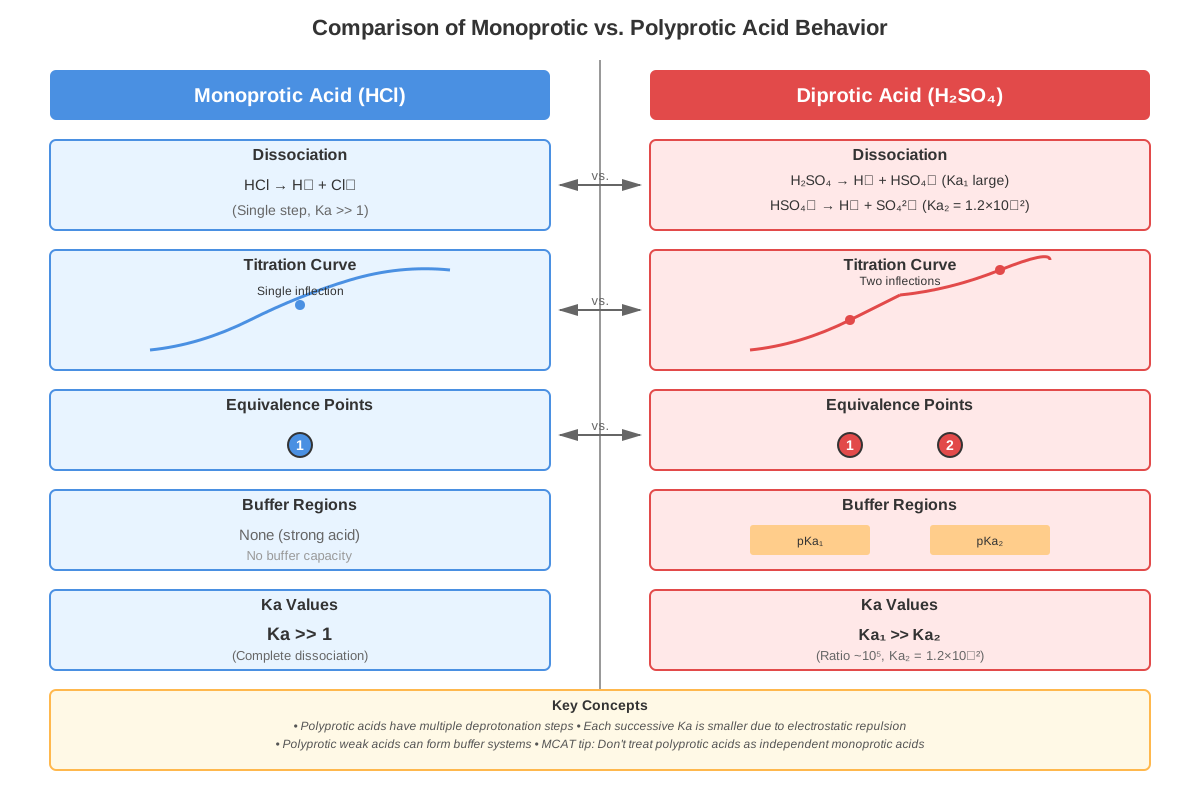
| H₂SO₄ | Very large | 1.2 × 10⁻² | — | ~10⁸ |
| H₂CO₃ | 4.3 × 10⁻⁷ | 5.6 × 10⁻¹¹ | — | ~10⁴ |
| H₃PO₄ | 7.5 × 10⁻³ | 6.2 × 10⁻⁸ | 4.8 × 10⁻¹³ | ~10⁵ |
pH Calculations for Polyprotic Acids
When calculating the pH of a polyprotic acid solution, the first dissociation typically dominates because Ka1 >> Ka2. For a solution of H₂A:
- Assume only the first dissociation contributes significantly to [H⁺]
- Set up the Ka1 expression: Ka1 = [H⁺][HA⁻]/[H₂A]
- Use the ICE table method with initial concentration C
- If Ka1 is small relative to C, use the approximation: [H⁺] ≈ √(Ka1 × C)
The contribution from the second dissociation is usually negligible because Ka2 is much smaller. However, at very low concentrations or when Ka1 and Ka2 are closer in magnitude, both dissociations may need consideration.
Predominant Species and pH Regions
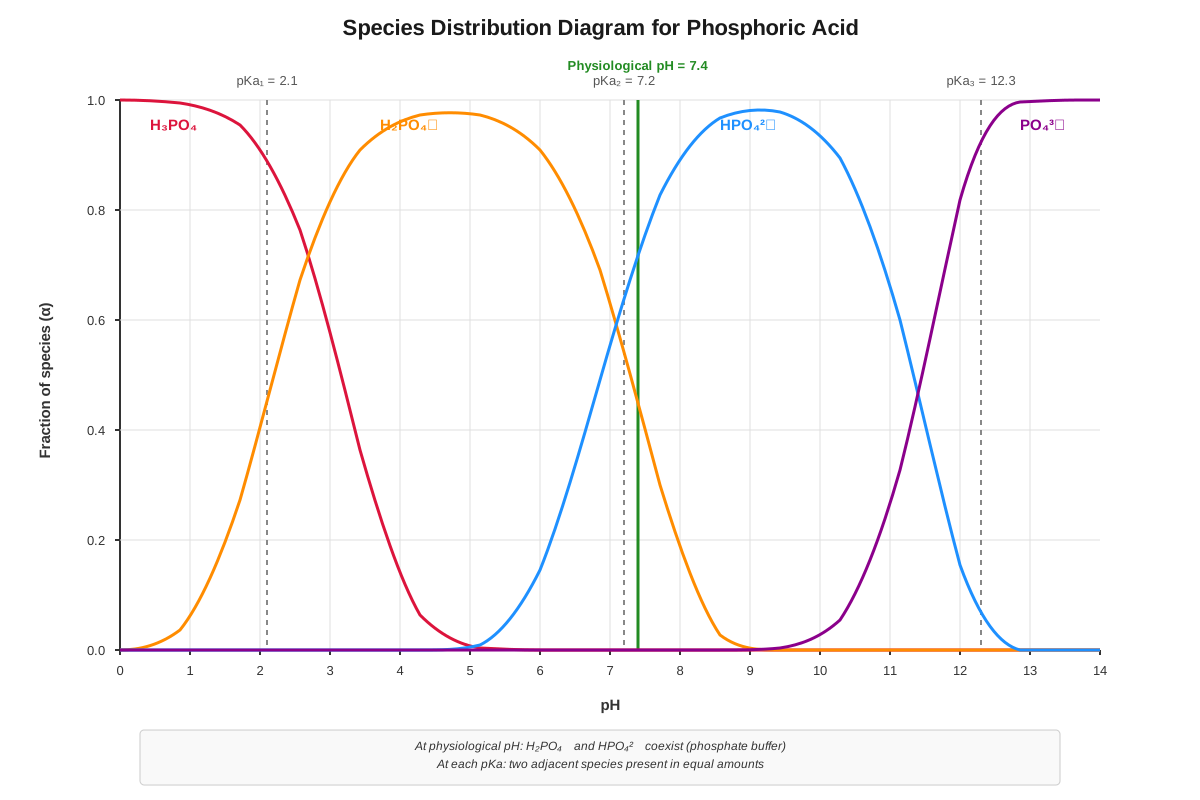
The predominant species of a polyprotic acid depends on solution pH relative to the pKa values:
- pH < pKa1: Fully protonated form (H₂A for diprotic) predominates
- pH ≈ pKa1: Equal concentrations of H₂A and HA⁻ (first buffer region)
- pKa1 < pH < pKa2: Intermediate form (HA⁻) predominates
- pH ≈ pKa2: Equal concentrations of HA⁻ and A²⁻ (second buffer region)
- pH > pKa2: Fully deprotonated form (A²⁻) predominates
This relationship enables prediction of speciation without calculation. For H₃PO₄ at pH 7.4 (physiological pH):
- pH is between pKa2 (7.21) and pKa3 (12.32)
- HPO₄²⁻ and H₂PO₄⁻ are the predominant species
- This creates the physiological phosphate buffer system
Titration Curves of Polyprotic Acids
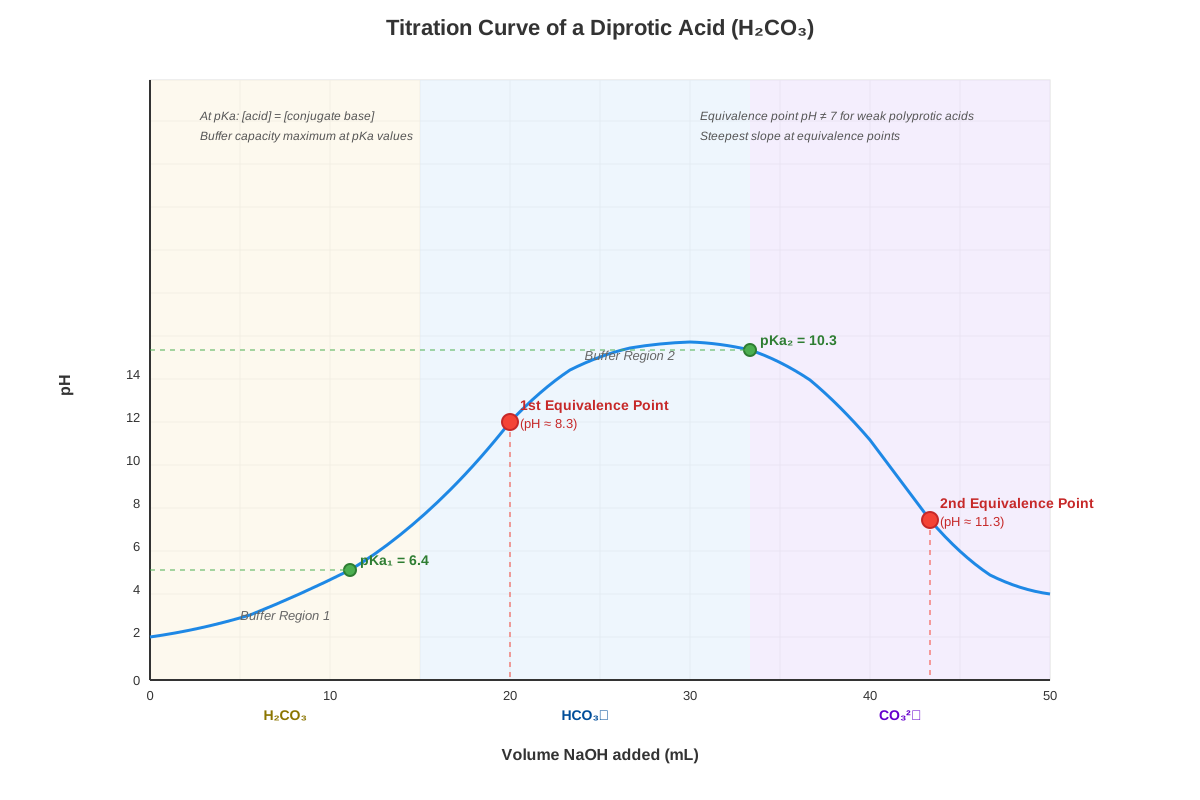
Titration of a polyprotic acid with strong base produces a curve with multiple equivalence points and multiple buffer regions. For a diprotic acid H₂A:
Key features:
- First equivalence point: All H₂A converted to HA⁻ (volume = V₁)
- First buffer region: Centered at pH = pKa1 (volume ≈ V₁/2)
- Second equivalence point: All HA⁻ converted to A²⁻ (volume = 2V₁)
- Second buffer region: Centered at pH = pKa2 (volume ≈ 3V₁/2)
The pH at each equivalence point is NOT 7.0:
- First equivalence point pH: Determined by the amphiprotic species HA⁻, calculated as pH ≈ (pKa1 + pKa2)/2
- Second equivalence point pH: Determined by the basic hydrolysis of A²⁻, pH > 7
The buffer capacity is greatest at pH = pKa, where the acid and conjugate base concentrations are equal. The flattest regions of the titration curve occur at these points.
Henderson-Hasselbalch Applications
The Henderson-Hasselbalch equation applies to each conjugate acid-base pair in a polyprotic system:
For H₂A/HA⁻:  pH = pKa1 + log([HA⁻]/[H₂A])
For HA⁻/A²⁻:  pH = pKa2 + log([A²⁻]/[HA⁻])
This equation is particularly useful for:
- Calculating pH in buffer regions during titration
- Determining the ratio of species at a given pH
- Designing buffers with specific pH values
- Analyzing physiological buffer systems
Amphiprotic Species
The intermediate forms of polyprotic acids (HA⁻ for diprotic, H₂A⁻ and HA²⁻ for triprotic) are amphiprotic or amphoteric—they can act as either acids or bases. For example, HCO₃⁻ can:
- Accept a proton: HCO₃⁻ + H⁺ → H₂CO₃ (acting as base)
- Donate a proton: HCO₃⁻ → H⁺ + CO₃²⁻ (acting as acid)
This dual nature is crucial for buffer function. The pH of a solution containing only an amphiprotic species is approximated by:
pH ≈ (pKa1 + pKa2)/2This approximation works when Ka1 and Ka2 differ by several orders of magnitude.
Concept Relationships
The study of polyprotic acids integrates multiple fundamental concepts in General Chemistry. The foundation begins with Brønsted-Lowry acid-base theory, which defines acids as proton donors—polyprotic acids simply extend this by donating multiple protons sequentially. Each dissociation step is governed by chemical equilibrium principles, with Ka expressions quantifying the extent of each deprotonation.
Sequential dissociation → decreasing Ka values → pH-dependent speciation
The relationship between Ka values and pH determines which species predominates at any given pH, connecting directly to buffer chemistry. Each conjugate acid-base pair (H₂A/HA⁻, HA⁻/A²⁻) can function as a buffer when present in comparable concentrations, which occurs when pH ≈ pKa. This links to the Henderson-Hasselbalch equation, which quantifies the pH-ratio relationship for each pair.
Buffer regions → Henderson-Hasselbalch equation → pH calculations
Polyprotic acid behavior is visualized through titration curves, which connect to stoichiometry and neutralization reactions. The number of equivalence points equals the number of ionizable protons, and the pH at these points depends on the hydrolysis behavior of the resulting species. This connects to hydrolysis equilibria and the concept that salts of weak acids produce basic solutions.
Titration → equivalence points → amphiprotic species → hydrolysis
In biological contexts, polyprotic acids connect to biochemistry through amino acids (which have both carboxyl and amino groups), nucleotides (containing phosphate groups), and metabolic intermediates. The carbonic acid-bicarbonate system links to respiratory physiology and acid-base homeostasis, demonstrating how polyprotic equilibria maintain physiological pH.
Physiological buffers → carbonic acid system → pH homeostasis → clinical medicine
High-Yield Facts
⭐ Ka1 is always greater than Ka2, which is always greater than Ka3 for any polyprotic acid due to increasing difficulty of removing protons from increasingly negative species.
⭐ The pH of a polyprotic acid solution is primarily determined by the first dissociation (Ka1) because subsequent Ka values are much smaller.
⭐ At pH = pKa, the concentrations of the acid and its conjugate base are equal, creating maximum buffer capacity.
⭐ The number of equivalence points in a titration equals the number of ionizable protons in the polyprotic acid.
⭐ The pH at the first equivalence point of a diprotic acid is approximately (pKa1 + pKa2)/2 because the amphiprotic species HA⁻ is present.
- Phosphoric acid (H₃PO₄) has three pKa values: 2.12, 7.21, and 12.32, making it useful for buffers across a wide pH range.
- Carbonic acid (H₂CO₃) has pKa1 = 6.37 and pKa2 = 10.32, with the H₂CO₃/HCO₃⁻ pair buffering blood at pH 7.4.
- Sulfuric acid (H₂SO₄) is a strong acid for the first dissociation but a weak acid (Ka2 = 1.2 × 10⁻²) for the second dissociation.
- The predominant species can be predicted without calculation: if pH < pKa, the protonated form predominates; if pH > pKa, the deprotonated form predominates.
- Buffer regions on titration curves are flattest (most resistant to pH change) at the half-equivalence points where pH = pKa.
- Amino acids are polyprotic with typical pKa values around 2 (carboxyl group), 9-10 (amino group), and sometimes a third for side chains.
- The isoelectric point (pI) of an amino acid is the pH where it has no net charge, calculated as the average of the two pKa values surrounding the zwitterion form.
Quick check — test yourself on Polyprotic acids so far.
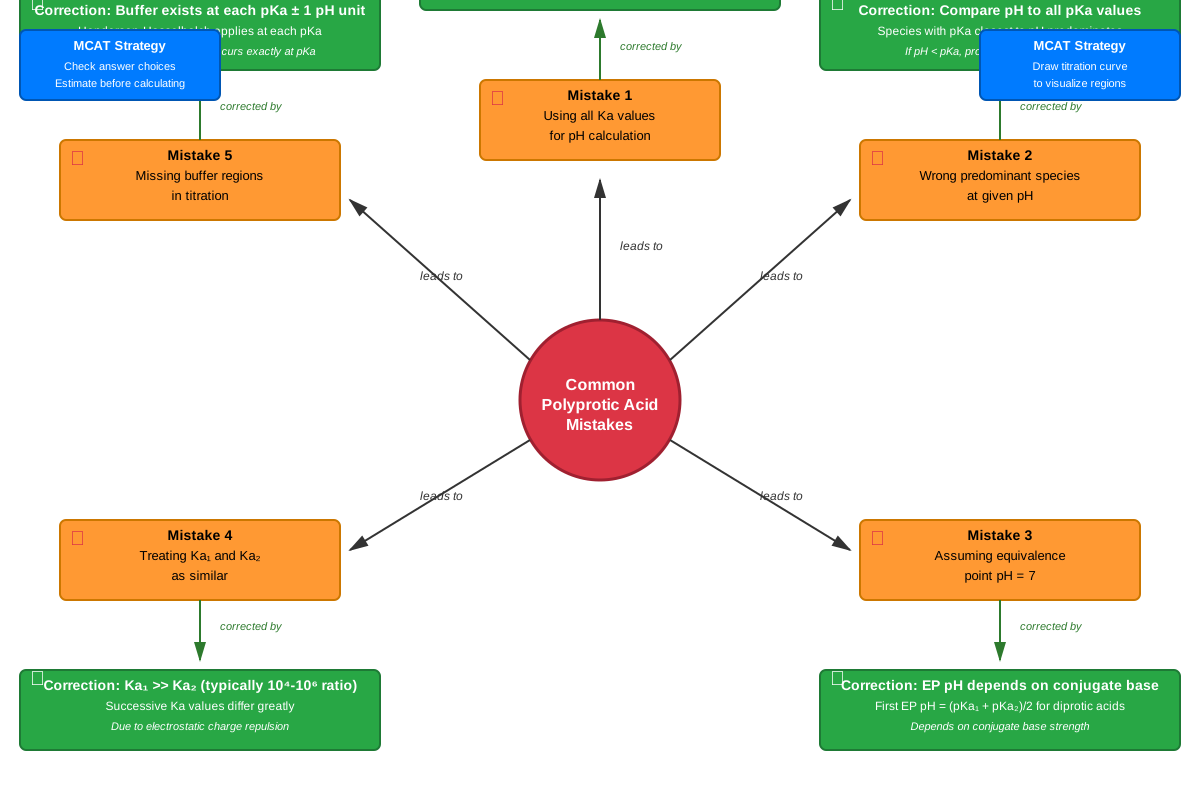
Try Flashcards →Common Misconceptions
Misconception: All dissociation steps of a polyprotic acid occur simultaneously.
Correction: Dissociation occurs sequentially, with each step having its own equilibrium. Because Ka1 >> Ka2, the first dissociation is essentially complete before the second begins. This allows treatment of each step independently in most calculations.
Misconception: The pH at the equivalence point of a polyprotic acid titration is always 7.0.
Correction: Only strong acid-strong base titrations have equivalence points at pH 7. For polyprotic acids, the first equivalence point involves an amphiprotic species (HA⁻), giving pH ≈ (pKa1 + pKa2)/2, while the second equivalence point involves a basic anion (A²⁻), giving pH > 7.
Misconception: You must account for all dissociation steps when calculating the pH of a polyprotic acid solution.
Correction: For most polyprotic acids, the first dissociation dominates [H⁺] because Ka1 >> Ka2. The second dissociation contributes negligibly to [H⁺] and can be ignored for pH calculations. Only when Ka1 and Ka2 are within 10³ of each other do both need consideration.
Misconception: Polyprotic acids have multiple equivalence points at the same pH.
Correction: Each equivalence point occurs at a different pH because each represents a different chemical species. The first equivalence point (HA⁻ for diprotic) has a lower pH than the second (A²⁻) because HA⁻ is less basic than A²⁻.
Misconception: The Henderson-Hasselbalch equation cannot be used for polyprotic acids.
Correction: The Henderson-Hasselbalch equation applies to each conjugate acid-base pair independently. For a diprotic acid, use pH = pKa1 + log([HA⁻]/[H₂A]) for the first pair and pH = pKa2 + log([A²⁻]/[HA⁻]) for the second pair, depending on which species are present.
Misconception: Buffer capacity is constant throughout the titration of a polyprotic acid.
Correction: Buffer capacity is maximum at pH = pKa (the half-equivalence points) where acid and conjugate base concentrations are equal. Buffer capacity is minimal at equivalence points where only one species predominates.
Worked Examples
Example 1: pH Calculation for Phosphoric Acid Solution
Question: Calculate the pH of a 0.10 M solution of phosphoric acid (H₃PO₄). Given: Ka1 = 7.5 × 10⁻³, Ka2 = 6.2 × 10⁻⁸, Ka3 = 4.8 × 10⁻¹³.
Solution:
Step 1: Recognize that Ka1 >> Ka2 >> Ka3, so only the first dissociation significantly contributes to [H⁺].
Step 2: Write the first dissociation equilibrium:
H₃PO₄ ⇌ H⁺ + H₂PO₄⁻Step 3: Set up the ICE table:
           [H₃PO₄]    [H⁺]    [H₂PO₄⁻]
Initial:    0.10       0        0
Change:     -x        +x       +x
Equilibrium: 0.10-x    x        x
Step 4: Write the Ka1 expression:
Ka1 = [H⁺][H₂PO₄⁻]/[H₃PO₄] = x²/(0.10-x) = 7.5 × 10⁻³Step 5: Check if the approximation 0.10 - x ≈ 0.10 is valid:
Ka1/C = (7.5 × 10⁻³)/(0.10) = 0.075 = 7.5%
Since this is greater than 5%, we cannot use the approximation and must solve the quadratic:
x² = 7.5 × 10⁻³(0.10 - x)
x² = 7.5 × 10⁻⁴ - 7.5 × 10⁻³x
x² + 7.5 × 10⁻³x - 7.5 × 10⁻⁴ = 0
Step 6: Using the quadratic formula:
x = [-7.5 × 10⁻³ ± √((7.5 × 10⁻³)² + 4(7.5 × 10⁻⁴))]/2
x = [-7.5 × 10⁻³ ± √(5.625 × 10⁻⁵ + 3.0 × 10⁻³)]/2
x = [-7.5 × 10⁻³ ± 0.0553]/2
x = 0.024 M (taking the positive root)
Step 7: Calculate pH:
pH = -log[H⁺] = -log(0.024) = 1.62Answer: pH = 1.62
Connection to learning objectives: This example demonstrates pH calculation for polyprotic acids and reinforces that the first dissociation dominates, a high-yield concept for MCAT problem-solving.
Example 2: Titration Curve Analysis
Question: A 25.0 mL sample of 0.100 M carbonic acid (H₂CO₃) is titrated with 0.100 M NaOH. Given: pKa1 = 6.37, pKa2 = 10.32.
(a) Calculate the pH at the first equivalence point.
(b) What volume of NaOH is required to reach the second equivalence point?
(c) What is the predominant species at pH 8.0?
Solution:
(a) pH at first equivalence point:
Step 1: At the first equivalence point, all H₂CO₃ has been converted to HCO₃⁻, an amphiprotic species.
Step 2: For an amphiprotic species, use the approximation:
pH ≈ (pKa1 + pKa2)/2 = (6.37 + 10.32)/2 = 8.35Answer (a): pH ≈ 8.35
(b) Volume to second equivalence point:
Step 1: The second equivalence point occurs when all HCO₃⁻ is converted to CO₃²⁻, requiring neutralization of both acidic protons.
Step 2: Calculate moles of H₂CO₃:
moles = M × V = 0.100 M × 0.0250 L = 0.00250 molStep 3: Two moles of NaOH are required per mole of H₂CO₃ to reach the second equivalence point:
moles NaOH needed = 2 × 0.00250 = 0.00500 molStep 4: Calculate volume of NaOH:
V = moles/M = 0.00500 mol / 0.100 M = 0.0500 L = 50.0 mLAnswer (b): 50.0 mL NaOH
(c) Predominant species at pH 8.0:
Step 1: Compare pH to pKa values:
- pH 8.0 is greater than pKa1 (6.37), so H₂CO₃ is mostly deprotonated to HCO₃⁻
- pH 8.0 is less than pKa2 (10.32), so HCO₃⁻ is mostly protonated (not yet converted to CO₃²⁻)
Step 2: Since pH is between pKa1 and pKa2, the intermediate form predominates.
Answer (c): HCO₃⁻ (bicarbonate) is the predominant species at pH 8.0
Connection to learning objectives: This example integrates titration stoichiometry, pH prediction at equivalence points, and species predominance—all essential skills for MCAT success with polyprotic acids.
Exam Strategy
Approaching MCAT Questions on Polyprotic Acids
Step 1: Identify the type of question
- pH calculation: Use Ka1 and ignore subsequent dissociations unless specified
- Titration analysis: Count equivalence points and identify buffer regions
- Species predominance: Compare pH to pKa values
- Buffer problems: Apply Henderson-Hasselbalch to the appropriate conjugate pair
Step 2: Extract key information
- Note all Ka or pKa values provided
- Identify the initial species (fully protonated, intermediate, or fully deprotonated)
- Determine what the question asks for (pH, volume, ratio, predominant species)
Step 3: Apply the appropriate simplification
- For pH calculations, assume only Ka1 matters unless Ka1 and Ka2 are close
- For titration curves, recognize that equivalence points = number of protons
- For buffer regions, use pH ≈ pKa at half-equivalence points
Trigger Words and Phrases
Watch for these exam signals:
- "Diprotic" or "triprotic": Immediately think multiple dissociations and multiple pKa values
- "Equivalence point": Consider which species is present and whether it's amphiprotic or basic
- "Buffer region": Look for pH ≈ pKa and apply Henderson-Hasselbalch
- "Predominant species": Compare pH to pKa values without calculation
- "Physiological pH": Often refers to carbonic acid/bicarbonate system (pH 7.4)
- "Phosphate buffer": Think H₂PO₄⁻/HPO₄²⁻ pair with pKa2 = 7.21
Process of Elimination Tips
- Eliminate answers where pH at equivalence point = 7.0 for weak polyprotic acids (only true for strong acid-strong base)
- Eliminate species that cannot exist at the given pH: If pH >> pKa, the protonated form is negligible
- Eliminate titration curves with wrong number of equivalence points: Must equal number of ionizable protons
- Eliminate Ka values that increase (Ka1 must be largest): This violates fundamental principles
Time Allocation
- Qualitative questions (predominant species, buffer identification): 30-45 seconds
- Simple calculations (pH using Ka1 only): 60-90 seconds
- Complex calculations (titration stoichiometry, quadratic equations): 2-3 minutes
- Passage-based questions: Read passage (2-3 minutes), then 60-90 seconds per question
Exam Tip: If a calculation seems too complex, look for conceptual shortcuts. The MCAT often tests understanding over computation. For example, knowing that pH at the first equivalence point ≈ (pKa1 + pKa2)/2 is faster than detailed calculation.
Memory Techniques
Mnemonics
"First Proton Leaves Easily, Next Needs Energy" - Reminds you that Ka1 > Ka2 > Ka3 because each successive proton is harder to remove from an increasingly negative species.
"PHEN" - Polyprotic acids have Half-Equivalence points at pH = pKa, where buffer capacity is maximum, and Neutral (amphiprotic) species at equivalence points.
"Between the pKs, the Middle Sticks" - When pH is between pKa1 and pKa2, the intermediate form (HA⁻ for diprotic) predominates.
Visualization Strategy
Mental titration curve template:
- Visualize a staircase with steps (buffer regions) and risers (equivalence points)
- Number of steps = number of ionizable protons
- Each step is centered at pH = pKa (flattest part)
- Each riser represents complete conversion to the next species
Species predominance ruler:
H₂A ←—pKa1—→ HA⁻ ←—pKa2—→ A²⁻
     (equal)        (equal)
Mentally place the pH on this ruler to instantly identify predominant species.
Acronym for Phosphoric Acid pKa Values
"2 Phosphates, 7 Hydrogens, 12 Oxygens" - Approximates H₃PO₄ pKa values: 2, 7, 12 (actual: 2.12, 7.21, 12.32)
Pattern Recognition
The "10⁴ to 10⁶ Rule": Successive Ka values typically differ by 10⁴ to 10⁶, meaning you can almost always ignore all but the first dissociation for pH calculations.
The "Average pKa Rule": pH at the first equivalence point of a diprotic acid ≈ (pKa1 + pKa2)/2 because the amphiprotic species is present.
Summary
Polyprotic acids are acids capable of donating multiple protons through sequential dissociation steps, each characterized by progressively smaller Ka values due to increasing difficulty of removing protons from negatively charged species. The first dissociation (Ka1) dominates pH calculations because Ka1 >> Ka2 >> Ka3, allowing most problems to be simplified by considering only the first step. Titration of polyprotic acids produces curves with multiple equivalence points (equal to the number of ionizable protons) and multiple buffer regions centered at pH = pKa values. The predominant species at any pH can be predicted by comparing pH to pKa values: below pKa, the protonated form predominates; above pKa, the deprotonated form predominates. Amphiprotic intermediate species (like HCO₃⁻ or H₂PO₄⁻) can act as both acids and bases, making them crucial for biological buffer systems. The Henderson-Hasselbalch equation applies independently to each conjugate acid-base pair, enabling pH calculations in buffer regions. For the MCAT, mastery requires understanding conceptual relationships (Ka trends, species predominance), quantitative skills (pH calculations, titration stoichiometry), and recognition of physiological applications (carbonic acid-bicarbonate and phosphate buffer systems).
Key Takeaways
- Polyprotic acids undergo sequential dissociation with Ka1 > Ka2 > Ka3, and the first dissociation dominates pH calculations in most scenarios
- The number of equivalence points in a titration equals the number of ionizable protons, with each equivalence point occurring at a different pH
- Predominant species can be predicted by comparing pH to pKa values: pH < pKa favors protonated form; pH > pKa favors deprotonated form
- Buffer regions occur at pH ≈ pKa (half-equivalence points) where acid and conjugate base concentrations are equal and buffer capacity is maximum
- The pH at the first equivalence point of a diprotic acid is approximately (pKa1 + pKa2)/2 due to the amphiprotic nature of the intermediate species
- Physiological buffer systems (carbonic acid-bicarbonate, phosphate) are polyprotic and maintain pH homeostasis in biological systems
- Henderson-Hasselbalch equation applies to each conjugate pair independently, making it a versatile tool for polyprotic acid calculations
Related Topics
Amino Acid Chemistry and Isoelectric Points: Amino acids are polyprotic with carboxyl and amino groups, requiring understanding of multiple pKa values to predict charge state and calculate isoelectric points. Mastering polyprotic acids enables analysis of amino acid behavior at different pH values, essential for biochemistry passages.
Solubility Equilibria and Polyprotic Anions: Many insoluble salts contain polyprotic anions (phosphate, carbonate, sulfide), and their solubility is pH-dependent. Understanding polyprotic acid equilibria allows prediction of how pH changes affect salt solubility through common ion effects and Le Chatelier's principle.
Respiratory and Metabolic Acid-Base Disorders: The carbonic acid-bicarbonate buffer system links polyprotic acid chemistry to clinical medicine. Understanding this system enables interpretation of blood gas data and diagnosis of acidosis/alkalosis, frequently tested in biological sciences passages.
Buffer Capacity and Buffer Design: Each conjugate pair in a polyprotic system can function as a buffer, and understanding pKa values allows selection of appropriate buffers for specific pH ranges. This connects to laboratory techniques and experimental design questions.
Redox Chemistry and pH Dependence: Many redox reactions involve proton transfer, and polyprotic acids can participate in coupled acid-base and redox processes. Understanding pH-dependent speciation enables prediction of redox behavior in different pH environments.
Practice CTA
Now that you've mastered the core concepts of polyprotic acids, it's time to solidify your understanding through active practice. Work through the practice questions to test your ability to calculate pH values, interpret titration curves, and predict predominant species—skills that appear frequently on the MCAT. Use the flashcards to reinforce high-yield facts like pKa values for common polyprotic acids and the relationship between pH and species predominance. Remember, polyprotic acids integrate multiple General Chemistry concepts, so each practice problem strengthens your overall acid-base reasoning. Your investment in mastering this topic will pay dividends not only in discrete questions but also in complex passage-based scenarios involving physiological buffers and laboratory titrations. You've got this!
Sign up free to keep reading
Create a free AnvayaPrep account to finish this MCAT guide on Polyprotic acids — plus flashcards and practice questions.