Overview
Average atomic mass is a fundamental concept in General Chemistry that bridges atomic theory with practical laboratory measurements and real-world applications. Unlike the mass number, which represents the total number of protons and neutrons in a single atom, average atomic mass accounts for the natural distribution of isotopes found in nature. This weighted average reflects the fact that most elements exist as mixtures of isotopes, each with different masses and relative abundances. Understanding this concept is essential for accurate stoichiometric calculations, molecular weight determinations, and interpreting mass spectrometry data—all of which appear regularly on the MCAT.
For the MCAT, average atomic mass serves as a gateway concept connecting Atomic Structure and Periodic Trends to quantitative problem-solving throughout chemistry and biochemistry. The periodic table values students use for molar mass calculations are actually average atomic masses, making this topic foundational for dimensional analysis, limiting reagent problems, and concentration calculations. The MCAT frequently tests whether students understand why atomic masses are not whole numbers and can apply isotopic abundance data to calculate weighted averages or work backward from average atomic mass to determine isotopic composition.
This topic integrates seamlessly with broader themes in General Chemistry MCAT preparation, including nuclear chemistry, mass spectrometry, radioactive decay, and molecular formula determination. Students who master average atomic mass develop stronger quantitative reasoning skills and gain deeper insight into the relationship between microscopic atomic properties and macroscopic measurements. The concept also reinforces critical thinking about significant figures, measurement precision, and the distinction between theoretical models and experimental observations—all high-yield skills for the Chemical and Physical Foundations of Biological Systems section.
Learning Objectives
- [ ] Define Average atomic mass using accurate General Chemistry terminology
- [ ] Explain why Average atomic mass matters for the MCAT
- [ ] Apply Average atomic mass to exam-style questions
- [ ] Identify common mistakes related to Average atomic mass
- [ ] Connect Average atomic mass to related General Chemistry concepts
- [ ] Calculate average atomic mass from isotopic abundance data with proper significant figures
- [ ] Determine isotopic abundances when given average atomic mass and individual isotope masses
- [ ] Interpret mass spectrometry data to extract isotopic information and calculate average atomic mass
- [ ] Distinguish between mass number, atomic mass, and average atomic mass in various contexts
Prerequisites
- Atomic structure fundamentals: Understanding protons, neutrons, and electrons is essential because isotopes differ only in neutron number, which directly affects atomic mass
- Isotope notation and terminology: Familiarity with isotope symbols (e.g., ¹²C vs ¹³C) enables interpretation of problems involving multiple isotopes of the same element
- Basic algebra and weighted averages: Mathematical proficiency with weighted average calculations forms the computational foundation for all average atomic mass problems
- Significant figures and scientific notation: Proper handling of measurement precision ensures accurate calculations and appropriate answer choices on quantitative MCAT questions
- Periodic table navigation: Knowing how to locate and interpret atomic mass values on the periodic table is necessary for stoichiometry and molecular weight calculations
Why This Topic Matters
Clinical and Real-World Significance
Average atomic mass has profound implications in medical diagnostics and treatment. Radioactive isotopes used in nuclear medicine (such as ¹³¹I for thyroid cancer treatment or ⁹⁹ᵐTc for imaging) must be distinguished from stable isotopes of the same element. Understanding isotopic composition enables physicians to calculate precise dosing for radiopharmaceuticals. In forensic science and archaeology, isotopic analysis (carbon-14 dating, stable isotope analysis) relies on accurate knowledge of isotopic abundances. Pharmaceutical chemistry uses isotopic labeling to track drug metabolism, requiring precise understanding of how isotopes affect molecular mass without changing chemical properties.
MCAT Exam Statistics and Question Types
Average atomic mass appears in approximately 3-5% of Chemical and Physical Foundations questions, typically integrated with stoichiometry, mass spectrometry, or nuclear chemistry passages. The MCAT tests this concept through:
- Discrete questions asking for direct calculation of average atomic mass from isotopic data
- Passage-based questions involving mass spectrometry interpretation where students must extract isotopic abundances from spectra
- Stoichiometry problems requiring use of average atomic mass for molar mass calculations
- Conceptual questions distinguishing between mass number and average atomic mass
- Data interpretation questions presenting isotopic abundance tables and asking for quantitative analysis
Common Exam Passage Contexts
The MCAT frequently embeds average atomic mass within passages about:
- Mass spectrometry analysis of organic compounds or biological molecules
- Radioisotope dating techniques in geology or archaeology
- Nuclear medicine applications and radiotracer studies
- Environmental chemistry involving isotopic signatures (carbon, nitrogen, oxygen isotopes)
- Analytical chemistry methods for determining elemental composition
Core Concepts
Definition and Fundamental Understanding
Average atomic mass (also called atomic weight) represents the weighted average of the masses of all naturally occurring isotopes of an element, expressed in atomic mass units (amu) or unified atomic mass units (u). This value accounts for both the mass of each isotope and its relative abundance in nature. The mathematical formula for average atomic mass is:
Average Atomic Mass = Σ(isotope mass × fractional abundance)Where fractional abundance is expressed as a decimal (e.g., 75% = 0.75) and the sum includes all naturally occurring isotopes. This weighted average explains why atomic masses on the periodic table are rarely whole numbers—they reflect the natural isotopic mixture rather than a single isotope's mass.
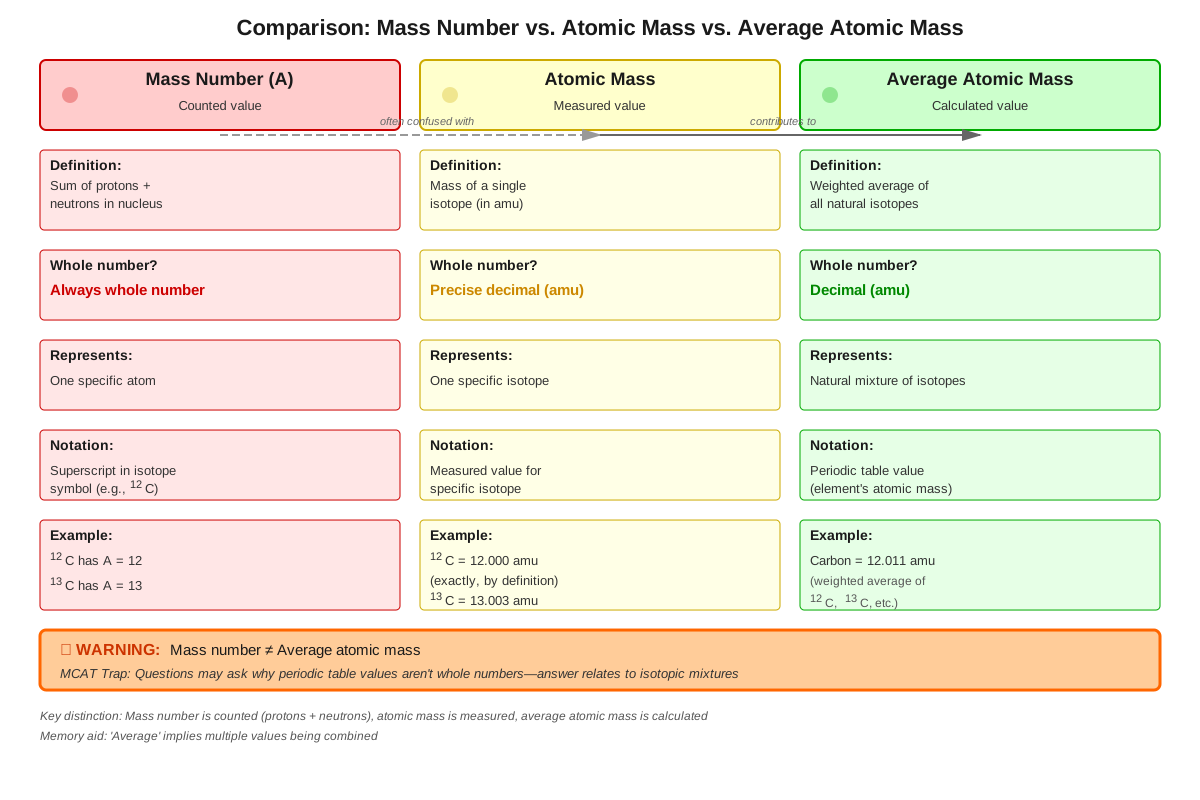
The mass number (A) of a specific isotope equals the sum of protons and neutrons and is always a whole number. In contrast, average atomic mass incorporates the distribution of multiple isotopes and typically includes decimal places. For example, carbon has a mass number of 12 for ¹²C specifically, but carbon's average atomic mass is 12.01 amu because natural carbon contains approximately 98.9% ¹²C and 1.1% ¹³C.
Isotopic Abundance and Natural Variation
Isotopic abundance refers to the percentage or fraction of each isotope present in a naturally occurring sample of an element. These abundances remain relatively constant across most terrestrial samples, which is why the periodic table lists a single average atomic mass value for each element. However, slight variations can occur due to:
- Geographic origin of the sample
- Biological or chemical fractionation processes
- Radioactive decay in the environment
- Industrial enrichment or depletion
For MCAT purposes, assume standard natural abundances unless the question specifies otherwise. Elements with only one stable isotope (monoisotopic elements) have average atomic masses very close to whole numbers because no averaging occurs. Examples include fluorine-19, sodium-23, and phosphorus-31.
Calculation Methods and Problem-Solving Approaches
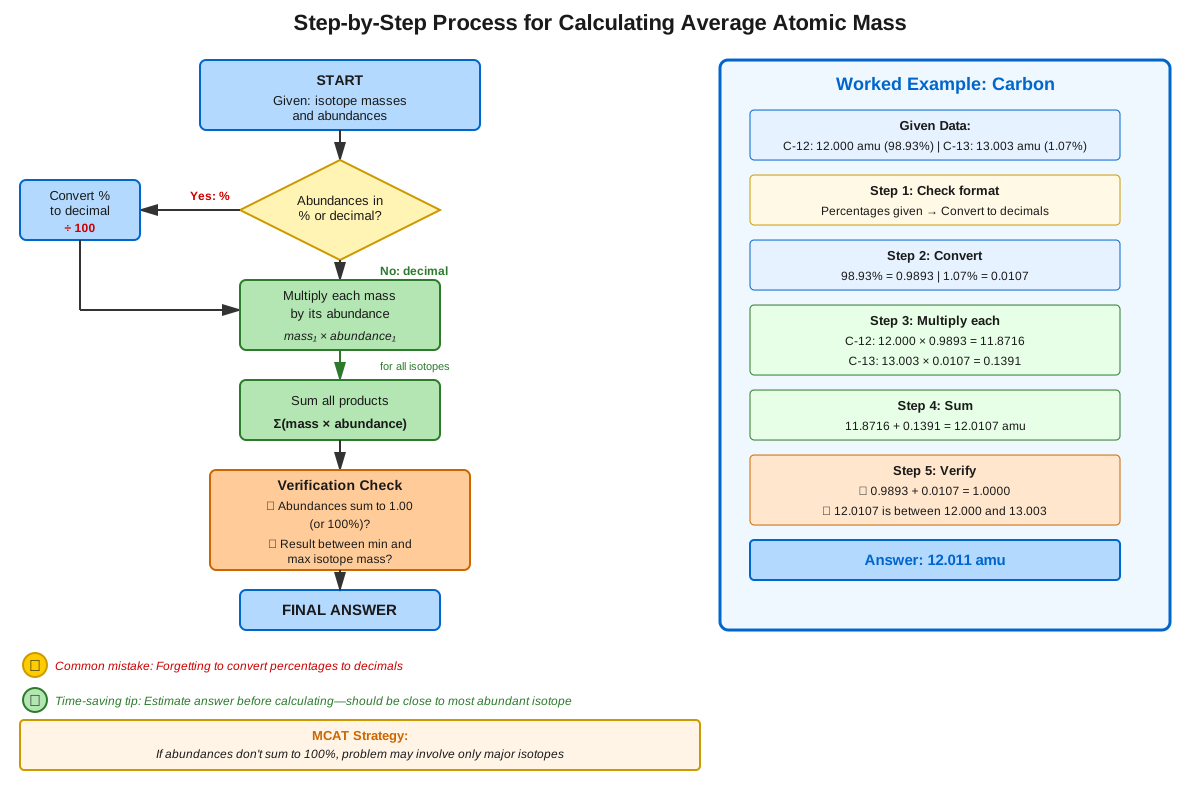
Direct calculation from isotopic data follows this systematic approach:
- Convert all percentages to decimal fractions (divide by 100)
- Multiply each isotope's mass by its fractional abundance
- Sum all products to obtain the average atomic mass
- Express the answer with appropriate significant figures
Example calculation: Chlorine exists as 75.77% ³⁵Cl (mass = 34.97 amu) and 24.23% ³⁷Cl (mass = 36.97 amu).
Average atomic mass = (34.97 × 0.7577) + (36.97 × 0.2423)
                    = 26.50 + 8.96
                    = 35.46 amu
Reverse calculation (determining isotopic abundance from average atomic mass) requires algebraic manipulation. If an element has two isotopes with masses m₁ and m₂, and the fractional abundance of isotope 1 is x, then:
Average atomic mass = (m₁ × x) + (m₂ × (1 - x))Solve for x by rearranging:
x = (Average atomic mass - m₂) / (m₁ - m₂)Relationship to the Periodic Table
The atomic mass values listed on the periodic table are average atomic masses based on naturally occurring isotopic distributions. These values serve as the foundation for:
- Molar mass calculations: The average atomic mass in amu numerically equals the molar mass in g/mol
- Stoichiometric conversions: Converting between mass and moles requires accurate average atomic mass values
- Molecular weight determination: Summing average atomic masses of constituent atoms yields molecular weight
The Atomic Structure and Periodic Trends unit emphasizes that while chemical properties depend primarily on electron configuration (determined by atomic number), physical properties like density and mass depend on average atomic mass. This distinction is crucial for understanding why isotopes have identical chemical behavior but different physical properties.
Mass Spectrometry Connection
Mass spectrometry provides experimental data for determining isotopic abundances. A mass spectrum displays:
- x-axis: mass-to-charge ratio (m/z), which equals mass for singly charged ions
- y-axis: relative abundance (intensity) of each ion
The height of each peak corresponds to the relative abundance of that isotope. To calculate average atomic mass from a mass spectrum:
- Identify peaks corresponding to different isotopes
- Determine the mass (m/z value) for each peak
- Measure relative peak heights (intensities)
- Convert intensities to fractional abundances by dividing each by the total
- Apply the weighted average formula
| Isotope | Mass (amu) | Relative Intensity | Fractional Abundance | Contribution to Average |
|---|---|---|---|---|
| ⁶³Cu | 62.93 | 69.2 | 0.692 | 43.55 |
| ⁶⁵Cu | 64.93 | 30.8 | 0.308 | 20.00 |
| Total | — | 100.0 | 1.000 | 63.55 amu |
Precision and Significant Figures
Average atomic mass calculations require careful attention to significant figures. The final answer should reflect the precision of the input data:
- Isotopic masses are typically given to 4-5 significant figures
- Abundances may be given as percentages (2-4 significant figures)
- The limiting factor determines the precision of the final answer
- MCAT answer choices typically differ by enough that rounding to 2-3 decimal places suffices
When performing calculations without a calculator (as on the MCAT), strategic rounding can simplify arithmetic while maintaining sufficient accuracy to distinguish between answer choices.
Concept Relationships
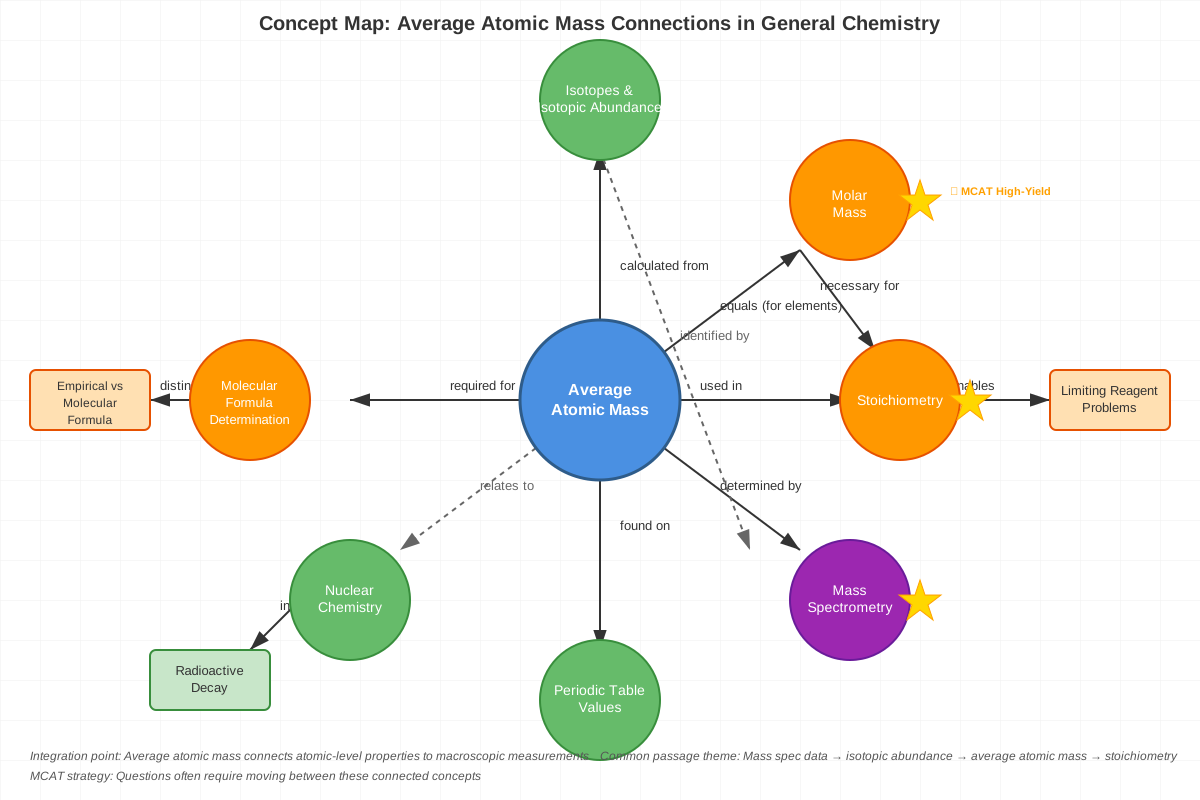
Average atomic mass serves as a central hub connecting multiple concepts within General Chemistry. The relationship map flows as follows:
Atomic Structure → Isotopes → Average Atomic Mass → Molar Mass → Stoichiometry
Understanding that atoms consist of protons, neutrons, and electrons leads to recognizing that isotopes (atoms with the same number of protons but different numbers of neutrons) have different masses. These isotopic masses, weighted by natural abundance, yield average atomic mass. This average atomic mass value then becomes the conversion factor between atomic-scale measurements (amu) and laboratory-scale measurements (grams per mole), enabling all stoichiometric calculations.
Average atomic mass also connects laterally to:
- Nuclear chemistry: Radioactive isotopes contribute to understanding how isotopic composition changes over time through decay processes
- Mass spectrometry: Analytical technique that experimentally determines isotopic abundances, providing the data needed to calculate average atomic mass
- Periodic trends: While average atomic mass generally increases down a group and across a period, it's distinct from atomic number and doesn't follow perfectly regular patterns due to isotopic variation
Within the topic itself, the concepts interconnect hierarchically:
- Isotope definition provides the foundation
- Isotopic abundance quantifies the distribution
- Weighted average calculation combines mass and abundance
- Periodic table values represent the practical application
- Stoichiometric applications demonstrate real-world utility
The prerequisite knowledge of weighted averages from mathematics directly enables the computational aspect, while understanding atomic structure provides the conceptual framework. This integration of mathematical and conceptual understanding exemplifies the interdisciplinary nature of MCAT preparation.
High-Yield Facts
⭐ Average atomic mass is a weighted average of all naturally occurring isotopes, not a simple arithmetic mean
⭐ The atomic mass values on the periodic table are average atomic masses in atomic mass units (amu), which numerically equal molar mass in g/mol
⭐ Isotopes have identical chemical properties but different masses, making average atomic mass essential for accurate stoichiometric calculations
⭐ To calculate average atomic mass: multiply each isotope's mass by its fractional abundance (as a decimal), then sum all products
⭐ Mass spectrometry peak heights represent relative abundances of isotopes, enabling experimental determination of average atomic mass
- Elements with only one naturally occurring isotope have average atomic masses very close to whole numbers
- Fractional abundances must sum to 1.00 (or percentages must sum to 100%) for all isotopes of an element
- The average atomic mass always falls between the masses of the lightest and heaviest naturally occurring isotopes
- Carbon-12 is defined as exactly 12.000 amu and serves as the reference standard for the atomic mass scale
- Significant figures in average atomic mass calculations are determined by the least precise input value (typically the abundance data)
Quick check — test yourself on Average atomic mass so far.
Try Flashcards →Common Misconceptions
Misconception: Average atomic mass is the same as mass number
Correction: Mass number (A) is the sum of protons and neutrons in a specific isotope and is always a whole number. Average atomic mass is a weighted average of all naturally occurring isotopes and typically includes decimal places. For example, chlorine-35 has a mass number of 35, but chlorine's average atomic mass is 35.45 amu.
Misconception: The most abundant isotope's mass equals the element's average atomic mass
Correction: Average atomic mass accounts for all isotopes weighted by abundance. Even if one isotope dominates (e.g., ¹²C at 98.9%), the presence of other isotopes (¹³C at 1.1%) shifts the average away from the dominant isotope's exact mass. The average atomic mass of carbon is 12.01 amu, not 12.00 amu.
Misconception: Isotopic abundances are the same everywhere in nature
Correction: While isotopic abundances are relatively constant for most terrestrial samples, variations occur due to radioactive decay, biological fractionation, and environmental processes. This is why some periodic tables list ranges for certain elements' atomic masses. For MCAT purposes, assume standard abundances unless stated otherwise.
Misconception: You can calculate average atomic mass by simply averaging the mass numbers of the isotopes
Correction: Average atomic mass requires weighting by fractional abundance, not a simple arithmetic mean. For bromine with ⁷⁹Br and ⁸¹Br in roughly equal amounts, the arithmetic mean would be 80.0, but the actual average atomic mass is 79.90 amu because ⁷⁹Br is slightly more abundant (50.69% vs 49.31%).
Misconception: Atomic mass and atomic weight are completely different concepts
Correction: These terms are often used interchangeably in chemistry, both referring to average atomic mass. Historically, "atomic weight" was the standard term, but "average atomic mass" is more technically accurate since it's a mass, not a weight (which would require gravitational force). The MCAT may use either term.
Misconception: All isotopes of an element are radioactive
Correction: Most elements have at least one stable (non-radioactive) isotope. Only elements with atomic number 84 (polonium) and higher have no stable isotopes. The isotopes used to calculate average atomic mass are typically stable isotopes that persist in nature without decaying.
Misconception: Average atomic mass calculations always require complex decimals
Correction: On the MCAT, strategic rounding and estimation often suffice. If chlorine is 75% ³⁵Cl (35 amu) and 25% ³⁷Cl (37 amu), you can estimate: (0.75 × 35) + (0.25 × 37) ≈ 26.25 + 9.25 = 35.5 amu, which is close enough to distinguish between answer choices.
Worked Examples
Example 1: Direct Calculation of Average Atomic Mass
Problem: Copper exists naturally as two isotopes: ⁶³Cu with a mass of 62.9296 amu (69.17% abundance) and ⁶⁵Cu with a mass of 64.9278 amu (30.83% abundance). Calculate the average atomic mass of copper.
Solution:
Step 1: Convert percentages to decimal fractions
- ⁶³Cu: 69.17% = 0.6917
- ⁶⁵Cu: 30.83% = 0.3083
Step 2: Verify that abundances sum to 1.00
- 0.6917 + 0.3083 = 1.0000 ✓
Step 3: Multiply each isotope's mass by its fractional abundance
- ⁶³Cu contribution: 62.9296 amu × 0.6917 = 43.5289 amu
- ⁶⁵Cu contribution: 64.9278 amu × 0.3083 = 20.0148 amu
Step 4: Sum the contributions
- Average atomic mass = 43.5289 + 20.0148 = 63.5437 amu
Step 5: Round to appropriate significant figures
- Given data has 4 significant figures in abundances
- Final answer: 63.54 amu
Connection to learning objectives: This problem directly applies the definition of average atomic mass and demonstrates the weighted average calculation method. The answer matches the periodic table value for copper, reinforcing the connection between theoretical calculations and practical reference values.
Example 2: Determining Isotopic Abundance from Average Atomic Mass
Problem: Gallium has two naturally occurring isotopes: ⁶⁹Ga (mass = 68.9256 amu) and ⁷¹Ga (mass = 70.9247 amu). The average atomic mass of gallium is 69.723 amu. Calculate the percent abundance of each isotope.
Solution:
Step 1: Define variables
- Let x = fractional abundance of ⁶⁹Ga
- Then (1 - x) = fractional abundance of ⁷¹Ga
Step 2: Set up the weighted average equation
69.723 = (68.9256)(x) + (70.9247)(1 - x)Step 3: Expand and simplify
69.723 = 68.9256x + 70.9247 - 70.9247x
69.723 = 70.9247 - 1.9991x
Step 4: Solve for x
1.9991x = 70.9247 - 69.723
1.9991x = 1.2017
x = 1.2017 / 1.9991
x = 0.6011
Step 5: Calculate both abundances
- ⁶⁹Ga: x = 0.6011 = 60.11%
- ⁷¹Ga: (1 - x) = 0.3989 = 39.89%
Step 6: Verify the answer
(68.9256 × 0.6011) + (70.9247 × 0.3989) = 41.42 + 28.30 = 69.72 amu ✓Connection to learning objectives: This reverse calculation demonstrates algebraic manipulation of the average atomic mass formula and shows how experimental measurements (average atomic mass from the periodic table) can be used to determine isotopic composition. This type of problem frequently appears on the MCAT in mass spectrometry contexts.
Example 3: Mass Spectrometry Interpretation
Problem: A mass spectrum of neon shows three peaks: m/z = 20 (intensity = 90.5), m/z = 21 (intensity = 0.3), and m/z = 22 (intensity = 9.2). Calculate the average atomic mass of neon from this data.
Solution:
Step 1: Calculate total intensity
- Total = 90.5 + 0.3 + 9.2 = 100.0
Step 2: Convert intensities to fractional abundances
- ²⁰Ne: 90.5 / 100.0 = 0.905
- ²¹Ne: 0.3 / 100.0 = 0.003
- ²²Ne: 9.2 / 100.0 = 0.092
Step 3: Calculate weighted average (assuming m/z values equal masses for singly charged ions)
Average atomic mass = (20 × 0.905) + (21 × 0.003) + (22 × 0.092)
                    = 18.10 + 0.063 + 2.024
                    = 20.187 amu
Step 4: Round appropriately
- Final answer: 20.19 amu (matches periodic table value for neon)
Connection to learning objectives: This example integrates mass spectrometry interpretation with average atomic mass calculation, demonstrating how experimental data translates to theoretical values. It also shows that even minor isotopes (²¹Ne at 0.3%) must be included for accurate calculations, though their contribution is small.
Exam Strategy
Approaching MCAT Questions on Average Atomic Mass
Trigger words and phrases that signal average atomic mass questions:
- "Naturally occurring isotopes"
- "Atomic mass on the periodic table"
- "Weighted average"
- "Mass spectrum shows peaks at..."
- "Isotopic abundance"
- "Why is the atomic mass not a whole number?"
When encountering these triggers, immediately recognize that the question involves isotopic distribution and weighted averaging, not simple atomic structure.
Systematic Problem-Solving Approach
- Identify the question type: Direct calculation, reverse calculation, or conceptual understanding
- Extract given information: List all isotope masses and abundances (or what needs to be found)
- Check for completeness: Verify that abundances sum to 100% or that you have enough information to solve
- Set up the equation: Write the weighted average formula before calculating
- Estimate the answer: Determine which isotope is more abundant and predict whether the average will be closer to the lighter or heavier isotope
- Calculate efficiently: Use strategic rounding for MCAT time constraints
- Verify reasonableness: Ensure the answer falls between the lightest and heaviest isotope masses
Process-of-Elimination Tips
- Eliminate answers outside the isotope mass range: Average atomic mass must fall between the lightest and heaviest naturally occurring isotopes
- Eliminate answers too close to minor isotopes: If one isotope is 90% abundant, the average will be very close to that isotope's mass, not near the 10% isotope
- Check for whole numbers: If answer choices include whole numbers and decimals, the decimal is almost always correct for average atomic mass
- Use benchmark values: Memorize common elements' average atomic masses (C = 12.01, N = 14.01, O = 16.00, Cl = 35.45) to quickly eliminate unreasonable answers
Time Allocation Advice
- Discrete questions: Allocate 60-90 seconds for straightforward calculations
- Passage-based questions: Spend 30-45 seconds extracting data from tables or spectra, then 60 seconds calculating
- Conceptual questions: These should take only 30-45 seconds if you understand the underlying principles
- Complex reverse calculations: If a problem requires extensive algebra, consider whether estimation or process of elimination might be faster
Exam Tip: On the MCAT, you won't have a calculator, so practice mental math and strategic rounding. For example, if calculating (35 × 0.75) + (37 × 0.25), recognize that 0.75 = 3/4 and 0.25 = 1/4, making the calculation: (35 × 3/4) + (37 × 1/4) = 26.25 + 9.25 = 35.5
Memory Techniques
Mnemonics and Acronyms
"WAIS" for Average Atomic Mass Calculation:
- Weighted average (not simple mean)
- Abundance as decimals (divide percentages by 100)
- Isotopes all included (don't forget minor ones)
- Sum the products (multiply then add)
"MASS" for Mass Spectrometry Interpretation:
- Measure peak heights (relative intensities)
- Add all intensities (get total)
- Scale to fractions (divide each by total)
- Solve weighted average (multiply and sum)
Visualization Strategies
Number Line Visualization: When estimating average atomic mass, visualize a number line between the two isotope masses. Place a point closer to the more abundant isotope. For example, if ³⁵Cl is 75% and ³⁷Cl is 25%, imagine a line from 35 to 37, and place your estimate at the 3/4 mark (closer to 35), which is approximately 35.5.
Seesaw Analogy: Think of average atomic mass like a seesaw balance point. The heavier isotope pulls the average up, but the more abundant isotope has more "weight" in determining where the balance point (average) falls. A small amount of a heavy isotope won't pull the average as much as a large amount of a lighter isotope.
Conceptual Memory Aids
"The Periodic Table Tells the Truth": Remember that periodic table values are average atomic masses, not mass numbers. When you see 35.45 for chlorine, immediately think "mixture of isotopes" rather than "35 protons + neutrons."
"Decimals = Distribution": The decimal portion of average atomic mass represents isotopic distribution. A value very close to a whole number (like fluorine at 18.998) indicates one dominant isotope, while a value far from whole numbers (like chlorine at 35.45) indicates significant amounts of multiple isotopes.
Summary
Average atomic mass represents the weighted average of all naturally occurring isotopes of an element, accounting for both the mass of each isotope and its relative abundance in nature. This fundamental concept in General Chemistry bridges atomic theory with practical laboratory measurements, serving as the foundation for stoichiometric calculations and molecular weight determinations throughout chemistry and biochemistry. The values listed on the periodic table are average atomic masses expressed in atomic mass units (amu), which numerically equal molar mass in grams per mole. Calculating average atomic mass requires multiplying each isotope's mass by its fractional abundance (expressed as a decimal) and summing all products. Mass spectrometry provides experimental data for determining isotopic abundances by displaying peaks whose heights represent relative abundances of different isotopes. Understanding the distinction between mass number (a whole number for a specific isotope) and average atomic mass (a weighted average with decimal places) is essential for MCAT success, as this concept appears in stoichiometry problems, mass spectrometry interpretation, and nuclear chemistry contexts throughout the exam.
Key Takeaways
- Average atomic mass is a weighted average of naturally occurring isotopes, calculated by multiplying each isotope's mass by its fractional abundance and summing the products
- Periodic table atomic mass values are average atomic masses in amu, which numerically equal molar mass in g/mol for stoichiometric calculations
- Mass number (whole number for a specific isotope) differs fundamentally from average atomic mass (decimal value representing isotopic mixture)
- Mass spectrometry peak heights indicate relative isotopic abundances, enabling experimental determination of average atomic mass
- Average atomic mass always falls between the lightest and heaviest naturally occurring isotope masses, positioned closer to the more abundant isotope
- Strategic estimation and rounding enable efficient MCAT problem-solving without calculators while maintaining sufficient accuracy
- Understanding average atomic mass connects atomic structure, isotopes, stoichiometry, and analytical chemistry into an integrated conceptual framework
Related Topics
Isotopes and Nuclear Stability: Explores why certain neutron-to-proton ratios create stable isotopes versus radioactive ones, explaining which isotopes contribute to average atomic mass calculations and which undergo decay.
Mass Spectrometry: Detailed examination of how mass spectrometers separate ions by mass-to-charge ratio, providing the experimental foundation for determining isotopic abundances and average atomic masses.
Stoichiometry and Molar Mass: Applies average atomic mass values to convert between mass and moles, enabling quantitative analysis of chemical reactions and solution concentrations.
Radioactive Decay and Half-Life: Investigates how radioactive isotopes change over time, affecting isotopic composition in samples and enabling dating techniques that rely on isotopic ratios.
Periodic Trends: Examines how average atomic mass generally increases across periods and down groups, though with irregularities due to isotopic distribution variations.
Mastering average atomic mass provides the quantitative foundation necessary for advanced topics in analytical chemistry, biochemistry, and nuclear medicine, making it an essential stepping stone in MCAT General Chemistry preparation.
Practice CTA
Now that you've thoroughly reviewed average atomic mass, it's time to solidify your understanding through active practice. Attempt the practice questions and flashcards specifically designed for this topic to test your ability to calculate weighted averages, interpret mass spectrometry data, and distinguish between related concepts. Focus particularly on problems requiring reverse calculations and mass spectrum interpretation, as these represent the most challenging MCAT question types. Remember that mastery comes through repeated application—each practice problem strengthens your pattern recognition and problem-solving speed. You've built a strong conceptual foundation; now transform that knowledge into exam-day confidence through deliberate practice!
Sign up free to keep reading
Create a free AnvayaPrep account to finish this MCAT guide on Average atomic mass — plus flashcards and practice questions.