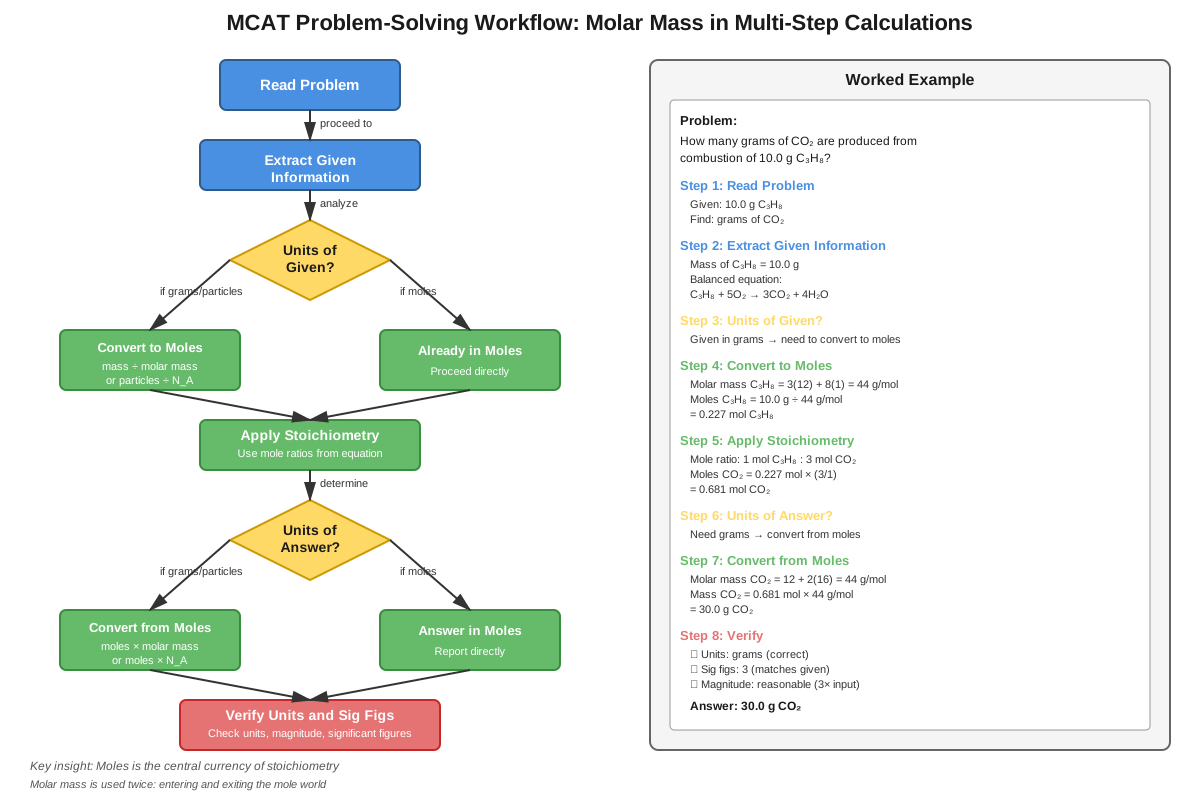
Overview
Molar mass is a foundational concept in General Chemistry that bridges the microscopic world of atoms and molecules with the macroscopic quantities measured in the laboratory. It represents the mass of one mole of a substance—whether an element, compound, or molecule—expressed in grams per mole (g/mol). This seemingly simple concept serves as the cornerstone of stoichiometry, enabling chemists and medical professionals to convert between the number of particles, moles, and mass. For MCAT test-takers, molar mass is not merely a definition to memorize; it is a computational tool that appears across multiple question types, from straightforward calculations to complex passage-based problems involving reaction yields, solution concentrations, and gas laws.
Understanding Molar mass MCAT questions requires both conceptual clarity and computational fluency. The MCAT frequently tests this topic within the context of Stoichiometry and Reactions, where students must calculate reactant quantities, determine limiting reagents, or predict product masses. Beyond pure calculation, the exam assesses whether students can apply molar mass concepts to interpret experimental data, analyze biochemical pathways, and solve problems involving molecular formulas and empirical formulas. The ability to quickly and accurately determine molar masses from chemical formulas is essential for success on timed exam sections.
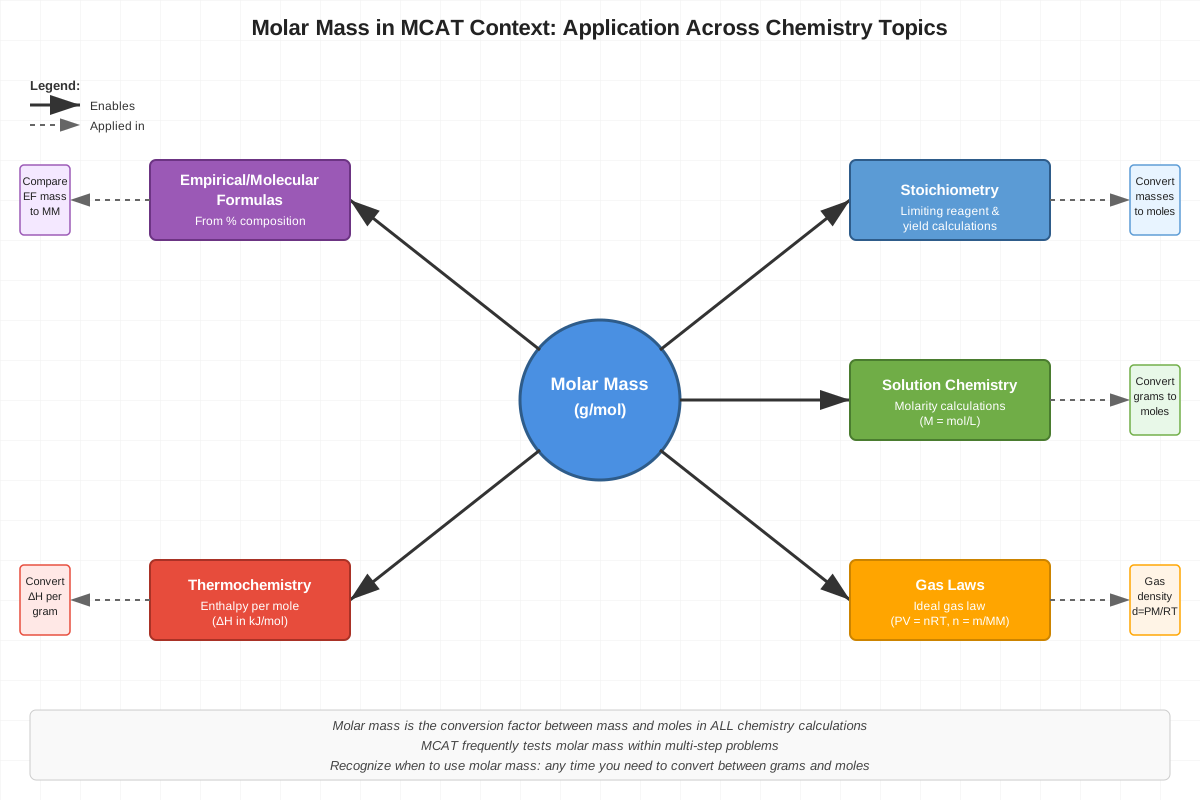
The significance of Molar mass General Chemistry extends throughout the entire chemistry curriculum. It connects atomic structure (atomic mass units and the periodic table) to quantitative analysis (stoichiometric calculations), solution chemistry (molarity and dilutions), gas behavior (ideal gas law applications), and thermochemistry (enthalpy calculations per mole). Mastering molar mass creates a foundation for understanding more advanced topics such as colligative properties, reaction kinetics, and equilibrium calculations—all of which appear regularly on the MCAT Chemical and Physical Foundations section.
Learning Objectives
- [ ] Define Molar mass using accurate General Chemistry terminology
- [ ] Explain why Molar mass matters for the MCAT
- [ ] Apply Molar mass to exam-style questions
- [ ] Identify common mistakes related to Molar mass
- [ ] Connect Molar mass to related General Chemistry concepts
- [ ] Calculate molar mass from chemical formulas with 100% accuracy within 30 seconds
- [ ] Convert between mass, moles, and number of particles using dimensional analysis
- [ ] Distinguish between molecular mass, formula mass, and molar mass in different contexts
Prerequisites
- Atomic structure and the periodic table: Understanding atomic mass units (amu) and how to read atomic masses from the periodic table is essential for calculating molar masses of compounds
- Basic algebra and dimensional analysis: Molar mass calculations require unit conversions and proportional reasoning
- Chemical formulas and nomenclature: Interpreting subscripts and parentheses in chemical formulas is necessary to count atoms correctly
- The mole concept: Recognizing that one mole equals Avogadro's number (6.022 × 10²³) of particles provides the conceptual foundation for molar mass
Why This Topic Matters
Clinical and Real-World Significance
Molar mass calculations are fundamental to pharmaceutical dosing, where medications must be prepared at precise concentrations. Clinicians use molar mass to convert between mass-based dosing (milligrams) and mole-based concentrations (millimolar) when preparing IV solutions or analyzing blood chemistry panels. In biochemistry, understanding the molar mass of proteins, enzymes, and nucleic acids enables researchers to determine concentrations from mass measurements and calculate specific activity. Toxicology relies on molar mass to convert exposure levels from mass per volume to molarity, which better reflects the number of toxic molecules present.
MCAT Exam Statistics
Molar mass appears in approximately 15-20% of General Chemistry questions on the MCAT, either as the primary focus or as a necessary step in multi-part calculations. The topic most commonly appears in:
- Discrete questions testing direct calculation skills (10-15% of chemistry discretes)
- Passage-based questions requiring stoichiometric analysis of experimental procedures (20-25% of chemistry passages)
- Integrated questions combining molar mass with gas laws, solution chemistry, or thermodynamics
Common Exam Contexts
MCAT passages frequently embed molar mass calculations within:
- Experimental procedures describing reagent preparation
- Data tables requiring interpretation of mass-to-mole relationships
- Reaction mechanisms where students must determine limiting reagents
- Biochemical pathways involving enzyme kinetics or substrate concentrations
- Analytical chemistry scenarios involving titrations or spectroscopy
Core Concepts
Definition and Fundamental Relationship
Molar mass (M) is defined as the mass of one mole of a substance, expressed in grams per mole (g/mol). It numerically equals the atomic or molecular mass expressed in atomic mass units (amu), but represents a macroscopic quantity rather than the mass of a single particle. This relationship emerges from the definition of the mole: one mole contains exactly 6.022 × 10²³ particles (Avogadro's number), and the atomic mass unit is defined such that one mole of carbon-12 atoms has a mass of exactly 12 grams.
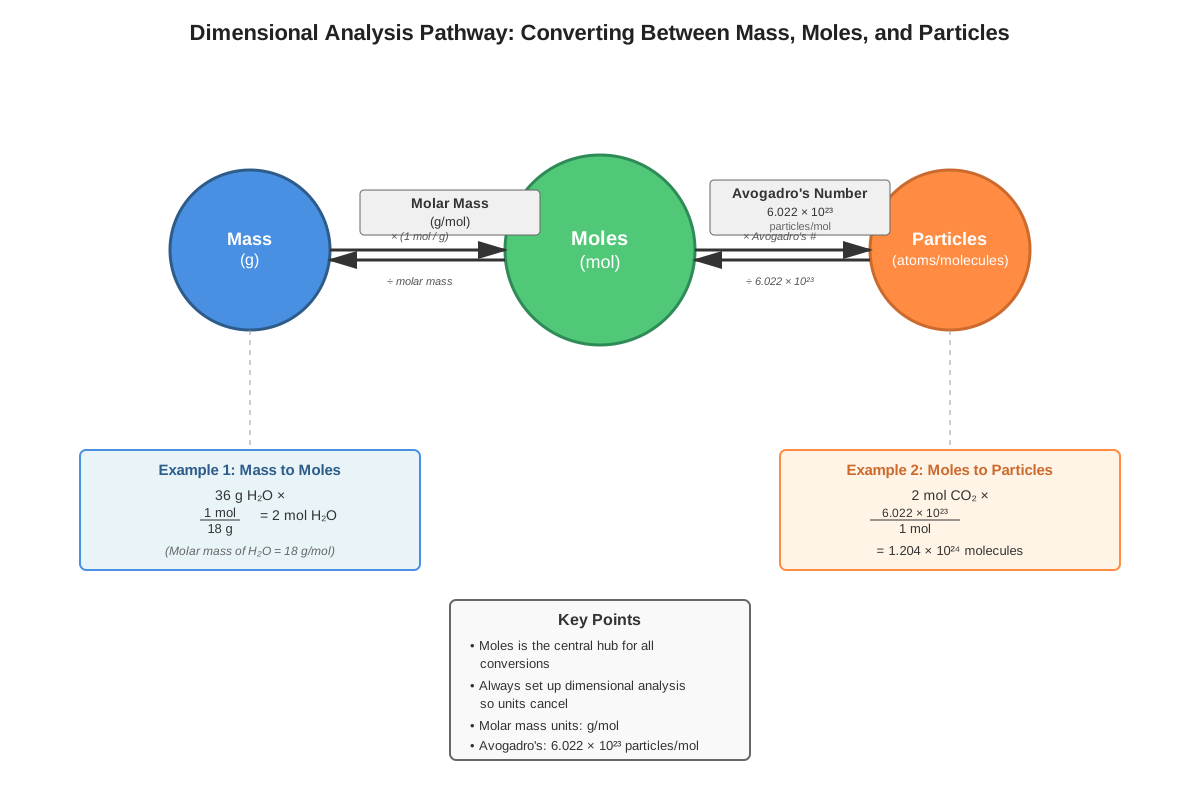
The fundamental equation connecting molar mass to measurable quantities is:
n = m/MWhere:
- n = number of moles (mol)
- m = mass of substance (g)
- M = molar mass (g/mol)
This equation can be rearranged to solve for any variable: m = n × M or M = m/n. The relationship extends to connect moles with the number of particles through Avogadro's number (Nₐ):
N = n × Nₐ = (m/M) × NₐWhere N represents the number of particles (atoms, molecules, or formula units).
Calculating Molar Mass from Chemical Formulas
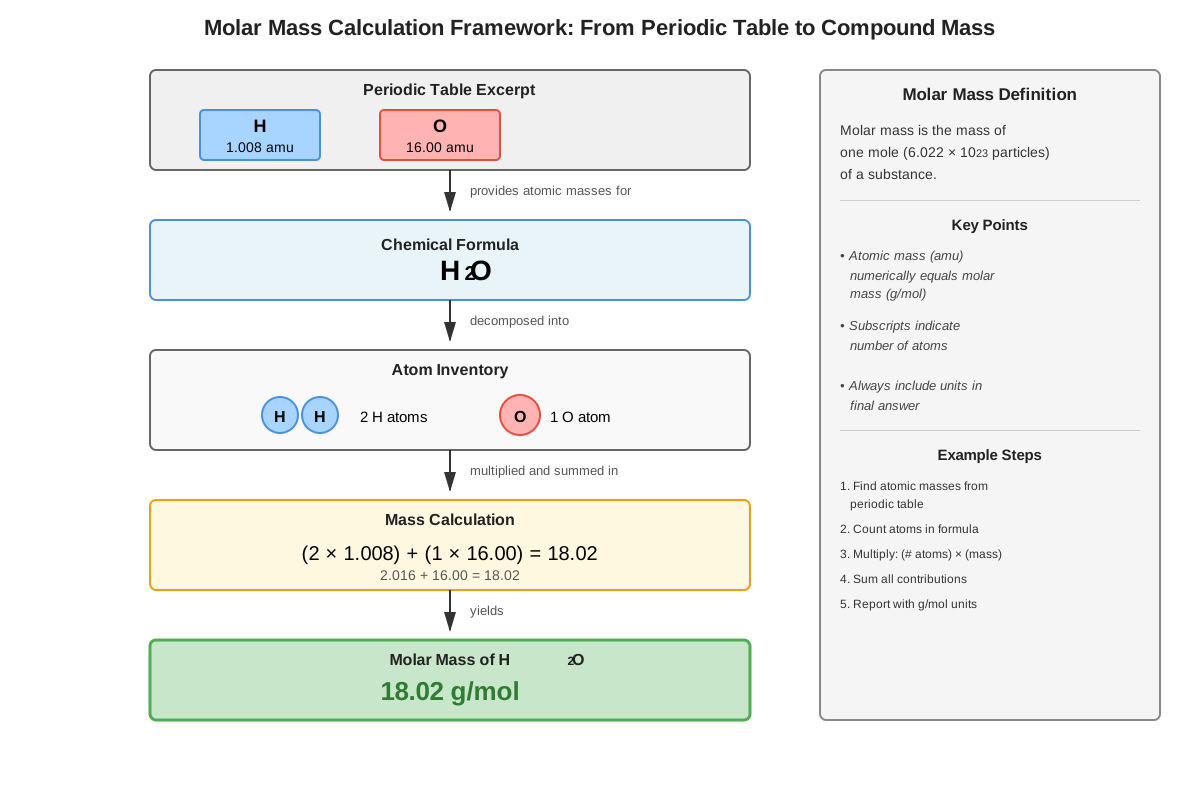
To determine the molar mass of a compound, sum the atomic masses of all constituent atoms. The process requires:
- Identify each element in the chemical formula
- Count the number of atoms of each element (accounting for subscripts and parentheses)
- Find atomic masses from the periodic table (typically rounded to one decimal place for MCAT calculations)
- Multiply each atomic mass by the number of atoms of that element
- Sum all contributions to obtain the total molar mass
Example: Calculate the molar mass of glucose (C₆H₁₂O₆)
- Carbon: 6 atoms × 12.0 g/mol = 72.0 g/mol
- Hydrogen: 12 atoms × 1.0 g/mol = 12.0 g/mol
- Oxygen: 6 atoms × 16.0 g/mol = 96.0 g/mol
- Total molar mass = 72.0 + 12.0 + 96.0 = 180.0 g/mol
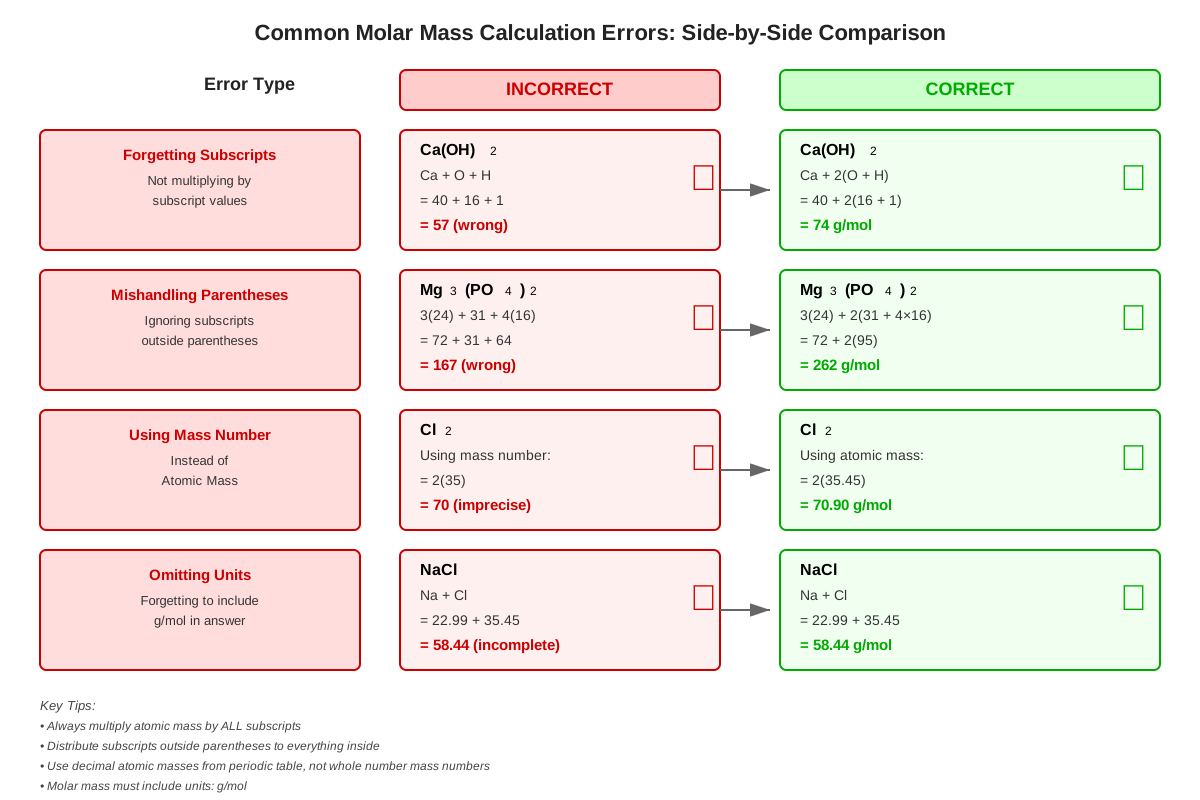
For compounds with parentheses, multiply the subscript outside the parentheses by each subscript inside:
Example: Calculate the molar mass of calcium phosphate [Ca₃(PO₄)₂]
- Calcium: 3 atoms × 40.0 g/mol = 120.0 g/mol
- Phosphorus: 2 atoms × 31.0 g/mol = 62.0 g/mol
- Oxygen: 2 × 4 = 8 atoms × 16.0 g/mol = 128.0 g/mol
- Total molar mass = 120.0 + 62.0 + 128.0 = 310.0 g/mol
Molar Mass of Elements
For elements, the molar mass depends on the natural form:
| Element Type | Molar Mass Determination | Example |
|---|---|---|
| Monatomic elements | Atomic mass from periodic table | Na: 23.0 g/mol |
| Diatomic molecules | 2 × atomic mass | O₂: 2 × 16.0 = 32.0 g/mol |
| Polyatomic molecules | Sum of all atomic masses | P₄: 4 × 31.0 = 124.0 g/mol |
EXAM TIP: The MCAT expects students to recognize the seven diatomic elements (H₂, N₂, O₂, F₂, Cl₂, Br₂, I₂). Always use the molecular form when these elements appear as reactants or products in their elemental state.
Molecular Mass vs. Formula Mass vs. Molar Mass
These terms are often used interchangeably but have subtle distinctions:
- Molecular mass: The mass of one molecule expressed in amu; applies only to covalent compounds with discrete molecules
- Formula mass: The mass of one formula unit expressed in amu; used for ionic compounds that don't form discrete molecules
- Molar mass: The mass of one mole of any substance expressed in g/mol; the macroscopic equivalent that numerically equals molecular or formula mass
For MCAT purposes, these distinctions rarely affect problem-solving, as the calculation method remains identical. However, understanding the terminology prevents confusion when reading passage text.
Average Molar Mass and Isotopes
Most elements exist as mixtures of isotopes, each with different atomic masses. The atomic mass listed on the periodic table represents a weighted average based on natural isotopic abundance. For MCAT calculations, use the periodic table values directly unless a question specifically addresses isotopic composition.
When calculating the average molar mass of an isotopic mixture:
M_average = Σ(fraction_i × M_i)Where fraction_i is the decimal abundance of isotope i, and M_i is its molar mass.
Percent Composition by Mass
Molar mass enables calculation of the percent composition of each element in a compound:
% element = (n × atomic mass of element / molar mass of compound) × 100%Where n is the number of atoms of that element in the formula.
Example: Calculate the percent composition of oxygen in water (H₂O)
- Molar mass of H₂O = 2(1.0) + 16.0 = 18.0 g/mol
- Mass contribution of oxygen = 16.0 g/mol
- % oxygen = (16.0/18.0) × 100% = 88.9%
This calculation frequently appears in MCAT questions involving empirical formula determination or analysis of experimental data.
Empirical vs. Molecular Formula
The empirical formula represents the simplest whole-number ratio of atoms in a compound, while the molecular formula shows the actual number of atoms in one molecule. Molar mass distinguishes between these:
- Empirical formula mass: Sum of atomic masses in the empirical formula
- Molecular formula mass: Actual molar mass of the compound
- Relationship: Molecular formula = n × (empirical formula), where n is a whole number
To determine the molecular formula from empirical formula and molar mass:
n = (molecular molar mass) / (empirical formula mass)Example: A compound has empirical formula CH₂O (empirical mass = 30.0 g/mol) and molar mass 180.0 g/mol
- n = 180.0/30.0 = 6
- Molecular formula = C₆H₁₂O₆ (glucose)
Concept Relationships
Molar mass serves as the central conversion factor in Stoichiometry and Reactions, connecting multiple quantitative concepts. The relationship map flows as follows:
Chemical Formula → Molar Mass → Moles → Mass
This bidirectional pathway enables conversion between the microscopic (molecular) and macroscopic (laboratory) scales. Extending this relationship:
Molar Mass → Stoichiometric Coefficients → Limiting Reagent Analysis → Theoretical Yield
In solution chemistry, molar mass connects to molarity:
Molar Mass + Mass of Solute + Volume of Solution → Molarity → Dilution Calculations
For gas-phase reactions, molar mass links to the ideal gas law:
Molar Mass + PV = nRT → Density of Gases → Molar Volume
The relationship to thermochemistry appears through enthalpy calculations:
Molar Mass + ΔH per mole → Heat Released or Absorbed for Given Mass
Understanding these interconnections allows students to recognize that molar mass rarely appears in isolation on the MCAT; it typically serves as one step in multi-concept problems requiring integrated knowledge across General Chemistry topics.
High-Yield Facts
⭐ The molar mass in g/mol numerically equals the atomic or molecular mass in amu—this 1:1 correspondence simplifies calculations and enables quick conversions.
⭐ To convert from mass to moles, divide by molar mass; to convert from moles to mass, multiply by molar mass—this is the most frequently tested relationship on the MCAT.
⭐ The seven diatomic elements (H₂, N₂, O₂, F₂, Cl₂, Br₂, I₂) must be written as diatomic molecules when in elemental form—forgetting to double the atomic mass is a common error.
⭐ Molar mass serves as the conversion factor between mass-based and mole-based stoichiometry—every stoichiometric calculation involving mass requires molar mass.
⭐ Percent composition can be calculated directly from molar mass without knowing the actual mass of sample—this enables analysis of unknown compounds from experimental data.
- The molar mass of water (18.0 g/mol) should be memorized for rapid calculations involving aqueous solutions and hydration reactions.
- Parentheses in chemical formulas require multiplying the subscript outside by each subscript inside before calculating molar mass.
- The molecular formula is always a whole-number multiple of the empirical formula, determined by comparing molar masses.
- Avogadro's number (6.022 × 10²³) connects moles to the actual number of particles, with molar mass providing the mass per mole.
- Molar mass units (g/mol) must always appear in dimensional analysis to ensure proper unit cancellation.
- For hydrated compounds (e.g., CuSO₄·5H₂O), include the water molecules in the molar mass calculation.
- The average atomic mass on the periodic table accounts for isotopic abundance, so isotope-specific calculations are rare on the MCAT.
Quick check — test yourself on Molar mass so far.
Try Flashcards →Common Misconceptions
Misconception: Molar mass and molecular mass are different values.
Correction: Molar mass (g/mol) and molecular mass (amu) are numerically identical; they differ only in units. The molar mass represents the mass of Avogadro's number of molecules, while molecular mass represents the mass of a single molecule.
Misconception: The molar mass of an element is always equal to its atomic mass from the periodic table.
Correction: For diatomic and polyatomic elements in their natural state, the molar mass must account for all atoms in the molecule. For example, oxygen gas (O₂) has a molar mass of 32.0 g/mol, not 16.0 g/mol.
Misconception: When calculating molar mass, subscripts apply only to the element immediately preceding them.
Correction: Subscripts outside parentheses multiply all subscripts inside the parentheses. In Ca(NO₃)₂, there are 2 nitrogen atoms and 6 oxygen atoms, not 2 nitrogen and 3 oxygen.
Misconception: Molar mass changes depending on the amount of substance present.
Correction: Molar mass is an intensive property—a characteristic of the substance itself that does not depend on the quantity. One gram of water and one kilogram of water both have the same molar mass (18.0 g/mol).
Misconception: The empirical formula and molecular formula always differ.
Correction: For some compounds, the empirical and molecular formulas are identical. For example, water (H₂O) and formaldehyde (CH₂O) have empirical formulas that match their molecular formulas.
Misconception: Molar mass calculations require precise atomic masses from the periodic table.
Correction: For MCAT calculations, rounding atomic masses to one decimal place (C = 12.0, H = 1.0, O = 16.0, N = 14.0) is typically sufficient and saves time. The exam rarely requires precision beyond this level.
Misconception: Molar mass only applies to pure substances and cannot be used for mixtures.
Correction: While individual components of a mixture each have their own molar masses, average molar mass can be calculated for mixtures when composition is known, particularly useful for gas mixtures and solutions.
Worked Examples
Example 1: Multi-Step Stoichiometry with Molar Mass
Question: A laboratory procedure requires 0.500 moles of sodium carbonate (Na₂CO₃). What mass of sodium carbonate should be measured?
Solution:
Step 1: Identify what is given and what is requested
- Given: n = 0.500 mol of Na₂CO₃
- Requested: mass (m) in grams
Step 2: Recognize that the relationship between moles and mass requires molar mass
- Formula: m = n × M
- Need to calculate M for Na₂CO₃
Step 3: Calculate molar mass of Na₂CO₃
- Sodium (Na): 2 atoms × 23.0 g/mol = 46.0 g/mol
- Carbon (C): 1 atom × 12.0 g/mol = 12.0 g/mol
- Oxygen (O): 3 atoms × 16.0 g/mol = 48.0 g/mol
- Total: M = 46.0 + 12.0 + 48.0 = 106.0 g/mol
Step 4: Calculate mass using m = n × M
- m = 0.500 mol × 106.0 g/mol = 53.0 g
Step 5: Check units and reasonableness
- Units cancel correctly: mol × (g/mol) = g ✓
- Half a mole should give approximately half the molar mass ✓
Connection to Learning Objectives: This problem demonstrates the application of molar mass to convert between moles and mass, a fundamental skill for MCAT stoichiometry questions. The systematic approach—calculate molar mass first, then apply the conversion—prevents errors and ensures accuracy under time pressure.
Example 2: Determining Molecular Formula from Empirical Formula
Question: A compound has the empirical formula CH and a molar mass of 78.0 g/mol. What is its molecular formula?
Solution:
Step 1: Calculate the empirical formula mass
- Carbon: 1 × 12.0 g/mol = 12.0 g/mol
- Hydrogen: 1 × 1.0 g/mol = 1.0 g/mol
- Empirical formula mass = 13.0 g/mol
Step 2: Determine the multiplier (n)
- n = (molecular molar mass)/(empirical formula mass)
- n = 78.0 g/mol / 13.0 g/mol = 6
Step 3: Multiply the empirical formula by n
- Molecular formula = (CH)₆ = C₆H₆
- This is benzene, a high-yield organic compound for the MCAT
Step 4: Verify by calculating molecular mass
- C₆H₆: 6(12.0) + 6(1.0) = 72.0 + 6.0 = 78.0 g/mol ✓
Connection to Learning Objectives: This example illustrates how molar mass distinguishes between empirical and molecular formulas, a concept that frequently appears in MCAT passages describing experimental determination of molecular structure. Recognizing that the multiplier must be a whole number helps eliminate incorrect answer choices.
Example 3: Percent Composition and Stoichiometry Integration
Question: What mass of oxygen is present in 90.0 g of glucose (C₆H₁₂O₆)?
Solution:
Step 1: Calculate the molar mass of glucose
- C: 6 × 12.0 = 72.0 g/mol
- H: 12 × 1.0 = 12.0 g/mol
- O: 6 × 16.0 = 96.0 g/mol
- Total: M = 180.0 g/mol
Step 2: Calculate percent composition of oxygen
- % O = (96.0/180.0) × 100% = 53.3%
Step 3: Calculate mass of oxygen in the sample
- Mass of O = 90.0 g × 0.533 = 48.0 g
Alternative approach (using moles):
- Moles of glucose = 90.0 g / 180.0 g/mol = 0.500 mol
- Moles of oxygen atoms = 0.500 mol glucose × 6 mol O/mol glucose = 3.00 mol O
- Mass of oxygen = 3.00 mol × 16.0 g/mol = 48.0 g
Connection to Learning Objectives: This problem demonstrates two valid approaches to the same question, both relying on molar mass. MCAT success requires flexibility in problem-solving; recognizing multiple pathways to the answer increases confidence and provides checking mechanisms during the exam.
Exam Strategy
Approaching MCAT Molar Mass Questions
Step 1: Identify the question type
- Direct calculation: "What is the molar mass of...?"
- Conversion problem: "How many grams of X are needed to prepare Y moles?"
- Integrated problem: Molar mass embedded within stoichiometry, gas laws, or solution chemistry
Step 2: Extract relevant information
- Chemical formulas (watch for subscripts and parentheses)
- Given quantities with units
- What the question asks for (mass, moles, or number of particles)
Step 3: Set up dimensional analysis
- Write the given quantity with units
- Identify conversion factors needed (molar mass, Avogadro's number, stoichiometric ratios)
- Arrange factors so units cancel to give desired units
Step 4: Calculate efficiently
- Round atomic masses appropriately (typically one decimal place)
- Use estimation when answer choices are widely spaced
- Check that units cancel correctly before calculating
Trigger Words and Phrases
Watch for these phrases that signal molar mass calculations:
- "How many grams..." or "What mass..." → Convert moles to mass
- "How many moles..." → Convert mass to moles
- "Molecular weight" or "formula weight" → Synonyms for molar mass
- "Per mole" → Indicates a molar quantity requiring molar mass for conversion
- "Empirical formula" + "molar mass" → Determine molecular formula
- "Percent composition" → Calculate from molar mass ratios
Process of Elimination Tips
When answer choices differ significantly:
- Estimate molar mass by rounding to nearest 10 g/mol for quick elimination
- Check magnitude: If calculating moles from mass, answer should be smaller than mass value (since molar masses are typically >1 g/mol)
- Verify units: Eliminate choices with incorrect units immediately
- Use benchmark values: Know common molar masses (H₂O = 18, CO₂ = 44, NaCl = 58.5) to assess reasonableness
Time Allocation
For discrete questions on molar mass:
- Simple calculation (direct molar mass determination): 30-45 seconds
- Conversion problem (mass ↔ moles): 45-60 seconds
- Multi-step problem (stoichiometry with molar mass): 90-120 seconds
For passage-based questions:
- Identify where molar mass is needed: 15-30 seconds
- Perform calculation: 30-60 seconds
- Integrate with passage information: 30-45 seconds
EXAM TIP: If a molar mass calculation is taking longer than expected, check whether the question provides the molar mass in the passage or stem. MCAT passages often include this information in tables or experimental descriptions to save time.
Memory Techniques
Mnemonic for Diatomic Elements
"Have No Fear Of Ice Cold Beer"
- Have = H₂ (Hydrogen)
- No = N₂ (Nitrogen)
- Fear = F₂ (Fluorine)
- Of = O₂ (Oxygen)
- Ice = I₂ (Iodine)
- Cold = Cl₂ (Chlorine)
- Beer = Br₂ (Bromine)
Common Molar Masses to Memorize
Create a mental "molar mass library" for frequently encountered compounds:
- Water (H₂O): 18 g/mol → "Water is legal at 18"
- Carbon dioxide (CO₂): 44 g/mol → "CO₂ is 44, like a .44 caliber"
- Sodium chloride (NaCl): 58.5 g/mol → "Salt is ~60"
- Glucose (C₆H₁₂O₆): 180 g/mol → "Sweet 180 (like a skateboard trick)"
- Oxygen gas (O₂): 32 g/mol → "O₂ is 32, like freezing point"
Visualization Strategy for Complex Formulas
For compounds with parentheses, visualize "distributing" the outside subscript:
- Ca(NO₃)₂: Picture two NO₃ groups attached to one Ca
- Draw a mental tree: Ca at the center, two branches each with N and three O atoms
- Count systematically: 1 Ca, 2 N, 6 O
Acronym for Calculation Steps
"FICS" - Formula, Identify, Calculate, Sum
- Formula: Write the chemical formula clearly
- Identify: Count atoms of each element
- Calculate: Multiply each count by atomic mass
- Sum: Add all contributions for total molar mass
Summary
Molar mass represents the mass of one mole of a substance expressed in grams per mole, serving as the essential conversion factor between the microscopic world of atoms and molecules and the macroscopic quantities used in laboratory work. For MCAT success, students must master both the conceptual understanding—that molar mass numerically equals atomic or molecular mass but represents a different scale—and the computational skills required to calculate molar masses from chemical formulas, convert between mass and moles, and apply these conversions within stoichiometric problems. The topic appears throughout General Chemistry, connecting atomic structure to quantitative analysis, solution chemistry, gas behavior, and thermochemistry. Common pitfalls include forgetting to account for diatomic elements, misinterpreting subscripts in complex formulas, and failing to recognize when molar mass is needed as an intermediate step in multi-concept problems. Success requires memorizing key molar masses, practicing dimensional analysis, and developing the ability to quickly and accurately perform calculations under time pressure while maintaining conceptual clarity about what molar mass represents and why it matters.
Key Takeaways
- Molar mass (g/mol) numerically equals atomic or molecular mass (amu) and serves as the conversion factor between moles and mass in all stoichiometric calculations
- The fundamental relationship n = m/M enables bidirectional conversion between mass and moles, forming the foundation for quantitative chemistry
- Calculating molar mass requires systematic counting of all atoms in a chemical formula, with special attention to subscripts, parentheses, and diatomic elements
- Molar mass connects to virtually every quantitative topic in General Chemistry, including stoichiometry, solution concentration, gas laws, and thermochemistry
- MCAT questions rarely test molar mass in isolation; instead, it appears as a necessary step in multi-concept problems requiring integrated knowledge
- Common errors include forgetting diatomic elements, miscounting atoms in complex formulas, and unit mistakes in dimensional analysis
- Efficient calculation strategies—rounding appropriately, using estimation, and memorizing high-yield values—are essential for success under time pressure
Related Topics
Stoichiometric Calculations: Molar mass enables the quantitative analysis of chemical reactions, including limiting reagent determination, theoretical yield calculations, and percent yield analysis. Mastering molar mass is prerequisite to all stoichiometric problem-solving.
Solution Chemistry and Molarity: Converting between mass of solute and molarity requires molar mass as the intermediate conversion factor. This connection extends to dilution problems and colligative properties.
Ideal Gas Law Applications: The relationship PV = nRT requires converting between mass and moles of gas, making molar mass essential for gas density calculations and molar volume determinations.
Empirical and Molecular Formula Determination: Experimental data from combustion analysis or mass spectrometry yields percent composition, which combined with molar mass enables determination of molecular structure.
Thermochemistry: Enthalpy changes are typically expressed per mole (kJ/mol), requiring molar mass to calculate heat released or absorbed for a given mass of reactant or product.
Practice CTA
Now that you've mastered the conceptual foundations and calculation strategies for molar mass, it's time to solidify your understanding through active practice. Attempt the practice questions and flashcards associated with this topic, focusing on both speed and accuracy. Challenge yourself to complete molar mass calculations in under 30 seconds and to recognize when molar mass is needed in multi-step problems. Remember: the MCAT rewards not just knowledge, but the ability to apply that knowledge efficiently under pressure. Each practice problem you solve builds the automaticity that will serve you on test day. You've got this!
Sign up free to keep reading
Create a free AnvayaPrep account to finish this MCAT guide on Molar mass — plus flashcards and practice questions.