Overview
Isotopes are atoms of the same element that contain identical numbers of protons but differ in their neutron count, resulting in different mass numbers. This fundamental concept in General Chemistry bridges atomic theory, nuclear chemistry, and periodic trends—all critical domains for MCAT success. Understanding isotopes requires mastery of atomic notation, mass calculations, and the relationship between atomic structure and elemental identity. The concept appears throughout the MCAT in contexts ranging from radioactive decay in physics passages to mass spectrometry in organic chemistry, making it an essential foundation for cross-disciplinary reasoning.
For the MCAT, isotopes represent more than just a definitional concept—they are the basis for understanding atomic mass calculations, nuclear stability, radioisotope applications in medicine, and analytical techniques like mass spectrometry. Questions may ask students to calculate average atomic mass from isotopic abundances, predict nuclear decay patterns, or interpret experimental data involving isotopic labeling. The topic integrates seamlessly with Atomic Structure and Periodic Trends, as isotopic variation does not affect chemical properties (determined by electron configuration) but significantly impacts physical properties and nuclear behavior.
Mastering isotopes enables deeper understanding of related topics including radioactive decay, nuclear binding energy, mass spectrometry, and even biochemical tracer studies. The MCAT frequently tests whether students can distinguish between properties affected by isotopic differences (mass, nuclear stability) versus those that remain constant (chemical reactivity, electron configuration). This conceptual clarity separates high-scoring students from those who struggle with nuanced questions about atomic identity and behavior.
Learning Objectives
- [ ] Define isotopes using accurate General Chemistry terminology, including proper atomic notation
- [ ] Explain why isotopes matter for the MCAT, including clinical and experimental applications
- [ ] Apply isotope concepts to exam-style questions involving mass calculations and nuclear properties
- [ ] Identify common mistakes related to isotopes, particularly regarding chemical versus physical properties
- [ ] Connect isotopes to related General Chemistry concepts including atomic mass, nuclear stability, and periodic trends
- [ ] Calculate average atomic mass from isotopic abundance data with precision
- [ ] Distinguish between isotopes, isobars, isotones, and isoelectronic species
- [ ] Predict relative stability of isotopes based on neutron-to-proton ratios
- [ ] Interpret mass spectrometry data to identify isotopic composition
Prerequisites
- Atomic structure fundamentals: Understanding protons, neutrons, and electrons is essential because isotopes are defined by differences in neutron number while maintaining constant proton count
- Atomic number and mass number: Knowledge of Z (atomic number) and A (mass number) notation enables proper identification and representation of isotopes
- Basic nuclear notation: Familiarity with symbolic representation (e.g., ¹²C, ¹⁴C) allows interpretation of isotopic formulas throughout chemistry and physics passages
- Weighted average calculations: Mathematical competency with weighted averages is necessary for computing atomic masses from isotopic abundances
- Periodic table navigation: Ability to locate elements and interpret atomic mass values provides context for isotopic composition of naturally occurring elements
Why This Topic Matters
Clinical and Real-World Significance
Isotopes have profound medical applications that appear regularly in MCAT passages. Radioisotopes serve as diagnostic tools in nuclear medicine—for example, iodine-131 treats thyroid disorders, technetium-99m enables imaging studies, and carbon-14 dating determines the age of biological samples. Positron emission tomography (PET) scans rely on fluorine-18, while stable isotopes like deuterium (²H) serve as tracers in metabolic studies without radiation exposure. Understanding isotopic behavior enables interpretation of clinical vignettes involving diagnostic imaging, radiation therapy, and pharmacokinetic studies using isotopic labels.
MCAT Exam Statistics
Isotope-related questions appear in approximately 3-5% of General Chemistry passages and discrete questions on the MCAT. The topic crosses into Chemical and Physical Foundations of Biological Systems sections, particularly in passages involving:
- Mass spectrometry analysis in organic chemistry contexts
- Radioactive decay calculations in physics problems
- Nuclear medicine applications in biological systems
- Experimental design using isotopic tracers
Questions typically test conceptual understanding rather than memorization, requiring students to apply isotope principles to novel scenarios. Medium-difficulty questions often involve calculating average atomic mass or interpreting isotopic abundance graphs, while higher-difficulty questions integrate isotopes with kinetics, equilibrium, or biochemical pathways.
Common Exam Contexts
The MCAT presents isotopes through diverse question formats: discrete questions testing definitional knowledge, passage-based questions analyzing experimental data from mass spectrometry, and integrated problems connecting isotopic labeling to metabolic pathways. Research passages may describe isotope-ratio mass spectrometry for determining protein structure or carbon-14 dating for archaeological samples. Clinical passages might explore radiotracer kinetics or radiation dosimetry. Recognizing these contexts helps students activate relevant knowledge quickly during the exam.
Core Concepts
Definition and Fundamental Properties
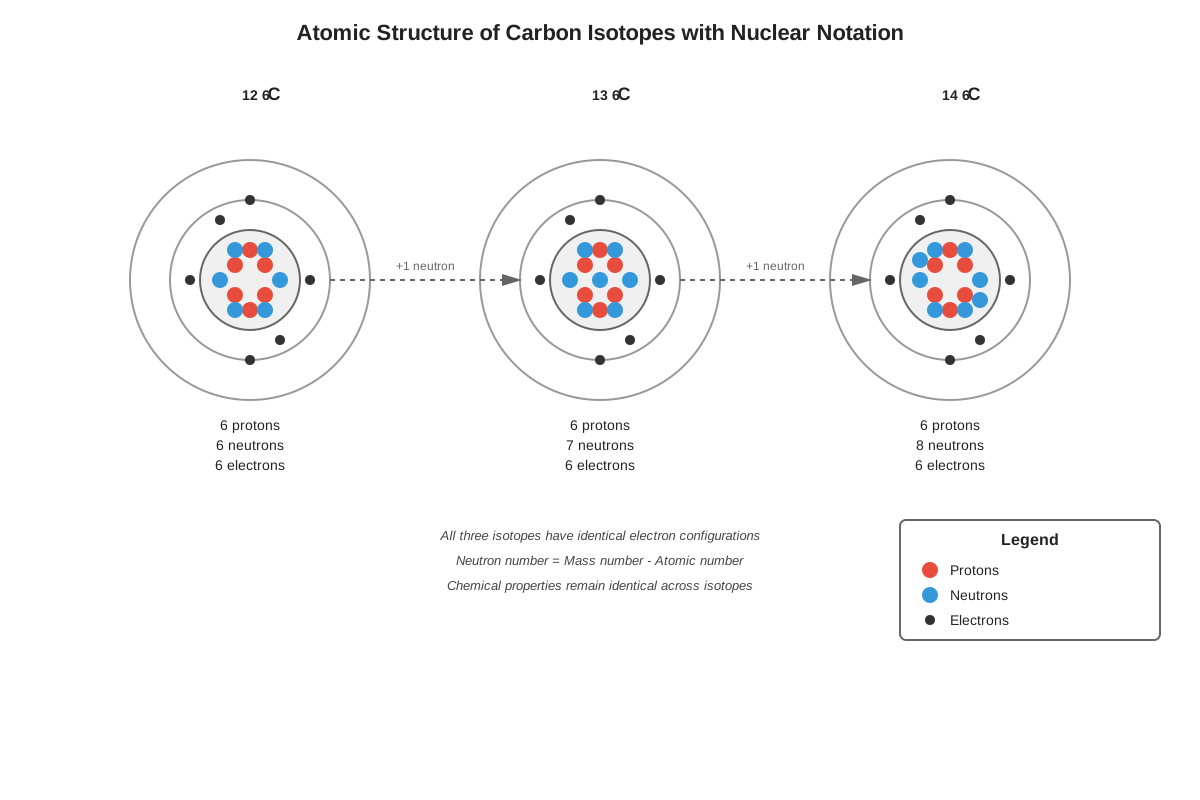
Isotopes are variants of a chemical element that share the same atomic number (Z) but possess different mass numbers (A) due to varying neutron counts. The atomic number, representing the number of protons, defines elemental identity—all carbon atoms contain exactly 6 protons, making them carbon regardless of neutron number. The mass number equals the sum of protons and neutrons (A = Z + N, where N represents neutrons). Therefore, isotopes of the same element have identical proton counts and electron configurations (in neutral atoms) but differ in neutron number and atomic mass.
For example, carbon exists naturally as three isotopes:
- Carbon-12 (¹²C): 6 protons, 6 neutrons, mass number 12
- Carbon-13 (¹³C): 6 protons, 7 neutrons, mass number 13
- Carbon-14 (¹⁴C): 6 protons, 8 neutrons, mass number 14
The standard notation for isotopes uses the format ᴬ_Z X, where X represents the element symbol, A is the mass number (superscript), and Z is the atomic number (subscript). Since the element symbol already indicates Z, the subscript is often omitted in practice, yielding ¹²C, ¹³C, and ¹⁴C. Alternative nomenclature includes hyphenated forms (carbon-12) or element names with mass numbers.
Chemical Versus Physical Properties
A critical distinction for MCAT success involves recognizing which properties remain constant across isotopes and which vary. Chemical properties—including reactivity, bonding behavior, and electron configuration—remain essentially identical for all isotopes of an element because chemistry is governed by electron arrangement, which depends on proton number (atomic number). Carbon-12 and carbon-14 form the same types of bonds, participate in identical reactions, and exhibit the same valence electron configuration (2s² 2p²).
However, physical properties differ among isotopes due to mass differences:
- Density: Heavier isotopes have greater density
- Diffusion and effusion rates: Lighter isotopes move faster (Graham's law)
- Vibrational frequencies: Affect spectroscopic properties
- Nuclear stability: Determines radioactive versus stable character
- Boiling and melting points: Subtle differences due to mass effects on intermolecular forces
This distinction explains why isotopic substitution doesn't alter reaction pathways but does affect reaction rates (kinetic isotope effect) and enables isotopic separation techniques like gaseous diffusion.
Isotopic Abundance and Atomic Mass
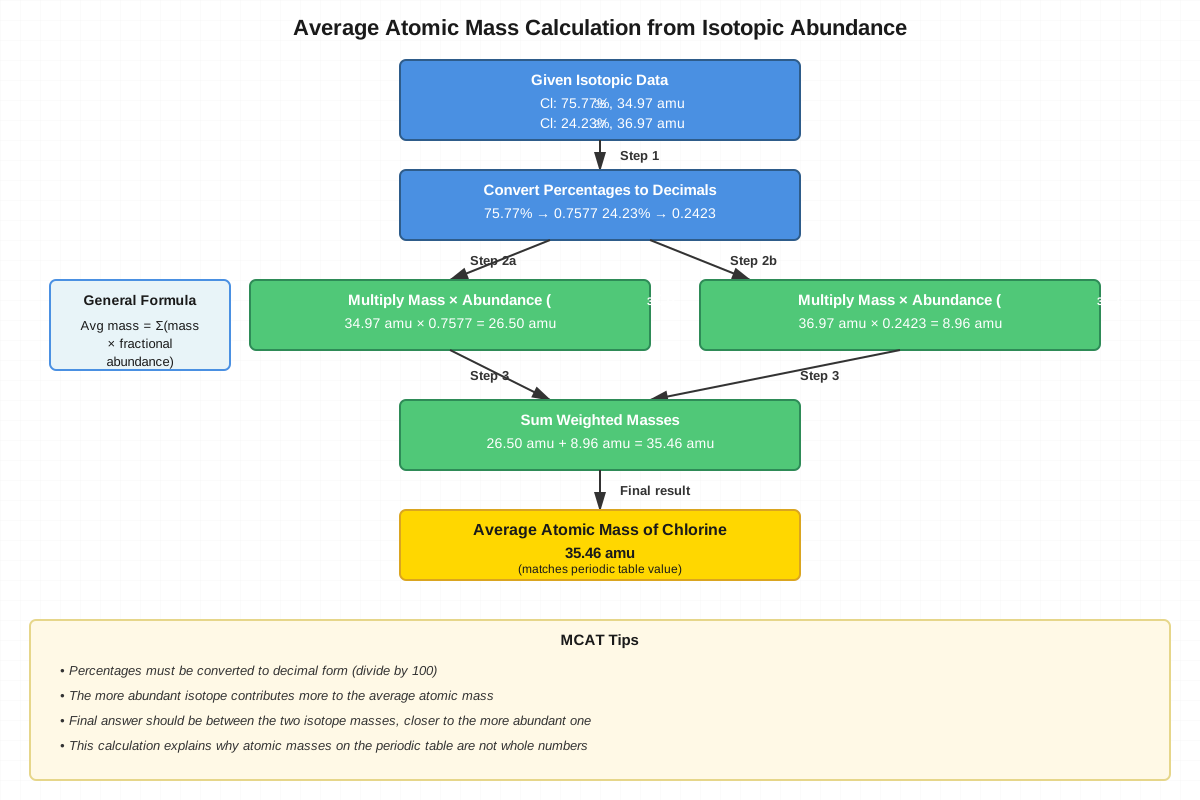
The atomic mass listed on the periodic table represents a weighted average of all naturally occurring isotopes, reflecting their relative abundances. This value rarely equals a whole number because it accounts for the mixture of isotopes found in nature. The calculation follows:
Atomic Mass = Σ (isotope mass × fractional abundance)For chlorine, which exists as approximately 75.8% chlorine-35 (34.97 amu) and 24.2% chlorine-37 (36.97 amu):
Atomic Mass = (34.97 × 0.758) + (36.97 × 0.242) = 26.51 + 8.95 = 35.46 amuThis calculated value matches the periodic table entry for chlorine. MCAT questions frequently provide isotopic masses and abundances, requiring students to compute average atomic mass or work backward from atomic mass to determine unknown abundances.
Nuclear Stability and Neutron-to-Proton Ratio
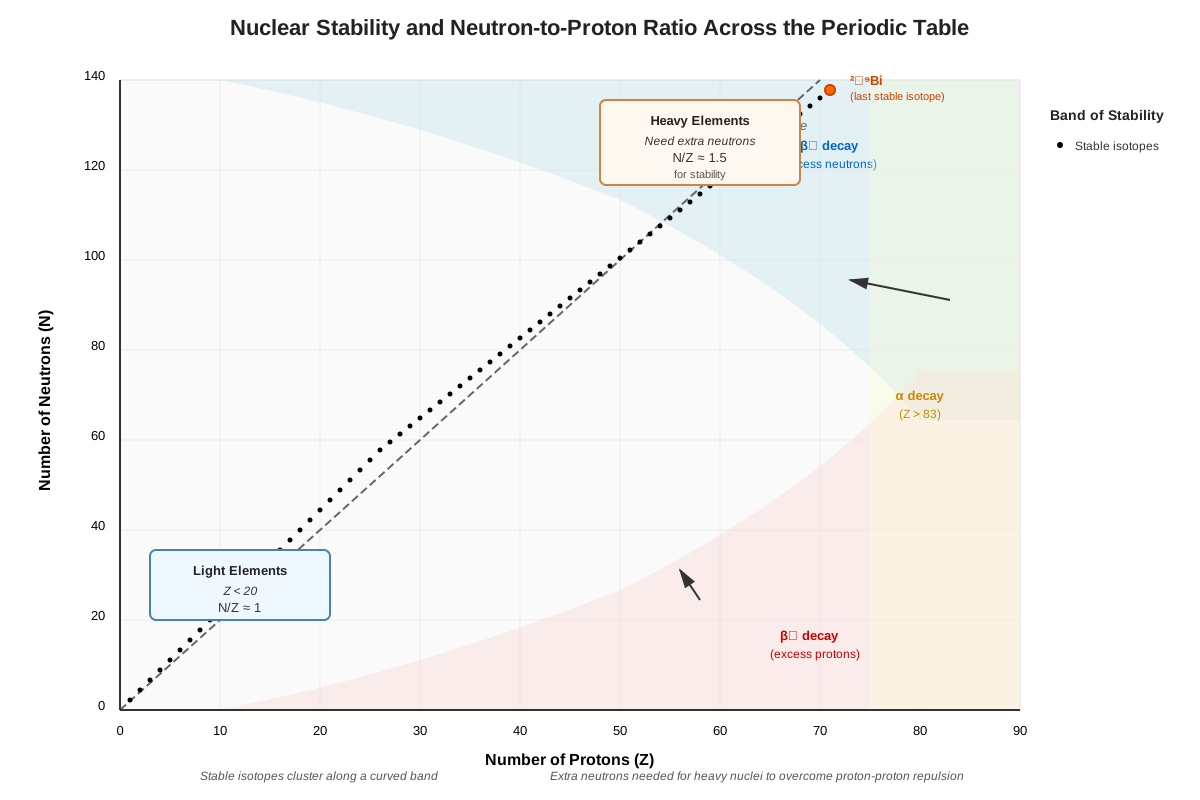
Not all isotopes exhibit equal stability. Nuclear stability depends primarily on the neutron-to-proton (N/Z) ratio. For light elements (Z < 20), stable isotopes typically have N/Z ratios near 1:1. As atomic number increases, stable isotopes require progressively higher N/Z ratios (approaching 1.5:1 for heavy elements) because additional neutrons help overcome electrostatic repulsion between protons in the nucleus.
Isotopes with unfavorable N/Z ratios undergo radioactive decay to achieve stability:
- Beta-minus decay (β⁻): Neutron-rich isotopes convert a neutron to a proton, emitting an electron
- Beta-plus decay (β⁺) or electron capture: Proton-rich isotopes convert a proton to a neutron
- Alpha decay (α): Very heavy nuclei emit helium-4 nuclei to reduce mass
Carbon-14, with 8 neutrons and 6 protons (N/Z = 1.33), is unstable and undergoes beta-minus decay with a half-life of 5,730 years, converting to stable nitrogen-14. This property enables radiocarbon dating of organic materials.
Related Nuclear Species
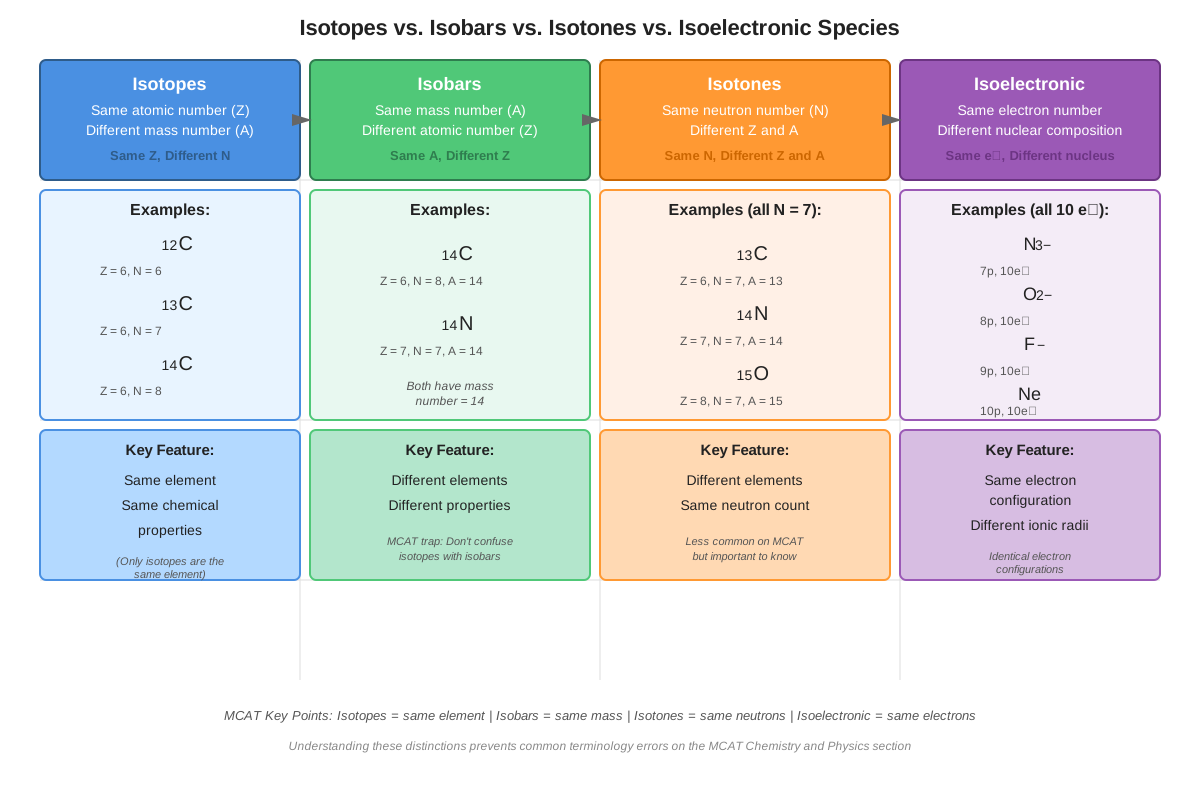
Understanding isotopes requires distinguishing them from similar nuclear species:
| Term | Definition | Example |
|---|---|---|
| Isotopes | Same Z, different A (different N) | ¹²C, ¹³C, ¹⁴C |
| Isobars | Different Z, same A | ¹⁴C, ¹⁴N (both mass 14) |
| Isotones | Different Z, same N | ¹³C (7n), ¹⁴N (7n) |
| Isoelectronic | Same electron count | O²⁻, F⁻, Ne (all 10e⁻) |
The MCAT may test whether students can correctly identify these relationships, particularly distinguishing isotopes (same element, different mass) from isobars (different elements, same mass).
Applications in Mass Spectrometry
Mass spectrometry separates ions based on mass-to-charge ratio (m/z), making it ideal for identifying isotopic composition. When a sample containing multiple isotopes is ionized and analyzed, the resulting spectrum shows distinct peaks corresponding to each isotope's mass. Peak heights reflect relative abundances. For example, a mass spectrum of chlorine gas (Cl₂) shows peaks at m/z = 70 (³⁵Cl-³⁵Cl), 72 (³⁵Cl-³⁷Cl), and 74 (³⁷Cl-³⁷Cl) with intensity ratios approximately 9:6:1, reflecting the statistical combination of the two isotopes.
MCAT passages may present mass spectra and ask students to:
- Identify the number of isotopes present
- Calculate relative abundances from peak heights
- Determine molecular formulas from isotopic patterns
- Interpret fragmentation patterns in organic molecules
Isotopic Labeling in Research
Stable and radioactive isotopes serve as tracers in biochemical research. Deuterium (²H) and carbon-13 can replace hydrogen and carbon-12 in molecules without significantly altering chemical behavior, allowing researchers to track metabolic pathways. Radioactive isotopes like phosphorus-32 and sulfur-35 enable detection through radiation emission. The MCAT may present experimental passages where isotopic labeling helps determine:
- Metabolic pathway intermediates
- Enzyme mechanisms
- DNA replication patterns (Meselson-Stahl experiment)
- Protein synthesis rates
Understanding that isotopes behave chemically like their lighter counterparts but remain distinguishable through mass or radioactivity is essential for interpreting these experimental designs.
Concept Relationships
Isotopes connect fundamentally to atomic structure, as they represent variations in nuclear composition while maintaining constant proton number. This relationship establishes elemental identity: changing neutron count creates different isotopes of the same element, while changing proton count creates a different element entirely. The concept flows directly from understanding that atomic number (Z) defines the element, while mass number (A) varies among isotopes.
The isotope concept enables calculation of atomic mass values on the periodic table, which represent weighted averages of naturally occurring isotopes. This connection links isotopes to Periodic Trends—while isotopic variation doesn't affect an element's position or chemical behavior (determined by electron configuration), it does influence precise mass measurements critical for stoichiometry and analytical chemistry.
Isotopes bridge to nuclear chemistry through radioactive decay. Unstable isotopes undergo decay processes to achieve favorable neutron-to-proton ratios, connecting to topics like half-life calculations, decay series, and nuclear equations. This relationship extends to kinetics when studying radioactive decay rates and to energy concepts through mass-energy equivalence and nuclear binding energy.
In analytical chemistry, isotopes connect to mass spectrometry, where isotopic patterns help identify molecular structures. The presence of multiple isotopes creates characteristic peak patterns that aid in determining molecular formulas and structures, particularly in organic chemistry applications.
Relationship Map:
Atomic Structure → Isotopes (varying neutron count) → Atomic Mass (weighted average) → Mass Spectrometry (isotopic analysis) → Nuclear Stability → Radioactive Decay → Medical Applications (diagnostic imaging, treatment)
Quick check — test yourself on Isotopes so far.
Try Flashcards →High-Yield Facts
⭐ Isotopes have identical atomic numbers (protons) but different mass numbers (neutrons), resulting in the same chemical properties but different physical properties
⭐ Atomic mass on the periodic table represents a weighted average of naturally occurring isotopes, not the mass of any single isotope
⭐ Chemical reactivity is determined by electron configuration (proton number), so isotopes of the same element undergo identical chemical reactions
⭐ Stable isotopes of light elements typically have neutron-to-proton ratios near 1:1, while heavier elements require higher ratios for stability
⭐ Carbon-14 dating relies on the radioactive decay of ¹⁴C (half-life 5,730 years) to ¹⁴N, enabling age determination of organic materials
- Deuterium (²H) and tritium (³H) are isotopes of hydrogen with 1 and 2 neutrons respectively, compared to protium (¹H) with 0 neutrons
- Mass spectrometry separates isotopes based on mass-to-charge ratio, producing distinct peaks for each isotope present in a sample
- The kinetic isotope effect causes reactions involving lighter isotopes to proceed faster than those with heavier isotopes due to differences in bond vibrational frequencies
- Isotopic labeling with stable isotopes (¹³C, ¹⁵N, ²H) or radioisotopes (¹⁴C, ³²P, ³⁵S) enables tracking of atoms through metabolic pathways and chemical reactions
- Chlorine's atomic mass of 35.45 amu reflects approximately 75% ³⁵Cl and 25% ³⁷Cl in natural abundance
- Isotopes are isoelectronic only when they have the same charge state; neutral isotopes of the same element always have identical electron counts
- Uranium-235 and uranium-238 differ by three neutrons, but this difference is critical for nuclear fission applications (U-235 is fissile, U-238 is not)
Common Misconceptions
Misconception: Isotopes of an element have different chemical properties and form different types of bonds.
Correction: Isotopes have virtually identical chemical properties because chemistry is governed by electron configuration, which depends only on proton number (atomic number). Carbon-12 and carbon-14 form the same bonds and participate in the same reactions. Only physical properties (mass, density, nuclear stability) differ significantly.
Misconception: The atomic mass on the periodic table represents the mass of the most common isotope.
Correction: The atomic mass is a weighted average of all naturally occurring isotopes based on their relative abundances. For example, chlorine's atomic mass of 35.45 amu doesn't match either ³⁵Cl (34.97 amu) or ³⁷Cl (36.97 amu) but represents their weighted average.
Misconception: All isotopes of an element are radioactive.
Correction: Many elements have both stable and radioactive isotopes. Carbon-12 and carbon-13 are stable, while carbon-14 is radioactive. Only elements with atomic number greater than 82 (lead) have no stable isotopes at all.
Misconception: Changing the number of neutrons changes the element's identity.
Correction: Elemental identity is determined solely by proton number (atomic number). Changing neutron count creates different isotopes of the same element. Only changing proton count transforms one element into another.
Misconception: Isotopes can be separated by ordinary chemical means.
Correction: Because isotopes have identical chemical properties, they cannot be separated by chemical reactions. Separation requires physical methods that exploit mass differences, such as gaseous diffusion, centrifugation, or mass spectrometry.
Misconception: Heavier isotopes always decay into lighter isotopes of the same element.
Correction: Radioactive decay often changes elemental identity by altering proton number. Beta-minus decay converts a neutron to a proton, increasing atomic number and creating a different element (e.g., ¹⁴C → ¹⁴N). Alpha decay decreases both proton and neutron counts, also changing the element.
Misconception: The mass number equals the actual mass of an isotope in amu.
Correction: The mass number is the sum of protons and neutrons (always a whole number), while the actual atomic mass in amu is slightly different due to nuclear binding energy effects (mass defect). For example, carbon-12 has mass number 12 but actual mass 12.000 amu by definition, while carbon-13 has mass number 13 but actual mass approximately 13.003 amu.
Worked Examples
Example 1: Calculating Average Atomic Mass
Question: Naturally occurring boron consists of two isotopes: boron-10 (10.013 amu) with 19.9% abundance and boron-11 (11.009 amu) with 80.1% abundance. Calculate the average atomic mass of boron.
Solution:
Step 1: Convert percentages to decimal fractions
- Boron-10: 19.9% = 0.199
- Boron-11: 80.1% = 0.801
Step 2: Apply the weighted average formula
Atomic Mass = (mass₁ × abundance₁) + (mass₂ × abundance₂)Step 3: Substitute values and calculate
Atomic Mass = (10.013 amu × 0.199) + (11.009 amu × 0.801)
Atomic Mass = 1.993 amu + 8.818 amu
Atomic Mass = 10.811 amuAnswer: The average atomic mass of boron is 10.811 amu, which matches the periodic table value.
Key Concepts Applied: This problem tests understanding that atomic mass represents a weighted average of isotopic masses based on natural abundance. The calculation requires converting percentages to decimals and applying the weighted average formula—both high-yield skills for MCAT General Chemistry.
Example 2: Interpreting Mass Spectrometry Data
Question: A mass spectrum of molecular chlorine (Cl₂) shows three peaks at m/z values of 70, 72, and 74 with relative intensities of 9:6:1. Given that chlorine has two naturally occurring isotopes (³⁵Cl and ³⁷Cl), explain the origin of these peaks and determine the approximate natural abundance of each isotope.
Solution:
Step 1: Identify what each peak represents
- m/z = 70: ³⁵Cl-³⁵Cl (35 + 35 = 70)
- m/z = 72: ³⁵Cl-³⁷Cl (35 + 37 = 72)
- m/z = 74: ³⁷Cl-³⁷Cl (37 + 37 = 74)
Step 2: Understand the statistical basis for peak intensities
If ³⁵Cl has abundance x and ³⁷Cl has abundance (1-x), then:
- Probability of ³⁵Cl-³⁵Cl = x²
- Probability of ³⁵Cl-³⁷Cl = 2x(1-x) [factor of 2 because either Cl can be which isotope]
- Probability of ³⁷Cl-³⁷Cl = (1-x)²
Step 3: Set up ratio equation using observed intensities (9:6:1)
x² : 2x(1-x) : (1-x)² = 9 : 6 : 1Step 4: Solve for x using the ratio of first to third peak
x²/(1-x)² = 9/1
x/(1-x) = 3
x = 3(1-x)
x = 3 - 3x
4x = 3
x = 0.75 or 75%
Therefore: ³⁵Cl ≈ 75% and ³⁷Cl ≈ 25%
Step 5: Verify with middle peak
2x(1-x) = 2(0.75)(0.25) = 0.375
x² = (0.75)² = 0.5625
Ratio = 0.5625 : 0.375 : 0.0625 = 9 : 6 : 1 ✓Answer: The three peaks represent the three possible isotopic combinations of Cl₂. The natural abundance is approximately 75% ³⁵Cl and 25% ³⁷Cl.
Key Concepts Applied: This problem integrates isotope concepts with mass spectrometry interpretation and probability. It demonstrates that isotopic patterns in mass spectra follow statistical distributions based on natural abundances—a common MCAT passage theme. Understanding that the middle peak has intensity 2x(1-x) rather than x(1-x) is crucial because there are two ways to form the mixed isotope molecule.
Exam Strategy
Question Recognition and Approach
When encountering isotope questions on the MCAT, first identify the question type:
- Definitional questions: Ask about basic isotope properties, notation, or terminology. Approach by recalling that isotopes have identical Z but different A, leading to same chemical but different physical properties.
- Calculation questions: Require computing average atomic mass from abundances or vice versa. Immediately set up the weighted average formula and convert percentages to decimals.
- Passage-based analytical questions: Present experimental data (often mass spectra or isotopic labeling studies). Read carefully to identify what isotopes are present and what property is being measured.
- Application questions: Connect isotopes to nuclear decay, medical imaging, or research techniques. Activate knowledge about radioactive versus stable isotopes and their practical uses.
Trigger Words and Phrases
Watch for these high-yield terms that signal isotope-related content:
- "Same element, different mass"
- "Isotopic abundance" or "natural abundance"
- "Average atomic mass" or "weighted average"
- "Mass spectrometry" or "m/z ratio"
- "Radioactive isotope" or "radioisotope"
- "Isotopic labeling" or "tracer study"
- "Neutron-to-proton ratio"
- "Nuclear stability"
When you see "atomic mass" in a question stem, immediately consider whether it refers to a specific isotope's mass or the weighted average. The periodic table value is always the weighted average.
Process of Elimination Strategies
For isotope questions, eliminate answer choices that:
- Claim isotopes have different chemical properties (they don't—same electron configuration)
- State that atomic mass equals mass number (mass number is a whole number; atomic mass usually isn't)
- Suggest isotopes have different atomic numbers (that would make them different elements)
- Confuse isotopes with ions (isotopes differ in neutrons; ions differ in electrons)
- Indicate all isotopes are radioactive (many elements have stable isotopes)
When calculating average atomic mass, eliminate answers that:
- Fall outside the range between the lightest and heaviest isotope masses
- Equal the mass of one specific isotope (unless that isotope has 100% abundance)
- Don't reflect the relative abundances (answer should be closer to the more abundant isotope's mass)
Time Allocation
For discrete isotope questions, allocate 60-90 seconds. These typically test straightforward concepts or require simple calculations. For passage-based questions involving isotopes:
- Spend 30-45 seconds identifying which isotopes are discussed and their key properties
- For calculation questions within passages, allocate 90-120 seconds to set up and solve
- For interpretation questions (mass spectra, experimental design), allow 90 seconds to analyze the data and connect to isotope principles
If a calculation becomes complex, consider whether estimation might eliminate enough answer choices to make an educated guess, preserving time for other questions.
Memory Techniques
Mnemonics
"Same P, Different N" - Isotopes have the Same Protons, Different Neutrons (helps distinguish from ions, which have different electrons)
"Chemical Same, Physical Different" - Isotopes have identical Chemical properties but different Physical properties
"ZMAN" - Z (atomic number) = protons, M (mass number) = A (protons + Neutrons); helps remember notation
"Heavy Stable Needs More Neutrons" - Heavier elements require higher neutron-to-proton ratios for stability
Visualization Strategies
Mental Image for Isotopes: Picture three identical houses (same element) with different numbers of cars in the garage (neutrons). The houses look the same from outside (same chemical properties) but have different total weights (different physical properties).
Atomic Mass Visualization: Imagine a seesaw with isotopes on each side. The balance point (fulcrum) represents the average atomic mass—closer to the heavier side if that isotope is more abundant.
Mass Spectrum Pattern: Visualize chlorine's three peaks (9:6:1) as a mountain range with the tallest peak on the left (³⁵Cl-³⁵Cl), medium peak in middle (mixed), and small peak on right (³⁷Cl-³⁷Cl). This pattern appears whenever an element has two isotopes.
Acronyms
IIIP - Isotopes: Identical In Protons (but different in neutrons)
WAAM - Weighted Average = Atomic Mass (reminds you that periodic table values are weighted averages)
NIPS - Neutrons Influence Physical Stability (neutron count affects physical properties and nuclear stability)
Summary
Isotopes represent a fundamental concept in atomic structure, defined as atoms of the same element with identical proton numbers but different neutron counts, resulting in varying mass numbers. This seemingly simple variation has profound implications: while isotopes maintain identical chemical properties due to unchanged electron configurations, they exhibit distinct physical properties including mass, density, nuclear stability, and radioactive behavior. The atomic masses listed on the periodic table reflect weighted averages of naturally occurring isotopes based on their relative abundances, not the mass of any single isotope. Understanding the neutron-to-proton ratio enables prediction of nuclear stability—light elements favor ratios near 1:1, while heavier elements require progressively higher ratios. Unstable isotopes undergo radioactive decay to achieve stability, forming the basis for applications ranging from carbon-14 dating to medical imaging with radioisotopes. Mass spectrometry exploits mass differences to separate and identify isotopes, producing characteristic peak patterns that aid molecular structure determination. For MCAT success, students must distinguish properties affected by isotopic variation (physical and nuclear) from those that remain constant (chemical reactivity), apply weighted average calculations accurately, and interpret isotopic data in experimental contexts including tracer studies and analytical techniques.
Key Takeaways
- Isotopes are atoms with identical atomic numbers (protons) but different mass numbers (neutrons), maintaining the same chemical properties while differing in physical and nuclear properties
- Atomic mass on the periodic table represents a weighted average of all naturally occurring isotopes, calculated using the formula: Σ(isotope mass × fractional abundance)
- Chemical behavior is determined by electron configuration (proton number), so isotopes of the same element undergo identical reactions despite mass differences
- Nuclear stability depends on neutron-to-proton ratio: light elements favor ~1:1 ratios, while heavier elements require higher ratios; unstable isotopes undergo radioactive decay
- Mass spectrometry separates isotopes by mass-to-charge ratio, producing distinct peaks whose intensities reflect relative abundances and statistical combinations
- Isotopic applications include radiocarbon dating (¹⁴C), medical imaging (radioisotopes), metabolic tracer studies (stable and radioactive isotopes), and analytical chemistry (mass spectrometry)
- Common MCAT question types involve calculating average atomic mass, interpreting mass spectra, distinguishing chemical from physical properties, and analyzing experimental designs using isotopic labels
Related Topics
Radioactive Decay and Half-Life: Building on isotope stability concepts, this topic explores decay mechanisms (alpha, beta, gamma), decay kinetics, and half-life calculations essential for nuclear chemistry questions.
Mass Spectrometry: Extends isotope analysis to molecular structure determination, fragmentation patterns, and analytical applications in organic chemistry and biochemistry passages.
Nuclear Binding Energy: Connects to isotope stability through mass-energy equivalence, explaining why actual isotopic masses differ slightly from mass numbers due to binding energy effects.
Periodic Trends: While isotopes don't affect an element's periodic position, understanding how electron configuration determines chemical properties reinforces why isotopes behave identically in reactions.
Stoichiometry and Molar Mass: Accurate molar mass calculations require using atomic masses (weighted averages of isotopes) from the periodic table, connecting isotope concepts to quantitative chemistry.
Kinetic Isotope Effect: Advanced topic explaining how mass differences between isotopes affect reaction rates, relevant for understanding enzyme mechanisms and reaction pathways in biochemistry.
Practice CTA
Now that you've mastered the core concepts of isotopes, it's time to solidify your understanding through active practice. Challenge yourself with MCAT-style questions that test your ability to calculate average atomic masses, interpret mass spectrometry data, and apply isotope concepts to experimental scenarios. Work through the practice problems systematically, checking your reasoning against the worked examples provided. Create flashcards for high-yield facts, especially the distinctions between chemical and physical properties of isotopes, and the applications of specific isotopes in medicine and research. Remember: understanding isotopes isn't just about memorizing definitions—it's about developing the analytical skills to tackle complex, integrated questions that connect atomic structure to real-world applications. Your investment in mastering this foundational topic will pay dividends across multiple MCAT sections. You've got this!
Sign up free to keep reading
Create a free AnvayaPrep account to finish this MCAT guide on Isotopes — plus flashcards and practice questions.