Overview
Ionization energy is one of the most fundamental periodic trends tested on the MCAT and represents a cornerstone concept in General Chemistry. It describes the minimum energy required to remove an electron from a gaseous atom or ion, and understanding this property is essential for predicting chemical reactivity, bonding behavior, and the stability of various oxidation states. The MCAT frequently tests ionization energy through direct questions about periodic trends, as well as indirectly through questions about atomic structure, chemical bonding, and reaction mechanisms.
Mastery of ionization energy provides critical insight into why certain elements readily form cations while others resist electron loss, why noble gases are chemically inert, and how electron configuration influences chemical behavior. This concept bridges atomic structure with chemical reactivity and appears across multiple MCAT sections, particularly in passages involving electrochemistry, coordination chemistry, and biochemical redox reactions. The Atomic Structure and Periodic Trends unit builds upon ionization energy to explain patterns in metallic character, electronegativity, and atomic radius.
For the MCAT, ionization energy questions often require students to integrate multiple concepts simultaneously—comparing trends across periods and groups, explaining exceptions based on electron configuration, and applying these principles to predict chemical behavior. This topic appears in approximately 3-5% of Chemical and Physical Foundations questions and frequently serves as the foundation for understanding more complex topics like electron affinity, bond formation, and oxidation-reduction chemistry. Strong command of ionization energy General Chemistry principles enables rapid elimination of incorrect answer choices and confident navigation of multi-step reasoning questions.
Learning Objectives
- [ ] Define ionization energy using accurate General Chemistry terminology
- [ ] Explain why ionization energy matters for the MCAT
- [ ] Apply ionization energy to exam-style questions
- [ ] Identify common mistakes related to ionization energy
- [ ] Connect ionization energy to related General Chemistry concepts
- [ ] Predict and explain periodic trends in ionization energy across periods and groups
- [ ] Distinguish between first, second, and successive ionization energies and interpret their patterns
- [ ] Analyze exceptions to ionization energy trends based on electron configuration and orbital stability
- [ ] Calculate relative ionization energies using Coulomb's law principles and effective nuclear charge
Prerequisites
- Atomic structure and electron configuration: Understanding orbital filling order, quantum numbers, and electron arrangement is essential for explaining why certain electrons are easier or harder to remove
- Periodic table organization: Knowledge of periods, groups, and element classification enables prediction of ionization energy trends
- Coulomb's law: The fundamental electrostatic attraction principle underlies all ionization energy phenomena
- Effective nuclear charge (Z_eff): This concept explains why outer electrons experience different attractive forces despite the same nuclear charge
- Quantum mechanical model of the atom: Understanding orbitals, electron shielding, and penetration helps explain exceptions to general trends
Why This Topic Matters
Clinical and Real-World Significance
Ionization energy principles govern essential biological processes including electron transport chains in cellular respiration, where electrons are transferred between molecules with progressively higher ionization energies. The sodium-potassium pump, critical for nerve impulse transmission, relies on the relatively low ionization energy of sodium and potassium compared to other elements. Understanding ionization energy helps explain why certain metal ions (like Ca²⁺, Mg²⁺, and Fe²⁺/Fe³⁺) serve as cofactors in enzymatic reactions while others do not—their ionization energies determine their ability to donate or accept electrons in biological redox reactions.
MCAT Exam Statistics
Ionization energy appears in approximately 3-5% of Chemical and Physical Foundations questions, making it a high-yield topic with excellent return on study investment. Questions typically fall into three categories: (1) direct comparison questions asking students to rank elements by ionization energy (15-20% of ionization energy questions), (2) explanation questions requiring students to justify trends using atomic structure principles (40-50%), and (3) application questions where ionization energy concepts support predictions about chemical reactivity or bonding (30-40%). The MCAT particularly favors questions about exceptions to trends and successive ionization energies.
Common Exam Passage Contexts
Ionization energy frequently appears in passages about: analytical chemistry techniques (mass spectrometry, photoelectron spectroscopy), coordination chemistry and transition metal complexes, electrochemical cells and reduction potentials, atmospheric chemistry and ionization in the upper atmosphere, and biochemical electron transport systems. Discrete questions often present graphs of successive ionization energies and ask students to identify the element or explain discontinuities in the data.
Core Concepts
Definition and Fundamental Principles
Ionization energy (IE), also called ionization potential, is defined as the minimum energy required to remove the most loosely bound electron from a neutral gaseous atom in its ground state, producing a gaseous cation and a free electron. The process is always endothermic, requiring energy input, and is represented by the equation:
X(g) → X⁺(g) + e⁻ ΔE = IE₁ (first ionization energy)The first ionization energy (IE₁) specifically refers to removing the first electron from a neutral atom. Second ionization energy (IE₂) refers to removing an electron from a +1 cation, third ionization energy (IE₃) from a +2 cation, and so forth. These are collectively termed successive ionization energies, and they always increase for a given element (IE₁ < IE₂ < IE₃ < ... < IEₙ) because removing electrons from increasingly positive ions requires progressively more energy to overcome stronger electrostatic attraction.
The magnitude of ionization energy depends on three primary factors: (1) effective nuclear charge (Z_eff)—the net positive charge experienced by an electron after accounting for shielding by other electrons, (2) distance from the nucleus—electrons in higher energy levels are easier to remove, and (3) electron-electron repulsion—paired electrons in the same orbital experience mutual repulsion, slightly decreasing ionization energy.
Periodic Trends in Ionization Energy
Ionization energy MCAT questions heavily emphasize periodic trends, which follow predictable patterns with notable exceptions:
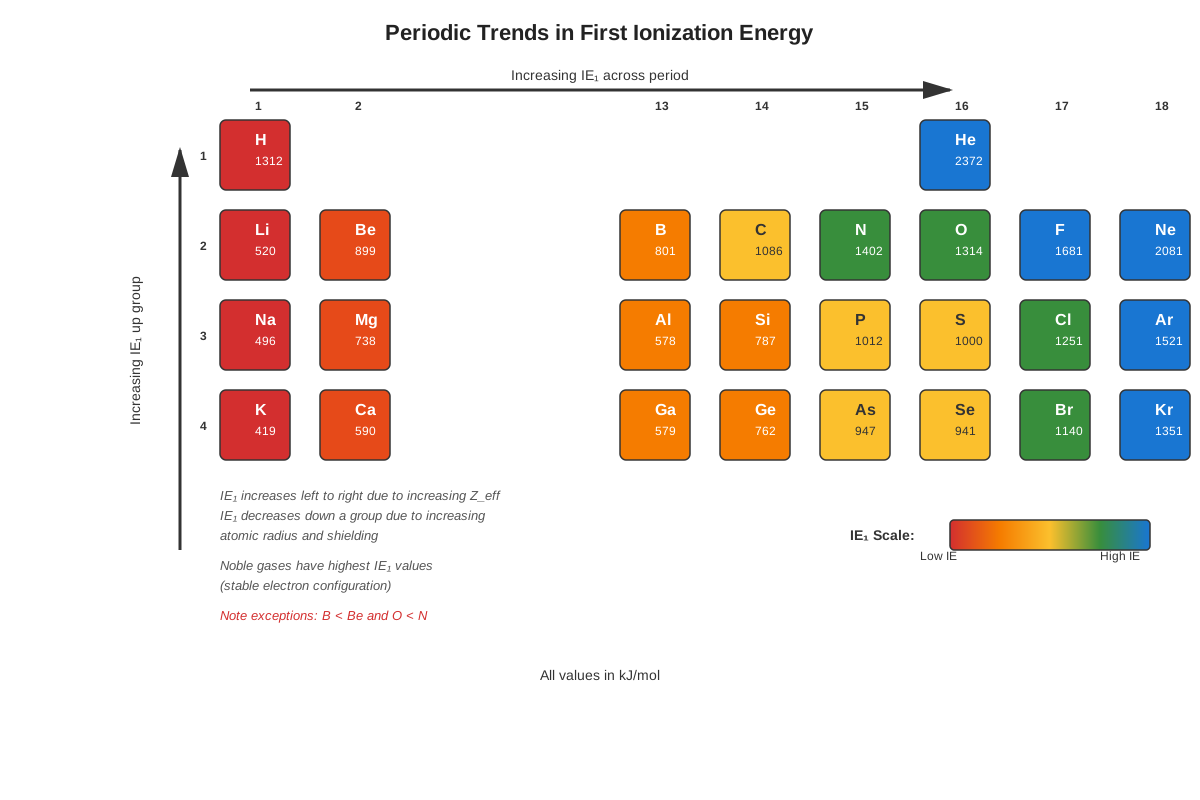
Trend Across a Period (Left to Right): Ionization energy generally increases across a period. As atomic number increases within a period, protons are added to the nucleus while electrons are added to the same principal energy level. The increased nuclear charge is not fully offset by shielding from electrons in the same shell, resulting in higher effective nuclear charge and stronger attraction to valence electrons. For example, ionization energy increases from sodium (496 kJ/mol) to argon (1521 kJ/mol) across Period 3.
Trend Down a Group (Top to Bottom): Ionization energy generally decreases down a group. Although nuclear charge increases, the valence electrons occupy progressively higher energy levels farther from the nucleus. The increased distance and additional inner electron shells provide substantial shielding, dramatically reducing effective nuclear charge experienced by valence electrons. For instance, first ionization energy decreases from lithium (520 kJ/mol) to cesium (376 kJ/mol) down Group 1.
| Period 2 Element | Atomic Number | First IE (kJ/mol) | Explanation |
|---|---|---|---|
| Li | 3 | 520 | Single 2s electron, relatively easy to remove |
| Be | 4 | 900 | Filled 2s subshell, stable configuration |
| B | 5 | 801 | First 2p electron, higher energy than 2s |
| C | 6 | 1086 | Half-filled 2p subshell approaching |
| N | 7 | 1402 | Half-filled 2p subshell, extra stability |
| O | 8 | 1314 | Electron pairing begins in 2p |
| F | 9 | 1681 | Highest in period, one electron from noble gas |
| Ne | 10 | 2081 | Noble gas, complete octet |
Exceptions to Periodic Trends
The MCAT frequently tests understanding of exceptions, which reveal deeper principles of electron configuration:
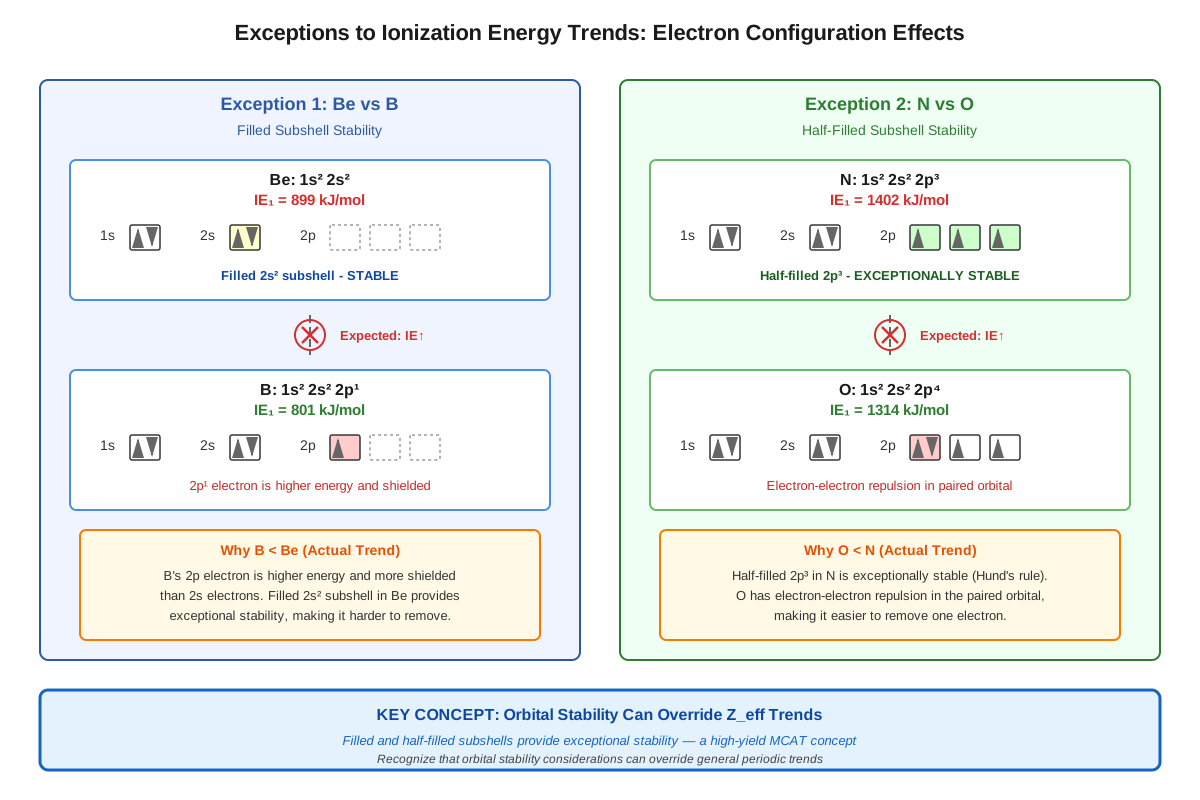
Group 13 vs. Group 2 Exception: Elements in Group 13 (B, Al, Ga) have slightly lower ionization energies than their Group 2 neighbors (Be, Mg, Ca) despite having higher atomic numbers. This occurs because Group 13 elements have their valence electron in a p orbital, which is higher in energy and experiences more shielding than the filled s orbital of Group 2 elements. For example, aluminum (IE₁ = 578 kJ/mol) has lower ionization energy than magnesium (IE₁ = 738 kJ/mol).
Group 16 vs. Group 15 Exception: Elements in Group 16 (O, S, Se) have slightly lower ionization energies than their Group 15 neighbors (N, P, As). Group 15 elements possess half-filled p subshells (p³), which provide extra stability due to exchange energy and the absence of electron pairing repulsion. Group 16 elements have p⁴ configurations with one paired electron set, and the electron-electron repulsion in the paired orbital makes one electron slightly easier to remove. Oxygen (IE₁ = 1314 kJ/mol) has lower ionization energy than nitrogen (IE₁ = 1402 kJ/mol).
Successive Ionization Energies
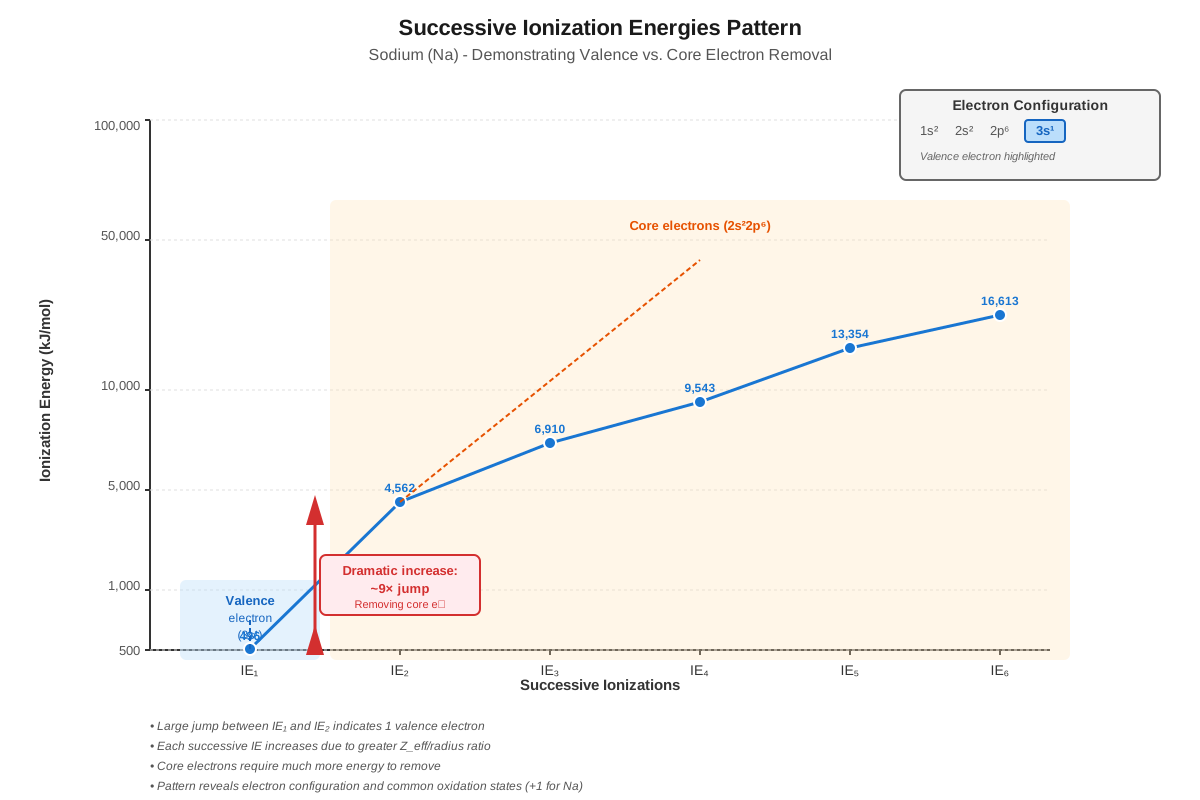
Analyzing successive ionization energies provides powerful insight into electron configuration and core versus valence electrons. Each successive ionization energy is larger than the previous one, but dramatic jumps occur when electrons are removed from a new, lower energy level (closer to the nucleus). These jumps reveal the number of valence electrons.
For example, sodium's ionization energies show:
- IE₁ = 496 kJ/mol (removing 3s¹ valence electron)
- IE₂ = 4562 kJ/mol (removing first 2p⁶ core electron—nearly 10× increase)
- IE₃ = 6910 kJ/mol (removing second 2p⁶ electron)
The massive jump between IE₁ and IE₂ confirms sodium has one valence electron. Similarly, magnesium shows modest increase from IE₁ to IE₂ (both removing 3s electrons), then a dramatic jump at IE₃ (removing first 2p electron), confirming two valence electrons.
Relationship to Effective Nuclear Charge
Effective nuclear charge (Z_eff) quantifies the net positive charge experienced by an electron and directly correlates with ionization energy. It is calculated as:
Z_eff = Z - Swhere Z is the actual nuclear charge (atomic number) and S is the shielding constant (electrons between the nucleus and the electron of interest). Electrons in the same shell provide minimal shielding (~0.35 per electron), while inner shell electrons provide nearly complete shielding (~1.0 per electron). Higher Z_eff means stronger attraction and higher ionization energy.
Across a period, Z_eff increases because nuclear charge increases faster than shielding, explaining the ionization energy increase. Down a group, although Z increases, the additional inner shells provide substantial shielding, and increased distance reduces attraction, resulting in decreased ionization energy despite higher Z_eff values.
Ionization Energy and Chemical Reactivity
Elements with low ionization energies (alkali and alkaline earth metals) readily lose electrons to form cations and are highly reactive metals. Elements with high ionization energies (halogens and noble gases) resist electron loss; halogens instead gain electrons to form anions, while noble gases are largely unreactive. This principle explains:
- Metallic character: Increases with decreasing ionization energy (down and left on periodic table)
- Cation formation: Metals with low IE readily form cations in ionic compounds
- Oxidation states: Elements can achieve oxidation states corresponding to successive ionization energy thresholds
- Redox reactions: Species with lower ionization energy serve as reducing agents (electron donors)
Concept Relationships
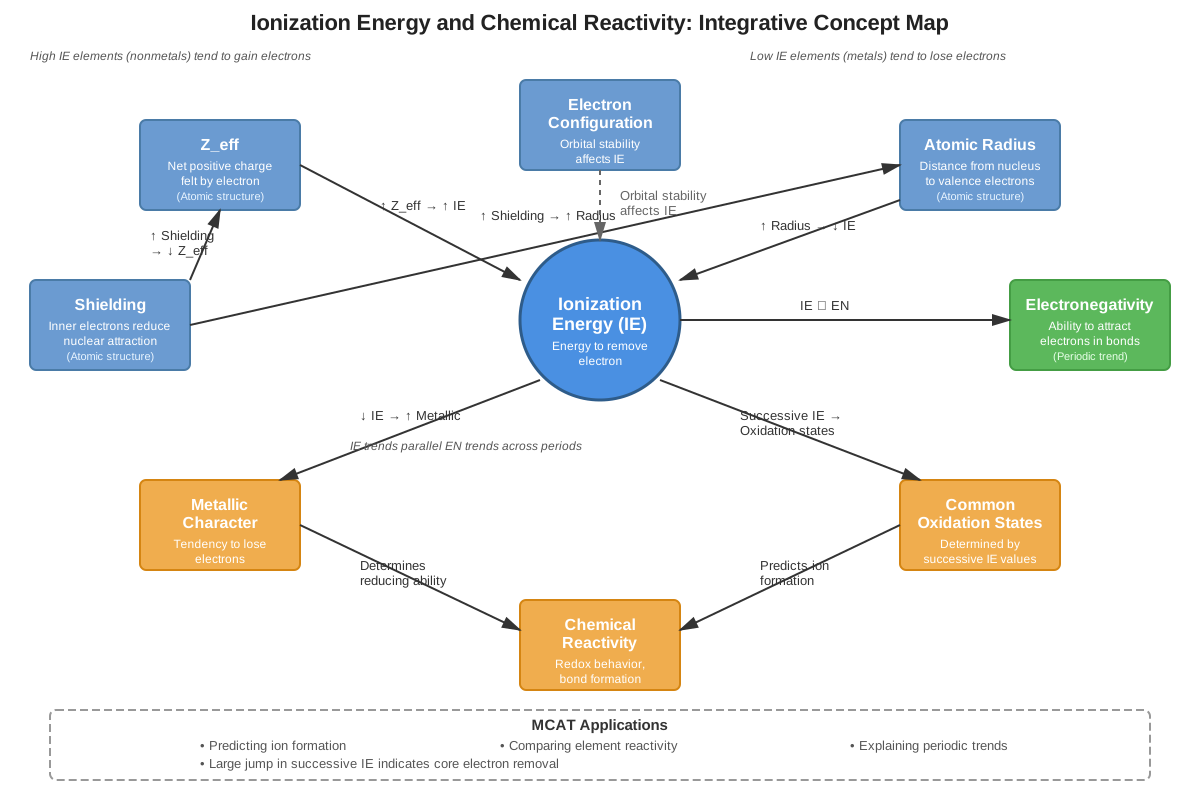
Ionization energy serves as a central hub connecting multiple General Chemistry concepts. At its foundation, electron configuration determines which electron will be removed and from which orbital, directly influencing ionization energy magnitude. The effective nuclear charge concept explains why ionization energy varies across the periodic table—higher Z_eff leads to higher ionization energy through stronger electrostatic attraction.
The relationship flows as: Atomic number → determines electron configuration → influences effective nuclear charge → determines ionization energy → predicts metallic character and chemical reactivity → explains bonding behavior and oxidation states.
Ionization energy inversely correlates with atomic radius—larger atoms have lower ionization energies because valence electrons are farther from the nucleus. It positively correlates with electronegativity—elements with high ionization energies also strongly attract bonding electrons. Electron affinity, the energy change when an atom gains an electron, follows similar periodic trends to ionization energy, though the relationship is less direct.
Understanding ionization energy enables prediction of redox behavior—species with low ionization energy are strong reducing agents, while those with high ionization energy resist oxidation. This connects to electrochemistry, where standard reduction potentials reflect the ease of electron loss or gain. In coordination chemistry, ionization energies of transition metals influence which oxidation states are accessible and stable.
Quick check — test yourself on Ionization energy so far.
Try Flashcards →High-Yield Facts
⭐ Ionization energy always increases with successive electron removals (IE₁ < IE₂ < IE₃) because removing electrons from increasingly positive ions requires more energy
⭐ Ionization energy generally increases across a period (left to right) due to increasing effective nuclear charge with minimal change in shielding
⭐ Ionization energy generally decreases down a group due to increasing atomic radius and electron shielding despite higher nuclear charge
⭐ Noble gases have the highest ionization energies in their respective periods due to stable, filled valence shells
⭐ Large jumps in successive ionization energies indicate removal of core electrons from a lower energy level, revealing the number of valence electrons
- Group 13 elements have slightly lower ionization energy than Group 2 elements due to the p orbital being higher in energy than the filled s orbital
- Group 16 elements have slightly lower ionization energy than Group 15 elements due to electron pairing repulsion in the p⁴ configuration versus the stable half-filled p³ configuration
- Alkali metals (Group 1) have the lowest ionization energies in their respective periods, making them highly reactive metals
- Ionization energy is always endothermic (positive ΔE) because energy must be supplied to overcome electrostatic attraction
- Elements with low ionization energies readily form cations and exhibit metallic character, while those with high ionization energies resist electron loss
Common Misconceptions
Misconception: Ionization energy and electron affinity are the same thing.
Correction: Ionization energy is the energy required to remove an electron from a neutral atom (always endothermic), while electron affinity is the energy change when an electron is added to a neutral atom (usually exothermic). They are related but distinct properties measuring opposite processes.
Misconception: Higher atomic number always means higher ionization energy.
Correction: Ionization energy depends on multiple factors including distance from nucleus and shielding, not just nuclear charge. Cesium (Z = 55) has much lower ionization energy than helium (Z = 2) because its valence electron is much farther from the nucleus and heavily shielded.
Misconception: The second ionization energy is exactly twice the first ionization energy.
Correction: Successive ionization energies increase by varying amounts depending on electron configuration. The ratio between successive ionization energies changes dramatically when crossing into a new electron shell. For sodium, IE₂/IE₁ ≈ 9.2, not 2.
Misconception: All elements in the same group have identical ionization energies.
Correction: Elements in the same group have similar valence electron configurations but different principal energy levels. Ionization energy decreases substantially down a group due to increasing atomic radius and shielding. Lithium's IE₁ (520 kJ/mol) is nearly 40% higher than cesium's (376 kJ/mol).
Misconception: Removing an electron from a cation releases energy.
Correction: Removing any electron from any species always requires energy input (endothermic process). The electrostatic attraction between positive nucleus and negative electron must be overcome. Removing an electron from a cation requires even more energy than from a neutral atom.
Misconception: Transition metals follow the same ionization energy trends as main group elements.
Correction: Transition metals show more complex patterns due to d orbital filling and variable shielding effects. While general trends apply, the differences between consecutive transition metals are smaller than between consecutive main group elements, and exceptions are more common.
Worked Examples
Example 1: Ranking Elements by Ionization Energy
Question: Rank the following elements in order of increasing first ionization energy: Na, Mg, Al, Si, P, S, Cl, Ar
Solution:
Step 1: Identify the period and general trend. All elements are in Period 3, so ionization energy generally increases left to right.
Step 2: Apply the general trend: Na < Mg < Al < Si < P < S < Cl < Ar
Step 3: Check for exceptions. Two exceptions exist in Period 3:
- Al has lower IE than Mg (Group 13 vs. Group 2 exception)
- S has lower IE than P (Group 16 vs. Group 15 exception)
Step 4: Adjust the ranking for exceptions:
- Swap Al and Mg: Na < Al < Mg
- Swap S and P: P > S
Final Answer: Na < Al < Mg < Si < P < S < Cl < Ar
Connection to Learning Objectives: This problem requires applying periodic trends (across a period) while recognizing exceptions based on electron configuration—specifically the stability of filled and half-filled subshells.
Example 2: Interpreting Successive Ionization Energy Data
Question: An unknown element has the following successive ionization energies (in kJ/mol): IE₁ = 738, IE₂ = 1451, IE₃ = 7733, IE₄ = 10540, IE₅ = 13630. Identify the element and explain the pattern.
Solution:
Step 1: Analyze the pattern. Notice that IE₁ and IE₂ are relatively close (IE₂/IE₁ ≈ 2.0), but there is a dramatic jump between IE₂ and IE₃ (IE₃/IE₂ ≈ 5.3).
Step 2: Interpret the jump. The large increase indicates that IE₃ involves removing an electron from a lower energy level (core electron) after all valence electrons have been removed. This means the element has 2 valence electrons.
Step 3: Identify the element. Elements with 2 valence electrons are in Group 2 (alkaline earth metals). The magnitude of IE₁ (738 kJ/mol) matches magnesium (Mg, IE₁ = 738 kJ/mol).
Step 4: Verify with electron configuration. Mg has configuration [Ne]3s². IE₁ and IE₂ remove the two 3s electrons (valence), while IE₃ begins removing 2p electrons from the neon core, explaining the dramatic jump.
Answer: The element is magnesium (Mg). The pattern shows two valence electrons in the 3s orbital, with core electrons requiring much more energy to remove.
Connection to Learning Objectives: This problem demonstrates how successive ionization energies reveal electron configuration and the distinction between valence and core electrons—a high-yield MCAT concept.
Exam Strategy
Approaching MCAT Questions
When encountering ionization energy questions, first identify the question type: (1) direct comparison/ranking, (2) explanation of trends, or (3) application to chemical behavior. For ranking questions, quickly apply the general periodic trends (increase across period, decrease down group), then check for the two major exceptions (Group 13 vs. 2, Group 16 vs. 15). For explanation questions, the answer almost always involves effective nuclear charge, shielding, or electron configuration stability.
Trigger Words and Phrases
Watch for these key phrases that signal ionization energy concepts:
- "Energy required to remove an electron" → direct definition of ionization energy
- "Most easily oxidized" → lowest ionization energy
- "Forms cations most readily" → lowest ionization energy
- "Least reactive" or "noble gas" → highest ionization energy
- "Large jump in successive ionization energies" → transition from valence to core electrons
- "Effective nuclear charge" → explanation for ionization energy trends
Process of Elimination Tips
For ranking questions, immediately eliminate answer choices that violate the fundamental trend (increase across period, decrease down group) unless exceptions apply. If comparing elements in the same period, the rightmost element (excluding noble gases in some contexts) should have highest ionization energy. If comparing elements in the same group, the topmost element should have highest ionization energy.
For successive ionization energy questions, eliminate answers suggesting IE decreases with successive removals (physically impossible) or that show large jumps at incorrect positions (inconsistent with stated electron configuration).
Time Allocation
Ionization energy questions typically require 60-90 seconds. Spend 15-20 seconds identifying the question type and relevant periodic trend, 30-40 seconds applying the trend and checking for exceptions, and 15-20 seconds verifying your answer and eliminating incorrect choices. For successive ionization energy interpretation questions, allow up to 90 seconds to analyze the data pattern and connect it to electron configuration.
Memory Techniques
Mnemonic for Periodic Trends
"I Ran Right, Dropped Down": Ionization energy Rises going Right across a period, Drops going Down a group.
Visualization Strategy
Picture the atom as a solar system with the nucleus as the sun and electrons as planets. Electrons closer to the sun (nucleus) are harder to remove (higher ionization energy) because of stronger gravitational (electrostatic) attraction. Adding more planets (electrons) in the same orbit doesn't change the distance much, but adding more mass to the sun (protons) increases attraction. Planets in outer orbits (higher energy levels) are easier to remove despite the sun being more massive.
Acronym for Exceptions
"BP Drops": Boron and Phosphorus groups show Drops in ionization energy compared to their left neighbors (Be and N respectively) due to orbital configuration effects.
Successive Ionization Energy Pattern
Remember "Core Jump": When successive ionization energies show a dramatic jump (typically 5-10× increase), you've reached the core electrons. Count the number of relatively small increases before the jump to determine the number of valence electrons.
Stability Configurations
"HEFF": Half-filled, Empty, Filled, Full—these electron configurations provide extra stability and higher ionization energy. Half-filled (p³, d⁵), empty (s⁰, p⁰), filled (s², p⁶), and full shells all resist electron removal more than expected.
Summary
Ionization energy represents the minimum energy required to remove an electron from a gaseous atom and serves as a fundamental periodic property that predicts chemical reactivity and bonding behavior. The MCAT extensively tests understanding of ionization energy trends—increasing across periods due to rising effective nuclear charge and decreasing down groups due to increased atomic radius and shielding. Critical exceptions occur at Group 13 (lower than Group 2 due to p vs. s orbital energy) and Group 16 (lower than Group 15 due to electron pairing repulsion vs. half-filled stability). Successive ionization energies always increase, with dramatic jumps indicating removal of core electrons from lower energy levels, revealing the number of valence electrons. Elements with low ionization energies readily form cations and exhibit metallic character, while those with high ionization energies resist electron loss. Mastery of ionization energy enables prediction of oxidation states, redox behavior, and chemical reactivity patterns essential for MCAT success.
Key Takeaways
- Ionization energy is the energy required to remove an electron from a gaseous atom; it is always endothermic and increases with successive electron removals
- Ionization energy increases across a period (left to right) due to increasing effective nuclear charge and decreases down a group due to increasing atomic radius and shielding
- Two major exceptions exist: Group 13 < Group 2 (p orbital vs. filled s orbital) and Group 16 < Group 15 (paired electrons vs. half-filled stability)
- Large jumps in successive ionization energies indicate removal of core electrons and reveal the number of valence electrons
- Noble gases have the highest ionization energies in their periods due to stable, filled valence shells, while alkali metals have the lowest
- Elements with low ionization energies readily form cations and are strong reducing agents; those with high ionization energies resist oxidation
- Ionization energy correlates with effective nuclear charge, inversely correlates with atomic radius, and connects to electronegativity, electron affinity, and chemical reactivity
Related Topics
Electron Affinity: The energy change when an atom gains an electron; follows similar periodic trends to ionization energy and helps predict anion formation and nonmetallic character. Understanding ionization energy provides the foundation for comparing electron loss versus electron gain tendencies.
Electronegativity: The ability of an atom to attract bonding electrons; correlates positively with ionization energy and explains bond polarity and molecular properties. Mastery of ionization energy trends enables prediction of electronegativity patterns.
Atomic and Ionic Radius: The size of atoms and ions; inversely related to ionization energy and essential for understanding periodic trends comprehensively. Ionization energy concepts explain why cations are smaller than their parent atoms.
Effective Nuclear Charge: The net positive charge experienced by electrons; the fundamental explanation for ionization energy trends and other periodic properties. Deep understanding of Z_eff is essential for explaining exceptions to general trends.
Oxidation-Reduction Chemistry: Electron transfer reactions where ionization energy determines which species serve as reducing agents; critical for electrochemistry and biochemical processes. Ionization energy principles predict redox behavior and reduction potentials.
Practice CTA
Now that you've mastered the core concepts of ionization energy, it's time to solidify your understanding through active practice. Challenge yourself with MCAT-style practice questions that test your ability to rank elements, explain exceptions, and interpret successive ionization energy data. Use flashcards to drill the periodic trends and exceptions until they become automatic. Remember, ionization energy questions reward pattern recognition and systematic thinking—skills that improve dramatically with deliberate practice. Your investment in mastering this high-yield topic will pay dividends across multiple General Chemistry concepts and boost your confidence on test day. You've got this!
Sign up free to keep reading
Create a free AnvayaPrep account to finish this MCAT guide on Ionization energy — plus flashcards and practice questions.