Overview
Dipole moments represent one of the most fundamental concepts in General Chemistry and are critical for understanding molecular behavior, intermolecular forces, and chemical reactivity. A dipole moment arises when there is an unequal distribution of electron density within a molecule, creating regions of partial positive and partial negative charge. This seemingly simple concept has profound implications for predicting molecular properties such as boiling points, solubility, and reactivity patterns—all of which are frequently tested on the MCAT.
Understanding dipole moments is essential for the MCAT because it bridges multiple high-yield topics within Bonding and Molecular Structure. Questions involving dipole moments often require integration of electronegativity differences, molecular geometry (VSEPR theory), and intermolecular forces. The MCAT frequently presents passages or discrete questions that ask students to predict whether a molecule is polar or nonpolar, explain solubility behavior, or identify the strongest intermolecular attractions between molecules—all of which depend on understanding dipole moments.
Within General Chemistry, dipole moments serve as a connecting thread between atomic-level properties (electronegativity) and macroscopic observations (physical properties). Mastery of this topic enables students to predict and explain phenomena ranging from why water is an excellent solvent to why certain anesthetics cross lipid membranes. For the MCAT, this topic appears not only in General Chemistry questions but also in passages related to biochemistry (protein folding, membrane structure) and organic chemistry (reaction mechanisms, functional group properties).
Learning Objectives
- [ ] Define dipole moments using accurate General Chemistry terminology
- [ ] Explain why dipole moments matter for the MCAT
- [ ] Apply dipole moments to exam-style questions
- [ ] Identify common mistakes related to dipole moments
- [ ] Connect dipole moments to related General Chemistry concepts
- [ ] Calculate the net dipole moment of a molecule given its geometry and bond dipoles
- [ ] Predict relative dipole moment magnitudes for a series of related molecules
- [ ] Determine molecular polarity from Lewis structures and three-dimensional geometry
Prerequisites
- Electronegativity: Understanding electronegativity differences between atoms is essential because dipole moments arise from unequal electron sharing in covalent bonds
- Lewis structures: The ability to draw correct Lewis structures is necessary to identify bond types and lone pairs that contribute to molecular polarity
- VSEPR theory and molecular geometry: Three-dimensional molecular shape determines whether individual bond dipoles cancel or combine to produce a net dipole moment
- Vector addition: Dipole moments are vector quantities, requiring basic understanding of how vectors add and cancel
- Intermolecular forces: Dipole moments directly influence the types and strengths of intermolecular attractions between molecules
Why This Topic Matters
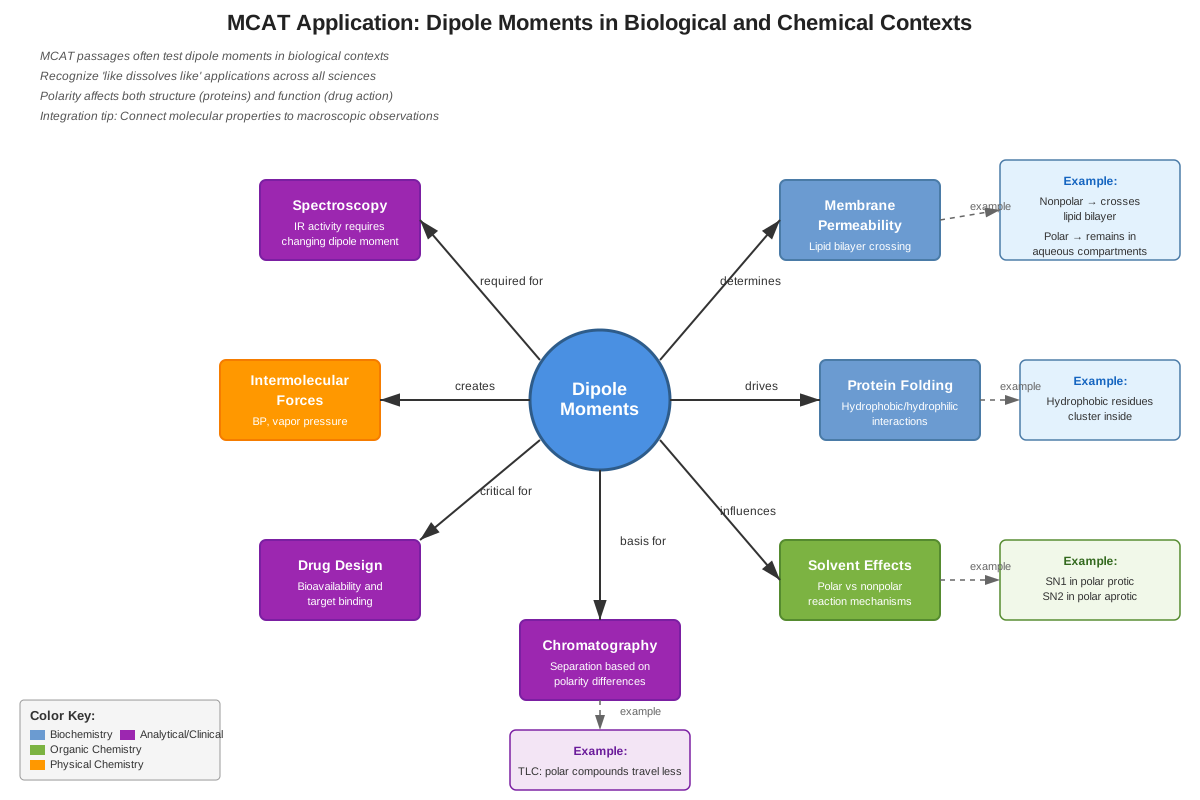
Dipole moments have significant real-world and clinical applications that make them relevant beyond the exam room. In pharmacology, drug polarity (determined by dipole moments) affects absorption, distribution, and the ability to cross biological membranes. Anesthetics, for example, tend to be relatively nonpolar to dissolve in lipid membranes, while many antibiotics are polar to remain in aqueous body fluids. Understanding dipole moments helps explain why certain drugs are administered orally while others require injection, and why some medications have poor bioavailability.
On the MCAT, dipole moments appear with moderate frequency across multiple sections. In the Chemical and Physical Foundations section, expect 2-4 questions per exam either directly testing dipole moments or requiring this knowledge to answer questions about intermolecular forces, solubility, or molecular properties. Questions typically appear as discrete items asking students to identify polar molecules or as passage-based questions where molecular polarity explains experimental observations. The Biological and Biochemical Foundations section may test dipole moments in the context of amino acid properties, membrane permeability, or protein structure.
Common MCAT question formats include: (1) identifying which molecule has the largest dipole moment from a set of structures, (2) explaining solubility patterns based on polarity, (3) predicting boiling point trends using intermolecular force strength, (4) determining whether a molecule will interact with an electric field, and (5) passage-based questions where molecular polarity explains chromatography results, extraction efficiency, or biological membrane transport. The MCAT particularly favors questions that require three-dimensional thinking—students must visualize molecular geometry to determine if bond dipoles cancel.
Core Concepts
Definition and Fundamental Nature of Dipole Moments
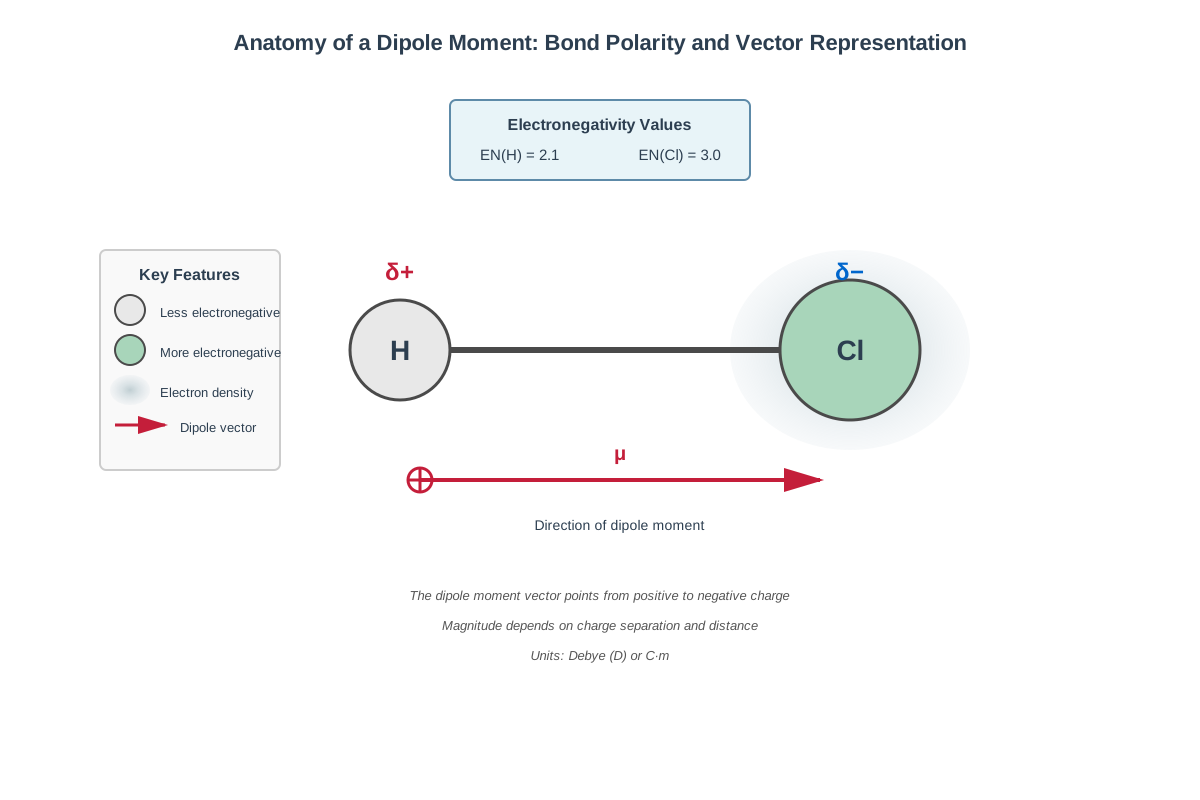
A dipole moment is a quantitative measure of the separation of positive and negative electrical charges within a molecule. More precisely, it is a vector quantity that has both magnitude and direction, pointing from the region of partial positive charge (δ+) to the region of partial negative charge (δ-). The dipole moment is represented by the Greek letter mu (μ) and is measured in Debye units (D), where 1 Debye equals 3.34 × 10⁻³⁰ coulomb-meters.
At the molecular level, dipole moments arise from two sources: (1) bond dipoles created by unequal sharing of electrons in polar covalent bonds, and (2) the three-dimensional arrangement of these bond dipoles and any lone pairs of electrons. A bond dipole exists whenever two atoms with different electronegativities form a covalent bond—the more electronegative atom attracts electron density more strongly, creating a partial negative charge (δ-) on that atom and a partial positive charge (δ+) on the less electronegative atom.
The magnitude of a bond dipole depends on two factors: the difference in electronegativity between the bonded atoms and the bond length. Greater electronegativity differences produce larger bond dipoles, as do longer bonds (since charge separation distance increases). For MCAT purposes, the most important electronegativity trend to remember is: F > O > N > Cl ≈ Br > C ≈ S ≈ I ≈ H. This trend allows rapid prediction of bond polarity.
Molecular Dipole Moments and Vector Addition
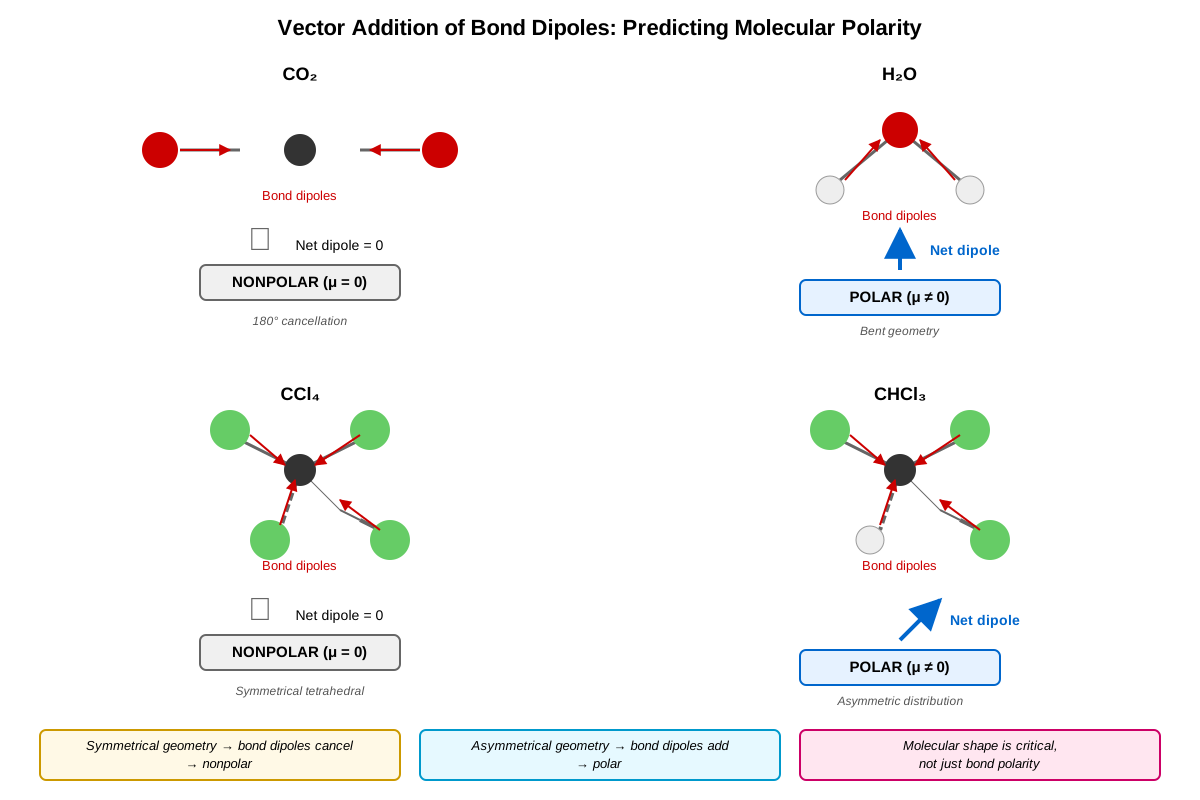
While individual bonds may be polar, the molecular dipole moment depends on the vector sum of all bond dipoles and lone pair contributions within the molecule. This is where molecular geometry becomes critical. Even if a molecule contains polar bonds, the overall molecule may be nonpolar if the bond dipoles cancel due to symmetry.
Consider carbon dioxide (CO₂): each C=O bond is highly polar, with oxygen being much more electronegative than carbon. However, CO₂ is a linear molecule (O=C=O), and the two bond dipoles are equal in magnitude but opposite in direction. When added as vectors, they cancel completely, resulting in a net dipole moment of zero—CO₂ is nonpolar despite having polar bonds.
In contrast, water (H₂O) has a bent molecular geometry (approximately 104.5° bond angle). The two O-H bond dipoles point from hydrogen (δ+) toward oxygen (δ-). Because of the bent shape, these bond dipoles do not cancel; instead, they add to produce a net dipole moment pointing from the hydrogen atoms toward the oxygen atom. Water has a substantial dipole moment of 1.85 D, making it highly polar.
The general principle for determining molecular polarity:
- Draw the correct Lewis structure
- Determine the molecular geometry using VSEPR theory
- Identify all bond dipoles (arrows pointing from δ+ to δ-)
- Consider lone pair contributions (lone pairs create regions of negative charge)
- Add all dipole vectors—if they cancel, the molecule is nonpolar; if they don't cancel, the molecule is polar
Symmetry and Dipole Moment Cancellation
Molecular symmetry is the key to predicting whether bond dipoles will cancel. Highly symmetrical molecules typically have zero net dipole moments even when they contain polar bonds. The most common symmetrical geometries that result in nonpolar molecules include:
| Molecular Geometry | Example | Bond Polarity | Molecular Polarity | Reason |
|---|---|---|---|---|
| Linear (2 atoms) | CO₂ | Polar | Nonpolar | Bond dipoles are equal and opposite |
| Trigonal planar | BF₃ | Polar | Nonpolar | Three bond dipoles arranged 120° apart cancel |
| Tetrahedral | CH₄, CCl₄ | Polar/Nonpolar | Nonpolar | Four identical bonds arranged symmetrically |
| Trigonal bipyramidal | PCl₅ | Polar | Nonpolar | Symmetrical arrangement cancels dipoles |
| Octahedral | SF₆ | Polar | Nonpolar | Six identical bonds arranged symmetrically |
Conversely, asymmetrical molecular geometries typically result in polar molecules when polar bonds are present:
| Molecular Geometry | Example | Molecular Polarity | Key Feature |
|---|---|---|---|
| Bent | H₂O, SO₂ | Polar | Bond dipoles don't cancel due to angle |
| Trigonal pyramidal | NH₃ | Polar | Lone pair creates asymmetry |
| Seesaw | SF₄ | Polar | Asymmetric arrangement of bonds |
| T-shaped | ClF₃ | Polar | Lone pairs create asymmetry |
| Square pyramidal | BrF₅ | Polar | One position differs from others |
Effect of Lone Pairs on Dipole Moments
Lone pairs of electrons significantly influence molecular dipole moments. Lone pairs represent regions of high electron density and contribute to the overall charge distribution. In molecules like ammonia (NH₃), the lone pair on nitrogen creates a region of partial negative charge. Combined with the three N-H bond dipoles (pointing from H toward N), this produces a substantial net dipole moment of 1.47 D.
The presence of lone pairs often breaks molecular symmetry, converting what would be a nonpolar geometry into a polar one. For example, methane (CH₄) is tetrahedral and nonpolar, but ammonia (NH₃) is trigonal pyramidal (tetrahedral with one lone pair) and polar. Similarly, carbon dioxide (CO₂) is linear and nonpolar, but sulfur dioxide (SO₂) is bent (due to a lone pair on sulfur) and polar.
Relationship Between Dipole Moments and Physical Properties
Dipole moments directly influence several important physical properties that are frequently tested on the MCAT:
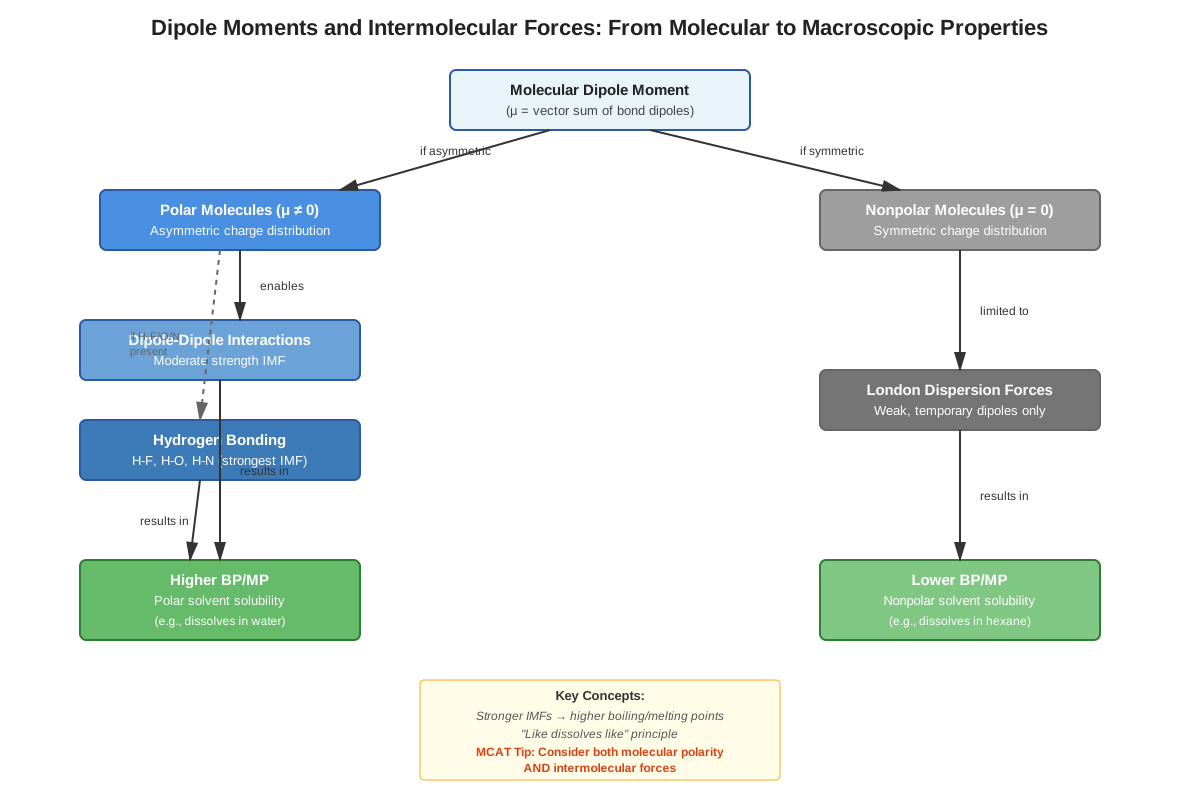
Boiling and melting points: Polar molecules generally have higher boiling and melting points than nonpolar molecules of similar molecular weight because dipole-dipole interactions are stronger than London dispersion forces. For example, propane (C₃H₈, nonpolar) has a boiling point of -42°C, while dimethyl ether (C₂H₆O, polar) has a boiling point of -24°C despite having similar molecular weights.
Solubility: The principle "like dissolves like" is fundamentally about dipole moments. Polar solvents (high dipole moments) dissolve polar solutes, while nonpolar solvents (zero or low dipole moments) dissolve nonpolar solutes. Water, with its large dipole moment, is an excellent solvent for ionic compounds and polar molecules but poorly dissolves nonpolar substances like oils and fats.
Dielectric constant: The dielectric constant of a substance measures its ability to reduce electric field strength and is directly related to molecular polarity. Polar solvents like water (dielectric constant ≈ 80) are much better at stabilizing charged species than nonpolar solvents like hexane (dielectric constant ≈ 2).
Quantitative Aspects of Dipole Moments
While the MCAT rarely requires numerical calculations of dipole moments, understanding the quantitative relationship helps conceptual mastery. The dipole moment magnitude is given by:
μ = q × dwhere q is the magnitude of charge separation and d is the distance between charges. This equation shows why both electronegativity difference (which affects q) and bond length (d) influence dipole moment magnitude.
For molecules with multiple bond dipoles, the net dipole moment is the vector sum:
μ_net = √(μ_x² + μ_y² + μ_z²)where μ_x, μ_y, and μ_z are the components of the dipole moment in three-dimensional space. This mathematical representation reinforces why molecular geometry is crucial—the spatial arrangement determines how individual bond dipoles combine.
Concept Relationships
The concept of dipole moments sits at the intersection of several fundamental General Chemistry principles, creating a web of interconnected ideas essential for MCAT success.
Electronegativity → Bond Polarity → Dipole Moments: The foundation begins with electronegativity, the tendency of an atom to attract electrons in a chemical bond. Electronegativity differences between bonded atoms create bond polarity, which generates individual bond dipoles. These bond dipoles are the building blocks of molecular dipole moments.
Lewis Structures → VSEPR Theory → Molecular Geometry → Dipole Moment Determination: To determine whether a molecule is polar, students must first draw correct Lewis structures showing all bonds and lone pairs. VSEPR theory then predicts three-dimensional molecular geometry based on electron pair repulsion. Finally, the geometry determines whether bond dipoles cancel or combine to produce a net molecular dipole moment.
Dipole Moments → Intermolecular Forces → Physical Properties: Molecular polarity (determined by dipole moments) dictates the types of intermolecular forces present. Polar molecules exhibit dipole-dipole interactions and potentially hydrogen bonding, while nonpolar molecules rely solely on London dispersion forces. These intermolecular forces directly determine physical properties like boiling point, melting point, viscosity, and surface tension.
Dipole Moments → Solubility → Biological Systems: The "like dissolves like" principle connects dipole moments to solubility, which has profound biological implications. Cell membrane structure (lipid bilayer) depends on the amphipathic nature of phospholipids—polar heads interact with aqueous environments while nonpolar tails cluster together. Drug design considers molecular polarity to optimize absorption and distribution.
Within the topic itself, bond dipoles combine vectorially to produce molecular dipoles, and molecular symmetry determines whether cancellation occurs. Lone pairs contribute to both molecular geometry and charge distribution, linking electron pair geometry to molecular polarity.
High-Yield Facts
⭐ A molecule can have polar bonds but still be nonpolar overall if bond dipoles cancel due to molecular symmetry (e.g., CO₂, CCl₄, BF₃)
⭐ Dipole moments are vector quantities that point from the positive end (δ+) to the negative end (δ-) of the dipole
⭐ Molecular geometry, not just bond polarity, determines whether a molecule has a net dipole moment
⭐ Lone pairs on the central atom often break symmetry and create polar molecules (e.g., NH₃, H₂O, SO₂)
⭐ Polar molecules have higher boiling points than nonpolar molecules of similar molecular weight due to stronger intermolecular forces
- The electronegativity trend most relevant for MCAT dipole moment questions is: F > O > N > Cl > Br > C ≈ H
- Water has one of the largest dipole moments (1.85 D) among common molecules, explaining its excellent solvent properties
- Symmetrical molecules with identical bonds arranged around a central atom are always nonpolar (CH₄, CCl₄, SF₆, PCl₅)
- Dipole-dipole interactions are approximately 1% as strong as covalent bonds but much stronger than London dispersion forces
- The dielectric constant of a solvent correlates with its polarity—high dielectric constants indicate polar solvents that stabilize ions
- Trans isomers are often less polar than cis isomers because of greater symmetry and dipole cancellation
- Molecules with dipole moments will orient in an external electric field, with the negative end toward the positive plate
Quick check — test yourself on Dipole moments so far.
Try Flashcards →Common Misconceptions
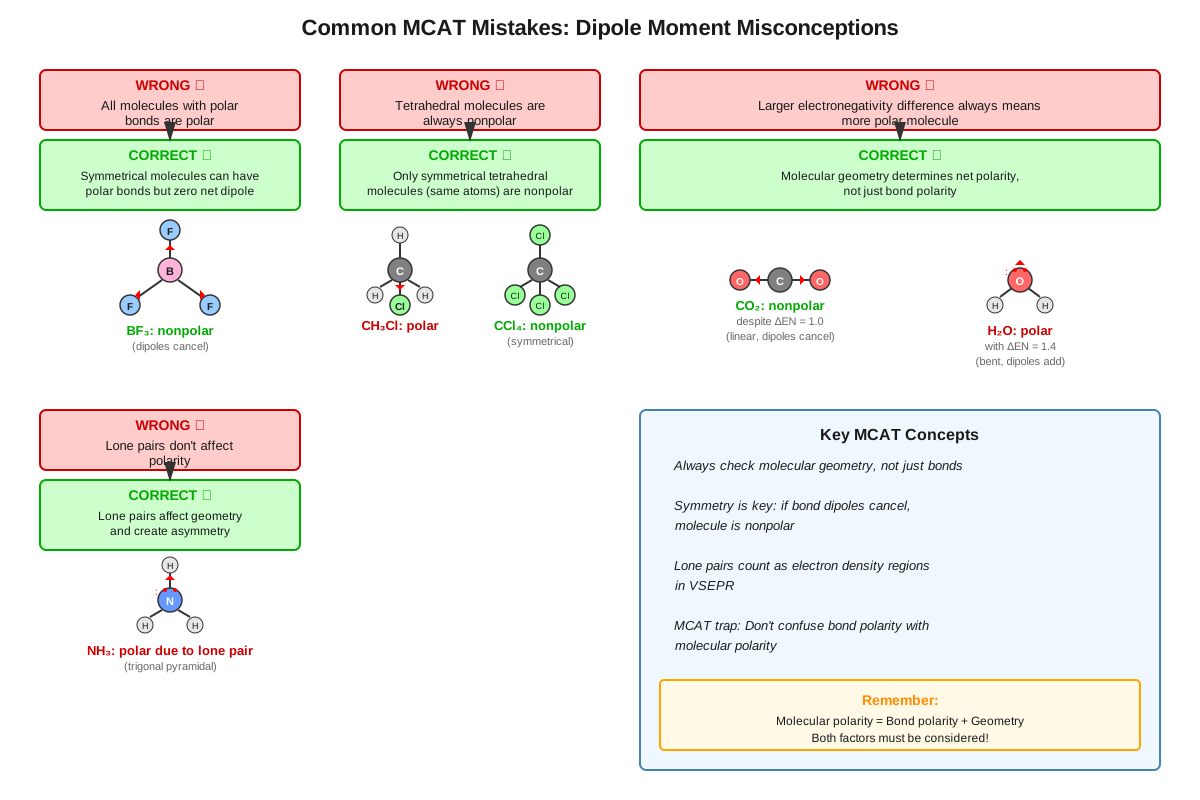
Misconception: All molecules containing polar bonds are polar molecules.
Correction: Molecular polarity depends on both bond polarity AND molecular geometry. Symmetrical molecules like CO₂, CCl₄, and BF₃ contain polar bonds but are nonpolar overall because bond dipoles cancel due to symmetry. Always consider three-dimensional geometry before concluding a molecule is polar.
Misconception: Larger molecules always have larger dipole moments.
Correction: Dipole moment magnitude depends on charge separation and molecular geometry, not molecular size. Small molecules like water (1.85 D) can have larger dipole moments than much larger molecules. Symmetrical large molecules may have zero dipole moment despite their size.
Misconception: The dipole moment arrow points from negative to positive charge.
Correction: By convention, the dipole moment vector points from the positive end (δ+) toward the negative end (δ-). This can be confusing because electric field lines point from positive to negative, but dipole moment vectors point in the opposite direction. Some textbooks use different conventions, but MCAT materials consistently use the δ+ → δ- convention.
Misconception: Nonpolar molecules cannot dissolve in polar solvents at all.
Correction: While "like dissolves like" is a useful guideline, it's not absolute. Small nonpolar molecules can have limited solubility in polar solvents, and factors like temperature, pressure, and specific molecular interactions can affect solubility. The principle means that polar-polar and nonpolar-nonpolar combinations are strongly favored, not that other combinations are impossible.
Misconception: All bent molecules are polar.
Correction: While most bent molecules are polar (H₂O, SO₂, NO₂), a bent molecule could theoretically be nonpolar if it had identical substituents arranged symmetrically. However, for MCAT purposes, bent molecules encountered in typical questions are polar. The key is understanding why: the bent geometry prevents bond dipole cancellation.
Misconception: Dipole moments only matter for intermolecular forces.
Correction: While dipole moments are crucial for understanding intermolecular forces, they also affect chemical reactivity, spectroscopic properties, and molecular behavior in electric fields. In organic chemistry, dipole moments help predict reaction mechanisms by identifying electron-rich and electron-poor regions of molecules.
Worked Examples
Example 1: Determining Molecular Polarity from Structure
Question: Rank the following molecules in order of increasing dipole moment magnitude: CH₄, CH₃Cl, CH₂Cl₂, CHCl₃, CCl₄
Solution:
Step 1: Determine the molecular geometry of each molecule.
All five molecules have a central carbon atom with four substituents, making them all tetrahedral in geometry.
Step 2: Identify bond dipoles.
- C-H bonds are essentially nonpolar (electronegativity difference is small)
- C-Cl bonds are polar, with chlorine being more electronegative (δ-) and carbon being less electronegative (δ+)
Step 3: Analyze symmetry and dipole cancellation for each molecule.
CH₄ (methane): Four identical C-H bonds arranged tetrahedrally. Perfect symmetry means any small bond dipoles cancel completely. Net dipole moment = 0 D (nonpolar).
CCl₄ (carbon tetrachloride): Four identical C-Cl bonds arranged tetrahedrally. Despite having polar bonds, perfect symmetry causes complete cancellation. Net dipole moment = 0 D (nonpolar).
CH₃Cl (methyl chloride): Three C-H bonds and one C-Cl bond. The C-Cl bond dipole points from C toward Cl and does not cancel with the essentially nonpolar C-H bonds. This molecule is polar with a moderate dipole moment.
CH₂Cl₂ (dichloromethane): Two C-H bonds and two C-Cl bonds. The two C-Cl bond dipoles point in similar directions (both toward chlorine atoms) and partially reinforce each other. The molecule is polar, but the two C-Cl dipoles are not perfectly aligned, so some cancellation occurs.
CHCl₃ (chloroform): One C-H bond and three C-Cl bonds. The three C-Cl bond dipoles point toward the three chlorine atoms and combine to create a net dipole pointing away from the single hydrogen. This molecule has a substantial dipole moment.
Step 4: Rank by dipole moment magnitude.
The ranking is: CH₄ = CCl₄ < CH₃Cl < CHCl₃ < CH₂Cl₂
Wait—let's reconsider. Actually, CHCl₃ has three C-Cl bonds pulling electron density toward three chlorines arranged around the carbon, while CH₂Cl₂ has only two. However, in CHCl₃, the three C-Cl dipoles are arranged symmetrically around the carbon (120° apart in projection), leading to some cancellation. In CH₂Cl₂, the two C-Cl dipoles are closer together (approximately 109° apart), leading to better reinforcement.
The correct ranking is: CH₄ = CCl₄ < CH₃Cl < CHCl₃ < CH₂Cl₂
Actually, experimental values show: CH₃Cl (1.87 D) > CH₂Cl₂ (1.60 D) > CHCl₃ (1.04 D) > CCl₄ = CH₄ (0 D)
The correct ranking is: CCl₄ = CH₄ < CHCl₃ < CH₂Cl₂ < CH₃Cl
Key insight: As more chlorines are added, they begin to cancel each other's dipole contributions. CH₃Cl has the largest dipole because one C-Cl bond is unopposed. This example illustrates why three-dimensional visualization is essential.
Example 2: Explaining Boiling Point Trends Using Dipole Moments
Question: Explain why dimethyl ether (CH₃OCH₃, bp = -24°C) has a higher boiling point than propane (C₃H₈, bp = -42°C) despite having similar molecular weights (46 g/mol vs. 44 g/mol).
Solution:
Step 1: Determine the molecular polarity of each compound.
Propane (C₃H₈): This is a hydrocarbon with only C-C and C-H bonds. The electronegativity difference between carbon and hydrogen is minimal, making these bonds essentially nonpolar. The molecule is symmetrical and nonpolar overall. Dipole moment ≈ 0 D.
Dimethyl ether (CH₃OCH₃): This molecule has a bent geometry around the central oxygen atom (two C-O bonds and two lone pairs on oxygen). The C-O bonds are polar because oxygen is much more electronegative than carbon. The bent geometry means the two C-O bond dipoles do not cancel—they combine to produce a net dipole moment. Dimethyl ether is polar with a dipole moment of approximately 1.30 D.
Step 2: Identify the intermolecular forces present.
Propane: Being nonpolar, propane molecules interact only through London dispersion forces (induced dipole-induced dipole interactions). These are the weakest intermolecular forces.
Dimethyl ether: Being polar, dimethyl ether molecules interact through both dipole-dipole interactions and London dispersion forces. Dipole-dipole interactions are significantly stronger than dispersion forces alone.
Step 3: Connect intermolecular forces to boiling point.
Boiling point reflects the energy required to overcome intermolecular forces and separate molecules in the liquid phase. Stronger intermolecular forces require more energy to overcome, resulting in higher boiling points.
Since dimethyl ether has stronger intermolecular forces (dipole-dipole plus dispersion) compared to propane (dispersion only), dimethyl ether requires more energy to boil, explaining its higher boiling point (-24°C vs. -42°C).
Step 4: Address the similar molecular weights.
The similar molecular weights mean that London dispersion forces are comparable for both molecules (dispersion forces increase with molecular size/surface area). The difference in boiling points is therefore attributable to the additional dipole-dipole interactions present in dimethyl ether but absent in propane.
Key insight: This example demonstrates how dipole moments directly influence physical properties through their effect on intermolecular forces. For MCAT questions comparing boiling points, always consider both molecular weight (affecting dispersion forces) and polarity (affecting dipole-dipole interactions and hydrogen bonding).
Exam Strategy
When approaching MCAT questions about dipole moments, follow this systematic strategy:
Step 1: Identify what the question is really asking. MCAT questions rarely ask directly "What is the dipole moment?" Instead, they ask about consequences of dipole moments: Which molecule is most polar? Which has the highest boiling point? Which is most soluble in water? Recognize that these questions require dipole moment analysis.
Step 2: Draw or visualize the three-dimensional structure. This is the most critical step. Many students incorrectly answer dipole moment questions because they think in two dimensions. For each molecule, determine:
- The correct Lewis structure
- The electron geometry (based on all electron pairs)
- The molecular geometry (based on atoms only)
- The three-dimensional arrangement of bonds and lone pairs
Step 3: Identify all bond dipoles. Mark polar bonds with arrows pointing from δ+ to δ-. Remember the electronegativity trend: F > O > N > Cl. For MCAT purposes, C-H bonds can be considered nonpolar.
Step 4: Check for symmetry. This is where most cancellation occurs. Ask: Are identical bonds arranged symmetrically around the central atom? If yes, bond dipoles likely cancel, making the molecule nonpolar. Common symmetrical geometries: linear (2 identical bonds), trigonal planar (3 identical bonds), tetrahedral (4 identical bonds), trigonal bipyramidal (5 identical bonds), octahedral (6 identical bonds).
Step 5: Consider lone pairs. Lone pairs break symmetry and contribute to molecular polarity. If the central atom has lone pairs, the molecule is likely polar unless perfect symmetry is maintained.
Trigger words and phrases to watch for:
- "Most polar" or "largest dipole moment" → Look for asymmetry and polar bonds
- "Nonpolar" → Look for symmetry or only nonpolar bonds
- "Soluble in water" → Polar molecules are water-soluble
- "Highest boiling point" → Consider both molecular weight and polarity
- "Dipole-dipole interactions" → Only polar molecules exhibit these
- "Separates in an electric field" → Polar molecules orient in electric fields
Process-of-elimination tips:
- Eliminate any symmetrical molecule when looking for the most polar option
- Eliminate any molecule with only C-H and C-C bonds when looking for polar molecules
- When comparing boiling points, if molecular weights are similar, choose the more polar molecule
- If a question asks about solubility in a nonpolar solvent, eliminate highly polar molecules
Time allocation advice:
Dipole moment questions should take 45-60 seconds for discrete questions and up to 90 seconds for passage-based questions. Don't spend excessive time trying to calculate exact dipole moment values—the MCAT tests conceptual understanding and relative comparisons. If you find yourself spending more than 90 seconds, make your best educated guess and move on. The most time-consuming step is visualizing three-dimensional geometry; practice this skill to improve speed.
Memory Techniques
Mnemonic for electronegativity trend: "FON Clerk" (F, O, N, Cl) are the four most electronegative elements commonly encountered in MCAT organic and general chemistry. Remember that fluorine is most electronegative, followed by oxygen, nitrogen, and chlorine.
Symmetry rule: "Same Bonds, Same Angles = No Dipole" - If all bonds around a central atom are identical and arranged at equal angles, the molecule is nonpolar. This applies to CH₄, CCl₄, CO₂, BF₃, PCl₅, and SF₆.
Lone pair rule: "Lone Pairs Break Pairs" - Lone pairs on the central atom break molecular symmetry and usually create polar molecules. Think of H₂O (bent, polar), NH₃ (trigonal pyramidal, polar), and SO₂ (bent, polar).
Visualization strategy for vector addition: Imagine each bond dipole as an arrow pulling electron density. If you can draw arrows that all point in roughly the same direction, the molecule is polar. If arrows point in opposite directions and cancel, the molecule is nonpolar. For complex molecules, imagine the "center of positive charge" and "center of negative charge"—if they're in different locations, the molecule is polar.
"Like dissolves like" memory aid: "Polar bears live at the poles, nonpolar bears live elsewhere" - Polar solvents dissolve polar solutes, nonpolar solvents dissolve nonpolar solutes. Water (polar) dissolves salts and sugars (polar), while hexane (nonpolar) dissolves fats and oils (nonpolar).
Boiling point comparison: "More Polar = More Power (to resist boiling)" - When comparing molecules of similar molecular weight, the more polar molecule has stronger intermolecular forces and therefore a higher boiling point.
Dipole direction convention: "Positive to Negative, Plus to Minus" - The dipole moment arrow points from the positive end (δ+) to the negative end (δ-). Think of it as showing the direction of electron density shift.
Summary
Dipole moments represent the quantitative measure of charge separation in molecules and are fundamental to understanding molecular polarity, intermolecular forces, and physical properties. A dipole moment arises when electron density is unevenly distributed, creating regions of partial positive and partial negative charge. While individual bond dipoles depend on electronegativity differences between bonded atoms, the molecular dipole moment depends critically on three-dimensional geometry—symmetrical molecules can have polar bonds yet be nonpolar overall due to dipole cancellation. Lone pairs on central atoms typically break symmetry and create polar molecules. Molecular polarity directly influences intermolecular forces (polar molecules exhibit dipole-dipole interactions while nonpolar molecules rely on London dispersion forces), which in turn determine physical properties like boiling point, melting point, and solubility. For the MCAT, success with dipole moment questions requires the ability to visualize three-dimensional molecular geometry, identify bond dipoles, recognize symmetry patterns, and connect molecular polarity to macroscopic properties. The most common mistakes involve thinking in two dimensions, forgetting to consider lone pairs, and assuming all molecules with polar bonds are polar overall.
Key Takeaways
- Dipole moments are vector quantities measuring charge separation; molecular geometry determines whether bond dipoles cancel or combine to produce a net dipole
- Symmetrical molecules (CO₂, CCl₄, BF₃, CH₄) are nonpolar even when they contain polar bonds because bond dipoles cancel completely
- Lone pairs on the central atom break molecular symmetry and typically create polar molecules (H₂O, NH₃, SO₂)
- Molecular polarity determines intermolecular force types: polar molecules exhibit dipole-dipole interactions while nonpolar molecules have only London dispersion forces
- "Like dissolves like"—polar solvents dissolve polar solutes, and nonpolar solvents dissolve nonpolar solutes, a principle with major biological and clinical implications
- For MCAT questions, always visualize three-dimensional molecular geometry before determining polarity; two-dimensional thinking leads to incorrect answers
- Polar molecules have higher boiling points than nonpolar molecules of similar molecular weight due to stronger intermolecular forces
Related Topics
Intermolecular Forces: Dipole moments directly determine the types and strengths of intermolecular attractions. Mastering dipole moments enables deeper understanding of hydrogen bonding, dipole-dipole interactions, and London dispersion forces.
Electronegativity and Bond Polarity: The foundation of dipole moments lies in electronegativity differences. Further study of periodic trends in electronegativity enhances the ability to predict bond polarity rapidly.
VSEPR Theory and Molecular Geometry: Three-dimensional molecular shape is essential for determining whether bond dipoles cancel. Advanced study of VSEPR theory, including molecules with five and six electron groups, builds on dipole moment concepts.
Solubility and Solution Chemistry: The "like dissolves like" principle, rooted in dipole moments, extends to complex topics like colligative properties, partition coefficients, and biological membrane transport.
Organic Chemistry Functional Groups: Different functional groups have characteristic polarities based on their dipole moments. Understanding dipole moments facilitates prediction of organic reaction mechanisms and physical properties.
Spectroscopy: Dipole moments affect how molecules interact with electromagnetic radiation. Infrared spectroscopy, in particular, requires molecules to have changing dipole moments during vibration to be IR-active.
Practice CTA
Now that you've mastered the core concepts of dipole moments, it's time to solidify your understanding through active practice. Attempt the practice questions and flashcards associated with this topic—they're specifically designed to mirror MCAT-style questions and will help you identify any remaining gaps in your knowledge. Remember, understanding dipole moments opens the door to mastering intermolecular forces, predicting physical properties, and explaining biological phenomena—all high-yield topics for test day. The investment you make in practicing these concepts now will pay dividends when you encounter them in passages and discrete questions on the actual MCAT. You've got this!
Sign up free to keep reading
Create a free AnvayaPrep account to finish this MCAT guide on Dipole moments — plus flashcards and practice questions.