Overview
Hund's rule (also known as Hund's rule of maximum multiplicity) is a fundamental principle in General Chemistry that governs how electrons populate orbitals of equal energy within an atom. This rule states that electrons will occupy degenerate (equal-energy) orbitals singly and with parallel spins before pairing up in the same orbital. Understanding this principle is essential for predicting electron configurations, magnetic properties of atoms, and the behavior of elements across the periodic table.
For the MCAT, Hund's rule represents a critical bridge between abstract quantum mechanical principles and practical chemical behavior. The exam frequently tests this concept through questions about electron configuration, paramagnetism versus diamagnetism, and the stability of half-filled and fully-filled subshells. Students must not only memorize the rule but also understand its physical basis in electron-electron repulsion and exchange energy. Questions may appear as standalone items testing orbital diagrams or embedded within passages discussing transition metal chemistry, spectroscopy, or periodic trends.
Within the broader context of Atomic Structure and Periodic Trends, Hund's rule works in concert with the Aufbau principle and the Pauli exclusion principle to provide a complete framework for understanding electron configuration. These three principles collectively explain why elements exhibit their characteristic chemical properties, why certain electron configurations are more stable than others, and how atomic structure determines an element's position and behavior in the periodic table. Mastery of Hund's rule enables students to predict ionization energies, atomic radii, and reactivity patterns—all high-yield topics for the MCAT General Chemistry section.
Learning Objectives
- [ ] Define Hund's rule using accurate General Chemistry terminology
- [ ] Explain why Hund's rule matters for the MCAT
- [ ] Apply Hund's rule to exam-style questions involving electron configurations
- [ ] Identify common mistakes related to Hund's rule
- [ ] Connect Hund's rule to related General Chemistry concepts
- [ ] Draw accurate orbital diagrams for atoms and ions following Hund's rule
- [ ] Predict magnetic properties (paramagnetic vs. diamagnetic) using Hund's rule
- [ ] Explain the quantum mechanical basis for Hund's rule in terms of electron repulsion and exchange energy
- [ ] Recognize exceptions to expected electron configurations that relate to Hund's rule
Prerequisites
- Quantum numbers (n, l, ml, ms): Understanding these quantum numbers is essential because Hund's rule specifically addresses how electrons with different spin quantum numbers (ms) occupy orbitals with the same ml values
- Orbital shapes and energy levels (s, p, d, f): Knowledge of orbital types is necessary to identify degenerate orbitals where Hund's rule applies
- Pauli exclusion principle: This principle establishes that no two electrons can have identical quantum numbers, which constrains how Hund's rule operates
- Aufbau principle: Understanding the order of orbital filling provides the foundation upon which Hund's rule operates
- Electron configuration notation: Familiarity with notation like 1s² 2s² 2p⁶ enables application of Hund's rule to specific atoms
Why This Topic Matters
Clinical and Real-World Significance
Hund's rule has profound implications for understanding the magnetic properties of materials used in medical imaging. Paramagnetic contrast agents used in MRI scans (such as gadolinium-based compounds) rely on unpaired electrons—a direct consequence of Hund's rule—to enhance image contrast. The rule also explains the behavior of oxygen molecules, which are paramagnetic due to unpaired electrons, affecting oxygen's reactivity in biological systems and its role in oxidative stress and cellular respiration.
MCAT Exam Statistics
Hund's rule appears on the MCAT with medium frequency, typically in 2-4 questions per exam either directly or indirectly. Questions most commonly appear in these formats:
- Discrete questions asking for electron configurations or orbital diagrams (30% of Hund's rule questions)
- Passage-based questions involving transition metal chemistry, coordination complexes, or spectroscopy (50%)
- Questions about magnetic properties requiring prediction of paramagnetic versus diamagnetic behavior (20%)
The Chemical and Physical Foundations of Biological Systems section accounts for approximately 70% of Hund's rule questions, with the remaining 30% appearing in passages that bridge chemistry and physics concepts.
Common Exam Contexts
Hund's rule frequently appears in MCAT passages discussing:
- Transition metal complexes and their electronic properties
- Spectroscopic techniques (UV-Vis, EPR) that depend on electron configuration
- Periodic trends in ionization energy, particularly anomalies
- Coordination chemistry and crystal field theory
- Magnetic resonance imaging principles
Core Concepts
Definition and Statement of Hund's Rule
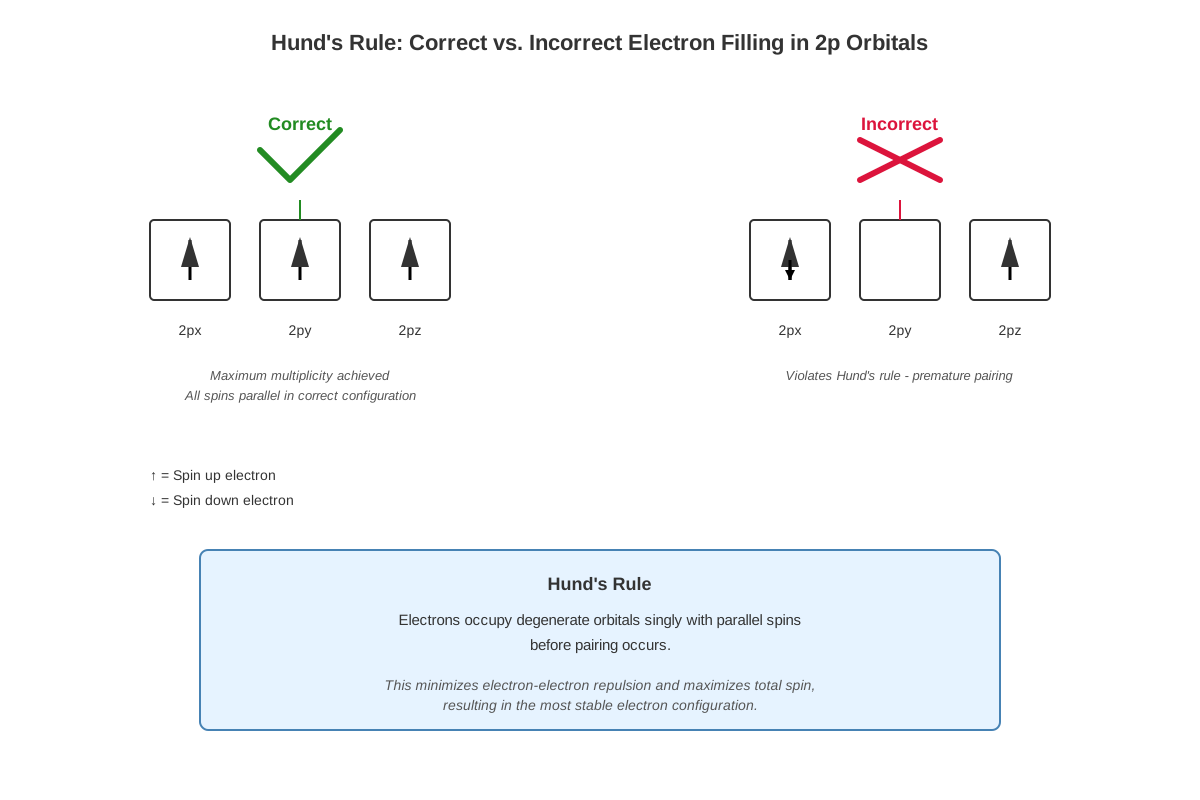
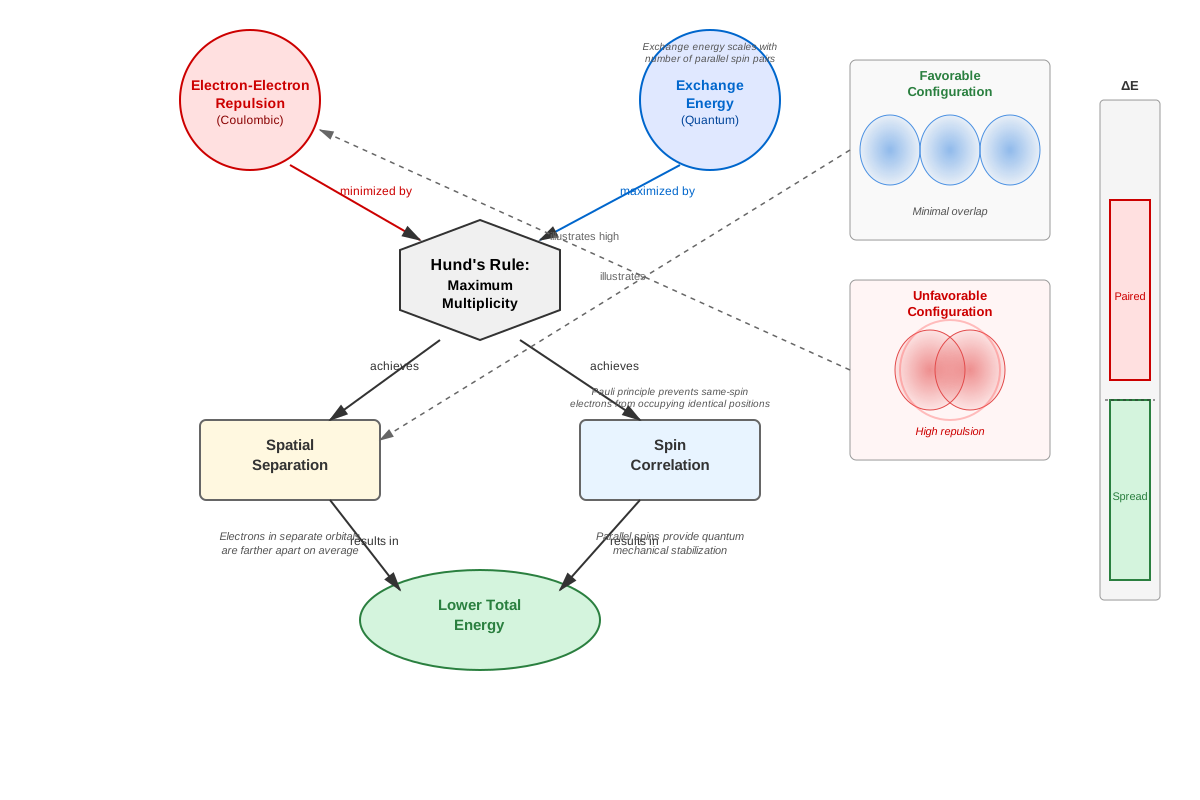
Hund's rule (or Hund's rule of maximum multiplicity) states that when electrons occupy degenerate orbitals (orbitals with the same energy level), they will first fill each orbital singly with parallel spins before any orbital receives a second electron with opposite spin. This principle minimizes electron-electron repulsion and maximizes exchange energy, resulting in the most stable electron configuration.
The rule can be broken down into three components:
- Electrons occupy all degenerate orbitals singly before pairing
- All unpaired electrons in singly-occupied orbitals have parallel spins (same ms value)
- Only after all degenerate orbitals contain one electron will pairing begin
Physical Basis: Why Hund's Rule Exists
The quantum mechanical justification for Hund's rule involves two competing factors:
Electron-electron repulsion: When two electrons occupy the same orbital, they are confined to the same region of space, resulting in significant electrostatic repulsion. By occupying separate orbitals, electrons maintain greater average distance from each other, reducing this repulsive energy.
Exchange energy: A quantum mechanical phenomenon with no classical analog, exchange energy represents a stabilization that occurs when electrons with parallel spins occupy different orbitals. This stabilization arises from the antisymmetric nature of the electron wavefunction and is maximized when the number of parallel spins is maximized. The exchange energy contribution typically outweighs the small energy cost of promoting an electron to a degenerate orbital.
Application to Orbital Diagrams
When constructing orbital diagrams (also called orbital box diagrams), Hund's rule dictates the specific arrangement of arrows representing electrons:
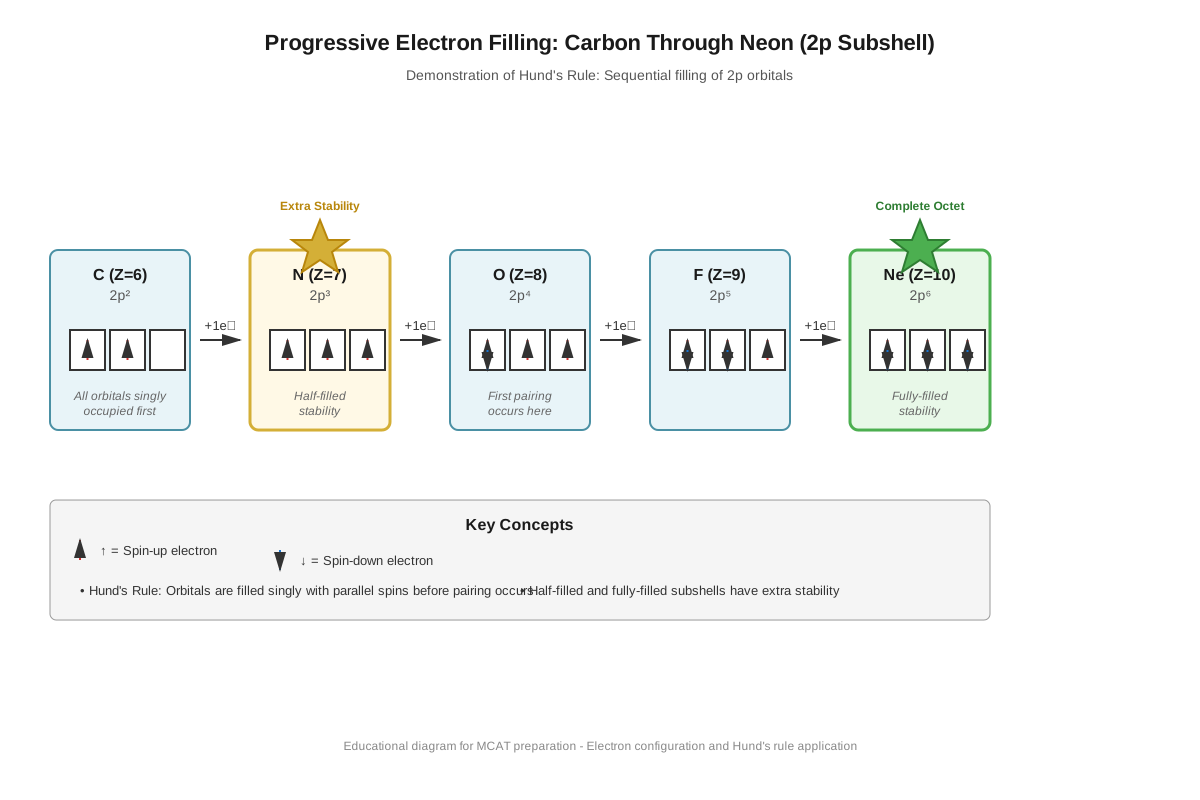
For carbon (C, atomic number 6) with configuration 1s² 2s² 2p²:
- The 2p subshell contains three degenerate orbitals
- Following Hund's rule, the two 2p electrons occupy separate orbitals with parallel spins
- Correct diagram: 2p: [↑][↑][ ]
- Incorrect diagram: 2p: [↑↓][ ][ ]
For nitrogen (N, atomic number 7) with configuration 1s² 2s² 2p³:
- All three 2p orbitals receive one electron each
- All three electrons have parallel spins
- Diagram: 2p: [↑][↑][↑]
- This half-filled subshell configuration provides extra stability
For oxygen (O, atomic number 8) with configuration 1s² 2s² 2p⁴:
- Three 2p orbitals are singly occupied, then the fourth electron pairs
- Diagram: 2p: [↑↓][↑][↑]
Degenerate Orbitals and Energy Considerations
Degenerate orbitals are orbitals that have identical energy in an isolated atom. The concept of degeneracy is crucial for applying Hund's rule:
| Subshell | Number of Degenerate Orbitals | Total Electron Capacity |
|---|---|---|
| s | 1 | 2 |
| p | 3 | 6 |
| d | 5 | 10 |
| f | 7 | 14 |
Hund's rule only applies within a set of degenerate orbitals. For example, the three 2p orbitals (2px, 2py, 2pz) are degenerate and must follow Hund's rule, but the 2s and 2p orbitals are not degenerate with each other, so Hund's rule does not govern electron distribution between them.
Magnetic Properties: Paramagnetism and Diamagnetism
Hund's rule directly determines the magnetic properties of atoms and molecules:
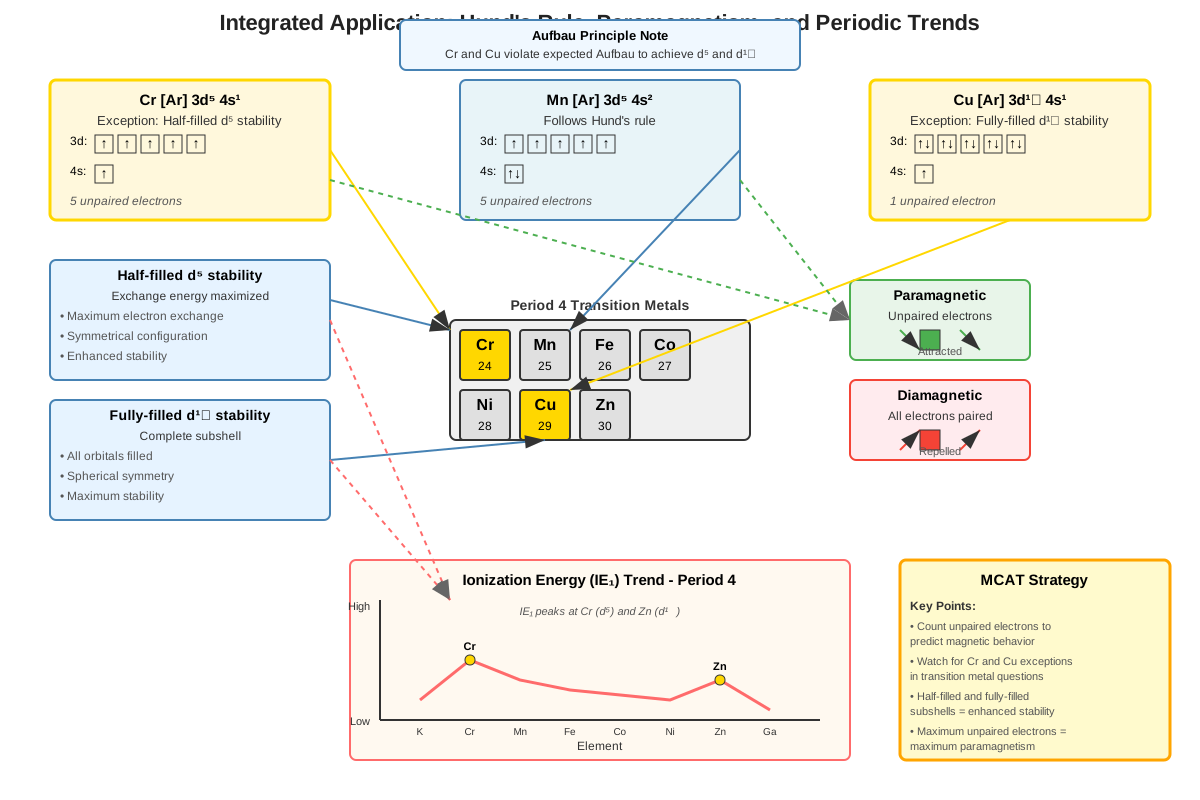
Paramagnetic substances contain one or more unpaired electrons and are attracted to magnetic fields. The presence of unpaired electrons results from following Hund's rule when filling degenerate orbitals. Examples include:
- Oxygen (O₂): Contains two unpaired electrons
- Iron (Fe): Contains four unpaired electrons in its neutral state
- Nitrogen (N): Contains three unpaired electrons
Diamagnetic substances contain only paired electrons and are weakly repelled by magnetic fields. Examples include:
- Helium (He): 1s² (all electrons paired)
- Neon (Ne): All subshells completely filled
- Zinc (Zn): [Ar] 3d¹⁰ 4s² (all electrons paired)
The MCAT frequently tests the ability to predict magnetic properties based on electron configuration, making this a high-yield application of Hund's rule.
Stability of Half-Filled and Fully-Filled Subshells
An important consequence of Hund's rule and exchange energy is the exceptional stability of half-filled and fully-filled subshells. This stability explains several anomalies in expected electron configurations:
Chromium (Cr, Z=24): Expected configuration [Ar] 3d⁴ 4s², but actual configuration is [Ar] 3d⁵ 4s¹
- The half-filled 3d subshell (five electrons, all with parallel spins) provides extra stability
- Maximum exchange energy is achieved with five unpaired electrons
Copper (Cu, Z=29): Expected configuration [Ar] 3d⁹ 4s², but actual configuration is [Ar] 3d¹⁰ 4s¹
- The fully-filled 3d subshell provides extra stability
- This configuration is more stable than having two electrons in the 4s orbital
These exceptions are testable on the MCAT and demonstrate the practical importance of understanding the quantum mechanical basis for Hund's rule.
Concept Relationships
Hund's rule operates within a hierarchical framework of electron configuration principles. The Aufbau principle determines the order in which orbitals are filled (1s, 2s, 2p, 3s, etc.), establishing which orbitals are available at each step. Once the Aufbau principle identifies the next subshell to be filled, Hund's rule dictates how electrons distribute among the degenerate orbitals within that subshell. The Pauli exclusion principle then constrains Hund's rule by requiring that paired electrons in the same orbital must have opposite spins.
This relationship can be mapped as:
Aufbau Principle → identifies next subshell → Hund's Rule → distributes electrons among degenerate orbitals → Pauli Exclusion Principle → constrains spin pairing
The magnetic properties (paramagnetism vs. diamagnetism) emerge directly from the electron distribution determined by Hund's rule. Unpaired electrons → paramagnetic; all paired electrons → diamagnetic.
Hund's rule connects to periodic trends by explaining anomalies in ionization energy. For example, oxygen has a lower first ionization energy than nitrogen because removing one electron from oxygen's paired 2p orbital relieves electron-electron repulsion, while removing an electron from nitrogen disrupts a stable half-filled configuration.
The concept also relates to molecular orbital theory, where Hund's rule applies to the filling of molecular orbitals, explaining the paramagnetism of O₂ and the bond order of various diatomic molecules.
Exchange energy (the quantum mechanical basis for Hund's rule) → connects to → crystal field theory in coordination chemistry, where the splitting of d-orbitals affects how Hund's rule applies in transition metal complexes.
High-Yield Facts
⭐ Hund's rule states that electrons occupy degenerate orbitals singly with parallel spins before pairing occurs
⭐ Atoms or molecules with unpaired electrons are paramagnetic (attracted to magnetic fields); those with all paired electrons are diamagnetic
⭐ Half-filled and fully-filled subshells have extra stability due to maximized exchange energy and symmetry
⭐ Chromium ([Ar] 3d⁵ 4s¹) and copper ([Ar] 3d¹⁰ 4s¹) are common exceptions to expected electron configurations due to d-subshell stability
⭐ The physical basis for Hund's rule is minimization of electron-electron repulsion and maximization of exchange energy
- The p subshell has 3 degenerate orbitals, the d subshell has 5, and the f subshell has 7
- Nitrogen (2p³) has three unpaired electrons, making it paramagnetic with maximum spin multiplicity for its electron count
- Oxygen (2p⁴) has two unpaired electrons despite having four p electrons total
- When drawing orbital diagrams, all unpaired electrons in degenerate orbitals should have parallel spins (all arrows pointing up)
- Hund's rule only applies within a set of degenerate orbitals, not between different subshells
- The exchange energy stabilization increases with the number of parallel electron spins
- Removing an electron from a paired orbital (like in oxygen) requires less energy than removing one from a half-filled configuration (like in nitrogen)
Quick check — test yourself on Hund rule so far.
Try Flashcards →Common Misconceptions
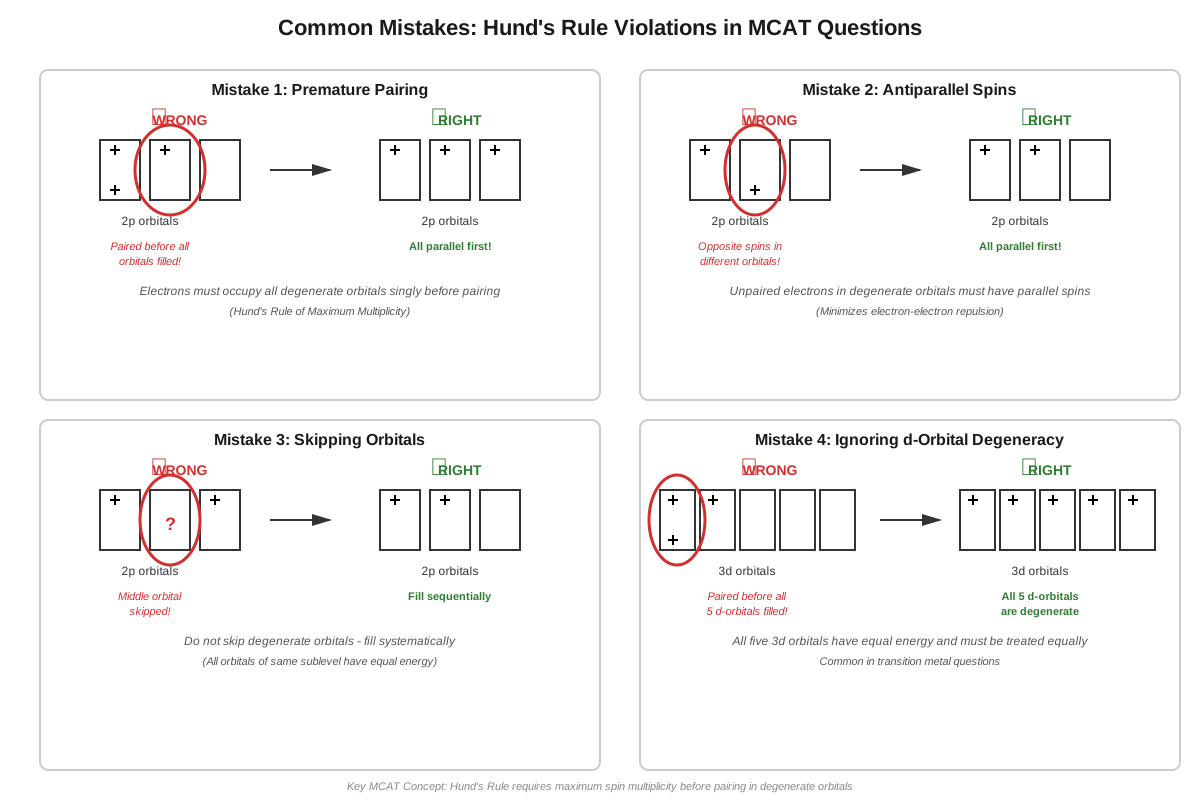
Misconception: Hund's rule means electrons always spread out as much as possible across all available orbitals in an atom.
Correction: Hund's rule only applies to degenerate orbitals (orbitals with the same energy within the same subshell). Electrons fill lower energy orbitals completely before moving to higher energy orbitals according to the Aufbau principle. For example, 2s fills completely before any electrons enter 2p orbitals.
Misconception: When applying Hund's rule, it doesn't matter whether unpaired electrons have parallel or antiparallel spins.
Correction: Hund's rule specifically requires that unpaired electrons in degenerate orbitals have parallel spins (all spin-up or all spin-down). This maximizes exchange energy and provides quantum mechanical stabilization. The correct configuration for nitrogen's 2p electrons is [↑][↑][↑], not [↑][↓][↑].
Misconception: Chromium's electron configuration ([Ar] 3d⁵ 4s¹) violates Hund's rule.
Correction: Chromium's configuration actually exemplifies the consequences of Hund's rule and exchange energy. The half-filled 3d subshell with five parallel spins provides maximum exchange energy stabilization, making this configuration more stable than [Ar] 3d⁴ 4s², which would have only four parallel spins in the d subshell.
Misconception: Diamagnetic substances have no electrons, which is why they aren't attracted to magnets.
Correction: Diamagnetic substances have electrons, but all electrons are paired. Paired electrons have opposite spins that cancel each other's magnetic moments, resulting in no net magnetic field. Diamagnetic substances are actually weakly repelled by magnetic fields, though this effect is much smaller than paramagnetic attraction.
Misconception: Hund's rule applies when filling molecular orbitals in the same way it applies to atomic orbitals.
Correction: While Hund's rule does apply to molecular orbitals, the situation is more complex because molecular orbitals may not be degenerate even when atomic orbitals are. Additionally, in molecular orbital theory, factors like bond order and molecular stability must be considered alongside Hund's rule. For example, O₂ has two unpaired electrons in degenerate π* orbitals, following Hund's rule at the molecular level.
Misconception: Once an orbital has one electron, it must receive its second electron before any other degenerate orbital receives its first electron.
Correction: This is exactly backward. Hund's rule requires that all degenerate orbitals receive one electron before any orbital receives a second electron. For carbon's 2p² configuration, the correct arrangement is [↑][↑][ ], not [↑↓][ ][ ].
Worked Examples
Example 1: Electron Configuration and Orbital Diagram
Question: Draw the complete orbital diagram for a neutral iron (Fe) atom (atomic number 26) and determine whether it is paramagnetic or diamagnetic.
Solution:
Step 1: Write the electron configuration for iron.
- Iron has 26 electrons
- Following the Aufbau principle: 1s² 2s² 2p⁶ 3s² 3p⁶ 4s² 3d⁶
- Note: 4s fills before 3d according to the Aufbau principle
Step 2: Draw the orbital diagram, applying Hund's rule to the 3d subshell.
- 1s: [↑↓]
- 2s: [↑↓]
- 2p: [↑↓][↑↓][↑↓]
- 3s: [↑↓]
- 3p: [↑↓][↑↓][↑↓]
- 4s: [↑↓]
- 3d: [↑↓][↑][↑][↑][↑]
Step 3: Apply Hund's rule to the 3d subshell.
- The 3d subshell has 5 degenerate orbitals and contains 6 electrons
- Following Hund's rule: first five electrons occupy separate orbitals with parallel spins
- The sixth electron pairs with one of the existing electrons
- Result: four unpaired electrons in the 3d subshell
Step 4: Determine magnetic properties.
- Iron has four unpaired electrons (in the 3d subshell)
- Any atom with unpaired electrons is paramagnetic
- Answer: Iron is paramagnetic
Connection to learning objectives: This example demonstrates application of Hund's rule to a transition metal, requires drawing accurate orbital diagrams, and predicts magnetic properties—all key MCAT skills.
Example 2: Comparing Ionization Energies
Question: Explain why the first ionization energy of oxygen (O) is lower than that of nitrogen (N), even though oxygen has a higher nuclear charge.
Solution:
Step 1: Write electron configurations for both atoms.
- Nitrogen (Z=7): 1s² 2s² 2p³
- Oxygen (Z=8): 1s² 2s² 2p⁴
Step 2: Draw orbital diagrams for the valence electrons, applying Hund's rule.
- Nitrogen 2p: [↑][↑][↑] (half-filled, all electrons unpaired)
- Oxygen 2p: [↑↓][↑][↑] (one pair, two unpaired)
Step 3: Analyze the stability of each configuration.
- Nitrogen has a half-filled 2p subshell with three unpaired electrons
- This configuration has maximum exchange energy and is exceptionally stable
- Oxygen has one paired set of electrons in a 2p orbital
- The paired electrons experience significant electron-electron repulsion
Step 4: Explain the ionization energy difference.
- Removing an electron from nitrogen disrupts the stable half-filled configuration
- Removing an electron from oxygen relieves electron-electron repulsion in the paired orbital
- The repulsion relief in oxygen makes it easier to remove an electron
- Answer: Oxygen has a lower first ionization energy than nitrogen because removing an electron from oxygen relieves electron-electron repulsion in a paired orbital, while removing an electron from nitrogen disrupts a stable half-filled 2p subshell
Step 5: Connect to Hund's rule.
- This phenomenon directly results from Hund's rule
- Hund's rule creates the half-filled configuration in nitrogen (maximum stability)
- Hund's rule requires pairing in oxygen (introduces repulsion)
- The stability difference explains the ionization energy anomaly
Connection to learning objectives: This example connects Hund's rule to periodic trends, explains the quantum mechanical basis for the rule (exchange energy and electron repulsion), and demonstrates a common MCAT question type involving anomalies in expected trends.
Exam Strategy
Approaching MCAT Questions on Hund's Rule
When encountering questions involving Hund's rule on the MCAT, follow this systematic approach:
- Identify the atom or ion: Determine the number of electrons (atomic number minus charge for cations, plus charge for anions)
- Write the electron configuration: Use the Aufbau principle to determine which subshells are occupied
- Focus on the valence electrons: Most questions concern the outermost subshell being filled
- Apply Hund's rule to degenerate orbitals: Distribute electrons singly with parallel spins before pairing
- Check for unpaired electrons: Count unpaired electrons to determine magnetic properties or stability
Trigger Words and Phrases
Watch for these key phrases that signal Hund's rule is being tested:
- "Paramagnetic" or "diamagnetic" → requires determining unpaired electrons
- "Orbital diagram" or "electron box diagram" → must apply Hund's rule to draw correctly
- "Half-filled subshell" or "fully-filled subshell" → relates to stability exceptions
- "Unpaired electrons" → direct application of Hund's rule
- "Ground state configuration" → must use Hund's rule for lowest energy arrangement
- "Anomaly in ionization energy" → often explained by Hund's rule and subshell stability
- "Magnetic properties" → requires Hund's rule to determine electron pairing
Process of Elimination Tips
When using process of elimination on Hund's rule questions:
- Eliminate any orbital diagram showing paired electrons before all degenerate orbitals are singly occupied → violates Hund's rule
- Eliminate configurations showing antiparallel spins in singly-occupied degenerate orbitals → violates Hund's rule's requirement for parallel spins
- For magnetic property questions, eliminate "diamagnetic" if you can identify any unpaired electrons → even one unpaired electron makes an atom paramagnetic
- Eliminate answer choices that ignore the stability of half-filled or fully-filled d subshells → when considering transition metal configurations
- For ionization energy questions, eliminate explanations that don't account for electron-electron repulsion or exchange energy → these are the physical basis for Hund's rule effects
Time Allocation Advice
Hund's rule questions typically require 60-90 seconds:
- 15-20 seconds: Read and identify what's being asked
- 20-30 seconds: Write electron configuration or draw orbital diagram
- 15-20 seconds: Apply Hund's rule to determine answer
- 10-15 seconds: Verify answer and eliminate incorrect options
For passage-based questions, budget an additional 30 seconds to extract relevant information from the passage before applying the above timeline.
Exam Tip: If a question asks about magnetic properties, immediately draw the orbital diagram for the valence electrons. This visual representation makes it much easier to count unpaired electrons accurately than trying to work from the electron configuration notation alone.
Memory Techniques
Mnemonic for Hund's Rule
"Single Seats Before Sharing" or "Buses Before Buddies"
- Think of electrons as passengers on a bus (orbital)
- Each passenger (electron) prefers their own seat (orbital) before sitting next to someone
- All passengers face the same direction (parallel spins) when sitting alone
- Only when all seats have one passenger will anyone share a seat
Visualization Strategy
The Concert Hall Method:
Imagine degenerate orbitals as seats in a row at a concert:
- Early arrivals (first electrons) spread out, taking separate seats
- Everyone faces forward (parallel spins)
- Only when all seats have one person will anyone sit next to someone else
- The second person in a seat must face backward (opposite spin)
Acronym for Electron Configuration Principles
"HAP" - Hund's, Aufbau, Pauli
- Hund's rule: spread out in degenerate orbitals
- Aufbau principle: fill from lowest to highest energy
- Pauli exclusion: no two electrons with identical quantum numbers
Remember: "Stay HAP-py with electron configurations!"
Memory Aid for Paramagnetic vs. Diamagnetic
"Para" = "Parallel"
- Paramagnetic substances have parallel unpaired spins
- If you can draw parallel arrows (unpaired electrons), it's paramagnetic
- Diamagnetic = Different directions (all paired, opposite spins)
Stability Exceptions Mnemonic
"Copper and Chromium Crave Complete or Half"
- Copper: Complete d subshell (d¹⁰)
- Chromium: Complete half-filled d subshell (d⁵)
- Both sacrifice an s electron to achieve d subshell stability
Summary
Hund's rule is a fundamental principle governing electron distribution in atoms, stating that electrons occupy degenerate orbitals singly with parallel spins before pairing occurs. This rule arises from quantum mechanical considerations: minimizing electron-electron repulsion and maximizing exchange energy. For the MCAT, students must apply Hund's rule to construct accurate orbital diagrams, predict magnetic properties (paramagnetic substances have unpaired electrons; diamagnetic substances have all paired electrons), and explain periodic trends and anomalies. The rule works in concert with the Aufbau principle and Pauli exclusion principle to determine ground-state electron configurations. Special stability is associated with half-filled and fully-filled subshells, explaining exceptions like chromium ([Ar] 3d⁵ 4s¹) and copper ([Ar] 3d¹⁰ 4s¹). Understanding Hund's rule enables prediction of chemical behavior, ionization energies, and magnetic properties—all high-yield topics for MCAT success.
Key Takeaways
- Hund's rule requires electrons to occupy degenerate orbitals singly with parallel spins before any pairing occurs, minimizing repulsion and maximizing exchange energy
- Paramagnetic substances contain unpaired electrons and are attracted to magnetic fields; diamagnetic substances have all paired electrons and are weakly repelled
- Half-filled and fully-filled subshells provide exceptional stability, explaining electron configuration exceptions in chromium and copper
- Hund's rule applies only within sets of degenerate orbitals (same subshell), not between different energy levels
- The physical basis for Hund's rule involves electron-electron repulsion (minimized by spatial separation) and exchange energy (maximized by parallel spins)
- Anomalies in periodic trends, particularly ionization energies, often result from the stability patterns created by Hund's rule
- Accurate orbital diagrams require systematic application of Aufbau principle, Hund's rule, and Pauli exclusion principle in that order
Related Topics
Pauli Exclusion Principle: This principle constrains how Hund's rule operates by requiring that paired electrons in the same orbital must have opposite spins. Mastering Hund's rule provides the foundation for understanding how the Pauli exclusion principle limits electron configurations.
Aufbau Principle: Understanding the order of orbital filling is essential before applying Hund's rule. These principles work together to predict complete electron configurations for all elements.
Periodic Trends in Ionization Energy: Hund's rule explains several anomalies in expected ionization energy trends, particularly the lower-than-expected values for oxygen and the higher-than-expected values for nitrogen.
Transition Metal Chemistry: The application of Hund's rule to d-orbital filling is crucial for understanding transition metal properties, oxidation states, and coordination chemistry—all testable MCAT topics.
Molecular Orbital Theory: Hund's rule extends to molecular orbitals, explaining the paramagnetism of O₂ and the electronic structure of other diatomic molecules.
Crystal Field Theory: In coordination complexes, d-orbital splitting affects how Hund's rule applies, determining whether complexes are high-spin or low-spin configurations.
Practice CTA
Now that you've mastered the core concepts of Hund's rule, it's time to solidify your understanding through active practice. Work through the practice questions and flashcards to test your ability to apply Hund's rule to diverse question types. Focus especially on drawing orbital diagrams, predicting magnetic properties, and explaining periodic trend anomalies—these are the highest-yield applications for the MCAT. Remember, understanding the "why" behind Hund's rule (electron repulsion and exchange energy) will help you reason through novel questions on test day. You've got this!
Sign up free to keep reading
Create a free AnvayaPrep account to finish this MCAT guide on Hund rule — plus flashcards and practice questions.