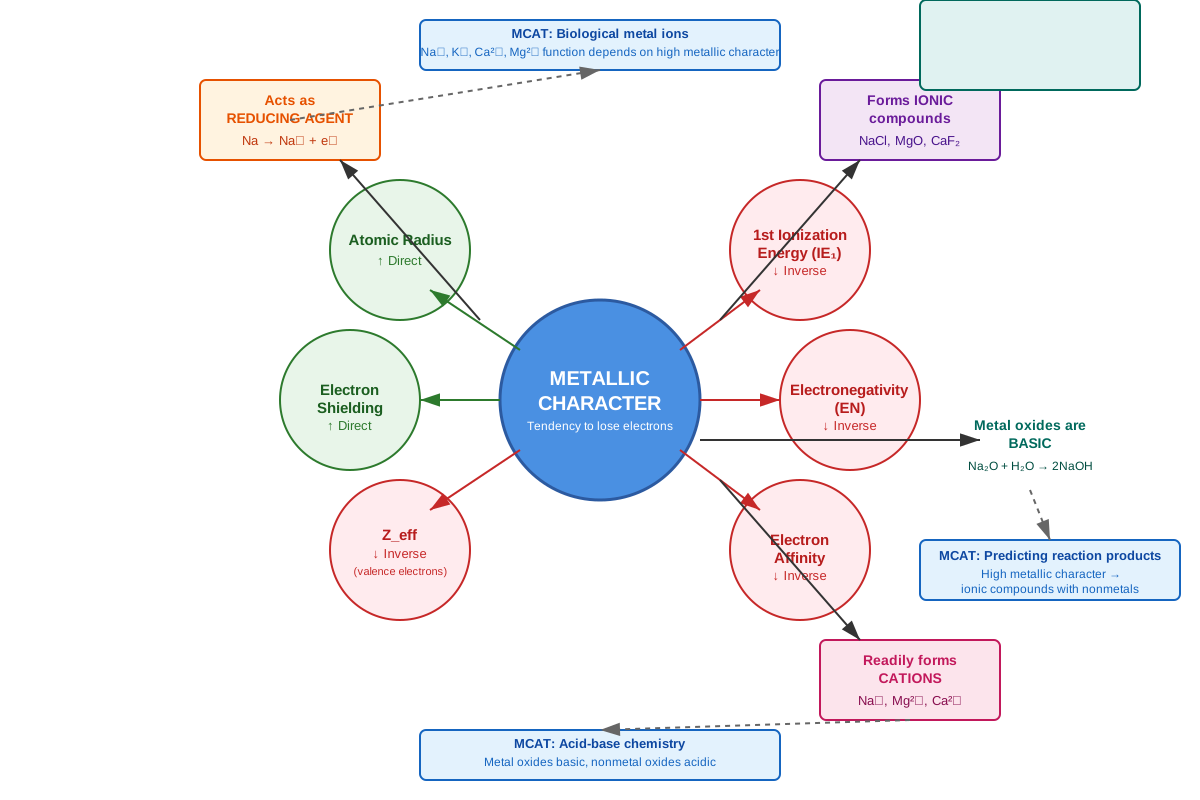
Overview
Metallic character is a fundamental periodic trend in General Chemistry that describes the extent to which an element exhibits properties characteristic of metals. These properties include the tendency to lose electrons (forming cations), electrical and thermal conductivity, malleability, ductility, and metallic luster. Understanding metallic character is essential for predicting chemical behavior, reactivity patterns, and bonding characteristics across the periodic table. This concept represents a bridge between atomic structure and macroscopic properties, making it a cornerstone of Atomic Structure and Periodic Trends.
For the MCAT, metallic character serves as a unifying principle that connects multiple testable concepts including ionization energy, electronegativity, atomic radius, and chemical reactivity. The exam frequently tests this topic through questions about periodic trends, predicting reaction products, understanding acid-base behavior of oxides, and explaining differences in bonding types. Questions may appear as discrete items testing trend knowledge or embedded within passages discussing materials science, biochemical cofactors, or pharmaceutical chemistry.
Metallic character General Chemistry concepts integrate seamlessly with other periodic trends and provide predictive power for understanding why elements behave as they do. Elements with high metallic character (like sodium or calcium) readily form ionic compounds and act as reducing agents, while elements with low metallic character (like oxygen or fluorine) tend to gain electrons and act as oxidizing agents. This gradient of behavior across the periodic table explains patterns in reactivity, compound formation, and biological function—all high-yield topics for Metallic character MCAT questions.
Learning Objectives
- [ ] Define Metallic character using accurate General Chemistry terminology
- [ ] Explain why Metallic character matters for the MCAT
- [ ] Apply Metallic character to exam-style questions
- [ ] Identify common mistakes related to Metallic character
- [ ] Connect Metallic character to related General Chemistry concepts
- [ ] Predict relative metallic character of elements based on periodic table position
- [ ] Explain the relationship between metallic character and other periodic trends (ionization energy, electronegativity, atomic radius)
- [ ] Use metallic character to predict chemical reactivity and bonding behavior
Prerequisites
- Periodic table organization: Understanding groups, periods, and the distinction between metals, nonmetals, and metalloids is essential for recognizing trends in metallic character
- Electron configuration: Knowledge of valence electrons and electron shells explains why elements exhibit different tendencies to lose electrons
- Effective nuclear charge (Z_eff): This concept underlies why metallic character varies across periods and down groups
- Basic bonding concepts: Familiarity with ionic versus covalent bonding helps explain how metallic character influences compound formation
- Oxidation states: Understanding electron loss and gain is fundamental to metallic character's definition
Why This Topic Matters
Metallic character appears regularly on the MCAT in multiple contexts. Statistical analysis of recent exams shows that periodic trends questions constitute approximately 5-8% of the Chemical and Physical Foundations section, with metallic character being one of the four major trends tested (alongside ionization energy, electronegativity, and atomic radius). Questions testing this concept appear both as discrete items and within passage-based questions.
In real-world and clinical contexts, metallic character explains crucial phenomena. The biological availability of metal ions (sodium, potassium, calcium, magnesium, iron) depends on their metallic character—highly metallic elements form stable cations that can be transported in aqueous biological systems. Pharmaceutical chemistry relies on understanding metallic character when designing metal-based drugs (cisplatin, lithium salts) or predicting drug-metal interactions. Toxicology of heavy metals (lead, mercury, cadmium) relates directly to their intermediate metallic character and ability to displace essential metal ions in biological systems.
Common MCAT question formats include: ranking elements by metallic character; predicting which element will most readily form a cation; explaining why certain oxides are basic while others are acidic; determining which element is the strongest reducing agent; and analyzing experimental data about electrical conductivity or reactivity patterns. Passage-based questions often embed metallic character concepts within discussions of battery chemistry, corrosion, metallurgy, or coordination chemistry in biological systems.
Core Concepts
Definition of Metallic Character
Metallic character refers to the set of chemical and physical properties associated with metals, most fundamentally the tendency of an atom to lose electrons and form positive ions (cations). At the atomic level, metallic character quantifies how readily an element donates its valence electrons. Elements with high metallic character have loosely held valence electrons that are easily removed, while elements with low metallic character hold their valence electrons tightly and tend to gain electrons instead.
The physical manifestations of metallic character include electrical conductivity (due to mobile electrons), thermal conductivity, metallic luster (reflection of light by delocalized electrons), malleability (ability to be hammered into sheets), and ductility (ability to be drawn into wires). However, for MCAT purposes, the chemical definition—the tendency to lose electrons—is most important.
Periodic Trends in Metallic Character
Metallic character exhibits predictable trends across the periodic table based on atomic structure:
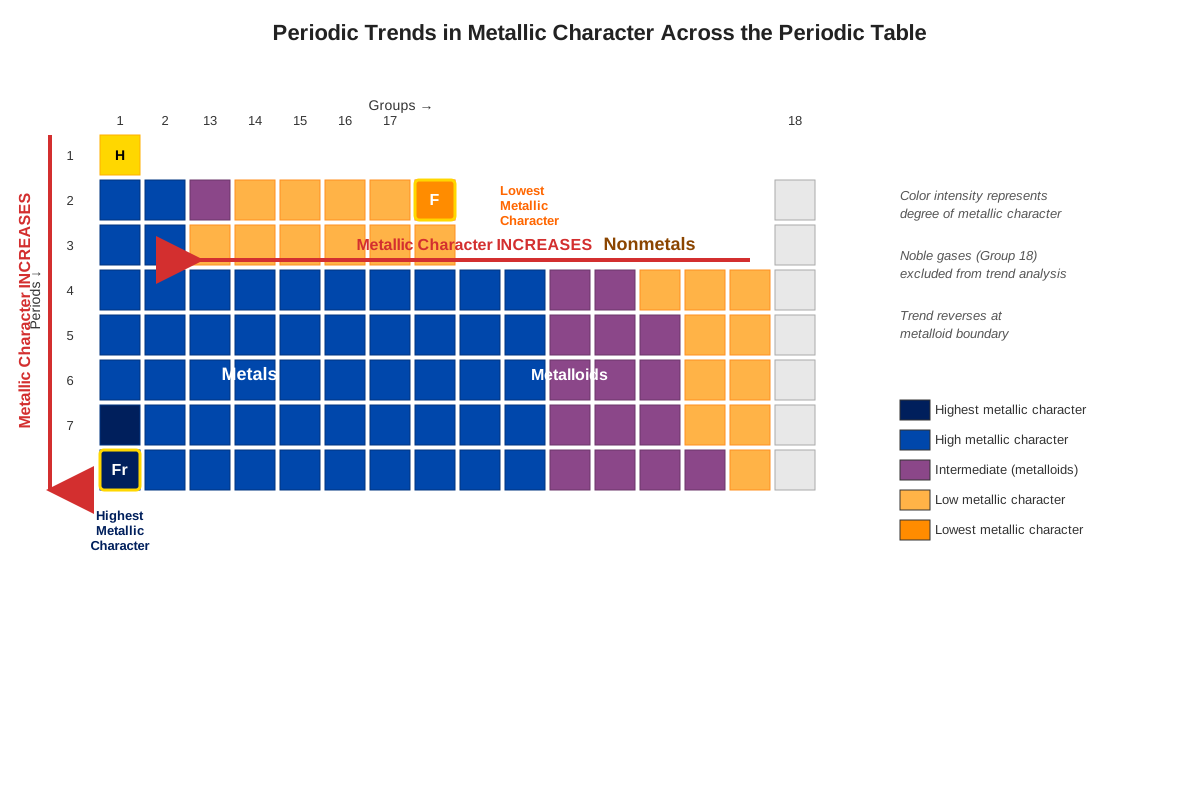
Trend across a period (left to right): Metallic character decreases as you move from left to right across a period. Elements on the left side of the periodic table (alkali and alkaline earth metals) exhibit the highest metallic character in their respective periods, while elements on the right side (halogens and noble gases) exhibit the lowest metallic character.
Trend down a group (top to bottom): Metallic character increases as you move down a group. Elements at the bottom of a group exhibit greater metallic character than those at the top.
| Period/Group Trend | Direction | Metallic Character Change | Reason |
|---|---|---|---|
| Across period (→) | Left to right | Decreases | Increasing Z_eff, smaller radius, electrons held more tightly |
| Down group (↓) | Top to bottom | Increases | Increasing atomic radius, greater shielding, electrons held less tightly |
Atomic Structure Basis for Metallic Character
The trends in metallic character arise from three interrelated atomic properties:
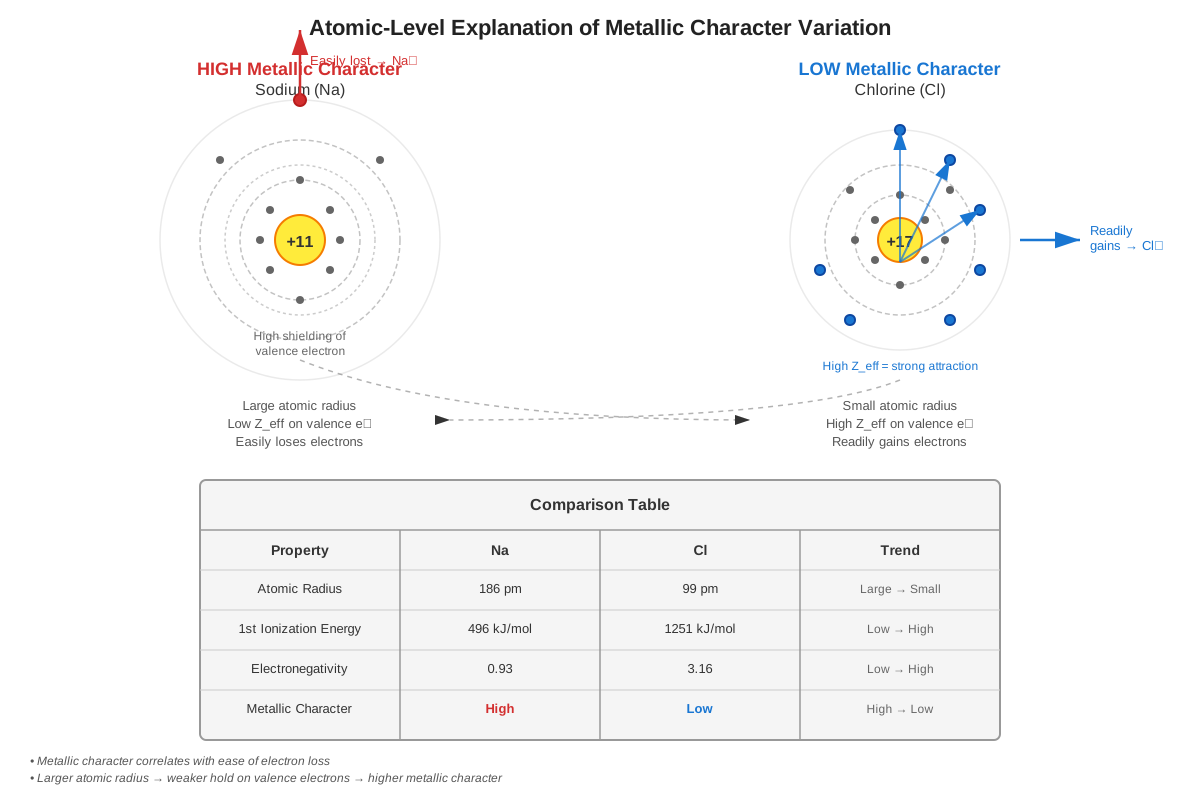
- Atomic radius: Larger atoms have valence electrons farther from the nucleus, experiencing weaker electrostatic attraction. These electrons are more easily removed, increasing metallic character.
- Effective nuclear charge (Z_eff): As Z_eff increases (moving left to right across a period), the nucleus pulls valence electrons more strongly, making them harder to remove and decreasing metallic character.
- Electron shielding: Inner electron shells shield valence electrons from the full nuclear charge. More electron shells (moving down a group) means greater shielding, weaker attraction to valence electrons, and increased metallic character.
These three factors work together: moving down a group, atomic radius increases and shielding increases while Z_eff remains relatively constant, resulting in increased metallic character. Moving across a period, Z_eff increases while shielding remains relatively constant and atomic radius decreases, resulting in decreased metallic character.
Relationship to Other Periodic Trends
Metallic character exhibits inverse relationships with several other periodic trends:
Ionization energy: Elements with high metallic character have low ionization energies because their valence electrons are easily removed. The first ionization energy measures the energy required to remove the outermost electron—exactly what defines metallic character. Therefore, metallic character and ionization energy are inversely related.
Electronegativity: Elements with high metallic character have low electronegativity because they tend to lose rather than attract electrons. Electronegativity measures an atom's ability to attract electrons in a bond, the opposite of metallic character's electron-donating tendency.
Electron affinity: While the relationship is less direct, elements with high metallic character generally have low (less negative) electron affinities because they do not readily accept electrons. Nonmetals with low metallic character have high (more negative) electron affinities.
Chemical Consequences of Metallic Character
The degree of metallic character determines several important chemical behaviors:
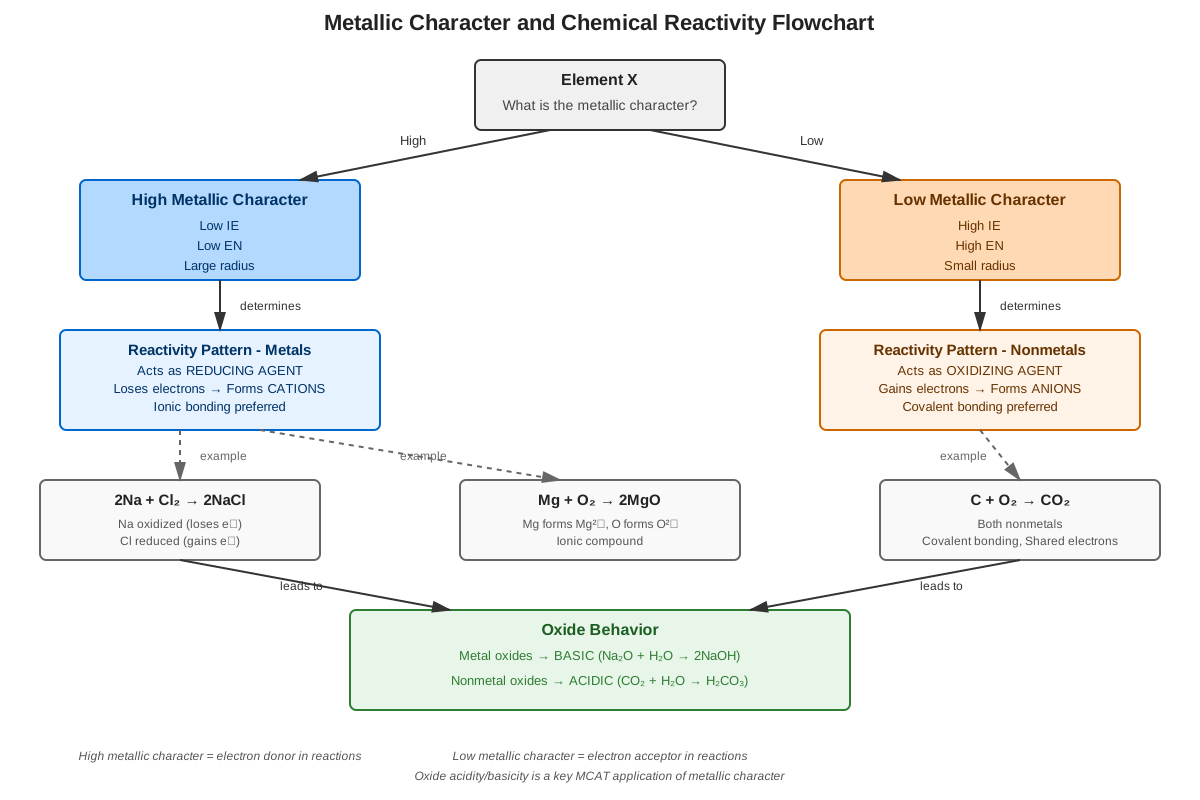
Oxide basicity: Elements with high metallic character form basic oxides (like Na₂O, CaO) that react with water to produce hydroxides and with acids to form salts. Elements with low metallic character form acidic oxides (like SO₃, N₂O₅) that react with water to produce acids and with bases to form salts. Intermediate metallic character produces amphoteric oxides (like Al₂O₃, ZnO) that can react as either acids or bases.
Reducing versus oxidizing agents: Elements with high metallic character are strong reducing agents because they readily donate electrons. Elements with low metallic character are strong oxidizing agents because they readily accept electrons.
Bonding type: High metallic character favors ionic bonding (electron transfer), while low metallic character favors covalent bonding (electron sharing). Intermediate metallic character can produce polar covalent bonds or metallic bonding.
Quantitative Aspects
While metallic character itself is not assigned a numerical value, it correlates quantitatively with measurable properties:
- Ionization energy values: Lower first ionization energy indicates higher metallic character (e.g., Cs: 376 kJ/mol vs. F: 1681 kJ/mol)
- Electronegativity values: Lower Pauling electronegativity indicates higher metallic character (e.g., Cs: 0.79 vs. F: 3.98)
- Standard reduction potentials: More negative reduction potentials indicate higher metallic character and stronger reducing ability (e.g., Li⁺/Li: -3.04 V vs. F₂/F⁻: +2.87 V)
Concept Relationships
Metallic character serves as a central organizing principle connecting multiple concepts within Atomic Structure and Periodic Trends. The relationship map flows as follows:
Electron configuration → determines → Number and location of valence electrons → influences → Atomic radius, Z_eff, and shielding → determines → Metallic character → predicts → Ionization energy, electronegativity, and reactivity patterns
More specifically: Elements with few valence electrons in outer shells (left side of periodic table) have large atomic radii and low Z_eff experienced by valence electrons, resulting in high metallic character. This high metallic character manifests as low ionization energy, low electronegativity, and high reactivity as reducing agents.
Metallic character connects to prerequisite knowledge of periodic table organization by explaining why the table is divided into metals, metalloids, and nonmetals. The metalloid diagonal (B, Si, Ge, As, Sb, Te) represents elements with intermediate metallic character, exhibiting properties of both metals and nonmetals.
The concept extends to chemical bonding by predicting bond types: high metallic character differences between bonding atoms favor ionic bonding, while similar low metallic character favors covalent bonding. This connects to acid-base chemistry through oxide behavior and to electrochemistry through reduction potential predictions.
Within the topic itself, the core definition (tendency to lose electrons) → explains → periodic trends (based on atomic structure) → predicts → chemical behavior (oxide basicity, reducing power, bonding type) → enables → problem-solving on exam questions.
High-Yield Facts
⭐ Metallic character increases down a group and decreases across a period from left to right
⭐ Elements with high metallic character have low ionization energies and low electronegativities
⭐ Francium (Fr) has the highest metallic character of all elements; fluorine (F) has the lowest
⭐ Metallic character is inversely proportional to ionization energy and electronegativity
⭐ Elements with high metallic character form basic oxides; those with low metallic character form acidic oxides
- Metallic character fundamentally measures the tendency to lose electrons and form cations
- Alkali metals (Group 1) exhibit the highest metallic character within their respective periods
- Noble gases have the lowest metallic character due to stable electron configurations
- Metalloids (B, Si, Ge, As, Sb, Te) have intermediate metallic character and exhibit amphoteric behavior
- Metallic character correlates with reducing power: higher metallic character means stronger reducing agent
- The metallic character gradient explains the diagonal relationship between certain elements (Li-Mg, Be-Al)
- Transition metals have moderate metallic character that varies less dramatically than main group elements
- Metallic character determines whether an element will form predominantly ionic or covalent compounds
Quick check — test yourself on Metallic character so far.
Try Flashcards →Common Misconceptions
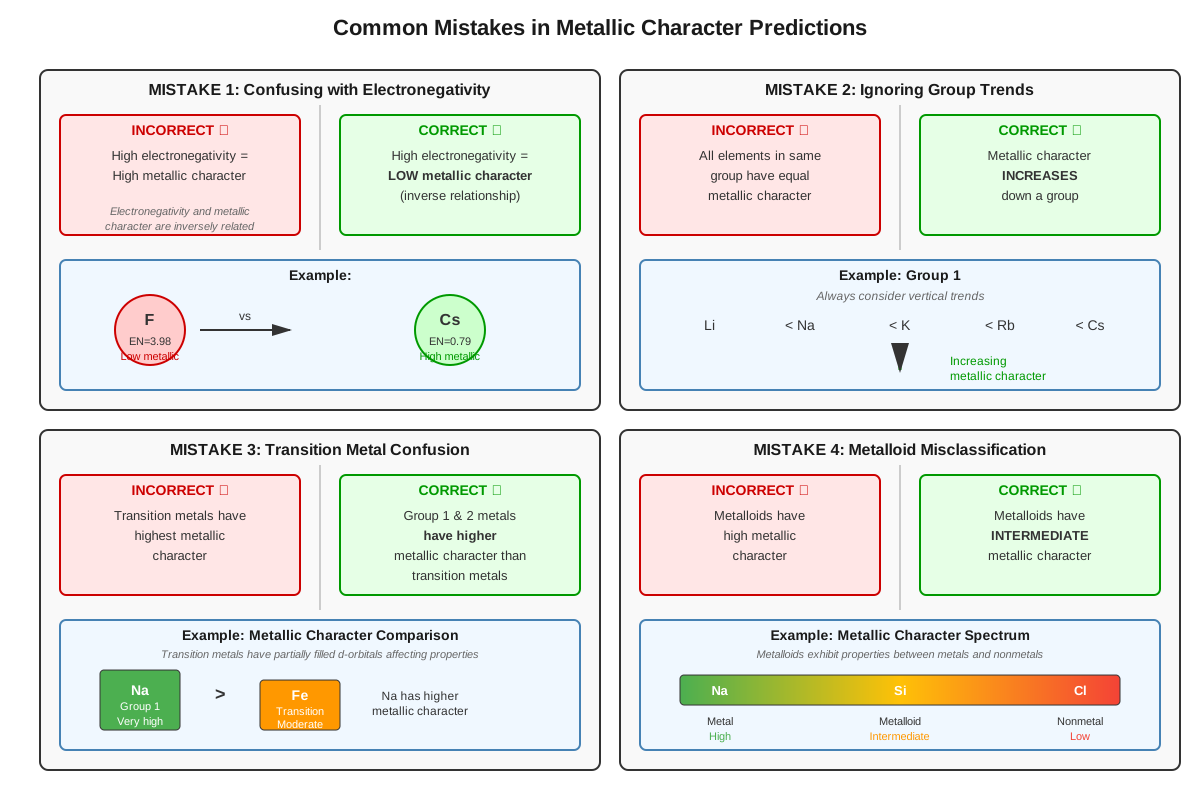
Misconception: Metallic character only refers to physical properties like shininess and conductivity → Correction: While these are manifestations of metallic character, the fundamental chemical definition is the tendency to lose electrons. The MCAT focuses on this chemical definition and its predictive power for reactivity and bonding.
Misconception: All metals have equally high metallic character → Correction: Metallic character varies significantly even among metals. Cesium has much higher metallic character than copper or gold. The periodic trends apply within the metal category, with alkali metals showing the highest metallic character.
Misconception: Metallic character increases across a period because there are more metals on the right side → Correction: Metallic character actually decreases across a period from left to right. The right side of the periodic table contains nonmetals (low metallic character), while the left side contains metals (high metallic character).
Misconception: Elements with high metallic character have high electronegativity → Correction: These properties are inversely related. High metallic character corresponds to LOW electronegativity because metallic elements tend to lose electrons (low electronegativity) rather than attract them (high electronegativity).
Misconception: Metallic character and atomic mass are directly related → Correction: While metallic character generally increases down a group (where atomic mass also increases), this is due to increasing atomic radius and shielding, not mass itself. Across a period, atomic mass increases but metallic character decreases.
Misconception: Metalloids have no metallic character → Correction: Metalloids have intermediate metallic character, exhibiting properties of both metals and nonmetals. This is why they can act as semiconductors and form amphoteric oxides.
Misconception: Transition metals don't follow metallic character trends → Correction: Transition metals do follow the general trends, though the changes are less dramatic due to d-orbital filling. They still show decreasing metallic character across their rows and increasing metallic character down their groups.
Worked Examples
Example 1: Ranking Elements by Metallic Character
Question: Rank the following elements in order of increasing metallic character: Si, Na, Cl, Mg, Al
Solution:
Step 1: Locate each element on the periodic table
- Na: Period 3, Group 1
- Mg: Period 3, Group 2
- Al: Period 3, Group 13
- Si: Period 3, Group 14
- Cl: Period 3, Group 17
Step 2: Apply the periodic trend
All elements are in Period 3, so we only need to consider the left-to-right trend. Metallic character decreases from left to right across a period.
Step 3: Order the elements
From left to right: Na, Mg, Al, Si, Cl
Therefore, metallic character: Na > Mg > Al > Si > Cl
Step 4: Write the answer in increasing order
Increasing metallic character: Cl < Si < Al < Mg < Na
Reasoning connection: This question tests the core periodic trend. Sodium (Group 1, alkali metal) has the highest metallic character because it most readily loses its single valence electron. Chlorine (Group 17, halogen) has the lowest metallic character because it tends to gain electrons rather than lose them. Silicon is a metalloid with intermediate properties.
Example 2: Predicting Chemical Behavior
Question: Element X forms an oxide that reacts with water to produce a basic solution. Element Y forms an oxide that reacts with water to produce an acidic solution. Which element has higher metallic character, and what can you predict about their relative positions on the periodic table?
Solution:
Step 1: Analyze the oxide behavior
- Element X forms a basic oxide → indicates high metallic character
- Element Y forms an acidic oxide → indicates low metallic character
Step 2: Determine which has higher metallic character
Element X has higher metallic character because basic oxides are formed by elements with high metallic character (metals), while acidic oxides are formed by elements with low metallic character (nonmetals).
Step 3: Predict periodic table positions
Element X is likely located on the left side of the periodic table (Groups 1-2 or early transition metals). Element Y is likely located on the right side of the periodic table (Groups 15-17, nonmetals).
If both elements are in the same period, X is to the left of Y. If both are in the same group, X is below Y.
Step 4: Provide examples
- Element X could be sodium (Na₂O + H₂O → 2NaOH, basic)
- Element Y could be sulfur (SO₃ + H₂O → H₂SO₄, acidic)
Reasoning connection: This question integrates metallic character with acid-base chemistry of oxides, a common MCAT connection. The oxide behavior directly reflects metallic character: metals form basic oxides (metal oxides are ionic, O²⁻ reacts with water to form OH⁻), while nonmetals form acidic oxides (nonmetal oxides are covalent, react with water to form oxyacids).
Example 3: Comparing Group Trends
Question: Explain why cesium (Cs) is a stronger reducing agent than lithium (Li), even though both are Group 1 alkali metals.
Solution:
Step 1: Define reducing agent strength
A stronger reducing agent more readily loses electrons (is more easily oxidized).
Step 2: Apply metallic character concept
Stronger reducing agents have higher metallic character. Since metallic character increases down a group, Cs (Period 6) has higher metallic character than Li (Period 2).
Step 3: Explain the atomic structure basis
- Cs has a much larger atomic radius than Li (valence electron is in the 6s orbital vs. 2s orbital)
- Cs has more inner electron shells providing greater shielding
- The valence electron in Cs experiences weaker attraction to the nucleus
- Therefore, Cs loses its valence electron more readily than Li
Step 4: Connect to ionization energy
This is confirmed by ionization energies: Cs has a first ionization energy of 376 kJ/mol, while Li has 520 kJ/mol. The lower ionization energy of Cs indicates it more readily loses its electron.
Answer: Cesium is a stronger reducing agent than lithium because it has higher metallic character due to its larger atomic radius and greater electron shielding, making its valence electron easier to remove.
Reasoning connection: This question tests understanding of how metallic character varies within a group and connects to reducing agent strength and ionization energy—demonstrating the integrated nature of periodic trends on the MCAT.
Exam Strategy
When approaching Metallic character MCAT questions, use this systematic strategy:
Step 1: Identify what the question is really asking
Look for trigger words and phrases:
- "Most readily loses electrons" → highest metallic character
- "Strongest reducing agent" → highest metallic character
- "Forms basic oxide" → high metallic character
- "Lowest ionization energy" → highest metallic character
- "Least electronegative" → highest metallic character
Step 2: Locate elements on the periodic table
Even if you don't have a periodic table, know the approximate positions of common elements. Remember the general layout: metals on the left, nonmetals on the right, metalloids on the diagonal.
Step 3: Apply the trends systematically
- Left to right: metallic character decreases
- Top to bottom: metallic character increases
- For elements not in the same row or column, apply both trends
Step 4: Use process of elimination
If comparing multiple elements:
- Eliminate elements on the right side when looking for high metallic character
- Eliminate elements at the top of groups when looking for high metallic character
- Eliminate noble gases (they have very low metallic character despite being on the right)
Time allocation advice: Discrete questions on metallic character should take 30-45 seconds. If you know the trends, you can answer quickly. Passage-based questions may take 60-90 seconds as you need to integrate the metallic character concept with passage information.
Exam Tip: If a question asks you to compare elements and you're unsure, remember that Group 1 elements (alkali metals) always have the highest metallic character in their period, and elements in Period 6-7 have the highest metallic character in their group.
Common question types and approaches:
- Ranking questions: Use the two-dimensional trend (period and group) to establish order
- Prediction questions: Connect metallic character to the property being predicted (oxide basicity, reducing power, bonding type)
- Explanation questions: Trace back to atomic structure (radius, Z_eff, shielding)
- Data interpretation: Look for patterns that match metallic character trends (conductivity, reactivity, ionization energy)
Memory Techniques
Mnemonic for periodic trends: "Metals Lose Electrons Easily Down and Left"
- Metallic character is highest Down (↓) groups and on the Left (←) side of the periodic table
Visualization strategy: Picture the periodic table as a metallic character "heat map"
- Bright red (highest) in the bottom-left corner (Fr, Cs)
- Gradually cooling to orange, yellow, green moving right and up
- Deep blue (lowest) in the top-right corner (F, O, N)
- This visual helps you quickly assess relative metallic character
Acronym for inverse relationships: "Metallic character Is Inversely Everything"
- Metallic character is Inversely related to Ionization energy and Electronegativity
- When metallic character goes up, these go down
Memory aid for oxide behavior: "Metals Make Bases, Nonmetals Need Acids"
- Metals (high metallic character) Make Basic oxides
- Nonmetals (low metallic character) make acidic oxides (they Need to be neutralized by bases, or they create Acids)
Finger trick for trends: Hold your left hand flat, palm down
- Your fingers point right (→) = metallic character decreases
- Your fingers point down (↓) = metallic character increases
- Bottom-left corner of your palm = highest metallic character
Story mnemonic: "Frank (Fr) is the most metal guy at the bottom-left of the party, while Flo (F) at the top-right is the least metal (most nonmetal)"
Summary
Metallic character represents the fundamental tendency of an element to lose electrons and exhibit metal-like properties, serving as a unifying concept in General Chemistry that connects atomic structure to chemical behavior. The trend is predictable and systematic: metallic character increases down groups (due to increasing atomic radius and electron shielding) and decreases across periods from left to right (due to increasing effective nuclear charge). This trend inversely correlates with ionization energy and electronegativity, making it a powerful predictive tool for chemical reactivity. Elements with high metallic character form basic oxides, act as strong reducing agents, and readily form cations in ionic compounds, while elements with low metallic character form acidic oxides, act as oxidizing agents, and tend to form anions or participate in covalent bonding. For MCAT success, students must be able to rapidly rank elements by metallic character, predict chemical behavior based on metallic character, and explain trends using atomic structure principles.
Key Takeaways
- Metallic character is defined as the tendency to lose electrons and form cations, increasing down groups and decreasing across periods from left to right
- Metallic character exhibits inverse relationships with ionization energy and electronegativity—when one increases, the others decrease
- Elements with high metallic character (alkali and alkaline earth metals) form basic oxides and are strong reducing agents
- Elements with low metallic character (halogens and other nonmetals) form acidic oxides and are strong oxidizing agents
- The atomic structure basis for metallic character trends involves atomic radius, effective nuclear charge, and electron shielding
- Francium has the highest metallic character of all elements; fluorine has the lowest
- Metalloids occupy the diagonal boundary between metals and nonmetals, exhibiting intermediate metallic character and amphoteric behavior
Related Topics
Ionization Energy: Understanding the energy required to remove electrons directly complements metallic character, as these concepts are inversely related. Mastering metallic character provides the foundation for predicting ionization energy trends.
Electronegativity: The tendency to attract electrons in bonds is the opposite of metallic character's electron-donating tendency. These concepts together explain bonding type predictions.
Atomic Radius: The size of atoms underlies metallic character trends. Understanding how radius changes across the periodic table is essential for explaining why metallic character varies.
Chemical Bonding: Metallic character determines whether elements will form ionic, covalent, or metallic bonds. This topic builds directly on metallic character concepts.
Oxidation-Reduction Reactions: Metallic character predicts reducing and oxidizing agent strength, making it foundational for understanding redox chemistry.
Acid-Base Chemistry: The behavior of metal and nonmetal oxides as bases or acids connects metallic character to acid-base theory, a high-yield MCAT topic.
Practice CTA
Now that you've mastered the core concepts of metallic character and its role in Atomic Structure and Periodic Trends, it's time to reinforce your learning through active practice. Work through the practice questions to test your ability to apply these concepts under exam conditions, and use the flashcards to ensure rapid recall of high-yield facts and trends. Remember, understanding the "why" behind metallic character trends—the atomic structure basis—will enable you to answer even unfamiliar question formats confidently. Your investment in mastering this foundational topic will pay dividends across multiple areas of General Chemistry on the MCAT!
Sign up free to keep reading
Create a free AnvayaPrep account to finish this MCAT guide on Metallic character — plus flashcards and practice questions.