Overview
Atomic radius is a fundamental concept in General Chemistry that describes the size of an atom, typically measured from the nucleus to the outermost electron shell. Understanding atomic radius is essential for predicting and explaining chemical behavior, bonding patterns, and reactivity trends across the periodic table. This topic represents a cornerstone of Atomic Structure and Periodic Trends, serving as one of the most testable periodic properties on the MCAT.
The concept of atomic radius extends beyond simple measurement—it provides insight into electron-nucleus interactions, shielding effects, and effective nuclear charge. When students master atomic radius trends, they gain predictive power over numerous chemical phenomena including ionization energy, electronegativity, and bond formation. The MCAT frequently tests this topic both directly through trend identification questions and indirectly through passages requiring application of periodic trends to predict molecular behavior or reaction outcomes.
Atomic radius General Chemistry concepts integrate seamlessly with broader chemistry principles tested on the MCAT. The size of atoms influences everything from ionic compound formation to the strength of intermolecular forces, making it a high-yield topic that appears across multiple question types. Students who thoroughly understand atomic radius trends can quickly eliminate incorrect answer choices and confidently approach questions involving periodic properties, chemical bonding, and molecular geometry—all critical components of the Chemical and Physical Foundations of Biological Systems section.
Learning Objectives
- [ ] Define atomic radius using accurate General Chemistry terminology
- [ ] Explain why atomic radius matters for the MCAT
- [ ] Apply atomic radius to exam-style questions
- [ ] Identify common mistakes related to atomic radius
- [ ] Connect atomic radius to related General Chemistry concepts
- [ ] Predict relative atomic sizes based on position in the periodic table
- [ ] Explain the underlying causes of atomic radius trends using electron configuration and nuclear charge concepts
- [ ] Distinguish between different types of atomic radii (covalent, ionic, metallic) and their measurement contexts
Prerequisites
- Electron configuration and orbital theory: Understanding how electrons fill orbitals is essential for explaining why atomic size changes across periods and down groups
- Periodic table organization: Knowledge of periods, groups, and the distinction between metals, nonmetals, and metalloids provides the framework for understanding trends
- Effective nuclear charge (Z_eff): The concept of how inner electrons shield outer electrons from nuclear attraction directly explains atomic radius variations
- Basic atomic structure: Familiarity with protons, neutrons, electrons, and energy levels forms the foundation for understanding what determines atomic size
Why This Topic Matters
Atomic radius appears consistently on the MCAT as both a standalone concept and as a tool for solving more complex problems. Statistical analysis of recent MCAT exams shows that periodic trends, including atomic radius, appear in approximately 3-5 questions per exam, either as direct questions or as necessary background knowledge for passage-based questions. Questions may ask students to rank elements by size, explain anomalies in trends, or apply size considerations to predict bonding behavior or molecular properties.
In real-world and clinical contexts, atomic radius influences drug design, as the size of atoms affects how molecules interact with biological receptors. Pharmaceutical chemists must consider atomic size when designing drugs that fit precisely into enzyme active sites or receptor binding pockets. Additionally, understanding atomic radius helps explain why certain elements are biologically essential while similar elements are toxic—size compatibility with biological systems is often the determining factor.
On the MCAT, atomic radius commonly appears in passages discussing: periodic trends and their exceptions, ionic versus covalent bonding, lattice energy calculations, molecular geometry predictions, and comparative reactivity of elements. The Chemical and Physical Foundations section frequently includes discrete questions requiring quick application of periodic trends, making atomic radius a high-efficiency study topic with excellent return on investment.
Core Concepts
Definition and Measurement of Atomic Radius
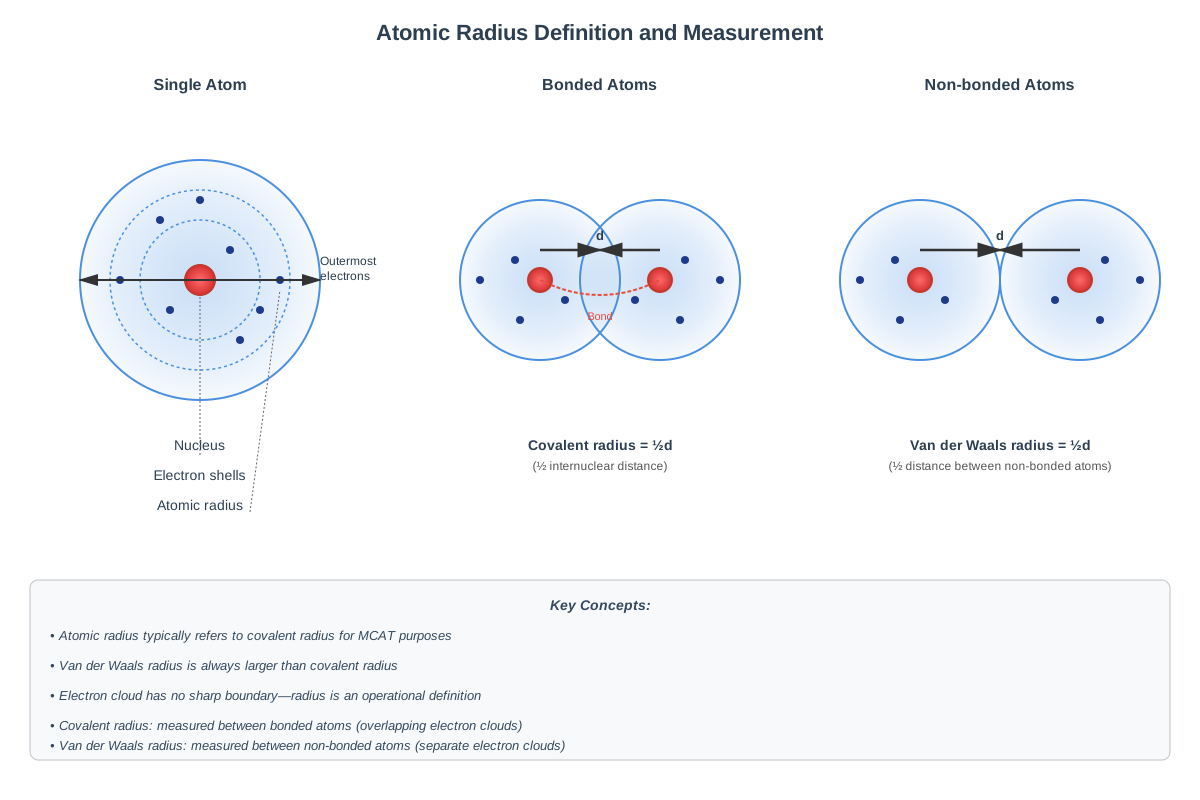
Atomic radius refers to the distance from an atom's nucleus to its outermost electron shell. However, defining this distance precisely presents challenges because electron clouds lack sharp boundaries—electrons exist in probability distributions rather than fixed orbits. Consequently, chemists measure atomic radius operationally through several methods, each appropriate for different contexts.
Covalent radius represents half the distance between nuclei of two identical atoms bonded together. For example, in a Cl₂ molecule, if the Cl-Cl bond length measures 198 pm, each chlorine atom has a covalent radius of 99 pm. This measurement applies primarily to nonmetals that form covalent bonds.
Metallic radius is defined as half the distance between nuclei of adjacent atoms in a metallic crystal lattice. This measurement applies to metals, where atoms pack together in regular crystalline arrangements without forming discrete bonds.
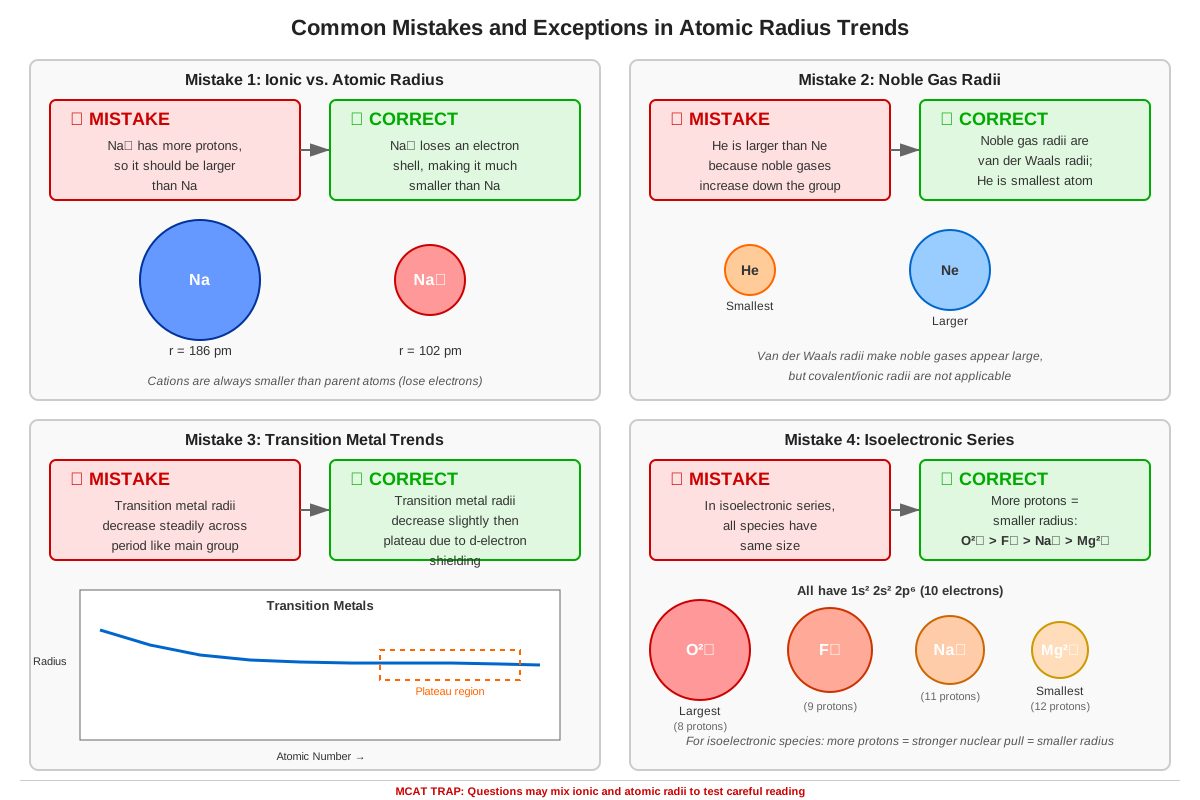
Ionic radius measures the size of an ion rather than a neutral atom. Cations (positive ions) are always smaller than their parent atoms because electron loss reduces electron-electron repulsion and often removes entire electron shells. Anions (negative ions) are always larger than their parent atoms because added electrons increase electron-electron repulsion, causing the electron cloud to expand.
Periodic Trends in Atomic Radius
Understanding how atomic radius changes across the periodic table is crucial for MCAT success. Two primary trends govern atomic size:
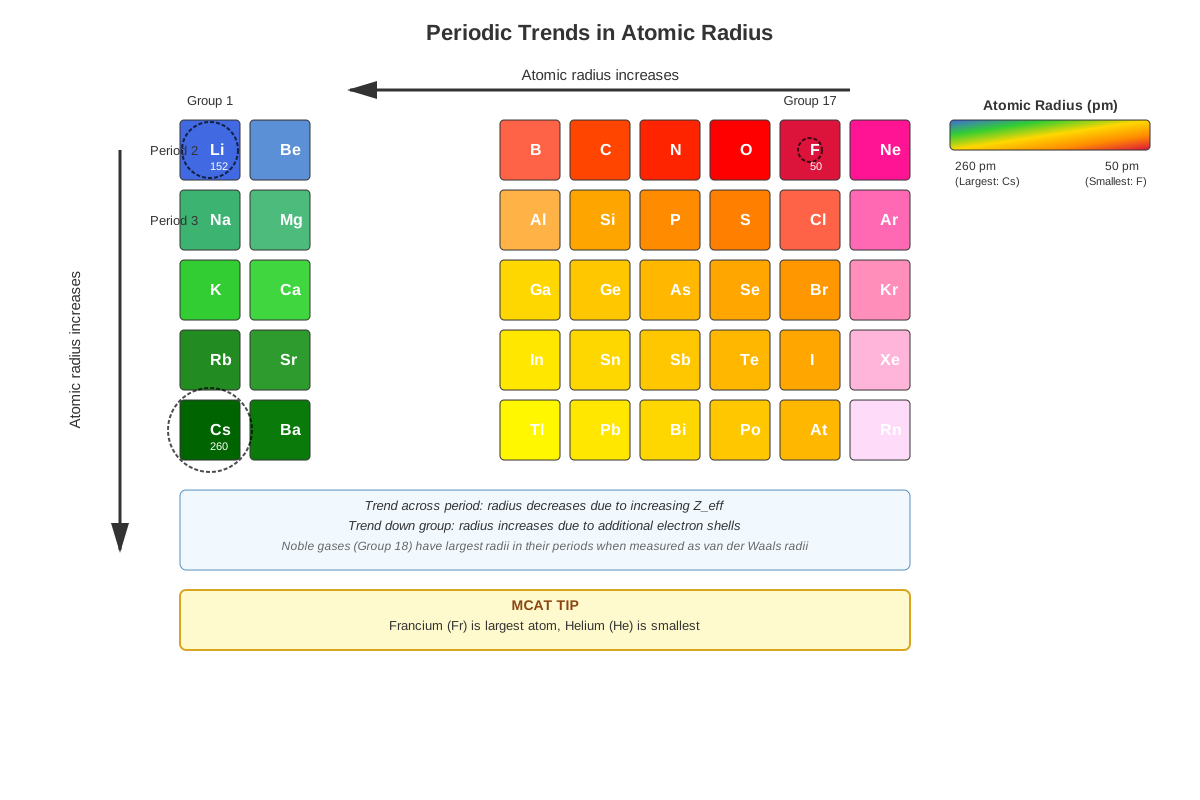
Trend 1: Atomic radius decreases from left to right across a period
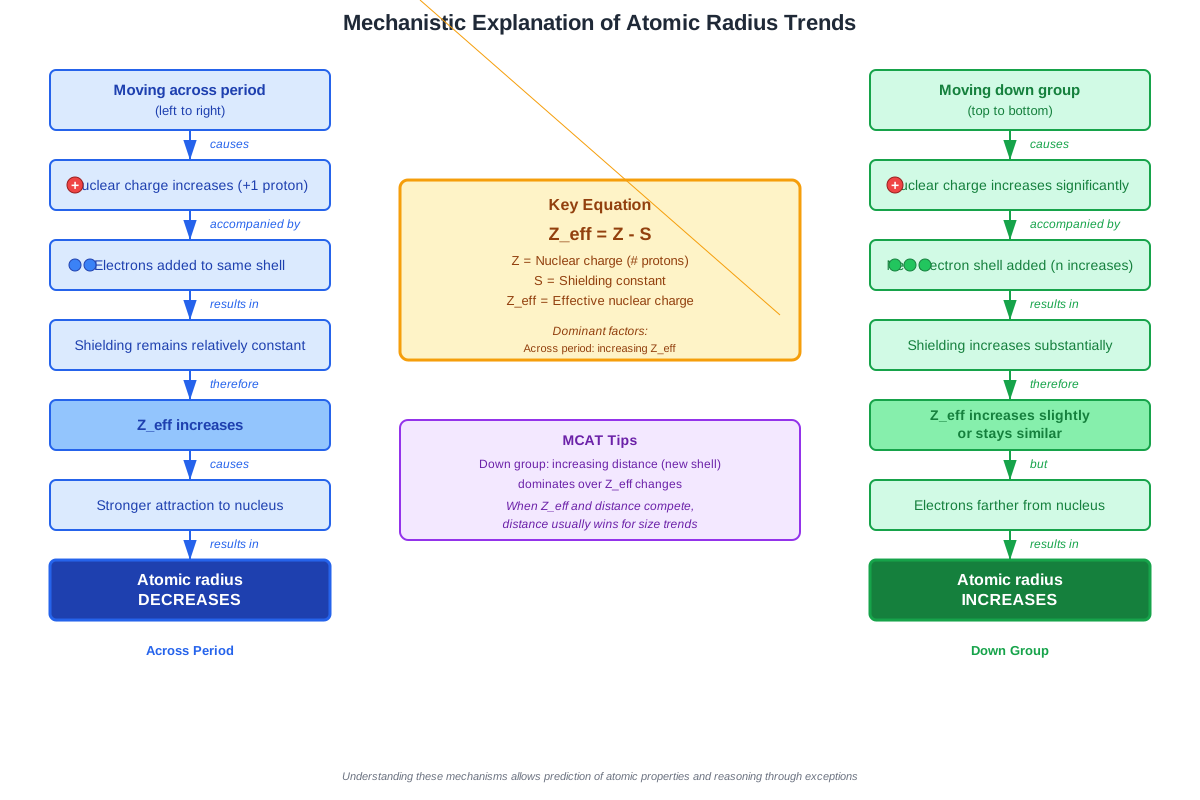
As you move across a period (left to right), protons are added to the nucleus while electrons fill the same principal energy level. Each additional proton increases the nuclear charge, pulling electrons closer to the nucleus. Although electron-electron repulsion also increases, the effect of increasing nuclear charge dominates because electrons in the same shell provide minimal shielding for each other. The effective nuclear charge (Z_eff) experienced by valence electrons increases steadily across a period, resulting in progressively smaller atomic radii.
For example, comparing Period 3 elements:
- Na (186 pm) > Mg (160 pm) > Al (143 pm) > Si (117 pm) > P (110 pm) > S (104 pm) > Cl (99 pm)
Trend 2: Atomic radius increases from top to bottom down a group
Descending a group adds complete electron shells, dramatically increasing the distance between the nucleus and outermost electrons. Although nuclear charge also increases down a group, the effect of additional electron shells dominates. Inner electron shells provide substantial shielding, reducing the effective nuclear charge felt by valence electrons. The combination of increased distance and enhanced shielding results in larger atomic radii down a group.
For example, comparing Group 1 elements:
- Li (152 pm) < Na (186 pm) < K (227 pm) < Rb (248 pm) < Cs (265 pm)
Factors Determining Atomic Size
Three fundamental factors determine atomic radius:
- Principal quantum number (n): Higher values of n indicate electron shells farther from the nucleus, directly increasing atomic size. This factor dominates the trend down groups.
- Effective nuclear charge (Z_eff): The net positive charge experienced by valence electrons after accounting for shielding by inner electrons. Higher Z_eff pulls electrons closer, decreasing atomic radius. This factor dominates the trend across periods.
- Electron-electron repulsion: Electrons in the same region of space repel each other, causing the electron cloud to expand. This effect is particularly important when comparing neutral atoms to ions.
Exceptions and Anomalies
While the general trends are reliable, several exceptions warrant attention for the MCAT:
Transition metals show relatively small changes in atomic radius across a period because added electrons enter inner d orbitals rather than the outermost shell. These d electrons provide additional shielding, partially offsetting the increased nuclear charge.
Lanthanide contraction refers to the unusually small atomic radii of elements following the lanthanide series. The poor shielding provided by f electrons causes a greater-than-expected increase in effective nuclear charge, resulting in smaller atoms than predicted by simple periodic trends.
Comparing Atomic and Ionic Radii
The relationship between atomic and ionic radii follows predictable patterns:
| Ion Type | Size Comparison | Explanation |
|---|---|---|
| Cation | Smaller than parent atom | Electron loss reduces repulsion; may lose entire shell |
| Anion | Larger than parent atom | Electron gain increases repulsion in same shell |
| Isoelectronic series | Size decreases with increasing nuclear charge | Same electron configuration, but more protons pull electrons closer |
For isoelectronic species (same number of electrons), the ion with the highest nuclear charge has the smallest radius. For example, in the series O²⁻, F⁻, Na⁺, Mg²⁺, Al³⁺ (all with 10 electrons), the radius decreases in that order because nuclear charge increases from 8 to 13 protons.
Concept Relationships
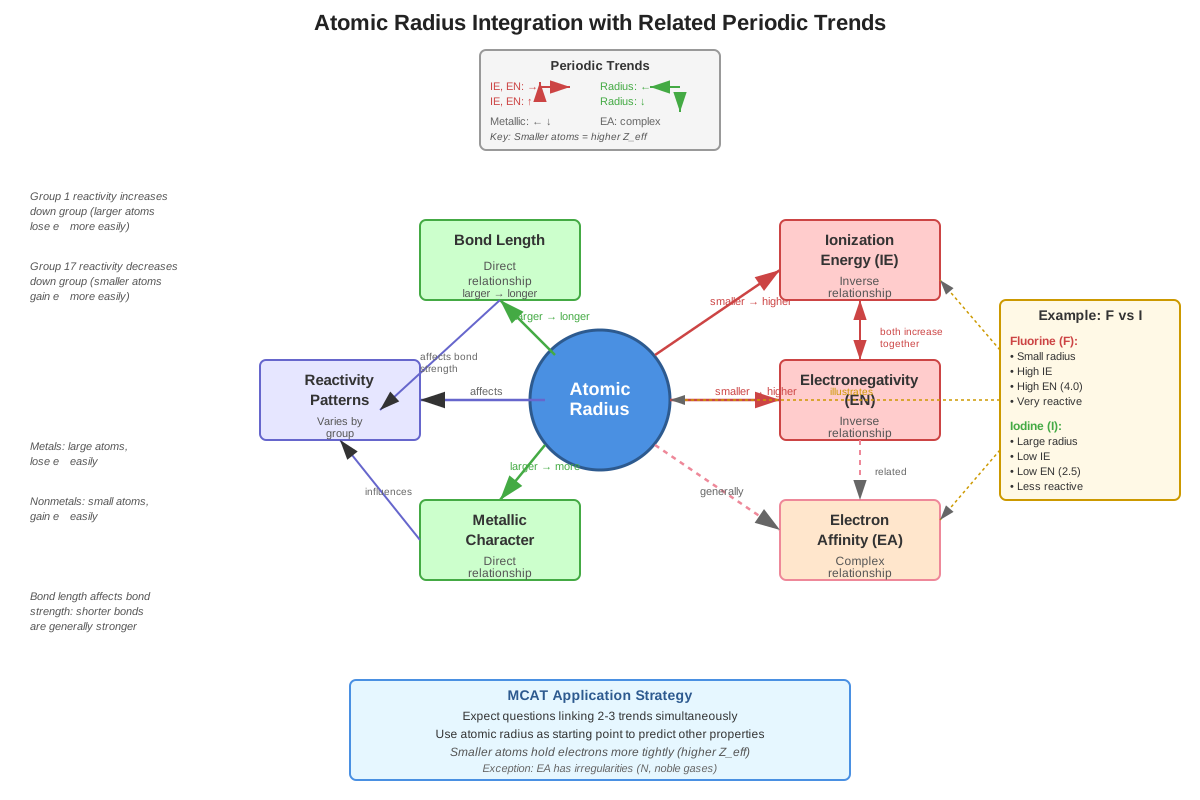
Atomic radius serves as a foundational concept connecting multiple areas of General Chemistry. The size of atoms directly influences ionization energy—smaller atoms hold electrons more tightly due to stronger nuclear attraction, requiring more energy to remove an electron. This relationship creates an inverse correlation: as atomic radius decreases across a period, ionization energy increases.
Similarly, atomic radius inversely correlates with electronegativity. Smaller atoms attract bonding electrons more strongly because the nucleus is closer to the bonding region. This explains why fluorine, the smallest halogen, is also the most electronegative element.
The concept flow follows this pattern:
Nuclear charge and electron configuration → determine → Effective nuclear charge and shielding → influence → Atomic radius → affects → Ionization energy, electronegativity, and electron affinity → predict → Chemical reactivity and bonding behavior
Atomic radius also connects to lattice energy in ionic compounds. Smaller ions pack more closely, resulting in stronger electrostatic attractions and higher lattice energies. This relationship explains why compounds containing small, highly charged ions (like MgO) have exceptionally high melting points.
Understanding atomic radius enables prediction of bond lengths in molecules. Larger atoms form longer bonds, which are generally weaker than shorter bonds between smaller atoms. This principle helps explain trends in bond dissociation energies and molecular stability.
Quick check — test yourself on Atomic radius so far.
Try Flashcards →High-Yield Facts
⭐ Atomic radius decreases from left to right across a period due to increasing effective nuclear charge with electrons added to the same shell
⭐ Atomic radius increases from top to bottom down a group due to addition of electron shells and increased shielding
⭐ Cations are always smaller than their parent atoms; anions are always larger than their parent atoms
⭐ In an isoelectronic series, the species with the most protons has the smallest radius
⭐ Francium (Fr) is the largest naturally occurring atom; helium (He) is the smallest
- Transition metal radii decrease slowly across a period because d electrons provide effective shielding
- Noble gases have the smallest radii in their respective periods when measured as van der Waals radii
- The lanthanide contraction causes sixth-period transition metals to have similar sizes to their fifth-period counterparts
- Metallic radius is typically larger than covalent radius for the same element due to different bonding environments
- Atomic radius influences reactivity: larger alkali metals are more reactive; smaller halogens are more reactive
Common Misconceptions
Misconception: Atomic radius increases across a period because more electrons are added.
Correction: While more electrons are added across a period, they enter the same principal energy level and do not shield each other effectively. The increasing nuclear charge dominates, pulling all electrons closer and decreasing atomic radius.
Misconception: All ions are smaller than their parent atoms.
Correction: Only cations are smaller than their parent atoms. Anions are larger than their parent atoms because the added electrons increase electron-electron repulsion while the nuclear charge remains constant, causing the electron cloud to expand.
Misconception: Atomic radius can be measured precisely like the radius of a sphere.
Correction: Atoms lack defined boundaries because electrons exist in probability distributions. Atomic radius is operationally defined through measurements like covalent radius (half the bond length between identical atoms) or metallic radius (half the distance between nuclei in a metal lattice).
Misconception: Elements in the same group have similar atomic radii.
Correction: Elements in the same group show dramatic increases in atomic radius down the group due to additional electron shells. For example, lithium (152 pm) is much smaller than cesium (265 pm), despite both being Group 1 elements.
Misconception: The element with the most electrons always has the largest atomic radius.
Correction: Atomic radius depends on the balance between nuclear charge, shielding, and principal quantum number—not simply electron count. Francium has fewer electrons than many elements but is the largest atom because its valence electrons occupy the seventh shell with substantial shielding from inner electrons.
Misconception: Transition metals follow the same atomic radius trend as main group elements.
Correction: Transition metals show much smaller decreases in atomic radius across a period because added electrons enter inner d orbitals, providing additional shielding that partially offsets increased nuclear charge.
Worked Examples
Example 1: Ranking Atoms by Size
Question: Rank the following atoms in order of increasing atomic radius: O, S, Se, Te
Solution:
Step 1: Identify the periodic trend. All four elements belong to Group 16 (the oxygen family), so we're comparing elements within the same group.
Step 2: Recall that atomic radius increases down a group due to addition of electron shells and increased shielding.
Step 3: Determine the period for each element:
- O: Period 2
- S: Period 3
- Se: Period 4
- Te: Period 5
Step 4: Apply the trend. Since atomic radius increases down a group, the order from smallest to largest is: O < S < Se < Te
Answer: O < S < Se < Te (increasing atomic radius)
Connection to learning objectives: This example demonstrates application of periodic trends to predict relative atomic sizes, a core skill for MCAT questions on Atomic Structure and Periodic Trends.
Example 2: Comparing Atomic and Ionic Radii
Question: Consider the following species: Na, Na⁺, Mg, Mg²⁺. Rank them in order of increasing radius and explain your reasoning.
Solution:
Step 1: Identify which species are neutral atoms and which are ions.
- Na and Mg are neutral atoms
- Na⁺ and Mg²⁺ are cations
Step 2: Recall that cations are smaller than their parent atoms because electron loss reduces electron-electron repulsion and may remove entire shells.
Step 3: Determine electron configurations:
- Na (11 electrons): 1s² 2s² 2p⁶ 3s¹
- Na⁺ (10 electrons): 1s² 2s² 2p⁶
- Mg (12 electrons): 1s² 2s² 2p⁶ 3s²
- Mg²⁺ (10 electrons): 1s² 2s² 2p⁶
Step 4: Notice that Na⁺ and Mg²⁺ are isoelectronic (same electron configuration). For isoelectronic species, the one with more protons has the smaller radius because greater nuclear charge pulls electrons closer.
Step 5: Compare sizes:
- Mg²⁺ has 12 protons pulling on 10 electrons → smallest
- Na⁺ has 11 protons pulling on 10 electrons → second smallest
- Mg has 12 protons pulling on 12 electrons, with valence electrons in the third shell → larger than both ions
- Na has 11 protons pulling on 11 electrons, with one valence electron in the third shell → largest (fewer protons than Mg, so less nuclear attraction)
Answer: Mg²⁺ < Na⁺ < Mg < Na (increasing radius)
Connection to learning objectives: This example integrates atomic radius concepts with ionic radius, electron configuration, and effective nuclear charge—demonstrating the interconnected nature of General Chemistry concepts tested on the MCAT.
Exam Strategy
When approaching atomic radius MCAT questions, follow this systematic approach:
Step 1: Identify the comparison type. Determine whether the question asks about atoms in the same period, same group, ions versus atoms, or isoelectronic species. Each comparison type follows specific rules.
Step 2: Apply the appropriate trend. For same-period comparisons, remember that radius decreases left to right. For same-group comparisons, radius increases top to bottom. For atom-ion comparisons, cations are smaller and anions are larger than parent atoms.
Step 3: Watch for trigger words that signal atomic radius questions:
- "Largest/smallest atom"
- "Increasing/decreasing size"
- "Ionic radius"
- "Isoelectronic series"
- "Periodic trends"
Process of elimination tips:
- Immediately eliminate choices that violate basic periodic trends (e.g., suggesting a Period 2 element is larger than a Period 5 element in the same group)
- For isoelectronic species, eliminate any choice that doesn't rank them by nuclear charge
- When comparing atoms and ions, eliminate choices showing cations larger than parent atoms or anions smaller than parent atoms
Time allocation: Discrete atomic radius questions should take 30-45 seconds. If a question requires more than one minute, you may be overthinking—return to basic periodic trends. For passage-based questions where atomic radius is one component, allocate 60-90 seconds total, spending no more than 20 seconds on the atomic radius portion.
Exam Tip: If you're unsure between two answer choices, visualize the periodic table and trace the path between the elements. The element encountered later when moving right or down is smaller or larger, respectively.
Memory Techniques
Mnemonic for periodic trends: "Right Down Is Large" (RDIL)
- Right: Going right across a period decreases radius
- Down: Going down a group increases radius
- Ions: Anions are larger, cations are smaller
- Large: The element in the bottom-left corner (Fr) is the largest
Visualization strategy: Picture the periodic table as a hill with the peak at fluorine (upper right). Atomic radius represents elevation—as you climb the hill toward fluorine, atoms get smaller (lower elevation). As you descend toward francium (bottom left), atoms get larger (higher elevation).
Acronym for factors affecting atomic radius: "PES"
- Principal quantum number (shell number)
- Effective nuclear charge
- Shielding by inner electrons
Memory aid for ion sizes: "CATions are SMALLer" (cats are small animals). This reminds you that cations are smaller than their parent atoms, which by extension means anions must be larger.
Isoelectronic series trick: "More Protons, More Pulling, More Petite" (MPPP). When species have the same number of electrons, more protons mean stronger pulling force and smaller (more petite) size.
Summary
Atomic radius represents a fundamental periodic property describing the size of atoms, measured operationally through covalent, metallic, or ionic radii. The two essential periodic trends—radius decreases left to right across periods due to increasing effective nuclear charge, and radius increases top to bottom down groups due to additional electron shells—enable prediction of relative atomic sizes. These trends arise from the interplay of nuclear charge, electron shielding, and principal quantum number. Cations are invariably smaller than their parent atoms due to reduced electron-electron repulsion, while anions are larger due to increased repulsion. For isoelectronic species, radius decreases with increasing nuclear charge. Mastery of atomic radius concepts provides the foundation for understanding related periodic trends including ionization energy, electronegativity, and chemical reactivity—all high-yield topics for MCAT success. Students who can quickly apply these trends and recognize exceptions will efficiently navigate both discrete questions and passage-based problems involving atomic structure and periodic properties.
Key Takeaways
- Atomic radius decreases across a period (left to right) and increases down a group (top to bottom)
- Effective nuclear charge and electron shielding are the primary factors determining atomic size trends
- Cations are always smaller than their parent atoms; anions are always larger than their parent atoms
- In isoelectronic series, the species with the highest nuclear charge has the smallest radius
- Atomic radius inversely correlates with ionization energy and electronegativity
- Understanding atomic radius enables prediction of bonding behavior, molecular geometry, and chemical reactivity
- Transition metals and lanthanides show exceptions to simple periodic trends due to d and f electron shielding effects
Related Topics
Ionization Energy: The energy required to remove an electron from an atom, which inversely correlates with atomic radius. Mastering atomic radius provides the foundation for understanding why ionization energy increases across periods and decreases down groups.
Electronegativity: The ability of an atom to attract bonding electrons, which also inversely correlates with atomic radius. Smaller atoms attract electrons more strongly, explaining periodic trends in electronegativity.
Electron Affinity: The energy change when an atom gains an electron, influenced by atomic size. Understanding atomic radius helps predict which elements most readily accept electrons.
Ionic Bonding and Lattice Energy: The strength of ionic bonds depends heavily on ionic radii. Smaller ions produce stronger electrostatic attractions and higher lattice energies, making atomic radius essential for predicting properties of ionic compounds.
Molecular Geometry and VSEPR Theory: Atomic size influences bond lengths and angles in molecules, affecting molecular shape and properties. Progression from atomic radius to molecular geometry represents a natural learning sequence in General Chemistry.
Practice CTA
Now that you've mastered the core concepts of atomic radius and its periodic trends, reinforce your understanding by attempting practice questions and flashcards. Focus on questions requiring you to rank elements by size, compare atomic and ionic radii, and apply periodic trends to predict chemical behavior. The more you practice applying these concepts under timed conditions, the more automatic your responses will become on test day. Remember: atomic radius questions are high-yield and highly predictable—consistent practice will translate directly into MCAT points. You've built a strong foundation in this essential topic; now solidify it through active recall and application!
Sign up free to keep reading
Create a free AnvayaPrep account to finish this MCAT guide on Atomic radius — plus flashcards and practice questions.