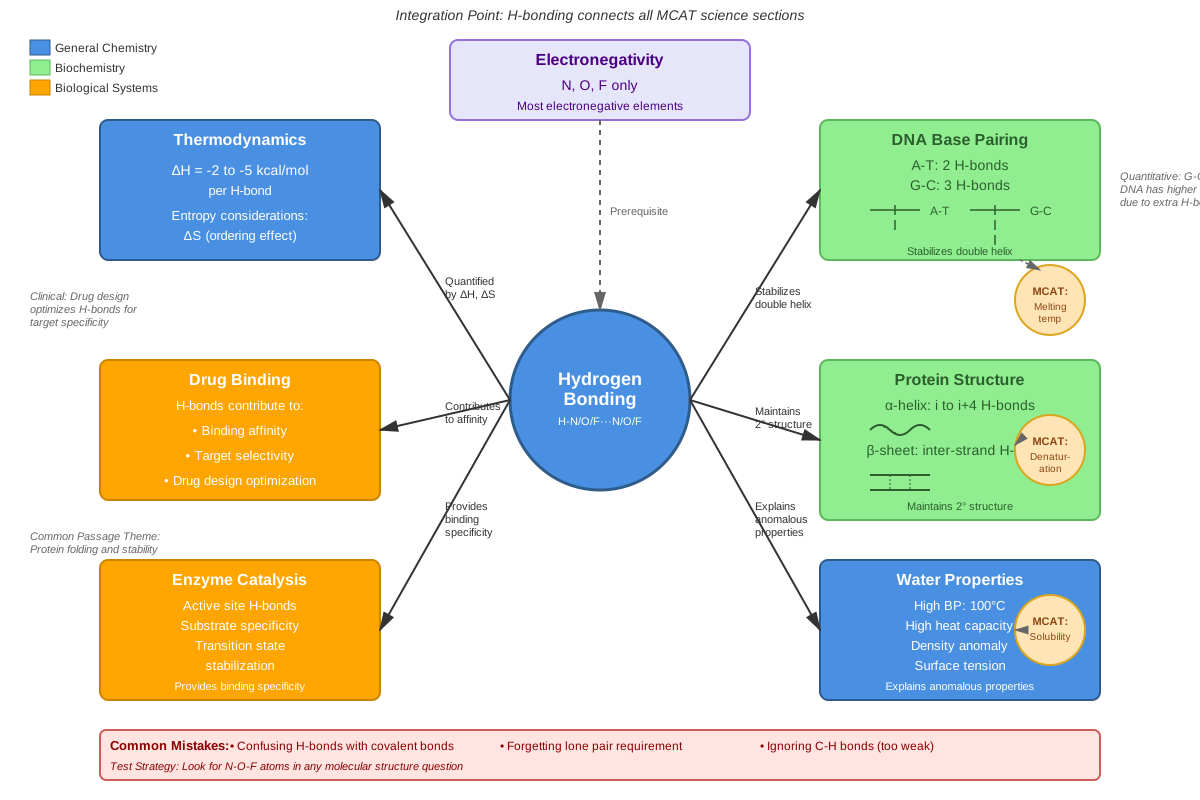
Overview
Hydrogen bonding is one of the most critical intermolecular forces tested on the MCAT, bridging concepts across General Chemistry, biochemistry, and biology. This special type of dipole-dipole interaction occurs when hydrogen atoms covalently bonded to highly electronegative atoms (nitrogen, oxygen, or fluorine) interact with lone pairs on nearby electronegative atoms. Understanding hydrogen bonding is essential for predicting molecular properties such as boiling points, solubility patterns, and the three-dimensional structures of biological macromolecules. The MCAT frequently tests this concept both directly through standalone questions and indirectly through passages involving protein folding, DNA base pairing, and drug-receptor interactions.
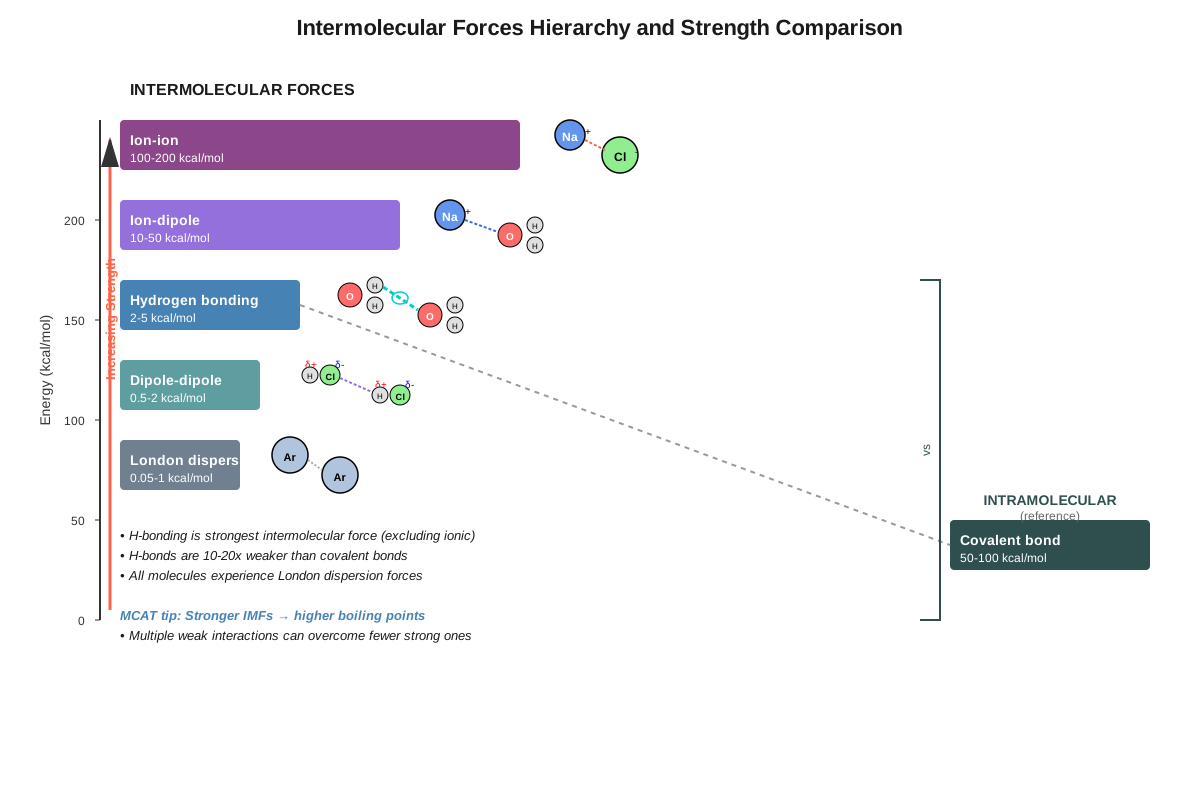
Within the broader context of Bonding and Molecular Structure, hydrogen bonding represents the strongest type of intermolecular force (excluding ion-ion interactions), making it a high-yield topic for comparative questions. Students must distinguish hydrogen bonds from other intermolecular forces like London dispersion forces and standard dipole-dipole interactions, while also understanding how these forces collectively determine physical properties. The hydrogen bonding MCAT questions often require integration of multiple concepts: electronegativity, molecular geometry, polarity, and thermodynamics.
Mastery of this topic enables students to predict and explain anomalous properties of water, understand the stability of secondary structures in proteins (α-helices and β-sheets), rationalize the complementary base pairing in DNA, and explain why certain molecules are water-soluble while others are not. This foundational knowledge in General Chemistry directly supports success in biochemistry passages and biological sciences questions, making it one of the most interconnected topics across all MCAT sections.
Learning Objectives
- [ ] Define hydrogen bonding using accurate General Chemistry terminology
- [ ] Explain why hydrogen bonding matters for the MCAT
- [ ] Apply hydrogen bonding to exam-style questions
- [ ] Identify common mistakes related to hydrogen bonding
- [ ] Connect hydrogen bonding to related General Chemistry concepts
- [ ] Predict relative boiling points and solubilities based on hydrogen bonding capacity
- [ ] Distinguish hydrogen bonding from other intermolecular forces quantitatively and qualitatively
- [ ] Analyze molecular structures to identify potential hydrogen bond donors and acceptors
Prerequisites
- Electronegativity and polarity: Understanding electronegativity differences is essential because hydrogen bonding only occurs with the most electronegative elements (N, O, F)
- Lewis structures and molecular geometry: Identifying lone pairs and molecular shape is necessary to predict hydrogen bonding sites and orientations
- Intermolecular forces fundamentals: Hydrogen bonding must be contextualized within the hierarchy of intermolecular forces (London dispersion, dipole-dipole, hydrogen bonding)
- Covalent bonding: Recognizing that hydrogen must be covalently bonded to N, O, or F distinguishes true hydrogen bonding from other interactions
- Thermodynamics basics: Understanding enthalpy and entropy helps explain why hydrogen bonding affects phase transitions and solubility
Why This Topic Matters
Hydrogen bonding appears in approximately 8-12% of General Chemistry questions on the MCAT and is integrated into countless biochemistry and biology passages. The MCAT tests this concept through multiple question formats: discrete questions asking students to rank compounds by boiling point, passage-based questions about protein structure stabilization, and experimental analysis questions involving solubility predictions. Understanding hydrogen bonding is particularly crucial for the Biological and Biochemical Foundations section, where it underlies DNA structure, enzyme-substrate interactions, and membrane transport mechanisms.
Clinically, hydrogen bonding explains drug design principles, as pharmaceutical compounds must form appropriate hydrogen bonds with target proteins to achieve therapeutic effects. The specificity of hydrogen bonding determines why certain drugs work while structurally similar molecules fail. Water's unique properties—high specific heat, high heat of vaporization, density anomaly, and excellent solvent capacity—all stem from extensive hydrogen bonding networks, making this concept essential for understanding physiological processes like thermoregulation and nutrient transport.
On the MCAT, hydrogen bonding commonly appears in passages discussing: (1) protein denaturation experiments where temperature or pH disrupts hydrogen bonds; (2) DNA melting curves showing the breaking of base-pair hydrogen bonds; (3) chromatography separations exploiting differential hydrogen bonding; (4) drug-receptor binding studies; and (5) membrane permeability questions where hydrogen bonding affects lipid solubility. Recognizing these contexts allows students to quickly identify relevant concepts and apply systematic reasoning.
Core Concepts
Definition and Molecular Requirements
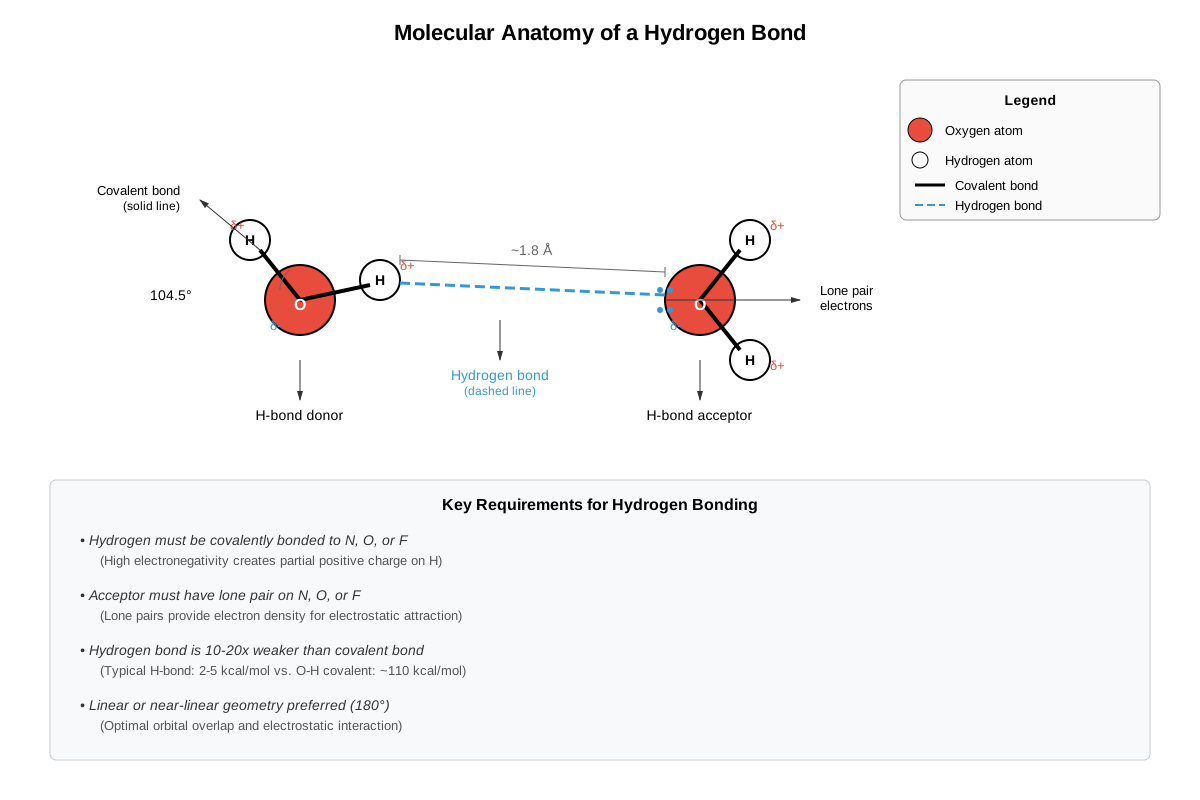
Hydrogen bonding is a special type of dipole-dipole intermolecular force that occurs when a hydrogen atom covalently bonded to a highly electronegative atom (nitrogen, oxygen, or fluorine) experiences electrostatic attraction to a lone pair of electrons on another electronegative atom (N, O, or F). The strength of a typical hydrogen bond ranges from 5-30 kJ/mol, making it significantly stronger than ordinary dipole-dipole interactions (2-5 kJ/mol) but weaker than covalent bonds (150-400 kJ/mol).
The molecular requirements for hydrogen bonding are strict and frequently tested:
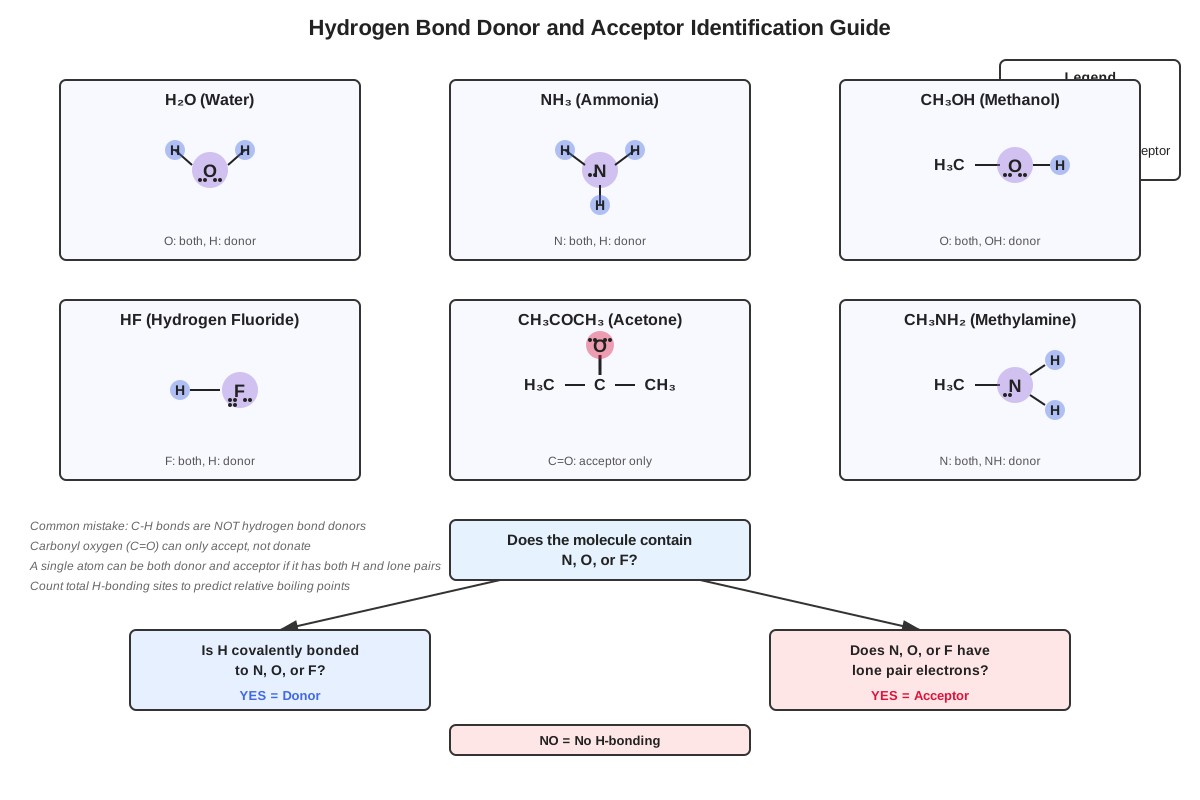
- Hydrogen bond donor: A hydrogen atom covalently bonded to N, O, or F
- Hydrogen bond acceptor: A lone pair of electrons on N, O, or F
- Appropriate geometry: The donor, hydrogen, and acceptor should be approximately linear (180° angle optimal)
The restriction to N, O, and F stems from their high electronegativity values (3.0, 3.5, and 4.0 respectively on the Pauling scale). These elements create sufficient bond polarity to leave the hydrogen atom with a substantial partial positive charge (δ+), enabling strong electrostatic attraction to nearby electron-rich regions.
Hydrogen Bonding vs. Other Intermolecular Forces
Understanding where hydrogen bonding fits within the hierarchy of intermolecular forces is essential for MCAT success:
| Force Type | Strength (kJ/mol) | Requirements | Example |
|---|---|---|---|
| London Dispersion | 0.5-2 | All molecules | CH₄...CH₄ |
| Dipole-Dipole | 2-5 | Polar molecules | CH₃Cl...CH₃Cl |
| Hydrogen Bonding | 5-30 | H bonded to N/O/F | H₂O...H₂O |
| Ion-Dipole | 15-50 | Ion + polar molecule | Na⁺...H₂O |
| Ionic Bonding | 400-4000 | Cation + anion | Na⁺Cl⁻ |
Note that hydrogen bonding is an intermolecular force (between molecules), not an intramolecular bond (within a molecule). However, intramolecular hydrogen bonds can occur in large molecules like proteins, where distant parts of the same molecule interact.
Directionality and Geometry
Unlike London dispersion forces, which are relatively non-directional, hydrogen bonding exhibits strong directional preferences. The optimal geometry places the hydrogen bond donor, hydrogen atom, and acceptor in a linear arrangement. This directionality arises because the hydrogen atom's partial positive charge is concentrated along the bond axis, and the acceptor's lone pairs have specific spatial orientations.
In water, each molecule can form up to four hydrogen bonds: two as a donor (using its two O-H bonds) and two as an acceptor (using the two lone pairs on oxygen). This tetrahedral arrangement of hydrogen bonds creates the extensive three-dimensional network responsible for water's unique properties. The MCAT may present molecular structures and ask students to determine the maximum number of hydrogen bonds possible, requiring careful counting of both donors and acceptors.
Effects on Physical Properties
Hydrogen bonding profoundly affects physical properties, creating predictable patterns testable on the MCAT:
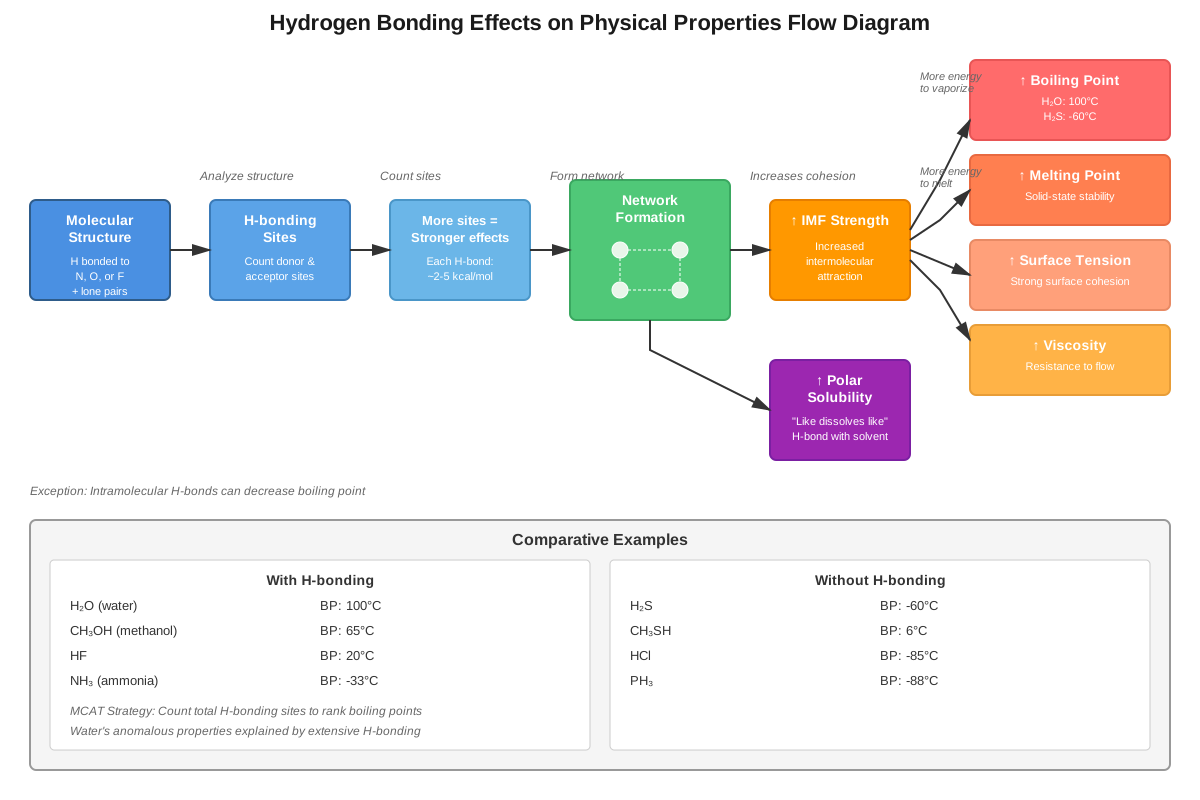
Boiling Point Elevation: Compounds capable of hydrogen bonding have significantly higher boiling points than similar-sized molecules without hydrogen bonding. For example, water (H₂O, MW = 18 g/mol) boils at 100°C, while methane (CH₄, MW = 16 g/mol) boils at -164°C. The extensive hydrogen bonding network in liquid water requires substantial energy input to break, elevating the boiling point far above what molecular weight alone would predict.
Solubility Patterns: The principle "like dissolves like" is refined by hydrogen bonding considerations. Molecules capable of hydrogen bonding with water (containing N-H, O-H, or F-H groups, or lone pairs on N, O, or F) show enhanced water solubility. Alcohols, amines, and carboxylic acids dissolve readily in water due to hydrogen bonding, while hydrocarbons do not. The MCAT frequently tests the solubility of organic compounds in various solvents based on hydrogen bonding capacity.
Density Anomaly of Ice: Water's solid phase is less dense than its liquid phase—an unusual property explained by hydrogen bonding. In ice, water molecules form a crystalline lattice with optimal hydrogen bonding geometry, creating an open hexagonal structure with significant empty space. When ice melts, this structure partially collapses, increasing density. This anomaly has profound biological significance, as ice floats on water, insulating aquatic ecosystems during winter.
Viscosity and Surface Tension: Liquids with extensive hydrogen bonding networks exhibit higher viscosity and surface tension. Water's high surface tension allows insects to walk on its surface and contributes to capillary action in plants. These properties reflect the cohesive forces between water molecules through hydrogen bonding.
Hydrogen Bonding in Biological Molecules
The MCAT extensively tests hydrogen bonding in biological contexts:
Protein Structure: Hydrogen bonds between backbone carbonyl oxygen atoms (C=O) and amide hydrogen atoms (N-H) stabilize secondary structures. In α-helices, hydrogen bonds form between residues four positions apart along the chain. In β-sheets, hydrogen bonds form between adjacent strands, either parallel or antiparallel. Disrupting these hydrogen bonds through heat or pH changes causes protein denaturation.
DNA Base Pairing: Complementary base pairs form specific hydrogen bonding patterns: adenine-thymine pairs form two hydrogen bonds, while guanine-cytosine pairs form three hydrogen bonds. The greater number of hydrogen bonds in G-C pairs makes them more stable, requiring higher temperatures to denature. DNA melting curves, which plot absorbance versus temperature, directly reflect hydrogen bond breaking.
Enzyme-Substrate Interactions: The specificity of enzyme active sites depends partly on precise hydrogen bonding between enzyme residues and substrate functional groups. Competitive inhibitors often mimic substrate hydrogen bonding patterns, while non-competitive inhibitors may disrupt enzyme structure by interfering with stabilizing hydrogen bonds.
Quantitative Aspects
While the MCAT rarely requires numerical calculations for hydrogen bonding, understanding relative strengths is crucial. A single hydrogen bond (5-30 kJ/mol) is much weaker than a covalent bond, but molecules forming multiple hydrogen bonds can achieve significant total interaction energy. For example, the two hydrogen bonds in an A-T base pair contribute approximately 10-15 kJ/mol total, while the three hydrogen bonds in a G-C pair contribute approximately 20-25 kJ/mol.
The strength of individual hydrogen bonds varies with the specific atoms involved:
- F-H...F: Strongest (up to 30 kJ/mol)
- O-H...O: Intermediate (15-25 kJ/mol)
- N-H...N: Weaker (10-20 kJ/mol)
This ordering reflects both electronegativity differences and the size of the atoms involved. Fluorine's small size and extreme electronegativity create the strongest hydrogen bonds, though F-H bonds are relatively rare in biological systems.
Concept Relationships
Hydrogen bonding emerges from the fundamental concept of electronegativity, which creates bond polarity in N-H, O-H, and F-H bonds. This polarity generates the partial charges necessary for electrostatic attraction between molecules. The concept builds directly on intermolecular forces, representing the strongest type of dipole-dipole interaction and sitting above London dispersion forces but below ionic interactions in the force hierarchy.
Within Bonding and Molecular Structure, hydrogen bonding connects to molecular geometry because the spatial arrangement of lone pairs and polar bonds determines whether molecules can effectively form hydrogen bonds. For instance, both water and hydrogen sulfide have bent geometries, but only water forms strong hydrogen bonds because oxygen is sufficiently electronegative while sulfur is not.
The relationship map flows as follows:
Electronegativity → creates → Bond Polarity → enables → Dipole-Dipole Forces → specialized form → Hydrogen Bonding → determines → Physical Properties (boiling point, solubility, viscosity) → influences → Biological Structure (protein folding, DNA stability) → affects → Biological Function (enzyme activity, membrane transport)
Hydrogen bonding also connects forward to thermodynamics concepts, as breaking hydrogen bonds requires enthalpy input (endothermic), while forming them releases energy (exothermic). The entropy changes associated with hydrogen bonding explain solubility patterns: dissolving a hydrogen-bonding solute in water may increase or decrease entropy depending on whether the solute disrupts or integrates into water's hydrogen bonding network.
Understanding hydrogen bonding is prerequisite knowledge for acid-base chemistry, as the stability of conjugate bases often depends on hydrogen bonding with solvent molecules. It also underlies colligative properties, as solutes that hydrogen bond with water affect vapor pressure, boiling point elevation, and freezing point depression differently than non-hydrogen-bonding solutes.
Quick check — test yourself on Hydrogen bonding so far.
Try Flashcards →High-Yield Facts
⭐ Hydrogen bonding only occurs when hydrogen is covalently bonded to N, O, or F—not with carbon, sulfur, or chlorine despite their electronegativity.
⭐ Water can form a maximum of four hydrogen bonds per molecule: two as donor (two O-H bonds) and two as acceptor (two lone pairs on oxygen).
⭐ Hydrogen bonds are 5-30 kJ/mol in strength, making them stronger than dipole-dipole forces (2-5 kJ/mol) but much weaker than covalent bonds (150-400 kJ/mol).
⭐ G-C base pairs have three hydrogen bonds while A-T pairs have two, making G-C pairs more stable and requiring higher temperatures to denature.
⭐ Compounds with hydrogen bonding capability have anomalously high boiling points compared to similar molecular weight compounds without hydrogen bonding.
- Hydrogen bonding is directional, with optimal geometry placing donor-H-acceptor in a linear arrangement (180° angle).
- Ice is less dense than liquid water because hydrogen bonding creates an open hexagonal crystal structure with significant empty space.
- Alcohols are water-soluble due to hydrogen bonding between the O-H group and water molecules, but solubility decreases as the hydrocarbon chain lengthens.
- Intramolecular hydrogen bonds can occur in large molecules like proteins, stabilizing specific conformations.
- Hydrogen bonding between water molecules creates high surface tension, allowing capillary action and supporting small objects on water's surface.
- The strength of hydrogen bonds decreases in the order F-H...F > O-H...O > N-H...N, reflecting electronegativity differences.
- Protic solvents (containing O-H or N-H bonds) can both donate and accept hydrogen bonds, while aprotic solvents lack hydrogen bond donors.
- Hydrogen bonding stabilizes α-helices through N-H...O=C interactions between residues four positions apart in the amino acid sequence.
- The high heat of vaporization of water (40.7 kJ/mol) results from the energy required to break extensive hydrogen bonding networks.
Common Misconceptions
Misconception: Hydrogen bonding can occur with any hydrogen atom in a molecule.
Correction: Hydrogen bonding specifically requires hydrogen covalently bonded to N, O, or F. Hydrogen atoms bonded to carbon (as in most organic molecules) do not participate in hydrogen bonding because carbon's electronegativity (2.5) is insufficient to create the necessary partial positive charge on hydrogen.
Misconception: Hydrogen bonds are a type of covalent bond.
Correction: Hydrogen bonds are intermolecular forces (electrostatic attractions between molecules), not covalent bonds. They are approximately 10-20 times weaker than typical covalent bonds. The term "bond" is somewhat misleading—"hydrogen interaction" would be more accurate, but "hydrogen bond" is the accepted terminology.
Misconception: Molecules with more hydrogen atoms form stronger hydrogen bonds.
Correction: The number of hydrogen atoms is irrelevant; what matters is the number of hydrogen atoms bonded to N, O, or F (donors) and the number of lone pairs on N, O, or F (acceptors). Methane (CH₄) has four hydrogen atoms but forms no hydrogen bonds, while ammonia (NH₃) has three hydrogen atoms and can form multiple hydrogen bonds.
Misconception: Hydrogen bonding only occurs between different molecules (intermolecular).
Correction: While hydrogen bonding is typically intermolecular, intramolecular hydrogen bonds occur when different parts of the same large molecule interact. This is common in proteins, where hydrogen bonds between distant amino acids stabilize tertiary structure, and in salicylic acid, where the carboxylic acid group hydrogen bonds with the hydroxyl group on the same molecule.
Misconception: All molecules with N, O, or F automatically form hydrogen bonds with each other.
Correction: Both a donor (H bonded to N/O/F) and an acceptor (lone pair on N/O/F) must be present. For example, carbon tetrafluoride (CF₄) contains fluorine but cannot form hydrogen bonds because it lacks H-F bonds (no donors). Similarly, molecules must have appropriate geometry for effective hydrogen bonding.
Misconception: Hydrogen bonding makes molecules more acidic.
Correction: Hydrogen bonding capability does not directly determine acidity. Acidity depends on the stability of the conjugate base after proton donation. However, hydrogen bonding can stabilize conjugate bases through solvation, indirectly affecting apparent acidity in aqueous solution. The presence of O-H or N-H bonds indicates potential for hydrogen bonding but does not automatically indicate acidity.
Worked Examples
Example 1: Ranking Boiling Points
Question: Rank the following compounds in order of increasing boiling point: propane (C₃H₈), ethanol (C₂H₅OH), and dimethyl ether (CH₃OCH₃). All have similar molecular weights (44-46 g/mol).
Solution:
Step 1: Identify the intermolecular forces present in each compound.
- Propane (C₃H₈): Nonpolar hydrocarbon with only London dispersion forces. No hydrogen bonding capability because hydrogen is bonded only to carbon.
- Ethanol (C₂H₅OH): Contains an O-H bond, providing both a hydrogen bond donor (the H in O-H) and acceptor (lone pairs on oxygen). Can form extensive hydrogen bonding networks.
- Dimethyl ether (CH₃OCH₃): Contains oxygen with lone pairs (hydrogen bond acceptor) but no O-H, N-H, or F-H bonds (no hydrogen bond donor). Can accept hydrogen bonds from other molecules but cannot donate them. Can only form dipole-dipole interactions with itself.
Step 2: Apply the hierarchy of intermolecular forces.
Hydrogen bonding > dipole-dipole > London dispersion forces
Step 3: Rank the compounds.
- Propane has the weakest intermolecular forces (only London dispersion), so it will have the lowest boiling point.
- Dimethyl ether has dipole-dipole interactions but cannot form hydrogen bonds with itself, giving it an intermediate boiling point.
- Ethanol can form hydrogen bonds with other ethanol molecules, giving it the highest boiling point.
Answer: Propane < Dimethyl ether < Ethanol
Actual boiling points: Propane (-42°C), Dimethyl ether (-24°C), Ethanol (78°C)
This example demonstrates how hydrogen bonding capability dramatically affects physical properties even when molecular weights are similar. The MCAT frequently tests this type of comparative reasoning.
Example 2: DNA Stability Analysis
Question: A researcher measures the melting temperature (Tm) of two DNA sequences of equal length. Sequence A has 60% G-C content, while Sequence B has 40% G-C content. Which sequence has the higher Tm, and why?
Solution:
Step 1: Recall the hydrogen bonding patterns in DNA base pairs.
- Adenine-Thymine (A-T): Forms 2 hydrogen bonds
- Guanine-Cytosine (G-C): Forms 3 hydrogen bonds
Step 2: Analyze the relationship between hydrogen bonding and stability.
More hydrogen bonds per base pair means greater stability and more energy required to separate the strands (denature the DNA). The melting temperature (Tm) is the temperature at which 50% of DNA molecules are denatured.
Step 3: Compare the sequences.
- Sequence A: 60% G-C content means more base pairs with 3 hydrogen bonds
- Sequence B: 40% G-C content means fewer base pairs with 3 hydrogen bonds (more A-T pairs with only 2 hydrogen bonds)
Step 4: Determine which requires more energy to denature.
Sequence A has more total hydrogen bonds per unit length, requiring more thermal energy to break all the hydrogen bonds and separate the strands.
Answer: Sequence A has the higher Tm because its greater G-C content means more hydrogen bonds per base pair, requiring higher temperatures to denature.
Connection to learning objectives: This example demonstrates how hydrogen bonding principles apply to biological macromolecules and explains experimental observations. The MCAT commonly presents DNA melting curves or stability data requiring this type of analysis. Understanding that G-C pairs are more stable than A-T pairs due to the additional hydrogen bond is a high-yield fact that appears in both passage-based and discrete questions.
Exam Strategy
When approaching hydrogen bonding MCAT questions, follow this systematic strategy:
Step 1: Identify the question type
- Comparison questions (rank by boiling point, solubility, or stability)
- Structural analysis (count hydrogen bonds, identify donors/acceptors)
- Biological application (protein structure, DNA stability, drug binding)
- Experimental interpretation (melting curves, solubility data)
Step 2: Look for trigger words and phrases
- "Intermolecular forces" → Consider hydrogen bonding among other forces
- "Boiling point," "melting point," "vapor pressure" → Physical properties affected by hydrogen bonding
- "Solubility in water" → Hydrogen bonding with water molecules
- "Protein denaturation," "DNA melting" → Breaking of hydrogen bonds
- "Secondary structure," "base pairing" → Hydrogen bonding in biological molecules
Step 3: Apply the systematic checklist
- Does the molecule contain N, O, or F? (If no, hydrogen bonding is impossible)
- Are there H atoms bonded to N, O, or F? (Identifies donors)
- Are there lone pairs on N, O, or F? (Identifies acceptors)
- Can the molecule hydrogen bond with itself, with water, or with other molecules?
- How many hydrogen bonds can form (count donors and acceptors)?
Step 4: Use process of elimination
- Eliminate options suggesting hydrogen bonding with C-H, S-H, or Cl-H bonds
- Eliminate options that confuse hydrogen bonding with covalent bonding
- Eliminate options that ignore the directionality of hydrogen bonding
- For ranking questions, eliminate options that place non-hydrogen-bonding molecules above hydrogen-bonding ones (when molecular weights are similar)
Time allocation advice: Hydrogen bonding questions typically require 60-90 seconds. Spend 20-30 seconds identifying the molecular features (donors, acceptors), 20-30 seconds applying the relevant principle (boiling point trends, solubility rules, biological structure), and 20-30 seconds eliminating wrong answers and confirming the correct choice. If a question requires drawing or visualizing hydrogen bonds, allocate an additional 30 seconds.
Common trap answers: Watch for options that suggest hydrogen bonding occurs with any hydrogen atom, that confuse hydrogen bonding strength with covalent bond strength, or that ignore the requirement for both donors and acceptors. The MCAT often includes distractors featuring molecules with N, O, or F but lacking the necessary H-N, H-O, or H-F bonds.
Memory Techniques
Mnemonic for hydrogen bonding atoms: "FON"
Hydrogen bonding occurs when hydrogen is bonded to Fluorine, Oxygen, or Nitrogen. Remember: "You need to be FONd of hydrogen bonding."
Mnemonic for DNA base pairing: "Three's Great Company"
Guanine-Cytosine pairs have three hydrogen bonds, making them more stable. A-T pairs have only two.
Visualization strategy for counting hydrogen bonds:
Draw a simple molecular structure and mark donors with a "D" (H bonded to N/O/F) and acceptors with an "A" (lone pairs on N/O/F). Each molecule can form as many hydrogen bonds as the smaller of its D or A count with other molecules, but the total is limited by both.
Acronym for physical properties affected by hydrogen bonding: "BSVD"
- Boiling point (elevated)
- Solubility (enhanced in water)
- Viscosity (increased)
- Density anomaly (ice less dense than water)
Memory aid for hydrogen bond strength:
"Hydrogen bonds are the middle child of intermolecular forces—stronger than dipole-dipole and London dispersion, but weaker than ionic interactions." Approximate strength: 5-30 kJ/mol (remember "5 to 30" as "five fingers to thirty days").
Visualization for protein secondary structure:
For α-helices, visualize a spiral staircase where each step (amino acid) connects to the step four positions above it via a hydrogen bond. For β-sheets, visualize a pleated curtain where adjacent strands are held together by hydrogen bonds running perpendicular to the strands.
Summary
Hydrogen bonding is a specialized dipole-dipole intermolecular force occurring when hydrogen covalently bonded to nitrogen, oxygen, or fluorine interacts with lone pairs on nearby N, O, or F atoms. With strengths of 5-30 kJ/mol, hydrogen bonds are significantly stronger than ordinary dipole-dipole forces but much weaker than covalent bonds. This unique force profoundly affects physical properties, causing elevated boiling points, enhanced water solubility, and unusual behaviors like water's density anomaly. For the MCAT, students must recognize that hydrogen bonding requires both donors (H bonded to N/O/F) and acceptors (lone pairs on N/O/F), and that not all molecules containing these atoms can form hydrogen bonds. The biological significance is immense: hydrogen bonding stabilizes protein secondary structures (α-helices and β-sheets), determines DNA base-pairing specificity (G-C pairs with three hydrogen bonds are more stable than A-T pairs with two), and governs enzyme-substrate interactions. MCAT questions test hydrogen bonding through boiling point comparisons, solubility predictions, biological structure analysis, and experimental data interpretation. Mastery requires systematic identification of donors and acceptors, understanding the hierarchy of intermolecular forces, and connecting molecular structure to macroscopic properties.
Key Takeaways
- Hydrogen bonding occurs exclusively when H is bonded to N, O, or F, and these atoms must also serve as acceptors with available lone pairs
- Hydrogen bonds (5-30 kJ/mol) are the strongest intermolecular forces except for ion-ion and ion-dipole interactions, dramatically affecting boiling points and solubility
- Water's unique properties—high boiling point, high heat capacity, density anomaly, excellent solvent capacity—all result from extensive hydrogen bonding networks
- G-C base pairs (3 H-bonds) are more stable than A-T pairs (2 H-bonds), explaining DNA melting temperature differences and the stability of GC-rich regions
- Protein secondary structures depend on backbone hydrogen bonding: α-helices form through i to i+4 hydrogen bonds, while β-sheets form between adjacent strands
- Both donors and acceptors must be present for hydrogen bonding; molecules with only N/O/F but no H-N/H-O/H-F bonds cannot donate hydrogen bonds
- Systematic analysis of molecular structure (counting donors and acceptors) enables prediction of hydrogen bonding capacity and resulting physical properties
Related Topics
Intermolecular Forces: Hydrogen bonding is one type within the broader category of intermolecular forces. Mastering this topic enables deeper understanding of London dispersion forces, dipole-dipole interactions, and ion-dipole forces, allowing comprehensive comparison of molecular properties.
Acid-Base Chemistry: The stability of conjugate bases often depends on hydrogen bonding with solvent molecules. Understanding hydrogen bonding enhances comprehension of pKa values and acid strength trends.
Protein Structure: Hydrogen bonding is fundamental to secondary, tertiary, and quaternary protein structures. This topic builds directly into biochemistry content on protein folding, denaturation, and enzyme mechanisms.
DNA and RNA Structure: Base pairing through hydrogen bonding is essential for genetic information storage and transfer. This topic connects to molecular biology passages on replication, transcription, and mutation.
Solubility and Colligative Properties: Hydrogen bonding determines solubility patterns and affects colligative properties like boiling point elevation and freezing point depression, connecting to solution chemistry.
Thermodynamics: The formation and breaking of hydrogen bonds involve enthalpy and entropy changes, connecting to broader thermodynamic principles tested on the MCAT.
Practice CTA
Now that you've mastered the core concepts of hydrogen bonding, it's time to reinforce your understanding through active practice. Attempt the practice questions and flashcards associated with this topic to test your ability to identify hydrogen bonding patterns, predict physical properties, and analyze biological structures. Focus on questions requiring you to compare molecules, interpret experimental data, and apply hydrogen bonding principles to novel scenarios. Remember: the MCAT rewards systematic thinking and pattern recognition. Each practice question you complete strengthens your ability to quickly identify hydrogen bonding contexts and apply the right strategy. You've built a strong foundation—now prove your mastery through deliberate practice!
Sign up free to keep reading
Create a free AnvayaPrep account to finish this MCAT guide on Hydrogen bonding — plus flashcards and practice questions.