Overview
The octet rule serves as a foundational principle in General Chemistry, stating that atoms tend to form bonds until they are surrounded by eight valence electrons, achieving a stable electron configuration similar to noble gases. However, nature is rarely absolute, and octet rule exceptions represent critical deviations from this guideline that students must master for the MCAT. These exceptions occur when molecules are stable despite having fewer than eight electrons (electron-deficient species), more than eight electrons (expanded octets), or an odd number of electrons (free radicals). Understanding these exceptions is essential because they appear frequently in Bonding and Molecular Structure questions and are tested both directly through Lewis structure problems and indirectly through questions about molecular geometry, reactivity, and chemical properties.
For the MCAT, octet rule exceptions General Chemistry concepts bridge multiple testable areas. Questions may ask students to identify which molecules violate the octet rule, predict molecular geometry for exception species, or explain why certain reactions proceed through radical mechanisms. The Chemical and Physical Foundations of Biological Systems section regularly incorporates these concepts when discussing coordination chemistry, biochemical radicals (like those in oxidative stress), and the behavior of transition metals in biological systems. Additionally, passage-based questions often present unfamiliar molecules where recognizing octet rule violations becomes key to predicting reactivity or understanding experimental observations.
The octet rule exceptions MCAT content connects intimately with electronegativity, formal charge calculations, resonance structures, and VSEPR theory. Mastering these exceptions enables students to accurately draw Lewis structures for a broader range of molecules, predict three-dimensional shapes correctly, and understand why certain elements behave differently in chemical reactions. This topic represents a medium-difficulty concept that requires both memorization of which elements commonly violate the rule and conceptual understanding of why these violations occur based on atomic structure and energetics.
Learning Objectives
- [ ] Define octet rule exceptions using accurate General Chemistry terminology
- [ ] Explain why octet rule exceptions matters for the MCAT
- [ ] Apply octet rule exceptions to exam-style questions
- [ ] Identify common mistakes related to octet rule exceptions
- [ ] Connect octet rule exceptions to related General Chemistry concepts
- [ ] Distinguish between the three major categories of octet rule exceptions (incomplete octets, expanded octets, and odd-electron species)
- [ ] Predict which elements are most likely to form each type of exception based on periodic trends
- [ ] Calculate formal charges to determine the most stable Lewis structure for molecules with octet rule exceptions
Prerequisites
- Lewis structures and electron dot diagrams: Essential for visualizing valence electrons and identifying when an atom has fewer or more than eight electrons
- Valence electrons and periodic table organization: Necessary to quickly determine how many electrons an atom contributes to bonding and which elements can accommodate expanded octets
- Formal charge calculations: Required to evaluate which exception structure is most stable when multiple possibilities exist
- Electronegativity trends: Helps explain why certain elements preferentially form electron-deficient or expanded octet structures
- Basic bonding theory (ionic and covalent bonds): Provides the foundation for understanding how atoms share electrons and when normal sharing patterns break down
Why This Topic Matters
Octet rule exceptions appear with moderate frequency on the MCAT, typically in 2-4 questions per exam either as direct structure-drawing problems or embedded within passage-based questions about molecular properties. The MCAT tests this concept because it assesses both memorization (knowing which elements violate the rule) and critical thinking (determining when and why violations occur). Questions commonly appear in formats asking students to identify incorrect Lewis structures, predict molecular geometry for exception molecules, or explain reactivity patterns based on electron deficiency or excess.
In real-world and clinical contexts, octet rule exceptions are ubiquitous. Free radicals (odd-electron species) play crucial roles in oxidative stress, aging, and disease processes—concepts frequently tested in the Biological and Biochemical Foundations section. Nitric oxide (NO), a biological signaling molecule and vasodilator, is a classic odd-electron species. Expanded octet compounds appear in biochemistry through phosphate groups (where phosphorus can accommodate more than eight electrons) and sulfur-containing amino acids. Boron-containing compounds, though less common biologically, appear in pharmaceutical chemistry and materials science.
Understanding these exceptions also prevents critical errors in predicting molecular behavior. A student who incorrectly assumes all molecules follow the octet rule might draw wrong structures, predict incorrect geometries, or misunderstand reaction mechanisms. Since the MCAT frequently presents unfamiliar molecules in passages, the ability to quickly recognize and correctly handle octet rule exceptions becomes a high-yield skill that distinguishes top-scoring students from average performers.
Core Concepts
The Standard Octet Rule
The octet rule states that atoms tend to gain, lose, or share electrons to achieve eight valence electrons, mimicking the stable electron configuration of noble gases. This rule works exceptionally well for main group elements in the second period (C, N, O, F) and provides a reliable starting point for drawing Lewis structures. However, the rule represents a guideline rather than an absolute law, and several categories of molecules systematically violate it while remaining stable.
Category 1: Incomplete Octets (Electron-Deficient Species)
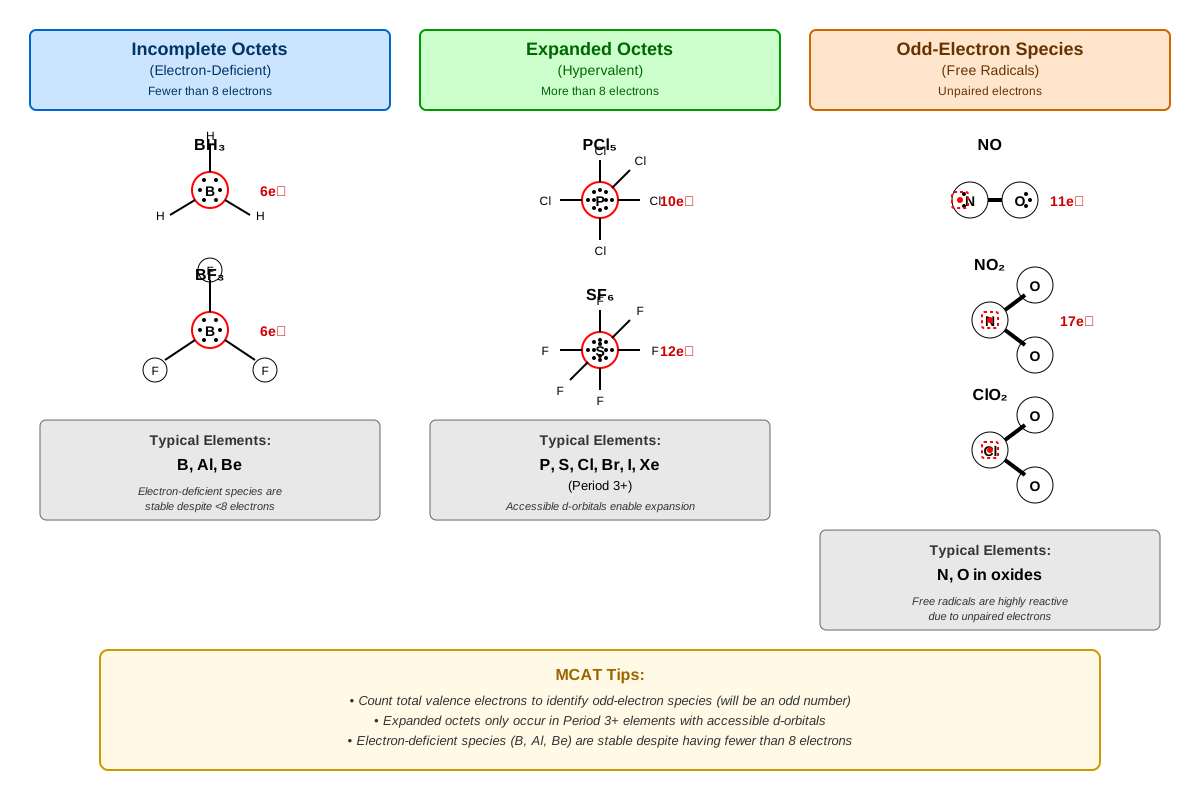
Incomplete octets occur when stable molecules contain atoms with fewer than eight valence electrons. This exception primarily affects three elements: boron (B), beryllium (Be), and aluminum (Al). These elements can form stable compounds despite electron deficiency because:
- They have relatively few valence electrons (3 for B and Al, 2 for Be)
- Achieving a full octet would require forming more bonds than is geometrically or energetically favorable
- The energy cost of promoting electrons or forming additional bonds exceeds the stability gained
Boron compounds represent the most commonly tested incomplete octet species. Boron trifluoride (BF₃) is the classic example, where boron has only six valence electrons in its most stable form. While resonance structures can be drawn showing double bonds that give boron an octet, formal charge calculations reveal that the structure with boron having six electrons (formal charge = 0) is more stable than structures with double bonds (which place positive formal charge on the highly electronegative fluorine atoms).
Beryllium compounds like beryllium chloride (BeCl₂) show beryllium with only four valence electrons. This linear molecule is stable despite the electron deficiency because beryllium's small size and low electronegativity make additional bonding unfavorable.
Aluminum compounds can also exhibit incomplete octets, though aluminum more commonly expands its octet in certain compounds. Aluminum trichloride (AlCl₃) exists as a monomer with an incomplete octet in the gas phase but dimerizes (Al₂Cl₆) in solid and liquid phases to satisfy aluminum's tendency toward higher coordination numbers.
Category 2: Expanded Octets (Hypervalent Species)
Expanded octets occur when atoms are surrounded by more than eight valence electrons. This exception is possible only for elements in period 3 and beyond because these elements have accessible d orbitals that can accommodate additional electrons. The most commonly tested elements that form expanded octets include:
| Element | Common Electron Counts | Example Molecules |
|---|---|---|
| Phosphorus (P) | 10, 12 | PCl₅ (10), H₃PO₄ (10) |
| Sulfur (S) | 10, 12 | SF₄ (10), SF₆ (12), H₂SO₄ (12) |
| Chlorine (Cl) | 10, 12, 14 | ClF₃ (10), ClF₅ (12) |
| Xenon (Xe) | 10, 12, 14, 16 | XeF₂ (10), XeF₄ (12), XeF₆ (14) |
| Iodine (I) | 10, 12, 14 | IF₅ (12), IF₇ (14) |
Phosphorus pentachloride (PCl₅) exemplifies expanded octets with phosphorus surrounded by 10 electrons (five bonding pairs). The trigonal bipyramidal geometry reflects this electron arrangement. Sulfur hexafluoride (SF₆) shows sulfur with 12 electrons (six bonding pairs) in an octahedral geometry. These structures are stable because:
- The central atom is large enough to accommodate multiple bonding atoms without excessive steric crowding
- Available d orbitals provide space for additional electrons
- The bonding atoms are often highly electronegative (like F or Cl), which stabilizes the electron-rich central atom
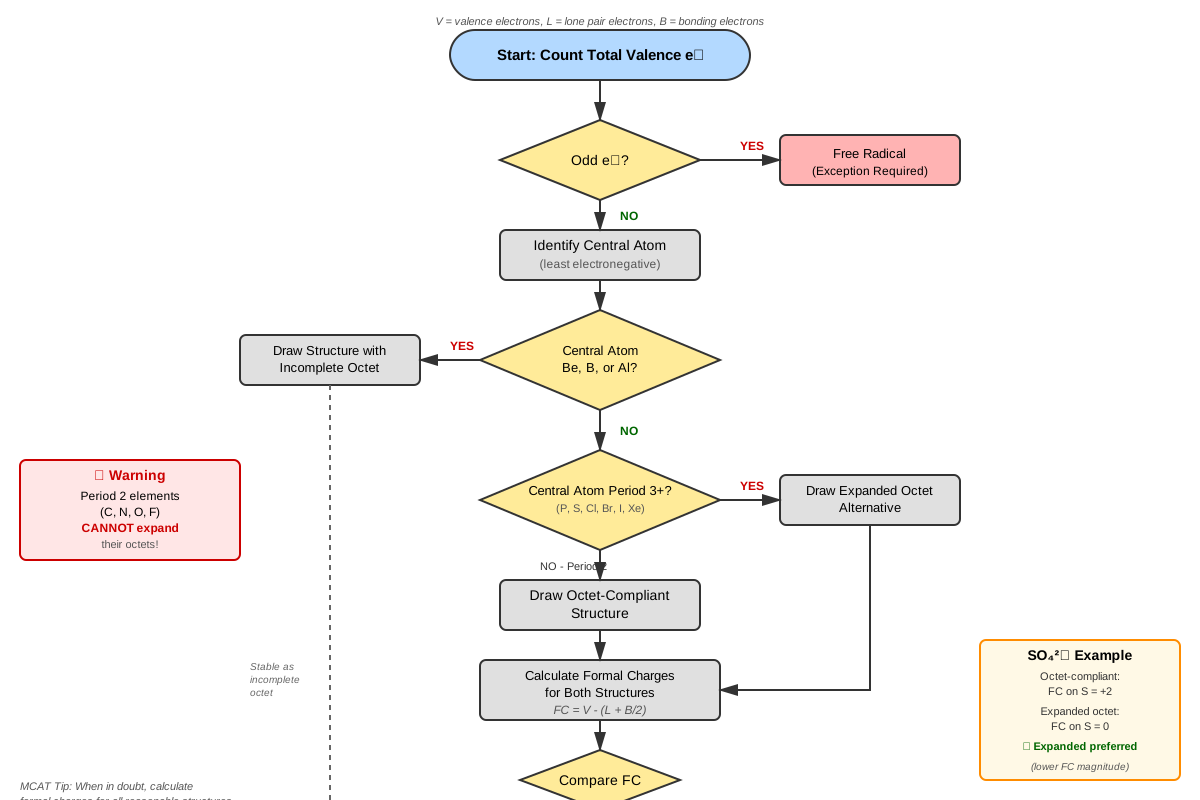
When drawing Lewis structures for expanded octet molecules, formal charge calculations often favor the expanded structure over alternatives with multiple bonds and lone pairs that maintain an octet. For example, in sulfuric acid (H₂SO₄), the structure with sulfur forming six bonds (expanded octet, formal charge = 0) is more stable than structures with sulfur maintaining an octet through single bonds and lone pairs (which result in formal charges of +2 on sulfur).
Category 3: Odd-Electron Species (Free Radicals)
Odd-electron species or free radicals contain an unpaired electron, making it mathematically impossible for all atoms to achieve complete octets. These molecules are typically highly reactive due to the unpaired electron's tendency to participate in reactions that pair it. Common examples include:
- Nitric oxide (NO): 11 total valence electrons, biologically important signaling molecule
- Nitrogen dioxide (NO₂): 17 total valence electrons, air pollutant and intermediate in acid rain formation
- Chlorine dioxide (ClO₂): 19 total valence electrons, used in water treatment
- Superoxide radical (O₂⁻): Important in cellular respiration and oxidative stress
For nitric oxide, the Lewis structure shows nitrogen and oxygen connected by a double bond with one unpaired electron. The unpaired electron can be placed on either nitrogen or oxygen, with formal charge considerations suggesting placement on nitrogen is slightly more favorable. Despite the odd electron, NO is relatively stable compared to most radicals and serves critical biological functions including vasodilation and neurotransmission.
Nitrogen dioxide demonstrates resonance in radical species, with the unpaired electron and double bond position alternating between the two oxygen atoms. This resonance stabilization makes NO₂ more stable than might be expected for a radical species.
Recognizing When Exceptions Apply
For MCAT success, students must quickly identify when to apply exceptions:
- Count total valence electrons first: Odd numbers immediately indicate a radical species
- Identify the central atom: If it's B, Be, or Al, consider incomplete octets; if it's period 3 or below and bonded to highly electronegative atoms, consider expanded octets
- Calculate formal charges: The most stable structure typically has formal charges closest to zero and negative formal charges on more electronegative atoms
- Check for biological or chemical reasonableness: Some structures that technically satisfy the octet rule are less stable than exception structures
Formal Charge and Exception Structures
Formal charge calculations become especially important when evaluating octet rule exceptions. The formula is:
Formal Charge = (Valence electrons) - (Non-bonding electrons) - (1/2 × Bonding electrons)For molecules that could be drawn with or without octet rule exceptions, the structure with formal charges closest to zero is typically most stable. Additionally, structures that place negative formal charges on more electronegative atoms are favored. This principle explains why expanded octet structures for molecules like H₂SO₄ and H₃PO₄ are preferred despite violating the octet rule.
Concept Relationships
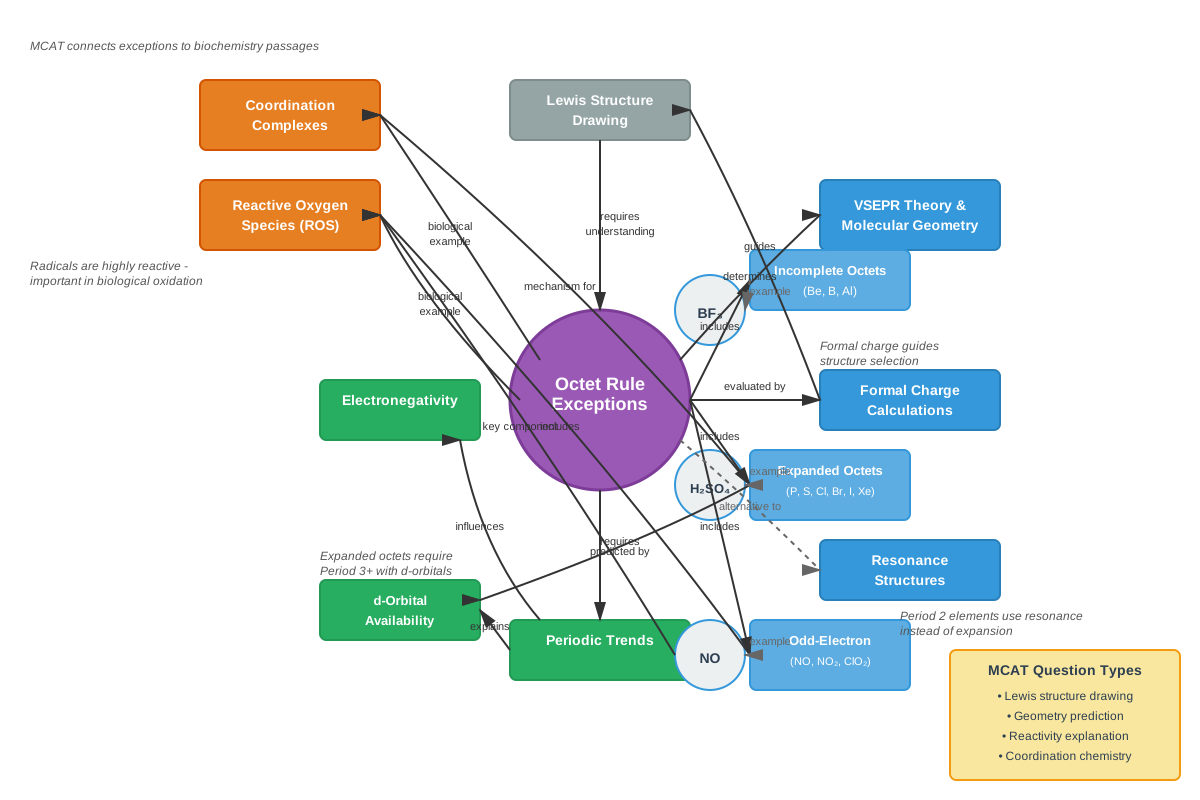
The three categories of octet rule exceptions interconnect through the underlying principle that electron configuration stability depends on multiple factors beyond simply achieving eight electrons. Incomplete octets relate to electronegativity and atomic size—small atoms with few valence electrons cannot accommodate enough bonding partners to reach eight electrons without creating unfavorable formal charges. This connects to formal charge calculations, which help determine when an incomplete octet structure is more stable than alternatives.
Expanded octets connect directly to periodic trends and orbital theory. The availability of d orbitals in period 3 and beyond enables these exceptions, linking to concepts of electron configuration and quantum numbers. Expanded octets also relate to molecular geometry through VSEPR theory—molecules like SF₆ and PCl₅ have geometries (octahedral and trigonal bipyramidal) that are only possible with more than four electron groups around the central atom.
Odd-electron species bridge to radical chemistry, reaction mechanisms, and biochemistry. Understanding free radicals as octet rule exceptions enables comprehension of oxidative stress, antioxidant mechanisms, and radical-mediated reactions in organic chemistry. This connects forward to reaction kinetics and thermodynamics, as radical reactions often have different energy profiles than non-radical reactions.
All three exception types connect back to Lewis structures as the primary tool for visualization and to resonance structures when multiple valid arrangements exist. The relationship map flows: Periodic Trends → Electron Configuration → Orbital Availability → Octet Rule Exceptions → Lewis Structures → Formal Charge → Molecular Geometry → Chemical Reactivity.
Quick check — test yourself on Octet rule exceptions so far.
Try Flashcards →High-Yield Facts
⭐ Boron, beryllium, and aluminum commonly form stable compounds with incomplete octets (fewer than 8 electrons around the central atom)
⭐ Only elements in period 3 and beyond can form expanded octets because they have accessible d orbitals
⭐ Phosphorus and sulfur are the most commonly tested elements for expanded octet questions on the MCAT
⭐ Molecules with an odd number of total valence electrons must be free radicals with at least one unpaired electron
⭐ Formal charge calculations help determine which octet rule exception structure is most stable—structures with formal charges closest to zero are favored
- BF₃ is more stable with boron having six electrons (incomplete octet) than with double bonds giving boron eight electrons
- SF₆ has 12 electrons around sulfur in an octahedral geometry
- PCl₅ has 10 electrons around phosphorus in a trigonal bipyramidal geometry
- Nitric oxide (NO) is a biologically important free radical with 11 total valence electrons
- Xenon can form stable compounds (XeF₂, XeF₄, XeF₆) despite being a noble gas, all involving expanded octets
- ClF₃ has 10 electrons around chlorine and adopts a T-shaped geometry
- The superoxide radical (O₂⁻) is an important reactive oxygen species in biological systems
- Expanded octet structures are more common when the central atom is bonded to highly electronegative atoms like F, O, or Cl
Common Misconceptions
Misconception: All stable molecules must follow the octet rule to be stable.
Correction: Many stable molecules violate the octet rule, including common species like BF₃, SF₆, PCl₅, and NO. Stability depends on multiple factors including formal charge, atomic size, and orbital availability, not just achieving eight electrons.
Misconception: Any element can form an expanded octet if needed.
Correction: Only elements in period 3 and beyond can form expanded octets because they have accessible d orbitals. Second-period elements (C, N, O, F) never exceed eight valence electrons in stable molecules because they lack d orbitals in their valence shell.
Misconception: Free radicals are always extremely unstable and reactive.
Correction: While many radicals are highly reactive, some like nitric oxide (NO) and nitrogen dioxide (NO₂) are relatively stable due to resonance stabilization or other factors. Biological systems even use NO as a signaling molecule, demonstrating that radicals can have controlled, functional roles.
Misconception: When drawing Lewis structures, always try to give every atom an octet, even if it means creating unfavorable formal charges.
Correction: Formal charge considerations often override the octet rule. For BF₃, the structure with boron having six electrons (all formal charges = 0) is more stable than structures with B=F double bonds that give boron an octet but place positive formal charge on highly electronegative fluorine.
Misconception: Expanded octets occur because atoms "want" more than eight electrons.
Correction: Expanded octets occur when the energy cost of using d orbitals is offset by the stability gained from forming additional bonds, particularly with highly electronegative atoms. It's an energetic consideration, not a preference. Elements form expanded octets when doing so creates a more stable structure than alternatives.
Misconception: Aluminum always forms expanded octets like other period 3 elements.
Correction: Aluminum more commonly forms incomplete octets (like in AlCl₃ monomer) than expanded octets. While it can expand its octet in certain coordination complexes, its chemistry more closely resembles boron's tendency toward electron deficiency than phosphorus and sulfur's tendency toward expansion.
Worked Examples
Example 1: Determining the Correct Lewis Structure for Sulfur Tetrafluoride (SF₄)
Problem: Draw the Lewis structure for SF₄ and determine whether sulfur follows the octet rule. If not, explain why the exception structure is stable.
Solution:
Step 1: Count total valence electrons
- Sulfur: 6 valence electrons
- Fluorine: 7 valence electrons × 4 atoms = 28 electrons
- Total: 6 + 28 = 34 valence electrons
Step 2: Draw the skeletal structure with sulfur as the central atom
- Place sulfur in the center with four fluorine atoms around it
- Connect each F to S with a single bond (uses 8 electrons)
- Remaining electrons: 34 - 8 = 26 electrons
Step 3: Complete octets on outer atoms (fluorine)
- Each fluorine needs 6 more electrons (3 lone pairs)
- 4 fluorines × 6 electrons = 24 electrons
- Remaining electrons: 26 - 24 = 2 electrons
Step 4: Place remaining electrons on central atom
- Place the remaining 2 electrons (1 lone pair) on sulfur
- Sulfur now has: 4 bonding pairs + 1 lone pair = 10 electrons total
Step 5: Evaluate the structure
- Sulfur has 10 electrons, violating the octet rule (expanded octet)
- This is stable because sulfur is in period 3 and has accessible d orbitals
- The molecular geometry is see-saw (based on 5 electron groups: 4 bonding, 1 lone pair)
Step 6: Check formal charges
- Sulfur: 6 - 2 - (8/2) = 6 - 2 - 4 = 0
- Each fluorine: 7 - 6 - (2/2) = 7 - 6 - 1 = 0
- All formal charges are zero, confirming this is the most stable structure
Conclusion: SF₄ is an expanded octet species with sulfur having 10 valence electrons. This exception is stable because sulfur can utilize d orbitals and the structure has favorable formal charges.
Example 2: Analyzing Nitrogen Dioxide (NO₂) as a Free Radical
Problem: A student draws the following Lewis structure for NO₂ with nitrogen in the center, double-bonded to one oxygen and single-bonded to another, with all atoms having complete octets. Explain what is wrong with this structure and draw the correct structure.
Solution:
Step 1: Count total valence electrons
- Nitrogen: 5 valence electrons
- Oxygen: 6 valence electrons × 2 atoms = 12 electrons
- Total: 5 + 12 = 17 valence electrons (odd number!)
Step 2: Recognize the implication
- An odd number of valence electrons means at least one atom cannot have a complete octet
- This molecule must be a free radical with an unpaired electron
Step 3: Draw the correct structure
- Place nitrogen in the center with two oxygen atoms
- Create one N=O double bond and one N-O single bond
- Distribute remaining electrons to complete octets where possible
- One electron will remain unpaired (typically placed on nitrogen)
Step 4: Verify electron count
- N=O double bond: 4 electrons
- N-O single bond: 2 electrons
- Lone pairs on double-bonded O: 4 electrons
- Lone pairs on single-bonded O: 6 electrons
- Unpaired electron on N: 1 electron
- Total: 4 + 2 + 4 + 6 + 1 = 17 electrons ✓
Step 5: Consider resonance
- The double bond and unpaired electron can be on either oxygen
- Draw resonance structures showing both possibilities
- The actual structure is a resonance hybrid
Step 6: Explain the error in the student's structure
- The student's structure with all complete octets would require 18 electrons (even number)
- With only 17 electrons available, a complete octet for all atoms is impossible
- The student likely forgot to count total electrons before drawing
Conclusion: NO₂ is a free radical (odd-electron species) that cannot satisfy the octet rule for all atoms. The unpaired electron makes this molecule reactive and explains its role as an air pollutant and intermediate in atmospheric chemistry. This example demonstrates why counting total valence electrons is always the critical first step in drawing Lewis structures.
Exam Strategy
When approaching octet rule exceptions questions on the MCAT, employ this systematic strategy:
Step 1: Count total valence electrons immediately. This single step reveals whether you're dealing with a free radical (odd number) and prevents wasting time trying to draw impossible structures. Write the count down to avoid recounting.
Step 2: Identify the central atom and its period. If the central atom is B, Be, or Al, anticipate an incomplete octet. If it's period 3 or beyond (especially P, S, Cl, Xe, or I) and bonded to highly electronegative atoms, anticipate a possible expanded octet.
Step 3: Watch for trigger words and phrases:
- "Most stable Lewis structure" → calculate formal charges to compare options
- "Molecular geometry" → correctly identifying octet rule exceptions is essential for VSEPR predictions
- "Reactive species" or "radical" → look for odd-electron molecules
- "Hypervalent" → expanded octet
- "Electron-deficient" → incomplete octet
Step 4: Use process of elimination effectively. On multiple-choice questions showing Lewis structures:
- Eliminate any structure with the wrong total electron count first
- Eliminate structures that show expanded octets for second-period elements (impossible)
- Eliminate structures with highly unfavorable formal charges (like positive charges on F or O)
- Among remaining options, choose the structure with formal charges closest to zero
Step 5: Time management. Lewis structure questions should take 30-45 seconds if you're systematic. If you find yourself spending more than one minute, make your best guess based on formal charge principles and move on. Don't let one structure question consume time needed for passage-based questions.
Step 6: Connect to other concepts. If a question asks about molecular geometry, reactivity, or polarity, your correct identification of octet rule exceptions directly impacts these answers. An incorrect Lewis structure cascades into multiple wrong answers, so invest the time to get the structure right first.
Exam Tip: If you're unsure whether an expanded octet is appropriate, check if the central atom is bonded to very electronegative atoms (F, O, Cl). Expanded octets are much more common in these situations because the electronegative atoms stabilize the electron-rich central atom.
Memory Techniques
Mnemonic for incomplete octet elements: "BBeAl" (sounds like "be all")
- Boron
- Beryllium
- Aluminum
Mnemonic for common expanded octet elements: "PSClXeI" (think "Psyche!")
- Phosphorus
- Sulfur
- Clorine
- Xenon
- Iodine
Visualization for expanded octets: Picture a "crowded dance floor" where only the larger elements (period 3+) have enough room to accommodate extra dance partners (electrons). Second-period elements are too small and would be crushed by extra partners.
Acronym for evaluating Lewis structures: "CHEF"
- Count total valence electrons
- Hook atoms together (skeletal structure)
- Extend octets to outer atoms first
- Formal charge check for stability
Memory aid for free radicals: "NO NO₂ ClO₂" - These three are the most commonly tested biological and environmental radicals. Remember them as a phrase: "No, no, chlorine dioxide!" (as if warning someone about water contamination).
Formal charge shortcut: For expanded octets, remember that structures with all formal charges equal to zero are almost always correct. If you see a structure with sulfur or phosphorus having +2 formal charge, it's probably wrong—the expanded octet structure is more stable.
Summary
Octet rule exceptions represent critical deviations from the standard principle that atoms achieve stability with eight valence electrons. The three major categories—incomplete octets (electron-deficient species like BF₃), expanded octets (hypervalent species like SF₆ and PCl₅), and odd-electron species (free radicals like NO and NO₂)—each arise from specific structural and energetic considerations. Incomplete octets occur primarily with boron, beryllium, and aluminum, which cannot accommodate enough bonding partners to reach eight electrons without creating unfavorable formal charges. Expanded octets occur only with period 3 and beyond elements that have accessible d orbitals, most commonly phosphorus, sulfur, and the halogens when bonded to highly electronegative atoms. Free radicals result from odd numbers of total valence electrons, making complete octets mathematically impossible. For MCAT success, students must systematically count valence electrons, identify the central atom's position in the periodic table, and use formal charge calculations to determine the most stable structure. These exceptions connect to molecular geometry, reactivity patterns, and biological processes, making them essential for both direct structure questions and passage-based applications in biochemistry and chemical reasoning.
Key Takeaways
- Octet rule exceptions fall into three categories: incomplete octets (B, Be, Al), expanded octets (period 3+ elements), and odd-electron species (free radicals)
- Only elements in period 3 and beyond can form expanded octets because they have accessible d orbitals; second-period elements never exceed eight valence electrons
- Counting total valence electrons first is the critical step that reveals whether a molecule must be a free radical (odd number) and guides structure drawing
- Formal charge calculations determine which exception structure is most stable—structures with formal charges closest to zero are strongly favored
- Common MCAT examples include BF₃ (incomplete octet), SF₆ and PCl₅ (expanded octets), and NO and NO₂ (free radicals with biological significance)
- Expanded octets are most common when the central atom is bonded to highly electronegative atoms like F, O, or Cl, which stabilize the electron-rich center
- Understanding octet rule exceptions is essential for correctly predicting molecular geometry, reactivity patterns, and biological functions of molecules that violate the standard rule
Related Topics
VSEPR Theory and Molecular Geometry: Mastering octet rule exceptions enables accurate geometry predictions for molecules like SF₆ (octahedral) and PCl₅ (trigonal bipyramidal) that require more than four electron groups around the central atom.
Resonance Structures: Many exception molecules, particularly free radicals like NO₂, exhibit resonance that distributes the unpaired electron or expanded octet across multiple atoms, affecting stability and reactivity.
Formal Charge and Lewis Structure Optimization: Advanced formal charge applications help determine when exception structures are more stable than octet-following alternatives, a skill essential for complex organic and inorganic molecules.
Coordination Chemistry and Complex Ions: Transition metals routinely violate the octet rule in coordination complexes, extending the principles learned here to biologically important molecules like hemoglobin and cytochromes.
Radical Reactions and Mechanisms: Understanding free radicals as octet rule exceptions provides the foundation for studying radical chain reactions, oxidative stress, and antioxidant mechanisms in biochemistry.
Periodic Trends and Orbital Theory: Deeper exploration of why d orbital availability enables expanded octets connects to quantum mechanics and advanced bonding theories like molecular orbital theory.
Practice CTA
Now that you've mastered the core concepts of octet rule exceptions, it's time to solidify your understanding through active practice. Challenge yourself with the practice questions and flashcards designed specifically for this topic. Focus on systematically applying the electron counting and formal charge strategies you've learned—these skills will serve you not only for direct Lewis structure questions but also for passage-based problems involving molecular geometry, reactivity, and biological function. Remember, recognizing octet rule exceptions quickly and accurately is a high-yield skill that distinguishes top MCAT performers. You've built the foundation; now strengthen it through deliberate practice!
Sign up free to keep reading
Create a free AnvayaPrep account to finish this MCAT guide on Octet rule exceptions — plus flashcards and practice questions.