Overview
Sigma bonds (σ bonds) represent the most fundamental type of covalent bonding in chemistry and form the structural backbone of virtually every molecule encountered in biological systems and on the MCAT. Understanding sigma bonds is essential because they constitute the single bonds in all molecular structures, from simple diatomic molecules to complex biomolecules like proteins and nucleic acids. A sigma bond forms through the direct, head-on overlap of atomic orbitals along the internuclear axis—the imaginary line connecting two bonded nuclei. This axial overlap creates the strongest type of covalent bond and allows for free rotation around the bond axis, a property that profoundly influences molecular geometry and conformational flexibility.
For MCAT success in General Chemistry, mastery of sigma bonds provides the foundation for understanding Bonding and Molecular Structure, molecular geometry, hybridization theory, and the distinction between single and multiple bonds. The MCAT frequently tests sigma bonds in the context of organic molecules, where recognizing that every single bond is a sigma bond and that multiple bonds contain exactly one sigma bond becomes crucial for predicting molecular properties, reactivity, and three-dimensional structure. Questions may present complex organic structures and ask students to count sigma bonds, determine hybridization states, or predict rotational freedom—all skills that depend on a solid understanding of sigma bond formation and characteristics.
The concept of sigma bonds connects intimately with orbital theory, molecular orbital diagrams, VSEPR theory, and the entire framework of chemical bonding. Students who thoroughly understand sigma bonds can more easily grasp pi bonds, resonance structures, bond energies, and the relationship between molecular structure and function—topics that appear throughout the Chemical and Physical Foundations section of the MCAT. This topic serves as a gateway to understanding why molecules adopt specific shapes, how bond strength influences reaction mechanisms, and why certain molecular conformations are energetically favored over others.
Learning Objectives
- [ ] Define sigma bonds using accurate General Chemistry terminology
- [ ] Explain why sigma bonds matters for the MCAT
- [ ] Apply sigma bonds to exam-style questions
- [ ] Identify common mistakes related to sigma bonds
- [ ] Connect sigma bonds to related General Chemistry concepts
- [ ] Distinguish between sigma and pi bonds based on orbital overlap geometry
- [ ] Determine the number of sigma bonds in complex molecular structures
- [ ] Predict molecular properties based on sigma bond characteristics, including rotational freedom and bond strength
- [ ] Relate sigma bond formation to atomic orbital hybridization (sp, sp², sp³)
Prerequisites
- Atomic orbital theory: Understanding s, p, d, and f orbitals is essential because sigma bonds form from the overlap of these atomic orbitals
- Electron configuration: Knowledge of how electrons fill orbitals enables prediction of which orbitals participate in bonding
- Lewis structures: The ability to draw Lewis structures provides the framework for identifying where sigma bonds exist in molecules
- Valence electrons: Recognizing valence electrons allows determination of bonding capacity and bond formation
- Electronegativity: Understanding electronegativity differences helps explain bond polarity in sigma bonds
Why This Topic Matters
Clinical and Real-World Significance
Sigma bonds form the structural framework of every biologically relevant molecule, from the peptide bonds linking amino acids in proteins to the phosphodiester bonds connecting nucleotides in DNA. The free rotation around sigma bonds enables proteins to fold into functional three-dimensional structures and allows drug molecules to adopt conformations that fit receptor binding sites. Understanding sigma bonds helps explain why certain molecular conformations are more stable (staggered vs. eclipsed), which directly relates to enzyme-substrate interactions and drug design.
MCAT Exam Statistics
Sigma bonds appear in approximately 15-20% of General Chemistry questions on the MCAT, either as the primary focus or as prerequisite knowledge for more complex bonding questions. The topic most commonly appears in:
- Discrete questions asking students to count sigma and pi bonds in organic molecules
- Passage-based questions involving molecular structure determination
- Questions linking hybridization to molecular geometry
- Problems requiring prediction of rotational barriers or conformational isomers
Common Exam Contexts
The MCAT typically presents sigma bonds within:
- Organic chemistry passages describing reaction mechanisms where bond breaking/forming is illustrated
- Biochemistry passages discussing protein structure or enzyme active sites
- General chemistry passages on molecular orbital theory or bonding energies
- Questions comparing single, double, and triple bonds in terms of bond length, strength, and composition
Core Concepts
Definition and Formation of Sigma Bonds
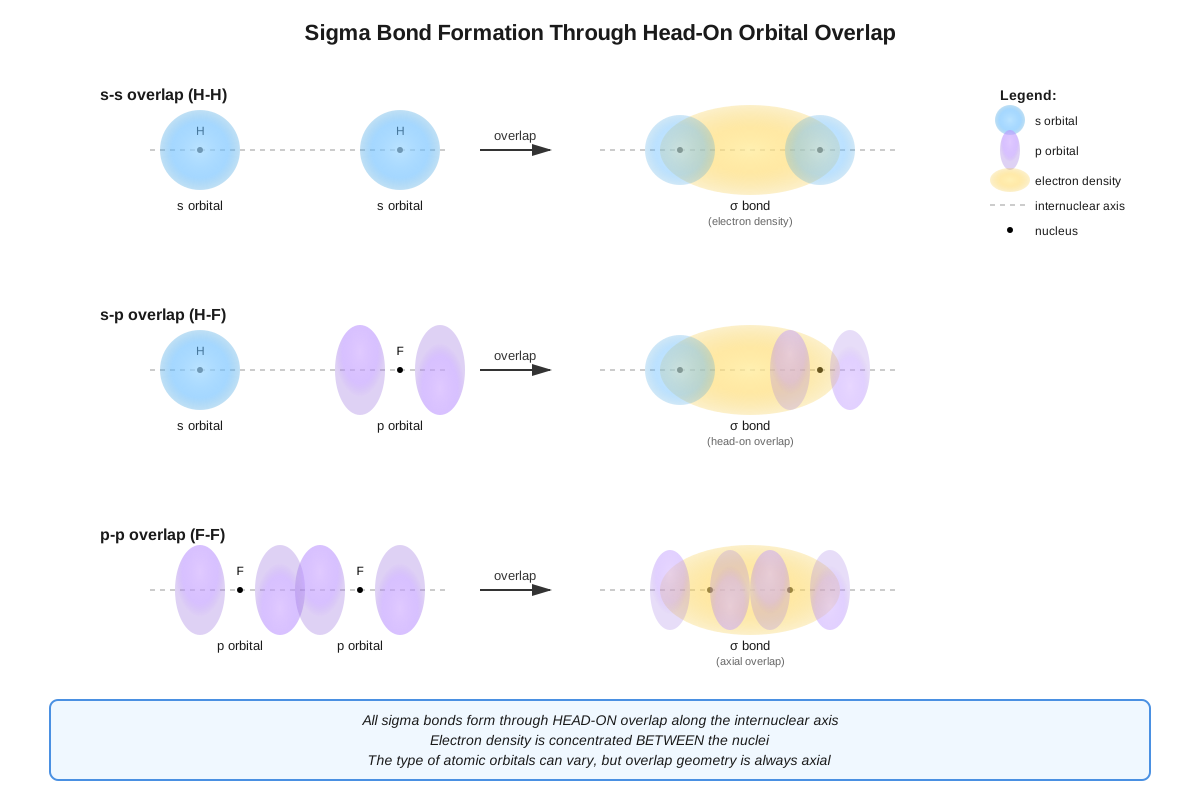
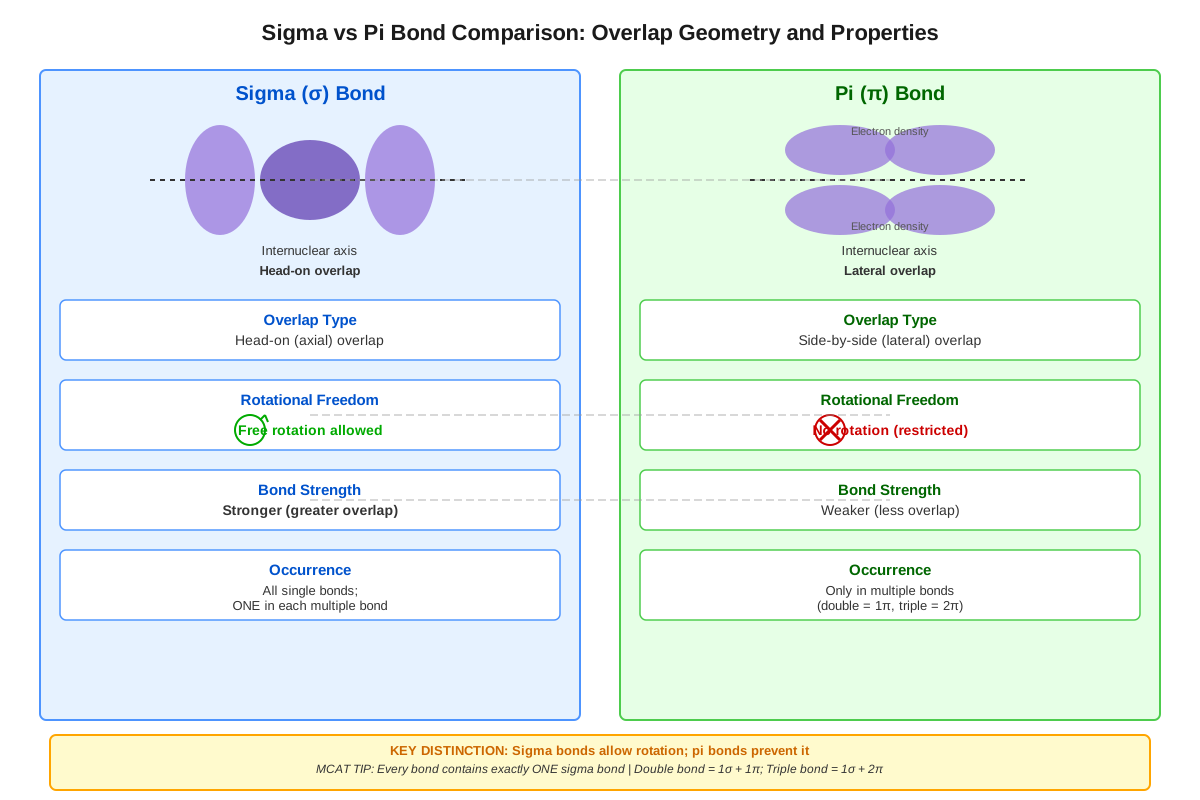
A sigma bond (σ bond) is a covalent bond formed by the head-on (axial) overlap of atomic orbitals along the internuclear axis connecting two bonded atoms. This direct overlap along the bond axis distinguishes sigma bonds from pi bonds, which form from side-to-side overlap of parallel p orbitals. The sigma bond represents the first and strongest bond formed between any two atoms, and it is present in every covalent bond—whether single, double, or triple.
The formation of a sigma bond involves the overlap of various combinations of atomic orbitals:
- s-s overlap: Two s orbitals overlap (e.g., H₂ molecule)
- s-p overlap: An s orbital overlaps with a p orbital (e.g., HCl molecule)
- p-p overlap: Two p orbitals overlap head-on along their axes (e.g., F₂ molecule)
- Hybrid orbital overlap: Hybridized orbitals (sp, sp², sp³) overlap with other atomic or hybrid orbitals (most common in organic molecules)
The electron density in a sigma bond is concentrated directly between the two nuclei along the bond axis, creating a cylindrically symmetrical distribution around the internuclear axis. This symmetry is a defining characteristic that allows for free rotation around the sigma bond without breaking the bond itself.
Orbital Overlap and Bond Strength
The strength of a sigma bond depends on the extent of orbital overlap—greater overlap produces stronger bonds with lower potential energy. Several factors influence overlap efficiency:
- Orbital size: Smaller orbitals overlap more effectively because electron density is more concentrated
- Orbital directionality: p orbitals and hybrid orbitals have directional character that enhances overlap when properly aligned
- Internuclear distance: Optimal overlap occurs at a specific bond length where attractive and repulsive forces balance
The bond energy of a sigma bond typically ranges from 150-600 kJ/mol, depending on the atoms involved and the type of orbital overlap. For comparison, C-C sigma bonds have energies around 347 kJ/mol, while C-H sigma bonds are approximately 413 kJ/mol. These values are crucial for understanding reaction energetics on the MCAT.
Sigma Bonds and Hybridization
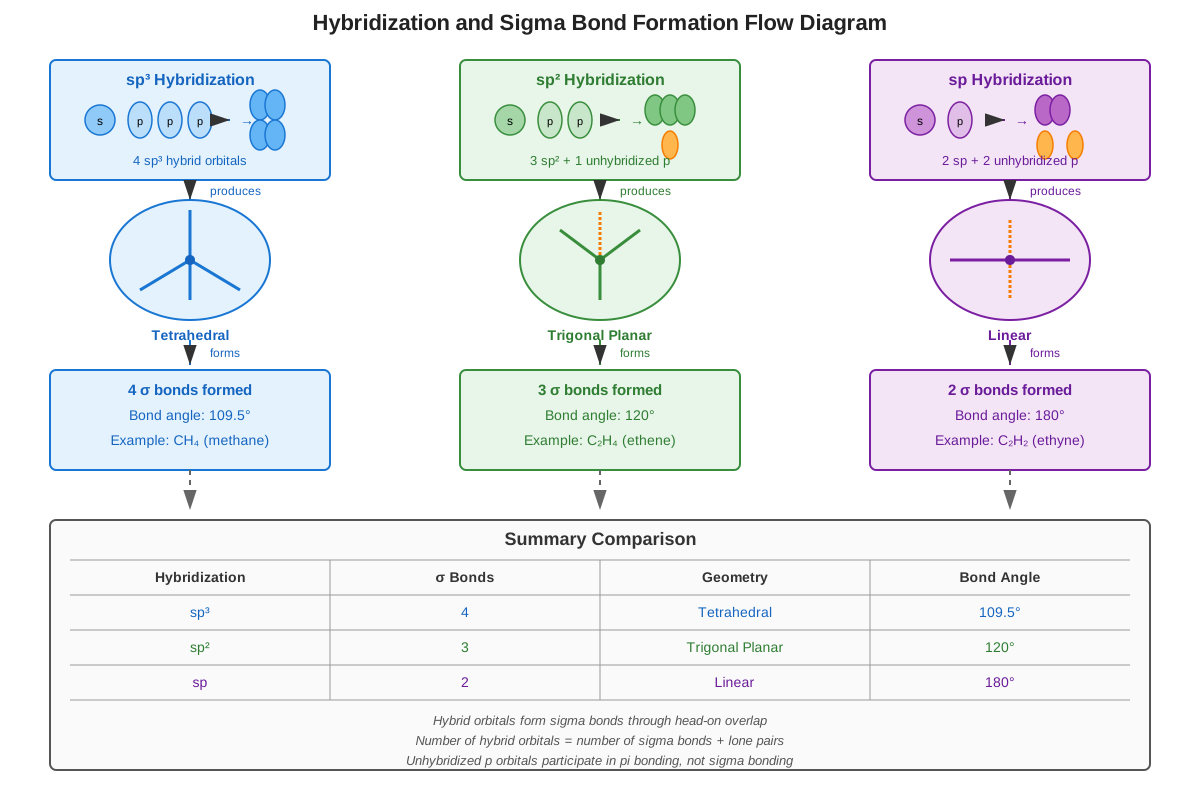
Hybridization theory explains how atomic orbitals mix to form new hybrid orbitals that optimize bonding geometry. The relationship between hybridization and sigma bonds is fundamental:
| Hybridization | Geometry | Bond Angle | Number of Sigma Bonds | Example |
|---|---|---|---|---|
| sp³ | Tetrahedral | 109.5° | 4 | CH₄, CCl₄ |
| sp² | Trigonal planar | 120° | 3 | C₂H₄, BF₃ |
| sp | Linear | 180° | 2 | C₂H₂, CO₂ |
Each hybrid orbital forms one sigma bond through overlap with another atomic or hybrid orbital. For example, in methane (CH₄), the carbon atom undergoes sp³ hybridization, creating four equivalent sp³ hybrid orbitals that each form a sigma bond with a hydrogen 1s orbital. In ethene (C₂H₄), each carbon is sp² hybridized, forming three sigma bonds (one C-C and two C-H) while retaining an unhybridized p orbital for pi bonding.
Sigma Bonds in Single, Double, and Triple Bonds
Understanding the composition of multiple bonds is essential for MCAT success:
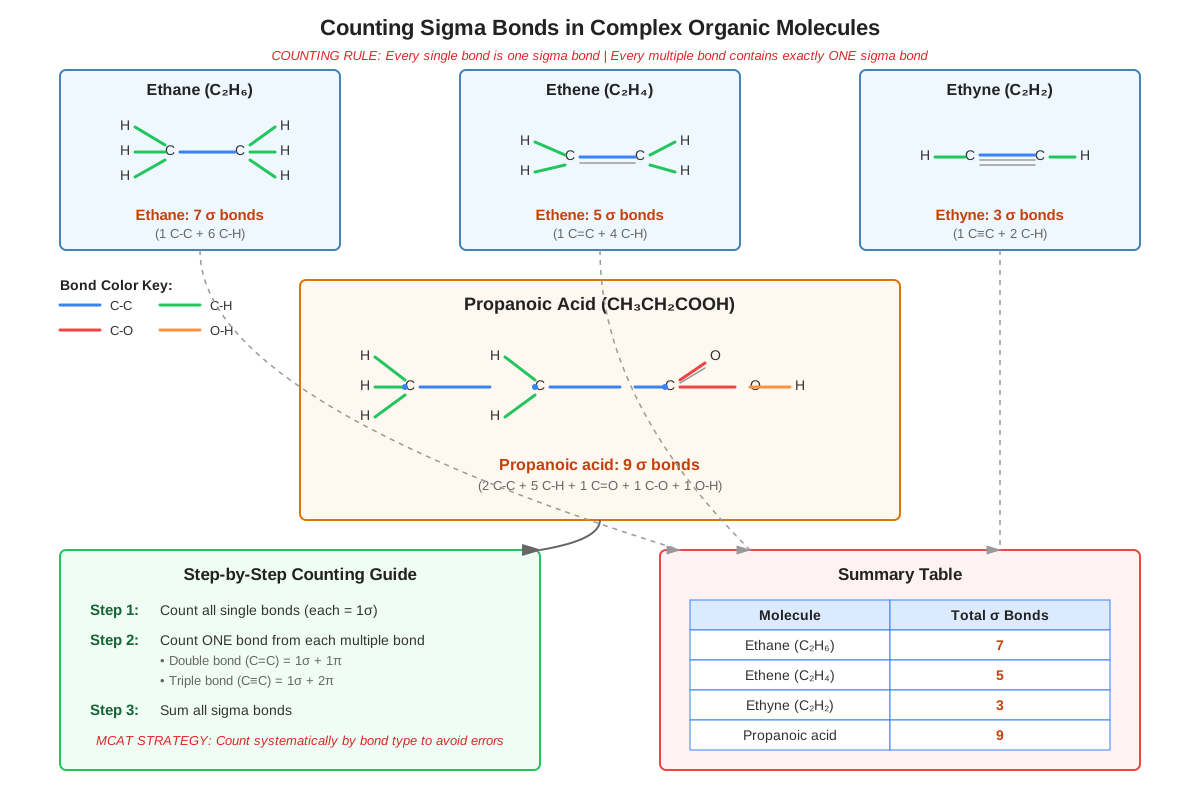
- Single bond: Contains exactly 1 sigma bond
- Double bond: Contains exactly 1 sigma bond + 1 pi bond
- Triple bond: Contains exactly 1 sigma bond + 2 pi bonds
This pattern is invariable: the first bond between any two atoms is always a sigma bond because it provides the strongest, most stable connection. Additional bonds (pi bonds) form from the side-to-side overlap of unhybridized p orbitals that remain after hybridization. For example, in nitrogen gas (N₂), which has a triple bond (N≡N), there is one sigma bond formed from sp hybrid orbital overlap and two pi bonds formed from the overlap of two pairs of parallel p orbitals.
Rotational Freedom Around Sigma Bonds
One of the most important properties of sigma bonds is that they permit free rotation around the bond axis. This occurs because the cylindrical symmetry of electron density means that rotation does not disrupt orbital overlap. This property has profound implications:
- Conformational isomers: Molecules can adopt different spatial arrangements (conformations) by rotating around sigma bonds
- Staggered vs. eclipsed conformations: Different rotational positions have different energies due to steric and electronic effects
- Biological function: Protein folding and enzyme flexibility depend on rotation around sigma bonds in the polypeptide backbone
In contrast, pi bonds restrict rotation because their side-to-side p orbital overlap would be broken by rotation, requiring significant energy input. This is why double bonds create geometric (cis-trans) isomers rather than freely interconverting conformations.
Sigma Bond Polarity
While all sigma bonds share the same geometric characteristics, they vary in polarity based on the electronegativity difference between bonded atoms:
- Nonpolar sigma bonds: Form between identical atoms (C-C, H-H) or atoms with similar electronegativity
- Polar sigma bonds: Form between atoms with different electronegativities (C-O, O-H, C-N)
The polarity of sigma bonds influences molecular properties including dipole moment, solubility, boiling point, and reactivity. On the MCAT, recognizing polar sigma bonds helps predict intermolecular forces and reaction mechanisms, particularly in organic chemistry passages.
Concept Relationships
The understanding of sigma bonds serves as a central hub connecting multiple concepts in General Chemistry and Bonding and Molecular Structure. The relationship map flows as follows:
Atomic Orbitals → combine through → Hybridization → which determines → Sigma Bond Formation → which establishes → Molecular Geometry → which influences → Molecular Properties
More specifically, knowledge of atomic orbitals (s, p, d) provides the foundation for understanding how these orbitals can mix (hybridize) to create optimal bonding arrangements. The hybridization state directly determines how many sigma bonds an atom can form and at what angles. These sigma bonds then establish the basic molecular framework, which VSEPR theory uses to predict three-dimensional geometry. The resulting geometry influences physical properties like polarity, intermolecular forces, and biological activity.
Sigma bonds also connect to pi bonds through the principle that multiple bonds always contain one sigma bond plus one or more pi bonds. This relationship is crucial for understanding resonance structures, where sigma bond frameworks remain constant while pi electrons delocalize. Additionally, sigma bonds relate to bond energy and bond length concepts—sigma bonds are shorter and stronger than pi bonds between the same atoms, and bond order (single, double, triple) correlates with both properties.
The concept extends to molecular orbital theory, where sigma bonds correspond to bonding molecular orbitals (σ) formed from constructive interference of atomic orbitals, while antibonding molecular orbitals (σ*) represent destructive interference. Understanding this connection helps explain bond stability and magnetic properties tested on the MCAT.
Quick check — test yourself on Sigma bonds so far.
Try Flashcards →High-Yield Facts
⭐ Every single covalent bond is a sigma bond; every double bond contains exactly one sigma bond and one pi bond; every triple bond contains exactly one sigma bond and two pi bonds
⭐ Sigma bonds form from head-on (axial) overlap of atomic orbitals along the internuclear axis, creating cylindrically symmetrical electron density
⭐ Free rotation is possible around sigma bonds but not around pi bonds, which explains the existence of conformational isomers vs. geometric isomers
⭐ The number of sigma bonds formed by an atom equals the number of hybrid orbitals: sp³ forms 4, sp² forms 3, sp forms 2
⭐ Sigma bonds are stronger than pi bonds between the same two atoms because head-on overlap is more effective than side-to-side overlap
- All C-C, C-H, C-O, C-N, O-H, and N-H bonds in organic molecules are sigma bonds (when they are single bonds)
- The sigma bond framework of a molecule remains intact during resonance; only pi electrons delocalize
- Hybrid orbitals always form sigma bonds, never pi bonds; pi bonds form from unhybridized p orbitals
- Bond length decreases as the number of bonds increases (triple < double < single) because additional pi bonds pull atoms closer
- In a molecule like benzene (C₆H₆), there are 12 sigma bonds (6 C-C and 6 C-H) and 3 pi bonds (delocalized)
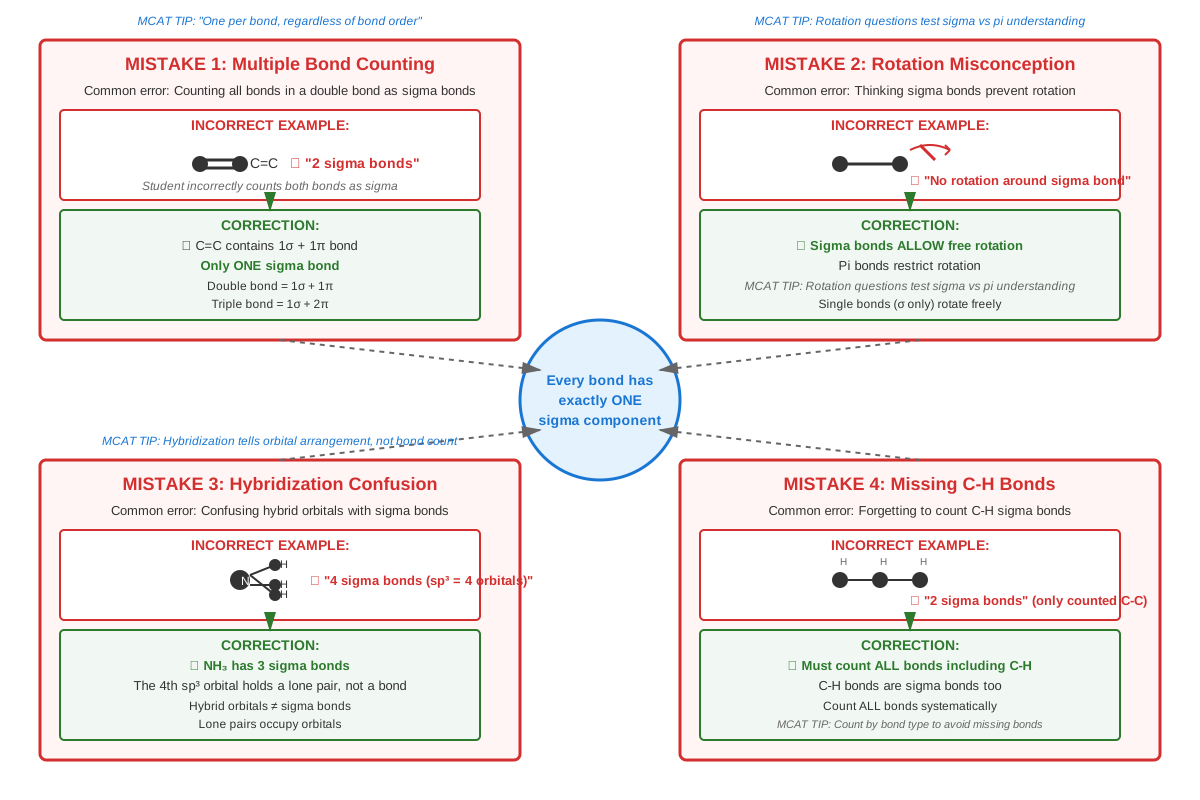
Common Misconceptions
Misconception: All bonds in a double bond are equivalent and identical.
Correction: A double bond consists of one sigma bond and one pi bond with different properties—the sigma bond is stronger, allows the initial connection, and forms from different orbital overlap (head-on) compared to the pi bond (side-to-side).
Misconception: Sigma bonds can only form between s orbitals.
Correction: The term "sigma" refers to the geometry of overlap (head-on along the bond axis), not the type of orbital involved. Sigma bonds can form from s-s, s-p, p-p, or hybrid orbital overlap, as long as the overlap is axial.
Misconception: Rotation around any bond is possible if enough energy is supplied.
Correction: While rotation around sigma bonds is relatively free (requiring minimal energy to overcome steric barriers), rotation around double bonds requires breaking the pi bond, which needs substantial energy (typically 250+ kJ/mol) and effectively doesn't occur under normal conditions.
Misconception: More bonds between atoms always means more sigma bonds.
Correction: Regardless of bond order, there is always exactly one sigma bond between any two directly bonded atoms. Triple bonds don't have three sigma bonds; they have one sigma bond and two pi bonds.
Misconception: Hybridization changes during rotation around a sigma bond.
Correction: Hybridization is a property of the atom based on its bonding environment and doesn't change during rotation around sigma bonds. Rotation changes the spatial relationship between groups but not the orbital hybridization.
Misconception: Sigma bonds are always nonpolar.
Correction: Sigma bond polarity depends on the electronegativity difference between bonded atoms. C-H sigma bonds are relatively nonpolar, but O-H and C-O sigma bonds are significantly polar, affecting molecular properties and reactivity.
Worked Examples
Example 1: Counting Sigma and Pi Bonds in a Complex Molecule
Question: How many sigma bonds and pi bonds are present in acetic acid (CH₃COOH)?
Solution:
Step 1: Draw the Lewis structure of acetic acid:
    H   O
    |   ||
H - C - C - O - H
    |
    H
Step 2: Identify each bond type systematically:
- Three C-H bonds in the methyl group (CH₃): 3 sigma bonds
- One C-C bond connecting the methyl to the carboxyl: 1 sigma bond
- One C=O double bond: 1 sigma bond + 1 pi bond
- One C-O single bond: 1 sigma bond
- One O-H bond: 1 sigma bond
Step 3: Count totals:
- Sigma bonds: 3 (C-H) + 1 (C-C) + 1 (C=O sigma) + 1 (C-O) + 1 (O-H) = 7 sigma bonds
- Pi bonds: 1 (from C=O) = 1 pi bond
Key Insight: This problem reinforces that every single bond is a sigma bond, and every double bond contributes one sigma and one pi bond. Systematically examining each bond prevents counting errors.
Example 2: Predicting Rotational Freedom and Isomerism
Question: Explain why 2-butene (CH₃CH=CHCH₃) exists as cis and trans isomers, but butane (CH₃CH₂CH₂CH₃) does not exhibit this type of isomerism.
Solution:
Step 1: Analyze the bonding in 2-butene:
- The C=C double bond consists of one sigma bond and one pi bond
- The pi bond forms from side-to-side overlap of p orbitals perpendicular to the molecular plane
- Rotation around the C=C bond would require breaking the pi bond, which requires ~250 kJ/mol
- This energy barrier is too high for rotation at room temperature
Step 2: Analyze the bonding in butane:
- All C-C bonds are single bonds (sigma bonds only)
- Sigma bonds have cylindrical symmetry around the bond axis
- Rotation around C-C sigma bonds is relatively free, requiring only ~12-20 kJ/mol to overcome steric barriers
- This energy is readily available at room temperature
Step 3: Connect to isomerism:
- In 2-butene, the restricted rotation around C=C allows two distinct spatial arrangements (cis: both CH₃ groups on same side; trans: CH₃ groups on opposite sides) that cannot interconvert
- In butane, free rotation around all C-C sigma bonds means any spatial arrangement can rapidly interconvert into any other, preventing stable geometric isomers
Key Insight: This example demonstrates how sigma bond properties (free rotation) versus pi bond properties (restricted rotation) directly determine whether geometric isomerism is possible. This concept frequently appears in MCAT organic chemistry questions.
Exam Strategy
Approaching MCAT Questions on Sigma Bonds
When encountering questions about sigma bonds on the MCAT, follow this systematic approach:
- Identify the question type: Is it asking you to count bonds, predict geometry, explain rotation, or compare bond types?
- Draw or visualize the structure: Even if not explicitly required, sketching Lewis structures prevents errors
- Apply the fundamental rule: First bond = sigma; additional bonds = pi
- Check hybridization if relevant: The number of sigma bonds correlates with hybridization state
Trigger Words and Phrases
Watch for these key phrases that signal sigma bond concepts:
- "How many bonds..." → Count sigma and pi separately
- "Free rotation" or "conformational isomers" → Sigma bond property
- "Geometric isomers" or "cis-trans" → Restricted rotation due to pi bonds
- "Hybridization" → Directly relates to sigma bond formation
- "Bond strength" or "bond energy" → Compare sigma vs. pi or different sigma bonds
- "Molecular geometry" → Determined by sigma bond framework
Process of Elimination Tips
When using POE on sigma bond questions:
- Eliminate answers that violate the one-sigma-per-bond-pair rule: If an answer suggests multiple sigma bonds between the same two atoms, it's wrong
- Eliminate answers that confuse sigma and pi properties: If rotation is described as restricted for a single bond, eliminate that choice
- Check numerical answers against structure: If counting bonds, eliminate answers that don't match the total number of atoms and their bonding capacity
- Watch for hybridization mismatches: If an answer claims sp² hybridization with 4 sigma bonds from one atom, eliminate it
Time Allocation
Sigma bond questions typically require 60-90 seconds:
- 20-30 seconds: Read and understand what's being asked
- 30-40 seconds: Draw/analyze structure and apply concepts
- 10-20 seconds: Verify answer and eliminate alternatives
For complex counting problems, invest the extra 15-20 seconds to draw the structure carefully—this prevents costly errors.
Memory Techniques
Mnemonics
"SIGMA = Single Is Greatest, Multiple Adds"
- Reminds you that single bonds are only sigma, and multiple bonds add pi bonds to the sigma
"Head-On Sigma, Side-by-Side Pi"
- Distinguishes the orbital overlap geometry for each bond type
"First bond First (sigma), Further bonds Follow (pi)"
- The first bond between atoms is always sigma; additional bonds are pi
Visualization Strategy
The Handshake Analogy: Think of sigma bonds as a firm handshake where hands meet directly (head-on overlap), creating a strong connection that allows the arms to rotate. Pi bonds are like a second person trying to hold hands with the same pair—they must approach from the side and prevent rotation.
The Axis Rule: Visualize the internuclear axis as a rod connecting two atoms. Sigma bond electron density wraps around this rod like a cylinder. This mental image helps remember why rotation is possible (the cylinder rotates smoothly around the rod).
Acronym for Bond Counting
"STOP" - Systematic Tally Of Pairs
- Single bonds: count each as 1 sigma
- Triple bonds: count each as 1 sigma + 2 pi
- One sigma always present in any bond
- Pi bonds: count separately (1 per double, 2 per triple)
Summary
Sigma bonds represent the fundamental building blocks of molecular structure, forming through head-on overlap of atomic orbitals along the internuclear axis. Every covalent bond contains exactly one sigma bond, which establishes the primary connection between atoms and determines the basic molecular framework. The cylindrical symmetry of sigma bonds permits free rotation around the bond axis, enabling conformational flexibility essential for biological function. Understanding that single bonds contain only sigma bonds, double bonds contain one sigma and one pi bond, and triple bonds contain one sigma and two pi bonds is crucial for analyzing molecular structure on the MCAT. Sigma bonds form from various orbital combinations (s-s, s-p, p-p, or hybrid orbital overlap), with the specific hybridization state determining the number and geometry of sigma bonds an atom can form. This knowledge connects directly to molecular geometry, bond strength, rotational freedom, and the distinction between conformational and geometric isomerism—all high-yield topics for MCAT General Chemistry and Organic Chemistry sections.
Key Takeaways
- Sigma bonds form from head-on orbital overlap along the internuclear axis and are present in every covalent bond (single, double, or triple)
- The bond composition rule is invariable: single = 1σ, double = 1σ + 1π, triple = 1σ + 2π
- Free rotation around sigma bonds (but not pi bonds) explains conformational isomers and distinguishes them from geometric isomers
- Hybridization determines sigma bonding capacity: sp³ forms 4 sigma bonds, sp² forms 3, sp forms 2
- Sigma bonds are stronger than pi bonds between the same atoms due to more effective head-on overlap
- Counting sigma bonds systematically by examining each atom's connections prevents errors on MCAT questions
- The sigma bond framework remains constant during resonance; only pi electrons delocalize
Related Topics
Pi Bonds: Understanding sigma bonds provides the foundation for learning about pi bonds, which form from side-to-side p orbital overlap and restrict rotation, creating geometric isomers.
Molecular Orbital Theory: Sigma bonds correspond to bonding molecular orbitals (σ) formed from constructive interference, while antibonding orbitals (σ*) explain bond stability and magnetic properties.
VSEPR Theory and Molecular Geometry: The sigma bond framework determines electron domain geometry, which VSEPR theory uses to predict molecular shape and bond angles.
Hybridization Theory: Mastering sigma bonds enables deeper understanding of how atomic orbitals mix to optimize bonding geometry in complex molecules.
Bond Energy and Thermochemistry: Sigma bond strengths are essential for calculating reaction enthalpies and predicting reaction spontaneity.
Conformational Analysis: The free rotation around sigma bonds leads to different conformations with varying energies, important for understanding molecular stability and biological function.
Practice CTA
Now that you've mastered the fundamentals of sigma bonds, reinforce your understanding by working through practice questions and flashcards. Focus on problems that require you to count bonds in complex structures, predict rotational freedom, and connect hybridization to bonding. The more you apply these concepts to MCAT-style questions, the more automatic your recognition and analysis will become. Remember: sigma bonds appear in virtually every chemistry question on the MCAT—mastering this topic pays dividends across multiple sections. Challenge yourself with increasingly complex molecules, and don't hesitate to draw structures when solving problems. Your investment in understanding sigma bonds thoroughly will strengthen your entire foundation in bonding and molecular structure!
Sign up free to keep reading
Create a free AnvayaPrep account to finish this MCAT guide on Sigma bonds — plus flashcards and practice questions.