Overview
The cathode is one of the two electrodes present in all electrochemical cells, serving as the site where reduction reactions occur. Understanding the cathode and its behavior is fundamental to mastering electrochemistry, a high-yield topic within General Chemistry that appears consistently on the MCAT. The cathode's role differs between galvanic (voltaic) cells and electrolytic cells, making it essential to understand both the underlying principles and the contextual differences that determine electrode behavior.
On the MCAT, questions involving the cathode frequently test students' ability to identify which electrode is which, predict the direction of electron flow, determine the sign of electrodes, and calculate cell potentials. The cathode concept integrates multiple areas of chemistry including oxidation-reduction reactions, thermodynamics, and solution chemistry. Students must be able to quickly identify the cathode in various cell configurations and understand how changing conditions affect cathode behavior.
The cathode connects to broader General Chemistry concepts including redox reactions, Gibbs free energy, equilibrium, and concentration effects on cell potential (Nernst equation). It also bridges to biological systems, as many physiological processes involve electrochemical gradients and redox reactions at membrane surfaces. Mastering cathode behavior provides the foundation for understanding topics like the electron transport chain, nerve signal transmission, and corrosion—all of which may appear in MCAT passages across multiple sections.
Learning Objectives
- [ ] Define cathode using accurate General Chemistry terminology
- [ ] Explain why cathode matters for the MCAT
- [ ] Apply cathode concepts to exam-style questions
- [ ] Identify common mistakes related to cathode identification and behavior
- [ ] Connect cathode to related General Chemistry concepts
- [ ] Distinguish between cathode behavior in galvanic versus electrolytic cells
- [ ] Calculate cathode potential and predict spontaneous reactions
- [ ] Analyze the relationship between cathode reactions and cell notation
Prerequisites
- Oxidation and Reduction: Understanding electron transfer is essential because the cathode is defined by reduction reactions occurring at its surface
- Electrochemical Cells: Basic knowledge of cell components allows proper identification of cathode location and function
- Standard Reduction Potentials: Familiarity with reduction potential tables enables prediction of which electrode serves as the cathode
- Thermodynamics Basics: Understanding spontaneity and Gibbs free energy helps distinguish galvanic from electrolytic cells
- Electron Flow and Current: Knowing the difference between electron movement and conventional current prevents electrode misidentification
Why This Topic Matters
Clinical and Real-World Significance
Electrochemical principles involving cathodes underlie numerous medical technologies and biological processes. Pacemakers rely on electrochemical cells where cathode reactions generate the electrical impulses that regulate heartbeat. Electrocardiograms (ECGs) measure electrical potentials generated by ion movements across cardiac cell membranes—processes fundamentally related to cathode behavior. Nerve signal transmission involves sodium and potassium ion movements that create electrical potentials analogous to electrochemical cells. Additionally, understanding cathode reactions is crucial for comprehending how batteries power medical devices, how electrolysis is used in medical treatments, and how corrosion affects medical implants.
MCAT Exam Statistics
Electrochemistry appears in approximately 5-8% of General Chemistry questions on the MCAT, with cathode identification and behavior being tested in roughly half of these questions. The topic appears most frequently in discrete questions and passage-based questions in the Chemical and Physical Foundations of Biological Systems section. Questions typically require students to identify the cathode, determine its charge, predict products of cathode reactions, or calculate cell potentials using standard reduction potentials.
Common Exam Presentations
MCAT passages often present electrochemistry in contexts such as: biological fuel cells, corrosion prevention, battery technology, electrolytic purification of metals, or electroplating. Questions may provide cell diagrams, standard reduction potential tables, or experimental setups requiring cathode identification. The exam frequently tests the distinction between galvanic and electrolytic cells by asking about electrode charges or the spontaneity of reactions. Students must quickly recognize trigger words like "reduction," "gains electrons," or "positive electrode" to identify cathode-related questions.
Core Concepts
Definition and Fundamental Characteristics
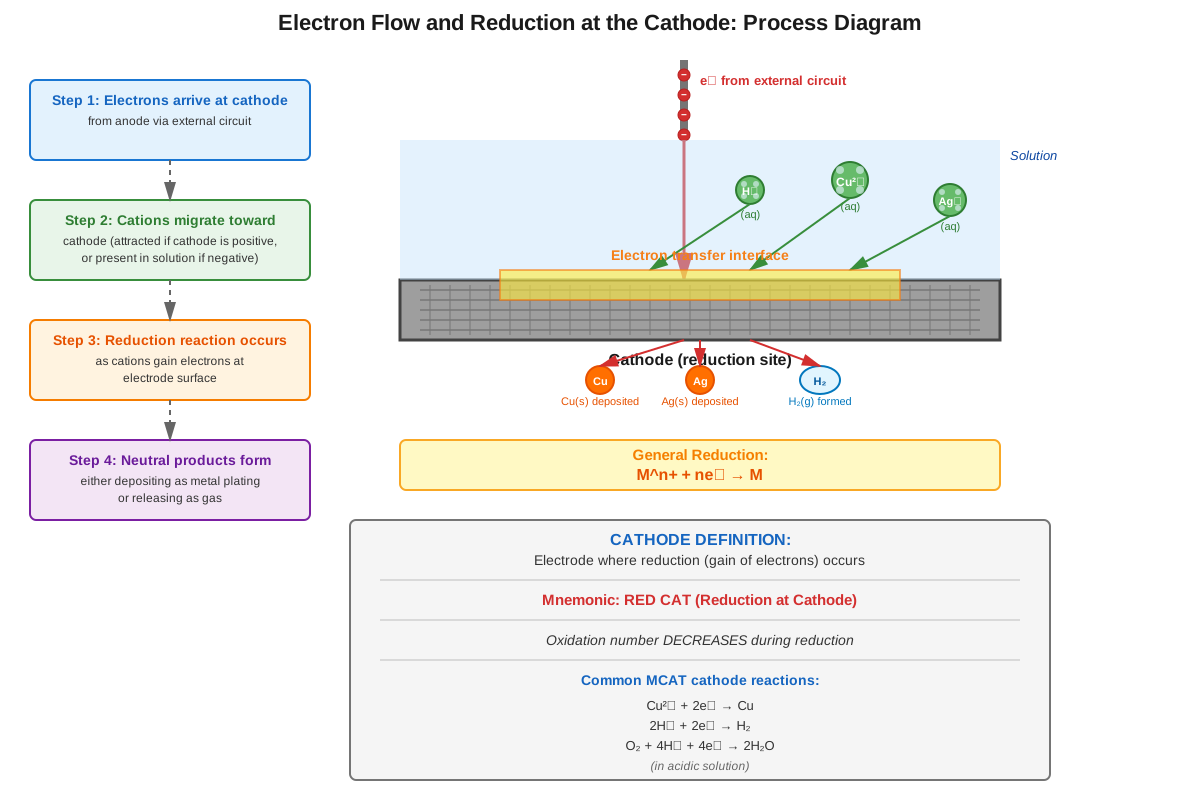
The cathode is the electrode at which reduction occurs in any electrochemical cell. Reduction, defined as the gain of electrons, can be remembered through the mnemonic "RED CAT" (Reduction occurs at the Cathode). At the cathode surface, chemical species in solution or from the electrode itself accept electrons, decreasing their oxidation state. The cathode's identity is determined solely by where reduction occurs, not by its charge or polarity, which varies depending on cell type.
The general form of a cathode reaction is:
Oxidized species + n e⁻ → Reduced speciesFor example, in a copper-zinc galvanic cell, the cathode reaction is:
Cu²⁺(aq) + 2e⁻ → Cu(s)Cathode in Galvanic (Voltaic) Cells
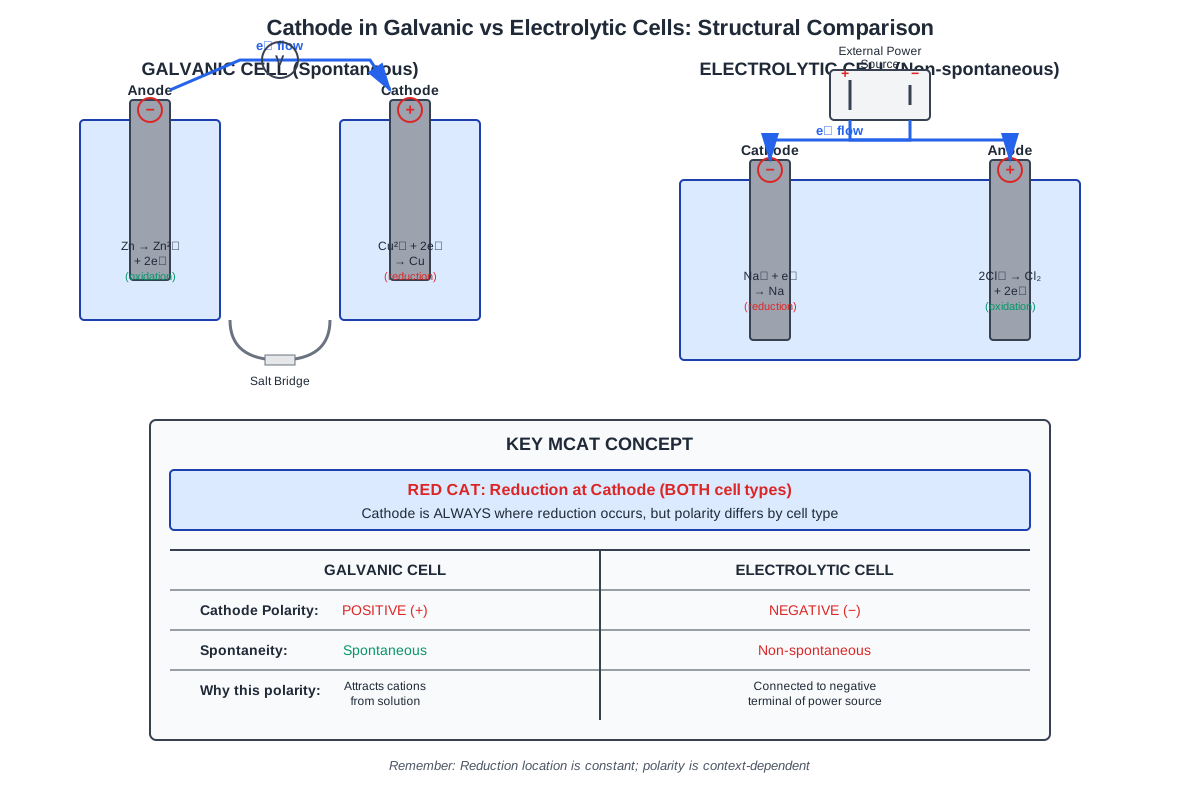
In galvanic cells, spontaneous redox reactions generate electrical energy. The cathode in these cells is the positive electrode (+). This occurs because the cathode attracts cations from solution and draws electrons through the external circuit from the anode. The cathode material often increases in mass as reduced metal ions plate onto its surface.
Key characteristics of galvanic cell cathodes:
- Positive terminal (+)
- Site of reduction
- Attracts cations from solution
- Electrons flow TO the cathode through external circuit
- Higher reduction potential than the anode
- Often gains mass during operation (if metal ions are being reduced)
Cathode in Electrolytic Cells
In electrolytic cells, electrical energy drives non-spontaneous reactions. The cathode in these cells is the negative electrode (−). An external power source forces electrons into the cathode, making it electron-rich and capable of reducing species in solution. This reversal of polarity compared to galvanic cells is a frequent source of student confusion.
Key characteristics of electrolytic cell cathodes:
- Negative terminal (−)
- Site of reduction
- Connected to negative terminal of external power source
- Electrons are forced INTO the cathode
- Reduction occurs despite being non-spontaneous
- Used in electroplating, electrolysis, and metal purification
Comparison Table: Galvanic vs. Electrolytic Cathodes
| Property | Galvanic Cell Cathode | Electrolytic Cell Cathode |
|---|---|---|
| Charge/Polarity | Positive (+) | Negative (−) |
| Reaction Type | Spontaneous reduction | Non-spontaneous reduction |
| Energy Flow | Produces electrical energy | Consumes electrical energy |
| Electron Source | From anode via external circuit | From external power source |
| Common Applications | Batteries, fuel cells | Electroplating, electrolysis |
| Mass Change | Often increases | Varies with reaction |
Standard Reduction Potentials and Cathode Identification
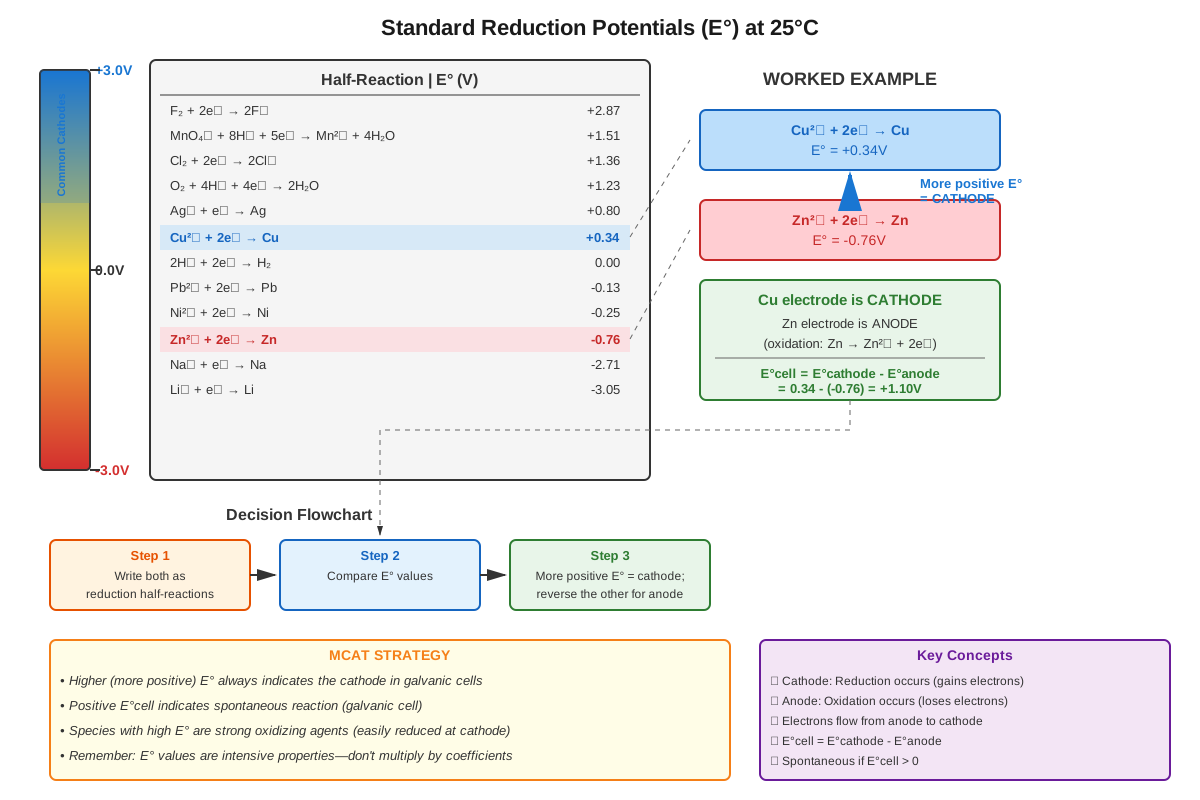
The electrode with the higher (more positive) standard reduction potential serves as the cathode in a galvanic cell. Standard reduction potentials (E°) are tabulated values measured under standard conditions (25°C, 1 M concentrations, 1 atm pressure) relative to the standard hydrogen electrode (SHE).
To identify the cathode:
- Compare the standard reduction potentials of both half-reactions
- The half-reaction with the more positive E° occurs as written (reduction)
- This electrode is the cathode
- The other half-reaction is reversed (oxidation occurs at the anode)
Example: In a cell with zinc and copper electrodes:
- Zn²⁺ + 2e⁻ → Zn(s), E° = −0.76 V
- Cu²⁺ + 2e⁻ → Cu(s), E° = +0.34 V
Copper has the more positive reduction potential, so copper is the cathode where Cu²⁺ ions are reduced to Cu metal.
Cell Notation and Cathode Position
In standard cell notation (line notation), the cathode appears on the right side:
Anode | Anode solution || Cathode solution | CathodeThe double vertical lines (||) represent the salt bridge. For the zinc-copper cell:
Zn(s) | Zn²⁺(aq) || Cu²⁺(aq) | Cu(s)This notation immediately identifies the cathode as the rightmost electrode, where reduction occurs.
Cathode Reactions and Stoichiometry
Cathode reactions must be balanced for both mass and charge. The number of electrons gained must equal the number lost at the anode for the overall cell reaction. When combining half-reactions, multiply each by appropriate coefficients to balance electrons before adding.
Example: For a cell with aluminum and silver:
- Cathode: Ag⁺ + e⁻ → Ag (E° = +0.80 V)
- Anode: Al → Al³⁺ + 3e⁻ (E° = −1.66 V)
To balance electrons, multiply the silver half-reaction by 3:
3Ag⁺ + 3e⁻ → 3Ag
Al → Al³⁺ + 3e⁻
_________________________
3Ag⁺ + Al → 3Ag + Al³⁺
Nernst Equation and Cathode Potential
The Nernst equation describes how cathode potential changes with non-standard conditions:
E = E° - (RT/nF)ln(Q)At 25°C, this simplifies to:
E = E° - (0.0592/n)log(Q)Where:
- E = cell potential under non-standard conditions
- E° = standard cell potential
- n = number of electrons transferred
- Q = reaction quotient
For the cathode specifically, increasing the concentration of the oxidized species (reactant) makes reduction more favorable, increasing the reduction potential. Decreasing the concentration of the reduced species (product) has the same effect.
Concept Relationships
The cathode concept sits at the intersection of multiple electrochemistry principles. Reduction reactions define the cathode → this requires understanding electron transfer and oxidation states → which connects to redox reaction balancing. The cathode's identity depends on standard reduction potentials → which relate to Gibbs free energy (ΔG° = −nFE°) → determining reaction spontaneity.
In galvanic cells: Higher reduction potential → cathode identification → positive electrode → electron flow direction → current direction (opposite to electrons). In electrolytic cells: External power source → forces electrons to cathode → negative electrode → drives non-spontaneous reduction.
The cathode connects to concentration effects through the Nernst equation → which links to Le Chatelier's principle and equilibrium concepts. Changes in ion concentration affect cathode potential, which influences cell voltage and reaction spontaneity.
Understanding cathode behavior enables comprehension of batteries (galvanic cells), electrolysis (electrolytic cells), corrosion (unwanted galvanic processes), and electroplating (controlled electrolytic deposition). These applications bridge to biological systems where electrochemical gradients drive processes like ATP synthesis and nerve transmission.
High-Yield Facts
⭐ The cathode is ALWAYS where reduction occurs, regardless of cell type or electrode charge
⭐ In galvanic cells, the cathode is positive (+); in electrolytic cells, the cathode is negative (−)
⭐ Electrons flow TO the cathode through the external circuit in galvanic cells
⭐ The electrode with the higher (more positive) standard reduction potential becomes the cathode in a galvanic cell
⭐ In cell notation, the cathode appears on the right side of the double vertical lines
- Cations migrate toward the cathode in solution (attracted to negative charge in electrolytic cells, or to complete the reduction reaction in galvanic cells)
- The mnemonic "RED CAT" (Reduction at Cathode) and "AN OX" (Oxidation at Anode) helps remember electrode functions
- Cathode mass typically increases in galvanic cells when metal ions are reduced and plate onto the electrode surface
- Standard reduction potentials are always written as reduction reactions; the more positive value indicates the stronger oxidizing agent
- The cathode reaction can be identified in a balanced cell reaction as the half-reaction that shows electron gain (electrons on the reactant side)
Quick check — test yourself on Cathode so far.
Try Flashcards →Common Misconceptions
Misconception: The cathode is always the negative electrode.
Correction: The cathode is negative only in electrolytic cells. In galvanic (voltaic) cells, which produce electricity spontaneously, the cathode is the positive electrode because it attracts electrons through the external circuit and cations from solution.
Misconception: Electrons flow from cathode to anode through the external circuit.
Correction: In galvanic cells, electrons flow FROM the anode TO the cathode through the external circuit. The anode loses electrons (oxidation) and the cathode gains electrons (reduction). Conventional current flows in the opposite direction (from + to −), but electron flow is from anode to cathode.
Misconception: The cathode is determined by the physical properties of the electrode material.
Correction: The cathode is determined by which electrode has the higher reduction potential in a galvanic cell, or which electrode is connected to the negative terminal of the power source in an electrolytic cell. The same metal can serve as either cathode or anode depending on what it's paired with.
Misconception: Anions move toward the cathode through solution.
Correction: Cations (positive ions) move toward the cathode. In electrolytic cells, cations are attracted to the negative cathode. In galvanic cells, cations move toward the cathode to replace positive charge as electrons are consumed in reduction reactions. Anions move toward the anode.
Misconception: The cathode always gains mass during electrochemical reactions.
Correction: The cathode gains mass only when metal ions from solution are reduced and deposited as solid metal. If the cathode reaction involves reduction of ions that remain in solution (like H⁺ being reduced to H₂ gas) or reduction of the electrode material itself, the cathode may not gain mass or may even lose mass.
Misconception: A higher reduction potential means a substance is more easily reduced.
Correction: This is actually correct, but students often confuse the sign. A MORE POSITIVE (higher) reduction potential indicates a species is more easily reduced (stronger oxidizing agent). A more negative reduction potential indicates a species is less easily reduced (more easily oxidized, stronger reducing agent).
Worked Examples
Example 1: Identifying the Cathode in a Galvanic Cell
Problem: A galvanic cell is constructed using a nickel electrode in 1.0 M Ni²⁺ solution and a silver electrode in 1.0 M Ag⁺ solution. Given the following standard reduction potentials, identify the cathode, write the cathode half-reaction, and calculate the standard cell potential.
- Ni²⁺(aq) + 2e⁻ → Ni(s), E° = −0.25 V
- Ag⁺(aq) + e⁻ → Ag(s), E° = +0.80 V
Solution:
Step 1: Identify which electrode has the higher reduction potential.
Silver has E° = +0.80 V, which is more positive than nickel's E° = −0.25 V.
Step 2: The electrode with the higher reduction potential is the cathode.
Silver is the cathode where reduction occurs.
Step 3: Write the cathode half-reaction.
The cathode reaction occurs as written in the reduction table:
Ag⁺(aq) + e⁻ → Ag(s)Step 4: Calculate standard cell potential.
E°cell = E°cathode − E°anode
E°cell = (+0.80 V) − (−0.25 V) = +1.05 V
The positive cell potential confirms this is a spontaneous galvanic cell. The silver electrode is the cathode (positive terminal), where Ag⁺ ions are reduced to solid silver metal. The nickel electrode is the anode (negative terminal), where solid nickel is oxidized to Ni²⁺ ions.
Connection to Learning Objectives: This example demonstrates cathode identification using standard reduction potentials, applies the concept to calculate cell potential, and reinforces that the cathode is the positive electrode in galvanic cells.
Example 2: Cathode Behavior in an Electrolytic Cell
Problem: An electrolytic cell contains molten NaCl. A 6.0 V external power source drives the non-spontaneous decomposition of NaCl. Identify the cathode, determine its charge, write the cathode half-reaction, and calculate the mass of product formed at the cathode if 0.50 moles of electrons pass through the cell.
Solution:
Step 1: Identify the cathode in an electrolytic cell.
In an electrolytic cell, the cathode is connected to the negative terminal of the external power source. The cathode is the negative electrode (−).
Step 2: Determine what reduction occurs at the cathode.
In molten NaCl, the available species are Na⁺ and Cl⁻. At the cathode, reduction must occur. The only species that can be reduced is Na⁺:
Na⁺(l) + e⁻ → Na(l)This is the cathode half-reaction.
Step 3: Calculate mass of sodium produced.
From the stoichiometry, 1 mole of electrons produces 1 mole of Na.
Moles of Na produced = 0.50 mol e⁻ × (1 mol Na / 1 mol e⁻) = 0.50 mol Na
Mass of Na = 0.50 mol × 23 g/mol = 11.5 g Na
Step 4: Verify understanding.
At the anode (positive electrode), oxidation occurs: 2Cl⁻ → Cl₂ + 2e⁻. The external power source forces electrons into the cathode, making it negative and enabling the non-spontaneous reduction of Na⁺ to Na metal.
Connection to Learning Objectives: This example illustrates the critical difference between galvanic and electrolytic cells, demonstrates cathode identification in electrolytic cells, applies stoichiometry to cathode reactions, and reinforces that reduction always occurs at the cathode regardless of its charge.
Exam Strategy
Approaching MCAT Cathode Questions
When encountering electrochemistry questions on the MCAT, immediately determine whether the cell is galvanic or electrolytic, as this determines cathode polarity. Look for key phrases: "battery," "spontaneous," or "produces electricity" indicate galvanic cells (cathode is +); "external power source," "electrolysis," or "non-spontaneous" indicate electrolytic cells (cathode is −).
Trigger Words and Phrases
Watch for these cathode-related triggers:
- "Reduction occurs at..." → cathode
- "Positive electrode" in galvanic context → cathode
- "Negative electrode" in electrolytic context → cathode
- "Gains electrons" → cathode reaction
- "Where electrons flow to" → cathode
- "Plating occurs" → typically cathode (in electroplating)
- "Higher reduction potential" → cathode in galvanic cell
Process of Elimination Tips
When identifying the cathode:
- Eliminate any answer choice that places oxidation at the cathode (oxidation ALWAYS occurs at the anode)
- If given reduction potentials, eliminate the electrode with lower E° as the cathode in galvanic cells
- If the question describes electron flow, eliminate any answer that has electrons flowing away from the cathode
- For charge questions, eliminate positive cathode for electrolytic cells and negative cathode for galvanic cells
Time Allocation
Cathode identification questions should take 30-60 seconds if you recognize the cell type immediately. Questions requiring calculations (Nernst equation, mass deposited, cell potential) may take 90-120 seconds. If a question requires extensive calculation, flag it and return if time permits—many cathode questions test conceptual understanding rather than calculation skills.
Exam Tip: If you forget whether the cathode is positive or negative, remember that in the batteries powering your calculator (galvanic cells), electrons flow from the negative terminal through the device to the positive terminal. The positive terminal where electrons arrive and are consumed in reduction is the cathode.
Memory Techniques
Primary Mnemonics
RED CAT and AN OX:
- REDuction occurs at the CAThode
- ANode is where OXidation occurs
OIL RIG (for electron movement):
- Oxidation Is Loss (of electrons)
- Reduction Is Gain (of electrons)
Cathode Charge Memory Device
"Galvanic Gives Positive Cathode": Galvanic cells give (produce) electricity, and have a positive cathode. Electrolytic cells take (consume) electricity and have a negative cathode.
Visualization Strategy
Picture a galvanic cell as a battery with a plus sign on one end and minus on the other. The plus side attracts electrons through the external circuit—this is where electrons arrive and reduction occurs (cathode). Visualize electrons flowing like water downhill from high energy (anode) to lower energy (cathode).
For electrolytic cells, visualize a power source forcing electrons uphill into the negative electrode, making it electron-rich and capable of reducing species—this forced electron entry point is the cathode.
Acronym for Cell Notation
"A-Salt-C": Anode on left, Salt bridge in middle (||), Cathode on right. This helps remember that in cell notation, the cathode always appears on the right side.
Reduction Potential Memory Aid
"Positive Potential Pulls Electrons": More positive reduction potentials indicate stronger pull on electrons (better oxidizing agents, more easily reduced). This electrode becomes the cathode in a galvanic cell.
Summary
The cathode is the electrode where reduction invariably occurs in all electrochemical cells, defined by the gain of electrons rather than by its charge or polarity. In galvanic cells, which spontaneously generate electrical energy, the cathode serves as the positive terminal and is identified as the electrode with the higher (more positive) standard reduction potential. Conversely, in electrolytic cells, which require external electrical energy to drive non-spontaneous reactions, the cathode is the negative terminal connected to the negative pole of the power source. Understanding cathode behavior requires integrating knowledge of redox reactions, electron flow, standard reduction potentials, and the fundamental differences between spontaneous and non-spontaneous electrochemical processes. The cathode's role in cell notation (appearing on the right), its relationship to ion migration (cations move toward it), and its behavior under non-standard conditions (described by the Nernst equation) are all high-yield concepts for MCAT success. Mastery of cathode identification and function enables students to quickly analyze electrochemical cells, predict reaction products, calculate cell potentials, and understand real-world applications from batteries to biological electron transport chains.
Key Takeaways
- The cathode is ALWAYS the site of reduction (electron gain), remembered by "RED CAT"—this definition never changes regardless of cell type
- Cathode polarity depends on cell type: positive (+) in galvanic cells, negative (−) in electrolytic cells
- The electrode with the higher (more positive) standard reduction potential becomes the cathode in galvanic cells
- Electrons flow TO the cathode through the external circuit in galvanic cells; electrons are forced INTO the cathode by external power in electrolytic cells
- In standard cell notation, the cathode always appears on the right side of the salt bridge (||)
- Cations migrate toward the cathode in solution, while anions migrate toward the anode
- Cathode reactions must be balanced for both mass and charge, with electrons appearing as reactants in the half-reaction
Related Topics
Anode and Oxidation Reactions: Understanding the anode as the complementary electrode where oxidation occurs completes the picture of electrochemical cells and enables full cell analysis.
Standard Reduction Potentials and Electrochemical Series: Deeper study of reduction potential tables and the activity series allows prediction of spontaneous reactions and cathode identification in complex systems.
Nernst Equation and Non-Standard Conditions: Advanced application of the Nernst equation enables calculation of cathode potentials under varying concentrations, temperatures, and pressures.
Electrolytic Applications: Studying electroplating, electrolysis of water, and metal purification demonstrates practical cathode applications in industrial and laboratory settings.
Biological Electrochemistry: Exploring the electron transport chain, membrane potentials, and nerve signal transmission reveals how cathode-like reduction processes drive essential biological functions.
Corrosion and Galvanic Protection: Understanding how unwanted galvanic cells cause corrosion and how sacrificial anodes protect structures applies cathode principles to real-world engineering problems.
Practice CTA
Now that you've mastered the fundamental concepts of cathode behavior in electrochemical cells, it's time to solidify your understanding through active practice. Challenge yourself with MCAT-style practice questions that require cathode identification, cell potential calculations, and analysis of both galvanic and electrolytic cells. Use flashcards to drill the key distinctions between cathode behavior in different cell types and to memorize standard reduction potentials for common half-reactions. Remember, electrochemistry questions often integrate multiple concepts—practicing now will build the pattern recognition and problem-solving speed essential for test day success. Your investment in mastering the cathode concept will pay dividends across numerous MCAT questions and provide a strong foundation for understanding biological systems. You've got this!
Sign up free to keep reading
Create a free AnvayaPrep account to finish this MCAT guide on Cathode — plus flashcards and practice questions.