Overview
The anode is one of the two electrodes present in any electrochemical cell, serving as a critical component in both galvanic (voltaic) and electrolytic cells. Understanding the anode's function, characteristics, and behavior is fundamental to mastering electrochemistry for the MCAT. The anode is defined as the electrode where oxidation occurs—a principle that remains constant regardless of cell type, though the charge polarity of the anode differs between spontaneous and non-spontaneous electrochemical processes. This seemingly simple definition belies the complexity and importance of understanding how electrons flow, how charge is distributed, and how chemical reactions proceed at electrode surfaces.
For General Chemistry on the MCAT, the anode concept appears frequently in both discrete questions and passage-based items, often integrated with thermodynamics, kinetics, and solution chemistry. Questions may ask students to identify which electrode is the anode in a given cell diagram, predict what chemical species will be oxidized, calculate cell potentials, or explain the direction of electron flow. The MCAT particularly favors questions that require students to distinguish between galvanic and electrolytic cells, as the charge designation of the anode switches between these two cell types—a common source of confusion that test-makers exploit.
The anode concept connects intimately with reduction potentials, Faraday's laws, the Nernst equation, and spontaneity of reactions. Mastery of anode behavior provides the foundation for understanding batteries, corrosion, electroplating, and biological electron transport chains—all topics that may appear in Chemical and Physical Foundations passages or in Biological and Biochemical Foundations contexts. The ability to quickly identify the anode, determine what happens there, and predict the consequences for the overall cell is an essential skill for achieving a competitive MCAT score.
Learning Objectives
- [ ] Define anode using accurate General Chemistry terminology
- [ ] Explain why anode matters for the MCAT
- [ ] Apply anode to exam-style questions
- [ ] Identify common mistakes related to anode
- [ ] Connect anode to related General Chemistry concepts
- [ ] Distinguish between anode behavior in galvanic versus electrolytic cells
- [ ] Predict which chemical species will undergo oxidation at the anode given standard reduction potentials
- [ ] Calculate mass changes at the anode using Faraday's laws of electrolysis
Prerequisites
- Oxidation-reduction (redox) reactions: Understanding electron transfer is essential because the anode is defined by oxidation occurring at its surface
- Electrochemical cell components: Knowledge of electrodes, electrolytes, and salt bridges provides context for where and how the anode functions
- Standard reduction potentials: These values determine which species will be oxidized at the anode and allow calculation of cell potentials
- Basic thermodynamics: Understanding spontaneity (ΔG) helps distinguish galvanic from electrolytic cells and predict anode behavior
- Stoichiometry and mole concepts: Necessary for applying Faraday's laws to calculate quantities of substances produced or consumed at the anode
Why This Topic Matters
The anode concept appears in approximately 2-4 questions per MCAT exam, either as discrete items or embedded within electrochemistry passages. These questions frequently test the ability to identify the anode in cell diagrams, determine the sign of the anode in different cell types, and predict products of oxidation reactions. The MCAT often presents electrochemical cells in non-standard formats or describes them verbally rather than with traditional diagrams, requiring students to construct mental models and apply fundamental principles rather than rely on memorized patterns.
Clinically and practically, anode processes are relevant to numerous real-world applications that may appear in MCAT passages. Pacemakers and defibrillators rely on controlled electrochemical reactions at electrodes. Corrosion of medical implants involves unwanted oxidation at anodic sites. Electroplating is used to coat surgical instruments. Biological systems employ electron transport chains where specific molecules serve as electron donors (analogous to anodes). Understanding anode behavior enables students to analyze these contexts critically and answer passage-based questions that integrate chemistry with biological or medical scenarios.
The MCAT particularly favors questions that require distinguishing between galvanic and electrolytic cells because this tests conceptual understanding rather than rote memorization. Students must recognize that while oxidation always occurs at the anode, the anode is negative in galvanic cells but positive in electrolytic cells—a reversal that confuses many test-takers. Questions may also involve calculating how much material is deposited or dissolved at an anode during electrolysis, requiring integration of stoichiometry with electrochemistry principles.
Core Concepts
Definition and Fundamental Principle
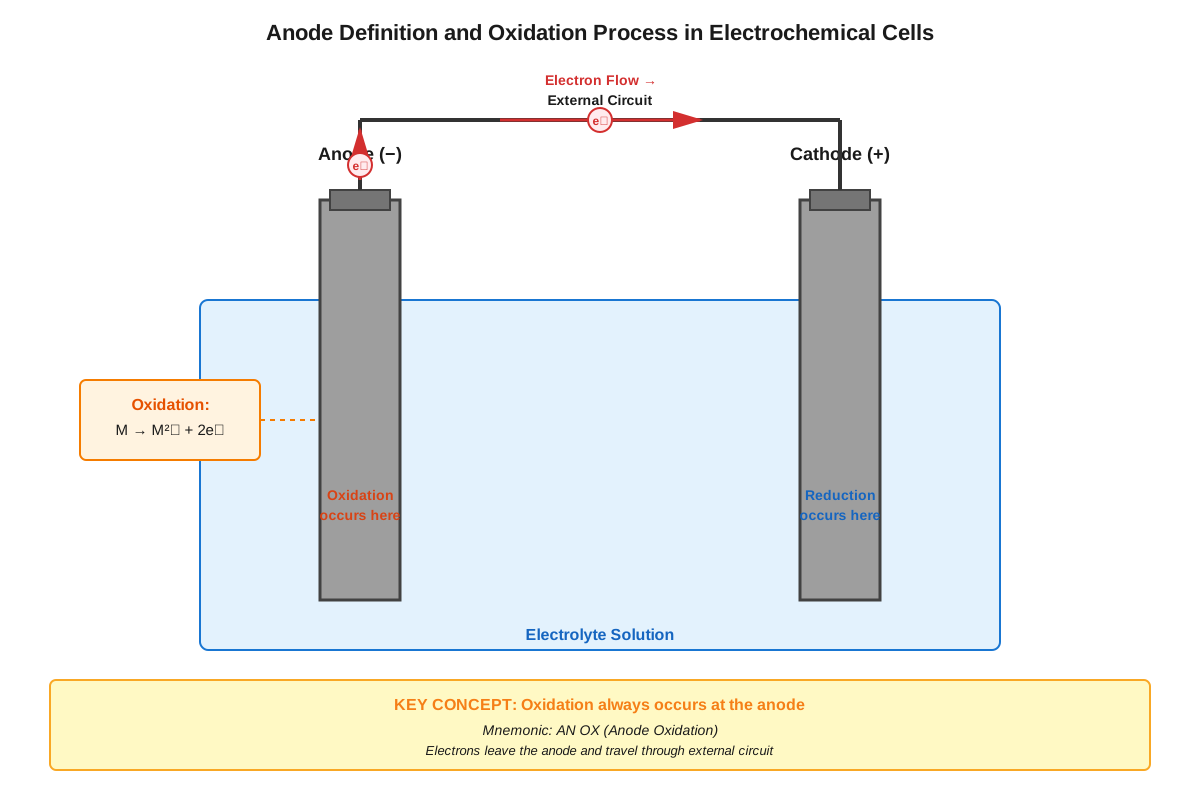
The anode is the electrode at which oxidation occurs in any electrochemical cell. This definition is universal and applies to both galvanic (voltaic) cells and electrolytic cells. Oxidation is defined as the loss of electrons, so the anode is where a chemical species releases electrons into the electrode material. These electrons then travel through an external circuit to the cathode, where reduction (gain of electrons) occurs.
The mnemonic "AN OX" (Anode = Oxidation) helps students remember this fundamental relationship. Regardless of whether the cell is spontaneous or requires external energy input, oxidation always occurs at the anode. This principle is absolute and serves as the primary criterion for identifying which electrode is the anode in any electrochemical setup.
Anode in Galvanic (Voltaic) Cells
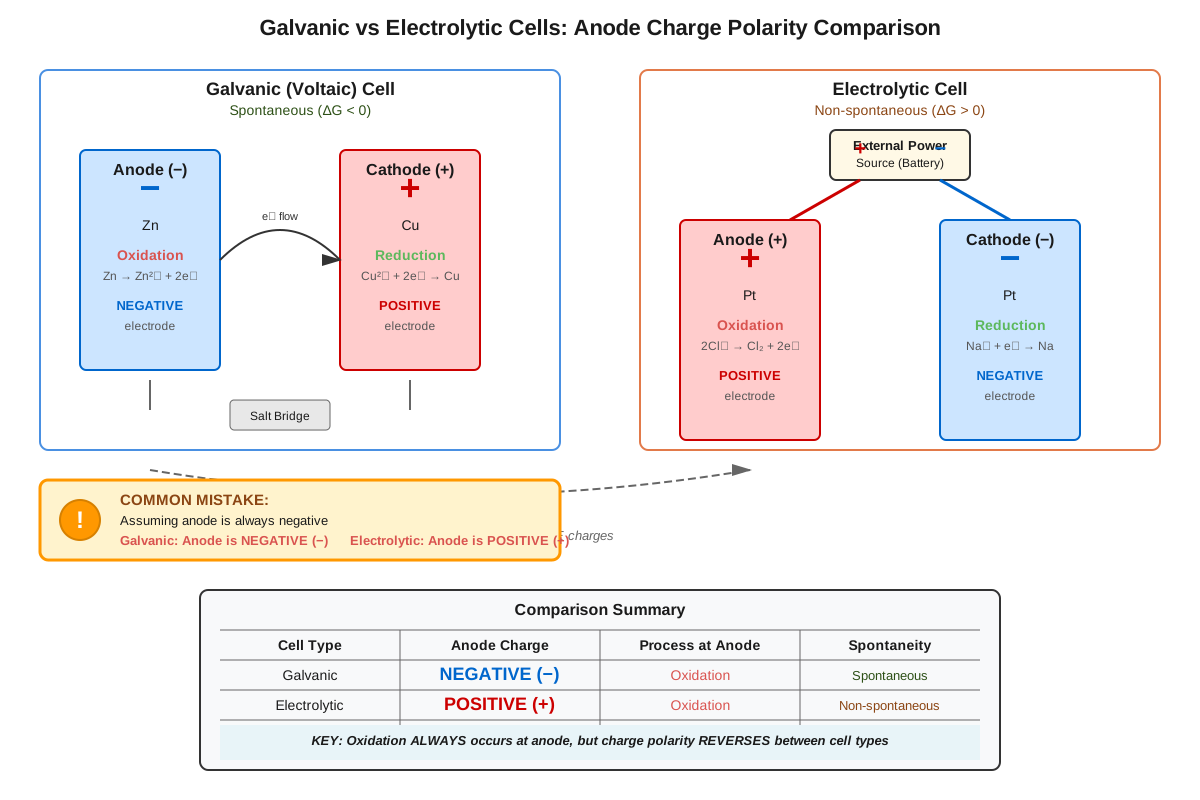
In galvanic cells, chemical reactions occur spontaneously and generate electrical energy. The anode in a galvanic cell is the negative electrode because it is the source of electrons. As oxidation occurs at the anode, electrons are released and accumulate on the electrode surface, giving it a negative charge relative to the cathode.
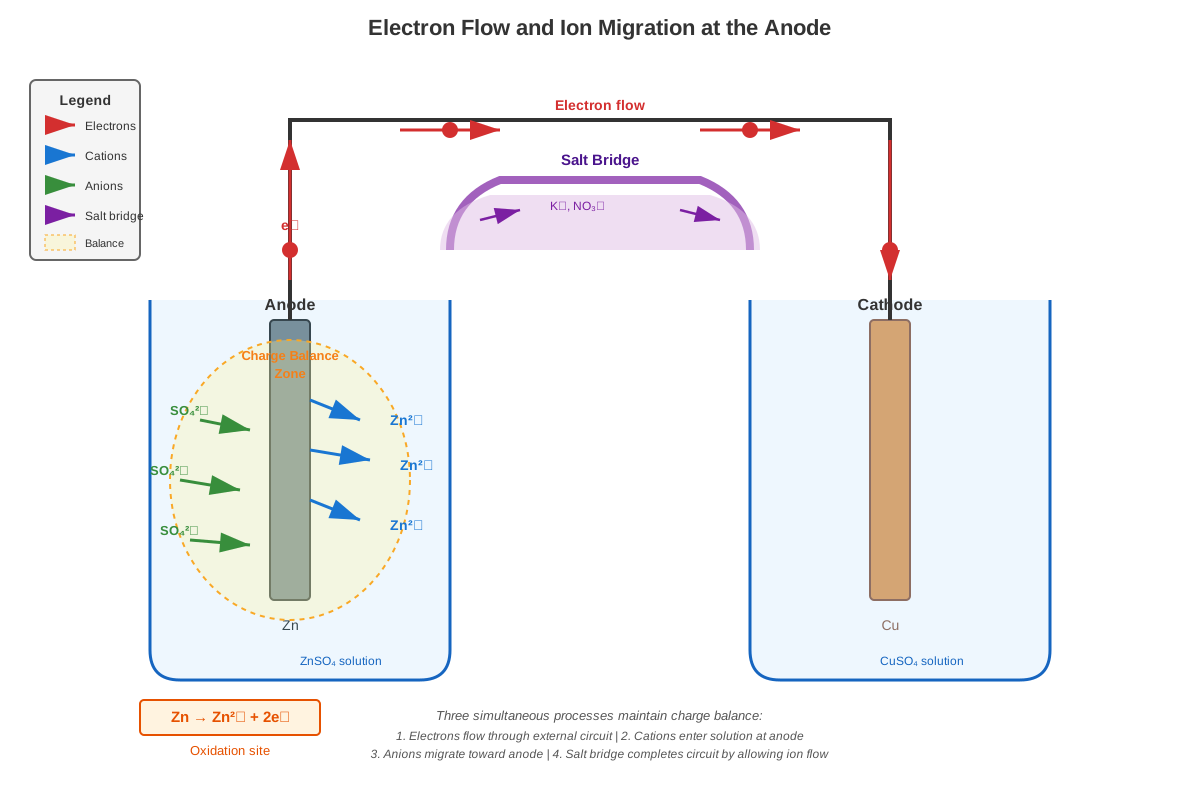
Consider a classic zinc-copper galvanic cell:
- The zinc electrode serves as the anode
- Zinc metal is oxidized: Zn(s) → Zn²⁺(aq) + 2e⁻
- Electrons flow from the zinc anode through the external circuit to the copper cathode
- The zinc electrode has a negative charge and gradually dissolves as zinc atoms lose electrons
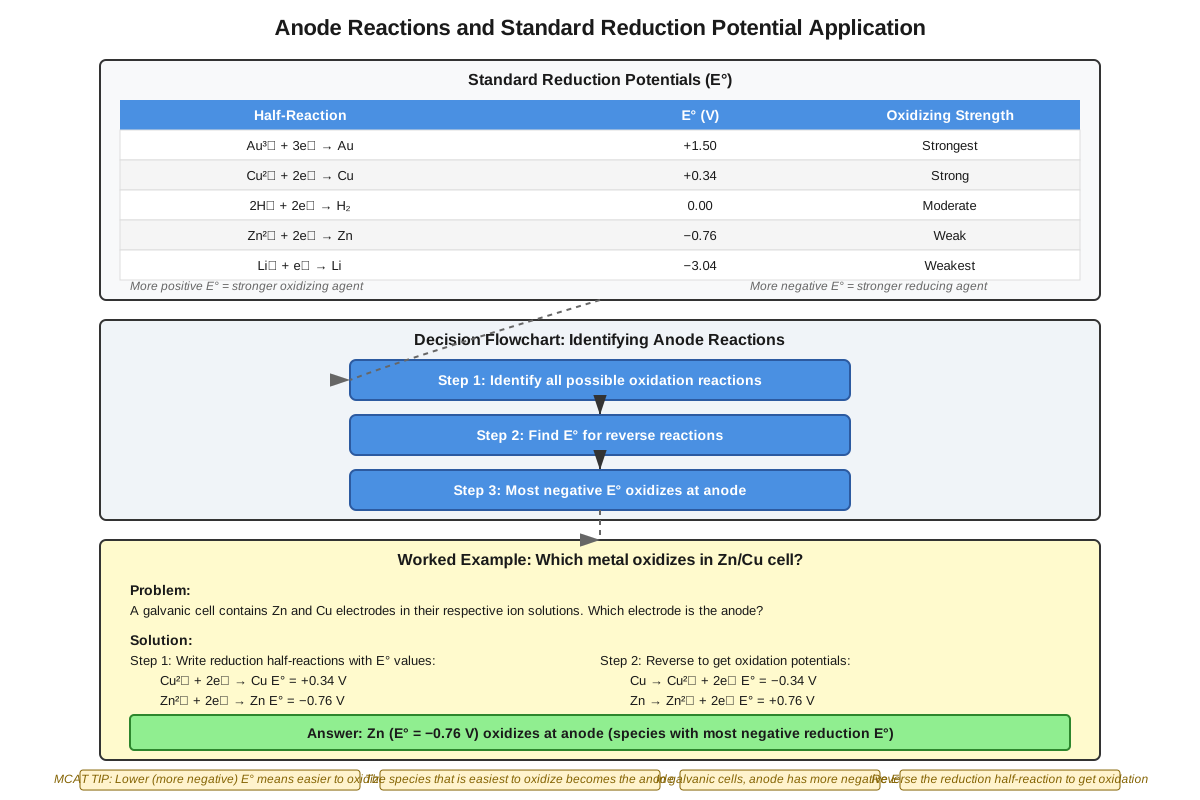
The anode in galvanic cells can be identified by finding which electrode has the lower (more negative) standard reduction potential. Since reduction potentials measure the tendency to gain electrons, the species with the lower reduction potential has a greater tendency to lose electrons (be oxidized) and therefore serves as the anode.
Anode in Electrolytic Cells
Electrolytic cells require external electrical energy to drive non-spontaneous reactions. In these cells, the anode is the positive electrode because it is connected to the positive terminal of an external power source. This positive charge attracts anions (negatively charged ions) from the solution, which then undergo oxidation at the anode surface.
For example, in the electrolysis of molten sodium chloride:
- The anode is connected to the positive terminal of the battery
- Chloride ions migrate to the anode
- Oxidation occurs: 2Cl⁻(l) → Cl₂(g) + 2e⁻
- Chlorine gas is produced at the anode
The reversal of charge polarity between galvanic and electrolytic cells is a critical concept. While oxidation always occurs at the anode, the charge of the anode depends on whether the cell is spontaneous (negative anode) or non-spontaneous (positive anode).
Electron Flow and Current Direction
Electrons always flow from the anode to the cathode through the external circuit. This is true for both galvanic and electrolytic cells. Since electrons are negatively charged, they move away from the negative electrode (anode in galvanic cells) or are pulled toward the positive terminal of the external power source (which connects to the anode in electrolytic cells).
Conventional current, defined as the flow of positive charge, moves in the opposite direction—from cathode to anode through the external circuit. The MCAT may test understanding of this distinction, particularly in questions involving circuit diagrams or calculations of current.
Oxidation Reactions at the Anode
The specific oxidation reaction that occurs at the anode depends on the chemical species present and their relative tendencies to be oxidized. In general, the species with the lowest (most negative) reduction potential will be oxidized preferentially. Common oxidation reactions at anodes include:
Metal dissolution:
M(s) → M^n+(aq) + ne⁻Anion oxidation:
2Cl⁻(aq) → Cl₂(g) + 2e⁻
2Br⁻(aq) → Br₂(l) + 2e⁻
Water oxidation (in aqueous solutions when no other species is more easily oxidized):
2H₂O(l) → O₂(g) + 4H⁺(aq) + 4e⁻The MCAT frequently tests the ability to predict which species will be oxidized when multiple options are present. Students must compare reduction potentials and recognize that the species with the most negative reduction potential (or equivalently, the most positive oxidation potential) will be oxidized at the anode.
Comparison Table: Anode Characteristics
| Property | Galvanic Cell Anode | Electrolytic Cell Anode |
|---|---|---|
| Charge | Negative (-) | Positive (+) |
| Reaction type | Oxidation | Oxidation |
| Electron flow | Away from anode | Away from anode |
| Ion migration | Anions away from anode | Anions toward anode |
| Energy | Releases energy | Requires energy input |
| Spontaneity | Spontaneous | Non-spontaneous |
| Example | Zn electrode in Zn-Cu cell | Positive electrode in electrolysis |
Mass Changes at the Anode
During electrochemical processes, the mass of the anode often changes as material is either deposited or dissolved. Faraday's laws of electrolysis govern these mass changes:
First Law: The amount of substance produced or consumed at an electrode is directly proportional to the quantity of electricity passed through the cell.
Second Law: The amounts of different substances produced by the same quantity of electricity are proportional to their equivalent weights.
The quantitative relationship is:
m = (Q × M) / (n × F)Where:
- m = mass of substance (grams)
- Q = total charge (coulombs) = current (A) × time (s)
- M = molar mass (g/mol)
- n = number of electrons transferred per atom/ion
- F = Faraday's constant (96,485 C/mol)
For anodes in galvanic cells, the anode typically loses mass as metal atoms are oxidized and enter solution as ions. For anodes in electrolytic cells, mass may be lost (if the anode material itself is oxidized) or gained (if ions from solution are reduced and deposited, though this would make it a cathode by definition).
Quick check — test yourself on Anode so far.
Try Flashcards →Concept Relationships
The anode concept sits at the intersection of multiple electrochemistry principles. Oxidation-reduction reactions provide the foundation—the anode is defined by oxidation occurring there. This connects directly to reduction potentials, which determine which species will be oxidized and allow calculation of cell potentials. The relationship is: species with lower (more negative) reduction potentials are oxidized at the anode.
Cell potential (E°cell) is calculated by subtracting the anode potential from the cathode potential: E°cell = E°cathode - E°anode. This relationship shows how anode behavior directly influences whether a reaction is spontaneous. When E°cell is positive, the reaction is spontaneous (galvanic cell); when negative, external energy is required (electrolytic cell).
The Nernst equation modifies cell potentials based on concentration, and changes in concentration at the anode (as reactants are consumed and products formed) affect the overall cell potential over time. As oxidation proceeds at the anode, the concentration of oxidized species increases, which by Le Chatelier's principle and the Nernst equation, decreases the driving force for further oxidation.
Faraday's laws connect the anode to stoichiometry and quantitative analysis, allowing calculation of how much material is transformed at the anode given current and time. This bridges electrochemistry with general stoichiometric principles.
The distinction between galvanic and electrolytic cells fundamentally affects anode properties, particularly charge polarity. This connection is crucial: oxidation at anode (constant) → but charge polarity depends on spontaneity → which determines whether the anode attracts or repels anions.
Relationship map:
Reduction potentials → determine which species oxidized → defines anode location → oxidation releases electrons → electrons flow to cathode → creates cell potential → spontaneity determines anode charge → charge affects ion migration → Faraday's laws quantify mass changes
High-Yield Facts
⭐ The anode is always the electrode where oxidation occurs, regardless of cell type
⭐ In galvanic cells, the anode is negative; in electrolytic cells, the anode is positive
⭐ Electrons always flow from anode to cathode through the external circuit
⭐ The species with the lowest (most negative) reduction potential will be oxidized at the anode
⭐ Anions migrate toward the anode in electrolytic cells but away from the anode in galvanic cells
- The mnemonic "AN OX, RED CAT" helps remember that oxidation occurs at the anode and reduction at the cathode
- In galvanic cells, the anode typically loses mass as metal is oxidized and dissolves
- Water can be oxidized at the anode in aqueous solutions, producing oxygen gas and hydrogen ions
- The anode in a standard electrochemical cell diagram is conventionally drawn on the left side
- Faraday's constant (96,485 C/mol) relates charge passed to moles of electrons, enabling calculation of mass changes at the anode
Common Misconceptions
Misconception: The anode is always positive.
Correction: The anode is negative in galvanic cells (spontaneous reactions) and positive only in electrolytic cells (non-spontaneous reactions requiring external energy). The defining characteristic is that oxidation occurs at the anode, not its charge.
Misconception: Electrons flow from negative to positive, so they flow from cathode to anode.
Correction: While electrons do flow from negative to positive terminals, the anode is the source of electrons (where oxidation releases them). In galvanic cells, the anode is negative, so electrons flow from the negative anode to the positive cathode. In electrolytic cells, electrons are pushed by the external power source from the negative terminal (connected to the cathode) to the positive terminal (connected to the anode).
Misconception: The anode is always made of a specific material like zinc or copper.
Correction: Any conductive material can serve as an anode. The identity of the anode depends on the specific electrochemical cell design. What matters is that oxidation occurs at that electrode, not the material composition.
Misconception: Anions are always attracted to the anode because "anode" and "anion" sound similar.
Correction: In electrolytic cells, anions migrate toward the positive anode where they are oxidized. However, in galvanic cells, the anode is negative, so anions are repelled from it and migrate toward the positive cathode. The similar names are coincidental and can be misleading.
Misconception: The anode always loses mass during electrochemical reactions.
Correction: In galvanic cells with metal anodes, the anode typically loses mass as metal atoms are oxidized. However, if the anode is inert (like platinum or graphite) and serves only to conduct electrons while solution species are oxidized, the anode mass remains constant. Additionally, in some specialized cells, deposition could theoretically occur at an anode if the definitions are based on connection to external circuitry rather than the actual reaction occurring.
Misconception: The electrode with the higher reduction potential is always the anode.
Correction: The electrode with the lower (more negative) reduction potential serves as the anode because it has a greater tendency to lose electrons (be oxidized). The electrode with the higher reduction potential serves as the cathode where reduction occurs.
Worked Examples
Example 1: Identifying the Anode in a Galvanic Cell
Problem: A galvanic cell is constructed with a silver electrode in 1 M AgNO₃ solution and a nickel electrode in 1 M Ni(NO₃)₂ solution. Given the standard reduction potentials: Ag⁺ + e⁻ → Ag(s), E° = +0.80 V and Ni²⁺ + 2e⁻ → Ni(s), E° = -0.26 V, identify which electrode is the anode and write the oxidation half-reaction.
Solution:
Step 1: Identify which species will be oxidized (anode) and which will be reduced (cathode).
- The species with the lower reduction potential has a greater tendency to be oxidized
- Nickel has E° = -0.26 V (lower than silver's +0.80 V)
- Therefore, nickel will be oxidized and serves as the anode
Step 2: Write the oxidation half-reaction at the anode.
- Reverse the reduction half-reaction for nickel
- Ni(s) → Ni²⁺(aq) + 2e⁻
Step 3: Verify the answer makes sense.
- The nickel electrode is the anode (negative electrode in this galvanic cell)
- Electrons flow from the nickel anode through the external circuit to the silver cathode
- The cell potential is E°cell = E°cathode - E°anode = 0.80 - (-0.26) = 1.06 V (positive, confirming spontaneity)
Connection to learning objectives: This example demonstrates how to identify the anode using reduction potentials and apply the principle that oxidation occurs at the anode.
Example 2: Calculating Mass Loss at an Anode
Problem: A copper electrode serves as the anode in an electrolytic cell. A current of 2.5 A is passed through the cell for 45 minutes. Calculate the mass of copper that dissolves from the anode. (Atomic mass of Cu = 63.5 g/mol; assume Cu is oxidized to Cu²⁺)
Solution:
Step 1: Write the oxidation half-reaction at the anode.
- Cu(s) → Cu²⁺(aq) + 2e⁻
- This shows that 2 moles of electrons are released per mole of copper oxidized
Step 2: Calculate the total charge passed through the cell.
- Q = I × t
- Convert time to seconds: 45 min × 60 s/min = 2700 s
- Q = 2.5 A × 2700 s = 6750 C
Step 3: Calculate moles of electrons transferred.
- n(e⁻) = Q / F = 6750 C / 96,485 C/mol = 0.0700 mol e⁻
Step 4: Calculate moles of copper oxidized.
- From the half-reaction, 2 mol e⁻ per 1 mol Cu
- n(Cu) = 0.0700 mol e⁻ × (1 mol Cu / 2 mol e⁻) = 0.0350 mol Cu
Step 5: Calculate mass of copper.
- m = n × M = 0.0350 mol × 63.5 g/mol = 2.22 g
Answer: 2.22 grams of copper dissolve from the anode.
Connection to learning objectives: This example applies Faraday's laws to calculate quantitative changes at the anode, integrating electrochemistry with stoichiometry.
Exam Strategy
When approaching MCAT questions about anodes, first determine whether the cell is galvanic or electrolytic, as this immediately tells you the charge of the anode. Look for trigger words: "battery," "spontaneous," or "generates electricity" indicate galvanic (negative anode), while "electrolysis," "external power source," or "non-spontaneous" indicate electrolytic (positive anode).
For questions asking you to identify the anode in a cell diagram, look for the electrode where oxidation occurs. If reduction potentials are provided, the species with the lower (more negative) value will be oxidized at the anode. If the question describes reactions occurring, identify which is oxidation (loss of electrons, increase in oxidation state) to locate the anode.
When questions involve calculations, immediately write down Faraday's constant (96,485 C/mol ≈ 96,500 C/mol for quick calculations) and the relationship Q = I × t. Identify the number of electrons transferred in the half-reaction, as this is crucial for stoichiometric calculations. Watch for unit conversions, especially time (minutes to seconds) and current (sometimes given in milliamps).
For process-of-elimination, remember that any answer choice claiming the anode is where reduction occurs can be immediately eliminated. Similarly, if a choice states that electrons flow from cathode to anode through the external circuit, eliminate it. Be cautious of choices that correctly identify oxidation at the anode but incorrectly state the charge for the cell type described.
Time management tip: Anode identification questions should take 30-45 seconds if you know the principles. Calculation questions involving Faraday's laws may take 90-120 seconds. If a question seems to require complex calculations, check whether you can estimate or use process-of-elimination first—the MCAT often allows you to narrow to two choices before calculating.
Memory Techniques
Primary mnemonic: "AN OX, RED CAT" (Anode = Oxidation, Reduction = Cathode)
Charge memory device: "GAN" for Galvanic Anode Negative. Since galvanic cells are the "default" spontaneous cells, remembering the anode is negative here helps you recall that it must be positive in the "opposite" electrolytic cells.
Electron flow visualization: Picture electrons as water flowing downhill from the anode (source/spring) to the cathode (collection point). The anode is where electrons originate because oxidation releases them.
Anion migration trick: In electrolytic cells, anions go to the anode (both start with vowels). This helps remember that anions migrate toward the positive anode in electrolytic cells.
Reduction potential rule: "Low goes, high stays" - the species with the low (negative) reduction potential goes (is oxidized) at the anode; the species with the high reduction potential stays (is reduced) at the cathode.
Faraday's law setup: Remember "QMnF" (pronounced "cue-em-en-ef") for the variables in mass calculations: Q (charge), M (molar mass), n (electrons), F (Faraday's constant). The formula is m = QM/nF.
Summary
The anode is the electrode where oxidation invariably occurs in any electrochemical cell, making it a cornerstone concept in MCAT electrochemistry. While oxidation at the anode is constant, the charge polarity of the anode differs between cell types: negative in spontaneous galvanic cells and positive in non-spontaneous electrolytic cells requiring external energy. Electrons always flow from the anode to the cathode through the external circuit, regardless of cell type. The species with the lowest reduction potential will be oxidized at the anode, allowing prediction of anode identity and calculation of cell potentials. Faraday's laws enable quantitative analysis of mass changes at the anode by relating charge passed to moles of substance transformed. Understanding these principles allows students to identify anodes in cell diagrams, predict oxidation reactions, calculate cell potentials, and solve stoichiometric problems involving electrochemical cells—all high-yield skills for MCAT success.
Key Takeaways
- The anode is defined as the electrode where oxidation occurs, universally across all electrochemical cells
- In galvanic cells, the anode is negative; in electrolytic cells, the anode is positive—but oxidation always occurs there
- Electrons flow from anode to cathode through the external circuit in both cell types
- The species with the lowest (most negative) reduction potential will be oxidized at the anode
- Faraday's laws (m = QM/nF) allow calculation of mass changes at the anode based on current and time
- Anions migrate toward the anode in electrolytic cells but away from the anode in galvanic cells
- The mnemonic "AN OX, RED CAT" is essential for quickly identifying electrode functions on the MCAT
Related Topics
Cathode: The complementary electrode where reduction occurs; understanding both electrodes together provides complete mastery of electrochemical cells
Standard Reduction Potentials: Tables of E° values that enable prediction of which species will be oxidized at the anode and calculation of cell potentials
Nernst Equation: Allows calculation of cell potentials under non-standard conditions, accounting for concentration changes that occur as reactions proceed at the anode
Faraday's Laws of Electrolysis: Quantitative relationships between charge, current, time, and mass changes at electrodes, essential for stoichiometric calculations
Galvanic vs. Electrolytic Cells: Understanding the differences between spontaneous and non-spontaneous cells is crucial for correctly identifying anode properties
Corrosion: A practical application where unwanted oxidation occurs at anodic sites on metal surfaces, relevant to real-world and passage-based MCAT questions
Practice CTA
Now that you've mastered the fundamental concepts of the anode, it's time to reinforce your understanding through active practice. Work through the practice questions and flashcards to test your ability to identify anodes, predict oxidation reactions, and solve quantitative problems. Focus especially on distinguishing between galvanic and electrolytic cells, as this is a high-yield area where many students lose points. Remember, electrochemistry questions are among the most predictable on the MCAT—consistent practice with these core concepts will translate directly into points on test day. You've got this!
Sign up free to keep reading
Create a free AnvayaPrep account to finish this MCAT guide on Anode — plus flashcards and practice questions.