Overview
The Faraday constant represents one of the most fundamental bridges between chemistry and electricity, quantifying the relationship between moles of electrons and electric charge. In electrochemistry, this constant serves as the conversion factor that allows students to calculate how much charge flows through an electrochemical cell when a specific amount of substance undergoes oxidation or reduction. Named after Michael Faraday, who pioneered the study of electrolysis, this constant has a value of approximately 96,485 coulombs per mole of electrons (C/mol e⁻), though for MCAT purposes, students often use the rounded value of ~96,500 C/mol or even 100,000 C/mol for quick estimation.
Understanding the Faraday constant is essential for the MCAT because it appears in multiple question formats across General Chemistry passages and discrete questions. The constant enables calculations involving electrolytic cells, galvanic cells, and the quantitative relationships in redox reactions. Students must be comfortable using this value to determine how long a current must flow to deposit a certain mass of metal, how much gas will be produced during electrolysis, or how many electrons are transferred in a given electrochemical process. These calculations frequently appear in both the Chemical and Physical Foundations of Biological Systems section and occasionally in passages discussing biological electron transport or membrane potentials.
The Faraday constant General Chemistry concept connects intimately with stoichiometry, thermodynamics, and kinetics. It links the macroscopic world of measurable electric current (amperes) and time with the molecular world of electron transfer and chemical change. This relationship makes it indispensable for understanding how batteries work, how electroplating occurs, and how biological systems generate and use electrical gradients. Mastery of the Faraday constant and its applications represents a high-yield investment of study time, as it consistently appears on the MCAT in both straightforward calculation questions and more complex passage-based scenarios.
Learning Objectives
- [ ] Define Faraday constant using accurate General Chemistry terminology
- [ ] Explain why Faraday constant matters for the MCAT
- [ ] Apply Faraday constant to exam-style questions
- [ ] Identify common mistakes related to Faraday constant
- [ ] Connect Faraday constant to related General Chemistry concepts
- [ ] Calculate the amount of substance produced or consumed in electrolysis using the Faraday constant
- [ ] Interconvert between charge (coulombs), current (amperes), time (seconds), and moles of electrons
- [ ] Predict the mass of metal deposited or gas evolved during electrochemical reactions using stoichiometry and the Faraday constant
Prerequisites
- Mole concept and Avogadro's number: The Faraday constant is derived from Avogadro's number and elementary charge, making understanding of the mole essential for grasping why this constant has its specific value
- Basic stoichiometry: Calculations involving the Faraday constant require converting between moles of electrons and moles of chemical species using balanced half-reactions
- Oxidation-reduction reactions: Understanding electron transfer in redox reactions is necessary because the Faraday constant quantifies the charge associated with electron movement
- Electric charge and current: Familiarity with coulombs (charge), amperes (current = charge/time), and their relationship is fundamental to applying the Faraday constant
- Electrochemical cells (galvanic and electrolytic): The Faraday constant is applied in the context of these cells to relate electrical measurements to chemical changes
Why This Topic Matters
The Faraday constant MCAT applications extend beyond pure chemistry into real-world and clinical contexts that make this topic particularly relevant. Electrochemical principles govern the function of pacemakers, defibrillators, and nerve signal transmission. The sodium-potassium pump, which maintains cellular membrane potential, operates on principles related to charge separation and ion movement. Understanding the quantitative relationship between charge and chemical change helps students appreciate how biological systems generate and utilize electrical energy at the molecular level. Industrial applications like electroplating, metal purification, and battery technology all rely on precise calculations using the Faraday constant.
From an exam perspective, the Faraday constant appears in approximately 2-4 questions per MCAT administration, making it a high-yield topic relative to study time investment. Questions typically fall into three categories: direct calculation problems requiring students to determine mass deposited or gas evolved during electrolysis; conceptual questions asking students to compare different electrochemical scenarios; and passage-based questions where the Faraday constant must be applied to interpret experimental data or predict outcomes. The MCAT frequently embeds Faraday constant calculations within longer passages about batteries, corrosion, or biological electron transport chains, requiring students to recognize when this constant is needed even when not explicitly mentioned.
Common passage contexts include: experimental setups measuring current flow during metal deposition; comparison of different metals' electroplating efficiency; analysis of battery discharge rates and capacity; and biological scenarios involving ion pumps or electron transport. The ability to quickly recognize that a problem requires the Faraday constant—often signaled by mention of current, time, and mass or volume of product—represents a crucial exam skill that separates high-scoring students from those who struggle with electrochemistry.
Core Concepts
Definition and Fundamental Value
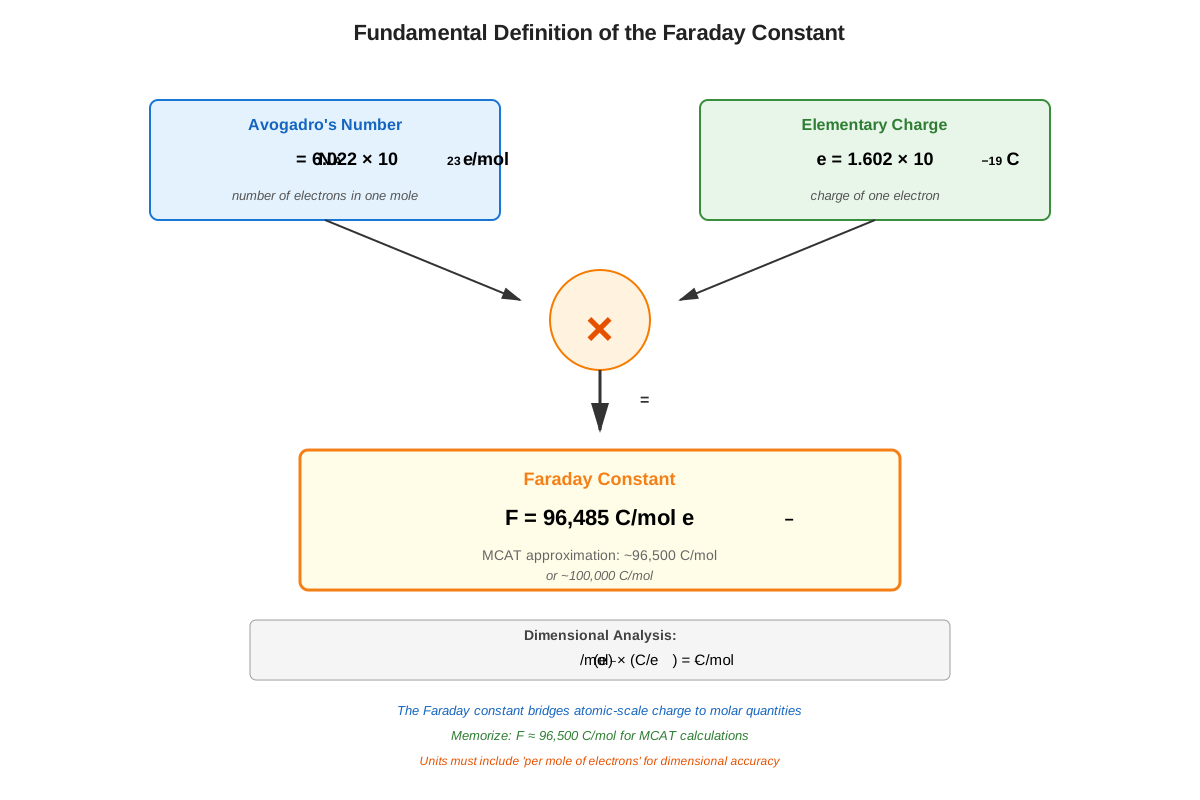
The Faraday constant (symbol: F) is defined as the magnitude of electric charge per mole of electrons. Mathematically, it equals Avogadro's number (Nₐ = 6.022 × 10²³ mol⁻¹) multiplied by the elementary charge (e = 1.602 × 10⁻¹⁹ C):
F = Nₐ × e = (6.022 × 10²³ mol⁻¹)(1.602 × 10⁻¹⁹ C) = 96,485 C/molFor MCAT purposes, students should memorize the approximate value of 96,500 C/mol or be comfortable using ~100,000 C/mol for rapid estimation. This constant represents the total charge carried by one mole of electrons, providing the essential link between the microscopic world of individual electron transfers and the macroscopic world of measurable electric current.
The physical meaning of the Faraday constant becomes clearer when considering that electric current (measured in amperes) represents charge flow per unit time (1 A = 1 C/s). When current flows through an electrochemical cell, electrons are transferred from one species to another, causing oxidation at one electrode and reduction at the other. The Faraday constant allows calculation of exactly how many moles of electrons have flowed when given the current and time, or conversely, how much current is needed for a specific chemical transformation.
The Fundamental Equation
The core relationship involving the Faraday constant connects charge (Q), moles of electrons (n), and the constant itself:
Q = n × FWhere:
- Q = total charge in coulombs (C)
- n = moles of electrons transferred
- F = Faraday constant (96,485 C/mol)
Since current (I) equals charge per unit time (Q/t), this equation can be rearranged to:
Q = I × t = n × FTherefore:
n = (I × t) / FThis relationship is the foundation for virtually all Faraday constant calculations on the MCAT. Students must become fluent in manipulating this equation to solve for any variable when given the others.
Stoichiometric Applications in Electrolysis
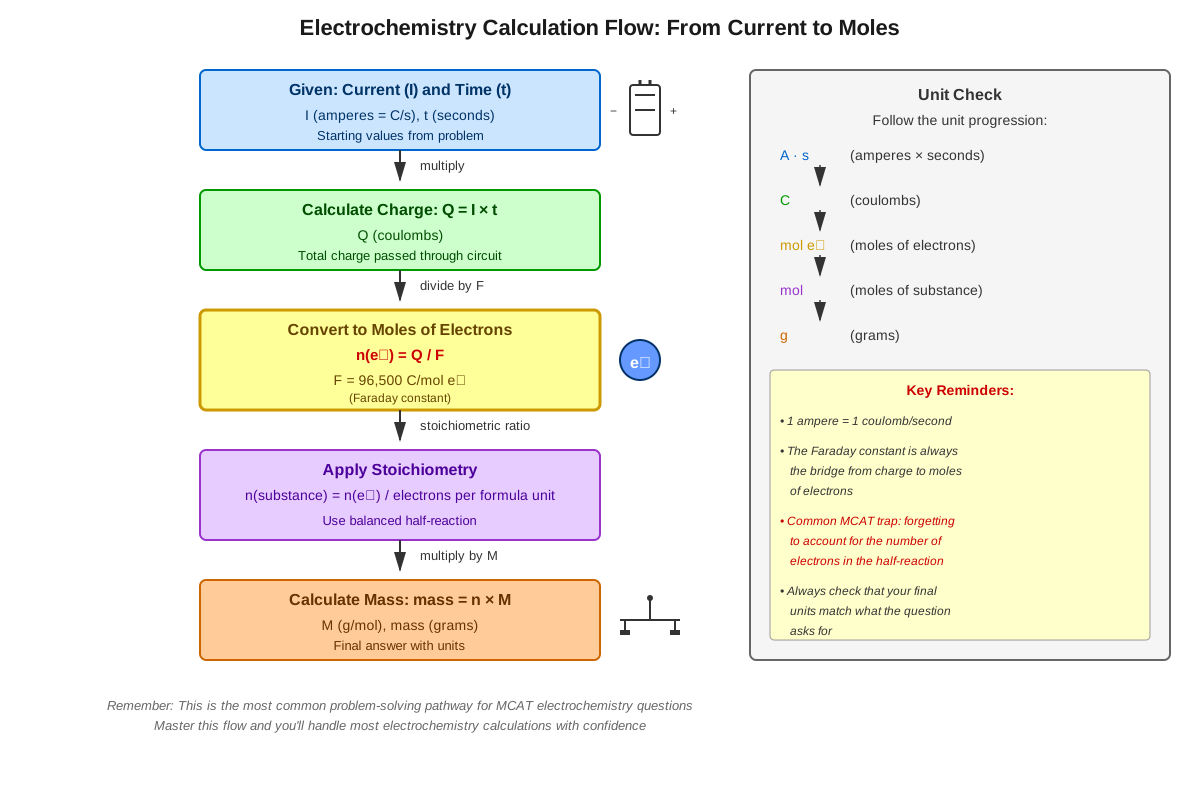
Electrolysis involves using electrical energy to drive non-spontaneous chemical reactions. The Faraday constant enables quantitative predictions about the products formed. The general problem-solving approach follows these steps:
- Calculate total charge: Q = I × t (if given current and time)
- Calculate moles of electrons: n(e⁻) = Q / F
- Use stoichiometry: Convert moles of electrons to moles of product using the balanced half-reaction
- Convert to desired units: Use molar mass to find mass, or molar volume for gases
For example, consider the electrolysis of molten sodium chloride:
- Cathode (reduction): Na⁺ + e⁻ → Na
- Anode (oxidation): 2Cl⁻ → Cl₂ + 2e⁻
The stoichiometric ratios show that one mole of electrons produces one mole of sodium metal, but two moles of electrons are required to produce one mole of chlorine gas. This stoichiometric relationship is crucial for accurate calculations.
Relationship to Current and Time
Understanding the relationship between current, time, and charge is essential for MCAT success. Current represents the rate of charge flow:
I = Q / tWhere I is measured in amperes (A), Q in coulombs (C), and t in seconds (s). One ampere equals one coulomb per second. This means that a current of 2 amperes flowing for 10 seconds delivers 20 coulombs of charge.
When solving problems, students must ensure consistent units:
- Current: amperes (A)
- Time: seconds (s)
- Charge: coulombs (C)
- Faraday constant: 96,485 C/mol (or ~96,500 C/mol)
A common MCAT scenario provides current in amperes and time in minutes or hours, requiring conversion to seconds before calculation. Developing the habit of immediately converting time to seconds prevents calculation errors.
Multiple Electron Transfers
Many electrochemical reactions involve the transfer of multiple electrons per atom or ion. The stoichiometry of the half-reaction determines the relationship between moles of substance and moles of electrons:
| Reaction | Electrons per atom/ion | Moles e⁻ per mole substance |
|---|---|---|
| Cu²⁺ + 2e⁻ → Cu | 2 | 2 |
| Al³⁺ + 3e⁻ → Al | 3 | 3 |
| Fe²⁺ → Fe³⁺ + e⁻ | 1 | 1 |
| O₂ + 4H⁺ + 4e⁻ → 2H₂O | 4 per O₂ | 4 |
| 2H⁺ + 2e⁻ → H₂ | 2 per H₂ | 2 |
When calculating mass deposited or gas evolved, students must account for these stoichiometric ratios. For instance, depositing one mole of aluminum requires three moles of electrons (three Faradays of charge), while depositing one mole of copper from Cu²⁺ requires only two moles of electrons.
Practical Calculation Framework
A systematic approach to Faraday constant problems ensures accuracy:
Given current and time, find mass of metal deposited:
- Calculate charge: Q = I × t
- Calculate moles of electrons: n(e⁻) = Q / F
- Use half-reaction stoichiometry: n(metal) = n(e⁻) / (electrons per metal atom)
- Calculate mass: mass = n(metal) × molar mass
Given mass deposited and time, find current:
- Calculate moles of substance: n = mass / molar mass
- Use stoichiometry to find moles of electrons: n(e⁻) = n × (electrons per atom)
- Calculate charge: Q = n(e⁻) × F
- Calculate current: I = Q / t
This framework applies to both metal deposition and gas evolution, with appropriate adjustments for the specific stoichiometry involved.
Concept Relationships
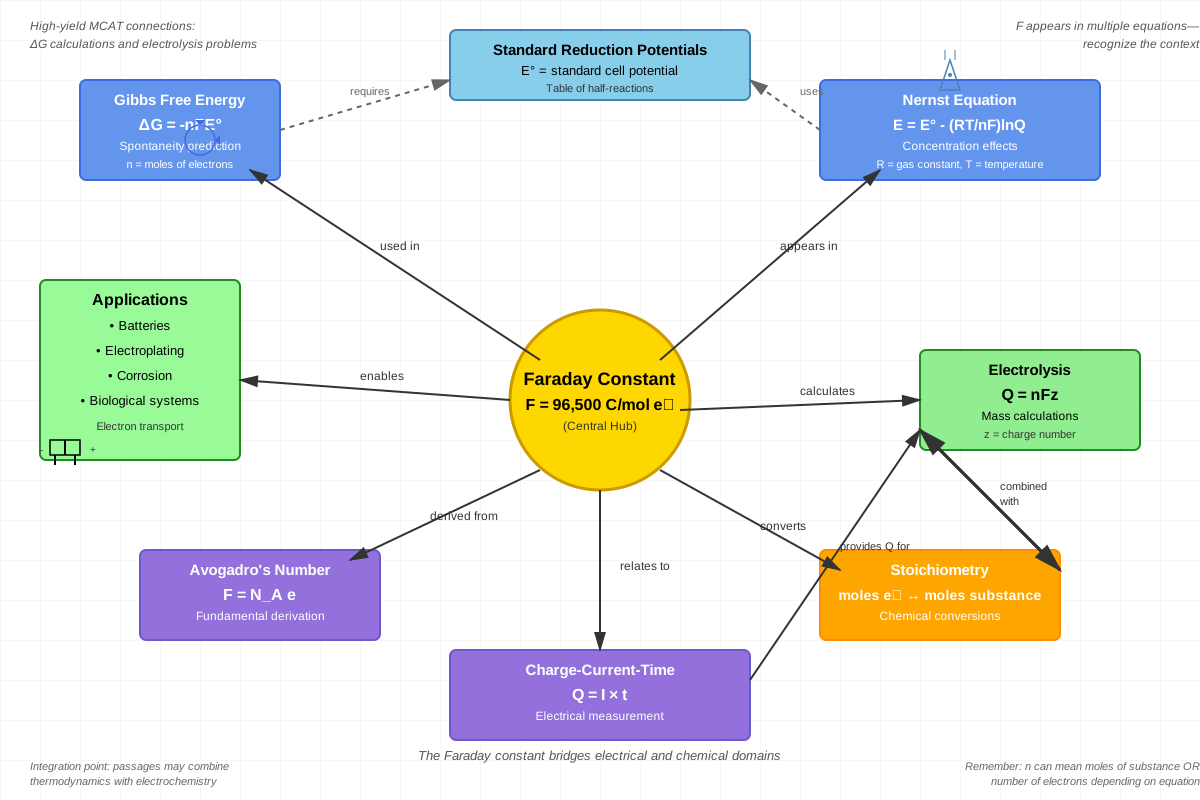
The Faraday constant serves as a central hub connecting multiple electrochemistry concepts. At its foundation, the constant derives from Avogadro's number and elementary charge, linking it to fundamental atomic theory and the mole concept. This relationship emphasizes that electrochemistry operates at the intersection of chemistry and physics, where particle counting meets electrical measurements.
The constant directly enables stoichiometric calculations in electrochemical contexts. Just as stoichiometry in traditional chemistry uses molar ratios from balanced equations, electrochemical stoichiometry uses the Faraday constant to convert between electrical measurements (current, time, charge) and chemical quantities (moles, mass, volume). This connection flows as: Current and time → Charge → Moles of electrons → Moles of substance → Mass or volume.
Oxidation-reduction reactions provide the chemical foundation for applying the Faraday constant. Every redox reaction involves electron transfer, and the Faraday constant quantifies the charge associated with that transfer. The relationship flows: Balanced half-reactions → Electron stoichiometry → Application of Faraday constant → Quantitative predictions.
The Faraday constant connects to cell potential and Gibbs free energy through the equation ΔG° = -nFE°, where n represents moles of electrons, F is the Faraday constant, and E° is the standard cell potential. This relationship bridges thermodynamics and electrochemistry, showing how electrical potential energy relates to chemical spontaneity.
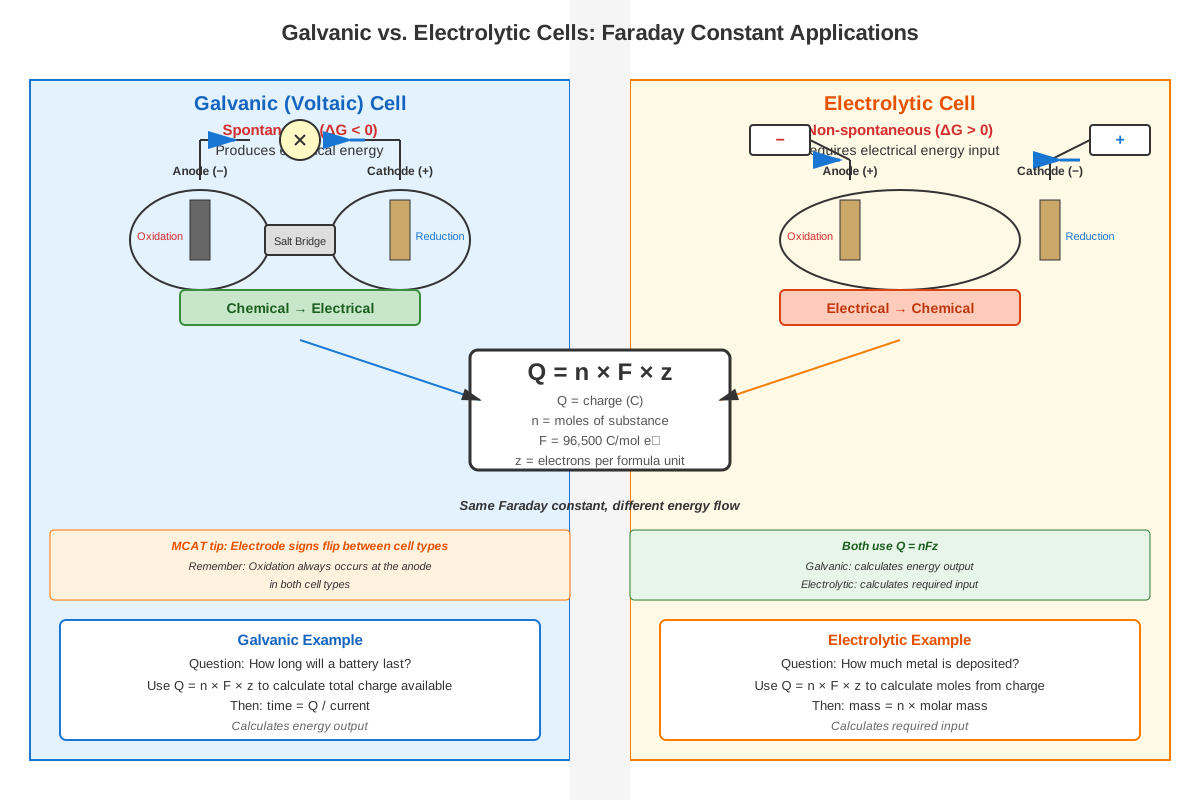
In electrolytic cells, the Faraday constant determines how much product forms for a given input of electrical energy. In galvanic cells, it relates to how much charge can be delivered as the cell discharges. Both applications demonstrate the bidirectional relationship between chemical change and electrical energy, with the Faraday constant serving as the conversion factor.
The concept also extends to biological systems through membrane potentials and ion transport. While the Nernst equation (which includes the Faraday constant) governs equilibrium potentials across membranes, the principles of charge separation and ion movement fundamentally rely on the same electron-charge relationships quantified by the Faraday constant.
Quick check — test yourself on Faraday constant so far.
Try Flashcards →High-Yield Facts
⭐ The Faraday constant equals approximately 96,500 C/mol (exact value: 96,485 C/mol), representing the charge of one mole of electrons
⭐ The fundamental equation Q = nF relates charge (Q in coulombs), moles of electrons (n), and the Faraday constant (F)
⭐ Current (I) equals charge per unit time: I = Q/t, where I is in amperes, Q in coulombs, and t in seconds
⭐ One ampere flowing for one second delivers one coulomb of charge: This relationship is essential for converting between current, time, and charge
⭐ The stoichiometry of the half-reaction determines the electron-to-substance ratio: Always check how many electrons are required per atom or molecule
- The Faraday constant derives from Avogadro's number multiplied by elementary charge: F = Nₐ × e
- Depositing one mole of Cu from Cu²⁺ requires 2 × 96,500 = 193,000 coulombs of charge
- Producing one mole of H₂ gas from water requires 2 moles of electrons (2F of charge)
- The Faraday constant appears in the relationship between Gibbs free energy and cell potential: ΔG° = -nFE°
- For quick estimation on the MCAT, using F ≈ 100,000 C/mol often provides sufficiently accurate answers
- Time must always be converted to seconds when using I = Q/t with current in amperes
- The same amount of charge will deposit different masses of different metals depending on their ionic charge and molar mass
Common Misconceptions
Misconception: The Faraday constant represents the charge of a single electron.
Correction: The Faraday constant represents the charge of one mole of electrons (6.022 × 10²³ electrons), not a single electron. The charge of a single electron is the elementary charge (e = 1.602 × 10⁻¹⁹ C). The Faraday constant equals Avogadro's number times the elementary charge.
Misconception: Current and charge are the same thing and can be used interchangeably in calculations.
Correction: Current (amperes) is the rate of charge flow (coulombs per second), while charge (coulombs) is the total amount of electrical charge. They are related by time: Q = I × t. Using current directly in the equation Q = nF without multiplying by time is a common error that leads to incorrect answers.
Misconception: The number of moles of electrons always equals the number of moles of product formed.
Correction: The relationship between moles of electrons and moles of product depends on the stoichiometry of the half-reaction. For Cu²⁺ + 2e⁻ → Cu, two moles of electrons produce one mole of copper. For Al³⁺ + 3e⁻ → Al, three moles of electrons produce one mole of aluminum. Always check the balanced half-reaction.
Misconception: The Faraday constant only applies to electrolytic cells, not galvanic cells.
Correction: The Faraday constant applies to all electrochemical processes involving electron transfer, including both electrolytic cells (non-spontaneous, requiring external energy) and galvanic cells (spontaneous, producing electrical energy). The constant quantifies the charge-electron relationship regardless of cell type.
Misconception: When time is given in minutes or hours, it can be used directly in calculations with current in amperes.
Correction: When current is in amperes (coulombs per second), time must be converted to seconds before calculating charge. Using minutes or hours without conversion will result in answers that are off by factors of 60 or 3600. Always convert time to seconds first.
Misconception: A larger Faraday constant value means more charge per electron.
Correction: The Faraday constant is a fixed physical constant with a single value (96,485 C/mol). It does not vary between reactions or conditions. What varies is the number of moles of electrons transferred (n), which depends on the specific reaction stoichiometry and the amount of substance reacting.
Worked Examples
Example 1: Metal Deposition Calculation
Problem: A current of 5.0 amperes is passed through a solution of copper(II) sulfate for 32 minutes and 10 seconds. What mass of copper metal will be deposited at the cathode? (Molar mass of Cu = 63.5 g/mol; use F = 96,500 C/mol)
Solution:
Step 1: Identify the relevant half-reaction and electron stoichiometry.
- Cathode reaction: Cu²⁺ + 2e⁻ → Cu
- This shows that 2 moles of electrons are required to deposit 1 mole of copper
Step 2: Convert time to seconds.
- Time = 32 minutes + 10 seconds = (32 × 60) + 10 = 1920 + 10 = 1930 seconds
Step 3: Calculate total charge passed.
- Q = I × t = 5.0 A × 1930 s = 9650 C
Step 4: Calculate moles of electrons transferred.
- n(e⁻) = Q / F = 9650 C / 96,500 C/mol = 0.10 mol e⁻
Step 5: Use stoichiometry to find moles of copper deposited.
- From the half-reaction: 2 mol e⁻ produces 1 mol Cu
- n(Cu) = 0.10 mol e⁻ × (1 mol Cu / 2 mol e⁻) = 0.050 mol Cu
Step 6: Convert moles to mass.
- mass = n × M = 0.050 mol × 63.5 g/mol = 3.175 g ≈ 3.2 g Cu
Key takeaway: This problem demonstrates the complete calculation pathway from current and time to mass deposited, emphasizing the importance of time conversion and stoichiometric ratios.
Example 2: Current Determination from Gas Evolution
Problem: During the electrolysis of water, 0.50 L of oxygen gas is collected at STP over a period of 2.0 hours. What current was flowing through the cell? (At STP, 1 mole of gas occupies 22.4 L; use F = 96,500 C/mol)
Solution:
Step 1: Identify the relevant half-reaction.
- Anode reaction: 2H₂O → O₂ + 4H⁺ + 4e⁻
- This shows that 4 moles of electrons produce 1 mole of O₂
Step 2: Calculate moles of oxygen gas produced.
- n(O₂) = volume / molar volume = 0.50 L / 22.4 L/mol = 0.0223 mol
Step 3: Use stoichiometry to find moles of electrons transferred.
- From the half-reaction: 1 mol O₂ requires 4 mol e⁻
- n(e⁻) = 0.0223 mol O₂ × (4 mol e⁻ / 1 mol O₂) = 0.0892 mol e⁻
Step 4: Calculate total charge.
- Q = n × F = 0.0892 mol × 96,500 C/mol = 8608 C
Step 5: Convert time to seconds.
- Time = 2.0 hours × 3600 s/hour = 7200 s
Step 6: Calculate current.
- I = Q / t = 8608 C / 7200 s = 1.195 A ≈ 1.2 A
Key takeaway: This problem works backward from product to current, demonstrating that the Faraday constant relationships work in both directions. Note the 4:1 electron-to-oxygen stoichiometry, which is commonly tested on the MCAT.
Exam Strategy
When approaching Faraday constant MCAT questions, begin by identifying the type of problem: Are you given electrical measurements (current, time) and asked to find chemical quantities (mass, volume)? Or are you given chemical information and asked to find electrical parameters? This initial categorization determines your calculation pathway.
Trigger words and phrases that signal Faraday constant problems include: "current flowing through," "electrolysis," "deposited at the electrode," "gas evolved," "charge passed," "coulombs," "amperes," and "electroplating." When you see these terms, immediately think about the relationship Q = nF and prepare to use stoichiometry from half-reactions.
Process-of-elimination strategies are particularly effective for Faraday constant questions:
- Eliminate answers with incorrect units (if asked for mass, eliminate answers in moles or coulombs)
- Check magnitude: If depositing a metal with a 2+ charge, the mass should be roughly half what it would be for a 1+ metal with similar molar mass
- Verify that answers make physical sense: depositing kilograms of metal with a small current and short time is unrealistic
- For multiple-choice calculations, consider working backward from answer choices, especially if the numbers are simple
Time allocation for these problems should be approximately 1.5-2 minutes for straightforward calculations and up to 3 minutes for passage-based questions requiring multiple steps. If a calculation becomes complex, consider whether estimation might work: using F ≈ 100,000 C/mol instead of 96,500 C/mol can simplify arithmetic and still yield an answer close enough to identify the correct choice.
Common question formats include:
- Direct calculation: Given current and time, find mass or volume
- Comparison: Which metal will deposit more mass under identical conditions?
- Reverse calculation: Given mass deposited, find current or time
- Efficiency: If only 80% of theoretical yield is obtained, what was the actual current?
For passage-based questions, look for experimental data tables showing current, time, and mass measurements. The passage may not explicitly mention the Faraday constant, but if electrochemical deposition or gas evolution is described, you'll need it. Quickly scan for the relevant half-reactions or determine them from the species mentioned.
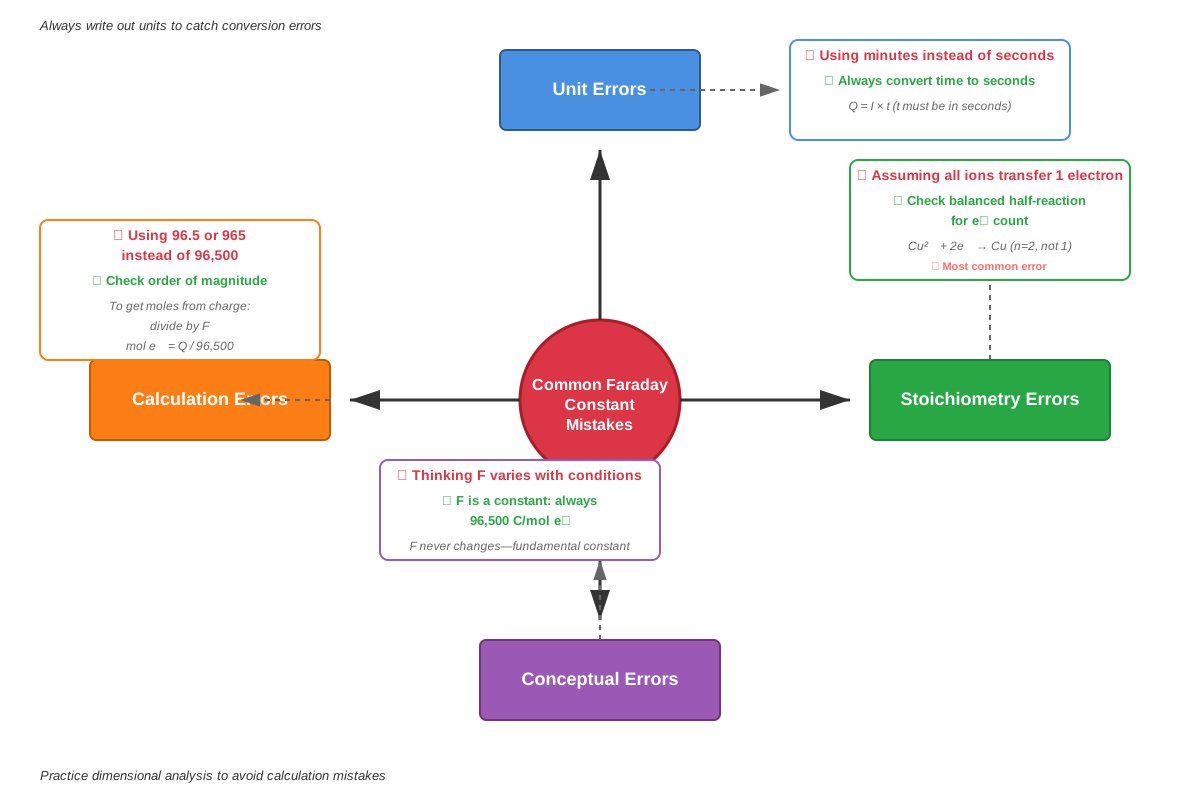
Red flags that indicate potential errors:
- Forgetting to convert time to seconds
- Using current (A) directly instead of charge (C)
- Ignoring the stoichiometric coefficient for electrons in the half-reaction
- Confusing the number of electrons per atom with the ionic charge (they're usually the same, but conceptually distinct)
Memory Techniques
Mnemonic for the Faraday constant value: "FaradAy Constant: 96,500 - Fancy Apples Cost 96,500 pennies" helps remember both the symbol (F) and the approximate value.
Acronym for calculation steps - "QUEST":
- Quantify the charge (Q = I × t)
- Use Faraday's constant (n = Q / F)
- Examine the half-reaction stoichiometry
- Solve for moles of substance
- Transform to desired units (mass or volume)
Visualization strategy: Picture electrons as tiny charged particles flowing through a wire like water through a pipe. The Faraday constant represents how many particles (one mole) are needed to carry a specific amount of "electrical water" (charge). When these electrons reach the electrode, they cause chemical change—one mole of electrons can "build" different amounts of product depending on the construction requirements (stoichiometry).
Relationship triangle for Q, I, and t:
    Q
   / \
  I   t
Cover the variable you want to find; the remaining two show the relationship:
- Cover Q: Q = I × t
- Cover I: I = Q / t
- Cover t: t = Q / I
Stoichiometry reminder: "Electrons To Product" (ETP) - Always check the Electron-To-Product ratio in the half-reaction before calculating final amounts.
Unit conversion reminder: "Seconds Are Crucial" (SAC) - When using amperes (A), time must be in seconds (s) to get coulombs (C).
Summary
The Faraday constant (F ≈ 96,500 C/mol) serves as the essential conversion factor between electrical measurements and chemical quantities in electrochemistry, representing the charge carried by one mole of electrons. Mastery of this constant enables students to solve quantitative problems involving electrolysis, electroplating, and battery discharge by connecting current, time, and charge to moles of electrons and ultimately to moles, mass, or volume of chemical substances. The fundamental relationship Q = nF, combined with the definition of current (I = Q/t), provides the mathematical framework for all Faraday constant calculations. Success on MCAT questions requires understanding the stoichiometry of half-reactions to determine how many electrons are needed per atom or molecule, consistently converting time to seconds when working with amperes, and systematically working through the calculation pathway from electrical parameters to chemical quantities or vice versa. The Faraday constant bridges multiple chemistry concepts including stoichiometry, redox reactions, and thermodynamics, making it a high-yield topic that appears frequently in both discrete questions and passage-based scenarios on the exam.
Key Takeaways
- The Faraday constant (F ≈ 96,500 C/mol) quantifies the charge per mole of electrons and serves as the bridge between electrical and chemical measurements in electrochemistry
- The fundamental equation Q = nF relates charge (coulombs), moles of electrons, and the Faraday constant, while Q = I × t connects charge to current and time
- Always convert time to seconds when current is given in amperes, and always check the half-reaction stoichiometry to determine the electron-to-substance ratio
- The calculation pathway flows: current and time → charge → moles of electrons → moles of substance → mass or volume (or in reverse for different problem types)
- The Faraday constant applies to all electrochemical processes including electrolytic cells, galvanic cells, and biological systems involving charge separation
- Common MCAT applications include calculating mass of metal deposited, volume of gas evolved, current required for a specific transformation, and time needed for complete electrolysis
- Systematic problem-solving using the QUEST framework (Quantify charge, Use Faraday's constant, Examine stoichiometry, Solve for moles, Transform to desired units) prevents calculation errors
Related Topics
Nernst Equation: Builds on the Faraday constant to calculate cell potentials under non-standard conditions, incorporating concentration effects and temperature; mastering the Faraday constant provides the foundation for understanding how F appears in the Nernst equation (E = E° - (RT/nF)ln Q).
Gibbs Free Energy and Cell Potential: The relationship ΔG° = -nFE° directly connects thermodynamic spontaneity to electrochemical cell potential using the Faraday constant, showing how electrical and chemical energy interconvert.
Electrolytic vs. Galvanic Cells: Understanding the Faraday constant enables quantitative analysis of both cell types, calculating how much product forms in electrolysis or how much charge a battery can deliver before depletion.
Oxidation-Reduction Reactions: The Faraday constant quantifies the charge associated with electron transfer in redox reactions, making it essential for advanced stoichiometric calculations in electrochemistry.
Biological Membrane Potentials: The principles underlying the Faraday constant extend to understanding how charge separation across biological membranes creates electrical potentials, relevant for nerve signal transmission and cellular energy production.
Practice CTA
Now that you've mastered the theoretical foundations and calculation strategies for the Faraday constant, it's time to solidify your understanding through active practice. Attempt the practice questions and work through the flashcards to reinforce these high-yield concepts. Focus especially on problems requiring multi-step calculations and those that combine the Faraday constant with stoichiometry—these represent the most common MCAT question formats. Remember, electrochemistry calculations become intuitive with repetition, and the Faraday constant is one of the most testable quantitative relationships in General Chemistry. Your investment in mastering this topic will pay dividends on test day!
Sign up free to keep reading
Create a free AnvayaPrep account to finish this MCAT guide on Faraday constant — plus flashcards and practice questions.