Overview
Reducing agents are fundamental chemical species in electrochemistry and redox reactions, representing substances that donate electrons to other species during chemical transformations. In the context of General Chemistry and the MCAT, understanding reducing agents is essential because they appear in approximately 15-20% of chemistry passages and discrete questions, often integrated with topics ranging from metabolism and cellular respiration to analytical chemistry and laboratory techniques. A reducing agent itself becomes oxidized while causing the reduction of another species—a concept that forms the cornerstone of electron transfer processes throughout chemistry and biology.
The mastery of reducing agents extends far beyond memorizing definitions. MCAT questions frequently test the ability to identify reducing agents in complex reaction schemes, predict the relative strength of different reducing agents based on reduction potentials, and apply these concepts to biological systems such as the electron transport chain, where molecules like NADH and FADH₂ serve as critical reducing agents. Understanding the behavior of reducing agents also connects directly to understanding oxidation states, galvanic cells, electrolytic cells, and the thermodynamics of redox reactions—all high-yield topics for the MCAT.
This topic integrates seamlessly with broader General Chemistry principles including thermodynamics, kinetics, and equilibrium. The spontaneity of redox reactions, determined by standard reduction potentials, dictates whether a substance will act as an effective reducing agent under given conditions. Furthermore, biological reducing agents play pivotal roles in metabolic pathways tested in the Biological and Biochemical Foundations section, making this a truly interdisciplinary MCAT topic that bridges general chemistry with biochemistry and cellular biology.
Learning Objectives
- [ ] Define reducing agents using accurate General Chemistry terminology
- [ ] Explain why reducing agents matter for the MCAT
- [ ] Apply reducing agents to exam-style questions
- [ ] Identify common mistakes related to reducing agents
- [ ] Connect reducing agents to related General Chemistry concepts
- [ ] Predict the relative strength of reducing agents using standard reduction potentials
- [ ] Distinguish between reducing agents in different oxidation states and chemical environments
- [ ] Analyze redox reactions in biological systems to identify the reducing agent
Prerequisites
- Oxidation-reduction (redox) reactions: Understanding electron transfer is fundamental to identifying which species donates electrons (the reducing agent)
- Oxidation states/numbers: Necessary to track electron movement and determine which species is oxidized during a reaction
- Electrochemical cells: Provides context for how reducing agents function at the anode in galvanic cells
- Standard reduction potentials (E°): Essential for predicting the strength and spontaneity of reducing agents
- Basic thermodynamics: Connects Gibbs free energy to the favorability of reduction-oxidation processes
Why This Topic Matters
Clinical and Real-World Significance
Reducing agents are ubiquitous in biological systems and medical applications. In cellular respiration, NADH and FADH₂ serve as the primary reducing agents that donate electrons to the electron transport chain, ultimately driving ATP synthesis. Antioxidants like vitamin C (ascorbic acid) and glutathione function as reducing agents that protect cells from oxidative damage by donating electrons to neutralize reactive oxygen species. In clinical settings, understanding reducing agents is crucial for comprehending drug metabolism, particularly in cytochrome P450 reactions, and for interpreting laboratory tests that rely on redox chemistry.
MCAT Exam Statistics
Reducing agents appear in approximately 15-20% of General Chemistry questions and are frequently integrated into Biological and Biochemical Foundations passages. The MCAT tests this concept through:
- Discrete questions asking students to identify reducing agents in chemical equations (10-15% of chemistry discretes)
- Passage-based questions involving electrochemical cells, batteries, or corrosion (20-25% of electrochemistry passages)
- Biochemistry passages featuring metabolic pathways where electron carriers act as reducing agents (30-35% of metabolism passages)
- Laboratory technique passages involving redox titrations or analytical methods
Common Exam Presentations
The MCAT presents reducing agents in several characteristic formats:
- Electrochemical cell diagrams requiring identification of the anode species (reducing agent)
- Metabolic pathway diagrams showing NAD⁺/NADH or FAD/FADH₂ conversions
- Reaction mechanisms where students must identify which reactant is oxidized
- Comparison questions asking which of several species is the strongest reducing agent based on reduction potentials
- Experimental passages describing redox titrations or analytical procedures
Core Concepts
Definition and Fundamental Properties
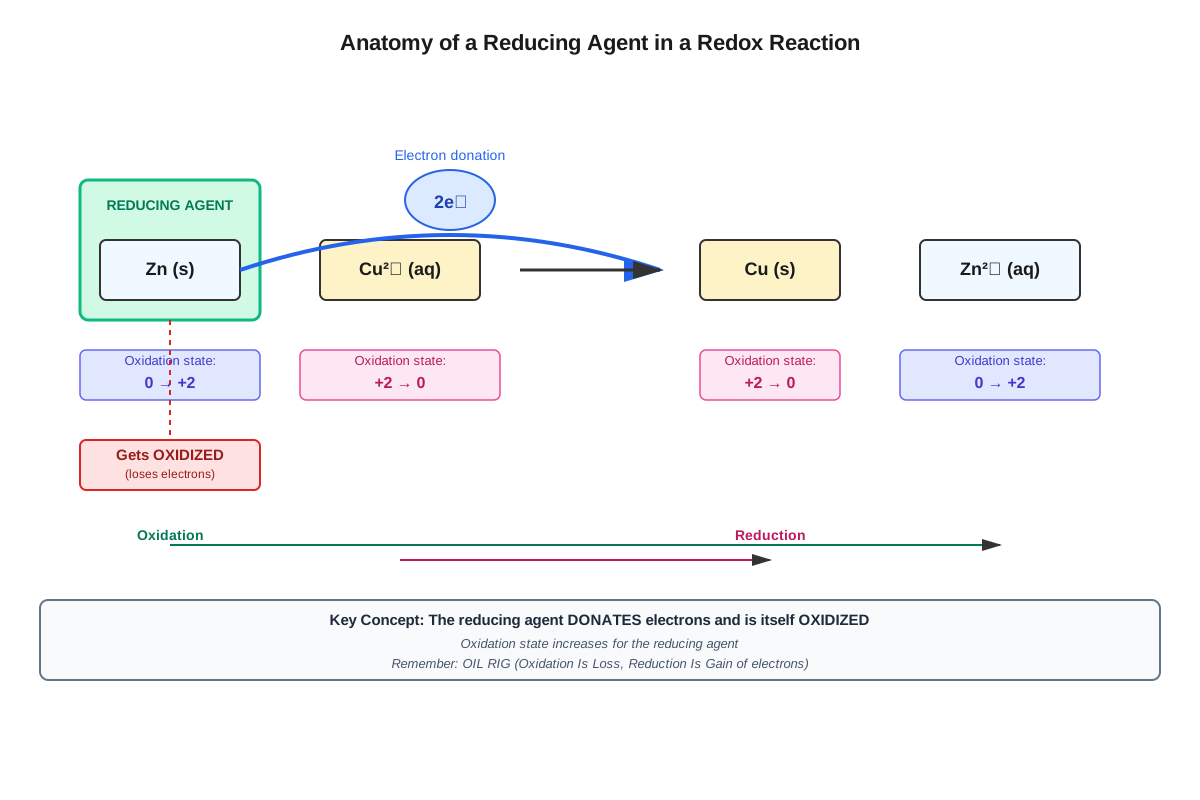
A reducing agent (also called a reductant) is a chemical species that donates electrons to another substance in a redox reaction, thereby causing that substance to be reduced. The reducing agent itself undergoes oxidation, meaning it loses electrons and increases in oxidation state. This reciprocal relationship—the reducing agent is oxidized while reducing another species—is central to all redox chemistry.
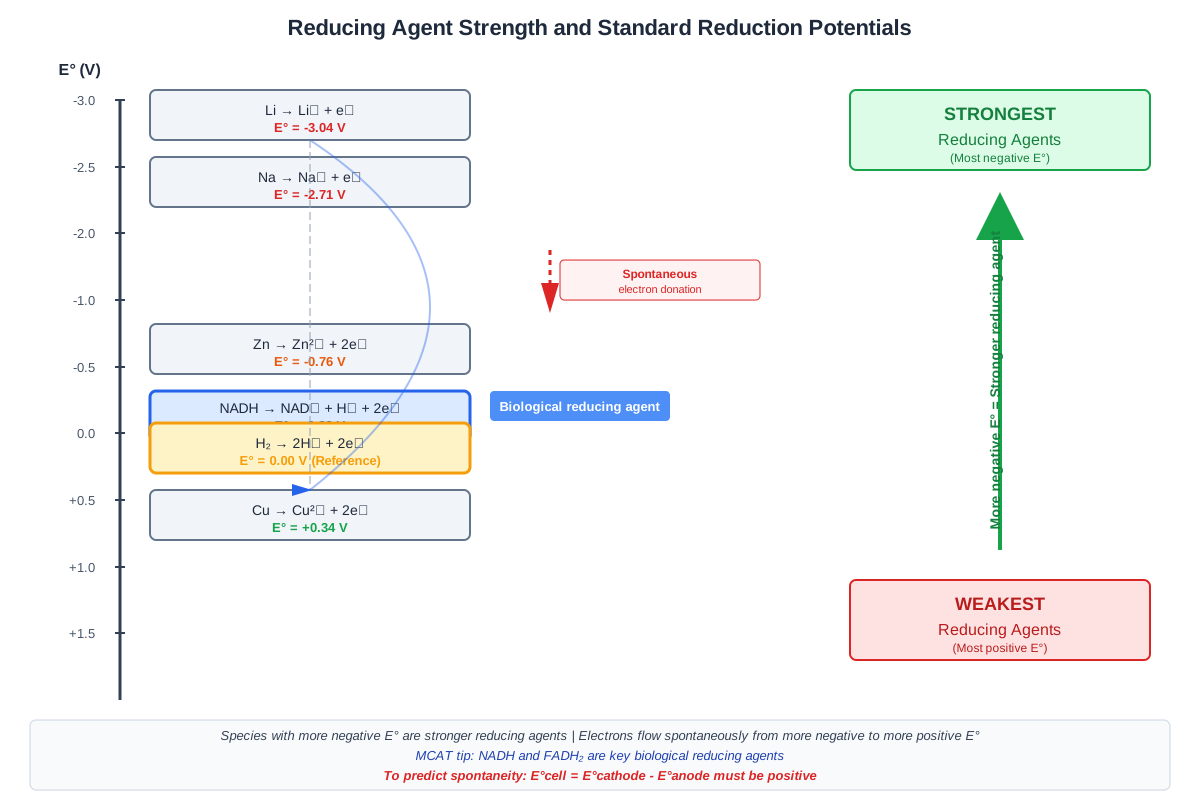
The strength of a reducing agent is inversely related to its reduction potential. Species with more negative (or less positive) standard reduction potentials (E°) are stronger reducing agents because they have a greater tendency to lose electrons. Conversely, species with more positive reduction potentials are weaker reducing agents but stronger oxidizing agents.
Identifying Reducing Agents in Chemical Equations
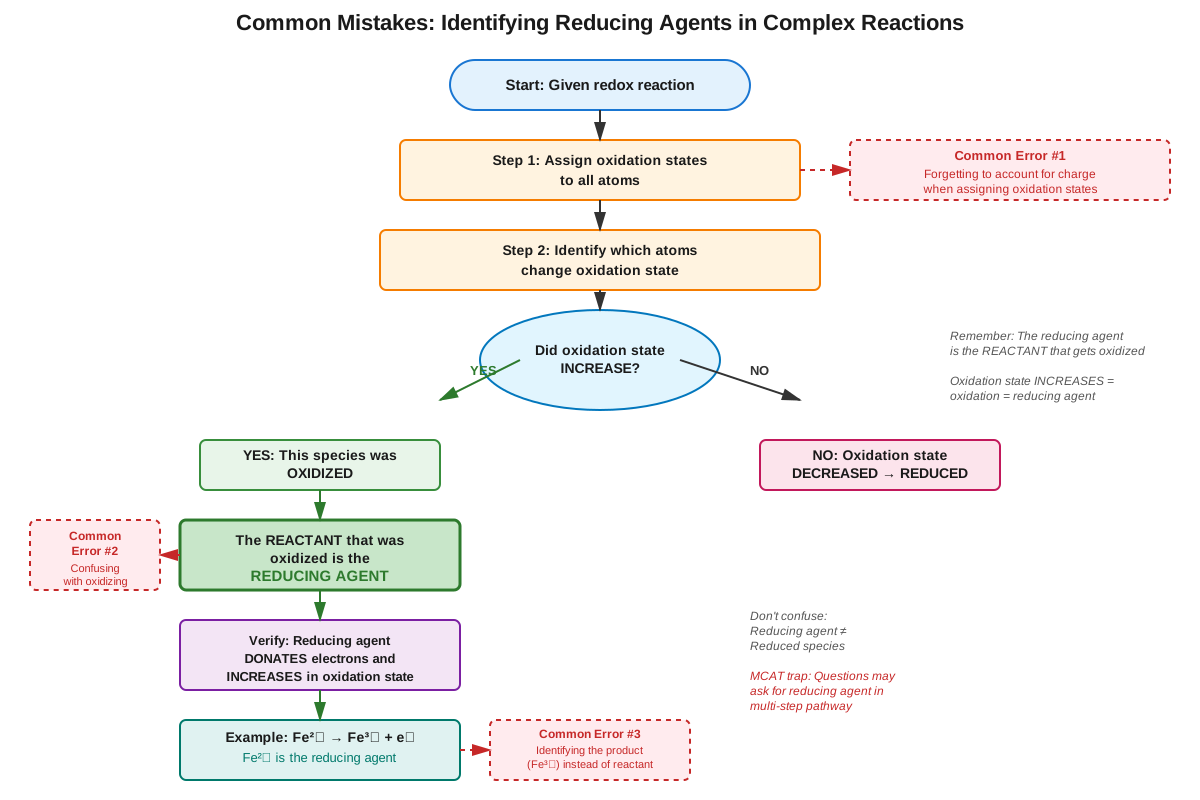
To identify the reducing agent in any redox reaction, follow this systematic approach:
- Assign oxidation states to all atoms in reactants and products
- Identify which species increases in oxidation state (loses electrons)
- The species containing the atom that is oxidized is the reducing agent
For example, in the reaction:
Zn(s) + Cu²⁺(aq) → Zn²⁺(aq) + Cu(s)Zinc changes from oxidation state 0 to +2 (loses electrons, is oxidized), making Zn the reducing agent. Copper changes from +2 to 0 (gains electrons, is reduced), making Cu²⁺ the oxidizing agent.
Relationship to Standard Reduction Potentials
The standard reduction potential (E°) quantifies the tendency of a species to gain electrons (be reduced). The relationship to reducing agent strength follows this principle:
Lower (more negative) E° → Stronger reducing agent
Higher (more positive) E° → Weaker reducing agent
This inverse relationship exists because reduction potentials measure the tendency to be reduced, while reducing agent strength measures the tendency to be oxidized (the opposite process).
| Species | E° (V) | Reducing Agent Strength |
|---|---|---|
| Li⁺/Li | -3.04 | Extremely strong |
| Na⁺/Na | -2.71 | Very strong |
| Zn²⁺/Zn | -0.76 | Moderate |
| H⁺/H₂ | 0.00 | Reference point |
| Cu²⁺/Cu | +0.34 | Weak |
| Ag⁺/Ag | +0.80 | Very weak |
| F₂/F⁻ | +2.87 | Essentially none |
Common Reducing Agents in General Chemistry
Several reducing agents appear frequently on the MCAT:
Metals: Most metals act as reducing agents, particularly alkali metals (Li, Na, K) and alkaline earth metals (Mg, Ca). These readily lose electrons to form cations.
Hydrogen gas (H₂): Serves as a moderate reducing agent, particularly important in hydrogenation reactions and as the reference electrode (E° = 0.00 V).
Carbon monoxide (CO): Acts as a reducing agent in metallurgy and industrial processes, being oxidized to CO₂.
Hydride donors: Species like NaBH₄ (sodium borohydride) and LiAlH₄ (lithium aluminum hydride) are powerful reducing agents in organic chemistry, though these appear more in organic chemistry contexts.
Biological Reducing Agents
The MCAT heavily emphasizes biological reducing agents, particularly electron carriers in metabolism:
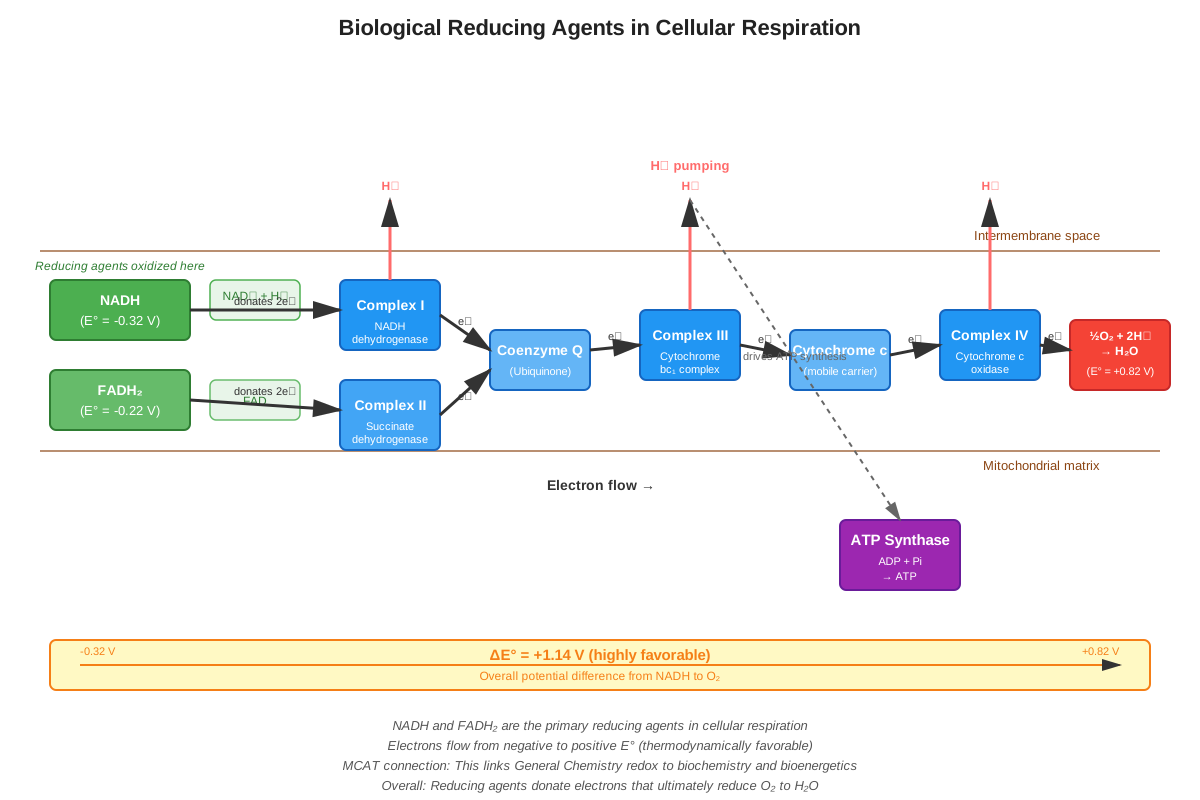
NADH (Nicotinamide Adenine Dinucleotide, reduced form): The primary electron carrier in cellular respiration. NADH donates electrons (and a proton) to Complex I of the electron transport chain, becoming oxidized to NAD⁺. Each NADH generates approximately 2.5 ATP molecules.
FADH₂ (Flavin Adenine Dinucleotide, reduced form): Another crucial electron carrier that donates electrons to Complex II of the electron transport chain, becoming oxidized to FAD. Each FADH₂ generates approximately 1.5 ATP molecules.
NADPH: The reducing agent in anabolic (biosynthetic) reactions, particularly in fatty acid synthesis and the pentose phosphate pathway. While chemically similar to NADH, NADPH serves distinct metabolic roles.
Glutathione (reduced form, GSH): A tripeptide that protects cells from oxidative damage by donating electrons to neutralize peroxides and free radicals.
Reducing Agents in Electrochemical Cells
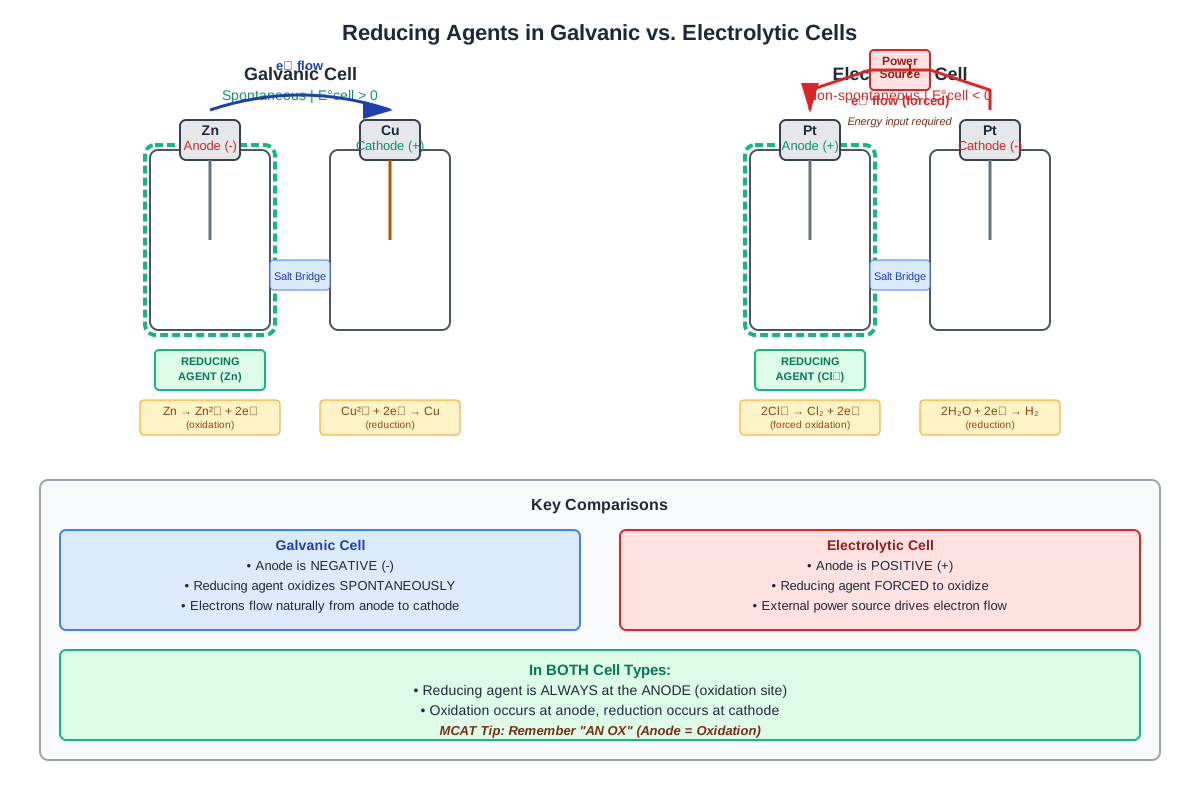
In galvanic (voltaic) cells, the reducing agent is located at the anode, where oxidation occurs. Electrons flow from the anode (where the reducing agent loses electrons) through the external circuit to the cathode (where reduction occurs). Understanding this spatial relationship is crucial for MCAT questions involving cell diagrams.
In electrolytic cells, an external voltage forces non-spontaneous reactions to occur. The reducing agent is still oxidized at the anode, but the process requires energy input rather than releasing energy.
Factors Affecting Reducing Agent Strength
Several factors influence how effectively a substance acts as a reducing agent:
Oxidation state: Elements in lower oxidation states are generally stronger reducing agents. For example, Fe²⁺ is a better reducing agent than Fe³⁺.
Atomic size: Larger atoms lose electrons more easily due to weaker nuclear attraction, making them stronger reducing agents. This explains why reducing agent strength increases down a group in the periodic table.
Ionization energy: Lower ionization energy correlates with stronger reducing agent behavior, as less energy is required to remove electrons.
Chemical environment: pH, temperature, and the presence of other species can significantly affect reducing agent strength. For example, many biological reducing agents function optimally only within specific pH ranges.
Concept Relationships
The concept of reducing agents sits at the nexus of multiple interconnected chemistry principles. Reducing agents directly depend on understanding oxidation-reduction reactions, as the reducing agent is defined by its role in electron transfer. This connection flows bidirectionally: identifying the reducing agent requires analyzing oxidation state changes, while predicting reaction spontaneity requires knowing which species acts as the reducing agent.
Standard reduction potentials provide the quantitative framework for comparing reducing agent strength. The relationship follows: E°(cell) = E°(cathode) - E°(anode), where the anode contains the reducing agent. This connects to thermodynamics through ΔG° = -nFE°, linking reducing agent strength to reaction spontaneity and equilibrium.
Within electrochemistry, reducing agents connect to both galvanic and electrolytic cells. In galvanic cells, the reducing agent at the anode drives spontaneous electron flow, while in electrolytic cells, external voltage forces the reducing agent to undergo oxidation. This distinction connects to energy and work concepts, as galvanic cells perform electrical work while electrolytic cells require work input.
The biological applications create bridges to biochemistry: NADH and FADH₂ as reducing agents in the electron transport chain connect to cellular respiration, ATP synthesis, and metabolic pathways. The oxidation of these reducing agents releases energy captured in the proton gradient, linking redox chemistry to bioenergetics.
Periodic trends explain why certain elements make strong reducing agents: alkali and alkaline earth metals have low ionization energies and readily lose electrons, making them powerful reducing agents. This connects to atomic structure and electron configuration.
Conceptual flow: Atomic structure → Ionization energy → Reducing agent strength → Standard reduction potentials → Electrochemical cells → Thermodynamics of redox reactions → Biological electron carriers → Metabolic energy production.
High-Yield Facts
⭐ The reducing agent is the species that is oxidized (loses electrons and increases in oxidation state) during a redox reaction
⭐ Stronger reducing agents have more negative (less positive) standard reduction potentials (E°)
⭐ In galvanic cells, the reducing agent is located at the anode, where oxidation occurs
⭐ NADH and FADH₂ are the primary reducing agents in cellular respiration, donating electrons to the electron transport chain
⭐ Alkali metals (Li, Na, K) and alkaline earth metals (Mg, Ca) are among the strongest reducing agents due to their low ionization energies
- The reducing agent and oxidizing agent are always on the reactant side of a redox equation
- Reducing agent strength increases down a group in the periodic table (larger atoms lose electrons more easily)
- In biological systems, NADPH serves as the reducing agent for anabolic reactions, while NADH is used in catabolic energy production
- The species with the lower (more negative) reduction potential will act as the reducing agent when two half-reactions are coupled
- Antioxidants function as reducing agents by donating electrons to neutralize reactive oxygen species
- In a reduction potential table, species on the left side of half-reactions with more negative E° values are stronger reducing agents
- The strength of a reducing agent can be pH-dependent, particularly for biological molecules
Quick check — test yourself on Reducing agents so far.
Try Flashcards →Common Misconceptions
Misconception: The reducing agent is the species that gets reduced.
Correction: The reducing agent is the species that gets oxidized (loses electrons). It causes reduction in another species while itself being oxidized. The terminology can be confusing because "reducing agent" sounds like it should be reduced, but it actually causes reduction by donating electrons.
Misconception: A higher (more positive) reduction potential means a stronger reducing agent.
Correction: The opposite is true. A more negative reduction potential indicates a stronger reducing agent. Reduction potentials measure the tendency to gain electrons (be reduced), so a negative value means the species prefers to lose electrons (be oxidized), making it a good reducing agent.
Misconception: The reducing agent is always a single atom or ion.
Correction: The reducing agent is the entire chemical species (molecule, ion, or atom) that contains the atom being oxidized. For example, in the oxidation of glucose, glucose (C₆H₁₂O₆) is the reducing agent, not just the carbon atoms, even though carbon is the element changing oxidation state.
Misconception: NADH and NADPH are interchangeable in biological systems.
Correction: While chemically similar, NADH and NADPH serve distinct metabolic roles. NADH primarily functions in catabolic pathways (breaking down molecules for energy), while NADPH serves in anabolic pathways (building molecules). Cells maintain separate pools of these molecules with different ratios.
Misconception: In an electrochemical cell, electrons flow from cathode to anode.
Correction: Electrons always flow from anode to cathode through the external circuit. The anode (where the reducing agent is oxidized) releases electrons that flow to the cathode (where reduction occurs). This is true for both galvanic and electrolytic cells.
Misconception: All metals are equally strong reducing agents.
Correction: Reducing agent strength varies dramatically among metals. Alkali metals are extremely strong reducing agents (very negative E°), while noble metals like gold and platinum are very weak reducing agents (positive E°). The position in the activity series or reduction potential table determines relative strength.
Misconception: The reducing agent must completely transfer all its electrons at once.
Correction: Many reducing agents can donate electrons in multiple steps or donate different numbers of electrons depending on conditions. For example, iron can be oxidized from Fe to Fe²⁺ (losing 2 electrons) or further to Fe³⁺ (losing 3 electrons total).
Worked Examples
Example 1: Identifying Reducing Agents and Predicting Reaction Spontaneity
Question: Consider the following half-reactions and their standard reduction potentials:
- Fe³⁺ + e⁻ → Fe²⁺ (E° = +0.77 V)
- Cu²⁺ + 2e⁻ → Cu (E° = +0.34 V)
Will Fe²⁺ reduce Cu²⁺ to Cu under standard conditions? If so, identify the reducing agent and calculate E°(cell).
Solution:
Step 1: Determine which species will be oxidized (act as reducing agent) and which will be reduced.
- For a spontaneous reaction, the species with the lower (more negative) reduction potential will be oxidized
- Fe²⁺/Fe³⁺ has E° = +0.77 V
- Cu/Cu²⁺ has E° = +0.34 V
- Since +0.34 V < +0.77 V, Cu would be oxidized and Fe³⁺ would be reduced in a spontaneous reaction
Step 2: Check if the proposed reaction is spontaneous.
- The question asks if Fe²⁺ will reduce Cu²⁺
- This means Fe²⁺ would be oxidized (act as reducing agent) and Cu²⁺ would be reduced
- This is the opposite of the spontaneous direction
Step 3: Calculate E°(cell) for the proposed reaction.
- Oxidation (anode): Fe²⁺ → Fe³⁺ + e⁻ (E°(oxidation) = -0.77 V)
- Reduction (cathode): Cu²⁺ + 2e⁻ → Cu (E°(reduction) = +0.34 V)
- E°(cell) = E°(cathode) - E°(anode) = +0.34 V - (+0.77 V) = -0.43 V
Step 4: Interpret the result.
- E°(cell) is negative, confirming the reaction is non-spontaneous under standard conditions
- Fe²⁺ will NOT spontaneously reduce Cu²⁺ to Cu
- If this reaction were forced to occur (electrolytic cell), Fe²⁺ would be the reducing agent
Key Takeaway: This example demonstrates that identifying the reducing agent requires understanding both the direction of electron flow and the spontaneity of the reaction. The species with the lower reduction potential acts as the reducing agent in spontaneous reactions.
Example 2: Biological Reducing Agents in Metabolism
Question: During glycolysis and the citric acid cycle, glucose is oxidized to CO₂, and NAD⁺ is reduced to NADH. In one turn of the citric acid cycle, three NADH molecules are produced.
(a) What is the reducing agent in the reactions that produce NADH?
(b) What happens to NADH in the electron transport chain?
(c) Why does NADH production represent energy storage?
Solution:
(a) Identifying the reducing agent:
- When NAD⁺ is reduced to NADH, NAD⁺ gains electrons (and a proton)
- These electrons must come from another species that is oxidized
- In the citric acid cycle, intermediates like isocitrate, α-ketoglutarate, and malate are oxidized
- Therefore, these metabolic intermediates (ultimately derived from glucose) serve as the reducing agents
- More broadly, glucose and its breakdown products are the reducing agents that produce NADH
(b) NADH in the electron transport chain:
- NADH donates electrons to Complex I (NADH dehydrogenase)
- In this process, NADH is oxidized back to NAD⁺
- NADH acts as a reducing agent, reducing Complex I
- The electrons then pass through the electron transport chain, ultimately reducing oxygen to water
- This electron flow drives proton pumping, creating the gradient that powers ATP synthesis
(c) NADH as energy storage:
- The oxidation of NADH to NAD⁺ is thermodynamically favorable (releases energy)
- This energy is captured in the proton gradient across the inner mitochondrial membrane
- The proton gradient drives ATP synthase, producing approximately 2.5 ATP per NADH
- NADH thus represents "stored" reducing power that can be converted to ATP
- The high-energy electrons in NADH (from C-H bonds in glucose) are at a higher energy level than when they ultimately reduce oxygen to water
- This energy difference is harnessed for ATP production
Key Takeaway: This example illustrates how reducing agents function in biological systems. Glucose serves as the ultimate reducing agent, with NADH acting as an intermediate electron carrier. Understanding this electron flow is essential for MCAT questions on metabolism and bioenergetics.
Exam Strategy
Approaching MCAT Questions on Reducing Agents
Step 1: Identify the question type
- Direct identification: "Which species is the reducing agent?"
- Comparative: "Which is the strongest reducing agent?"
- Application: "What happens at the anode?" or "Which molecule donates electrons?"
- Biological context: Questions about NADH, FADH₂, or metabolic pathways
Step 2: Use systematic analysis
- For identification questions: Assign oxidation states, find which species increases in oxidation state
- For comparison questions: Use reduction potentials (more negative = stronger reducing agent)
- For cell diagrams: Remember that the reducing agent is at the anode
- For biological questions: Recall that electron donors (NADH, FADH₂) are reducing agents
Trigger Words and Phrases
Watch for these key phrases that signal reducing agent questions:
- "Which species is oxidized?" (The oxidized species is the reducing agent)
- "What occurs at the anode?" (Oxidation of the reducing agent)
- "Electron donor" (Another term for reducing agent)
- "Which has the most negative reduction potential?" (Strongest reducing agent)
- "NADH donates electrons to..." (NADH is the reducing agent)
- "Antioxidant activity" (Antioxidants function as reducing agents)
Process of Elimination Tips
For identification questions:
- Eliminate species that decrease in oxidation state (these are being reduced, not oxidized)
- Eliminate species that appear only on the product side (reducing agents are reactants)
- Eliminate species with no change in oxidation state (spectator ions)
For comparison questions:
- Eliminate species with more positive reduction potentials when looking for the strongest reducing agent
- Eliminate non-metals when comparing metals (metals are generally stronger reducing agents)
- Eliminate oxidized forms when the reduced form is also listed (Fe³⁺ vs Fe²⁺: Fe²⁺ is the stronger reducing agent)
For biological questions:
- Eliminate oxidized forms (NAD⁺, FAD) when looking for reducing agents
- Eliminate molecules that accept electrons (oxygen, oxidizing agents)
- Remember that reduced electron carriers (NADH, FADH₂, NADPH) are always reducing agents
Time Allocation Advice
- Discrete questions (1-1.5 minutes): Quickly assign oxidation states or recall reduction potentials
- Passage-based questions (1.5-2 minutes): Locate relevant information in the passage, then apply systematic analysis
- Complex calculations (2-3 minutes): If calculating E°(cell), work methodically but don't get bogged down—estimate if needed
Exam Tip: If a question asks about both the reducing agent and oxidizing agent, identify one first, then the other becomes obvious (they're the two reactants in a redox reaction). This can save valuable time.
Exam Tip: For biological passages, if you see NADH or FADH₂ mentioned, immediately think "reducing agent" and "electron donor." This association will help you quickly answer related questions.
Memory Techniques
Mnemonics
OIL RIG: Oxidation Is Loss (of electrons), Reduction Is Gain (of electrons)
- The reducing agent undergoes oxidation (OIL), so it loses electrons
LEO the lion says GER: Lose Electrons = Oxidation; Gain Electrons = Reduction
- The reducing agent LEOs (loses electrons through oxidation)
AN OX and RED CAT: ANode = OXidation; REDuction = CAThode
- The reducing agent is at the anode where oxidation occurs
"Negative Nancy Reduces Reluctantly": Negative reduction potentials indicate strong reducing agents
- More negative E° = stronger reducing agent
Visualization Strategy
The Electron Donor Analogy: Visualize the reducing agent as a philanthropist donating money (electrons) to others. The philanthropist (reducing agent) becomes poorer (oxidized, loses electrons) while making others richer (reduced, gain electrons). The most generous philanthropist (most negative E°) is the strongest reducing agent.
The Biological Cascade: Picture NADH as a bucket of high-energy electrons at the top of a waterfall (electron transport chain). As NADH (the reducing agent) pours its electrons down the cascade, energy is released and captured (ATP production). The empty bucket (NAD⁺) returns to be refilled by glucose oxidation.
Acronyms
STRONG: Characteristics of strong reducing agents
- Small ionization energy
- Tendency to lose electrons
- Reactants in redox reactions
- Oxidized during the reaction
- Negative reduction potential
- Group 1 and 2 metals (examples)
NADH: Remember its role
- Nicotinamide adenine dinucleotide
- Acts as reducing agent
- Donates electrons
- High-energy carrier
Summary
Reducing agents are chemical species that donate electrons to other substances, causing reduction while themselves being oxidized. Understanding reducing agents is crucial for MCAT success, as they appear in approximately 15-20% of chemistry questions and integrate with biochemistry passages on metabolism. The strength of a reducing agent is inversely related to its standard reduction potential—more negative E° values indicate stronger reducing agents. In electrochemical cells, reducing agents are located at the anode where oxidation occurs, and electrons flow from anode to cathode. Common reducing agents include metals (especially alkali and alkaline earth metals), hydrogen gas, and biological electron carriers like NADH and FADH₂. In cellular respiration, NADH and FADH₂ serve as critical reducing agents that donate electrons to the electron transport chain, driving ATP synthesis. To identify reducing agents, systematically assign oxidation states and determine which species increases in oxidation state (loses electrons). The MCAT tests this concept through discrete questions, electrochemical cell diagrams, and biological passages involving metabolic pathways. Mastering reducing agents requires understanding their relationship to oxidation-reduction reactions, standard reduction potentials, electrochemistry, and biological energy production.
Key Takeaways
- The reducing agent is the species that is oxidized (loses electrons, increases in oxidation state) while causing another species to be reduced
- Stronger reducing agents have more negative (less positive) standard reduction potentials (E°)
- In galvanic cells, the reducing agent is always located at the anode where oxidation occurs
- NADH and FADH₂ are the primary biological reducing agents in cellular respiration, donating electrons to the electron transport chain
- Alkali metals and alkaline earth metals are among the strongest reducing agents due to their low ionization energies and tendency to lose electrons
- To identify the reducing agent in any reaction, assign oxidation states and find which species increases in oxidation state
- The reducing agent and oxidizing agent are always both reactants in a redox reaction, never products
Related Topics
Oxidizing Agents: The complementary concept to reducing agents; species that accept electrons and cause oxidation. Understanding both concepts together provides complete mastery of redox chemistry.
Standard Reduction Potentials and the Electrochemical Series: Quantitative framework for predicting reducing agent strength and reaction spontaneity. Essential for solving electrochemistry problems.
Galvanic and Electrolytic Cells: Applications of reducing agents in electrochemical cells. Mastering reducing agents enables understanding of battery function and electrolysis.
Electron Transport Chain and Oxidative Phosphorylation: Biological application where NADH and FADH₂ act as reducing agents. Critical for biochemistry and cellular biology passages.
Redox Titrations: Analytical technique using reducing agents for quantitative analysis. Appears in laboratory-based passages.
Corrosion and Metal Reactivity: Real-world applications of reducing agents in materials science and environmental chemistry.
Practice CTA
Now that you've mastered the core concepts of reducing agents, it's time to reinforce your understanding through active practice. Attempt the practice questions and flashcards associated with this topic to solidify your knowledge and identify any remaining gaps. Remember, the MCAT rewards not just knowledge but the ability to apply concepts quickly and accurately under time pressure. Each practice question you complete builds the pattern recognition and problem-solving speed essential for test day success. You've built a strong foundation—now strengthen it through deliberate practice!
Sign up free to keep reading
Create a free AnvayaPrep account to finish this MCAT guide on Reducing agents — plus flashcards and practice questions.